Guest Post By Willis Eschenbach
One reason that I’m always hesitant to speculate on other peoples’ motives is that half the time I have no clue about my own motives.
So … for the usual unknown reasons and with the usual unknown motives, I got to thinking about the GISS climate model known as the “GISS GCM ModelE”, or as I call it, the “MuddleE”.
Like many such climate muddles, it was not designed before construction started. Instead, it has grown over decades by accretion, with new parts added, kluges to fix problems, ad-hoc changes to solve new issues, and the like. Or to quote one of the main GISS programmers, Gavin Schmidt, in a paper describing the ModelE:
The development of a GCM is a continual process of minor additions and corrections combined with the occasional wholesale replacement of particular pieces.
For an additional difficulty factor, as with many such programs, it’s written in the computer language FORTRAN … which was an excellent choice in 1983 when the MuddleE was born but is a horrible language for 2022.
How much has it grown? Well, not counting header files and include files and such, just the FORTRAN code itself, it has 441,668 lines of code … and it can only run on a supercomputer like this one.

So I thought I’d wander through the GISS model and see what I could find. I knew, from a cruise that I’d taken through the MuddleE code two decades ago, that they’d had trouble with “melt pools”. These are the pools of meltwater that form on top of the seasonal sea ice. They are important in calculating the albedo of the sea ice. In my previous cruise, I’d found that they’d put a hard time limit on the days during which melt pools could form.
This leads me to a most important topic—the amazing stability of the climate system. It turns out that modern climate muddles have a hard time staying on course. They are “iterative” models, meaning that the output of one timestep is used as the input for the next timestep. And that means that any error in the output of timestep “J” is carried over as an error in the input into timestep “K”, and on ad infinitum … which makes it very easy for the muddle to spiral into a snowball earth or go up in flames. Here, for example, are a couple of thousand runs from a climate model …

Figure 1. 2,017 runs from the climateprediction.net climate model.
Notice in the upper panel how many runs fall out the bottom during the control phase of the model runs … and that has never happened with the real earth.
So I wrote up a computer program that searches through the 511 individual files containing the 441,688 lines of computer code for keywords and word combinations and the like, and when it finds a match it lists the file number and the line number where the keyword appears, and prints out the line in question and the surrounding lines, so I can investigate what it’s found.
To avoid the climate model losing the plot and wandering away from reality, as a programmer you have two choices. You can either fix what’s wrong with the model that’s making it go off the rails … or you can do what the MuddleE programmers did with the melt ponds. You can simply put a hard limit, basically an adjustable guardrail, that prevents the muddle from jumping the shark.
It appears that they’ve improved the melt pond code because I can no longer find the hard limit on the days the melt ponds can form. Instead, they’ve put in the following code:
C**** parameters used for Schramm sea ice albedo scheme (Hansen)
 !@var AOImin,AOImax           range for seaice albedo
 !@var ASNwet,ASNdry           wet,dry snow albedo over sea ice
 !@var AMPmin                  mininimal melt pond albedo
       REAL*8 ::
 C                         VIS   NIR1   NIR2   NIR3   NIR4   NIR5
      *     AOImin(6)=(/ .05d0, .05d0, .05d0, .050d0, .05d0, .03d0/),
      *     AOImax(6)=(/ .62d0, .42d0, .30d0, .120d0, .05d0, .03d0/),
      *     ASNwet(6)=(/ .85d0, .75d0, .50d0, .175d0, .03d0, .01d0/),              *     ASNdry(6)=(/ .90d0, .85d0, .65d0, .450d0, .10d0, .10d0/),                  *     AMPmin(6)=(/ .10d0, .05d0, .05d0, .050d0, .05d0, .03d0/)
What this code does is to put up hard limits on the values for the albedo for sea ice and melt ponds, as well as specifying constant values for wet and dry snow on the sea ice. It specifies the limits and values for visible light (VIS), as well as for five bands of the near infrared (NIR1-5).
What this means is that there is code to calculate the albedo of the sea ice … but sometimes that code comes up with unrealistic values. But rather than figure out why the code is coming up with bad values and fixing it, the climate muddle just replaces the bad value with the corresponding maximum or minimum values. Science at its finest.
Here’s a comment describing another bit of melt pond fun:
 C**** safety valve to ensure that melt ponds eventually disappear (Ti<-10)
         if (Ti1 .lt.-10.) pond_melt(i,j)=0.  ! refreeze
Without this bit of code, some of the melt ponds might never refreeze, no matter how cold it got … gotta love that kind of physics, water that doesn’t freeze.
This is what the climate modelers mean when they say that their model is “physics-based“. They mean it in the same sense as when the producers say a Hollywood movie is “based on a true story” …
Here, for example, is a great comment from the MuddleE code (the “c” or the “!” in a line indicates a comment):
 !@sum tcheck checks for reasonable temperatures
 !@auth  Ye Cheng/G. Hartke
 !@ver   1.0
 c ----------------------------------------------------------------------
 c  This routine makes sure that the temperature remains within
 c  reasonable bounds during the initialization process. (Sometimes the
 c  the computed temperature iterated out in left field someplace,
 c  *way* outside any reasonable range.) This routine keeps the temp
 c  between the maximum and minimum of the boundary temperatures.
 c ----------------------------------------------------------------------
In other words, when the temperature goes off the rails … don’t investigate why and fix it. Just set it to a reasonable temperature and keep rolling.
And what is a reasonable temperature? Turns out they just set it to the temperature of the previous timestep and keep on keeping on … physics, you know.
Here’s another:
c  ucheck makes sure that the winds remain within reasonable
c    bounds during the initialization process. (Sometimes the computed
c    wind speed iterated out in left field someplace, *way* outside
c    any reasonable range.) Tests and corrects both direction and
c    magnitude of the wind rotation with altitude. Tests the total
c    wind speed via comparison to similarity theory. Note that it
c    works from the top down so that it can assume that at level (i),
c    level (i+1) displays reasonable behavior.
… when the climate muddle goes off the rails, and the wind is blowing five hundred miles per hour, don’t look for the reason why. Just prop it up, put it back on the rails, and keep going …
Then we have a different class of non-physics. These are tunable parameters. Here’s a description from Gavin Schmidt’s paper linked to above:
The model is tuned (using the threshold relative humidity U00 for the initiation of ice and water clouds) to be in global radiative balance (i.e., net radiation at TOA within ±0.5 W m−2 of zero) and a reasonable planetary albedo (between 29% and 31%) for the control run simulations.
In other words, the physics simulated in the climate muddle won’t keep the modelworld in balance. So you simply turn the tuning knob and presto! It all works fine! In fact, that U00 tuning knob worked so well that they put in two more tuning knobs … plus another hard limit. From the code:
 !@dbparam U00a tuning knob for U00 above 850 mb without moist convection
 !@dbparam U00b tuning knob for U00 below 850 mb and in convective regions
 !@dbparam MAXCTOP max cloud top pressure
Finally, all models are subjected to what I call “evolutionary tuning”. That is the process whereby a change is made, and then the model is tested against the only thing we have to test it against—the historical record. If the model is better able to replicate the historical record, then the change is kept. But if the change makes it work worse at hindcasting the past, it’s thrown out.
Unfortunately, as the stock brokers’ ads in the US are required by law to say, “Past performance is no guarantee of future success”. The fact that a climate model can hindcast the past means absolutely nothing about whether it can successfully predict the future. And this is particularly true when the model is propped up and kept from falling over by hard limits and tunable parameters, and then evolutionarily tuned to hindcast the past …
What else is going on? Well, as in many such ad-hoc projects, they’ve ended up with a single variable name representing two different things in different parts of the program … which may or may not be a problem, but is a dangerous programming practice that can lead to unseen bugs. (Note that FORTRAN is not “case sensitive”, so “ss” is the same variable as “SS”.) Here are some of the duplicate variable names.
SUBR	identifies after which subroutine WATER was called
SUBR	identifies where CHECK was called from
SUBR	identifies where CHECK3 was called from
SUBR	identifies where CHECK4 was called from

ss = photodissociation coefficient, indicies
SS = SIN(lat)*SIN(dec)

ns = either 1 or 2 from reactn sub
ns = either ns or 2 from guide sub i2 newfam ifam dummy variables

nn = either nn or ks from reactn sub
nn = either nn or nnn from guide sub
nn = name of species that reacts, as defined in the MOLEC file.

ndr = either ndr or npr from guide sub
ndr = either nds or ndnr from reactn sub

Mo = lower mass bound for first size bin (kg)
Mo = total mass of condensed OA at equilibrium (ug m-3)

ks = local variable to be passed back to jplrts nnr or nn array.
ks = name of species that photolyses, as defined in the MOLEC file.

i,j = dummy loop variables
I,J = GCM grid box horizontal position
Finally, there’s the question of conservation of energy and mass. Here’s one way it’s handled …
C**** This fix adjusts thermal energy to conserve total energy TE=KE+PE
       finalTotalEnergy = getTotalEnergy()
       call addEnergyAsDiffuseHeat(finalTotalEnergy - initialTotalEnergy)
Curiously, the subroutine “addEnergyAsDiffuseHeat” is defined twice in different parts of the program … but I digress. When energy is not conserved, what it does is simply either add or subtract the difference equally all over the globe.
Now, some kind of subroutine like this is necessary because computers are only accurate to a certain number of decimals. So “rounding errors” are inevitable. And their method is not an unreasonable one for dealing with this unavoidable error.
However, twenty years ago I asked Gavin Schmidt if he had some kind of “Murphy Gauge” on this subroutine to stop the program if the energy imbalance was larger than some threshold. In the real world, a “Murphy Swichgauge” is a gauge that will give an alarm if some user-set value is exceeded. Here’s what one looks like

Without such a gauge, the model could be either gaining or losing a large amount of energy without anyone noticing.
Gavin said no, he didn’t have any alarm to stop the program if the energy imbalance was too large. So I asked him how large the imbalance usually was. He said he didn’t know.
So in this cruise through the code 20 years later, once again I looked for such a “Murphy Gauge” … but I couldn’t find one. I’ve searched the subroutine “addEnergyAsDiffuseHeat” and the surrounds, as well as looking for all kinds of keywords like “energy”, “kinetic”, “potential”, “thermal”, as well as for the FORTRAN instruction “STOP” which stops the run, and “STOP_MODEL” which is their subroutine to stop the model run based on certain conditions and print out a diagnostic error message.
In the ModelE there are 846 calls to “STOP_MODEL” for all kinds of things—lakes without water, problems with files, “mass diagnostic error”, “pressure diagnostic error”, solar zenith angle not in the range [0.0 to 1.0], infinite loops, ocean variables out of bounds, one STOP_MODEL that actually prints out “Please double-check something or another.”, and my personal favorites, “negative cloud cover” and “negative snow depth”. Hate it when those happen …
And this is all a very good thing. These are Murphy Gauges, designed to stop the model when it goes off of the rails. They are an important and necessary part of any such model.
But I couldn’t find any Murphy Gauge for the subroutine that takes excess or insufficient energy and sprinkles it evenly around the planet. Now, to be fair, there are 441,668 lines of code, and it’s very poorly commented … so it might be there, but I sure couldn’t track it down.
So … what is the conclusion from all of this?
Let me start with my bona fides. I wrote my first computer program over a half-century ago, and have written uncountable programs since. On my computer right now, I have over 2,000 programs I wrote in the computer language R, with a total of over 230,000 lines of code. I’ve forgotten more computer languages than I speak, but I am (or at one time was) fluent in C/C++, Hypertalk, Mathematica (3 languages), VectorScript, Basic, Algol, VBA, Pascal, FORTRAN, COBOL, Lisp, LOGO, Datacom, and R. I’ve done all of the computer analysis for the ~1,000 posts that I’ve written for WUWT. I’ve written programs to do everything from testing blackjack systems, to providing the CAD/CAM files for cutting the parts for three 80′ fishing steel boats, to a bidding system for complete house construction, to creating the patterns for cutting and assembling a 15-meter catenary tent, to … well, the program that I wrote today to search for keywords in the code for the GISS ModelE climate model.
So regarding programming, I know whereof I speak.
Next, regarding models. On my planet, I distinguish between two kinds of models. These are single-pass models and iterative models. Single-pass models take a variety of inputs, perform some operations on them, and produce some outputs.
Iterative models, on the other hand, take a variety of inputs, perform some operations on them, and produce some outputs … but unlike single-pass models, those outputs are then used as inputs, which the model performs operations on, and the process is repeated over and over to give a final answer.
There are a couple of very large challenges with iterative models. First, as I discussed above, they’re generally sensitive and touchy as can be. This is because any error in the output becomes an error in the input. This makes them unstable. And as mentioned above, two ways to fix that—correct the code, or include guardrails to keep it from going off the rails. The right way is to correct the code … which leads us to the second challenge.
The second challenge is that iterative models are very opaque. Weather models and climate models are iterative models. Climate models typically run on a half-hour timestep. This means that if a climate model predicting say 50 years into the future, the computer will undergo 48 steps per day times 365 days per year times 50 years, or 876,000 iterations. And if it comes out with an answer that makes no sense … how can we find out where it went off the rails?
Please be clear that I’m not picking on the GISS model. These same issues, to a greater or lesser degree, exist within all large complex iterative models. I’m simply pointing out that these are NOT “physics-based”—they are propped up and fenced in to keep them from crashing.
In conclusion, a half-century of programming and decades of studying the climate have taught me a few things:
• All a computer model can do is make visible and glorify the under- and more importantly the misunder-standings of the programmers. Period. If you write a model under the belief that CO2 controls the temperature … guess what you’ll get?
• As Alfred Korzybski famously said, “The map is not the territory”. He used the phrase to poetically express that people often confuse models of reality with reality itself. Climate modelers have this problem in spades, far too often discussing their model results as if they were real-world facts.
• The climate is far and away the most complex system we’ve ever tried to model. It contains at least six subsystems—atmosphere, biosphere, hydrosphere, lithosphere, cryosphere, and electrosphere. All of these have internal reactions, forces, resonances, and cycles, and they all interact with all of the others. The system is subject to variable forces from both within and without the system. Willis’s First Rule of Climate says “In the climate, everything is connected to everything else … which in turn is connected to everything else … except when it isn’t.”
• We’ve only just started to try to model the climate.
• Iterative models are not to be trusted. Ever. Yes, modern airplanes are designed using iterative models … but the designers still use wind tunnels to test the results of the models. Unfortunately, we have nothing that corresponds to a “wind tunnel” for the climate.
• The first rule of buggy computer code is, when you squash one bug, you probably create two others.
• Complexity ≠ Reliability. Often a simpler model will give better answers than a complex model.
Bottom line? The current crop of computer climate models are far from being fit to be used to decide public policy. To verify this you only need to look at the endless string of bad, failed, crashed-and-burned predictions that have come from the models. Pay them no attention. They are not “physics-based” except in the Hollywood sense, and they are far from ready for prime time. Their main use is to add false legitimacy to the unrealistic fears of the programmers.
And there you have it, a complete tour of a climate muddle.
Here in the redwood forest, it’s my birthday.

I’m three-quarters of a century old. And I’ll take this opportunity to thank all of my friends both in real life and on the web for two things.
The first is the endless support that I’ve gotten for my life, my writings, and my research. Everything of value in my life I’ve learned from family and friends. I owe profound thanks to the encouragement and support of people like Anthony Watts, Steve McIntyre, Roy Spencer, William Gray, Charles the Moderator, Viscount Ridley, Bishop Hill, Judith Curry, of course my gorgeous ex-fiancee, and many others for all that you have done. No way to mention everyone individually, but you know who you are, and you have my thanks.
The second thing I’m thankful for is the endless checking and public peer-review of my work. I love writing for WUWT because I know that a) whatever I write about, someone out there has done it for a living and knows more than I do about it, and b) whatever mistakes I make won’t last longer than a couple of hours without people pointing them out. This has been immensely useful to me because it has kept me from following false trails and wasting weeks or years going down blind alleys based on mistaken beliefs. Keep up the good work!
So what does a man do at 75? Well, after doing absolutely nothing today, tomorrow I’m going back to climbing 20 feet (6m) up a ladder to pressure-wash shingles with my new pressure washer … hey, do I know how to party or what?
My very best to all,
w.
Again I Ask: When commenting, please quote the exact words you’re responding to. And if you’re commenting on something not on the thread, provide a link. It avoids endless misunderstandings.
A Murphy Gauge might shut off funding. You can’t have that.
The aim of green scientists is to be sustainable. Therefore the output of the model must generate enough resources to sustain modelling.
The resource academia needs is money.
To correctly assess climate models against their aim you don’t need to survey the code. You need to survey the funding.
Climate funding isn’t dependent on the Models working reliably time after time….they just have to give the “correct answer” ONCE for each set of “runs”. And the result has to be at least a little more alarming on each successive run.
I wish this were satire.
Happy birthday, Willis.
Happy Birthday! Here’s to another three quarters of a Century.
I would never trust an iterative model that didn’t eventually blow up.
I’m a PhD scientist doing generic drugs. This sounds like adjusting data to achieve the outcome that you want, AKA pseudoscience. The reason why they do this is because they are not regulated like we do by FDA. We have the risk of getting audited and figured out fixing numbers of safety, purity. If I cook my numbers, someone could die, I could lose my company, my job, get heavily-fined and even get arrested. What a difference!
Faulty climate models can also cause death.
As I recall two of us were born just over 175 miles distance apart, but alas in different year, regretfully (or not) country of our birth has disappeared from the world maps, which is a bit of a problem when filling all kind of forms, have a Happy Birthday.
Not that you need my advice, but if your property has a good water supply consider installing a sprinkler system all around along the fence.
It makes you wonder where we would be today if Einstein and fellow physicists delving into quantum mechanics and relativity had similar online rapid feedback and error checking of papers and equations.
Einstein wasn’t very good at maths, he relied on his student days friends, his first wife Mileva Maric, and well known mathematician Marcel Grossmann, but even he couldn’t solve some of Einstein’s field equations before his paper went into publication.

Solution was found soon after publication by Karl Schwarzschild, another less known German. For those really keen to know (not that I have any idea how to get there) here is the solution:
Everything was visual with Einstein. He had visual reference memory (not photographic, but videos with sound) and his brain switched back and forth from left to right hemispheres visualizing and analyzing. His brain still holds the record for most cross-connections between hemispheres.
Same with Nikola Tesla.
“Tesla developed the ability to visualise his work in great detail and that allowed him to save vast amounts of time, money and effort in designing, testing and building his machines. He cultivated his ability to visualise complex rotating machinery, electric currents, magnetic fields and astoundingly, how all these things interact together – before he touched a piece of machinery!”
Is pressure-washing shingles up a 20 foot ladder the sort of thing a 75-year-old should be doing? We can’t afford to lose you, Willis! Come to that, is pressure-washing shingles a good idea, period? Much greater force than rainfall… Happy Birthday!
Very good advice atticman – for the shingles also.
Now I will venture wildly Off Topic – apart from the one concerning property (and Willis) preservation techniques…
In all my time looking after myriad wooden constructions around the family farm, I have never had the urge to pressure wash anything.
My first thought was in the example of the farm Quad Bike (ATV) or my petrol powered pony.
Several of my neighbours liked to regularly pressure wash their bikes but I couldn’t the point – within minutes of venturing out on the thing, in Cumbria, it was right back where you started. Muddy.
I mentioned this to a farm machinery salesman who sold ATVs to farmers and his advice was:
Do Not Ever Pressure wash the thing. Except if you’re trying to sell it
Reason being that the high power water jet pushes dirt, grit, soil, mud etc into all sorts of places it should not get = drive joints, wheels bearings, brakes drums, suspension bushes etc etc and very effectively trashes your bike
That was my thinking regards the shingles – you are going to be forcing water and whatever grot into places it should not go
So I did ‘search’ and first thing I found confirmed the suspicion..
https://www.customshingles.com/blog/why-you-should-not-power-wash-a-cedar-roof
Previously yo mentioned ‘FireStop’
If you’ve not already bought the stuff – don’t.
If you have but not opened the containers, take it back.
As best I can understand it is little more than highly diluted PVA adhesive and/or being as they say a ‘water based polymer’ is no more than emulsion paint.
If the shingles are mossy and mouldering, that probably will be an effective fire-stop in its own right. That moss is there because it has found moisture within the wood and is always working to collect ever more.
THAT is your fire-stop.
But but but, the moss is destroying the wood and, frankly, just like cement roof tiles here in the UK, when they grow moss they are finished. Replace them.
Not least, that damp is getting into the fabric of your house and certainly will be setting off (black) mould in whatever the shingles are fixed to.
Equally worse, moss is dirty stuff, it will be constantly showering down a mini blizzard of spores, dust and all sorts of shyte that has nothing better to do than set off some hideous respiratory complaint in the residents of the house
And it is generally ‘dirty’ stuff when it gets inside.
(Many folks in the UK imagine that a house with a mossy roof is somehow ‘romantic’ and countrified. They could not be more wrong and if/when it sets of Asthma in their children…….sigh)
If the shingles are still fairly strong, do as the link suggests, clean them with some bleach – applied at very low pressure or via a brush.
Maybe some Copper Sulphate solution painted on afterwards to slow down its return.
But It Will Return
As regards fire prevention, save the pressure washer for when a fire does approach – soak the wood before the flames get near.
Also, take a leaf out of Climate Science and increase the Albedo of the shingles – get them to reflect the heat of the approaching fire.
Win win win, the bleach will have that effect – it will ‘whiten’ the wood.
If household bleach doesn’t do much, go nuclear = get some Sodium Hydroxide
That really will take down the moss, lichen, spores, dirt, grot with lasting effect and will thoroughly bleach the wood – leaving it with a pretty high Albedo
(It takes down all forms of biologic things – be careful with it)
After all that and in conjunction with what the shingles link said – I’ve sussed out the FireStop and how it might help.
What that stuff is doing is gluing down the very fine fibres on the surface of the wood- it is they that burn easiest and let the fire take hold.
So there you are. Home made firestop process=
Have fun Willis, and lots more birthdays
(I was never ‘good with ladders’ I get dizzy going beyond the 2nd rung usually)
You might also wish to think about using paint. This will not stop fire, but if you use a brand called “Aluminium” or “Silverine” it will reflect the heat of the fire and reduce the increase of temperature of the shingles. Remember the episode of those two ‘special effects’ men who parked two identical cars in full sunshine and recorded the internal temperature. The only difference was that one was white and the other black. And generally the white car had an internal temperature 10 degrees (presumably F) less than in the white car.
I have suggested in the past that since book paper, and most other carbon fibre materials self ignite at 451F or around that figure (remember Ray Bradbury), the best way to protect your house is to add portable panels of aluminium foil (kitchen foil) stretched over a wooden framework to cover the exterior windows. These should reflect much of the radiant energy from a fire front (reputedly up to 2000F) and stop the transmission of this radiant energy into the house, where it can set many things on fire.
Keep on going, Willis, and you will eventually realise that there are many on this site and elsewhere who appreciate your thought.
We had to limit my grandmother to no higher than two stories on a ladder at 83. She reluctantly agreed.
I’m with Granny. I can’t let age be a reason to stop doing things, particularly since I’m only in my late youth.
And as for the ladder, I strap it in, and wear a proper OSHA-approved safety harness …
w.
You only stop doing stuff when you can’t. Happy Birthday.
My 76 year old mother used to climb the ladder to get on her roof to clean the rain gutters. I dropped over one day and found her on top and chastised her. “Phone me before you do so someone will know.” I knew better than to tell her not to go.
The next year I got a call. “I’m on the roof so you’ll know” she said. Thanks mom.
A few minutes later it occurred to me that she only had a dial telephone, not a remote. So I headed over there and sure enough, she was on the roof with her dial telephone with a newly added 50 ft. extension cord.
Once upon a time, I had the pleasure of working on a model for estimating electric generation costs for a network of generating plants. One part summed up a long list of small numbers in single precision Fortran. Even in double precision, the list was long enough, and the values small enough, that a good part of the list got ignored once the sum got big enough. The model ran rough, in that small changes in the input made big changes in the output. I’m guessing similar things happen in this code.
Classic numerical analysis issue, a better way to do the addition would be adding two numbers at a time and storing the sums, then add two sums at a time to get a second set of suns and repeat the process until getting down to a single sum of the total. Note that the algorithm would need a slight tweak to handle other than a power of two quantity of numbers. The numerical analysis issue is not limited to Fortran, which is still a reasonable programming language.
I would not be surprised if the various GCM’s had problems with similar numerical analysis oopsies.
My FORTRAN skills are more than 4 decades fallow, but I don’t see how this pair-wise summation improves things. What am I missing?
With floating-point numbers (basically scientific notation in binary format), when you add two numbers of different magnitudes, it has to shift the mantissa of the smaller number until the exponent matches the larger number. This can cause the loss of a lot of precision in the smaller number.
To use a decimal example to illustrate, with 4-digit “mantissas”:
(1.234 x 10^6) + (5.678 x 10^3) =
(1.234 x 10^6) + (0.006 x 10^6) = 1.240 x 10^6
You can see that almost all the precision of the smaller number is lost.
Erik’s technique makes it more likely that numbers of similar magnitude are added together.
Here’s what my computer running R says about an even more extreme version of your example …
> (1.234 * 10^15) + (5.678 * 10^3)
[1] 1234000000005678
w.
Hi Willis! If you have a long enough mantissa, you can do a lot more before you get into trouble.
I was illustrating the point with a very limited mantissa – 4 decimal digits only (equivalent to ~14 bits) to show the principle of how you can lose precision. Standard IEEE-754 single-precision floats have a 24-bit mantissa, and double-precision floats have a 52-bit mantissa. I suspect R is using quadruple-precision.
If you are doing integer arithmetic, pair-wise summation will not make any difference other than taking up more CPU time.
With floating point arithmetic, adding a small number to a large number results in a loss of precision in the smaller number. With a sufficiently large difference in magnitude, the process of addition will result in a complete loss of information from the smaller number because the smaller number was less than the difference in magnitude of the change of the LSB of the larger number. By doing pair wise summation, chances are that the two numbers in each pair will be reasonably close to the same magnitude and thus less information will be lost compared to an infinite precision sum.
UCB Prof Kahan had a paper about the difference in accuracy for calculating beam deflection with the 8087’s 80 bit floating point arithmetic versus the IEEE 64 bit floating point arithmetic showing significant improvements with 80 bits over 64 bits. I would contend a re-factoring of the problem would have greatly improved the 64 bit result.
Many thanks to those who took the time to walk me through the thought process.
By definition, computers always add two numbers at a time and store the result. There is no other way to do it.
Remember that 2+ 2 = 5, if you allow rounding.
It would make more sense to sort the numbers from smallest to largest, and add them up that way to preserve the precision as much as possible, instead of relying on random chance that pairs of numbers will be of equal/close magnitude.
Not sure if this helps the climate models, or even the thermohydraulic models like CATHENA used to characterize nuclear reactors, because one is not summing a table of numbers but doing quasi interpolation, calculating the value of a cell (position in space at a point in time) based on a calculation that takes into account the values in the other cells around it – which will probably be of the same magnitude.
That said, it’s always good to look out for the problem you mentioned and other kinds of numerical analysis issues when designing any model, definitely.
Back in the nineties, thirty years ago, I was at a presentation about such models. So, being a physicist, I asked a simple question about (early) atmosphere-ocean coupled models they were working on: how do you treat the exchange of energy between water and atmosphere? The anwer was reavealing: it’s rather difficult so we have some heuristic approach with a few adjustable parameters. Any experiments in the real world to test the validity of that approach? Eh, no, not yet.
If it wasn’t so sad it would have been funny. I’m sure it is not much better now, thirty years later. The more I know about those models, the more I realise that if aircaft had been designed using that level of dillentantism, I would not set a foot in an airplane. Climate models model a sardonic universe designed by clowns.
Setting aside the question “how fast does the sea water evaporate?” (a difficult one, depends on the water temperature, the air temperature, the wind speed, the waves, and probably many other things): even if they somehow divine how much water evaporates, they still don’t get the latent heat correct. They disregard the temperature dependence of the latent heat of vaporization. Maybe not all models, but the CESM model for sure – and it does not stand out in the CMIP6 model assembly. The error in energy transfer is 3% for tropical seas. The error of 3% in a global temperature 300 degrees Kelvin is 9 degrees C, or 16 degrees Fahrenheit.
While living on a boat my father did some research into this. He found that ripples were very important. They make tubes of air surrounded on three sides by water. This high water surface to air volume ratio leads to increased water vapour content in the air along the ripple.
And when the ripple breaks due to disruption
9waves, impacts… other things) that high water vapour tube is no long surrounded on three sides by water. And so is less likely to exchange the water vapour back into the liquid.
Now ripples are small. But there are a lot of them. And no-one considers this mechanism in seas, lakes, ponds or puddles.
In a 2003 paper, Carl Wunsch pointed out that most ocean mixing occurs at the margins. But that dynamic is not part of the climate models.
Climate models are typically made by either meteorologists I wouldn’t trust to predict weather or physicists I wouldn’t trust to design an autopilot.
It seems to me, to take such pains to build a detailed model on “the physics” and then to have to add all kinds of fixes on an ad hoc continuing basis to ‘keep the model on the rails’ which in itself requires knowing where you want everything to go, is completely ridiculous. Doesn’t the model itself in this case totally falsify the chosen “physics” of a CO2 control knob?
Time and massive failures of projections shows this to be the case. CO2 is clearly dropping out of the principal component category, let alone being the control knob. The “Pause” and a 300% overestimate of warming should have been the end of it all. The 2016 el Niño gave temporary hope, but since, 7years of cooling pulled the rug out. Gavin Schmidt finally stated what was known over a decade ago that “models are running a way too hot, and we don’t know the reason why”. Willis seems to have several reasons why in this article.
See my comment at February 19, 2022 10:51 am pertaining to Verification and Validation of simulation models.
Happy Birthday, Willis! And Thanks A Bunch for the tour de force on predicting future climates by examining climate model entrails.
Happy birthday Willis!
Again Happy Birthday Willis!
On iterative models and your experience of code writing,I have a query.
For AR6 2022 there are I believe some 86 CMIP 6 computer models.
Do the authors of each of these models create their programs from scratch or are they borrowing the essential codes from each other to save time and no doubt great cost?
What “ crossover” of coding exists between say the Russian Model which I understand gives the lowest SSP of 1.9 and the many Western computer models giving much higher results?
Does it matter or am I asking the wrong question?
Thanks.
No, it’s a good question. There’s actually a scientific study on the question, “On the Effective Number of Climate Models“.
w.
Thanks, Willis. Much appreciated.
There is a common core kernel of code that is passed to each of the 86 climate units for each version number. Thus CMIP 6 is the 6th version of this core code. I highly suspect that it contains the formula for translating W/m^2 to temperature increase via increases in CO2 in the atmosphere. This is to keep the predicted temperature showing increases with any CO2 atmosphere increase. However it can be overridden with specific code as the Russian model does. The Russian model is the closest to the UAH satellite results. I have verified the 1st sentence above with Greg Flato the head of the Canadian computer model unit with Environment Canada.
Thanks, Alan.
Most informative and useful to know.
Also google Reto Knutti, Climate model geneology
Nice picture. To those living in the US, can you possibly recall how the sky looked like during the post 9/11 shut down?
In the course of Covid lockdowns, especially March/April 2020, we had amazingly blue skies over Europe. It was not just the absence of contrails, but a much darker blue with otherwise clear skies.
Something similar is reported with regard to the short downing of air traffic during the 2010 icelandic volcano eruption.
And I too had marvellously clear skies.
Just airborne out of Malaga (Spain)…
ATC: “Cargo-123, direct to Brussels.”
Brilliant – not been able to do that since 1945…
Ralph
I know in Canada, the rich clear blue is a regular feature of an arctic air mass overhead. In the case you describe, probably the drop in particulate matter is the whole explanation and my arctic air blue is just because its clean.
The thing is, it was not just Spring 2020, but also early 2021 (again widespread lockdowns) that the sky was deep blue. Not quite as extreme, but still. Air traffic was down by about 70%. And I have pictures of it.
Given similar enounters with previous groundings, it seems hard to blame the weather on it.
In terms of climate this may be a big thing. If it is due to air traffic, then it would make a huge forcing.
Since these programs are typically done with floating point data, then every step has errors and they are built in due to rounding issues that are inherent with floating point data. After millions of iterations, these errors can become a significant fraction of the data being displayed.
Am I correct in believing that in any itinerative process the final error is the stage error multiplied by the square root of the number of iterations?
It’s unbelievable that economic/energy policy is based on this muddled junk
Global scale policy fail is unprecedented and yes unbelievable. It rivals world wars for diversion of output, wealth, and human progress.
The muddled junk is a feature. The politicians funding the green lobby only care that the “results” of the GCM drives cash flow to the politicians donors.
Happy Birthday Willis. Thank you for another excellent exposition. I always look forward to the reading and enjoyment of your posts.
Willis,
“In other words, when the temperature goes off the rails … don’t investigate why and fix it.”
You missed a key part of both of these comments (this and wind), which was
“during the initialization process”.
GCM’s, like CFD, have to start from an initial state, but, as often commented here, yield results that are not well related to that particular choice. So they have an “initialization process” which winds back to an earlier time, when you don’t necessarily know the state very well, and then let it work through a few decades until it reaches a starting point which is physically realistic. An initial spec will have velocities that are converging, which will make unintended waves etc. The wind-back allows that all to settle down. And it is during that time that they exercise these controls. They accelerate the settling down.
“Without such a gauge, the model could be either gaining or losing a large amount of energy without anyone noticing.”
No, the point of the routine is that it checks the total energy balance after each step. If there is a discrepancy, it corrects it. A “Murphy gauge” would only check if this accountancy had been done correctly.
“This makes them unstable. And as mentioned above, two ways to fix that”
No, as I wrote about here there is much art to designing iterative processes to be stable, emulating the stability of nature. If you don’t succeed, the program just won’t work, and can’t be repaired with hard boundaries etc. But we know how to do it. CFD works.
And hence not physical as Willis said.
“then let it work through a few decades until it reaches a starting point which is physically realistic”. This is bullshit. The only physically realistic starting point would be the present temperature 2 metres( you pick the exact height you want) above ground at the billions of points around the globe which all have different temperatures, different wind speeds, different air pressures, different topographies, different relative humidities, different insolation…………..etc. Since the above parameters change in an unknowable way every split second, averaging the billions of spots is an impossible task. THERE IS NO REALISTIC STARTING POINT.
“The only physically realistic starting point would be the present temperature 2 metres( you pick the exact height you want) above ground”
You have no idea how GCMs work. They are not models of surface temperature. They model the whole atmosphere/ocean; at all levels, humidity, wind, temperature, the lot. You can’t measure it all anyway, and there certainly aren’t measurements a hundred years ago. You can’t get a measured initial state, with values for all gridpoints. So you have to interpolate from whatever you do know. The interpolation will have artefacts which lead to spurious flows.
The good thing is that both the atmosphere and the model are basically stable, and conserve energy mass and momentum. All this initial stuff diffuses away. That is the initialization process.
“You have no idea how GCMs work…”
First of all, the GCMs don’t work.
You wrote above that nobody knows the correct data for starting now. But then you claim that by letting a model work through decades, it will have the correct starting data.
Obviously, if you don’t know what the correct data is to start the model run from today, you don’t know the data from running it for decades is correct, either.
You also made the beginner error of mistaking model output for data. It’s not data. Models don’t output facts. At best, the output is a prediction that must be compared to the actual future climate.
“you don’t know the data from running it for decades is correct”
We go round and round with this one. Often quoted here is the IPCC TAR statement
“The climate system is a coupled non-linear chaotic system, and therefore the long-term prediction of future climate states is not possible.”
Less often quoted is the next sentence:
“Rather the focus must be upon the prediction of the probability distribution of the system’s future possible states by the generation of ensembles of model solutions.”
Also from time to time, people discover that small changes in initial conditions grow into big differences later on. True in all fluid flow. These things are all related. We can’t predict those long future states, with the correct weather. But there are underlying patterns of climate, with conservation of energy mass and momentum, which we can figure out, and in particular how they are affected by changing GHGs. That is what climate models are for.
This is a general situation in fluid mechanics, both computational and physical. There is sensitive dependence on initial conditions, but we don’t know what they were anyway. The aim of experiment and computation is to calculate stuff like lift on a wing, or drag on a vehicle. Or for GCMs, climate. These do not depend on details of initial conditions.
“calculate stuff like lift on a wing, or drag on a vehicle.”
Parameterized to reproduce observables within the calibration bounds, i.e., the specified operational limits.
“Or for GCMs, climate.” Parameterized to reproduce observables within the historical climate, and then extrapolated off into bizarroland.
There’s absolutely no valid comparison between the methods.
It really is amazing how alarmists actually think that pointing out that some models work, is proof that their models wok.
“Rather the focus must be upon the prediction of the probability distribution of the system’s future possible states by the generation of ensembles of model solutions.”
Another impossibility—does GCM error go to zero as the GCM count goes to infinity?
”“Rather the focus must be upon the prediction of the probability distribution of the system’s future possible states by the generation of ensembles of model solutions.”
God spare me.
Nick Stokes February 18, 2022 3:10 pm
“We can’t predict those long future states, with the correct weather. But there are underlying patterns of climate, with conservation of energy mass and momentum, which we can figure out, and in particular how they are affected by changing GHGs.”
Nick, I can’t tell you how many times I’ve seen this boast, that we can’t predict weather but we can predict climate.
What I’ve never seen is any actual scientific evidence that it’s true. I mean, seriously, how GHGs affect conservation of mass? Really?
Mandelbrot showed that in terms of chaos, there’s no difference between weather and climate. So absent any evidence other than the boasts of climate alarmists about their ability to foresee the future, I find it very hard to believe that we cannot predict one, but we can predict the other …
Finally, the average of an ensemble of climate models MIGHT be more accurate than a single model … but only if we assume that a) the models only differ in initial states and minor internal variations, and b) that they fully explore the parameter space.
Because obviously, the average of seven biased rubbish models is not going to be accurate.
For example, millions and millions of dollars have been spent on hundreds of attempts to model the stock market … do you truly think that if we simply averaged them all, we could make money in the stock market?
Because if you do, I have a bridge to sell to you …
w.
Your claim makes zero sense as do your arguments. If you don’t know if the starting data is right, you don’t know. You claim you can’t just input the data for a run starting today, but if you start the run decades ago, the data for today is correct.
You simply can’t claim both as true.
Again, a very rookie mistake in claiming models output data. That is, the output from a decades-long run is input data for starting now. Again, models do not output facts or data.
Nobody can argue with that.
If both the atmosphere and the model are basically stable, then where do the tipping points climate scientists warn about come from?
“where do the tipping points climate scientists warn about come from”
Non-linearity. Although climate scientists don’t say there is a tipping point; they just say we don’t know that there isn’t. We’re currently in a state where small disturbances do not have big climate effects. That could change.
Far as I know, nobody has ever successfully seen a climate tipping point coming. But they remain a wonderful thing for scaring people, as Nick once again is attempting to do.
w.
You can not see a tipping point. In the theory of catastrophes, a “catastrophe” is whether you catch your train or miss it. But an observer will only see you sitting in a train or in a waiting room.
“We’re currently in a state where small disturbances do not have big climate effects. That could change.” What evidence do you have that there will be a big change? Supposedly the words “climate change” are what you mean. However all the world’s databases on extreme weather show no difference from previous decades/centuries. And yes I understand the basics of GCMs. They are basically iterative Fortran modules that all run large groups of code to model the atmosphere with a core kernel of code that is passed to each modeler around the world, thus the basis for version 6. There have been 5 previous kernels. Among other things this basic kernel of code translates the amount of warming predicted from the increase in atmospheric CO2. It can be overridden as the Russian model has shown.
“We’re currently in a state where small disturbances do not have big climate effects. That could change.”
Pure speculation.
So who has been warning us about tipping points for 40 years and where did they get that idea?
Whether or not “tipping point” is a good label for it, there are such actual changes in the real world. Something(s) changing produces the condition that continental ice sheets start forming and continue to do so, or continental ice sheets start melting and continue to do so. If heat is continually applied for a long enough time, water changes from liquid to vapor and the locomotive starts moving.
For some things humans have a good general understanding, shown by their ability to get parts of the world to do what they want; the freight gets moved from point A to point B. Other things must exist, by evidence in the real world, but we can only speculate about the particulars of why the ice sheets formed. It is clear there are many different opinions because there are unknown.
Based on the evidence the world presents to us, that atmospheric CO2 concentrations have previously been much higher than now, without catastrophic results, any CO2 concentration tipping point is extremely far away.
Didn’t the IPCC “interpolate” their 1.5C warming limit?
(which means pulling a number out of one’s arse?)
Isn’t interpolate just a fancy way of saying, guess?
In any other scientific or engineering field, interpolate means to start with what you know and figure out what you don’t. Sort of like filling in a crossword around an answer you don’t know, but eventually enough boxes are filled in to see the answer.
But yes in climate scientology it means to guess. Well actually one makes a computer model that makes the guess for you, that makes it more sciency.
Yes, they did.
Models have been running for many decades, and they still haven’t managed to actually create anything realistic.
Nick Stokes February 18, 2022 11:28 am
That would be true if the tcheck subroutine were only called during the initialization. But it’s also called during the running of the model … it’s part of the “SOCPBL.f” module that keeps watch over boundary layer physics.
Next, I said:
You replied:
I fear you’ve missed the point. Their routine forces the model back into balance no matter how big the imbalance is. And without a Murphy gauge BEFORE the correction process, the imbalance could be quite large.
Moving on, I said:
Your reply:
Well, I’m glad to see you acknowledge that you’re talking about “art” and not science … but I digress.
First, if the model “can’t be repaired” with “hard boundaries etc.”, then why does the ModelE contain the hard boundaries I quoted above? And why does it have tunable parameters, which are just hard boundaries with a width of zero?
Does it have those hard boundaries and tunable parameters just for good looks, or to “repair” a model that simply won’t work without them?
Next, yes, CFD works … except when it doesn’t. Which as I pointed out is why airplane designers still use wind tunnels. And CFD is only one part of the climate models. CFD has nothing to do with the hard boundaries on things like melt ponds or the lowest possible cloud tops.
Finally, AFAIK, nobody has even shown that the version of the Navier-Stokes CFD equations used in climate models actually converges …
Thanks for your informed comments,
w.
In his 2002 “Ocean Observations and the Climate Forecast Problem,” Carl Wunsch noted that ocean models don’t converge.
He noted that when brought up at conferences the modelers shrug him off because, the circulations look reasonable. So has the standard of modern physicists deteriorated.
This just doesn’t pass the smell test. This code stinks, literally. It’s a poor way of handling the problem. As Willis stated, the correct method is to find and fix the problem.
It isn’t necessarily the case that it can be fixed. If one does not understand the real world processes well enough, one may not be able to get any puppet to emulate them to a useful degree.
Your here refuted here.
Nick’s usual nonsense. The foundation of the atmosphere and hence the climate is the atmospheric boundary layer. Model that correctly and you have a chance. Get it wrong and you will never get anywhere. Of course, if it was modeled correctly one would immediately notice there is no such thing as a dangerous greenhouse effect. It’s all diffused in the boundary layer.
“GCM’s, like CFDs” – ok, stop right there. That is comparing giant pumpkins to strawberries. Computational fluid dynamics is a well understood field and usually one is dealing with a wing or pipe not the whole f’n planet with its oceans, atmosphere, plant and sea-life.
It’s like defending that buggy, unplayable Cyberpunk video game by comparing it to how well your pocket calculator works.
“And it is during that time that they exercise these controls.”
I suspect this is nonsense. I’d be willing to bet GCMs don’t have a parameter that turns off boundary checks because it’s out of its control period. You can see that they blow up during the actual runs too.
“because it’s out of its control period”
It isn’t the control period. It is the initialization process. Once initialized, a lot will change.
What is the difference between initialisation and control? You can see from Willis’ graphics they well after, say, the first few iterations.
Also, do you have any evidence that’s how they create initial values? I would have thought they’d try values until they find ones that dont immediately blow up and then they become valid initialisation values at least for that version of the model. Not that they’d knobble the “physics” (and I use that term loosely) until the model settles down.
OT
Car carrier on fire in Atlantic around Azores
Sounds like some battery powered cars caught fire
Lithium-ion batteries in the electric cars on board have caught fire and the blaze requires specialist equipment to extinguish, captain Joao Mendes Cabecas of the port of Hortas said.
It was not clear whether the batteries first sparked the fire.
“The ship is burning from one end to the other… everything is on fire about five meters above the water line,” Cabeças said.
Just read the story, more than 1,000 Porsche cars and a good number of Bentley’s onboard. The ship has been abandoned and available for salvage, would-be salvage crews racing as we “speak”.
Perhaps one for Eric Worrall to dissect on the blog.
Happy Birthday!
Perhaps “negative snow depth” is the result of particularly heavy hail?
This excellent post got me wondering how good the CMIP6 version of GISS Model E is. So I did a bit of internet wandering. At data.GISS.NASA.gov I learned that the version for CMIP6 is E2.1. It has an atmospheric grid resolution of 250x250km. So per my previous posts, must be parameterized, which drags in the attribution problem.
After some more Google-Fu, found an unpaywalled 2021 paper with Gavin as second author at J. Advances in Modeling Earth Systems, v13 issue 1, id e02034. Some quotes:
“more sensitive to GHG than for CMIP5” translation ran too hot in hindcasts, solved by
”a historical forcing reduction attributed to greater opacity”—the old throw in more historical aerosols to cool hindcasts down trick. Resulting in
”Most model versions [so not all] match observed temperature trends since 1979 reasonably well”.
How about the future? Back to GISS. The SPP4.5 scenario produces 4C by 2100! The SPP8.5 (impossible) scenario is over 5C. Even more impossible.
Laughable.
Is “reasonably well” defined?
Of course not.
(1) close enough for government work
(2) keeps the funding coming
(3) keeps the faithful happy
Happy Birthday*, good fellow and job well done with this post.
*
“One reason that I’m always hesitant to speculate on other peoples’ motives is that half the time I have no clue about my own motives.”
—
Whew. I thought it was just me.
I truly believe Willis is only seeking accuracy and truth. Noble fellow indeed!
I’m (almost exactly) 19 years younger than Willis, but always appreciate the “thought provoking” aspects of his articles.
As someone who never got further than “C” programming, I’m in awe of anyone who’s managed to get as far as “R”.
When he writes “half the time [50%] I have no clue about my own motives”, I can only shake my head with admiration as my “I have no clue” ratio for that particular metric is more like 90% (minimum) …
It could be worse; MuddleE could be in charge of all nuclear weapons or DoD could be sharing computer time on the same system.
False Warnings of Soviet Missile Attacks Put U.S. Forces on Alert in 1979-1980 | National Security Archive (gwu.edu)
ResourceGuy,
An Aussie mate of mine wrote this story about a guy in USA who has high responsibility for ex-reactor nuclear material.
The Dog Days of the Biden Administration – Quadrant Online
If a muddle exists with nuclear material, it is plausible that a muddle exists with general climate models. Part of that appears to be increasingly political. Geoff S
Do they have an input parameter for Chinese industrial dust and soot?
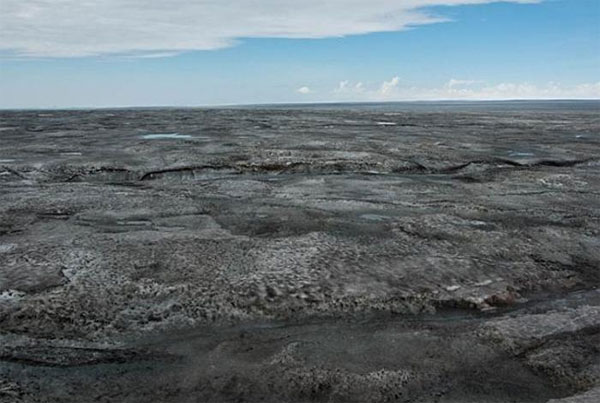
The problem with ‘reasonable parameters’ is that soot on sea-ice can radically change the surface albedo from 0.9 to 0.2, and thus radically increase the amount of Arctic summer insolation absorption. (Note: Antarctic sea ice is not reducing in the same fashion as Arctic. Until 2017, Antarctic sea ice was increasing.)
Here is an image of Arctic sea ice, after some Chinese industrial deposition. Couple of problems with this. a. The models do not allow for this. b. The Dark Ice project to investigate this had it funding cut, and so its website is defunct and all the imaged they had uploaded are gone.
How can anyone investigate climate, if they do not investigate all possibilities?
One of the Dark Ice Project images of Arctic ice.
Ralph
That’s some dirty ice.
Are the Chinese trying to melt the Arctic on purpose, to sell move turbines and solar panels?
Willis –
Your posts are always fantastic and I learn a lot from each one. Thank you for taking the time to present your work on this site.
And HAPPY BIRTHDAY. (I’m 11 years behind you.)
Great Post ! Some highlights according to me (-:
But rather than figure out why the code is coming up with bad values and fixing it,
You mean coming up with values that they like. Uh. you know, supports the narrative.
________________________________________
This is what the climate modelers mean when they say that their model is “physics-based“. They mean it in the same sense as when the producers say a Hollywood movie is “based on a true story”
Ha ha ha ha ha ha! Good one (-:
________________________________________
In other words, when the temperature goes off the rails … don’t investigate why and fix it. Just set it to a reasonable temperature and keep rolling.
And once again, reasonable means supports the narrative.
________________________________________
twenty years ago I asked Gavin Schmidt if he had some kind of “Murphy Gauge” on this subroutine to stop the program if the energy imbalance was larger than some threshold. In the real world,
I am reminded of Trenberth’s “Iconic” Earth Energy Budget that he changed about ten years ago by adding “Net absorbed 0.9 W/m² ” obviously he changed it because it balanced, meaning world temperature wouldn’t increase. Original & Adjusted
________________________________________
“negative cloud cover” and “negative snow depth”.
Another Ha ha ha ha ha ha ha ha!
________________________________________
but unlike single-pass models, those outputs are then used as inputs, which the model performs operations on, and the process is repeated over and over to give a final answer.
A drunk walk graph where a random value is tacked on to the last one. It’s easy to produce a graph that looks a lot like the GISTEMP rendition we constantly see. All you have to do is add a small positive number to your random value. Run it a few times, and you’ll get one that you like.
________________________________________
Willis’s First Rule of Climate says “In the climate, everything is connected to everything else … which in turn is connected to everything else … except when it isn’t.”
The IPCC addresses that in that famous Quote from their Third Assessment Report:
In sum, a strategy must recognise what is possible. In climate research and modelling, we should recognise that we are dealing with a coupled non-linear chaotic system, and therefore that the long-term prediction of future climate states is not possible. LINK
________________________________________
The first rule of buggy computer code is, when you squash one bug, you probably create two others.
Yes, the rule of unintended consequences. We just bought a Ford Hybrid Escape, and it’s loaded with automatic shit some of which is great but there’s one in cruise control that forced me to jam on the brakes. When I flipped on the turn signal to pass the slow car in front of me. It stepped on the gas even though there was a car just a foot or two ahead of me in the left lane. I doubt a wind tunnel would have found that one.
“All you have to do is add a small positive number to your random value. Run it a few times, and you’ll get one that you like.” It’s the same trick used in inflating ARGO results by 0.12 C to “better match shipboard engine intake measurements.” As more ARGO data is added later in the series-establishing trends, the higher the temperature trend.