Welcome to the Hurricane and Tropical Cyclone Reference Page
NOTE: Most of the imagery on this page updates automatically. Storm-specific imagery may appear or disappear as storms develop and dissipate.
For official bulletins see https://www.nhc.noaa.gov
Atlantic Satellite Imagery

NOAA NESDIS GOES-East – Tropical Atlantic GeoColor – Click image to view satellite products at NHC
Hurricane Widget

Add our hurricane widget to your sidebar — it updates every 30 minutes. Copy/paste the code below into your blog’s HTML editor:
<a href="https://wattsupwiththat.com/tropical-cyclone/"><img src="https://wcw.intelliweather.net/imagery/wcw/wcw_sat_atlhurr_175x225.gif" alt="Hurricane Widget" width="175" height="225" /></a>
Atlantic Tracking Maps

Atlantic hurricane tracking map – updates every 3–4 hours – click to enlarge

North Atlantic tracking map – updates every 3–4 hours – click to enlarge
Saffir-Simpson Hurricane Wind Scale

Click image for the full NOAA NHC explanation of the Saffir-Simpson Hurricane Wind Scale
Hurricane Tracking Software
The NOAA NHC Hurricane Center offers free, official storm tracking tools, interactive maps, and mobile-optimized resources:
- NHC Mobile Site – optimized for phones and tablets
- NHC RSS Feeds – subscribe to official storm advisories
- NHC Email/Wireless Notifications – sign up for free hurricane watch/warning alerts
Current Atlantic Conditions

NOAA NHC TAFB Tropical Weather Analysis – click to enlarge
Current Atlantic Tropical Weather Outlook

National Weather Service – National Hurricane Center (NHC) – click to enlarge
2-Day Atlantic Outlook

National Weather Service – National Hurricane Center (NHC) – click to enlarge
5-Day Atlantic Outlook

National Weather Service – National Hurricane Center (NHC) – click to enlarge
Atlantic Hurricane Potential

Center for Ocean-Land-Atmosphere Studies (COLA) / Institute of Global Environment and Society (IGES) – click to view at source
Atlantic Sea Surface Temperatures

NOAA Office of Satellite and Product Operations (OSPO) – Sea Surface Temperatures – click to enlarge
Pacific Imagery
Current Eastern Pacific Satellite Conditions

NOAA NESDIS GOES-West – Tropical East Pacific GeoColor – click image to view satellite products at NHC
Current Pacific Tropical Weather Outlook

National Weather Service – National Hurricane Center (NHC) – click to enlarge
2-Day Pacific Outlook

National Weather Service – National Hurricane Center (NHC) – click to enlarge
5-Day Pacific Outlook

National Weather Service – National Hurricane Center (NHC) – click to enlarge
Eastern Pacific Hurricane Potential

Center for Ocean-Land-Atmosphere Studies (COLA) / Institute of Global Environment and Society (IGES) – click to view at source
Historical Hurricane Data
US Hurricane Landfalls 1900–2013

Roger Pielke, Jr. – Center for Science and Technology Policy Research, University of Colorado at Boulder – click to enlarge
US Hurricanes 1851–2010

NOAA – Atlantic Oceanographic and Meteorological Laboratory (AOML) – click to view at source
Accumulated Cyclone Energy (ACE) – Global and Atlantic Basin

Climatlas.com – Global Running Accumulated Cyclone Energy – click to enlarge
Source Guide
Center for Ocean-Land-Atmosphere Studies (COLA) – Institute of Global Environment and Society (IGES)
Home Page – https://wxmaps.org/pix.html
Height and Vorticity Analyses – https://wxmaps.org/pix/analyses.html
Hurricane Potential Page – https://wxmaps.org/pix/hurpot.html
Forecast Page – https://wxmaps.org/pix/forecasts.html
NOAA – Earth System Research Laboratories (ESRL) Physical Sciences Laboratory (PSL)
Home Page – https://psl.noaa.gov/
Products Page – https://psl.noaa.gov/products/
Data Page – https://psl.noaa.gov/data/
Map Room – https://psl.noaa.gov/map/
NOAA – National Centers for Environmental Information (NCEI)
Home Page – https://www.ncei.noaa.gov/
Products Page – https://www.ncei.noaa.gov/products
Tropical Cyclone Data – https://www.ncei.noaa.gov/products/international-best-track-archive
NOAA – National Weather Service – Climate Prediction Center (CPC)
Home Page – https://www.cpc.ncep.noaa.gov/
Monitoring and Data Products – https://www.cpc.ncep.noaa.gov/products/MD_index.shtml
Atmospheric & SST Indices – https://www.cpc.ncep.noaa.gov/data/indices/
Regional Climate Maps – https://www.cpc.ncep.noaa.gov/products/analysis_monitoring/regional_monitoring/
NOAA – National Weather Service – National Hurricane Center (NHC)
Home Page – https://www.nhc.noaa.gov/
Active Storms – https://www.nhc.noaa.gov/cyclones/
Graphical Tropical Weather Outlook – https://www.nhc.noaa.gov/gtwo.php
Satellite Imagery – https://www.nhc.noaa.gov/satellite.php
Email/Wireless Notifications – https://www.nhc.noaa.gov/aboutnhcnotifications.shtml
NOAA – Office of Satellite and Product Operations (OSPO)
SST Contour Charts – https://www.ospo.noaa.gov/Products/ocean/sst/contour/
NOAA NESDIS – GOES Satellite Imagery
GOES-East (GOES-16) Imagery – https://www.star.nesdis.noaa.gov/
GOES-West (GOES-18) Imagery – https://www.star.nesdis.noaa.gov/
NOAA – Atlantic Oceanographic and Meteorological Laboratory (AOML)
Home Page – https://www.aoml.noaa.gov/
Hurricane Research Division – https://www.aoml.noaa.gov/hurricane-research-division/
Global Warming and Hurricanes – https://www.aoml.noaa.gov/hrd/Landsea/gw_hurricanes/
Remote Sensing Systems (RSS)
Home Page – https://www.remss.com/
MSU/AMSU Upper Air Temperature – https://www.remss.com/measurements/upper-air-temperature/
SST Products – https://www.remss.com/measurements/sea-surface-temperature/
Weather Models – Ryan Maue’s Weather Maps (NCEP GFS, NAM, ECMWF)
https://weathermodels.com/
Roger Pielke Jr. – Hurricane Landfall and ACE Data
Substack – https://rogerpielkejr.substack.com/
Historical Landfall Data – https://rogerpielkejr.blogspot.com/2013/11/graphs-of-day-major-us-hurricane.html
Climatlas.com – Accumulated Cyclone Energy Tracking
https://climatlas.com/tropical/
Here are some suggestions for additional content:
Hurricane Sector Images:
http://www.goes.noaa.gov/g8hu.html
Model Guidance:
http://euler.atmos.colostate.edu/~vigh/guidance/
Navy NRL Tropical Cyclone Page
http://www.nrlmry.navy.mil/TC.html
Navy NRL Global Ocean Modelling (good for SS temps, Heat content, and loop current eddies which are of particular concern to gulf coast residents)
http://www7320.nrlssc.navy.mil/global_nlom32/atlantic.html
Stormpulse
http://www.stormpulse.com/
CIMSS Tropical Cyclones (shear and dust maps)
http://tropic.ssec.wisc.edu/tropic.php
I also have numerous links to wave model sites, if you’re interested.
Read about jet streams being accelerated by mid-latitude oxygen/ozone conversion which extends Rossby wave meander loops. Study this new theory on your desktop at this dedicated website:
https://www.harrytodd.org
still real useful page especially given the renewed interest in fomenting fear on climate change… notably now that coronafear is waning.
I’m hoping WUWT will be devoting some main blog time to the hurricane reporting by the NHC since last year’s kitchen sink tally of last year’s season.
I spent a bit of time cross-referencing the last Danny Public Advisory (#4) with on the ground weather reporting (via Weather Underground) and couldn’t find NHC’s maximum sustained winds and rainfall accumulation using Mobile, Huntsville, Montgomery, Atlanta, Macon, Savannnah. All locations I checked reported nothing more than 8 mph (range 1 to 8), and 0,25 inches of rainfall
(trace to 0,25) compared to the advisory’s MSW of 25 mph and 1″-3″ of rainfall.
Granted this is a tail’s end of Danny, but you’d think their observations would match up somewhere with ground observations. I’ll await the next one and catch it earlier to see what’s what. The trouble is that WU charts (shown using the 10 day weather presentation) isn’t available for more than 4 hours in the past.
Did the Saharan Air Layer tamp down TD formation during July? If so how long will it continue?
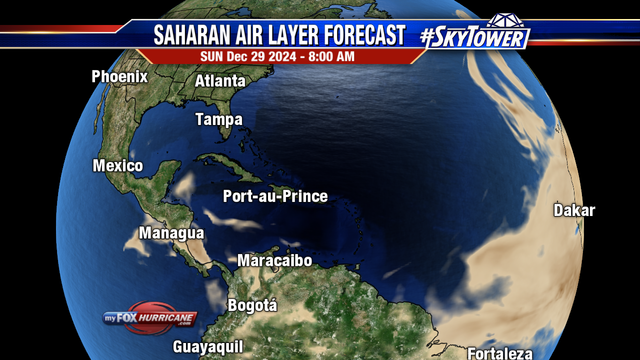
Whatever the cause(s), there will need to be 1 TD, 5 TS’s, plus 4 H’s in August to catch up to the 2020 season. I wonder if and how NHC will summarize July tomorrow.
This hurricane can cause catastrophic flooding.

Is there any possibility of getting dependable graphics for hurricane strength and frequency. This is a frequent claim that they are stronger and more frequent. Would love to be able to find a good graphic of TCE.