
Image Credit: Monterey Marine Meteorology Division – HYbrid Coordinate Ocean Model (HYCOM)
By WUWT regular “Just The Facts”
In making several updates to the WUWT Ocean Reference Page I observed something in the Sea Surface Temperature animation above, that I’ve seen a few times before. More about that below, but first the reason for the updates. The Naval Research Laboratory Navy Coastal Ocean Model (NCOM) was “scheduled to be retired on 5 April 2013 and replaced by operational 1/12° HYbrid Coordinate Ocean Model or HYCOM.” The “HYCOM consortium is a multi-institutional effort sponsored by the National Ocean Partnership Program (NOPP), as part of the U. S. Global Ocean Data Assimilation Experiment (GODAE), to develop and evaluate a data-assimilative hybrid isopycnal-sigma-pressure (generalized) coordinate ocean model (called HYbrid Coordinate Ocean Model or HYCOM).” Here is HYCOM’s home page of and here is the system background information on the “Real-time 1/12° Global HYCOM Nowcast/Forecast System”.
The new HYCOM Global Sea Surface Temperature 30 Day Animation Including 7 Day Forecast at the head of this article has been added to the WUWT Ocean Reference Page, along with the 1 Day graphics for Sea Surface Height and Sea Surface Salinity. In addition to the new Global imagery from HYCOM, there are also a wide array of regional images and animation available from HYCOM including various sections of the Atlantic, Indian, Pacific, and Polar Oceans. The HYCOM regional imagery and animations include not only Sea Surface Temperature, Sea Surface Height and Sea Surface Salinity, but also offer Speed/Currents images and animations, such as this Equatorial Pacific Speed/Currents 30 Day Animation Including 7 Day Forecast:


In terms of the observation that gave me a sense of Déjà vu, if you look at this Equatorial Pacific Sea Surface Temperature – 30 Day Animation Including 7 Day Forecast;

you’ll see a tongue of cold water begin to extend across the Equatorial Pacific. The last time I saw a similar feature was August of last year;

i.e. the last time ENSO (El Niño/La Niña Southern Oscillation) swung towards a neutral/colder phase:

It also reminds me of when Phil Salmon argued in his article Is the ENSO a nonlinear oscillator of the Belousov-Zhabotinsky reaction type? here on WUWT, that ENSO may be a Non-Equilibrium Pattern System, i.e.:
“Of the class of known attractors of nonlinear oscillatory systems, the Lorenz and possibly Roessler attractors bear similarities to the attractor likely responsible for the alternating phases of La Nina and el Nino dominance that characterise the ENSO and constitute the PDO.”
A Non-Equilibrium Pattern System, aka “nonlinear pattern formation in far-from-equilibrium dissipative system” and “pattern formation in dissipative system” refers to;
“the spontaneous formation of spatio-temporal patterns” that “can occur when a stationary state far from thermodynamic equilibrium is maintained through the dissipation of energy that is continuously fed into the system. While for closed systems the second law of thermodynamics requires relaxation to a state of maximal entropy, open systems are able to interchange matter and energy with their environment. By taking up energy of higher value (low entropy) and delivering energy of lower value (high entropy) they are able to export entropy, and thus to spontaneously develop structures characterized by a higher degree of order than present in the environment.” PhD thesis – “Controlling turbulence and pattern formation in chemical reaction” by Matthias Bertram
Here are a couple videos of Non-equilibrium Pattern Systems these being examples of Belousov-Zhabotinsky (BZ) reactions:
and for comparison here is another animation and visualization of Equatorial Pacific Ocean Temperatures. Furthermore, another interesting observation from the WUWT Ocean Reference Page are the BoM Monthly Subsurface Pacific Ocean Equatorial Temperature Anomalies down to 400 Meters;

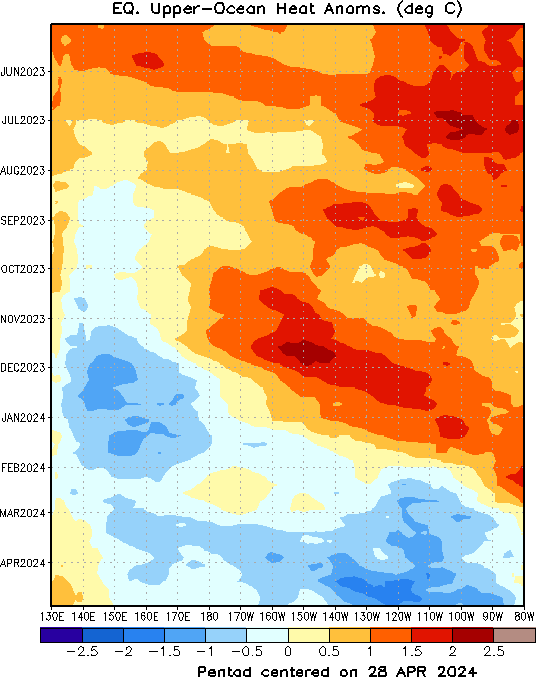

which show that cold water has recently begun to well up from depth in the Equatorial Pacific. For reference:
In a “normal,” or ENSO-neutral year, a low atmospheric pressure center forms over northern Australia and Indonesia and a high pressure center forms on the other side of the Pacific over Peru. At the same time, the trade winds blow steadily east to west along both sides of the equator to move warm surface waters from the eastern to the western Pacific and cause cold, nutrient-rich bottom water to well up off the coast of South America. Woods Hole Oceanographic Institution
El Niño is the name given to the occasional development of warm ocean surface waters along the coast of Ecuador and Peru. When this warming occurs the usual upwelling of cold, nutrient rich deep ocean water is significantly reduced. El Niño normally occurs around Christmas and usually lasts for a few weeks to a few months. Sometimes an extremely warm event can develop that lasts for much longer time periods. In the 1990s, strong El Niños developed in 1991 and lasted until 1995, and from fall 1997 to spring 1998.
The formation of an El Niño is linked with the cycling of a Pacific Ocean circulation pattern known as the southern oscillation. In a normal year, a surface low pressure develops in the region of northern Australia and Indonesia and a high pressure system over the coast of Peru (see Figure 7z-1 below). As a result, the trade winds over the Pacific Ocean move strongly from east to west. The easterly flow of the trade winds carries warm surface waters westward, bringing convective storms to Indonesia and coastal Australia. Along the coast of Peru, cold bottom water wells up to the surface to replace the warm water that is pulled to the west. PhysicalGeography.net
This is not to say with certainty that ENSO (El Niño/La Niña Southern Oscillation) is in fact a Non-Equilibrium Pattern System, nor that ENSO has begun to swing towards a neutral or cold phase, rather these are just observations of interesting patterns within the Equatorial Pacific.
In addition to the WUWT Ocean Reference Page if you have not had the opportunity to look through some of our other Reference Pages, it is highly recommended:
- Atmosphere Page
- Atmospheric Oscillation Page
- ENSO (El Niño/La Niña Southern Oscillation) Page
- “Extreme Weather” Page
- Geomagnetism Page
- Global Climatic History Page
- Global Temperature Page
- Ocean Page
- Oceanic Oscillation Page
- Polar Vortex Page
- Potential Climatic Variables Page
- Scafetta’s Solar-Lunar Cycle Forecast -vs- Global Temperature
- Sea Ice Page
- Solar Page
- Spencer and Braswell Papers
- Tropical Cyclone Page
- US Climatic History Page
- US Weather Page
Please note that WUWT cannot vouch for the accuracy of the data within the Reference Pages, as WUWT is simply an aggregator. All of the data is linked from third party sources. If you have doubts about the accuracy of any of the graphs on the WUWT Reference Pages, or have any suggested additions or improvements to any of the pages, please let us know in comments below.
The bodies of water where I see some minor temperature “sloshing” occuring is in the Mediterranean and Black Sea. What’s that all about?
http://www.the-cryosphere.net/7/699/2013/tc-7-699-2013.pdf
Greg Goodman says: April 26, 2013 at 8:18 pm
What seems clear in these graphs is that the body of colder water is being drawn across the Pacific by the persistent oceanic gyres , not by surface, wind-driven currents. Secondly, the hotter water is not ‘piling up’ but sinking.
This would seem to more likely to indicate that there is a deep bulk water movement that I believe is inertial in origin. A very slow, deep water tidal movement in the halocline.
The “tongue”, be it hot or cold, is just the result of the convergence of the northern and southern oceanic gyres in that region.
Yes, Earth’s Rotational Energy</a causes the Coriolis Effect, which imparts Planetary Vorticity on the oceans and manifests as Ocean Gyres. Gyres play an important role in ocean circulation, especially along the equator. Also the Thermohaline Circulation;
http://en.wikipedia.org/wiki/Thermohaline_circulation
http://oceanmotion.org/html/impact/conveyor.htm
and its circulation patterns;
http://en.wikipedia.org/wiki/File:Conveyor_belt.svg
http://www.whoi.edu/page.do?pid=12455&tid=441&cid=47170&ct=61&article=20727
http://www.john-daly.com/polar/flows.jpg
also should be taken into account.This map shows where cold dense ocean water is sinking;
http://www.thewe.cc/thewei/&/&/bbc12/gulf_stream.gif
this one shows where heat is released to the atmosphere:
http://www.windows2universe.org/earth/Water/images/thermohaline_circulation_conveyor_belt_big.gif
With this said, there also seems to reasonable evidence for the influence of winds, i.e.:
I also wonder if part of the “pile”; NOAA – Earth System Research Laboratory (ESRL) – Click the pic to view at source[/caption]
 NOAA – Earth System Research Laboratory (ESRL) – Click the pic to view at source[/caption]
[caption id="" align="alignnone" width="578"]
[caption id="" align="alignnone" width="578"]
is the Equatorial Bulge:
http://en.wikipedia.org/wiki/Equatorial_bulge“>http://en.wikipedia.org/wiki/Equatorial_bulge
Kudos to you, JUST THE FACTS and to RGBATDUKE for your perceptive insight at Comment #1 for why long-term climate models that rely that rely on linearized predictions are esentially useless.
Those pesky butterflies at work. However there is no reason for instilling a climate of fear because as Lorenz showed however the chaos is DETERMINISTIC.
We might not be able to predict with deadly accuracy when an earthquake will happen but there is no excuse for failing to explain after an earthquake has occured to explain what happened with perfect accuracy. Gutenberg-Richter applied to seismic measurements etc.
Earth’s observed warming from the 1850’s onwards can be explained perfectly with an understanding of Einstein who added energy and energy transfer and release processes to Newton’s mighty body of work
The Gorists and their fellow carbon dioxide travellers are either scientific illiterates or worse still deliberate liars and deceivers.
We are now headed for a long multi-year La Nina and the majority of Anthony’s readers as a few knowlegable commentators on this posting clearly prove know exactly what that entails.
Regards,
Robert
as from 1905 when Einstein added
noaaprogrammer says: April 26, 2013 at 9:29 pm NOAA – Earth System Research Laboratory (ESRL) – Click the pic to view at source[/caption]
 NOAA – Earth System Research Laboratory (ESRL) – Click the pic to view at source[/caption]
The bodies of water where I see some minor temperature “sloshing” occuring is in the Mediterranean and Black Sea.
The Black Sea is a swirling cauldron;
[caption id="" align="alignnone" width="578"]
and there is definitely some:temperature “sloshing” in the Mediterranean:
[caption id="" align="alignnone" width="578"]
What’s that all about?
Well from a structural perspective:
However, another factor might be, “Death hangs over Black Sea: Polluted by the effluent of 16 countries, it is now the ‘most damaged sea in the world'”:
http://www.independent.co.uk/news/world/death-hangs-over-black-sea-polluted-by-the-effluent-of-16-countries-it-is-now-the-most-damaged-sea-in-the-world-1444529.html
As such, in terms of your question, “what’s that all about?, the best I’ve got for you thus far is enclosed areas, complex systems and lots of human effluent… 🙂
justthefactswuwt says:
April 26, 2013 at 7:40 pm
rgbatduke says: April 26, 2013 at 10:18 am
As for its basic assertion, that the Earth’s climate system is rife with, and perhaps best described by, precisely these sorts of non-equilibrium self-organizing chaotic patterns, I think there is no doubt of it.
It seems that all of the elements are there, e.g. in his article Phil Salmon wrote of Matthias Bertram’s thesis that:
The author goes on to analyze several experimental non-equilibrium pattern systems, including the Belousov-Zhabotinsky reaction. He outlines the essential conditions for the operation of a nonlinear oscillator such as a far from equilibrium state, and an “excitable medium”, that is, a medium within which localized positive feedbacks can be initiated and run their course according to their associated refractory period.
In terms of that “excitable medium”,
“The oceanic or limnological Mixed Layer;
http://en.wikipedia.org/wiki/Mixed_layer
Thanks for the reference about the mixed layer within which complex nonlinar pattern phenomena no doubt occur.
However in relation to the BZ reaction the term “excitable medium” or “reactive medium” refers specifically to positive feedbacks and the potential for such feedbacks. In the case of ENSO this condition is provided by the Bjerknes feedback – which you yourdelf have referenced in this thread. The Bjerknes feedback model states that both el Nino and La Nina are time-limited episodes of positive feedback, from interaction between Peruvian upwelling and the east to west trade winds.
Thanks again for this thought-provoking post.
The “Forcing Heat” for the El Nino/La Nina comes from the Extreme UV from the Sun.
1) Sun heats Equatorial Pacific via UV to a depth of 30 meters.
2) The Heat drives the Hadley Cell.
3) At the Northern/Southern ends of the Hadley Cell, the Trade Winds are formed. These winds drive back to the Equator.
4) Trade Winds normally blow from East to West due to Coriolis effects.
5) Pacific water mounds up in Indonesia [1 to 2 meters higher than Western South America].
6) The water mound drives the Northern/Southern Pacific circular currents giving up the heat near the Poles [both Arctic and Antarctic] .
7) These currents go deep and eventually return to Equatorial West South America.
8) La Nina is the normal for a quiet Sun. El Nino is the result of an active Sun. Note the relationship between Peak Solar Cycles and El Nino.
If the “Quiet Sun” continues, the Pacific will give up its heat, and the Planet will cool. The La Nina will become massive. In addition, the same type of cycle occurs in the Atlantic. The Gulf of Mexico is 0.3 to 0.6 meters higher than the West Coast of Africa. The current generated by this mound of water is the Gulf Stream.
The PO and AO are both driven by this cycle. Note the heat in the Northern Pacific Gyre; this is the remaining area of concentrated Pacific heat.
This is truly a wonderful thread. Thanks again, justthefactswuwt and all who are commenting.
What I find of great importance in this thread is that we are beginning to talk about the various phenomena that make up ENSO. We should not be surprised that there are many processes involved and that many remain undiscovered. In my humble opinion, our study of ENSO is roughly at the same point that scientists were when they figured out that air consists of several things.
I suggest that all of us consider a pre-emptive application of Occam’s Razor. Looking at the known processes and the sparse but richly suggestive data, it is tempting to invoke Chaos Theory. I suggest that we do that as not so much a last resort but as a later resort. It seems to me that the thing to do now is clearly describe the natural processes that we can identify. That task alone is a heavy undertaking.
“El Niño normally occurs around Christmas and usually lasts for a few weeks to a few months. Sometimes an extremely warm event can develop that lasts for much longer time periods. In the 1990s, strong El Niños developed in 1991 and lasted until 1995, and from fall 1997 to spring 1998.”
Wow, this is certainly a good fit to the late 20thCentury warming and is measured warmth, not the undue requirement of high climate sensitivity.
Re the Black Sea and Mediterranean “cauldrons”, I note that they don’t exceed the “Willis Thermostatic Limit” of ~30C, even though the Black Sea would tend to be more ‘heatable’.
Steven Mosher says:
April 26, 2013 at 9:50 pm
———————
Thanks
phlogiston says: April 27, 2013 at 4:18 am
However in relation to the BZ reaction the term “excitable medium” or “reactive medium” refers specifically to positive feedbacks and the potential for such feedbacks. In the case of ENSO this condition is provided by the Bjerknes feedback – which you yourdelf have referenced in this thread. The Bjerknes feedback model states that both el Nino and La Nina are time-limited episodes of positive feedback, from interaction between Peruvian upwelling and the east to west trade winds.
Yes, you are correct, i.e.:
From the various animations, it looks like Willis is correct regarding the upper limits. Low 30’s then the regulator kicks in.
Do you have a ‘Med’ style animation for the Arabian Sea/ Persian Gulf? Tis very hot on land in that area and it would be interesting to see an animation of the Sea in those parts.
justthefactswuwt says: “What are your thoughts in terms of ENSO as ‘a nonlinear oscillator of the Belousov-Zhabotinsky reaction type’?”
I don’t know enough about the Belousov-Zhabotinsky reaction to comment.
Regards
justthefactswuwt says:
April 27, 2013 at 12:06 pm
Thanks for the link to a great review of ENSO (Wang et al 2012). Its good to see the Bjerknes feedback (nicely summarised in the section you quoted) righly being placed center-stage in the current discussion of ENSO. (It was from Bob Tisdale that I first learned about the Bjerknes feedback.) I think that the Bjerknes feedback and the nonlinear dynamics and oscillation that flow from it are the core of ENSO. And since the ENSO peaks are clustered around certain fixed times of year e.g. el Nino peaking generally at Christmas, this indicates that is is likely a periodically forced oscillator of some kind.
Bob Tisdale says:
April 27, 2013 at 2:47 pm
justthefactswuwt says: “What are your thoughts in terms of ENSO as ‘a nonlinear oscillator of the Belousov-Zhabotinsky reaction type’?”
I don’t know enough about the Belousov-Zhabotinsky reaction to comment.
With hindsight I dont think that the BZ oscillator is the greatest analogy of ENSO, since many of the patterns it exhibits, e,g, spiral, are quite unlike ENSO. What is analagous is the spontaneous oscillation between two (or more) states, and the issue of the “excitable medium” i.e. the potential for “outbreaks” of limited positive feedbacks. My own view is that the Bjerknes feedback is such a positive feedback system that qualifies the Pacific as an excitable medium and allows ENSO to be characterised as a nonlinear oscillator. There may be much better analogies of ENSO among nonlinear oscillators, but the BZ reaction is one of the best known and studied. (There are many types of BZ oscillator.)
phlogiston says: April 27, 2013 at 3:00 pm
Further to Wang et al.2012:
I enjoy reading the posts on WUWT such as these discussions; and I often have to go hunting other information to fully understand what was said. A little over a year ago, Willis posted his graphs on the Argo float data that shows that the Ocean temperature is limited to approximately 30 degrees. I also note that NOAA charts do not graph temperatures above 31 degrees. Looking at Willis’ graphs, I concluded that only a chemical reaction in the ocean could produce such a consistent limit on temperature. I know Willis is looking at thunderstorms along the equator; however, I do not think they are consistent enough to produce the 30 degree limit as robust as the graphs show. Reading a number of papers on ocean chemical reactions and ocean acidification; I find that there are a lot of reactions. But, none of the papers discuss the heat exchanges that happen in these reactions. Looking at my chemistry text I find that almost all of these reactions are endothermic and remove heat from the ocean. Just how much is the question. I do not have the ability to analyze and determine this number. But, if you consider that the ocean temperature is being limited to 30 degrees and say that all the heat removed to keep it at this temperature is being absorbed in a chemical reaction,this would be a very large number. The reason that I am posting this is to see if some of the very talented people on this site would look at the chemical reactions, they are well known, and check the energy transfers that are present. If I am right, a major piece of understanding of the ocean and possibly the El Nino cycles is missing.
justthefactswuwt says:
April 27, 2013 at 9:01 pm
phlogiston says: April 27, 2013 at 3:00 pm
Further to Wang et al.2012:
What do Wang et al. mean by “stochastic forcing”? Periodic forcing I can understand, from orbital, tidal etc rhythms, but what would provide stochastic forcing?
Retired Engineer John:
re your post at April 28, 2013 at 7:38 am .
The maximum limit to sea surface temperature was first observed in 1991 by Ramanathan & Collins who reported it in Nature magazine in 1991.
http://www.nature.com/nature/journal/v351/n6321/abs/351027a0.html
The abstract of their paper says
In the subsequent 5 years a series of papers in Nature disputed both the reality of the limit and the reason for it. However, the outcome was a general acceptance of the statement in the abstract I have copied here.
Please note that this is a purely physical effect which involves no chemical reactions.
Importantly, the effect provides not only a limit but also a negative feedback.
When maximum sea surface temperature (SST) is reached then any additional heat input to the sea (from any reason) increases evapouration and, thus, cirrus clouds which drift away from the region of maximum SST. These clouds near the region of maximum SST shield sea near the region of maximum SST and so reduce solar heating near the region. Hence, the clouds not only restrict SST at a limit of solar heating; additional heat input generates clouds which reduce the heating of the ocean so the ocean cools.
I hope this is an adequate answer to your question.
Richard
phlogiston says:
April 28, 2013 at 8:58 am
justthefactswuwt says:
April 27, 2013 at 9:01 pm
phlogiston says: April 27, 2013 at 3:00 pm
Further to Wang et al.2012:
“What do Wang et al. mean by “stochastic forcing”?”
I hope that they are not serious about the phrase ‘stochastic forcing’. To say that something is stochastic is to say that it belongs to a non-deterministic system. To say that something is a forcing is to say that it is a real world effect of something such as CO2.
So, where is the non-determinism? Is it in the forcing or in the system? Or is there a difference?
I do not believe that Wang et. al. know.
Wang should have said that he is using a stochastic system to describe a forcing. The stochastic system is a representation of the world. The forcing is in the world. The fact that it can be described by a stochastic system does not make it stochastic.
richardscourtney says: April 28, 2013 at 9:59 am
Thank you Richard. I will read the article you referenced. I intend to continue to investigate the 30 degree limit. There are too many indications that the limit is a chemical reaction. It is also obvious that the answer is complex.
Richard, do you know where this article can be found without paying the $35.
Retired Engineer John:
No, sorry, I don’t. But that was the seminal work. As I said, it was controversial at the time so there were several other studies after it.
The basic point which has become accepted is
(a) evapouration rate increases as heat input to ocean surface increases,
(b) the evapouration removes heat from the ocean surface layer, and
(c) the evapourated water induces more cirrus, then
(d) the cirrus reflects sunlight so it is prevented and
(e) the reflected sunlight does not reach the ocean surface, so
(f) heat input to the ocean is reduced, with the result that
(g) sea surface temperature is prevented from rising above 305K.
This information is accepted and is over two decades old. Therefore, I suspect you can find it in a climatology textbook if there is a university library near you.
Richard
richardscourtney says:
April 28, 2013 at 9:59 am
Your link to Ramanathan and Collins “possible” limit of 30C for SST is a good start, but I would have also added the link to the more recent work by Willis Eschenbach who actually illustrates the phenomenon using buoy data and connects it to the creation of cumulus (not cirrus), followed by thunderstorm heat engines that cool hot spots – published in E&E.
Volume 21, Number 4 / August 2010
A later work has unequivocal graphics of data showing that 30C is pretty much the limit. Scroll down to the blue “dotted graphics” to see these unequivocal illustrations
http://wattsupwiththat.com/2013/04/21/dehumidifying-the-tropics/.
Despite prior mention by Ramanathan and Collins, I propose that this phenomenon be named the “Eschenbach effect” for the full clear explanation for the phenomenon.
Gary Pearse:
Thankyou for your post addressed to me at April 28, 2013 at 12:22 pm.
Yes, I agree all you say. Thankyou for saying it.
Clearly, your post requires me to explain my interest which induced me to suggest looking in a uni. library.
I did not mention the E&E article by Willis Eschenbach for two reasons.
Firstly, it is also pay-walled.
Secondly, I am on the Editorial Board of E&E so it could have been misunderstood if I had recommended a paper in E&E when the subject is covered in other papers accessible in a uni. library.
Richard