Compiled by WUWT regular “Just The Facts”
This list of Potential Climatic Variables was built with the help of a multitude of WUWT reader comments, beginning on this thread on January, 15th 2011, and growing on January 22nd, 2011, February 10th, 2011, February 28th, 2011, June 30th, 2011 and January 21st, 2012. Your help in continuing to build this list would be most appreciated. Please take a look through the list below and note in comments if you have any additions, suggestions or corrections.
Wikipedia Warning: The list relies heavily upon Wikipedia due to the fact that it is the only source that offers reasonably coherent content on such broad range of subjects. However, there are known issues with Wikipedia’s content, especially biases in their climate articles. As such, please take care to view any Wikipedia articles with a critical eye and check Wikipedia’s references to evaluate the credibility of their sources. Additionally, in comments, please provide your suggestions of articles from alternate sources that can be added to this list in order to help readers to easily verify the veracity of the Wikipedia articles within.
1. Earth’s Rotational Energy
https://en.wikipedia.org/wiki/Rotational_energy
https://en.wikipedia.org/wiki/Earth%27s_rotation
https://www.physicalgeography.net/fundamentals/6h.html
results in day and night; causes the Coriolis Effect:
https://en.wikipedia.org/wiki/Coriolis_effect
imparts Planetary Vorticity on the oceans;
https://en.wikipedia.org/wiki/Vorticity
and manifests as Ocean Gyres;
https://en.wikipedia.org/wiki/Ocean_gyre
the Antarctic Circumpolar Current;
https://en.wikipedia.org/wiki/Antarctic_Circumpolar_Current
https://en.wikipedia.org/wiki/File:Conveyor_belt.svg

Arctic Ocean Circulation;
can result in the formation of Polynya;
https://en.wikipedia.org/wiki/Polynya
and causes the Equatorial Bulge:
https://en.wikipedia.org/wiki/Equatorial_bulge
Earth’s Rotational Energy influences Atmospheric Circulation;
https://en.wikipedia.org/wiki/Atmospheric_circulation
including the Jet Stream;
https://en.wikipedia.org/wiki/Jet_stream
Westerlies;
https://en.wikipedia.org/wiki/Westerlies
Tradewinds;
https://en.wikipedia.org/wiki/Trade_wind
Geostrophic Wind;
https://en.wikipedia.org/wiki/Geostrophic_wind
Surface Currents;
https://oceanservice.noaa.gov/education/tutorial_currents/welcome.html
https://en.wikipedia.org/wiki/Ocean_current
through Ekman Transport;
https://en.wikipedia.org/wiki/Ekman_transport
https://oceanmotion.org/html/background/ocean-in-motion.htm
Tropical Cyclones;
https://en.wikipedia.org/wiki/Tropical_cyclone
possibly Tornadoes;
https://en.wikipedia.org/wiki/Tornado
however, the NOAA Storm Prediction Center notes that scientists don’t think the Coriolis Effect is responsible for tornado rotation because anticyclonic tornadoes also occur:
https://www.spc.noaa.gov/faq/tornado/
and Polar Vortices;
https://en.wikipedia.org/wiki/Polar_vortex
https://wattsupwiththat.com/reference-pages/polar-vortex/
which “are caused when an area of low pressure sits at the rotation pole of a planet. This causes air to spiral down from higher in the atmosphere, like water going down a drain.”
https://www.universetoday.com/973/what-venus-and-saturn-have-in-common/
When a Polar Vortex splits or breaks down it can cause a Sudden Stratospheric Warming:
https://en.wikipedia.org/wiki/Sudden_stratospheric_warming
https://earthobservatory.nasa.gov/images/36972/
Rossby Waves;
https://en.wikipedia.org/wiki/Rossby_wave
are a subset of Inertial Waves:
https://en.wikipedia.org/wiki/Inertial_waves
“Atmospheric Rossby Waves emerge due to shear in rotating fluids, so that the Coriolis force changes along the sheared coordinate. In planetary atmospheres, they are due to the variation in the Coriolis effect with latitude.” “Atmospheric Rossby waves are giant meanders in high-altitude winds that are a major influence on weather” and “are principally responsible for the Brewer-Dobson circulation”;
https://en.wikipedia.org/wiki/Brewer-Dobson_circulation
Atmospheric Rossby Waves “are not to be confused with Oceanic Rossby Waves, which move along the thermocline: that is, the boundary between the warm upper layer of the ocean and the cold deeper part of the ocean.” “Oceanic Rossby waves are thought to communicate climatic changes due to variability in forcing, due to both the wind and buoyancy. Both barotropic and baroclinic waves cause variations of the sea surface height, although the length of the waves made them difficult to detect until the advent of satellite altimetry. Baroclinic waves also generate significant displacements of the oceanic thermocline, often of tens of meters. Satellite observations have revealed the stately progression of Rossby waves across all the ocean basins, particularly at low- and mid-latitudes. These waves can take months or even years to cross a basin like the Pacific.”
https://en.wikipedia.org/wiki/Rossby_wave
Earth’s Rotational Energy influences Plate Tectonics;
https://en.wikipedia.org/wiki/Plate_tectonics
“By analyzing the minute changes in travel times and wave shapes for each doublet, the researchers concluded that the Earth’s inner core is rotating faster than its surface by about 0.3-0.5 degrees per year.”
https://www.livescience.com/9313-earth-core-rotates-faster-surface-study-confirms.html
The surface movement is called plate tectonics. It involves the shifting of about a dozen major plates and is what causes most earthquakes;
https://en.wikipedia.org/wiki/Earthquake
Volcanoes;
https://en.wikipedia.org/wiki/Volcano
and Mountain Formation;
https://en.wikipedia.org/wiki/Mountain_formation
which can create Mountain Jets;
https://en.wikipedia.org/wiki/Mountain_jet
and influence the creation of Atmospheric Waves:
https://en.wikipedia.org/wiki/Atmospheric_wave
Rotational Energy is the primary driver of Earth’s Dynamo;
https://en.wikipedia.org/wiki/Dynamo_theory
which generates Earth’s Magnetic Field;
https://en.wikipedia.org/wiki/Earth%27s_magnetic_field
and is primarily responsible for the Earthly behaviors of the Magnetosphere;
https://en.wikipedia.org/wiki/Magnetosphere
with certain secular variations in Earth’s magnetic field originating from ocean flow/circulation;
https://iopscience.iop.org/article/10.1088/1367-2630/11/6/063015
though Leif Svalgaard notes that these are minor variations, as the magnetic field originating from ocean flow/circulation “is 1000 times smaller than the main field generated in the core.”
Earth’s Rotation results in the Equatorial Anomaly, “characterized as the occurrence of a trough in the ionization concentration at the equator and crests at about 17° in magnetic latitude in each hemisphere, the equatorial anomaly has been well described as arising from the electrodynamics at the equator.”
Earth Core Changes appear “to be generated in the Earth’s core by a dynamo process, associated with the circulation of liquid metal in the core, driven by internal heat sources”. These core changes influence Earth’s Magnetic Field, including movement of the Geomagnetic Poles:
https://www.ncei.noaa.gov/products/wandering-geomagnetic-poles
Also of note, “Over millions of years, Earth’s rotation is significantly slowed by gravitational interactions with the Moon: see tidal acceleration.”
https://en.wikipedia.org/wiki/Tidal_acceleration
“Tidal acceleration is an effect of the tidal forces between an orbiting natural satellite (e.g. the Moon), and the primary planet that it orbits (e.g. the Earth). The ‘acceleration’ is usually negative, as it causes a gradual slowing and recession of a satellite in a prograde orbit away from the primary, and a corresponding slowdown of the primary’s rotation. The process eventually leads to tidal locking of first the smaller, and later the larger body. The Earth-Moon system is the best studied case.”
“The presence of the moon (which has about 1/81 the mass of the Earth), is slowing Earth’s rotation and lengthening the day by about 2 ms every one hundred years.”
Lastly Length of Day (LOD);
https://en.wikipedia.org/wiki/Day_length
“varies when any mass on or in the Earth moves, affecting the state of its angular momentum. Take weather in the atmosphere, for instance. The seasonal changes in the trade winds and monsoons have a well-known effect on the length-of-day over the course of the year. The IERS calculates the angular momentum of the whole atmosphere every six hours, allowing the signal of large-scale weather systems to be detected.”
“An analysis of time variations in the earth’s length of day (LOD) for 25 years (1973–1998) versus atmospheric circulation changes and lunar phase is presented. It is found that, on the average, there is a 27.3-day and 13.6-day period oscillation in global zonal wind speed, atmospheric geopotential height, and LOD following alternating changes in lunar phase.”
https://link.springer.com/article/10.1007/s00382-006-0167-0
“The third important index is Length of Day (LOD) – a geophysical index that characterizes variation in the earth rotational velocity. Full time series of LOD cover more than 350 years, with the most reliable data obtained in the last 150 years.”
https://www.fao.org/3/y2787e/y2787e03.htm
Earth’s rotation is slowing “due to a transfer of Earth’s rotational momentum to the Moon’s orbital momentum as tidal friction slows the Earth’s rotation.”
In this paper, “Are Changes in the Earth’s Rotation Rate Externally Driven and Do They Affect Climate?”, by Ian R. G. Wilson, the General Science Journal, 2011, “evidence is presented to show that the phases of two of the Earth’s major climate systems, the North Atlantic Oscillation (NAO) and the Pacific Decadal Oscillation (PDO), are related to changes in the Earth’s rotation rate.”
In this paper, “On the correlation between air temperature and the core Earth processes: Further investigations using a continuous wavelet analysis” by Stefano Sello, 2011:
https://arxiv.org/pdf/1103.4924.pdf
2. Orbital Energy, Orbital Period, Orbital Spiral, Elliptical Orbits (Eccentricity), Tilt (Obliquity), Wobble (Axial precession) and Polar Motion
https://en.wikipedia.org/wiki/Specific_orbital_energy
https://en.wikipedia.org/wiki/Synodic
https://www.physicalgeography.net/fundamentals/6h.html
creates Earth’s seasons;
https://en.wikipedia.org/wiki/Season
which drives annual changes in Arctic Sea Ice and Antarctic Sea Ice; the freezing and melting of which helps to drive the Thermohaline Circulation;
https://en.wikipedia.org/wiki/Thermohaline_circulation
and can result in the formation of Polynyas:
https://en.wikipedia.org/wiki/Polynya
Earth’s orbit around the Sun, Earth’s tilt, Earth’s wobble and the Moon’s orbit around Earth, Earth’s Rotation, and the gravity of the Moon, Sun and Earth, act in concert to determine the constantly evolving Tidal Force on Earth:
https://en.wikipedia.org/wiki/Tidal_force
This Tidal Force is influenced by variations in Lunar Orbit;
https://en.wikipedia.org/wiki/Orbit_of_the_Moon
as seen in the Lunar Phases;
https://en.wikipedia.org/wiki/Lunar_phase
Lunar Precession;
https://en.wikipedia.org/wiki/Lunar_precession
Lunar Node;
https://en.wikipedia.org/wiki/Lunar_node
Saros cycles;
https://en.wikipedia.org/wiki/Saros_cycle
and Inex cycles:
https://en.wikipedia.org/wiki/Inex
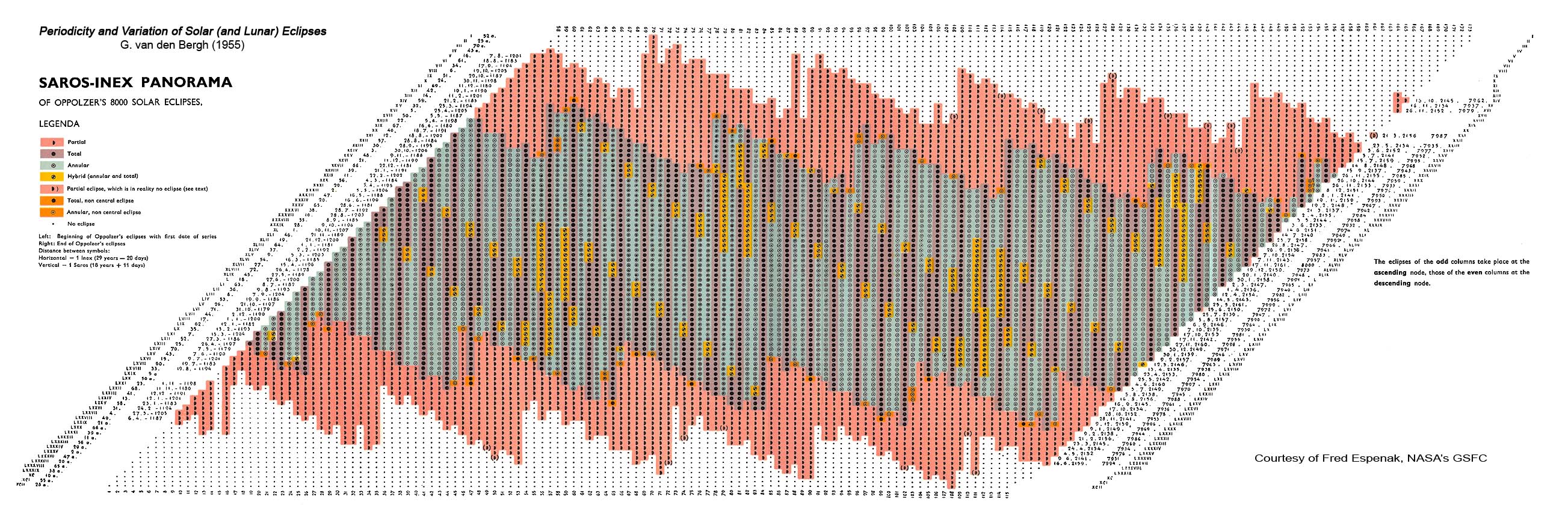
The combined cycles of the Saros and Inex Cycles can be visualized here:
https://eclipse.gsfc.nasa.gov/SEsaros/image/SEpanoramaGvdB-big.JPG
Keeling and Whorf propose in Geophysics, 2000 “that such abrupt millennial changes, seen in ice and sedimentary core records, were produced in part by well characterized, almost periodic variations in the strength of the global oceanic tide-raising forces caused by resonances in the periodic motions of the earth and moon.”
https://www.ncbi.nlm.nih.gov/pmc/articles/PMC18099/
“When perigee, perihelion, and either the new or full moon occur at approximately the same time, considerably increased tidal ranges result.”
https://tidesandcurrents.noaa.gov/restles4.html
Richard Holle argues that “The solar wind inductive effects, drive the lunar declinational movement, which in turn drives the atmospheric declinational tides.”
Nicola Scafetta argues that “The 9.1-year cycle is shown to be likely related to a decadal Soli/Lunar tidal oscillation, while the 10–10.5, 20–21 and 60–62 year cycles are synchronous to solar and heliospheric planetary oscillations.”
https://scienceandpublicpolicy.org/images/stories/papers/reprint/astronomical_harmonics.pdf
https://www.fel.duke.edu/~scafetta/pdf/Scafetta_models_comparison_ATP.pdf
“Past studies have detected a 1500-year climate cycle in various types of Pleistocene geologic or ice deposits.”
https://cdnsciencepub.com/doi/10.1139/E10-050
“The inertial motion of the Sun around the Barycentre, or centre of mass, of the Solar System”
https://en.wikipedia.org/wiki/Barycentric_coordinates_%28astronomy%29
https://www.orbitsimulator.com/gravity/articles/ssbarycenter.html
https://spaceplace.nasa.gov/barycenter/en/
In Ed Fix’s paper, “The Relationship of Sunspot Cycles to Gravitational Stresses on the Sun”:
https://tallbloke.wordpress.com/2011/07/25/ed-fix-solar-activity-simulation-model-revealed/
https://arxiv.org/pdf/astro-ph/0507269.pdf
Polar Motion;
https://en.wikipedia.org/wiki/Polar_motion
The Chandler Wobble;
https://en.wikipedia.org/wiki/Chandler_wobble
Over longer time frames changes to Earth’s orbital eccentricity, obliquity (tilt) and precession (wobble), called Croll/Milankovitch cycles;
https://en.wikipedia.org/wiki/Milankovitch_cycles
may be responsible for the periods of Glaciation (Ice Ages) that Earth has experienced for the last several million years of its climatic record:
https://en.wikipedia.org/wiki/Ice_age
“There are three major forms of Milankovitch cycle: Eccentricity, Obliquity, and Precession.”
https://www.azimuthproject.org/azimuth/show/Milankovitch+cycle
https://www.physicalgeography.net/fundamentals/7y.html
Gerard Roe argues in support of the Milankovitch framework in this paper:
https://agupubs.onlinelibrary.wiley.com/doi/10.1029/2006GL025955
However, Don Easterbrook argues that there are major problems with the Croll/Milankovitch theory:
Also of interest, “during a solar eclipse the Moon’s passage overhead blocks out the majority of the Sun’s light, casting a wide swath of the Earth into darkness.”
https://agupubs.onlinelibrary.wiley.com/doi/10.1029/2011GL048805
And over very long time frames, “the Moon is spiraling away from Earth at an average rate of 3.8 cm per year”:
https://en.wikipedia.org/wiki/Lunar_distance_%28astronomy%29
3. Gravitation
https://en.wikipedia.org/wiki/Gravitation
The gravity of the Moon, Sun and Earth, Earth’s rotation, Earth’s orbit around the Sun, Earth’s tilt, Earth’s wobble and the Moon’s orbit around Earth act in concert to determine the constantly evolving Tidal Force on Earth:
https://en.wikipedia.org/wiki/Tidal_force
This tidal force results in Earth’s Ocean Tide;
https://en.wikipedia.org/wiki/Tide
https://tidesandcurrents.noaa.gov/restles4.html
Atmospheric Tide;
https://en.wikipedia.org/wiki/Atmospheric_tide
Earth Tide;
https://en.wikipedia.org/wiki/Earth_tide
Magma Tide:
https://link.springer.com/article/10.1007/s11589-006-0070-3
Earth’s Gravity;
https://en.wikipedia.org/wiki/Convection#Gravitational_or_buoyant_convection
https://visibleearth.nasa.gov/
in concert with Tidal Forces, influence Earth’s Ocean Circulation which influences Oceanic Oscillations including El Niño/La Niña;
https://en.wikipedia.org/wiki/El_Ni%C3%B1o-Southern_Oscillation
the Pacific Decadal Oscillation (PDO);
https://en.wikipedia.org/wiki/Pacific_Decadal_Oscillation
the Atlantic Multi-Decadal Oscillation (AMO);
https://en.wikipedia.org/wiki/Atlantic_Multidecadal_Oscillation
the Indian Ocean Dipole (IOD)/Indian Ocean Oscillation (IOO);
https://en.wikipedia.org/wiki/Indian_Ocean_Dipole
and can result in the formation of Polynyas:
https://en.wikipedia.org/wiki/Polynya
Gravity Waves;
https://en.wikipedia.org/wiki/Gravity_wave
which may be partially responsible for the Quasi-Biennial Oscillation (QBO);
https://en.wikipedia.org/wiki/Quasi-biennial_oscillation
“on an air–sea interface are called surface gravity waves or Surface Waves”;
https://en.wikipedia.org/wiki/Surface_wave
“while internal gravity waves are called Inertial Waves”:
https://en.wikipedia.org/wiki/Inertial_waves
Rossby Waves;
https://en.wikipedia.org/wiki/Rossby_wave
Geostrophic Currents;
https://en.wikipedia.org/wiki/Geostrophic_current
and Geostrophic Wind are examples of inertial waves. Inertial waves are also likely to exist in the core of the Earth.
https://en.wikipedia.org/wiki/Geostrophic_wind
Earth’s gravity is the primary driver of Plate Tectonics:
https://en.wikipedia.org/wiki/Plate_tectonics
which causes most Earthquakes;
https://en.wikipedia.org/wiki/Earthquake
Volcanoes;
https://en.wikipedia.org/wiki/Volcano
and Mountain Formation;
https://en.wikipedia.org/wiki/Mountain_formation
which can create Mountain Jets and influence the creation of Atmospheric Waves:
https://en.wikipedia.org/wiki/Mountain_jet
https://en.wikipedia.org/wiki/Atmospheric_wave
The Slab Pull force;
https://en.wikipedia.org/wiki/Slab_pull
is a tectonic plate force due to subduction, and the Ridge Push force accounts for 5 to 10% of the overall force:
https://en.wikipedia.org/wiki/Ridge_push
Isostasy also exists whereby a “state of gravitational equilibrium between the earth’s lithosphere and asthenosphere such that the tectonic plates ‘float’ at an elevation which depends on their thickness and density.”
https://en.wikipedia.org/wiki/Isostasy
Plate Tectonics drive “cycles of ocean basin growth and destruction, known as Wilson cycles,” involving continental rifting;
https://en.wikipedia.org/wiki/Rift
seafloor spreading;
https://en.wikipedia.org/wiki/Seafloor_spreading
subduction;
https://en.wikipedia.org/wiki/Subduction
and collision:
https://en.wikipedia.org/wiki/Continental_collision
“Climate change on ultra-long time scales (tens of millions of years) are more than likely connected to plate tectonics.” This process is called the Supercontinent Cycle:
https://en.wikipedia.org/wiki/Supercontinent_cycle
Earth’s gravity is responsible for Katabatic Wind:
https://en.wikipedia.org/wiki/Katabatic_wind
4. Solar Energy
https://en.wikipedia.org/wiki/Solar_energy
results in Solar Radiation/Sunlight;
https://en.wikipedia.org/wiki/Solar_radiation
which varies based upon 11 and 22 year cycles:
https://en.wikipedia.org/wiki/Solar_cycle
Total Solar Irradiance (TSI);
https://www.ncei.noaa.gov/products/space-weather/solar-irradiance
appears to fluctuate “by approximately 0.1% or about 1.3 Watts per square meter (W/m2) peak-to-trough during the 11-year sunspot cycle”:
https://en.wikipedia.org/wiki/Solar_variation
Solar Energy also drives the Hydrological/Water Cycle;
https://en.wikipedia.org/wiki/Hydrological_cycle
within the Hydrosphere;
https://en.wikipedia.org/wiki/Hydrosphere
as Total Solar Irradiance (TSI) causes evaporation;
https://en.wikipedia.org/wiki/Evaporation
that drives Cloud formation;
https://en.wikipedia.org/wiki/Cloud
and results in Precipitation;
https://en.wikipedia.org/wiki/Precipitation_%28meteorology%29
including Rain;
https://en.wikipedia.org/wiki/Rain
and Snow;
https://en.wikipedia.org/wiki/Snow
including Sublimation;
https://en.wikipedia.org/wiki/Sublimation_%28phase_transition%29
Snow sublimation losses, particularly blowing snow sublimation, can be significant in alpine environments:
https://hess.copernicus.org/articles/14/1401/2010/
Precipitation results in the Water Distribution on Earth;
https://en.wikipedia.org/wiki/Water_distribution_on_Earth
creates surface Runoff;
https://en.wikipedia.org/wiki/Runoff_%28water%29
which result in Rivers and drives Erosion:
https://en.wikipedia.org/wiki/River
https://en.wikipedia.org/wiki/Erosion
“The driving force behind atmospheric circulation is solar energy, which heats the atmosphere with different intensities at the equator, the middle latitudes, and the poles.”
https://en.wikipedia.org/wiki/Atmospheric_circulation
Atmospheric Circulation includes Hadley Cells;
https://en.wikipedia.org/wiki/Hadley_cell
Ferrel Cells;
https://en.wikipedia.org/wiki/Atmospheric_circulation#Ferrel_cell
Polar Cells;
https://en.wikipedia.org/wiki/Polar_cell
all of which help to create Wind;
https://en.wikipedia.org/wiki/Wind
that influence Surface Currents through Ekman Transport;
https://en.wikipedia.org/wiki/Ekman_transport
https://oceanmotion.org/html/background/ocean-in-motion.htm
and also cause Langmuir circulations:
https://en.wikipedia.org/wiki/Langmuir_circulation
Solar energy influences Atmospheric Waves;
https://en.wikipedia.org/wiki/Atmospheric_wave
including Atmospheric Tides;
https://en.wikipedia.org/wiki/Atmospheric_tide
and Atmospheric Pressure:
https://en.wikipedia.org/wiki/Atmospheric_pressure
https://acp.copernicus.org/articles/10/24015/2010/
and Atmospheric Escape;
https://en.wikipedia.org/wiki/Atmospheric_escape
which “is the loss of planetary atmospheric gases to outer space”:
https://www.scientificamerican.com/article/how-planets-lose-their-atmospheres/
Solar energy drives the Brewer-Dobson Circulation;
https://en.wikipedia.org/wiki/Brewer-Dobson_circulation
which influences Polar Vortices:
https://en.wikipedia.org/wiki/Polar_vortex
https://wattsupwiththat.com/reference-pages/polar-vortex/
Solar variability may also influence the Polar Night Jets:
https://en.wikipedia.org/wiki/Jet_stream#Polar_night_jet
Solar Ultraviolet (UV) radiation;
https://en.wikipedia.org/wiki/Ultraviolet
appears to vary by approximately 10% during the solar cycle and has been hypothesized to influence Earth’s climate:
https://wattsupwiththat.com/2011/04/05/courtillot-on-the-solar-uv-climate-connection/
however Leif Svalgaard argues that the energy in the EUV/UV band is very small compared to total solar irradiation, and that a larger solar cycle variation of EUV does not make any significant difference in the energy budget:
https://wattsupwiththat.com/2011/04/05/courtillot-on-the-solar-uv-climate-connection/#comment-636477
Additionally “the thermosphere intercepts extreme ultraviolet (EUV) photons from the sun before they can reach the ground.” In 2008-2009 “A Puzzling Collapse of Earth’s Upper Atmosphere” occurred when “high above Earth’s surface where the atmosphere meets space, a rarefied layer of gas called ‘the thermosphere’ recently collapsed and now is rebounding again.”
https://science.nasa.gov/science-research/heliophysics/
Infrared Radiation;
https://en.wikipedia.org/wiki/Infrared
Henrik Svensmark believes that the Solar Wind,
https://en.wikipedia.org/wiki/Solar_wind
“a wave of charged particles from the sun, interacts with cosmic rays as they approach Earth. How many cosmic rays get through the solar wind determines how many clouds form, he suggests. The amount of cloud cover then determines how hot or cold the planet is.”
Henrik Svensmark’s Papers: https://www.space.dtu.dk/english/research/solar-terrestrial-physics
Several studies have found correlations between solar cycles, cosmic rays and agricultural output:
https://arxiv.org/pdf/astro-ph/papers/0312/0312244.pdf
https://ui.adsabs.harvard.edu/abs/2010cosp…38.4244P
Solar – Coronal Holes;
https://solarscience.msfc.nasa.gov/coronalholes.shtml
Solar – Solar Energetic Particles (SEP);
https://solarscience.msfc.nasa.gov/SEP.shtml
Solar – Coronal Mass Ejection;
https://www.esa.int/Science_Exploration/Space_Science/Cluster
Sun Erupts to Life – Huge CME on 13 April 2010 (YouTube)
Solar Magnetosphere Breach; Solar Polar Field Reversal;
https://science.nasa.gov/science-news/science-at-nasa/2001/ast15feb_1
Solar Sector Boundary;
https://science.nasa.gov/heliophysics/
Grand Minimum; Leif Svalgaard says: “If L&P are correct and sunspots become effectively invisible, it might mean another Grand Minimum lasting perhaps 50 years. During this time the solar cycle is still operating, cosmic rays are still modulated, and the solar wind is still buffeting the Earth. It will lead to a cooling of a couple of tenths of a degree.”
Solar Influences on Climate:
https://www.leif.org/EOS/2009RG000282.pdf
Statistical issues about solar–climate relations:
https://www.leif.org/EOS/Yiou-565-2010.pdf
5. Geothermal Energy
https://en.wikipedia.org/wiki/Geothermal_energy
“is thermal energy generated and stored in the Earth. Earth’s geothermal energy originates from the original formation of the planet (20%) and from radioactive decay of minerals (80%).”
“The Earth’s internal thermal energy flows to the surface by conduction at a rate of 44.2 terawatts (TW), and is replenished by radioactive decay of minerals at a rate of 30 TW.”
https://en.wikipedia.org/wiki/Geothermal_gradient
Geothermal Heat Flows;
https://en.wikipedia.org/wiki/Geothermal_gradient#Heat_flow
https://www.smu.edu/dedman/research/institutes-and-centers/geothermal-lab
Geothermal Heat also flows through Hydrothermal Vents;
https://en.wikipedia.org/wiki/Hydrothermal_vent
which can be a factor in Hydrothermal Circulations:
https://en.wikipedia.org/wiki/Hydrothermal_circulation
as well as Hot Springs:
https://en.wikipedia.org/wiki/Hot_spring
Geothermal Energy can have major influence on Earth’s climate when released by Volcanoes, generally found where tectonic plates are diverging;
https://en.wikipedia.org/wiki/Divergent_boundary
or converging;
https://en.wikipedia.org/wiki/Convergent_boundary
however, “intraplate volcanism has also been postulated to be caused by mantle plumes”:
https://en.wikipedia.org/wiki/Mantle_plume
These so-called “hotspots”;
https://en.wikipedia.org/wiki/Hotspot_%28geology%29
Volcanoes’ influence on Earth’s climate;
https://en.wikipedia.org/wiki/Volcanic_winter
include the infamous Year Without a Summer;
https://en.wikipedia.org/wiki/Year_Without_a_Summer
which was partially caused by the 1815 eruption of Mount Tambora:
https://en.wikipedia.org/wiki/1815_eruption_of_Mount_Tambora
Volcanic Ash;
https://en.wikipedia.org/wiki/Volcanic_ash
Tephra;
https://en.wikipedia.org/wiki/Tephra
“The greatest volcanic impact upon the earth’s short term weather patterns is caused by sulfur dioxide gas;”
https://en.wikipedia.org/wiki/Sulfur_dioxide
which is converted to Sulfuric Acid:
https://en.wikipedia.org/wiki/Sulfuric_acid
https://volcanology.geol.ucsb.edu/gas.htm
Volcanoes and Yellowstone geothermal processes:
https://www.usgs.gov/volcanoes/yellowstone/yellowstone-frequently-asked-questions
Volcanic water vapor in the stratosphere:
https://journals.ametsoc.org/doi/pdf/10.1175/1520-0442(2003)016%3C3525%3AAGSOVE%3E2.0.CO%3B2
“Stratospheric water vapor concentrations decreased by about 10% after the year 2000. Here we show that this acted to slow the rate of increase in global surface temperature over 2000–2009 by about 25% compared to that which would have occurred due only to carbon dioxide and other greenhouse gases.”
https://www.science.org/doi/10.1126/science.1181931
RSS Temperature Lower Stratosphere (TLS) – Brightness Temperature Anomaly – 1979 to Present, punctuated by warming events associated with the eruptions of El Chichon (1982) and Mt Pinatubo (1991):
→ RSS MSU/AMSU Time Series Browser (select Channel TLS v4.0)
The eruptions of El Chichon and Mt Pinatubo are readily apparent in the Apparent Atmospheric Transmission of Solar Radiation at Mauna Loa, Hawaii:
https://gml.noaa.gov/webdata/grad/mloapt/mlo_transmission.gif

6. Outer Space/Cosmic/Galactic Effects
https://en.wikipedia.org/wiki/Outer_space
https://en.wikipedia.org/wiki/Cosmos
https://en.wikipedia.org/wiki/Galaxy
including Asteroids;
https://en.wikipedia.org/wiki/Asteroid
Meteorites;
https://en.wikipedia.org/wiki/Meteorite
and Comets;
https://en.wikipedia.org/wiki/Comet
can all significantly impact Earth’s climate upon impact if they are large enough.
It has also been hypothesized that small comets impact Earth at a high rate, adding water to the atmosphere. “Debate over the source of the Earth’s water has been raging for decades” with some arguing comets were responsible for Earth’s oceans, and others arguing ice asteroids were the likely source.
It has been hypothesized that Galactic Cosmic Rays;
https://en.wikipedia.org/wiki/Galactic_cosmic_ray
https://en.wikipedia.org/wiki/Cosmic_ray
modulated by Solar Wind, may influence cloud formation on Earth:
A Forbush decrease is a rapid decrease in the observed galactic cosmic ray intensity following a coronal mass ejection (CME):
https://en.wikipedia.org/wiki/Forbush_decrease
Studies of Forbush decreases and cloud formation:
https://www.astrophys-space-sci-trans.net/7/315/2011/astra-7-315-2011.html
“Close passages of coronal mass ejections from the sun are signaled at the Earth’s surface by Forbush decreases in cosmic ray counts. We find that low clouds contain less liquid water following Forbush decreases.”
CERN CLOUD experiment results on ion-induced nucleation:
https://www.nature.com/articles/nature10343
Also, “the density of cosmic ray sources in the galaxy is not uniform. In fact, it is concentrated in the galactic spiral arms.” This connection between spiral arm crossings and ice ages is explored here:
https://www.sciencebits.com/ice-ages
Galactic Magnetic Fields;
https://www.scholarpedia.org/article/Galactic_magnetic_fields
result in the Galactic Tide;
https://en.wikipedia.org/wiki/Galactic_tide
which may influence the hypothesized Oort cloud:
https://en.wikipedia.org/wiki/Oort_Cloud
Also Cosmic Dust;
https://en.wikipedia.org/wiki/Cosmic_dust
“Depending on their size and overall number, cosmic dust and other particles in the atmosphere have the potential to change Earth’s climate. They can reflect sunlight, which cools the Earth, absorb sunlight, which warms the atmosphere, and act as a blanket for the planet.”
https://www.space.com/1484-source-cosmic-dust.html
All of the Gamma-ray bursts (GRBs);
https://en.wikipedia.org/wiki/Gamma-ray_burst
that “astronomers have recorded so far have come from distant galaxies and have been harmless to Earth, but if one occurred within our galaxy and were aimed straight at us, the effects could be devastating.”
7. Earth’s Magnetic Field
https://en.wikipedia.org/wiki/Earth%27s_magnetic_field
is primarily responsible for the Earthly behaviors of the Magnetosphere;
https://en.wikipedia.org/wiki/Magnetosphere
with certain secular variations in Earth’s magnetic field originating from ocean flow/circulation:
https://iopscience.iop.org/article/10.1088/1367-2630/11/6/063015
though Leif Svalgaard notes that these are minor variations, as the magnetic field originating from ocean flow/circulation “is 1000 times smaller than the main field generated in the core.”
Earth Core Changes appear “to be generated in the Earth’s core by a dynamo process.” These core changes influence the Magnetosphere, including movement of the Geomagnetic Poles:
https://www.ncei.noaa.gov/products/wandering-geomagnetic-poles
According to a 2009 Danish study “Is there a link between Earth’s magnetic field and low-latitude precipitation?” by Knudsen and Riisager, Geology, 2009:
https://pubs.geoscienceworld.org/gsa/geology/article/37/1/71/3523
“Intriguingly, we observe a relatively good correlation between the high-resolution speleothem δ18O records and the dipole moment, suggesting that Earth’s magnetic field to some degree influenced low-latitude precipitation in the past.”
“Oxygen is constantly leaking out of Earth’s atmosphere and into space. ESA’s Cluster satellites have discovered the physical mechanism that is driving the escape — Earth’s own magnetic field is accelerating the oxygen away.”
https://sci.esa.int/web/cluster
8. Atmospheric Composition
https://en.wikipedia.org/wiki/Atmosphere_of_Earth
Nitrogen (N2) represents approximately 780,840 ppmv or 78.084% of Earth’s Atmosphere;
https://en.wikipedia.org/wiki/Nitrogen
Oxygen (O2) represents approximately 209,460 ppmv or 20.946%;
https://en.wikipedia.org/wiki/Oxygen
Argon (Ar) represents approximately 9,340 ppmv or 0.9340%;
https://en.wikipedia.org/wiki/Argon
Carbon Dioxide (CO2) represents approximately 420+ ppmv (currently rising);
https://en.wikipedia.org/wiki/Carbon_dioxide
contributes to the Greenhouse Effect;
https://scied.ucar.edu/learning-zone/atmosphere/greenhouse-effect
and influences the rate of Plant Growth. “Of all the carbon dioxide (CO2) emitted into the atmosphere, one quarter is taken up by land plants, another quarter by the oceans.”
https://www.harvardmagazine.com/2002/11/the-ocean-carbon-cycle.html
Roy Spencer argues that during a warm El Niño year, more CO2 is released by the ocean into the atmosphere:
https://www.drroyspencer.com/2009/05/global-warming-causing-carbon-dioxide-increases-a-simple-model/
However, Steve Fitzpatrick argues that the CO2 released by human activities, combined with slow ocean absorption/neutralization, is broadly consistent with the measured historical trend in atmospheric CO2:
https://wattsupwiththat.com/2009/05/22/a-look-at-human-co2-emissions-vs-ocean-absorption/
Neon (Ne) represents approximately 18.18 ppmv;
https://en.wikipedia.org/wiki/Neon
Helium (He) represents approximately 5.24 ppmv;
https://en.wikipedia.org/wiki/Helium
Krypton (Kr) represents approximately 1.14 ppmv;
https://en.wikipedia.org/wiki/Krypton
Methane (CH4) represents approximately 1.9 ppmv (currently rising);
https://en.wikipedia.org/wiki/Methane
contributes to the Greenhouse Effect. “Natural sources of CH4 include fires, geologic processes, and bacteria that produce CH4 in a variety of settings.”
https://www.epa.gov/ghgemissions/overview-greenhouse-gases
The Clathrate Gun Hypothesis;
https://en.wikipedia.org/wiki/Clathrate_gun_hypothesis
“is the popular name given to the hypothesis that rises in sea temperatures (and/or falls in sea level) can trigger the sudden release of methane from methane clathrate compounds buried in seabeds and permafrost.” Evidence from submarine sediment failures in the North Atlantic:
https://pubs.geoscienceworld.org/gsa/geology/article/32/1/53/
Hydrogen (H2) represents approximately 0.55 ppmv;
https://en.wikipedia.org/wiki/Hydrogen
Nitrous Oxide (N2O) represents approximately 0.33 ppmv and contributes to the Greenhouse Effect;
https://en.wikipedia.org/wiki/Nitrous_oxide
Ozone (O3) represents approximately 0.0 to 0.07 ppmv and contributes to the Greenhouse Effect;
https://en.wikipedia.org/wiki/Ozone
https://en.wikipedia.org/wiki/Ozone#Ozone_as_a_greenhouse_gas
Nitrogen Dioxide (NO2) represents approximately 0.02 ppmv;
https://en.wikipedia.org/wiki/Nitrogen_dioxide
Iodine (I2) represents approximately 0.01 ppmv;
https://en.wikipedia.org/wiki/Iodine
Ammonia (NH3) represents a trace amount of Earth’s Atmosphere:
https://en.wikipedia.org/wiki/Ammonia
Water vapor (H2O) represents approximately 0.40% over the full atmosphere, typically 1%–4% at surface:
https://en.wikipedia.org/wiki/Water_vapor
“Water Vapor accounts for the largest percentage of the greenhouse effect, between 36% and 66% for clear sky conditions and between 66% and 85% when including clouds.”
https://en.wikipedia.org/wiki/Greenhouse_gas#Role_of_water_vapor
Aerosols;
https://en.wikipedia.org/wiki/Aerosol
“act as cloud condensation nuclei, they alter albedo (both directly and indirectly via clouds) and hence Earth’s radiation budget, and they serve as catalysts of or sites for atmospheric chemistry reactions.”
Geothermal Energy:
I have seen only one source which acknowledged geothermal energy as a factor in ocean circulation. Here are two links which would lead me to believe that it could be very influential.
http://www.heatflow.und.edu/index2.html
http://smu.edu/geothermal/heatflow/heatflow.htm
While I have not delved deeply into the climate models, I have never seen an indication that they considered the spatial variances of the geothermal heat flow through the continental land masses.
An excellent effort, Anthony. I would make two points …
Earth’s Core – thermal momentum
The amount of thermal energy in the core (approx 5,700 deg.C) as well as the mantle and inner crust outweighs the total thermal energy in the oceans, land surfaces and atmosphere by many orders of magnitude. As a result, it provides a very stabilising effect on Earth’s climate. It does this for the following reason. The physics relating to the conduction process tells us that, if the surface temperature were to rise to a new mean, say 3 deg.C above the present, then the whole plot of the temperature gradient from the core to the surface would have to rise by 3 deg.C at the surface end. This represents a huge amount of additional thermal energy that would have to be stored to “fill the gap” between the current plot and the new plot. So it takes a lot more energy than would be required merely to warm the oceans. In fact, if it were happening we would see a slowing down of the small trickle of heat flow from the core, or maybe even a net flow into the surface. My main point is that it could take thousands of years, maybe hundreds of thousands of years. No doubt someone could calculate this, so all we need to do is monitor the terrestrial flow.
The greenhouse fallacy
The IPCC model is a flat Earth model and belongs to the days of flat Earth science. The main consequence of their flat Earth concept is that they just look at overall net effects over a 24 hour cycle. They claim that, because there is a net flow of energy from the surface to the atmosphere over 24 hours that net cooling somehow means there is no breach of the Second Law of Thermodynamics. However, the real Earth has mornings and evenings. In the mornings the energy in radiation from the Sun is converted to thermal energy in the atmosphere and, mostly, in the surface. (Some of the absorption of solar radiation is actually due to so-called greenhouse gases, because about half the Sun’s radiated energy is in the infra-red band. Carbon dioxide in the atmosphere sends back to space some of the Sun’s radiation, thus having a cooling effect.) However, when the surface is getting hotter and hotter each sunny morning, the IPCC claims that there is additional thermal energy being transported by radiation from a much cooler atmosphere to the much warmer (and still warming) surface. So, even though net radiation is clearly into the surface, they still claim that the cooler atmosphere warms the surface even more. This clearly violates the Second Law of Thermodynamics. The Second Law is still violated even when the surface is cooling because it would still take extra thermal energy to slow the cooling process.
The very reason the Second Law of Thermodynamics does operate for radiation (as well as conduction) between any two points at any time is that the energy in radiation from the cooler body merely resonates with a warmer body and is effectively scattered without being converted to thermal energy. The end result energy wise is the same as if it had been reflected. One needs to remember that empirical measurements of absorptivity are not normally made with radiation from a very cold source such as the atmosphere, so this may help to understand that such measurements are a function of temperatures of the target as well as temperatures of the emitting source, and thus frequencies of the radiation. All this is substantiated by standard physics but, in addition, has been proved theoretically by Claes Johnson, a well-published Professor of Applied Mathematics in his Computational Blackbody Radiation which is one of the most important documents in the climate debate.
As any resident of the east coast of Australian or the U.S.A will attest,
Isoprenes are worthy of their own listing!
“The yearly production of isoprene emissions by vegetation is around 600 Tg, with half that coming from tropical broadleaf trees and the remainder coming from shrubs.[1] This is about equivalent to methane emission into the atmosphere and accounts for ~1/3 of all hydrocarbons released into the atmosphere.”
http://en.wikipedia.org/wiki/Isoprene
Should not the wasted BTUs resulting from Global Warming scientists’ numerous and massive computers crunching away to fabricate the next warming trend numbers be considered a Potential Climatic Variable?
Style point – the 14 points are all in a common font and size except 9. Albedo.
Phil
There should be some mention that CO2 and water vapor are not alone in having absorption capability in the IR. It goes unmentioned, by virtually everybody, that O2 and N2 DO HAVE absorption bands in the IR. As only CO2 and water vapor are mentioned in the Wikipedia definition of greenhouse gases, everybody assumes that N2 and O2 are transparent to IR They are most definitely not.
Someone should look these up and point out that the absorption spectra for the atmosphere clearly shows the presence of the bands for these two main components of the atmosphere.
Thus, the idea that CO2 drives climate becomes stupid in the face of nitrogen, oxygen, and water vapor which ALL have more absorption bands than CO2.
Something that may be worth adding
Salt.
The geographical and temporal distribution of salt (disolved and crystal/rock) horizontally and vertically.
This effects just about every part of the hydrological cycle, from evaporation to freezing and so will modulate climate (on short to very, very long periodicity).
On Electricity, I’ve bumped into a hundred-year-old idea that seems to be relatively unexplored today.
http://polistrasmill.blogspot.com/2012/02/ideas-from-old-book.html
Conifers have pointy needles that seem designed for optimal ion exchange. (Think of the recent discoveries of nanowires on bacteria.) Conifers seem to enjoy being closer to the Arctic, where ionization is higher. Do they live more by electron exchange than photosynthesis? And do they help to form homeostasis in Northern latitudes? Something like an RC low-pass filter?
Always interactions. Thx for this study resource, Anthony. It’s always about the data.
Donald Mitchell says: February 19, 2012 at 1:19 pm
Geothermal Energy:
I have seen only one source which acknowledged geothermal energy as a factor in ocean circulation. Here are two links which would lead me to believe that it could be very influential.
http://www.heatflow.und.edu/index2.html
http://smu.edu/geothermal/heatflow/heatflow.htm
While I have not delved deeply into the climate models, I have never seen an indication that they considered the spatial variances of the geothermal heat flow through the continental land masses.
I’ve added more detail on Heat Flows to section 5. Geothermal Energy:
“Geothermal Heat Flows;
http://en.wikipedia.org/wiki/Geothermal_gradient#Heat_flow
http://smu.edu/geothermal/heatflow/heatflow.htm
http://www.heatflow.und.edu/index2.html
“constantly from its sources within the Earth to the surface. Total heat loss from the earth is 44.2 TW (4.42 × 10¹³ watts).[12] Mean heat flow is 65 mW/m2 over continental crust and 101 mW/m2 over oceanic crust.[12] This is approximately 1/10 watt/square meter on average, (about 1/10,000 of solar irradiation,) but is much more concentrated in areas where thermal energy is transported toward the crust by convection such as along mid-ocean ridges and mantle plumes.[13] The Earth’s crust effectively acts as a thick insulating blanket which must be pierced by fluid conduits (of magma, water or other) in order to release the heat underneath. More of the heat in the Earth is lost through plate tectonics, by mantle upwelling associated with mid-ocean ridges. The final major mode of heat loss is by conduction through the lithosphere, the majority of which occurs in the oceans due to the crust there being much thinner and younger than under the continents.
The heat of the earth is replenished by radioactive decay at a rate of 30 TW.”
Geothermal Heat also flows through Hydrothermal Vents;
http://en.wikipedia.org/wiki/Hydrothermal_vent
which can be a factor in Hydrothermal Circulations:
http://en.wikipedia.org/wiki/Hydrothermal_circulation
as well as Hot Springs:
http://en.wikipedia.org/wiki/Hot_springs
“Worldwide, about 10,715 megawatts (MW) of geothermal power is online in 24 countries. An additional 28 gigawatts of direct geothermal heating capacity is installed for district heating, space heating, spas, industrial processes, desalination and agricultural applications.”
http://en.wikipedia.org/wiki/Geothermal_heating”
Thank you
Phil says: February 19, 2012 at 5:38 pm
Style point – the 14 points are all in a common font and size except 9. Albedo.
Phil
Fixed, thank you
higley7 says: February 19, 2012 at 6:35 pm
There should be some mention that CO2 and water vapor are not alone in having absorption capability in the IR. It goes unmentioned, by virtually everybody, that O2 and N2 DO HAVE absorption bands in the IR. As only CO2 and water vapor are mentioned in the Wikipedia definition of greenhouse gases, everybody assumes that N2 and O2 are transparent to IR They are most definitely not.
Someone should look these up and point out that the absorption spectra for the atmosphere clearly shows the presence of the bands for these two main components of the atmosphere.
Thus, the idea that CO2 drives climate becomes stupid in the face of nitrogen, oxygen, and water vapor which ALL have more absorption bands than CO2.
To be fair, Wikipedia’s page on Greenhouse Gas accuratly states that;
“A greenhouse gas (sometimes abbreviated GHG) is a gas in an atmosphere that absorbs and emits radiation within the thermal infrared range. This process is the fundamental cause of the greenhouse effect.[1] The primary greenhouse gases in the Earth’s atmosphere are water vapour, carbon dioxide, methane, nitrous oxide, and ozone.”
I’ve added the “Greenhouse Effect” to section 12. Physics:
The Greenhouse Effect
http://en.wikipedia.org/wiki/Greenhouse_effect
“is a process by which thermal radiation from a planetary surface is absorbed by atmospheric greenhouse gases, and is re-radiated in all directions. Since part of this re-radiation is back towards the surface and the lower atmosphere, it results in an elevation of the average surface temperature above what it would be in the absence of the gases.”
A Greenhouse Gas;
” is a gas in an atmosphere that absorbs and emits radiation within the thermal infrared range. This process is the fundamental cause of the greenhouse effect. The primary greenhouse gases in the Earth’s atmosphere are water vapour, carbon dioxide, methane, nitrous oxide, and ozone.”
http://en.wikipedia.org/wiki/Greenhouse_gas
“Absorption spectra of main atmospheric gases (H2O, CO2, O3, CH4, N2O, CFCs)” can be found in section 4 of these lecture notes:
http://www.heliosat3.de/e-learning/remote-sensing/Lec7.pdf
Thank you
Richard says: February 20, 2012 at 2:12 am
Something that may be worth adding
Salt.
The geographical and temporal distribution of salt (disolved and crystal/rock) horizontally and vertically.
This effects just about every part of the hydrological cycle, from evaporation to freezing and so will modulate climate (on short to very, very long periodicity).
Yep, added to section 11. Chemical:
“Sea Salt particles—a common ingredient of coastal and ocean air—undergo a previously unrecognized chemical reaction in daylight to release chlorine molecules, which can influence ozone levels in the lower atmosphere.” “sea salt particles may be a factor that needs to be taken into account in assessing levels of greenhouse gases and air pollutants such as ozone in the air.”
http://www.sciencedaily.com/releases/2000/04/000414075355.htm
Thank you
polistra says: February 29, 2012 at 7:23 am
On Electricity, I’ve bumped into a hundred-year-old idea that seems to be relatively unexplored today.
http://polistrasmill.blogspot.com/2012/02/ideas-from-old-book.html
Conifers have pointy needles that seem designed for optimal ion exchange. (Think of the recent discoveries of nanowires on bacteria.) Conifers seem to enjoy being closer to the Arctic, where ionization is higher. Do they live more by electron exchange than photosynthesis? And do they help to form homeostasis in Northern latitudes? Something like an RC low-pass filter?
It is true that, “The electric field is strongly enhanced on the tips of leaves and on needles of plants.” however “the environmental effect of the electric mechanism of aerosol deposition is the redistribution of the deposit on the elements of biological structures. Knowledge of deposition geometry improves our understanding of air pollution damage to plants. In particular, electric deposition of aerosol particles should be considered when discussing enhanced pollution damage to the top branches of conifer trees.”
I find no evidence that Conifers proximity closer to the Arctic is associated with higher ionization, rather this seems to be associated with Conifers cold weather survivabilty, i.e.:
“Each year conifers also drop leaves, similar to broad-leafed trees, they just don’t shed them all. Most conifers retain needles for two to three years before shedding them. Although conifers require the resources to produce new needles each year, they gain a large measure of economy by using a set of needles for more than one year. The coniferous exception to this needle-retention strategy is the genus Larix, the tamarack and larches.
Conifer needles have a thick, waxy coating of cutin that significantly reduces water loss. Needles also have much tighter stomatal closure. Stomata are the pores that allow air and water to pass in and out of the needle. Lastly, tissues undergo an acclimation process, similar to other living tissues in trees.
Retaining needles allows trees to extend the length of the photosynthetic season. It also potentially allows trees to take advantage of winter thaws and, perhaps, even to permit slow rates of photosynthesis during cold weather. However, needle retention presents serious challenges in terms of water loss, water re-supply, and snow-loading.”
http://mff.dsisd.net/Environment/WinterTrees.htm
I find no evidence that a Conifer lives “more by electron exchange”.
I’ve added additional detail to section 12. Physics – Electricity:
There also appears that the “environmental effect of the electric mechanism of aerosol deposition is the redistribution of the deposit on the elements of biological structures. Knowledge of deposition geometry improves our understanding of air pollution damage to plants. In particular, electric deposition of aerosol particles should be considered when discussing enhanced pollution damage to the top branches of conifer trees.”
http://ael.physic.ut.ee/tammet/WWW/ElectricParticleDeposition.pdf
Thank you
Everyone loves it when individuals come together and share opinions. Great website, keep it up!
Many thanks to all contributors.
A magnificent listing of things that may/do affect weather and climate – with good ‘uncertainties’.
I propose taking highlights from this for a client presentation soon.
Again thanks -and, yes, suitable acknowledgement will be made.
Auto
Dude, my model takes all this into account and the answer is: 2 degrees
You list #8 Atmospheric Composition. What about the Atmosphere itself. It has mass, layers (strata), etc. and I did not see much about these mentioned, although it was skimmed. It would be good to have the Atmosphere by itself given a number in this list. Also, Under #8 Atmospheric Composition I did not see any references to strata, mass, temperature decrease with elevation, boiling points at various pressures, etc.
Perhaps I am off target here, but thought I’d throw in my 2 cents.
Good answers in return of this difficulty with solid arguments and describing the whole thing regarding
that.
Wandering magnetic poles affect the 21% oxygen which gets more and more paramagnetic as spirals poleward. Check out a new climate change theory at this dedicated website:
https://www.harrytodd.org
An interesting discussion is worth comment. I do believe
that you ought to write more about this issue, it might not
be a taboo matter but usually folks don’t talk about such subjects.
To the next! Kind regards!!
I have seen on many platforms that many climates specialist spokes on other topics but no highlighted betterment on water treatment system in third world countries.
Being an electrical engineer I would like to add two more factors that is Sun and Tides. I read somewhere in the books of my engineering that anything which gives power to human beings, have potential to make energy just like sun. Solar panels are really great invention when it comes to climate. They are environmental friendly. It can be used anywhere and have ability to convert sun energy to electricity.
I got an opportunity to work under the home care Lincoln organization which was solely based on health care. Health is something we shouldn’t ignore it in 2021 and most of the time I went into rural areas they use solar panels for electricity, they are cheap and great for green environment. In the last decade, coal and nuclear electricity plants have damaged a lot to our climate and now we should focus on green energy.
I found a great resource on solar panels how they are good at environment https://en.wikipedia.org/wiki/Solar_panel
Tidal energy resource: https://www.ctc-n.org/technologies/tidal-energy#:~:text=Tidal%20stream%20devices%20directly%20contribute,turbines%20due%20to%20the%20broadly
If greenhouse fuel concentrations maintain rising, climatic modifications are probable to result. Those modifications will probably have wide-ranging outcomes at the surroundings and socio-monetary and associated sectors, inclusive of health, agriculture, forests, water resources, coastal regions, and biodiversity. That impacts society very badly. So health insurance in Chula Vista is compulsory for the public especially those who have residency near industrial ares.