Please note that WUWT cannot vouch for the accuracy of the data within this page, as all of the data is linked from third party sources and WUWT is simply an aggregator.
Atmospheric Temperatures:
UAH Lower Atmosphere Temperature Anomalies – 1979 to Present

Surface Temperature, US. Climate Reference Network, 2005 to present:

UAH Lower Atmosphere Temperature Anomalies – 1979 to Present

RSS Temperature Lower Troposphere (TLT) – Brightness Temperature Anomaly – 1979 to Present


Note: Per John Christy, RSS and UAH anomalies are not comparable because they use different base periods, i.e., “RSS only uses 1979-1998 (20 years) while UAH uses the WMO standard of 1981-2010.”
RSS Temperature Middle Troposphere (TMT) – Brightness Temperature Anomaly – 1979 to Present

Temperature Troposphere / Stratosphere (TTS) – Brightness Temperature Anomaly – 1987 to Present

Temperature Lower Stratosphere (TLS) – Brightness Temperature Anomaly – 1979 to Present

Global Surface Temperatures:
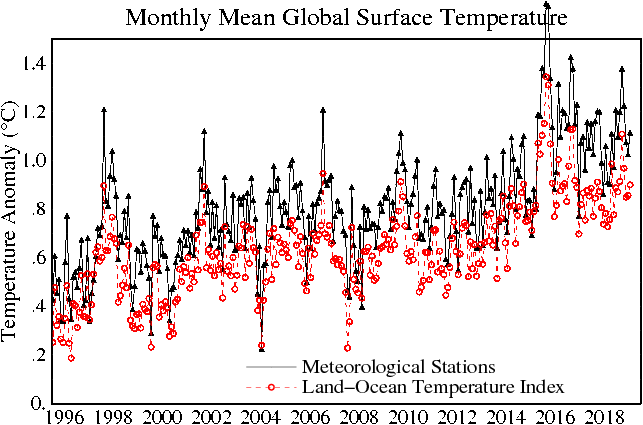
Monthly Mean Surface Temperature Anomaly – 1996 to Present
Annual Global Mean Temperature Anomaly Over Land & Sea – 1880 to Present

Annual Global Average Land and Ocean Temperature Anomaly – 1850 to 2012

Monthly Global Average Land Temperature – 1850 to Present

HadCRUT4 Global, Northern and Southern Hemispheric Temperature Anomalies

Ocean Temperature:
Global Sea Surface Temperature Anomaly – NCDC

Global Sea Surface Temperature Anomaly – HadSST2 and HadSST3

Global Sea Surface Temperature Anomaly – Monthly

Global Sea Surface Temperature

Global Sea Surface Temperature Animation – 30 Days Including 7 Day Forecast

Global Sea Surface Temperature – 3 Months – NOAA:
http://www.cpc.ncep.noaa.gov/products/analysis_monitoring/enso_update/gsstanim.gif
Global Sea Surface Temperature – 12 Months – Naval Research Laboratory (NRL):
http://www7320.nrlssc.navy.mil/GLBhycom1-12/navo/globalsst_nowcast_anim365d.gif
Custom Sea Surface Temperature Mapping Tool – from 1981 – NOAA:
http://www.cpc.ncep.noaa.gov/products/GODAS/mnth_movie.shtml
Equatorial Pacific Sea Surface Temperature – 30 Days Including 7 Day Forecast

Equatorial Pacific Sea Surface Temperature – NOAA – 3 Months:
http://www.cpc.ncep.noaa.gov/products/analysis_monitoring/enso_update/sstanim.gif
Equatorial Pacific Sea Surface Temperature Anomalies – BoM – 3 Months:
http://www.bom.gov.au/climate/enso/surface_anim.gif
Equatorial Pacific Sea Surface Temperature – 1 Year Including 7 Day Forecast:
http://www7320.nrlssc.navy.mil/GLBhycom1-12/navo/equpacsst_nowcast_anim365d.gif
Ocean Subsurface Temperature:
BoM Global Subsurface Average Temperature and Anomalies at 150 Meters:

BoM Global Subsurface Average Temperature and Anomalies at 400 Meters:

BoM Monthly Subsurface Pacific Ocean Equatorial Temperature Anomalies down to 400 Meters:

BoM 5 Day Subsurface Pacific Ocean Equatorial Temperature Means and Anomalies down to 500 Meters:

Global Ocean Heat Content – 0-700 Meters – 1955 to Present

Accumulated Cyclone Energy
Global Tropical Cyclone Accumulated Cyclone Energy – 1970 to Present

Northern Hemisphere Temperatures:
Northern Hemisphere Temperature Lower Troposphere (TLT) 1979 to Present

Northern Hemisphere Surface Temperatures

Northern Hemisphere Sea Surface Temperature

RSS Northern Polar Temperature Lower Troposphere (TLT) – 1979 to Present

Mean Temperature above 80°N

Southern Hemisphere Temperatures:
Southern Hemisphere Temperature Lower Troposphere (TLT) 1979 to Present

RSS Southern Polar Temperature Lower Troposphere (TLT) – 1979 to Present

Shortlink for this page, suitable for blog posts and Twitter feeds:
Source Guide:
Australian Bureau of Meteorology (BOM):
Home Page – http://www.bom.gov.au/
Climate Page – http://www.bom.gov.au/climate/
ENSO Page – http://www.bom.gov.au/climate/enso/
Center for Ocean-Atmospheric Prediction Studies (COAPS), Florida State University – Ryan N. Maue PhD – Environmental Prediction (NCEP) – Global Forecast System (GFS)
Home Page –http://www.coaps.fsu.edu/index.shtml
Products Page – http://www.coaps.fsu.edu/~maue/weather/
Data Page – http://www.coaps.fsu.edu/~maue/extreme/gfs/current/
Cryosphere Today – Arctic Climate Research at the University of Illinois:
Home Page – http://arctic.atmos.uiuc.edu/
Products Page – http://arctic.atmos.uiuc.edu/cryosphere/
Images Indexed By Date – http://arctic.atmos.uiuc.edu/cryosphere/IMAGES/
DrRoySpencer.com – Dr. Roy Spencer
Home Page – http://www.drroyspencer.com/
Current Temperature Page – http://www.drroyspencer.com/latest-global-temperatures/
Uploads Page – http://www.drroyspencer.com/wp-content/uploads/
Danish Meteorological Institute (DMI) – Centre for Ocean and Ice
http://ocean.dmi.dk/english/index.php
http://ocean.dmi.dk/arctic/index.uk.php
climate4you.com – Ole Humlum
Home Page –http://climate4you.com/
Ole Humlum Bibliography – http://climate4you.com/Text/BIBLIOGRAPHY%20OLE%20HUMLUM.pdf
Center for Ocean-Atmospheric Prediction Studies (COAPS), Florida State University – Ryan N. Maue PhD – Environmental Prediction (NCEP) – Global Forecast System (GFS)
Home Page –http://www.coaps.fsu.edu/index.shtml
Products Page – http://www.coaps.fsu.edu/~maue/weather/
Data Page – http://www.coaps.fsu.edu/~maue/extreme/gfs/current/
Met Office – Hadley Center
Home Page – http://www.metoffice.gov.uk/
Products Page – http://www.metoffice.gov.uk/hadobs/
Global Temperature Products Page – Products Page – http://www.metoffice.gov.uk/hadobs/hadcrut3/diagnostics/comparison.html
National Oceanic & Atmospheric Administration (NOAA) – Climate Prediction Center (CPC)
Home Page – http://www.cpc.ncep.noaa.gov/
Products Page – http://www.cpc.ncep.noaa.gov/products/
Monitoring and Data Products Page – http://www.cpc.ncep.noaa.gov/products/MD_index.shtml
Atmospheric & SST Indices Page – http://www.cpc.ncep.noaa.gov/data/indices/
Regional Climate Maps – http://www.cpc.ncep.noaa.gov/products/analysis_monitoring/regional_monitoring/
Monitoring and Data Page – http://www.cpc.ncep.noaa.gov/products/monitoring_and_data/
FTP Page – ftp://ftp.cpc.ncep.noaa.gov/
National Oceanic & Atmospheric Administration – (NOAA) – Environmental Modeling Center (EMC)
Home Pagehttp://www.emc.ncep.noaa.gov/
National Oceanic and Atmospheric Administration (NOAA) – Earth System Research Laboratory (ESRL)
Home Page – http://www.esrl.noaa.gov/
Physical Sciences Division (PSD) Products Page – http://www.esrl.noaa.gov/psd/products/
Physical Sciences Division (PSD) Data Data Page – http://www.esrl.noaa.gov/psd/data/
Physical Sciences Division (PSD) Data Maps Page – http://www.esrl.noaa.gov/psd/map/
National Aeronautics and Space Administration (NASA) Goddard Institute for Space Studies (GISS)
Home Page – http://data.giss.nasa.gov/gistemp/
Products – http://data.giss.nasa.gov/
National Oceanic and Atmospheric Administration (NOAA) – National Operational Hydrologic Remote Sensing Center (NOHRSC)
Home Page – http://www.nohrsc.noaa.gov/
Snow Analysis Page –http://www.nohrsc.noaa.gov/nsa/
Forecasts – http://www.nohrsc.noaa.gov/forecasts/
National Oceanic and Atmospheric Administration (NOAA) – National Ice Center (NATICE):
Home Page – http://www.natice.noaa.gov/mission.html?bandwidth=high
Products Page – http://www.natice.noaa.gov/products/products_on_demand.html?bandwidth=high
National Oceanic and Atmospheric Administration (NOAA) – National Climatic Data Center (NCDC)
Home Page – http://www.ncdc.noaa.gov/oa/about/about.html?bandwidth=high
Products Page – http://www.ncdc.noaa.govgov/oa/ncdc.html?bandwidth=high
FTP Page – http://www1.ncdc.noaa.gov/pub/data/cmb/?bandwidth=high
National Oceanic & Atmospheric Administration – (NOAA) – National Oceanographic Data Center (NODC)
Home Pagehttp://www.nodc.noaa.gov/
Products Page – http://www.nodc.noaa.gov/General/NODC-About/NODC-Major-Products.html
Data Page – http://www.nodc.noaa.gov/General/getdata.html
Heat Content Page – http://www.nodc.noaa.gov/OC5/3M_HEAT_CONTENT/
Naval Research Laboratory (NRL) Monterey Marine Meteorology Division
Home Page – http://www.nrlmry.navy.mil/
Products Page – http://www.nrlmry.navy.mil/proddemo.htm
Satellite Products Page- http://www.nrlmry.navy.mil/sat_products.html
NOGAPS Forcast Products Page – http://www.nrlmry.navy.mil/metoc/nogaps/NOGAPS_global_net.html
Data Page – http://www.nrlmry.navy.mil/archdat/
Multi-view – http://www.nrlmry.navy.mil/sat-bin/global.cgi
Navel Coasal Ocean Model – http://www7320.nrlssc.navy.mil/global_ncom/
FTP Page – http://www7320.nrlssc.navy.mil/global_ncom/Links/
FTP Page Global – http://www7320.nrlssc.navy.mil/global_ncom/Links/glb/
Remote Sensing Systems (RSS)
Home Page – http://ssmi.com/?bandwidth=high
MSU Page – http://ssmi.com/msu/msu_browse.html?bandwidth=high
MSU FTP Page – ftp://ftp.ssmi.com/msu/?bandwidth=high
FTP Page – ftp://ftp.ssmi.com/?bandwidth=high
Rutgers University – Global Snow Lab (GSL)
Home Page – http://climate.rutgers.edu/snowcover/index.php?bandwidth=high
Products Page – http://climate.rutgers.edu/snowcover/chart_seasonal.php?ui_set=eurasia&ui_season=1?bandwidth=high
University of Colorado at Boulder
Home Page – http://sealevel.colorado.edu/
Sea Level Calibration Page: http://sealevel.colorado.edu/content/calibration
Sea Level Release Notes Page: http://sealevel.colorado.edu/content/release-notes
Temperature Results Page – http://sealevel.colorado.edu/results.php
FTP Page – http://sealevel.colorado.edu/current/
University of East Anglia (UEA) – Climatic Research Unit (CRU)
Home Page – http://www.cru.uea.ac.uk/
Data Page – http://www.cru.uea.ac.uk/data
Additional Resources:
University of Alabama at Huntsville – Distributed Information Services for Climate and Ocean Products and Visualizations for Earth Research (DISCOVER) Project:
Home Page – http://discover.itsc.uah.edu/
Temperature Page – http://discover.itsc.uah.edu/amsutemps/amsutemps.html
Global Temp Page – http://discover.itsc.uah.edu/amsutemps/
Sea Surface Temperature Page – http://discover.itsc.uah.edu/amsutemps/execute.csh?amsutemps+001
Temperature 14,000 feet Page: – http://discover.itsc.uah.edu/amsutemps/execute.csh?amsutemps+002
Temperature 25,000 feet Page – http://discover.itsc.uah.edu/amsutemps/execute.csh?amsutemps+003
Temperature 36,000 feet Page: – http://discover.itsc.uah.edu/amsutemps/execute.csh?amsutemps+004
Temperature 46,000 feet Page – http://discover.itsc.uah.edu/amsutemps/execute.csh?amsutemps+005
Temperature 56,000 feet Page: – http://discover.itsc.uah.edu/amsutemps/execute.csh?amsutemps+006
Temperature 68,000 feet Page – http://discover.itsc.uah.edu/amsutemps/execute.csh?amsutemps+007
Temperature 82,000 feet Page: – http://discover.itsc.uah.edu/amsutemps/execute.csh?amsutemps+008
Temperature 102,000 feet Page – http://discover.itsc.uah.edu/amsutemps/execute.csh?amsutemps+009
Temperature 118,000 feet Page: – http://discover.itsc.uah.edu/amsutemps/execute.csh?amsutemps+010
Temperature 135,000 feet Page – http://discover.itsc.uah.edu/amsutemps/execute.csh?amsutemps+011
Thank you for making this compilation available.
Any time I see historical records that show the 1930s as cooler than today… I am skeptical.
EPA “Disappears” the 1930s Drought and Heat Wave Climate Data – Watts Up With That?
I also noticed the charts that didn’t have biased/adjusted ground station data conveniently start at the end of 1970’s cold period. Those Globull Warming Alarmists are tricky folks.
Maybe the graph in the “CRU Information Sheet no. 1: Global Temperature Record” (Dr. Phil Jones), at http://www.cru.uea.ac.uk/cru/info/warming/ should be included?
Thanks Anthony, great work!
The above gives a lot on nice information. I am a dabbler, not very knowledgeable, and I am usually only interested in the global results for a month or year(the numbers). The following URL’s are implicit or explicit above but some readers might find them helpful when gathered. These are the only ones I know of—please correct me if I have misinterpreted something or omitted some interdependent source.
1)Hadley Centre.
http://www.cru.uea.ac.uk/cru/data/temperature/hadcrut3gl.txt [gives monthly(first 12 columns) and yearly global(last column)]
http://www.cru.uea.ac.uk/cru/data/temperature/ [page with links to various Hadley Centre data sets]
2)GISS-NASA
http://data.giss.nasa.gov/gistemp/tabledata/GLB.Ts.txt [gives monthly and yearly results]
[explains at bottom how to go from “anomaly”to temperature at this site.]
3)RISS
ftp://ftp.ssmi.com/msu/monthly_time_series/rss_monthly_msu_amsu_channel_tlt_anomalies_land_and_ocean_v03_3.txt [gives monthly only(first column is ? global)—must average to get yearly]
ftp://ftp.remss.com/msu/monthly_time_series/ [page with links to various RISS monthly series]
4)UAH
http://vortex.nsstc.uah.edu/data/msu/t2lt/uahncdc.lt [gives monthly only(first column is global)—must average to get yearly]
http://www.drroyspencer.com/latest-global-temperatures/ [graph of above]
The Annual Global Average Land Temperature Anomaly – 1850 to Present, HADCRUT3, Land & Ocean, is at http://www.metoffice.gov.uk/hadobs/hadcrut3/diagnostics/global/nh+sh/annual_bar.png
Thanks for the kind words, but most of us ( Steve included) know where this is going ovleral the next 20-30 years. N America has been the warm heart of a cooling planet. For the record, I expect a weak to perhaps moderate el nino to evolve this summer into winter, and while that will push global temps up a bit, double la ninas followed by el ninos with a cold PDO means the break we had this year in N America is not likely to repeat next year. Europe is likely to have another severe stretch, which would make it 4 winters in a row year to deal with a cold extreme. While I officially have forecasted global temps , as measured by objective satellites, to return to the temps of the late 70s by 2030, I must confess that some of the more extreme forecasts due to solar cycle theory certainly have reason to have a seat at the table. The real shame is that we are now handcuffed by out of control warmingistas that have choked the lifeblood of our nations economy and find ourselves in a real bind as far as energy because of a ghost that never existed, and a reality that has a good chance of proving the opposite. Its amazing how many problems would be solved if we were just drilling without the paranoia about global warming. A more prosperous economy, less unemployment, more national security, and right on down the line. Years from now, people will marvel at how all this actually went on, perhaps with the same morbid fascination we look at what happened at Europe in the 30s. Tell a big enough lie loud enough , and people believe it
Well said – we are in total agreement. The big lie of CAGW is a global wealth redistribution scam.
Rushikesh Hi there,it’s now 2016-would you like to revise your statement here ? (from 2012)?
Jerry, Hi there, It’s now mid 2018, and Rushikesh can still stand by his assessment.
I have learn some excellent stuff here. Certainly value bookmarking for revisiting. I surprise how so much attempt you put to create the sort of fantastic informative website.
[Reply: Is this a legit comment? I don’t know, so I am letting it through. ~dbs, mod.]
The disconnect between Temperatures and CO2 is now stunningly obvious!
See http://www.colderside.com/Colderside/Temp_%26_CO2.html
Please take a look at years 2014, 2015, and 2016, now that the data is out.
Bruce, the disconnect still remains for previous datasets throughout earth’s history on CO2. However, Cosmic Ray Flux vs Temperature is still spot on.
Thank you rdr200 for the links. Everyone is so concerned with the anomalies that they forget to include the absolute temperatures, and you can’t create a mathematical climate model without knowing the absolute temperature!
WHERE CAN ONE GET ABSOLUTE TEMPERATURE? I once saw a chart of absolute temperature from the 1800s to present, but I cannot find it now. Can any one provide the link?
How about a chart for contiguous US temperatures, since that’s often in dispute? E.g., Bill McKibben recently claimed that 2012 would be the hottest temperature ever for the lower 48.
Often in dispute? Tony Heller has eviscerated NOAA’s work for the contiguous USA. Strangely, ‘experts’ such as NS contend that he is wrong, but no one has gone to his blog and demonstrated that he is wrong. I particularly like TH’s using newspapers from the 20s, 30s and 40s to validate the raw NOAA data, then he demonstrates how those temperatures have been ‘adjusted’ down to give us the ‘warmest ever’ story.
Thus I do not accept many of the graphs shown here to be valid. Certainly, any graph showing global temperatures before satellites is a fraud. There simply is no data behind those cartoons. No one had the oceans monitored by thermometers, ditto much of Africa, South America, the Arctic, and the Antarctic. When they have no data for 85% of the world, how dare scientists call it ‘global’ anomalies!
A more recent graph for the NOAA-NCDC database is at http://www.ncdc.noaa.gov/sotc/service/global/global-land-ocean-mntp-anom/201101-201112.png
It is linked from http://lwf.ncdc.noaa.gov/cmb-faq/anomalies.php
Roger Knights says: November 20, 2012 at 9:42 am
How about a chart for contiguous US temperatures, since that’s often in dispute? E.g., Bill McKibben recently claimed that 2012 would be the hottest temperature ever for the lower 48.
Should be covered on the WUWT US Climatic History Page:
http://wattsupwiththat.com/reference-pages/us-weather-climate-pages/us-climatic-history/
If there are any charts you’d like added to that page, please let us know.
Andres Valencia says: November 24, 2012 at 7:27 am
A more recent graph for the NOAA-NCDC database is at http://www.ncdc.noaa.gov/sotc/service/global/global-land-ocean-mntp-anom/201101-201112.png
It is linked from http://lwf.ncdc.noaa.gov/cmb-faq/anomalies.php
Updated, thank you.
Lots of charts not showing any longer. Some outdated. Same for the sea ice page.
A more recent graph for UAH Lower Atmosphere Temperature Anomalies – 1979 to Present is at http://www.drroyspencer.com/wp-content/uploads/UAH_LT_1979_thru_Jan_2013_v5.5.png
Andres Valencia says: February 18, 2013 at 8:39 am
A more recent graph for UAH Lower Atmosphere Temperature Anomalies – 1979 to Present is at http://www.drroyspencer.com/wp-content/uploads/UAH_LT_1979_thru_Jan_2013_v5.5.png
Updated, thanks.
Assumptions? Conclusions?
Very contrary to the plots on this page, there has been no net global warming for now relative to the 1940s, and that can be seen by looking closely at the *unadjusted* instrumental temperature data for the world, for the northern hemisphere, and for the southern hemisphere in the plots in http://wattsupwiththat.com/2013/05/17/an-analysis-of-night-time-cooling-based-on-ncdc-station-record-data/
That is in direct contradiction to plots from Hansen’s GISS, from the CRU of climategate (HadCRUT), and from the U.K. Met Office which has a level of bias and trustworthiness illustrated, for example, by what is discussed in http://wattsupwiththat.com/2013/06/14/12-reasons-why-the-met-office-is-alarmed/ . But those are all heavily *adjusted* data in contrast.
(Observe the total of three temperature plots here which extend as far back as 1940/before are two from the Met Office and one from the NOAA/NCDC; the rest are more recent decades alone).
The “Annual Global Mean Temperature Anomaly Over Land & Sea – 1880 to Present” graphic is no longer available from the NCDC. An equivalent graphic is at NCDC – Annual Global Land and Ocean Temperature Anomalies (1880-2013).
See http://www.ncdc.noaa.gov/cag/time-series/global/globe/land_ocean/13/1880-2013
With numerical data, but without the average line or error bars.
A copy of the original is available at http://www.ncdc.noaa.gov/sotc/service/global/global-land-ocean-mntp-anom/201101-201112.png
My 10 year old daughter just read an article in National Geographic Kids about global warming. ‘The world is getting warmer, daddy! See?’ She wouldn’t believe me when I said it wasn’t. I told her that data is more important than written words, and showed her this page as an explanation. We discussed how temperatures had increased but were now flat, and so when the article made the usual claims about the hottest temperatures being all in the last 10 years, we agreed it could be true but it still didn’t mean the world was still getting warmer.
She had no idea she could go online to see the actual numbers for herself, they don’t mention that sort of thing at school.
I don’t know if you ever find time to read these comments Anthony, but thank you and all at WUWT for being there and doing the work you do. It changes people.
Jonathan Abbott; When you and your daughter looked at these charts,did you notice that all of them show a warming?? Maybe you should listen to her…she could teach you something.(2016)
Yeah, show her 2014, 2015, & 2016 Global surface temps.
Jerry, maybe you could learn something by going to Tony Heller’s blog and looking at the thermometer coverage of the earth prior to satellites. There were essentially none for most of the earth. That makes your “teaching” moment a moment of propaganda bs. Maybe its better is to listen to Briffa’s trees: https://wattsupwiththat.com/2009/11/26/mcintyre-data-from-the-hide-the-decline/
The whole story of hiding the cooling(decline) is right there.. official “scientific” propaganda. It still goes on.
Jonathan Abbott says: July 23, 2013 at 12:59 pm
Thank you for your comment, it makes me think that it might be beneficial to craft some of our reference pages and articles to be more accessible to younger and less knowledgeable audiences. Any suggestions on how we might do so?
Show her this one
I like this one Mark, thank you….
Can you give me the link? And who took the data? Is it the same one that is taking data of the oceans’ temperature in current days? I get that some scientists can approximate the temperature, but at this point? And why would a scientist be more credible than another one?
Thank you in advance.
Are there any references for UAH and RSS temperatures by daytime hours and by night time to see the difference?
WUWT for Kids. I love that idea! I know we have some creative minds here, and most probably with children. How fun would that be for the family to browse kid friendly reference pages just for them.