Guest Post by Kevin Kilty
No planning is likely possible without calculations of what the future may hold, but such calculations are fraught with uncertainty when they also involve exponential processes. Indeed, as the author of one chapter in a recent book [1] states:
“One characteristic of an exponential growth process that humans find it really difficult to comprehend is how fast such a process actually is. Our daily experiences do not prepare us to judge such a process accurately, or to make sensible predictions.” [emphasis is mine.]
Quests to reveal a future governed by exponential processes, or what people guess to be exponential processes, run through many themes here at WUWT — future climate, energy demand, economics, epidemics. This guest contribution takes a selected look at exponential growth. Two examples are historical, and perhaps obscure, but pertinent. The third one, which comprises the bulk of this essay, is an examination of R0, which dominates the present imagination.
Failure on the Plains
Cattle arrived on the Northern Plains of the U.S. frontier first in the mid-1860s. The industry was infested with promoters, people with interests in railroads and such, who promoted using tales of how to get rich on the plains to Eastern and European investors. Some early investors made money selling to bigger cattle corporations. But the industry was based on cattle herds rather than titles to real property, and cattle counts were notoriously difficult to carry out. Thus, much of the promotion and accounting became based on “book” counts. These were not credible, but had the effect of a stampede to the plains financed by people who little understood the business or its risks.
Figure 1 shows an actual book count against a Fibonacci series representing a hypothetical rabbits.[2] The exponential behavior of the book count is obvious.

Figure 1.
The hard winter of 1886-1887, which was an instance of weather not climate change, wiped out many live cattle, but it wiped out many larger book counts. It provided an opportunity for the range managers to adjust plainly inaccurate inventories and save face at the same time. The story at the present day, for the few who know anything of the story at all, is of millions of cattle perishing in blizzards. It is much more acceptable to be bankrupted by weather than by foolish belief in an exponent.
Is there a modern equivalent? Well, the strangely smooth curve of Chinese deaths from COVID19 looks like one. It resembles a calculated curve with a certain goal in mind, rather than a measured curve with all the wiggles back and forth like the comparison curves from other countries.
Projection of Electric Energy Demand
Electric energy demand grew at an exponential rate after WWII, especially during the 1960s, when the grid expanded into every conceivable corner of North America, and new uses, such as the mercury vapor light, expanded into every conceivable market. The near perfect fit of geometrical growth of 7.13% per annum to electrical demand in 1960-1972 as Figure 2 shows, led to wild predictions of future demand and its consequences. A simple projection of constant geometrical growth (Figure 3) arrives at a staggering demand of 12 TWhr in year 2000, and one might be tempted to dismiss it. However, 1972 a workshop held at Cornell, sponsored by NSF, produced a “consensus” estimate of 10.25 TWhr, which is not much lower. [3] These estimates were driven by exponential growth in usage and population.

Figure 2.
What occurred in the 1970s was a constant drumbeat of future shortages, the decimation of free flowing rivers, the needed changes to society and the economy, the need for government mandates because government is the only institution big enough to deal with the crisis. Untold amounts of taxpayer and private money poured into schemes long forgotten (magnetohydrodynamics) or schemes that should have been (geothermal). The crisis prompted everyone to push their preferred hobby horse. Sounds familiar.

Figure 3.
What actually happened post 1970s? Actual electrical energy consumption never reached 40% of these projections. Figure 4 shows electric consumption to the present time along with the supply available from selected sources. Note the supply from petroleum. It provided a large source of electrical energy pre-1973. However, the two oil price shocks (1973 and 1979) had the effect of immediately putting a halt to the growing use of petroleum to generate electricity and diminished it each time.[4] People may not comprehend the speed of exponentials, but they respond quickly to prices.
More interesting still is that not only did demand not grow exponentially after 1972, but that post 2008 it hasn’t grown at all, as Figure 4 also shows. We appear to have reached a point where slowing economic growth has enabled innovation such as outsourcing, container ships, LED light bulbs and myriad other things to provide increased standard of living without use of more energy. Can it continue? Time will tell.

Figure 4.
Trajectory of a Pandemic
In times of crisis, real or imagined, people become fixated on certain technical measures or parameters of the problem, which become something like fetishes. The mean temperature of the Earth, the level of CO2, or its rate of production all play such a role in climate change. The parameter R0, the basic reproductive ratio, plays such a role in the present COVID19 crisis. Let’s explain what R0 describes, and what it has to do with some selected observations about the present pandemic.
What is R0?
The best way to explain R0 is through a simple model of an epidemic involving three populations: X, the population of people who are susceptible to a disease but who are presently not infected; Y, the population of infected (and infectious) people; and Z, the population who have recovered, and are not for the present time likely to fall back into population Y.
Many factors affect population X — births, deaths, migration, and so forth. However, over a short period of an epidemic we might consider only becoming infected and transitioning to population Y as having any pertinence. People often model the factor describing this transition as a term like -BXY. The product of populations (XY) indicates something about the probability of an X person encountering an infected one; B is a factor of transmissibility describing the probability that the encounter between an X and a Y results in X becoming infected.
It should be obvious that in the short term any person leaving the group of Xs does so by entering the Ys. So, the equation describing the rate of change of Y contains the term +BXY. However, the change of Y also depends on the rate at which the infected become well, and transition to the group of Zs — a rate we call U, and the rate at which infected people die and vanish from the model altogether — a rate we call V. Thus our differential equation for Y is
dY/dt = (BX – (U+V)) Y
Someone familiar with differential equations will recognize the factor (BX – (U+V)) as a sort of time constant; large BX tends to make this time constant positive, and results in a population of Y which grows exponentially; large (U+V) tends to push it toward negative values which would result in exponential decay.
People don’t like to deal with summations of factors in a time constant, and in the case of epidemics what people have done is to turn the time constant into a ratio, with those factors tending to make it positive in the numerator and those making it negative in the denominator.
The resulting definition is something like R0 = BX/(U+V) ref.[5]
There is a tendency, apparently even among the medical community, to think of R0 as a sort of time constant, but it is not. It is a dimensionless measure more akin to what engineers would call a figure of merit. There is also a tendency to think of it as intrinsically a function of the disease itself. It is not. Let’s discuss each factor in turn and explain what about each factor is important to the epidemic.
The factor B has to do not only with how easily a disease intrinsically jumps from person to person (like measles with a large value of B), but also has to do with cultural and social factors of the Xs. Touchy-feely sorts of societies will make B larger and push R0 to a value larger than 1.0; other societies have more intrinsic distance and push B toward smaller values. All sorts of strategies to increase social distance — lockdowns, isolation of the vulnerable, isolation of the infected and even disinfecting surfaces — seek to make B smaller in value.
X, the population of unaffected people, doesn’t necessarily include the entire population. There are people with intrinsic immunity to the disease. For example, Willis’s contribution from some time ago pointed out that on the Grand Princess not everyone who was exposed became infected. Perhaps only 20-40% did.[6] Obviously X depends on the age distribution and also on the distribution of other morbidities in a population. A common strategy to reduce X is immunization.
Factor U has to do with the virulence of the disease, but also has to do with population characteristics such as age distribution and other morbidities. Within my home state we have an unusually large fraction of the known infected who have recovered quickly. It suggests a lower R0 than places displaying long convalescent periods. Does this tell us anything valuable about COVID19, or does it simply reflect differences in various state departments of health making assessments of recovery? One strategy toward boosting U is to employ treatments such as what New York City is attempting with chloroquine.
What is important about R0?
R0 is not a constant. As a disease progresses through a population X becomes smaller and tends to push R0 to smaller values. Eventually it becomes small enough that R0 falls to a value less than one and the epidemic peters out. This is the principal factor that converts the initial exponential growth of an epidemic to a logistic sort of curve toward its conclusion. Also, just like example about energy, people change their behavior in a time of stress. They avoid other people, and improve hygiene — factors which improve B. Also, different ethnic groups and different parts of the U.S. will display different values of R0. These combined factors probably explain the wiggly behavior of the various graphs on the Daily Coronavirus Graph page.
Getting a handle on R0
Having an accurate estimate of R0, especially early in an epidemic cycle, would be very useful for public health policies. Here are the hurdles one has to clear to get an accurate value:
First, the most valuable estimate of R0 to get ahead of an epidemic is one made early in the epidemic. Without experience to draw upon a person has to use observations. The only population leading to a useful estimate of R0 is the infected, Y. We have no idea how this population is growing at present relative to X.
Second, I have commented elsewhere about individuals local to me who are not only included in the “cases” of two neighboring states (double counted), but who may have been placed within the data at the wrong time of exposure and infection. Early estimates of R0 are made when there are very few infected individuals. Such estimates are very sensitive to errors of observation. Observations placed erroneously too far along in the epidemic will have the effect of erroneously making R0 too large; while those placed erroneously too early will make R0 appear, erroneously, too small.
Because all of the factors involved in R0 keep changing with time, one has to keep collecting timely data for evaluation about effectiveness of strategies. Thus one is always presented with the problem of limited individuals who are pertinent, and then decisions about which individuals should be counted, and exactly where to place them in sequence. At no time does estimating R0 become simple.
Third, because R0 is not a time constant, but rather a dimensionless figure of merit, the pertinent observations for its estimate are of the growth generation to generation — that is, growth of Y in the chain of transmission from person to person. In my state public health officials estimate that more than 60% of the infected can explain where they were infected. However, this estimate has to be tempered with knowledge of how faulty people’s memories are.
One MD has spoken elsewhere about observations, such as the spread through the call center at Daegu, South Korea, which suggest an R0 well below 1.0. However much his number may pertain to the special case of this particular call center, the value of R0 cannot be below 1.0 generally. If it were, the plainly obvious growing epidemic across the U.S. at present would require an utterly improbable set of initial conditions.
Similarly, the large values of R0 (2.0 to 2.6) used by Neil Ferguson, along with estimates of generation duration and other parameters, propelled initial panic. One can tell from the press conferences that Dr. Fauci, Trump’s principal advisor, is still highly influenced by these early estimates.These were guesses, albeit educated ones. Apparently Ferguson is stepping back from these initial estimates. This is just my opinion, but it appears that we, across the Western world, were unprepared to gather the sort of data early to make valuable estimates of R0 at an actionable time — for example rather than daily counts of infections we need counts by generation of spread, and estimates of uncertainty. Estimates of deaths in Britain from 20,000 to 500,000 do nothing to aid in policy prescriptions.
Conclusion
There is no doubt that we will survive this pandemic, but at great cost. A famous quotation seems apropo:
“ If we are victorious in one more battle with the Romans, we shall be utterly ruined.”
Phyrric, 275 B.C.
After this crisis has passed we really need to have a sober evaluation of strategies versus outcome, and decide whether we might have done better. We should decide whether our goals were even sensible. Nic Lewis’s contribution is an example of sober analysis; so is Alec Rawls’s. We do not need a second such victory over exponents.
Notes:
[1] Philip Dutre, Thinking and Conscious Machines?, in “A Truly Golden Handbook”, Ed. by Veerle Achten, Geert Bouckaert, Erik Schokkaert, Leuven University Press, 2017.
[2] Dan Fulton, Failure on the Plains, Big Sky Books, Montana State University Press, 1982.
Throughout Fulton’s early chapters quotations refer to the book counts as “arithmetic progressions” when in fact they are geometrical. The book count data came from Robert Strahorn, one time superintendent of the Union Pacific Railroad.
[3] This projection, along with the projections of the Federal Power Commission and National Petroleum Council would be featured in Congressional testimony in May 1972 and in a companion paper in (Chapman, et. al., Science, v.78,p.703-708,1972) as Table 1. While the authors stated that these projections might prove too high, they emphasized that “…to the extent that past population growth rates continue, the projections of Table 1 are supported…”
[4] All electrical consumption data are from EIA spreadsheets.
[5] Martin Nowak, Evolutionary Dynamics, Belknap/Harvard Press, 2006. Nowak’s definition is not exactly like mine but is functionally the same.
[6] https://wattsupwiththat.com/2020/03/16/diamond-princess-mysteries/
Just some food for thought as you sit at your computer, likely sheltering:
The future is where the multiverse of infinite possibilities exist (not the past, as in many SciFi adventures) across the spectrum of probabilities. The present is the entropy-driven “meat grinder” of observation that reduces all of those possibilities to one single outcome. The past is then set, and it is immutable by the Law of Conservation of energy. Together, the Second Law and First Law of Thermodynamics form the arrow of time that we call the future, present, and past. We are all time travelers to the future.
In this regard, all of those exponential/log growth curves when applied to the future of some outcome, whether climate model projections or viral epidemics or the price of tulip bulbs, are just probabilities. And probabilities tied to educated guesses are still nothing more than guesses adjusted by the prognosticator’s own biases, whether they wish to acknowledge that or not.
Good and thoughtful comment.
Often, biases include something more nefarious than simple self interest.
Doomsayers make their living saying doom!
On somewhat more cheerful note without any of ‘the prognosticator’s own biases’ another SC25 sunspot came to view today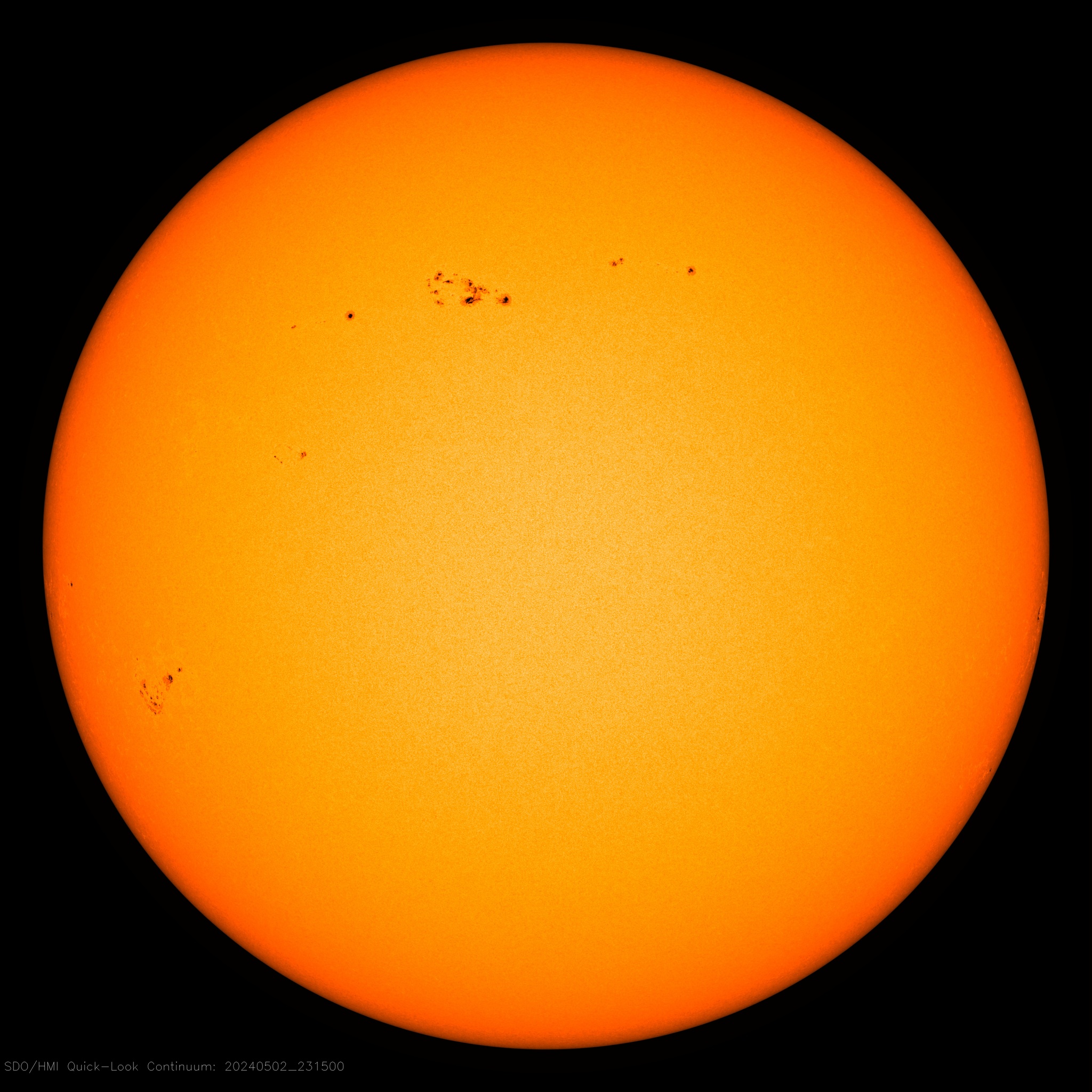
How is this year shaping up so far?
A kind of a “where’s Waldo?” type of sunspot.
as they would say in The Dirty Dozen … “Thats a pretty model you got there, can it fight ?”
every year the flu is given unfettered access to the planet (yes some countries have a shot but darn few use it)
and it dies out in 3 months … every year … the biggest driver of Ro is geography (which it can’t begin to factor in) … if the infected don’t move then the exponential growth can’t continue … and we don’t all live in the same town …
a virus could have an Ro of 10 today … lock everyone in their homes for 2 weeks and its zero …
or have a bad snowstorm for a week … same effect …
the Ro is a looking back measure with limited value looking forward …
“just because we can measure something doesn’t mean we can divine the future from it …”
as they say in my business … “your results may vary” consult a professional (using that term very loosely )
I wish everyone would look at the data. The actual data.
Italy, Spain, UK, Switzerland, Iran, the Netherlands, and more — In all these countries new bcaes peaked 4-7 days ago.
In many other countries new cases are FLAT, meaning the rate of new infections IS FALLING.
https://www.worldometers.info/coronavirus/#countries
click on each country and look at the real data
Most people and when I say most I mean ALMOST EVERYBODY — does not know anyone personally that has a confirmed COVID-19 infection, much less died.
There is a ridiculous youtube video of a “nurse” yeah right, in Mobile, Alabama talking about “people dropping left and right” or some such rubbish. There is 1 dead from/with covid in Mobile County alabama.
https://alpublichealth.maps.arcgis.com/apps/opsdashboard/index.html#/6d2771faa9da4a2786a509d82c8cf0f7
I couldn’t agree more about the data. If it’s a choice between computer models and data, I’ll choose data every time. It’s true for the pandemic and also for climate change.
The likes of CNN are calling America the epicentre of the pandemic, because it has the largest number of cases (about 188,000). But of course America has a large population. What really matters is the number of cases per head of population. On that measure America is fairly average.
There’s one irony from the data. Globally, the region with by far the highest number of cases per head of population is the Vatican City. Draw your own conclusions from that….
Sadly, hysteria seems to be just as contagious as the virus. Just as with climate change, there have been many exaggerated claims about future numbers of cases and deaths, some of which have already been shown to be hopelessly wrong. I distinctly remember a reporter saying that the number of cases in Wuhan alone coud be 100,000 by the end of that week. This was in January, just as the panic was starting. Of course, the actual number was a small fraction of 100, 000. In fact it took the entire world around two months to reach 100,000.
The EU data shows that, with the possible exception of Italy, the total number of deaths from all causes is significantly below the normal averages. I do wonder if the panic is worse than the actual problem.
I think it was a US president who said something like: we have nothing to fear but fear itself.
How very true.
Chris
“In God we trust, everybody else bring data.” – A sign at NASA in the Apollo days.
Fear is a motivator that sells. Usually, early damage projections are scary scenarios offered up to effect action.
We should be happy that “projections” are becoming more realistic and orders of magnitude less severe, except financially. We should be angry that truth is often the first casualty in these “crises” and in each the average person loses wealth, freedom and sometimes life itself.
I fear there is a lot more politics pushing this current pandemic than math and science. That Scares me the most.
Observe, here in the U.S., when we have reached the other side of this COVID19, how the politicians will posture and congratulate or blame one another and recall the old joke about covering the furniture with newspaper to keep the elephants away. The media will proclaim it worked.
What we have allowed these politicians, driven by media hysteria, to do is set a very dangerous precedent of stripping away major elements of our Bill of Rights on the premise that doing so saved lives. Trust me they will be quicker on the trigger at the next opportunity.
Freedom of assembly is sacrificed at the alter of this panic driven by a free press. And there will be far greater damage from this shutdown than the virus could have caused.
Seems to me if something needs to be sacrificed its the latter (Media) by adding a responsibility amendment to the Press and hold these panic makers accountable when they destroy lives needlessly for political purposes. Not just monetary but real jail time for intentionally creating hysteria.
I agree with you regarding and our loss of freedoms. It makes no sense that I can’t go sit by the ocean by myself. Can’t walk on nature trail, by myself. Can’t go fishing, by myself.
I’m currently (re) reading “1984” — going through my library to find material to keep me busy — and so many parallels to what is happening today, it is really disconcerting. Brilliant book though.
Bill Powers,
What you have rightly noted applies to the UK, also.
And here, our Secretary of State for Transport has started to talk about pushing the populace onto Public Transport.
Now Public Transport has its place – I commuted into London for almost a quarter of a century, using public transport.
But no car – no (real) freedom.
BBC report of Grant Shapps’ announcement [slipped out under Covid-19 cover] is now hard to find.
Beware.
Auto
“Observe, here in the U.S., when we have reached the other side of this COVID19, how the politicians will posture and congratulate or blame one another and recall the old joke about covering the furniture with newspaper to keep the elephants away. The media will proclaim it worked.”
The media will proclaim that Trump made it worse, no matter the outcome. That’s just a fact.
Fear is going to be a hurdle to getting the economy move again in places. Some of this fear will be warranted, but, based on what I have observed about people, much of it will be predicated on superstition. I see so many events which are scheduled far into the future being cancelled right now. Grandma’s marathon in Duluth, for example, is a huge event held on June 20 this year, nearly three months away. It’s cancelled. That will help dig an even bigger hole for area hotels and restaurants. If we have not tamped this down to near the vanishing point by June, with the present strategy of near quarantines and social distancing — then something isn’t quit right.
People are going to be fearful of contamination in the outdoors, when, in fact, sunlight ought to do a good job of disinfecting outdoors in a few hours or half a day.
One factor in events being cancelled so far ahead is the logistics tail behind them. Instabilities in the earlier part of that tail ripple through the entire thing, and can make it untenable.
The bigger the event, the bigger the logistics tail. (This also applies to industry; even if this tails off in the next couple of weeks, getting back to “normal” will be a long process.)
True. Good grief. Look at the auto industry.
Thanks Kevin. I found this an interesting analysis, although I had to read through it three times before I was reasonably sure I was following your logic. This is a suggestion, not a criticism, but if you had used more mnemonic letters in your equations, e.g. S for susceptible, I for infected, R for recovered, then I may have gotten by with two read-throughs.
re: “Futile Fussings – a history of graphical failure from cattle to #coronavirus”
LTCM et al
“The Crisis of Crowding: Quant Copycats, Ugly Models, and the New Crash Normal”
https://books.google.com/books?id=iJWG_X5SUHgC&pg=PT118&lpg=PT118&dq=LTCM+%22quants%22&source=bl&ots=mIs2LX_52G&sig=ACfU3U3eubgvSoQIpeEm-2VEuVVuB219Xw&hl=en&sa=X&ved=2ahUKEwiShsDen8XoAhVDlKwKHTdzCisQ6AEwA3oECAsQAQ#v=onepage&q=LTCM%20%22quants%22&f=false
Thank you. A sensible and pragmatic look at what’s transpiring. Some may say waiting for the outcome before knowing the proper approach to take is like closing the barn door after the cattle have left though. Weighing various solutions against their risks should be a priority we seem to be lacking in the case of #19.
My response to the barn door analogy is to ask, “What if the problem is a fire in the barn, but you don’t know that yet?” Obviously closing the barn door in that case is exactly the wrong thing to do.
The current ECDC case and death trends are linear not exponential.
most EU countries seem to be peaking in new daily cases now. John Hopkins U. data shows this a bit more than ECDC. Not clear where the differnce comes from.
Italy is beginning to descend , though the peak is 6k per day ! Spain around 8k. It’s taken about 30 days to get here from the 10 cases / day level.
That’s probably going to leave deaths equivalent of a bad flu year.
Bad flu years have never needed destruction of the economy and suspension of the fundamental liberties.
None of this messy poorly collated data is linear. If you mean the daily new cases is flattening off , yes, breaking out of the exponential growth phase. Noisy but leveling off. Italy is now reducing.
Yes in Italy, Spain, Germany, etc that would be a NEGATIVE LINEAR SLOPE.
As in — much ado about nothing — 20 Trillion in Wealth up in smoke (add up all the drops in the Stock exchanges and commodities exchanges world wide and challenge me on the number) — the S&P 500 index
lost 11 Trillion alone from its peak to today.
Absolutely a great explanation and summation. Thank you.
UK Covid-19 numbers have turned for worse. Tuesday update here:
http://www.vukcevic.co.uk/UK-COVID-19.htm
https://twitter.com/DefaultUserNa13/status/1244433584984928258
But the deaths lag the rate of infection by a couple of weeks, so this should be no surprise!
Vuk, as I pointed out to someone in another thread, the idea of taking the ratio of daily cases to daily deaths is misleading and ultimately pointless. That is NOT how you calculate a mortality figure.
You have two exponentially growing datasets: simplistically C=exp(c*t) and F=exp(f*t)
The ratio C/F = exp(c-f) , it is also exponential. Don’t be surprised or alarmed if C/F increases during initial explosive infection phase. It does not mean it’s becoming more deadly.
A one day spike in such messy data is not surprising either in view of the anarchic data collection methods used in UK.
The protective effect of the Channel means UK is late to the party, EU countries are already ( finally ) starting to peak. The UK herd is behind the curve.
Hi again Greg
I have taken a note of your comments now and on the previous occasions.
I use the UK government’s officially published data, which is the best available at the moment. There are shortcomings to the available data, but that may not be good enough reason to deprive the UK’s readers of this blog of an overview of situation as it is officially presented by their government. Alternatively, the readers would be left to search through various other sources, which may or may not be as comprehensive.
As always, for the readers better informed or those who may consider information provided of no use there is a simple choice to ignore the updates, which I provide here as a bit of a public service, however imperfect it may be.
Best wishes to everyone at this highly uncertain time.
Vuk, very interesting graph, indeed, but something is missing. Please, depict also the number of tests performed. If the number of test-positive individuals in relation to the number of tests performed remains constant then it means that the number of affected doesn’t really increase and there is no real epidemic and we all are victims of a fallacy.
Many writers have thought, and I think with good justification, that the winter of 1886 – 1887 was the death knell of the “Old West”, and of the Cowboy Era in general. For all the romanticism and attention we pay to that era, it was really quite brief ; 1865 – 1887. By 1890, the famous pronouncement was published, There was no more Frontier to be conquered. There were still some cowboys around, of course, but from that winter on, they were always in decline.
The Pony Express only lasted about a year and a half from April 1860, done in by the telegraph.
I grew up in an area that must have been nearly the end of the west. I knew a few old-timers who wore six guns, and rode horses 15 miles to town. Tom Horn was hanged in 1903. But you are probably correct that the wild west was a short period of modest lawlessness spawned by the Civil War — it lasted until its proponents were too decrepit to ride and shoot at the same.
Apparently Ferguson is stepping back from these initial estimates. This is just my opinion, but it appears that we, across the Western world, were unprepared to gather the sort of data early to make valuable estimates of R0 at an actionable time — for example rather than daily counts of infections we need counts by generation of spread, and estimates of uncertainty. Estimates of deaths in Britain from 20,000 to 500,000 do nothing to aid in policy prescriptions.
I think we need to set the record straight here. Neil Ferguson has not stepped back from anything. The Imperial College paper (March 16th) provides projections for several levels of intervention. It predicted 500k deaths if no mitigating action was take. From the paper
The paper then gave predictions for different intervention strategies. Initially, Ferguson advised the UK government to adopt a relatively light touch strategy but as more data became available he realised that the virus was spreading faster than he predicted. This is from a recent Ferguson tweet
I’ve read elsewhere that Ferguson thinks that the initial R0 value in the UK was 3.0. So to summarise
(a) Ferguson’s 510k figure relates to a ‘Do Nothing’ policy. (b) Ferguson is predicting 20k death toll based on current UK policy. The paper can be found in the link.
https://www.imperial.ac.uk/media/imperial-college/medicine/sph/ide/gida-fellowships/Imperial-College-COVID19-NPI-modelling-16-03-2020.pdf
I had to spend a good deal of time in a “Zoom” meeting with a group of Senior Design students, but now I am back with a response to your “set the record” straight comment. I am not particularly interested in starting a fight over Ferguson’s numbers, but one ought to be able to point out some failures to communicate here.
First, No one has ever spoken of doing nothing, so I don’t know why that option was included. Ferguson is presumably sophisticated enough about the press to have known how the press would responded a sensational number.
Second, all this work was done with the objective of minimizing mortality. Ferguson also speaks of 18 months to two years of these efforts, either continuously or in fits and starts. In view of this schedule, one might have opted for an optimum of minimization constrained by such things as keeping the economy functional. After all the medical community cannot function in the absence of the economy. Moreover, government is likely to get use to a control and command economy over that period of time — where will that reach?
Third, the whole effort was couched in numbers of deaths. A long time ago Wiiliam Inman (Risk: Manmade Hazards to Man, Oxford U. Press, 1985) wrote about the unhelpful trend in official judgments both in the U.S. and U.K. that focus on numbers rather than risks. He quoted from a Richard Dimbleby lecture of 1978, Lord Rothschild stating that risk should be stated in straight forward terms such as 1 in 1000 or some such, and also be told the timescale over which this risk pertains. If not, the pronouncement should be ignored. Ferguson really doesn’t do so in a straight forward manner.
Finally, we have lots of numbers without error bounds. Ferguson speaks of the results being “robust to uncertainties”, but elsewhere points out the large uncertainties in factors of transmission.
I am going to maintain that this did not so much good as you apparently, and Ferguson seem to think.
I would agree and also point out that death rate is always 100% in the end. The question is how many years of life or years of healthy life are lost by the action of a specific factor. If cancer and cardiovascular diseases are the most common listed cause of death they seem the most important to reduce. If however you find that road traffic accidents and trauma have a much larger disproportionate influence on the young – thus higher years of life lost, then that might deserve much more attention. CoVID leans towards lower years of life lost per death because it is more pathogenic in the elderly and more benign in the young. This is not a cold blooded calculation. Personally I would rather die of CoVID at age 70 than have died at 18 in a roll-over.
First, No one has ever spoken of doing nothing, so I don’t know why that option was included.
Actually quite a few commentators have suggested we should effectively do nothing. That aside, it’s not unusual to provide the default worst case scenario and work to reduce the effect from there. This allows policymakers to choose the most appropriate “trade off” option.
I am going to maintain that this did not so much good as you apparently, and Ferguson seem to think.
I don’t think anything. I’m simply pointing out that all scenarios were covered in the paper and that Ferguson has not stepped back from them. The 500k & 20k figures refer to different scenarios.
Reading your post again you say “Ferguson is stepping back from these initial estimates” which appears to relate to the range of R0 values used in the modelling. These seem perfectly reasonable estimates and rather than “step back” from them Ferguson believes the initial R0 estimate should have been closer to 3.
Is the modelling correct? I don’t know but I suspect it was under-estimating rather than over-estimating the problem which is why there was a sharp change in strategy a week or so back.
OK, I’m going to admit I wasn’t accurate on this one point, but we have never turned entire economies over to MDs to run, they have the wrong mindset in my opinion to balance all interests. I think it will turn out badly.
I don’t disagree with with most of your post but the “Ferguson backtracked” narrative is being widely used and it just so happened that this was my first opportunity to comment fully on it.
I apologise if I came across as too aggressive. I’ve often read your WUWT contributions and generally find them interesting. It was just that this one point had been niggling me for days.
FWIW, like you, I’m not sure we’re doing the ‘right’ thing. However, my interpretation of the evolution of UK policy is that they were hoping to manage the epidemic rather than suppress it thus allowing the economy to run as normally as possible. Ferguson’s group then analysed most recent data and decided our healthcare (NHS) system would be overwhelmed unless further restrictions were imposed.
The point being made was Ferguson was not back tracking. What happened was media were snatching the “could be as much as” figure as they always do get the most dramatic headlines. Climate change redux.
Ferguson’s figures have not changed.
He many have naively or deliberately played to media hysteria or “communicated poorly”. He was probably trying to counter the ‘herd immunity’ strategy.
I see that, but the first time I read that report (there was a link posted on another site I frequent) I just became sick of all the graphs with numbers expressing exactitude. Then after John posted a link to the report, and I read it a second time, I just became more steamed still. It is a report designed in the worst possible way to communicate to the public and the media. And on second reading I noticed small things here and there. For example, Ferguson seems to suggest that over the next two years we can remain in the economic coma, or that somehow we can go in and out of it. I don’t see that any such thing is possible. Can you imagine going through this again next year.
Also, not noted by anyone I suppose, Ferguson suggests that banning large gatherings has little effect, and that this virus is unlikely to be in the mix for the cold season next winter. The evidence for both are pretty sketchy though.
“Things seemed more ominous by early July. On July 9, The Seattle Times reported that the influenza in Spain had “spread over other parts of Europe” (“A Puzzling Epidemic”). On July 28 the newspaper noted that Camp Lewis had 327 cases of flu, but a week later the number had fallen to below 100. As late as mid-August there were reassuring reports that the count of flu cases at the army base continued to decrease, and no indication of any special concern. Even into September, the general mood was one of confidence. An optimistic commentator enthused, “It is a marvel, due to the perfection of our medical science, that there has been no widespread epidemic this summer of a more serious character than ‘flu,’ as the Spanish influenza and other allied fevers are called” (“Heavy Rain and Mud … “).”
https://www.historylink.org/File/20300
Interesting and timely posting, Kevin. Your introduction of the phrase “touchy-feely sorts of societies…” is the wild card in this pandemic. That is, touchy-feely tendencies, population density, and onset of social spacing demands (the ultimate of which is quarantine) seems to be visible in the pandemic statistics, age of population, state of medical availability, etc, notwithstanding. Consider Japan, a high population density but a low touchy-feely culture, and at low infection rates, against Italy and Spain, at moderate population density but high touchy-feely culture and at high infection rates. I live in Argentina, a high touchy-feely culture but a very early enactment of quarantine, and now at low infection rates. There are a lot of additional variables, some of which are at least locally very important, but the view presented is that stop touching each other, especially their and your face, and it will help flatten out this pandemic more quickly.
Look at the Johns Hopkins COVID-19 resource page (https://coronavirus.jhu.edu/map.html ) mapping and graphing worldwide cases. What stands out? China, the source of the virus, is the only nation in the world showing no rapid increase or even stabilization, and most Chinese cases are reported as recovered. China, communist government or not, has no ability to completely stop the spread of the virus, especially since it is reported to have appeared in practically every Chinese province. This leaves at least three logical alternatives, (1) the Chinese are lying and it is massively taking over the country, (2) they have quit even trying to test or monitor the virus spread and are accepting it as just one more virus in the consortium, or (3) the virus quickly burned itself out on its own. Whatever the case, the Chinese data are a massive outlier.
Some cases, like some doctors and journalists just disappear in China.
Thanks PFlash and Capt Obvious,
“the Chinese data are a massive outlier”. It was so big, I didn’t notice it. Sincerely.
First thing to note in China data is that they changed the reporting method about half way down the recovery slope ( look at daily cases ). That needs scaling by 1.6 to make it roughly compatible. They were very clear in announcing that the day it happened. European data has jumps peaks and holes with not explanation and UK data collection is total anarchy. The chinese by comparison were very well organised, as were S.K.
China DID have an exponential growth period. The only remarkable feature is that daily cases went fairly abruptly from rise to decay without even a few days of plateau. I find that curious.
But then, so did S. Korea and we don’t need to accuse them of being communist of disappearing doctors.
The “outlier” is S.K. which rose fast and decayed fast. They went through the whole cycle notably faster than PRC and avoided totally screwing their own economy.
They are still on an exponential rise if you look at the graph. It looked like they would go into decay, but their graph has gained a respectable slope to it.
The Chinese government has admitted it hasn’t been counting asymptomatic COVID-19 cases but will from today.
That’s nice.
I wonder if the New Deaths data is as “reliable” ?
The chinese data is useful for 1 thing. and to understand that 1 thing you need to look
at individual city data. Do you know what that 1 thing is?
prolly not. Think
Also, expect china numbers to Jump tomorrow as they will start to include asymptomatic cases
There you go again, trying to seem smarter than everyone else. We’re tired of your riddles. Say it and be done with it.
Did they already have a vaccine before they intentionally unleashed it on the rest of the world? Could be a form of biological warfare with not a shot fired.
…I have used some of my day trying to falsify the theory, initially thought of by Australian scientists that the number of bad Covid-19 cases leading to casualties is related to the individual country’s
Calmette vaccine program. In Europe , but also in 3. world countries, there seem to be strong correlation.
https://www.ncbi.nlm.nih.gov/pmc/articles/PMC3062527/
China should , as I understand , have been vaccinating a large proportion of the rural population – but not necessarily all the people living in cities with no or few tuberculosis problems. Wuhan could be such an area?
Anyway – US , Italy , Nederland’s and Belgium – have never adopted such a vaccine program – take a look at their graphs now-
https://wattsupwiththat.com/daily-coronavirus-covid-19-data-graph-page/
Germany and Norway kept on their programs for the longest time. Look at theirs.
India started out long before UK – where the program first started in 1953. Look at India now – nearly not a single reported casualty among 1.2 billion people.
If this is a weapon – and the above is true – it is targeted right at the United States.
Very interesting. If one looks at the flu pandemics of the 20th century one sees the same factors in play here. There is always a strong interaction among age, other morbidities, and opportunistic infections such as bacterial pneumonia.
Have you reliable data regarding the Calmette program for all affected countries?
…no – only what google and the internet is telling me – and I haven’t found one country that doesn’t fit the Calmette explanation except from Spain.
But civil war/ ww2 and Franco – I don’t believe their Calmette story to be true. Look at neighbours Portugal – No Covid problems.
. And the strange neighbour numbers continues.. Nederlands is NOT Italy – culturally or otherwise. Much more close to Germany in all aspects – but the Covid numbers does not match.
Denmark and Sweden – to completely different Covid strategies – but the numbers are nearly the same. Same Calmette programme.
The weapon explanation is far-fetched – I agree – but giving the recent tension between China and US – it is a strange coincidence.
re: “If this is a weapon – and the above is true – it is targeted right at the United States.”
Title: The Comprehensive Timeline of China’s COVID-19 Lies
By Jim Geraghty
March 23, 2020 9:13 AM
The story of the coronavirus pandemic is still being written. But at this early date, we can see all kinds of moments where different decisions could have lessened the severity of the outbreak we are currently enduring. You have probably heard variations of: “Chinese authorities denied that the virus could be transferred from human to human until it was too late.” What you have probably not heard is how emphatically, loudly, and repeatedly the Chinese government insisted human transmission was impossible, long after doctors in Wuhan had concluded human transmission was ongoing — and how the World Health Organization assented to that conclusion, despite the suspicions of other outside health experts.
Clearly, the U.S. government’s response to this threat was not nearly robust enough, and not enacted anywhere near quickly enough. Most European governments weren’t prepared either. Few governments around the world were or are prepared for the scale of the danger. We can only wonder whether accurate and timely information from China would have altered the way the U.S. government, the American people, and the world prepared for the oncoming danger of infection.
Some point in late 2019: The coronavirus jumps from some animal species to a human being. The best guess at this point is that it happened at a Chinese “wet market.”
December 6: According to a study in The Lancet, the symptom onset date of the first patient identified was “Dec 1, 2019 . . . 5 days after illness onset, his wife, a 53-year-old woman who had no known history of exposure to the market, also presented with pneumonia and was hospitalized in the isolation ward.” In other words, as early as the second week of December, Wuhan doctors were finding cases that indicated the virus was spreading from one human to another.
December 21: Wuhan doctors begin to notice …
MORE – see link above
Heh. Link – https://www.nationalreview.com/the-morning-jolt/chinas-devastating-lies/
Did it “jump” or was it pushed?
Why the total silence about the P4 biotech lab within 200m of the said market. This new “state of the art lab” had been build in collaboration with the Louis Pasteur Institute and with a sizeable investment from the french government. They are not crowing quite so loud about this cooperative effort this year.
Labs are constantly working on “novel” viruses and it is quite likely they would be using animals from the wet market for source material. Especially bats which are a known reservoir of viruses.
It was not “aimed” at anyone, you don’t test A-bombs by dropping them on one of you major cities and transport hubs. It very likely was an accidental leak.
That is much simpler than contorted and improbably bat ( well not bat but bats then pangolin ) multi-species jumping viruses.
That is just a rewrite of the Africans eating monkeys story for the AIDS virus. It relies on our eagerness to attack other cultures eating habits blinding us to the total improbability of the story.
re: “Did it “jump” or was it pushed?”
Did we go over “open crotch pants” (as used by the Chinese on their young kids in lieu of diapers) on this board or was it another?
Do you want I should go down this road further?
re: “Did it “jump” or was it pushed?”
Been over this before … see: https://wattsupwiththat.com/2020/02/27/cdc-covid-19-possible-us-case-of-chinese-corona-virus-from-an-unknown-source/#comment-2928578
Repeating:
In the category of cold, hard reality, and NSFW –
From https://regiehammblog.wordpress.com/2020/02/27/birth-of-a-virus/
“Regie’s Blog – BIRTH OF A VIRUS”
As I watched my neighbor put her dog’s poop in a single-use plastic baggy, I thought about split pants in China.
When my wife and I got off the plane, 18 years ago, to adopt our first daughter, we were taken aback by the split pants. Split pants are (or at least were, back then) pants the children wear that are open in the crotch area. That allows them to … [use your imagination -_Jim]
Either way, I distinctly remember my brand new Nike slip-ons (probably made not far from where I was standing) sloshing into a mix of urine and who knows what else, and continuing to do so for the next three weeks.
As I started feeling the cough coming on, I remember one of the women in our group saying, at one of the airports (as she too, stepped into urine) “The people in this country probably have built up antibodies inside them our bodies have never even thought about.”
Read the rest at the link above.
re: “It was not “aimed” at anyone, ”
Not my words; You aren’t addressing me. Perhaps a previous poster and ‘stimulus generalization’ kicked in, in which case please read a little closer, for comprehension, and attribution.
re: “Did it “jump” or was it pushed? ”
Or, maybe you did not catch this some time back; in which case you are not as well-informed as assumed:
from: https://wattsupwiththat.com/2020/03/20/wuhan-coronavirus-therapies-scientific-background/#comment-2944976
The genetic data I have seen (Figure 1 in: Andersen et al. 2020. The proximal origin of SARS-CoV-2. Nature Medicine preprint: 20 March 2020. https://doi.org/10.1038/s41591-020-0820-9) seems to indicate transferred to humans from bats via pangolin.
https://doi.org/10.1038/s41591-020-0820-9
.
What on Earth has that got to do with what you quoted?
You are promoting the “devastating lies” article. Which starts by accepting the fundamental devastating lie. If there was a bio leak that would explain their keenness to smoother the story.
If there was a new strain of flu ( or even an existing starting a new outbreak ) why would they not want to get on top of it as quickly as possible.
Apart from the fun aspect of calling the Chinese “lying commies” there’s no point to that article.
If US is totally unprepared four months after the initial outbreak you should be asking why. You were warned by events in China, you were warned by the fiasco in Europe.
Maybe the devastating lies are not where you think they are.
re: “What on Earth has that got to do with what you quoted? ”
Must be a gross misunderstanding on your part. That’s all I can figure, or a misplaced burr in the saddle. You tell me. The article is rather straight forward … did you read it or no?
Australia started selective BCG vaccination of healthcare workers from 1948. It was introduced to schools, except NSW and ACT, in the 1950s and continued until the mid 1980s.
That means a significant number of aged Australians would have had BCG vaccination – me included.
It was recommended for any Australian travelling to countries with high rates of TB.
The most obvious difference in Germany is that they have a well funded well equipt health service and are able to do much more testing than any other EU country.
All the other european countries with massive problems had under funded care services and sat on their hands until their pants were on fire. We all had fully 2 months notice but no one started “emergency” preparations and trying to build thousands of ventilators over night, until their A&Es were busting at the seams.
Italy did nothing to shut off communication with China despite 300,000 chinese to-ing and fro-ing with Lombardy and Wuhan. EU countries ( with the exception of Austria ) refused to close the border with basket case Italy even when people could not move within Italy.
Don’t look for complicated explanations where there are obvious ones.
…one of Denmarks leading virologist’ has just estimated R0 in Denmark to 1.1 – giving a lot of credit to strategy and the danish populations compliance to guidelines.
I don’t believe it. There must be something else driving ‘the explosions’ we are seeing around the wold – other than hand washing.
It would have been about 1958 when I had BCG (Calmette) in India. Having spent my youth there, I would not put a great deal of weight on their estimates of mortality. When I was a kid, any inconvenient death in villages was reported as “snake bite”.
🙂
By the way, anytime pundits, pols or pseudo scientists start projecting using that “magical” exponential curve, my defenses go up instantly. Many things appear to fit an exponential curve in the short term, but almost nothing in nature turns out that way. As the author here stated, reality and data always beat extrapolations (projections; predictions) that are based on exponential curve fitting.
https://youtu.be/dTRKCXC0JFg
“I’ll take #1 for a BILLION dollars, Alex”.
Poor old Pyrrhus, why couldn’t his parents stick with something simple like Pete?
My first job after grad school in 1972 was as a load forecaster for a medium sized electric utility. The company was hurtling into one of the most ambtious generation expansion plans in the U.S. Executives recognized that perhaps a straight line extrapolation of recent growth on semilog paper, yep, 7% forever, may need to be bolstered with econometric modelling. Enter the cool econometrician in bell bottom pants to develop a supporting forecast with a more modern tool for upcoming licensing hearings. Well, my simple models required us to contemplate future population growth, income, electric price, competing natural gas price, etc. Executives were not happy that my results came in considerably lower than 7%. I quickly learned a hard lesson that trying to convince executives to change their plans was a career limiting exercise.
A minor correction to an otherwise excellent article: it’s King Pyrrhus of Epirus after whom the pyrrhic victory is named.
Good gravy. Cut and paste to avoid a misspelling, and the source is faulty. Thanks.
The whole debate rests on definitions of cause of death. If Spain and Italy both have 8% death rates how come Germany has only 1%? The former register any cause of death as Covid if the patient tested positive and the latter register those who directly died of Covid.
If the Chinese use the German interpretation they aren’t lying.
Furthermore the UK currently only has 163 serious or critical cases. The rest are classified as mild.
“This virus communicates like nothing else that we have seen,” Cuomo told MSNBC late Monday. “This is like a fire through dry grass with a strong wind behind it. New York is just the test case for this. We’re the canary in the coal mine. There’s nothing unique about New Yorkers’ immune system. There is no American who is immune from the virus.”
What an idiot
Yeah, half the developed world has already got this and he talks about being the canary.
I suspect there will something unique about NYers immune systems but it is unlikely to a positive. In a country where heart disease hyper tension and obesity are also “epidemic” the comorbidities may not play out well.
But I’m sure his brother will get the best care money can buy.
The co-morbidities are what really concern me. A large percentage of America is really not that healthy. I hope chlorquine + zinc can keep them from going over the edge.
The third one, which comprises the bulk of this essay, is an examination of R0…
https://en.wikipedia.org/wiki/Basic_reproduction_number
Interesting. Thanks for the link. Maybe it’s just my age, but I tend not to think about looking at Wikipedia, even though, when I have, I find it’s a good source if the subject doesn’t involve politics..
I posted that, because I had to look up what “RO” was. I found out it was “R0” akin to patient zero. I have no idea why people post obscure acronyms and abbreviations as if it’s common knowledge as to what they are or mean when it is not.
It’s either laziness or they think it makes them look smart.
Hyper-politicization of climate science is now being matched by a similar reaction to this flu pandemic.
The 2009 Swine-Flu epidemic killed almost 13,000 Americans, but no shut down of the country. That epidemic weighed heavily on children…too young and innocent to realize the threat to them. This Wuhan virus has a predilection for adults who are most aware and sensitive to the threat to their lives, and are obviously willing to do anything to protect themselves. This imbalance brings to mind Orwell’s Animal Farm: “All animals are equal, but some animals are more equal than others.”
For an up to date, wide ranging, and relevant chat between two virologists, one of whom is now a Covid-19 patient this is a good listen (you get to hear his coughing and wheezing, but it doesn’t distract.)
David Suzuki is always blathering on about exponential growth. Apparently he thinks everyone else is as innumerate as he is.
I have a question for him. How come the world isn’t buried five hundred feet deep in fruit flies?
He’s worried about runaway population growth. I have another question. How do you stop a population from over breeding? One answer: You make them prosperous. Runaway population growth is a non-problem that would solve itself anyway. Unlike rabbits and coyotes, people and cultures learn and adapt their behavior to changing conditions. Example: the western European marriage pattern
The most effective way to slow population growth is to educate young women. They then have the choice what they do with their bodies. Most choose not to be prolific breeders.
re: “The most effective way to slow population growth is to educate young women. They then have the choice what they do with their bodies. Most choose not to be prolific breeders.”
The movie “Idiocracy” is your guide there, and, also highlights the problem with that approach (b/c, we will not* go the forced sterilization route of, well, how do I say “under-classes”).
.
.
* not going into the moral ramifications of limiting procreation here on WUWT.
This is a strawman argument. Epidemics indeed an exponential function but the exponent is negative:
Y = e ** -f()t
This is the family of exponential functions that includes the normal distribution. It generates an s-shaped curve that is asymptotic to the some proportion of the population. Normalize it and you get a cummulative probability distribution. It is not an unbounded function.
if you don’t define -f()t it does not mean anything.
Normal or gaussian bell is not S shaped.
If you want CFD you need to integrate it.