I am a petroleum geologist/geophysicist with about 36 years of experience in oil & gas exploration mostly in the Gulf of Mexico. In light of Andy May’s recent post, Oil – Will we run out?, I thought I might post an essay on oil formation.
Over the past six years, I have been fortunate to have the opportunity to write guest posts for Watts Up With That thanks to Anthony Watts. Many of my posts have been about issues related to oil production and each of these posts usually triggers comments from Abiogenic Oil advocates. So, this post’s main thrust will be to explain why the Abiogenic Oil hypothesis is not widely accepted and why we think that the original source of crude oil is organic matter.
It’s possible that oil forms in the mantle all the time. The chemical equations can be balanced. So, as an olive branch to Abiogenic Oil aficionados, I will unequivocally state that their favored hypothesis is not impossible.
Biogenic vs abiogenic is really a poor way to characterize the issue. It implies that the formation of crude oil is either a biological or non-biological process. The process is thermogenic. The original source material is considered to be of organic origin because all of the evidence supports this.
The Generally Accepted Theory for Hydrocarbon Formation
I’m not going to go into a lot of detail on this. OffshoreEngineering.com has a very good basic primer here.
The basic steps are:
Algae, plankton and other marine and lacustrine photosynthesizers die and sink to the bottom of the ocean.
They are buried in mud under anoxic conditions.
As more sediment is deposited, they are buried deeper.
The geothermal gradient gradually raises the temperature of the buried critters.
Diagenesis and catagenesis lead to the formation of kerogen, then oil, then wet gas.
Metagenesis leads to the formation of dry gas and then high temperature methane.
The depth scale is generalized. It can vary a great deal depending on the nature of the overburden. http://www.offshoreengineering.com/oil-and-gas/petroleum-geology/1-hydrocarbon-formation
Or the old Conoco commercial which showed a Vibroseis crew hunting for a buried dinosaur, this has never been the theory of hydrocarbon formation.
Methane and Other Simple Hydrocarbons vs Crude Oil
What is a Hydrocarbon?
hydrocarbon
1. n. [Geology]
A naturally occurring organic compound comprising hydrogen and carbon. Hydrocarbons can be as simple as methane [CH4], but many are highly complex molecules, and can occur as gases, liquids or solids. The molecules can have the shape of chains, branching chains, rings or other structures. Petroleum is a complex mixture of hydrocarbons. The most common hydrocarbons are natural gas, oil and coal.
It’s important to note that “organic” doesn’t necessarily mean “related to life,” although it usually is.
Organic chemistry is the chemistry discipline that is concerned with the study of compounds containing carbon that is chemically bonded to hydrogen. Organic chemistry encompasses the synthesis, identification, modeling, and chemical reactions of such compounds.
Methane, ethane and other alkanes, alkenes, alkynes, cycloalkanes and alkadienes are simple hydrocarbons. Inorganically sourced methane is massively abundant on Earth and elsewhere in our Solar System and probably throughout our Galaxy. Other simple hydrocarbons are also often associated with inorganically sourced methane, usually in trace quantities.
The Saturnian moon, Titan, has seas of liquid methane and there is evidence of polycyclic aromatic hydrocarbons (PAHs) in Titan’s atmosphere. PAH’s are pollutants that occur naturally in crude oil and coal deposits and as the result of burning of carbon-based fuels.
The fact that Titan’s methane-rich atmosphere can generate PAH’s and trace amounts of heavier hydrocarbons has no relevancy to how petroleum and natural gas liquids form on Earth. Even if it was relevant to the formation of petroleum, it would be totally irrelevant to how oil and gas accumulate in the Earth’s crust.
Methane and simple hydrocarbons are not even remotely close to crude oil.
There’s a fairly standard litany of Abiogenic Oil “evidence.” I am sure that the following does not cover all of the erroneous “evidence.”
Dniepr–Donets Basin, Ukraine
This is usually cited as proof of Abiogneic Oil because some Russians said there were no source rocks.
Palaeozoic source rocks in the Dniepr–Donets Basin, Ukraine
Reinhard F. Sachsenhofer, Viacheslav A. Shymanovskyy, Achim Bechtel, Reinhard Gratzer, Brian Horsfield, Doris Reischenbacher
DOI: 10.1144/1354-079309-032 Published on November 2010, First Published on October 20, 2010
ArticleFiguresInfo & Metrics PDF
Abstract
ABSTRACT The Dniepr–Donets Basin (DDB) is a major petroleum province in Eastern Europe. In order to understand the regional and stratigraphic distribution of source rocks for the dominantly gas-prone petroleum system, 676 fine-grained rocks from 30 wells were analysed for bulk parameters (total organic carbon (TOC), carbonate, sulphur, RockEval). A subset of samples was selected for maceral and biomarker analysis, pyrolysis-gas chromatography and kinetic investigations. Organic-rich sediments occur in different intervals within the basin fill. Maximum TOC contents (5.0 ± 1.9%) occur in the Rudov Beds, several tens of metres thick. The oil-prone rocks (Type III–II kerogen) were deposited in basinal settings above an unconformity separating Lower and Upper Visean sections. While maximum TOC contents occur in the Rudov Beds, high TOC contents are observed in the entire Tournaisian and Visean section. However, these rocks are mainly gas condensate-prone. Highly oil-prone black shales with up to 16% TOC and hydrogen index values up to 550 mgHC g–1TOC occur in Serpukhovian intervals in the northwestern part of the DDB. Oil-prone Lower Serpukhovian and gas condensate-prone Middle Carboniferous coal is widespread in the southern and southeastern part of the basin. Although no source rocks with a Devonian age were detected, their presence cannot be excluded.
The Dneiper-Donets Basin has clearly identifiable sedimentary source rocks.
Eugene Island 330 Field, Gulf of Mexico
The sudden, mysterious, inexplicable reversal of fortunes for the Eugene Island 330 field has often been cited as evidence for Abiogenic Oil…
Something mysterious is going on at Eugene Island 330. Production at the oil field, deep in the Gulf of Mexico off the coast of Louisiana, was supposed to have declined years ago. And for a while, it behaved like any normal field: Following its 1973 discovery, Eugene Island 330’s output peaked at about 15,000 barrels per day (2,400 m3/d). By 1989, production had slowed to about 4,000 barrels per day (640 m3/d). Then suddenly — some say almost inexplicably — Eugene Island’s fortunes reversed. The field, operated by PennzEnergy Co., is now producing 13,000 barrels per day (2,100 m3/d), and probable reserves have rocketed to more than 400 million barrels from 60 million.[5]
Firstly, there is nothing unusual about EI 330’s production curve…
Rate vs Cumulative Production https://www.fromthewilderness.com/free/ww3/011205_no_free_pt2.shtml
Eugene Island 330 is one of the largest oilfields in the Gulf of Mexico. However, there is nothing unusual about its production curve. The “bump” in the late 1990’s was largely due to drilling activities. The field is still in decline. From 1972 through 2016, the field has produced 452 million bbl of oil, 1.88 TCF of gas and 484 million barrels of salt water. Last year, the field averaged about 11,500 BOPD, 14,400 MCFD and *28,400 BSWD*. Most of the reservoirs are strong water drives. These types of reservoirs can exhibit 50% or better primary recoveries.
The only odd thing about EI 330 has been relatively clear evidence (4d seismic) of oil migrating up a fault plane (which is how the oil got there in the first place). The source rocks in the Gulf of Mexico are still generating hydrocarbons, which are still migrating into geologic traps.
Ultradeep Oil Accumulations Are Too Deep and Hot to be in the Oil Window
Oil comes from organic material, mostly algae,which was quickly buried in mud at the bottom of oceans and lakes – So, it never had a chance to fossilize. Pressure, heat and time converted the organic material into kerogen, oil and natural gas…
As the biomass is buried more deeply in the sedimentary column, increasing pressure compacts it, increasing temperature cooks it and over time, the hydrocarbons slowly migrate toward the surface because they are less dense than connate/formation water. The kerogen first cooks to heavy oil, then light oil, then wet thermogenic gas, then thermogenic light gas, then high temperature methane…
Crude oil cracks at temperatures above about 300°F. It generally can’t exist at depths anywhere close to the mantle.
Walker Ridge 758 Chevron #1 is the deepest active oil producer in the Gulf of Mexico; drilled to a true vertical depth (TVD) of 28,497’ (8.7 km) in a water depth of 6,959’. It was completed in a Lower Tertiary Wilcox sandstone (26,831’ – 27,385’). The bottom hole temperature was 226°F. The oil migrated upward from deeper Mesozoic and Lower Tertiary source rocks. Even deeper oil reservoirs have been discovered in the oil window, many of these will be coming on production over the next few years.
There are no oil wells in the Gulf of Mexico with bottom hole temperatures outside of the oil window. The ultra-deepwater Lower Tertiary oil discoveries are well within the oil window. The shallow water Lower Tertiary gas discovery at Davy Jones is well out of the oil window, but in the gas window…
The depths on the chart are approximations based on a generalized geothermal gradient. The geothermal gradient is highly variable. Water and halite (salt) are less dense than most rocks. When the overburden consists of 8,000’ of seawater and 2,000’ of halite, 30,000’ of overburden weighs a lot less than it does when it’s all composed of more dense rocks.
The ultra-deepwater Lower Tertiary play in the Gulf of Mexico and the deep subsalt plays offshore Brazil are often cited as examples of abiotic oil because the reservoirs are supposedly too deep, too hot and/or too highly pressured to be in the oil window. This is simply wrong.
Tabular salt acts like a radiator. It conducts heat away from the substrata toward the surface. The combination of thick layers of salt and deep water depths enable oil to exist at depths previously unexpected. Salt and water are also less dense than most other overburden. This enables reservoir quality rocks to exist at deeper depths than previously expected.
I’ve drilled wells deeper than 20,000’ in the Gulf of Mexico. The bottom hole temperatures were in the range of 215°F (100°C). Ten wells in the Gulf of Mexico, drilled to true vertical depths greater than 20,000’ have each produced more than 20 million barrels of oil. The maximum bottom hole temperature (213°F) was encountered in the Mississippi Canyon (MC) 777 TF001 well, drilled by BP. The average bottom hole temperature of those ten 20 million barrel producers was 197°F.
For further reading about the geology and petroleum systems of the Gulf of Mexico, I recommend:
Offshore Vietnam and other Fractured Basement Reservoirs
Some oilfields produce from fractured basement rocks, usually granitic rocks. The Cuu Long Basin, offshore Vietnam is often cited as an example of Abiogenic Oil.
Petroleum Geology of Cuu Long Basin – Offshore Vietnam*
By Nguyen Du Hung and Hung Van Le
Search and Discovery Article #10062 (2004)
*Adapted from “extended abstract,” entitled “Hydrocarbon Geology of Cuu Long Basin – Offshore Vietnam,” for presentation at the AAPG International Conference, Barcelona, Spain, September 21-24, 2003.
[…]
Source Rocks
The effective source rocks are the Upper Oligocene shale that is present throughout the basin and the Lower Oligocene interbedded shale. They contain mostly kerogen type I/II generated from lacustrine sediments. The average TOC is from more than 1% up to nearly 10%; the hydrogen index ranges from 300 to more than 600 mg/gTOC (Figure 5).
Fractured Basement Reservoir
Fractured basement reservoirs are the unique characteristics of the Cuu Long basin, although there are other oil discoveries in clastics and volcanics plays. The first oil discovery in basement was made by Vietsopetro in the Bach Ho field in 1988. Oil was stored in macro-fractures, micro-fractures, and vuggy pores. The matrix porosity of the magmatic body is negligible. Fractures inside the basement may originate from one or a combination of the following factors:
Organic markers in the oil match the kerogen in the Oligocene shale. For the “abiotic theory” to work, the oil would have had to migrate out of the granite, leach the organic material from the shale and then migrate back into the granite.
There’s Not Enough Organic Matter Buried in the Oceans to Account for all of the Oil
Here’s the math…
The crust is ~1% of the Earth’s volume.
Sedimentary rocks comprise ~5% of the volume of the crust.
Total world crude production since 1900 has been ~1.3 trillion barrels.
If there are ~3.0 trillion barrels remaining to be found and produced, sedimentary rocks contain an average of 0.01 barrels of recoverable crude oil per acre*ft.
A typical oil reservoir has a recovery factor of ~300 barrels per acre*ft.
This means that only 0.003% of the Earth’s sedimentary rocks would have to be charged with crude oil to explain all of the crude oil ever likely to be produced on Earth.
The volume of organic carbon-rich sediment in the Earth’s crust is massively large. The Gulf of Mexico has accumulated more than 60,000′ of sedimentary column over the last 200 million years. The Cenozoic section, alone, is more than 40,000′ thick in places. The Quaternary can be more than 30,000′ thick in some locations. Most of the sedimentary column is composed of thick, organic-rich shale.
Oil is still being formed and migrating from source to reservoir rocks in the Gulf of Mexico. The Pleistocene reservoirs are less than 2.5 million years old and many have only been charged over the last 275,000 years. The reservoirs simply aren’t being charged as quickly as we are producing them.
Red areas indicate ~20,000 meter sediment thickness.
The Cretaceous, in particular, was a hydrocarbon “kitchen.” Marine conditions couldn’t have been more favorable for the deposition of source rocks even if they had been designed for such a purpose…
“DSDP sites at which Cretaceous sediments rich in organic matter were encountered. From Dean and Arthur, 1986.”
The Lower Tertiary Eocene was also a hydrocarbon kitchen (up to 21% TOC).
There is no shortage of organic matter in the sedimentary basins of the Earth’s crust.
The Siljan Ring
Proof of abiogenic oil would consist of the discovery of a significant volume of abiogenic oil.
So far, the closest thing to evidence has been the recovery of an “asphaltenic-type material removed from the drillstem at 5945 m [19,505 ft] in Well Gravberg-1 from the Precambrian granite, Siljan, Sweden.”
The chemical characterization showed that this material contains small amounts of hydrocarbons maximizing in the diesel range. No heavy hydrocarbons were identified, except for trace amounts of polycyclic aliphatics. From the chemical and stable isotopic characterizations, we concluded that the black gelatinous material is derived predominantly from the alteration of biodegradable nontoxic lubricant (BNTL) additives by caustic soda, admixed with diesel oil and trace amounts of polycyclic hydrocarbons from recirculating local lake water. No evidence for an indigenous or deep source for the hydrocarbons could be justified.
Unfortunately, the “asphaltenic-type material” was most likely derived from the drilling fluid used in the well.
Other Odd Arguments
These arguments, supposedly from Thomas Gold’s book, demonstrate a total ignorance of the conventional theory of hydrocarbon formation and accumulation…
(8) Petroleum and methane are found frequently in geographic patterns of long lines or arcs, which are related more to deep-seated large-scale structural features of the crust, than to the smaller scale patchwork of the sedimentary deposits.
Oil is generally trapped by structural features, commonly fault systems. Structural trends tend to follow linear and arc-like patterns…
The black blobs are salt bodies and the curvilinear line segments are major fault systems. Source: U. of Idaho
(9) Hydrocarbon-rich areas tend to be hydrocarbon-rich at many different levels, corresponding to quite different geological epochs, and extending down to the crystalline basement that underlies the sediment. An invasion of an area by hydrocarbon fluids from below could better account for this than the chance of successive deposition.
This is just plain ignorance. The conventional theory of oil formation and accumulation doesn’t state that oil forms in situ. It forms in deeper sedimentary rocks and migrates upwards to accumulate in structural and stratigraphic traps… In other words, “an invasion of an area by hydrocarbon fluids from below.”
“Hydrocarbon-rich areas tend to be hydrocarbon-rich at many different levels” because structural deformation creates traps at many levels and the oil migrates into them from below.
(10) Some petroleum from deeper and hotter levels almost completely lack the biological evidence. Optical activity and the odd-even carbon number effect are sometimes totally absent, and it would be difficult to suppose that such a thorough destruction of the biological molecules had occurred as would be required to account for this, yet leaving the bulk substance quite similar to other crude oils.
Abject nonsense.
(11) Methane is found in many locations where a biogenic origin is improbable or where biological deposits seem inadequate: in great ocean rifts in the absence of any substantial sediments; in fissures in igneous and metamorphic rocks, even at great depth; in active volcanic regions, even where there is a minimum of sediments; and there are massive amounts of methane hydrates (methane-water ice combinations) in permafrost and ocean deposits, where it is doubtful that an adequate quantity and distribution of biological source material is present.
The methane straw man. No one has argued against inorganically sourced methane.
(12) The hydrocarbon deposits of a large area often show common chemical or isotopic features, quite independent of the varied composition or the geological ages of the formations in which they are found. Such chemical signatures may be seen in the abundance ratios of some minor constituents such as traces of certain metals that are carried in petroleum; or a common tendency may be seen in the ratio of isotopes of some elements, or in the abundance ratio of some of the different molecules that make up petroleum. Thus a chemical analysis of a sample of petroleum could often allow the general area of its origin to be identified, even though quite different formations in that area may be producing petroleum. For example a crude oil from anywhere in the Middle East can be distinguished from an oil originating in any part of South America, or from the oils of West Africa; almost any of the oils from California can be distinguished from that of other regions by the carbon isotope ratio.
This is because the source rocks are “independent of the varied composition or the geological ages of the formations in which” the oil has been tapped.
This argument from Kenny et al., 2002 fundamentally misstates the conventional theory of hydrocarbon formation, migration and accumulation and then argues against a strawman of their own construction.:
The spontaneous genesis of hydrocarbons that comprise natural petroleum have been analyzed by chemical thermodynamic-stability theory. The constraints imposed on chemical evolution by the second law of thermodynamics are briefly reviewed, and the effective prohibition of transformation, in the regime of temperatures and pressures characteristic of the near-surface crust of the Earth, of biological molecules into hydrocarbon molecules heavier than methane is recognized.
The conventional theory of hydrocarbon does not bear any resemblance to a “spontaneous genesis of hydrocarbons” and the sources of energy are heat, pressure and chemical reaction resulting from heat and pressure.
Conclusions
One of the more inane criticisms of the generally accepted theory of hydrocarbon formation is the notion our adherence to an ancient theory prevents us from finding Abiogenic Oil. This is abject nonsense. We don’t look for oil using any theories about hydrocarbon formation. The theory was developed from the observations of hydrocarbon accumulations. When exploring a new basin, we do look for total petroleum systems; however, when I am prospecting in the Gulf of Mexico, I’m not looking for the source rocks.
Geologists generally adhere to Chamberlin’s Method of Multiple Working Hypotheses and most of us have an open mind to the Abiogenic Oil hypothesis. The American Association of Petroleum Geologists (AAPG) has even hosted conferences on the subject…
ABSTRACTS
AAPG Research Conference
Origin of Petroleum
June 18, 2005, Calgary, Alberta, Canada
Search and Discovery Article #90043 (2005)
Posted July 26, 2005
Note: Items preceded by asterisks(*) designate extended abstracts, most with illustrations.
The conventional theory explains all of the observations.
It wouldn’t affect the process of oil & gas exploration.
The process of hydrocarbon formation is very organized, has been observed at all stages in nature, can be quantified in a rigorous scientific theory and can be largely simulated under laboratory conditions. The only part of the process that cannot be directly repeated in the laboratory is time.
Petroleum generation by laboratory-scale pyrolysis over six years simulating conditions in a subsiding basin
J. D. SAXBY & K. W. RILEY
CSIRO Division of Fossil Fuels, PO Box 136, North Ryde, New South Wales 2113, Australia
[…]
Consequently, we have heated potential source material from 100 to 400 °C over six years, increasing the temperature by 1 °C per week. This was done in an attempt to simulate the thermal history of a sample being buried in a continuously subsiding basin with a constant geothermal gradient. After four years, a product indistinguishable from a paraffinic crude oil was generated from a torbanite, while a brown coal gave a product distribution that could be related to a wet natural gas. Of great significance is the absence of olefins and carbon monoxide in all products. We believe the present experiments, which are possibly as slow as can be realistically planned within a human time scale, have for the first time successfully duplicated hydrocarbon generation in a continuously subsiding sedimentary basin.
While it is possible for oil to form through mantle serpentinization or the Fischer–Tropsch process, there simply isn’t any evidence that any crude oil has ever naturally formed through these processes on Earth. If oil was forming in the mantle, it would be flowing out of mid-ocean ridges (methane flowing out of mid-ocean ridges is not oil).
There are very few crude oil accumulations that are even consistent with the abiogenic hypotheses and no significant accumulations inconsistent with the generally accepted theory of hydrocarbon formation.
Ultimately, the entire debate is academic. “Oil is where you find it.” However it originally formed, it has to be found in economic accumulations. Igneous and metamorphic rocks are rarely porous and permeable… And rarely contain crude oil. Even if oil was commonly formed inorganically… It wouldn’t alter how and where oil companies look for oil. It still has to be trapped in porous and permeable reservoirs – Sandstones, limestones, shales and other sedimentary rocks. Even the oil that’s trapped in fractured granites and other basement rocks, had to migrate through and be trapped by sedimentary rocks.
Excellent primer on the origins of petroleum. Thank you. Slightly off topic, but related to the abiogenic arguments, I would be interested on your take on the origins of helium in Texas natural gas. I also remember a shallow gas well in northeast Kansas that produced burnable quantities of hydrogen gas. In fact, enough hydrogen, that the concrete for well completion would not cure.
” To the Editor:
It appears that Prof. Thomas Gold of Cornell University has discovered natural gas and oil beneath a meteorite crater in Sweden (news article, March 22). If this finding is confirmed, then vast amounts of hydrocarbons lie deeply hidden in the earth’s crust. This finding would have far-reaching implications for energy-related industries.
According to Professor Gold’s hypothesis, once the planets were forming, they generated enough gravity to alter the orbits of comets and asteroids. Many of these objects rich in hydrocarbons and other organic compounds struck the earth. Therefore, natural gas and petroleum were derived from substances that fell from the sky.
The conventional view of most scientists is that natural gas and petroleum originated from fossil remains of living organisms. However, the extraterrestrial source of hydrocarbons was suggested much earlier by Immanuel Velikovsky in 1950 in his book ”Worlds in Collision.” Velikovsky argued that the earth’s petroleum deposits came from comets. The idea that petroleum came from space was ridiculed at the time. Now it is put forward by others in perfect seriousness.
A related article, ”A New Light in the Sky” (New York Times Magazine, March 29), described ”a tarlike chemical, mainly molecules of carbon and hydrogen, that was discovered in Comet Halley last year.” The article continued: ”There are strong suspicions that the dark substance contributes to the blast crust that was found to cover Halley’s. Such dark surfaces are also seen on some of the satellites of Jupiter and Saturn, leading scientists to wonder if there are connections between the planetary satellites and comets.”
Perhaps Velikovsky was right! Clearly, his ideas are intriguing and have attracted many supporters. Recent discoveries in space and in the earth’s crust have demonstrated, at the least, that his cataclysmic concept of the world’s history must be taken seriously. ROBERT R. GALLO Auburn, N.Y., April 1, 1987 ” http://www.nytimes.com/1987/04/16/opinion/l-oil-from-comets-shades-of-velikovsky-742487.html
Talk about massive leaps of faith.
My post re Abiotic Methane, Ethane and Propane on Titan seems to have disappeared – any explanation mods?
PaleoSapiens
February 19, 2017 1:37 am
Comment is not meant to be harshly critical of David Middleton’s article. Being succinct has its inherent flaws.
Long story short – oil from non-biological sources (abiogenic) are possible, but not scientifically probable. This is based on current knowledge and technology. Also based on present information, how the oil was originally formed really doesn’t matter.
After a second thought, I freely admit resisting even legitimate warnings at this stage, if the selected communication method even remotely resembles the following:
A&B expert declares x looms, because A is followed by B and, thus, it’s pretty much guaranteed B is followed by A. There is 97% consensus among A&B experts, so it must be true. Anything from C to Z can be ignored, because according to A&B experts expertise in C to Z is y, z, ü. You are qualified to question A&B experts only by being one yourself. And even so, you’ll risk discovering yourself collectively categorised ö. The A&B science covers everything under the sky, is settled, x looms and it’s your fault. Look, even POTUS says so.
And yes, Middleton’s arguments seem valid based on the information currently at our disposal. Peak oil seems logical. But so did in their own way also phlogiston, horse manure crisis, nuclear winter, acid rain, ozone hole and, my personal favourite, the Fiery EarthTM, justifying about any draconian measures throughout human history and even today.
And yes, the world will end. Thankfully not at 2008 hockey stick tipping point and unlikely because of anything classifiable as biosphere on this planet anyway. Perhaps when the sun finally runs out of fuel. In the meanwhile, I’ll continue considering any safe and self-sustainably viable energy alternatives. Albeit the bar is not high with current standards and acquired expertise:
-Experts declare fossil fuelTM origins support claims it’s rapidly depleting? Okay then, better consider it as non-viable already and prepare for sparing the remains for raw material use.
-Based on repeated societal scale experiments, wind and solar have been proven not to qualify. Better leave it for individual choice already.
-While loving environment and mankind equally, I dislike the idea of burning of forests and food for energy.
-What’s left? Well, not much. Now I’m ready to consider other solutions previously dismissed as unsafe, including small scale nuclear applications. After all, even water is deadly if inhaled.
/rant
cedarhill
February 19, 2017 3:49 am
Thus, we should work on producing complex hydrocarbons via synfuel manufacturing using thorium reactors to provide the power. Thorium will last a few billion years and it’s use as to manufacture hydrocarbons just means a simple replacement of hydrocarbon drilling industry. We’d still need engineers – just more nuclear than petro.
bobl
February 19, 2017 5:12 am
The point I was trying to make in my missing post is that Methane (CH4) Ethane (CH6) and Propane (CH8) are all present on Titan where there is no biological source. Occams razor would suggest that Carbon Hydrides occur due to BOTH biotic and Abiotic processes. The fact is that with manufacturing of hydrocarbons and syngas using Nuclear energy being straight forward, and the likely abiotic sources of Methane and Ethane (at least) while there may be a peak oil there will be no peak Hydrocarbon.
“Ultimately, the entire debate is academic. “Oil is where you find it.” However it originally formed, it has to be found in economic accumulations. Igneous and metamorphic rocks are rarely porous and permeable… And rarely contain crude oil. Even if oil was commonly formed inorganically… It wouldn’t alter how and where oil companies look for oil. It still has to be trapped in porous and permeable reservoirs – Sandstones, limestones, shales and other sedimentary rocks. Even the oil that’s trapped in fractured granites and other basement rocks, had to migrate through and be trapped by sedimentary rocks.”
The economics of oil production has been ignored in the past decade as shale companies that have never been free-cash-flow positive keep borrowing to produce oil that is sold at a loss. When the financial engineering stops distorting the picture, most people will be in for a rude awakening.
All that reckless spending by the frackers brought on a flood of technology. Now they are concentrating on efficiency, and in some cases can produce unconventional oil and make a profit at prices in the high $20’s. The improvements in efficiency and technology will continue, as will the increase in regions they are applied. The awakening will not be so rude.
I worked in the data processing center for Geophysical Services… This article is excellent!!
Griff
February 19, 2017 7:43 am
A great piece.
this is scientific evidence being used to good effect to refute nonsense science.
If climate scepticism is going to ever be considered a respectable point of view, it needs to argue like this (and a lot less about the whole thing being the views of leftists, etc)
Individual plankton cells are not much denser than water and sink very slowly. It’s likely that transport of their carbon-rich organic matter is via fecal pellets of copepods or whatever organisms performed their function way back then.
William Astley
February 19, 2017 10:17 am
The discussion of the origin of oil and natural gas ignores hundreds of observations that support the assertion that CH4 is extruded from the core of the planet as it solidifies.
The super high pressure, extruded liquid CH4 from the core is what drives tectonic plate movement on the planet.
The core of the planet is estimated to have started to solidify roughly 1 billion years ago which explains why the tectonic plate movement has doubled in the last 2 billion years which is a paradox from the standpoint of the competing theory that heat plumes in the liquid core somehow move the tectonic plates.
It is estimated that roughly 5% of the liquid iron core is made up of CH4.
The movement of super high pressure CH4 up to the surface of the planet explains multiple geological anomalies such as the Denver plateau or the Tibet plateau and the formation of mountain ranges.
It also explains why there are methane seeps all over the planet’s surface and explains massive methane releases such as the Madrid Missouri earthquake. https://www.newscientist.com/article/mg22329843-000-earths-tectonic-plates-have-doubled-their-speed/
Earth’s tectonic plates have doubled their speed
Plate tectonics is driven by the formation and destruction of oceanic crust. This crust forms where plates move apart, allowing hot, light magma to rise from the mantle below and solidify. Where plates are being pushed together, the crust can either rise up to form mountains or one plate is shoved under the other and is sucked back into the mantle.
The planet’s inner heat powers plate tectonics. That heat is ebbing away as Earth ages, and this was expected to slow plate motion. A study last year by Martin Van Kranendonk at the University of New South Wales in Sydney, Australia, and colleagues measured elements concentrated by tectonic action in 3200 rocks from around the world, and concluded that plate motion has been slowing for 1.2 billion years.
Now Kent Condie, a geochemist at the New Mexico Institute of Mining and Technology in Socorro and his colleagues have used a different approach and concluded that tectonic activity is increasing. They looked at how often new mountain belts form when tectonic plates collide with one another. They then combined these measurements with magnetic data from volcanic rocks to work out at which latitude the rocks formed and how quickly the continents had moved.
Both techniques showed plate motion has accelerated. The average rate of continental collisions, and the average speed with which the continents change latitude, has doubled over the last 2 billion years (Precambrian Research, doi.org/vbv).
Peter Cawood at the University of St Andrews in the UK thinks the work is interesting and provocative. “The overall increase in the rate of plate motion with time seems real and believable,” he says, and could well be linked to changes in the mantle’s water content – although convincing sceptics that plates move faster now will be difficult without more data, he adds.
Van Kranendonk is not ready to change his mind. “Our paper documents a reduction in the rate and volume of crustal recycling for 1.2 billion years, supporting the idea that plate tectonics actually has been slowing down since that time,” he says.
New Madrid earthquake, Missouri.
Earthquake Phenomena
Sand Boils
The world’s largest sand boil was created by the New Madrid earthquake. It is 1.4 miles long and 136 acres in extent, located in the Bootheel of Missouri, about eight miles west of Hayti, Missouri. Locals call it “The Beach.” Other, much smaller, sand boils are found throughout the area.
Seismic Tar Balls
Small pellets up to golf ball sized tar balls are found in sand boils and fissures. They are petroleum that has been solidified, or “petroliferous nodules.”
Earthquake Lights
Lights flashed from the ground, caused by quartz crystals being squeezed. The phenomena is called “seismoluminescence.”
Warm Water
Water thrown up by an earthquake was lukewarm. It is speculated that the shaking caused the water to heat up and/or quartz light heated the water.
Earthquake Smog
The skies turned dark during the earthquakes, so dark that lighted lamps didn’t help. The air smelled bad, and it was hard to breathe. It is speculated that it was smog containing dust particles caused by the eruption of warm water into cold air.
Loud Thunder
Sounds of distant thunder and loud explosions accompanied the earthquakes.
Strange Happenings during the Earthquakes
The New Madrid earthquakes were the biggest earthquakes in American history. They occurred in the central Mississippi Valley, but were felt as far away as New York City, Boston, Montreal, and Washington D.C. President James Madison and his wife Dolly felt them in the White House. Church bells rang in Boston. From December 16, 1811 through March of 1812 there were over 2,000 earthquakes in the central Midwest, and between 6,000-10,000 earthquakes in the Bootheel of Missouri where New Madrid is located near the junction of the Ohio and Mississippi Rivers.
In the known history of the world, no other earthquakes have lasted so long or produced so much evidence of damage as the New Madrid earthquakes. Three of the earthquakes are on the list of America’s top earthquakes: the first one on December 16, 1811, a magnitude of 8.1 on the Richter scale; the second on January 23, 1812, at 7.8; and the third on February 7, 1812, at as much as 8.8 magnitude.
About 500 new streams of shimmering methane bubbles have been discovered off the Pacific Northwest coast.
The discovery of copious methane seeps in the Cascadia margin near Oregon and Washington was “at the top” of the list of 2016 discoveries, Ausubel said.
“It’s a scale question,” he said. “We’ve known for a few decades that these exist, but it’s turning out that they could be really extensive, and if they’re very extensive, that starts to change your ideas about ocean life, because there are animals, mussels and sea worms and so forth, that can live off the energy” released by the seeps.
Numerous methane leaks found on Atlantic sea floor
“So far everybody has been looking at small spots. This is the first time anyone has systematically mapped an entire margin,” says Christian Berndt, a marine geophysicist at GEOMAR in Kiel, Germany, who was not involved in the study. It was also a surprise because seeps are typically found above known methane reservoirs, or above regions of active tectonic activity. The continental margin was thought to be virtually devoid of seeps—until scientists studied the sonar data. “They found that there was much more methane coming out than was suspected beforehand,” Berndt says.
Proving that climate change is directly responsible could be difficult, Berndt says. In January, he and colleagues published a study in Science on methane seeps in the Arctic Ocean off the coast of the island of Svalbard, where temperature changes are occurring more rapidly. Berndt found evidence that the seeps there had existed for at least 3000 years and saw no evidence that the ocean sediments had been heating up—and releasing methane—on the decadeslong timescales associated with climate change. At the very least, though, he says, the Atlantic Ocean study shows that ocean and climate modelers should start to incorporate methane inputs from many more types of seafloor terrains around the world. “We have this extra source here,” he says. “Not much attention has been paid to it.
Inorganically sourced methane is massively abundant on Earth and elsewhere in our Solar System and probably throughout our Galaxy. Other simple hydrocarbons are also often associated with inorganically sourced methane, usually in trace quantities.
The Saturnian moon, Titan, has seas of liquid methane and there is evidence of polycyclic aromatic hydrocarbons (PAHs) in Titan’s atmosphere. PAH’s are pollutants that occur naturally in crude oil and coal deposits and as the result of burning of carbon-based fuels.
The fact that Titan’s methane-rich atmosphere can generate PAH’s and trace amounts of heavier hydrocarbons has no relevancy to how petroleum and natural gas liquids form on Earth. Even if it was relevant to the formation of petroleum, it would be totally irrelevant to how oil and gas accumulate in the Earth’s crust.
Methane and simple hydrocarbons are not even remotely close to crude oil.
The following is a repeat of a link that was provided in my above post. High pressure in the mantel converts methane to light crude.
The point is there is evidence of immense amounts of CH4 moving through from the core of the planet to the surface of the planet which explains plate tectonics and the reason why the speed of movement of the plate tectonics has doubled in the last 2 billion years.
When are we going to run out CH4?
The entire cult of CAGW paradigm is built on the assumption that the rise in atmospheric CO2 is due to anthropogenic emissions. There are multiple observations and analysis results that dispute that assertion.
The IPCC reports use the cult of CAGW’s Bern model with its ridiculous assumed extremely low natural sources of CO2 (volcanic only ignoring hundreds of thousands of CH4 seeps on the ocean floor that are constantly emitting CH4 at pressure) and logically connected ridiculously long lifetimes for CO2 in the atmosphere (The Bern model lifetime for CO2 in the atmosphere is roughly 75% 200 years and 25% for every while observations set the lifetime at around 5 years which supports a large natural source of CO2 constantly entering the atmosphere). The elephant in the room is the massive amounts of CH4 constantly entering the biosphere.
The CH4 disassociates by sunlight high in the atmosphere into unstable ions which in turn are converted to water and carbon dioxide.
P.S.
I notice that you completely ignore observational data that does not support the fossil origin of black coal and light crude such as the fact that heavy metals in both.
Gold includes in his book specific examples of black coal deposits that can only have formed by upper movement of very hot CH4 into the geological formation after they were formed.
Black Coal Example 1:
New Brunswick, Canada coal seam that is near vertical that move through sedimental layers. The hot CH4 moves through a crack in the earth that has been filled with sand. The hot CH4 burns in a low oxygen environment leaving carbon and forming acidic water which removes the sand leaving the black carbon along with the heavy metals that where picked up by the liquid CH4 as it move up through the crust.
Black Coal Example 2:
Germany dual coal seams that are separated by a one to two inch shale. Again same mechanism. Two sandstone formations, the first formation is covered with mud and then covered again by sand. After the formation of the two sandstones separated by shale the hot CH4 comes up through the formation.
The fossil source mechanism cannot produce the same formation observations.
Black Coal Example 3:
In regions where there is coal seams observed. Rocky Mountains for example there are small coal seams the size of a person’s waist two or three some times in close proximity. Again these are sandstone seams that have formed in the limestone where sand has been deposited. Later the high temperature CH4 moves up through the formation forming the tiny coal seams. http://www.nature.com/ngeo/journal/v2/n8/abs/ngeo591.html
‘Methane-derived hydrocarbons produced under upper-mantle conditions
Anton Kolesnikov1,2, Vladimir G. Kutcherov2,3 & Alexander F. Goncharov1
There is widespread evidence that petroleum originates from biological processes1, 2, 3. Whether hydrocarbons can also be produced from abiogenic precursor molecules under the high-pressure, high-temperature conditions characteristic of the upper mantle remains an open question. It has been proposed that hydrocarbons generated in the upper mantle could be transported through deep faults to shallower regions in the Earth’s crust, and contribute to petroleum reserves4, 5. Here we use in situ Raman spectroscopy in laser-heated diamond anvil cells to monitor the chemical reactivity of methane and ethane under upper-mantle conditions. We show that when methane is exposed to pressures higher than 2 GPa, and to temperatures in the range of 1,000–1,500 K, it partially reacts to form saturated hydrocarbons containing 2–4 carbons (ethane, propane and butane) and molecular hydrogen and graphite. Conversely, exposure of ethane to similar conditions results in the production of methane, suggesting that the synthesis of saturated hydrocarbons is reversible. Our results support the suggestion that hydrocarbons heavier than methane can be produced by abiogenic processes in the upper mantle.’
skorrent1
February 19, 2017 11:07 am
Enjoyed the post. Only problem I have is with the chart/explanation of the potential amount of oil laid down over the ages. Seems to me that this has nothing to do with what might be available for recovery. The constant leakage to the surface over tens of millions of years up the same types of passages that allow some of it to be trapped in domes, is bound to be many, many times greater than what we have recovered. Not so?
It just addresses the erroneous argument that there couldn’t be enough buried organic material to account for all of the oil that has been produced.
Berényi Péter
February 19, 2017 11:27 am
Hi David,
if the abiotic oil hypothesis is untenable, could you explain a couple of observations?
It is generally agreed upon, that diamond is a crystalline form of carbon, which is only metastable at low pressure and is (really) slowly transformed into graphite at that pressure. It can only form at high pressure in the upper mantle, where conditions are such, that it is the stable crystalline form of carbon. Subsequently it is transported to near surface regions quickly through a kimberlite pipe. The only alternative way for diamond to form is in far from thermodynamic equilibrium processes like shockwaves generated by a meteorite impact.
Now, mineral oil inclusions are found in some diamond crystals, while nanodiamonds and diamondoids are dissolved in some oils. What biological process might be responsible for it?
You say for oil generation from organic matter “the sources of energy are heat, pressure and chemical reaction resulting from heat and pressure“.
It is a grave misunderstanding, I should say. Neither heat nor pressure can provide any free energy to transform organic material of low chemical potential to complex hydrocarbons of much higher chemical potential. Only temperature and/or pressure differences can serve as a net source of free energy. However, my impression is that maturation is a process which is supposed to happen under local thermodynamic equilibrium. In that case no matter how much time elapses, there is no thermodynamic driving force to do the job.
Could you explain clearly what is the source of free energy that transforms organic stuff to complex hydrocarbons?
At low pressure (in the crust) the only stable hydrocarbon is methane, all complex hydrocarbons are only metastable, like diamond. However, in the upper mantle (at a depth of 150 km or so) it is the other way around. This is why limestone (calcium carbonate), water and ferrous oxide transforms spontaneously into complex hydrocarbons, calcium oxide and ferric oxide under such conditions. We know it for sure, because the experiment was done under laboratory conditions, using diamond anvils.
The diamondoid nonsense is just one more fundamental misconception.
Hydrocarbon diamondoids are not created by biological processes. They are a byproduct of hydrocarbon cracking during katagenesis. Diamondoid concentration is an indicator of thermal maturity. The carbon in the diamondoid is of organic origin because it exhibits 13-C depletion.
Over time the total isotopic fraction of 13-C declines due to radioactive decay. 13-C depletion in hydrocarbon diamondoids is an indicator of the age of the oil formation…
13-C depletion is not assumed to be evidence of organic origin due to theoretical stipulation. The observations of 13-C depletion in organic vs inorganic matter are what led to the theory.
Ok, I see I can’t get answers. Never mind.
1. I never said it was a biological process. It was you, who maintained the source material was of biological origin.
2. 13C is a stable isotope, no radioactive decay is involved in depletion.
3. Cretaceous is much earlier, than either Eocene, Oligocene or Miocene. The image you’ve provided does not support your proposition.
4. Could you specify the chemical reactions leading to diamondoid formation during thermal maturation? It would worth the effort, since higher polymantanes are abundant in some oils, but they are failed to be synthesized in the lab so far. Diamondoid Molecules
5. Could you elaborate on why relative Oxygen contents of kerogen is much lower, than that of biogenic stuff? Removing Oxygen from molecules requires considerable free energy input. Source?
1. I never said it was a biological process. It was you, who maintained the source material was of biological origin.
The source material is clearly of a biological origen. The process of converting the biological material to kerogen, then oil and gas is not a biological process. I clearly explained this in the post.
Present-day analysis of petroleum systems, when performed integrated with direct geochemistry, remote sense and high resolution geochemistry technology (HRGT), can provide irrefutable proof that 99.99999% of all the oil and gas accumulations found up to know in the planet earth have a biologic origin. The technologies can be so accurate and useful that they can predict pre-drilling insights regarding the quality and potential volumes of hydrocarbons to be found, including deep gas reservoirs, oil versus gas prone areas, degree of oil and gas cracking and of mixture of hydrocarbons derived from different sources, from different petroleum systems.
[…]
Today, the biogenic theory, which recognizes that all petroleum found in our planet is derived from biological precursors, is well proved and supported by laboratory experiments, in which petroleum composition is shown to reflect that of oil generated from kerogen by pyrolysis.
The application of high resolution biomarker technologies using GC-MS, GC-MS-MS, Diamondoids, CSIA-B and CSIA-D methods, integrated with detailed geological and paleontology cal characterization, provide scientific evidence that that oils can be attributed to organic-rich sedimentary rocks of specific geological age and depositional environments.
Oil samples related to sedimentary rocks of a certain depositional environment and geologic age show biomarkers derived from organisms that are known to have derived from biological precursor that evolved by that time (Figs 1 and 2). For example, oils that can be related to late Cretaceous and Tertiary source rocks generally show Oleanane, which derives from triterpane precursors in angiosperms that evolved and radiated in the Cretaceous and Tertiary, and/or they show the highly branched isoprenoid, which is synthesized by diatoms that evolved and radiated in about the same geologic time-span. Clear examples from major oil-producing basins are Venezuela, Nigeria and California (USA).
Tetracyclic terpanes, such as kaurane, beyerane and phyllocladane occur only in rocks and oils younger than the age of evolution of land plants, i.e., Silurian, because these are biogenic diterpenoid structures that are associated exclusively with hormone (gibberellins) synthesis required by all land plants. Such terrestrially dominated oils that show such compounds can be found widely in China, Southeast Asia, Australia, and in Venezuela. Oil samples that can be tied to early Paleozoic rocks, Cambrian-Devonian often show a unique n-alkane distribution with high odd/even predominance, terminating at n-C19 (Fig.1). This is the biochemical signature that has become identified and attributed to an early Paleozoic alga Gloeocapsamorpha Prisca, and can be found in certain oil habitats in basins of the Central USA, Australia, and Russia. It is also interesting to note that oils derived from marine and lacustrine source rock environments without higher plant influence lack terrestrial plant terpanes and oils derived from terrestrially dominated source rocks lack algally-derived C27 and C30 steranes. Another case, in point, is the presence of β-carotane derived from pigments in halophyllic bacteria that thrive in hypersaline environments, such as the Lagoa Feia source and derived oils of Brazil. http://www.searchanddiscovery.com/documents/abstracts/2005research_calgary/abstracts/extended/mello/mello.htm
2. 13C is a stable isotope, no radioactive decay is involved in depletion.
Correct. The 13C depletion actually has more of an inverse relation with age. I was copying some old notes because I was in a hurry, rather than finding the original paper…
Another irrefutable proof of the biogenic origin of petroleum is the character of diamondoids in all petroleum liquids. One might expect an ultrastable hydrocarbon “non-biomarker” in oil, such as a diamondoid, to have an abiogenic origin. But, alas, it is not the case and it is proven by carbon isotopic composition. Diamonds are invariably formed from abiogenic carbon and, without argument, are abiogenic. They show carbon isotope ratios around 0 to 5 per mil indicating little, if any isotopic fractionation during their formation. However, the structurally related diamondoids in oil show high levels of isotopic fractionation in the range of -20 to -30 per mil, the same as most true biomarkers, indicating diamondoid derivation from enzymatic ally-created lipids with subsequent structural rearrangement during the process of source rock maturation and oil generation.
Application of diamondoid technology in the petroleum basins of the Gulf of Mexico has led to a uniquely detailed understanding of the oil and gas generating systems. Quantitative and isotopic analysis of diamondoid compounds in Mexican oils provide a depth of knowledge of the of the oil and gas biogenic origins, tying them to source ages and ranging from Oxfordian to Miocene in time, and from marine hypersaline to deltaic depositional environments, in which high amounts of higher plants were responsibly for the organic matter (Fig. 2).
http://www.searchanddiscovery.com/documents/abstracts/2005research_calgary/abstracts/extended/mello/images/fig02.jpg
The original carbon for the diamondoids is clearly of organic origin. The diamondoids are derived from biogenic carbon. 3. Cretaceous is much earlier, than either Eocene, Oligocene or Miocene. The image you’ve provided does not support your proposition.
That’s because I was in a hurry and misstated the relevance of the 13C depletion. 4. Could you specify the chemical reactions leading to diamondoid formation during thermal maturation? It would worth the effort, since higher polymantanes are abundant in some oils, but they are failed to be synthesized in the lab so far. Diamondoid Molecules.
Heat, pressure and time…
Diamondoid hydrocarbons as a molecular proxy for thermal maturity and oil cracking: Geochemical models from hydrous pyrolysis
Organic Geochemistry
By:
Z. Wei, J.M. Moldowan, S. Zhang, R. Hill, D.M. Jarvie, Hongfang Wang, F. Song, and F. Fago
Abstract
A series of isothermal hydrous pyrolysis experiments was performed on immature sedimentary rocks and peats of different lithology and organic source input to explore the generation of diamondoids during the thermal maturation of sediments. Oil generation curves indicate that peak oil yields occur between 340 and 360 C, followed by intense oil cracking in different samples. The biomarker maturity parameters appear to be insensitive to thermal maturation as most of the isomerization ratios of molecular biomarkers in the pyrolysates have reached their equilibrium values. Diamondoids are absent from immature peat extracts, but exist in immature sedimentary rocks in various amounts. This implies that they are not products of biosynthesis and that they may be generated during diagenesis, not just catagenesis and cracking. Most importantly, the concentrations of diamondoids are observed to increase with thermal stress, suggesting that they can be used as a molecular proxy for thermal maturity of source rocks and crude oils. Their abundance is most sensitive to thermal exposure above temperatures of 360-370 C (R0 = 1.3-1.5%) for the studied samples, which corresponds to the onset of intense cracking of other less stable components. Below these temperatures, diamondoids increase gradually due to competing processes of generation and dilution. Calibrations were developed between their concentrations and measured vitrinite reflectance through hydrous pyrolysis maturation of different types of rocks and peats. The geochemical models obtained from these methods may provide an alterative approach for determining thermal maturity of source rocks and crude oils, particularly in mature to highly mature Paleozoic carbonates. In addition, the extent of oil cracking was quantified using the concentrations of diamondoids in hydrous pyrolysates of rocks and peats, verifying that these hydrocarbons are valuable indicators of oil cracking in nature. https://pubs.er.usgs.gov/publication/70033091 https://pubs.er.usgs.gov/publication/70033091
Heat does not remove oxygen while leaving behind hydrogen. It may remove water in an anoxic environment, in a 2:1 H:O molar ratio. What you are left with is coal, not kerogen.
I am still curious, in your opinion how hydrocarbon inclusions can get into diamond crystals.
There are three phases in the transformation of OM into hydrocarbons: Diagenesis, Catagenesis, and Metagenesis (Tissot, 1997). Diagenesis occurs in the shallow subsurface and begins during initial deposition and burial. It takes place at depths from shallow to perhaps as deep as 1,000 meters and at
the oil window temperatures ranging from near normal to less than 60C. Biogenic decay aided by bacteria (such asThiobacillus) and non-biogenic reactions are the principal processes at work producing primarily CH4 (Methane), CO2 (Carbon Dioxide), H2O (Water), kerogen, a precursor to the creation of the petroleum, and bitumen. Temperature plays an important role in the process. Ambient temperatures increase with depth of burial which decreases the role of bacteria in the biogenic reactions because they die out. However, much of the initial methane production begins to decline because it is the bacteria that produces the methane as a by-product during diagenesis. Simultaneous to the death of the bacteria however, the increased temperatures accelerate organic reactions.
Kerogen: the name given to insoluble, disseminated organic (carbonaceous) matter in sediments
Bitumen: the name given to soluble, disseminated organic (carbonaceous) matter in sediments http://www.dnr.louisiana.gov/assets/TAD/education/BGBB/3/transformation.html
Laboratory thermal conversion of sedimentary lipids to kerogen-like matter
Makoto Shioya. Author links open the author workspace.Ryoshi Ishiwatari. Author links open the author workspace.
Department of Chemistry, Faculty of Science, Tokyo Metropolitan University, Fukasawa, Setagaya-ku, Tokyo 158, Japan
Show more http://dx.doi.org/10.1016/0146-6380(83)90011-6
Abstract
A laboratory heating experiment was conducted in an attempt to evaluate the possible role of lipids as precursors for petroleum hydrocarbons. Lipids were extracted from a Recent lake sediment (Lake Haruna, Japan), and heated under N2 atmosphere, at 125–370°C, for 1–7 days. A significant amount of lipids was polymerized to kerogen-like matter (lipid-derived kerogen) at the low temperature of 175°C for 1 day. The polymerization follows first-order kinetics, and the half life of lipids is calculated to be 104–105 yr at 0–30°C. The lipid-derived kerogen generated a significant amount (62 mg/g) of n-alkanes (C14–C36) on heating at 350°C for 1 day.
The results indicate a possible occurrence of lower temperature thermal polymerization of lipids in a relatively early stage of diagenesis as one of the formation pathways of kerogen with high hydrocarbon producing potential. http://www.sciencedirect.com/science/article/pii/0146638083900116
I am not aware of any hydrocarbon inclusions in diamonds, apart from Marmarosh Diamonds, which aren’t diamonds.
Berenyi Peter:
One of the claims of J. F. Kenney and his Russian collaborators is that the formation of oil (i.e. straight-chain saturated hydrocarbons) in the crustal “oil window” is as thermodynamically impossible as diamonds forming under those conditions. As you point out, there are recent diamond-anvil experiments demonstrating the generation of higher-than-methane alkanes under upper mantle conditions.
Are there any experiments demonstrating the generation of such chemical substances under crustal conditions? I had asked about this of a noted chemical engineering researcher working on the synthesis of biofuels. Not being confrontational by bringing up either Gold or Kenney, I simply asked whether the chemical reactions or processes by which organic material is turned into oil under crustal conditions in the “oil window” is known, and I was told a flat out, “no.”
The Fischer-Tropsch process converts molecular hydrogen and carbon monoxide into those straight-chain saturated hydrocarbons. That process, however, is a non-equilibrium chemical reaction. Given my interest in peak oil and energy supplies, I had attended a talk by a speaker from Norway hosted by that noted researcher mentioned above. It was explained that the end point of Fischer-Tropsch is methane. In Norway having abundant “stranded natural gas”, methane is “reformed” into H2 and CO, and turning that feedstock back into methane would defeat their purpose. The Fischer-Tropsch process, it was explained, needs to be “quenched” by withdrawing the generated higher alkanes from the chemical reactor before they eventually become methane at chemical equilibrium — to make this point, graphs were shown in the talk of curves comparing higher hydrocarbon and methane concentrations vs time.
It is widely regarded that the formation of oil from whatever is in algae is an equilibrium thermodynamic process where chemical reactions proceed to completion in the absence of some “quenching” or means of withdrawing the formed oil in something like an industrial Fischer-Tropsch reactor before it reverts to methane?
I have heard of two avenues where oil could form under crustal conditions. One is the “serpentinization” reaction involving hydrothermal vents. This appears to be a geologic, catalyzed (the serpentine minerals acting as a catalyst), non-thermal equilibrium reaction. The other is that it is widely regarded that oil forms from algae or perhaps cyanobacteria (so-called blue-green algae) in deep anoxic lakes. I read a paper claiming that oil is sourced from particular vesicles in those organisms accumulating a substance close to crude oil, and this narrow source for oil accounts for oil being rare compared to other crustal hydrocarbon substances. J. F. Kenney may be generating a straw man to claim that generating straight-chain hydrocarbons from cellulose is impossible, because David Middleton here concedes as much.
But however biogenic source material and which particular biogenic source material becomes oil, there is a gaping hole in our scientific knowledge if oil can be generated in a laboratory diamond anvil apparatus under mantle conditions whereas one cannot point to a comparable experiment where oil is generated under crustal conditions?
Even if the preponderance of the evidence points to a biogenic source for all commercially recoverable oil, the biogenic case does not meet the “beyond a reasonable doubt” standard, especially without addressing the thermodynamics question. There is a legal saying, “When the facts are on your side (i.e. your client is really innocent), pound on the facts. When the law is on your side (i.e. there is a legal technicality to free your client), pound on the law. When neither, pound on the table.” Did I just witness an advocate of biogenic origin in claiming “100% wrong and/or irrelevant” for the points your raise, just start to pound the table?
I am not an “abiotic oil advocate”, just want to understand what’s actually going on. I am quite sure “maturation”, “cooking” and the like are woodoo terms, not chemical ones, so they lack explanatory power.
Also, by now we do know that a vast number of underground microorganisms are feeding on oil, therefore no wonder so called “biomarkers” are present in oil, quite independent of its original source.
No doubt higher alkanes are metastable at low (crustal) pressure. If oil is left alone in an anoxic environment for a long enough time, it is spontaneously transformed into methane and carbon. However, the timescale involved is enormous, this is why we still have it.
If it is metastable, we have oil as a result of a non equilibrium process. Even if the abyssal abiotic theory is true, oil has to be moved to the crust from the upper mantle quickly, otherwise the same thing would happen to it as to graphite pseudomorphs (graphitized diamonds).
If it is of biological origin, only a very special kind of biological matter has any chance to turn into complex hydrocarbons, especially carbohydrates (sugars and their polymers like starch or cellulose) has no chance at all, in spite of comprising the bulk of biomass. Lipids have a considerably higher chemical potential than the rest, but even fatty acids are not quite alkanes, so an additional source of free energy seems to be indispensable to that transformation path. Also, I can’t see an effective separation process selective to lipids after bulk biomass burial, algal matter or not.
I can see no chemical path either that would turn fatty acids into high order diamondoids. That does not mean such path can’t exist, but I reckon the phrase “diamondoid derivation from enzymatically created lipids with subsequent structural rearrangement during the process of source rock maturation and oil generation” has no specific meaning whatsoever.
It is true photosynthesis does not like 13C, but carbon isotope ratio is not a sure sign of biological origin, because there are all kinds of abiotic processes leading to isotope fractionation as well. The very fact isotope ratio depends somewhat on the age of oil deposit, is suspicious in itself. Do we have evidence that photosynthesis has got more efficient in rejecting 13C over geologic time?
By the way, kerogen is not crude oil. Obtaining usable oil from that substance requires human-supplied chemical engineering of some form?
Mike Bromley the wannabe Kurd
February 19, 2017 2:38 pm
Lovely summary, David.
Stan on The Brazos
February 19, 2017 6:14 pm
David just remember the first purpose drilled hydrocarbon well in the US was in 1825, TD 27’produced enough gas(from shale)to provide light of about 2 good candles(google FredoniaNY and gas fired street lights. Sunday eve, 77years old, drinking wine after 3weeks skiing the Rockies, can’t remember much more. From an old Pet Eng, good article.
ian cairns
February 19, 2017 7:16 pm
Point #1 – Would you believe that any organic material can be converted into oil in less than a day?
Old news – 2006 story in Discover Magazine, see: http://discovermagazine.com/2006/apr/anything-oil/
Point #2 – One thing not mentioned in discussions, (unless I missed it) is the presence of porphoryns in oils from trace amounts up to 0.4%. porphoryns come from either plant or animal tissues. But this raises a big problem, a real elephant in the room! Porphyrins are quickly destroyed by oxidizing conditions (oxygen) and by heat, so the source rocks containing the organic matter had to be catastrophically buried in order to obtain the anaerobic environment for oil production. quote: ” plant porphyrin breaks down in as little as three days when exposed to temperatures of only 410°F (210°C) for only 12 hours. Therefore, the petroleum source rocks and the crude oils generated from them can’t have been deeply buried to such temperatures for millions of years.”
And, since all oils contain porphyrins, here is a theory of the source of today’s oil: Such global catastrophic burial of oil-producing organic material certainly points to a relatively recent global catastrophe, such as the global flood of Noah’s day (about 5000 years ago). I know that atheists will automatically reject the theory because it does not fit within their world view, but it does fit the data that we observe in the real world today, and thus is worthy of consideration.
ian
porphoryns come from either plant or animal tissues
Untrue. Alphaproteobacteria for example do synthesize porphyrin. They are neither plants nor animals, but bacteria. Some of them feed on hydrocarbons.
While reading the first few paragraphs, I realized that the biologic-versus-abiotic origin of oil is drastically simpler than I thought. Oil forms when there is sufficient temperature and pressure to turn hydrogen and carbon to the petroleum species.
There has been life on this mudball for about 3 billion years according to the consensus scientific estimate. This carbon has cycled around a variety of molecular forms. When corpses are buried under conditions of sufficient temperature and pressure, oil forms as described in this article. Most of the oil within a mile or so of the surface was formed from biologic organisms.
No scientist believes that the Earth appeared in an instant out of nothing with all its current organisms. There was a time when there was no life on Earth. There was plenty of carbon and hydrogen, etc.The molecules these formed depended on the physical conditions of temperature, pressure, etc. The first petroleum of the world was abiotic–it must have been. Those conditions would have been present at depth, at least. And great depths are where abiotic oil prospectors find their petroleum today.
There is some confusion because the biologic oil was found first and detailed concepts were derived from its appearance. When Russians figured out that oil could form without the carbon ever being alive first, they published in Russian science journals and developed their understanding in depth, too. Eventually, some Americans found out about this and did a terrible job explaining it. That made the whole thing look ridiculous and American engineers quickly decided there was nothing in it. There was no checking the original data–who reads any Russian in this country?
But I have seen websites written in English by Russians who explained the chemistry of it very well. Abiotic oil is absolutely logical.
The big mistake is only in thinking that there is some kind of contradiction between the two theories of petroleum origin. That somebody must be wrong. Nobody is wrong; everybody is right. Oil has formed on Earth for billions of years when conditions were right–both abiotically and from fossils.
The man needing a fillup does not care where his gas came from–just its price. Once burned, the plants don’t care, either–they just grow. Animals eat the plants AND benefit directly from an increased stimulation to breathe. People like the author are VERY valuable individuals and those of us on this website appreciate you!
alastair Gray
February 20, 2017 2:31 am
Hi David
A brilliant exposition. AS a geophysicist I always thought the dinosaur heresy was one to tell petroleum engineers to keep them out of trouble and satisfy their idle curiosity Like the stork for babies. It usually worked.
I concede that for abiogenic origin you can do lab experiments with hydrogen and carbon in a cast iron bomb at high Temp and Pressure so it is a theoretical possibility. I see no reason to doubt biogenic hy[pothesis and I think the abiotic hypothesis is only of intellectual interest. talking to Russians it is a bit Lysenkoist but also a tool to promote atreas deficient in source
Two questions
1) Dnieper Donitz bituminous occurrences in high grade anthracite seem anomalous. No problem with source in the area but overmaturity should preclude liquids. This observation spurred my mild interest
2) Agree comments on Siljan ring analysis on deep HC’s found during drilling but there is a surface seep which started the whole thing going antyway
Alastair Gray
Engineers and Geo’s are separated by a common language… 😉
1)…
A single total petroleum system encompassing the entire sedimentary succession is identified in the Dnieper-Donets basin. Discovered reserves of the system are 1.6 billion barrels of oil and 59 trillion cubic feet of gas. More than one-half of the reserves are in Lower Permian rocks below the salt seal. Most of remaining reserves are in upper Visean-Serpukhovian (Lower Carboniferous) strata. The majority of discovered fields are in salt-cored anticlines or in drapes over Devonian horst blocks; little exploration has been conducted for stratigraphic traps. Synrift Upper Devonian carbonate reservoirs are almost unexplored. Two identified source-rock intervals are the black anoxic shales and carbonates in the lower Visean and Devonian sections. However, additional source rocks possibly are present in the deep central area of the basin. The role of Carboniferous coals as a source rock for gas is uncertain; no coal-related gas has been identified by the limited geochemical studies. The source rocks are in the gas-generation window over most of the basin area; consequently gas dominates over oil in the reserves.
[…]
The principal identified source rocks are in the Visean (Lower Carboniferous) and Upper Devonian stratigraphic units. Additional source rocks, including Carboniferous coals, possibly are present in deep parts of the basin. Over most of the basin, the source rocks are overmature with respect to oilgeneration; consequently gas dominates over oil in the resource base. Carboniferous–Lower Permian clastic reservoirs contain the great majority of discovered oil and gas reserves.
The rocks in the Siljan impact structure have been explored for oil and gas, for example oil seeps in Upper Ordovician Boda Limestone at Solberga (e.g. Auton 1980). Investigated source rocks were suggested to be immature by the burial history;however, the meteorite impact locally matured the source rock(Vlierboom et al. 1986; Stein et al. 2009). Geochemical datapoint to Ordovician sedimentary rocks as the main source for hydrocarbon in the region (Vlierboom et al. 1986).
I get that it ultimately makes no economic difference what creates crude oil, it’s what’s producible that counts.
That said, this would appear to be the forum to air my pet theory. It seems to be the case that large oil fields are mostly found offset from major crustal fractures, with impact craters being particularly productive zones — the whole Gulf rim from Venezuela right around to Mexico and Texas seems to be such a fracture zone.
Could it be that highly fractured areas created by plate tectonics or comet impacts create a habitat for the microorganisms that are posited to create abiotic oil from simple hydrocarbons?
The Gulf of Mexico is not an impact crater. The only major impact feature in the Gulf of Mexico is the end-Cretaceous Chicxulub Crater. http://www.sciencemag.org/sites/default/files/images/030416IWeb_Chicxulub_GG4.jpg
It’s effects on the structural geology of the Gulf are very localized and play no role in the Cenozoic geology of the Gulf… Where most of the production comes from.
Many sedimentary basins were deposited into rift or failed rift systems. The early Gulf of Mexico (Jurassic) was a rift basin. However, the post-rift geology has been dominated by sediment loading and salt mobilization,
Faults are major conduits for hydrocarbon formation. The Gulf of Mexico is loaded with faults. None of them are “major crustal fractures.” They are mostly the result of sediment loading and salt tectonics.
Most oilfields are located on anticlinal features, often faulted anticlinal features…
An anticline is a subsurface positive topographic feature (like a buried hill).
The Bakken, Eagle Ford, Permian Basin, Spindletop, the East Texas Oil Field are nowhere near “major crustal fractures.” At least not present day “major crustal fractures.”
Where is the source of the heavy metals that is found in both black coal and liquid petroleum?
Why are the amounts of heavy metals in liquid crude the same in a region where the fields in question are geological separated i.e. The fields are not connected to the same source rock and there is no heavy metals in the source rock or the reservoir rock. There is no source of heavy metals and even if there where the sources would be local and vary widely over a large region. The deep earth CH4 mechanism explains the heavy metals as there are picked up by the liquid CH4 as it move through the mantel.
An example where there is very similar amount of heavy metals in liquid crudes which from geological separate fields would be the Western Canadian oil fields or the California oil fields. Gold uses the California oil field in his example. I checked the Western Canadian oil field data and found it supported his assertion that a fossil source could not explain the uniformity of heavy metals in a region where the individual fields are geologically separated.
Your cartoon picture ignores specific examples that cannot be explained such as Gold’s example in his book which it appears you did not read, of an Oklahoma liquid oil field that has coal mixed within the oil field.
Gold also notes that black coal is often found in the same regions where oil is found which makes sense if both black coal and liquid oil’s ultimate source is deep earth CH4.
Gold’s analysis is deeper, more like a crime scene investigation where are of the evidence must be explained rather than an argument where one person can present cartoon pictures which illustrate a Zombie theory but ignore the specific observational data that disproves theory. See my above comments of black coal deposits that cannot be explained by a fossil source mechanism.
There are piles and piles of anomalies and paradoxes associated with the fossil theory all of which can be explained by the non biological source theory.
Your cartoon picture does not show the relative deeps that black coal, liquid oil, and coal are found at. Black coal is found near the surface, then liquid oil and then ‘natural’ gas. The relative deeps makes sense if the mechanism that creates the formations is deep earth CH4.
Gold provides examples where is observational evidence to support the assertion that the deep source CH4 is still connected to the formation such as the black coal deposit in Japan where mining had to be stopped as there it was not possible to remove the high volumes of CH4.
In multiple places in the world there are now viable commercial natural gas projects where the CH4 is obtained by drilling into the black coal formation.
Where is the source of the heavy metals that is found in both black coal and liquid petroleum?
The same fracking source as the heavy metals in the formation water: Rocks.
The minerals/metals in question are not found in sufficient amounts in the surrounding sedimentary rock.
The problem (paradox which is specifically stated as a paradox in the textbook Gold quotes ) is not limited to explaining why there are heavy metals in black coal and liquid oil but what is the mechanism in general to explain the super concentration of metals in the upper crust of the planet. (More than million times concentrated).
The water Zombie theory for concentration of heavy metals in black coal and oil that is assumed is ridiculous based on even a back of an envelop quantitive analysis of how much water would need to move based on the concentrations that have occurred and how much of the specific metals will dissolve in the water.
There is no mechanism to move sufficient volumes of water through the crust, the amounts of dissolved metals in water are not high enough, and there is no mechanism to cause the mineral to suddenly dropout) are super concentration of metals in the crust.
The deep earth super high pressure liquid CH4 extruded from the core of the earth as it solidifies theory explains the observations.
The metals dissolve in the super high pressure liquid CH4 which confirmed by experiments and by high pressure theory. As the core solidifies more and more liquid CH4 is extruded.
The pressure of the core pushes the liquid CH4 through the mantel. As the pressure decreases some of the metals drop out of solution from the high pressure CH4. This explains why specific concentrated metals are found in the same formation.
An example is the concentration of gold in the crust. Gold does not dissolve in water. As Gold notes small gold miners look for tracks of black coal in the sedimentary rock which lead in some cases to highly concentrated gold deposits. The deep earth extruded super high pressure liquid CH4 explains the super gold concentration and explains why there is tiny seam of coal that leads to the gold.
WTF do you think sedimentary rocks are? Sandstone and shale come from eroded igneous, sedimentary and metamorphic rocks. And the metals are not just from the surrounding sedimentary rock. The hydrothermal brines which transport the oil from source rocks to reservoirs can come from very deep sources.
formation water
1. n. [Geology]
Water that occurs naturally within the pores of rock. Water from fluids introduced to a formation through drilling or other interference, such as mud and seawater, does not constitute formation water. Formation water, or interstitial water, might not have been the water present when the rock originally formed. In contrast, connate water is the water trapped in the pores of a rock during its formation, and may be called fossil water.
The following are additional specific examples where Gold presents specific observation after observation that disproves the fossil theory of the formation of black coal, liquid oil, and natural gas.
Gold examines the evidence as one would a crime scene investigation.
It is a fact that a deep analysis of the observations indicates the fossil theory is a Zombie theory.
It is obvious that those who argue against the Soviet/Gold abiogenic theory of the formation of black coal, oil, and natural gas have never read his book as they never address fundamental issues which disprove the fossil theory such heavy metals being found in both crude oil and black coal.
Deeper analysis is required to find the paradoxes and anomalies which are then used to solve the puzzle.
From Gold’s Book, The Deep Hot Biosphere The Myth of Fossil Fuels which I would highly recommend. Gold book is one of the best modern ‘science’ books that I have read. No ranting. All observations supported by links to sources. Logical pillar after logical pillar to support his assertion.
Perhaps the strongest refutation of the traditional (William: Fossil Theory) theory of the formation of (William: Black coal) coal formation can be found in the paucity of mineral ash in most black coals.
Some coal seams are more than 10 meters thick, yet the mineral content may be as low as 4%. The bulk of the material is just carbon, with a little hydrogen, oxygen, and sulfur mixed in the various compounds.
For a swamp to lay down enough carbon to produce such a seam, it would need to have grown to a depth of more than 300 meters, with a mineral content in the that volume of less than 1 percent.
No such swamps exist today, and even if they once existed, it seems that unlikely plants would have grown in such conditions. (Plants need minerals to live and to grow)
The ratio of minerals to carbon in any present-day accumulation of plant debris is a very much higher one, and accumulations of the quantities of biomass carbon necessary to account for major coal seams are not found anywhere. ….
…Another anomaly that is difficult for geologists to explain (William the fossil theory for the formation of black coal) through the biogenic theory is the present of coal seams in places where they ought not to be and at inclinations they ought not to take.
Most commercial mined coal seams are layered between sedimentary strata, but many coal deposits in the world are not.
Coal that is interbedded with volcanic areas, most notably in southwestern Greenland (10). There coal is found in close proximity to large, lava-encrusted lumps of metallic iron, not far from mud volcanoes burping methane and from a rock face that frequently has flames issuing from its cracks (11).
Another notable non-sedimentary deposit (William: Black coal) is located in New Brunswick, Canada. There a coal seam called Albertite that fills a vertical crack that goes through many horizontally bedded sedimentary layers.
It was mined in the last century, but difficulty in mining a near vertical seam caused the operation to be curtailed (12).
The biogenic theory can offer no remote plausible causal explanation for these and other anomalous coal environments.
The geological distribution of coal deposits poses another problem for the conventional theory. It is assumed that oil and coal are the result of completely different types of biological deposits laid down in quite different circumstances and, in many regions where thy both occur, at quite different times.
Biological debris from marine algae is usually invoked for the formation of crude oil, and terrestrial vegetation for coal. No close relationship between the geological distributions of the two substances would thus be expected.
But in fact, as the oil and coal maps of the world have been drawn in ever-increasing detail, a close relationship has become unmistakeable.
The coal and oil maps of southeastern Brazil are striking in this respect (Figure 5.3 in his book).
Indonesia presents another example; local lore among those who drilled there for oil was “Once we hit coal, we knew we were going to hit oil”
Coal on top and oil below is such a common feature that chance cannot possibly account for it. In Wyoming, some coal is actually found within the oil reservoirs. In many sedimentary basins including San Juan Basin in New Mexico and the Anardarko Basin of Oklahoma, coal directly overlies oil and gas (Figure 5.4 in Gold’s book).
Thanks for posting those excerpts. They are simply awesome for the lack of basic understanding of geology! I wonder if he ever actually looked at a single coal bearing sequence of strata before writing such drivel.
I particularly like the Indonesian quote. I authored a book on the Petroleum Geology of Indonesia, speak the language, and never heard that one.
Good fracking grief! What a load of idiotic horse-schist. Gold must not have the slightest concept of basic geology.
Sedimentary basins routinely contain intervals of marine, terrigenous and land depositional sequences due to transgression and regression.
The D-J Basin has coal production from the Cretaceous Laramie formation, which was deposited as a coastal swamp along the edge of the Western Interior Seaway; and oil production from the deeper and older Pierre Shale and Niobrara Chalk, which were marine deposits in the Western Interior Seaway.. http://www.wsgs.wyo.gov/docs/wsgs-web-db-xsec-cgs.png
” Inorganically sourced methane is massively abundant on Earth and elsewhere in our Solar System and probably throughout our Galaxy.”
Picking nits, but you just got through establishing that methane is clearly an ORGANIC molecule.
Yep.
Organic chemistry refers to compounds with at least one hydrogen-carbon bond. While much of organic chemistry is related to life, many simple hydrocarbons are not.
I thought I clearly explained this in the original post.
Yes, the point is that not all organic chemistry is biotic. If Thomas Gold was correct [or partially correct, the processes are not mutually exclusive], bacteria convert abiotic methane to hydrocarbons we percieve as biotic. Modern bogs produce methane that is wildly isotopically fractionated. A typical value is -40PDB. Human cumbustion is about -20. Coal gas has been measured as low as -100.
Hard to imagine how this would work without reprocessing.
Gymno,
The possibility that microbes deep in the crust produce petroleum is a separate issue from its arising from abiotic processes in the mantle, IMO.
Methane, ethane and other alkanes, alkenes, alkynes, cycloalkanes and alkadienes are simple hydrocarbons. Inorganically sourced methane is massively abundant on Earth and elsewhere in our Solar System and probably throughout our Galaxy. Other simple hydrocarbons are also often associated with inorganically sourced methane, usually in trace quantities.
The Saturnian moon, Titan, has seas of liquid methane and there is evidence of polycyclic aromatic hydrocarbons (PAHs) in Titan’s atmosphere. PAH’s are pollutants that occur naturally in crude oil and coal deposits and as the result of burning of carbon-based fuels.
The fact that Titan’s methane-rich atmosphere can generate PAH’s and trace amounts of heavier hydrocarbons has no relevancy to how petroleum and natural gas liquids form on Earth. Even if it was relevant to the formation of petroleum, it would be totally irrelevant to how oil and gas accumulate in the Earth’s crust.
Methane and simple hydrocarbons are not even remotely close to crude oil.
Methane and other simple hydrocarbons don’t have to be sourced from other organic molecules. This is 100% irrelevant to how crude oil forms on the Earth.


Excellent primer on the origins of petroleum. Thank you. Slightly off topic, but related to the abiogenic arguments, I would be interested on your take on the origins of helium in Texas natural gas. I also remember a shallow gas well in northeast Kansas that produced burnable quantities of hydrogen gas. In fact, enough hydrogen, that the concrete for well completion would not cure.
” To the Editor:
It appears that Prof. Thomas Gold of Cornell University has discovered natural gas and oil beneath a meteorite crater in Sweden (news article, March 22). If this finding is confirmed, then vast amounts of hydrocarbons lie deeply hidden in the earth’s crust. This finding would have far-reaching implications for energy-related industries.
According to Professor Gold’s hypothesis, once the planets were forming, they generated enough gravity to alter the orbits of comets and asteroids. Many of these objects rich in hydrocarbons and other organic compounds struck the earth. Therefore, natural gas and petroleum were derived from substances that fell from the sky.
The conventional view of most scientists is that natural gas and petroleum originated from fossil remains of living organisms. However, the extraterrestrial source of hydrocarbons was suggested much earlier by Immanuel Velikovsky in 1950 in his book ”Worlds in Collision.” Velikovsky argued that the earth’s petroleum deposits came from comets. The idea that petroleum came from space was ridiculed at the time. Now it is put forward by others in perfect seriousness.
A related article, ”A New Light in the Sky” (New York Times Magazine, March 29), described ”a tarlike chemical, mainly molecules of carbon and hydrogen, that was discovered in Comet Halley last year.” The article continued: ”There are strong suspicions that the dark substance contributes to the blast crust that was found to cover Halley’s. Such dark surfaces are also seen on some of the satellites of Jupiter and Saturn, leading scientists to wonder if there are connections between the planetary satellites and comets.”
Perhaps Velikovsky was right! Clearly, his ideas are intriguing and have attracted many supporters. Recent discoveries in space and in the earth’s crust have demonstrated, at the least, that his cataclysmic concept of the world’s history must be taken seriously. ROBERT R. GALLO Auburn, N.Y., April 1, 1987 ”
http://www.nytimes.com/1987/04/16/opinion/l-oil-from-comets-shades-of-velikovsky-742487.html
Talk about massive leaps of faith.
Why am I in the sin bin A?
My post re Abiotic Methane, Ethane and Propane on Titan seems to have disappeared – any explanation mods?
Comment is not meant to be harshly critical of David Middleton’s article. Being succinct has its inherent flaws.
Long story short – oil from non-biological sources (abiogenic) are possible, but not scientifically probable. This is based on current knowledge and technology. Also based on present information, how the oil was originally formed really doesn’t matter.
Isn’t that what I posted?
My point exactly, spasiba (спасибо -Cyrillic font generally not available).
After a second thought, I freely admit resisting even legitimate warnings at this stage, if the selected communication method even remotely resembles the following:
A&B expert declares x looms, because A is followed by B and, thus, it’s pretty much guaranteed B is followed by A. There is 97% consensus among A&B experts, so it must be true. Anything from C to Z can be ignored, because according to A&B experts expertise in C to Z is y, z, ü. You are qualified to question A&B experts only by being one yourself. And even so, you’ll risk discovering yourself collectively categorised ö. The A&B science covers everything under the sky, is settled, x looms and it’s your fault. Look, even POTUS says so.
And yes, Middleton’s arguments seem valid based on the information currently at our disposal. Peak oil seems logical. But so did in their own way also phlogiston, horse manure crisis, nuclear winter, acid rain, ozone hole and, my personal favourite, the Fiery EarthTM, justifying about any draconian measures throughout human history and even today.
And yes, the world will end. Thankfully not at 2008 hockey stick tipping point and unlikely because of anything classifiable as biosphere on this planet anyway. Perhaps when the sun finally runs out of fuel. In the meanwhile, I’ll continue considering any safe and self-sustainably viable energy alternatives. Albeit the bar is not high with current standards and acquired expertise:
-Experts declare fossil fuelTM origins support claims it’s rapidly depleting? Okay then, better consider it as non-viable already and prepare for sparing the remains for raw material use.
-Based on repeated societal scale experiments, wind and solar have been proven not to qualify. Better leave it for individual choice already.
-While loving environment and mankind equally, I dislike the idea of burning of forests and food for energy.
-What’s left? Well, not much. Now I’m ready to consider other solutions previously dismissed as unsafe, including small scale nuclear applications. After all, even water is deadly if inhaled.
/rant
Thus, we should work on producing complex hydrocarbons via synfuel manufacturing using thorium reactors to provide the power. Thorium will last a few billion years and it’s use as to manufacture hydrocarbons just means a simple replacement of hydrocarbon drilling industry. We’d still need engineers – just more nuclear than petro.
The point I was trying to make in my missing post is that Methane (CH4) Ethane (CH6) and Propane (CH8) are all present on Titan where there is no biological source. Occams razor would suggest that Carbon Hydrides occur due to BOTH biotic and Abiotic processes. The fact is that with manufacturing of hydrocarbons and syngas using Nuclear energy being straight forward, and the likely abiotic sources of Methane and Ethane (at least) while there may be a peak oil there will be no peak Hydrocarbon.
Oops CH4, C2H6 and C3H8 brain attack
Thanks,
Post and comments made for an enjoyable read.
“Ultimately, the entire debate is academic. “Oil is where you find it.” However it originally formed, it has to be found in economic accumulations. Igneous and metamorphic rocks are rarely porous and permeable… And rarely contain crude oil. Even if oil was commonly formed inorganically… It wouldn’t alter how and where oil companies look for oil. It still has to be trapped in porous and permeable reservoirs – Sandstones, limestones, shales and other sedimentary rocks. Even the oil that’s trapped in fractured granites and other basement rocks, had to migrate through and be trapped by sedimentary rocks.”
The economics of oil production has been ignored in the past decade as shale companies that have never been free-cash-flow positive keep borrowing to produce oil that is sold at a loss. When the financial engineering stops distorting the picture, most people will be in for a rude awakening.
All that reckless spending by the frackers brought on a flood of technology. Now they are concentrating on efficiency, and in some cases can produce unconventional oil and make a profit at prices in the high $20’s. The improvements in efficiency and technology will continue, as will the increase in regions they are applied. The awakening will not be so rude.
I worked in the data processing center for Geophysical Services… This article is excellent!!
A great piece.
this is scientific evidence being used to good effect to refute nonsense science.
If climate scepticism is going to ever be considered a respectable point of view, it needs to argue like this (and a lot less about the whole thing being the views of leftists, etc)
Thanks Griff.
LOL, skeptics have to prove the null hypothesis.
Lol. Griff is thanking big bad oil for good science.
Individual plankton cells are not much denser than water and sink very slowly. It’s likely that transport of their carbon-rich organic matter is via fecal pellets of copepods or whatever organisms performed their function way back then.
The discussion of the origin of oil and natural gas ignores hundreds of observations that support the assertion that CH4 is extruded from the core of the planet as it solidifies.
The super high pressure, extruded liquid CH4 from the core is what drives tectonic plate movement on the planet.
The core of the planet is estimated to have started to solidify roughly 1 billion years ago which explains why the tectonic plate movement has doubled in the last 2 billion years which is a paradox from the standpoint of the competing theory that heat plumes in the liquid core somehow move the tectonic plates.
It is estimated that roughly 5% of the liquid iron core is made up of CH4.
The movement of super high pressure CH4 up to the surface of the planet explains multiple geological anomalies such as the Denver plateau or the Tibet plateau and the formation of mountain ranges.
It also explains why there are methane seeps all over the planet’s surface and explains massive methane releases such as the Madrid Missouri earthquake.
https://www.newscientist.com/article/mg22329843-000-earths-tectonic-plates-have-doubled-their-speed/
http://www.new-madrid.mo.us/index.aspx?nid=132
https://www.yahoo.com/news/500-champagne-methane-seeps-discovered-114400702.html
http://www.sciencemag.org/news/2014/08/numerous-methane-leaks-found-atlantic-sea-floor
Good fracking grief! From the post…
The following is a repeat of a link that was provided in my above post. High pressure in the mantel converts methane to light crude.
The point is there is evidence of immense amounts of CH4 moving through from the core of the planet to the surface of the planet which explains plate tectonics and the reason why the speed of movement of the plate tectonics has doubled in the last 2 billion years.
When are we going to run out CH4?
The entire cult of CAGW paradigm is built on the assumption that the rise in atmospheric CO2 is due to anthropogenic emissions. There are multiple observations and analysis results that dispute that assertion.
The IPCC reports use the cult of CAGW’s Bern model with its ridiculous assumed extremely low natural sources of CO2 (volcanic only ignoring hundreds of thousands of CH4 seeps on the ocean floor that are constantly emitting CH4 at pressure) and logically connected ridiculously long lifetimes for CO2 in the atmosphere (The Bern model lifetime for CO2 in the atmosphere is roughly 75% 200 years and 25% for every while observations set the lifetime at around 5 years which supports a large natural source of CO2 constantly entering the atmosphere). The elephant in the room is the massive amounts of CH4 constantly entering the biosphere.
The CH4 disassociates by sunlight high in the atmosphere into unstable ions which in turn are converted to water and carbon dioxide.
P.S.
I notice that you completely ignore observational data that does not support the fossil origin of black coal and light crude such as the fact that heavy metals in both.
Gold includes in his book specific examples of black coal deposits that can only have formed by upper movement of very hot CH4 into the geological formation after they were formed.
Black Coal Example 1:
New Brunswick, Canada coal seam that is near vertical that move through sedimental layers. The hot CH4 moves through a crack in the earth that has been filled with sand. The hot CH4 burns in a low oxygen environment leaving carbon and forming acidic water which removes the sand leaving the black carbon along with the heavy metals that where picked up by the liquid CH4 as it move up through the crust.
Black Coal Example 2:
Germany dual coal seams that are separated by a one to two inch shale. Again same mechanism. Two sandstone formations, the first formation is covered with mud and then covered again by sand. After the formation of the two sandstones separated by shale the hot CH4 comes up through the formation.
The fossil source mechanism cannot produce the same formation observations.
Black Coal Example 3:
In regions where there is coal seams observed. Rocky Mountains for example there are small coal seams the size of a person’s waist two or three some times in close proximity. Again these are sandstone seams that have formed in the limestone where sand has been deposited. Later the high temperature CH4 moves up through the formation forming the tiny coal seams.
http://www.nature.com/ngeo/journal/v2/n8/abs/ngeo591.html
‘Methane-derived hydrocarbons produced under upper-mantle conditions
Anton Kolesnikov1,2, Vladimir G. Kutcherov2,3 & Alexander F. Goncharov1
There is widespread evidence that petroleum originates from biological processes1, 2, 3. Whether hydrocarbons can also be produced from abiogenic precursor molecules under the high-pressure, high-temperature conditions characteristic of the upper mantle remains an open question. It has been proposed that hydrocarbons generated in the upper mantle could be transported through deep faults to shallower regions in the Earth’s crust, and contribute to petroleum reserves4, 5. Here we use in situ Raman spectroscopy in laser-heated diamond anvil cells to monitor the chemical reactivity of methane and ethane under upper-mantle conditions. We show that when methane is exposed to pressures higher than 2 GPa, and to temperatures in the range of 1,000–1,500 K, it partially reacts to form saturated hydrocarbons containing 2–4 carbons (ethane, propane and butane) and molecular hydrogen and graphite. Conversely, exposure of ethane to similar conditions results in the production of methane, suggesting that the synthesis of saturated hydrocarbons is reversible. Our results support the suggestion that hydrocarbons heavier than methane can be produced by abiogenic processes in the upper mantle.’
Enjoyed the post. Only problem I have is with the chart/explanation of the potential amount of oil laid down over the ages. Seems to me that this has nothing to do with what might be available for recovery. The constant leakage to the surface over tens of millions of years up the same types of passages that allow some of it to be trapped in domes, is bound to be many, many times greater than what we have recovered. Not so?
It just addresses the erroneous argument that there couldn’t be enough buried organic material to account for all of the oil that has been produced.
Hi David,
if the abiotic oil hypothesis is untenable, could you explain a couple of observations?
It is generally agreed upon, that diamond is a crystalline form of carbon, which is only metastable at low pressure and is (really) slowly transformed into graphite at that pressure. It can only form at high pressure in the upper mantle, where conditions are such, that it is the stable crystalline form of carbon. Subsequently it is transported to near surface regions quickly through a kimberlite pipe. The only alternative way for diamond to form is in far from thermodynamic equilibrium processes like shockwaves generated by a meteorite impact.
Now, mineral oil inclusions are found in some diamond crystals, while nanodiamonds and diamondoids are dissolved in some oils. What biological process might be responsible for it?
You say for oil generation from organic matter “the sources of energy are heat, pressure and chemical reaction resulting from heat and pressure“.
It is a grave misunderstanding, I should say. Neither heat nor pressure can provide any free energy to transform organic material of low chemical potential to complex hydrocarbons of much higher chemical potential. Only temperature and/or pressure differences can serve as a net source of free energy. However, my impression is that maturation is a process which is supposed to happen under local thermodynamic equilibrium. In that case no matter how much time elapses, there is no thermodynamic driving force to do the job.
Could you explain clearly what is the source of free energy that transforms organic stuff to complex hydrocarbons?
At low pressure (in the crust) the only stable hydrocarbon is methane, all complex hydrocarbons are only metastable, like diamond. However, in the upper mantle (at a depth of 150 km or so) it is the other way around. This is why limestone (calcium carbonate), water and ferrous oxide transforms spontaneously into complex hydrocarbons, calcium oxide and ferric oxide under such conditions. We know it for sure, because the experiment was done under laboratory conditions, using diamond anvils.
100% wrong and/or irrelevant.
That’s not an answer. What’s wrong with it?
Everything is either wrong and/or irrelevent. The formation of crude oil is not a biological process. I clearly explained this in the post.
The diamondoid nonsense is just one more fundamental misconception.
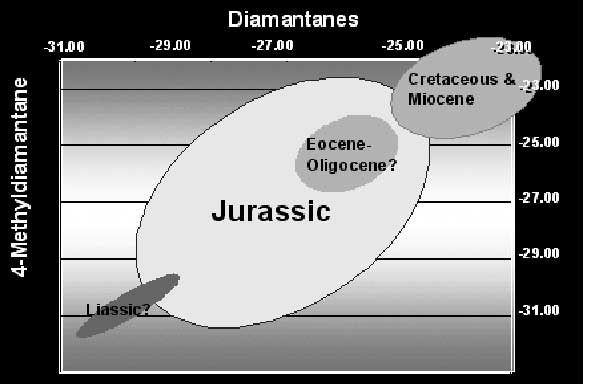
Hydrocarbon diamondoids are not created by biological processes. They are a byproduct of hydrocarbon cracking during katagenesis. Diamondoid concentration is an indicator of thermal maturity. The carbon in the diamondoid is of organic origin because it exhibits 13-C depletion.
Over time the total isotopic fraction of 13-C declines due to radioactive decay. 13-C depletion in hydrocarbon diamondoids is an indicator of the age of the oil formation…
13-C depletion is not assumed to be evidence of organic origin due to theoretical stipulation. The observations of 13-C depletion in organic vs inorganic matter are what led to the theory.
Ok, I see I can’t get answers. Never mind.
1. I never said it was a biological process. It was you, who maintained the source material was of biological origin.
2. 13C is a stable isotope, no radioactive decay is involved in depletion.
3. Cretaceous is much earlier, than either Eocene, Oligocene or Miocene. The image you’ve provided does not support your proposition.
4. Could you specify the chemical reactions leading to diamondoid formation during thermal maturation? It would worth the effort, since higher polymantanes are abundant in some oils, but they are failed to be synthesized in the lab so far. Diamondoid Molecules
5. Could you elaborate on why relative Oxygen contents of kerogen is much lower, than that of biogenic stuff? Removing Oxygen from molecules requires considerable free energy input. Source?
1. I never said it was a biological process. It was you, who maintained the source material was of biological origin.
The source material is clearly of a biological origen. The process of converting the biological material to kerogen, then oil and gas is not a biological process. I clearly explained this in the post.
2. 13C is a stable isotope, no radioactive decay is involved in depletion.
Correct. The 13C depletion actually has more of an inverse relation with age. I was copying some old notes because I was in a hurry, rather than finding the original paper…
http://www.searchanddiscovery.com/documents/abstracts/2005research_calgary/abstracts/extended/mello/images/fig02.jpg
The original carbon for the diamondoids is clearly of organic origin. The diamondoids are derived from biogenic carbon.
3. Cretaceous is much earlier, than either Eocene, Oligocene or Miocene. The image you’ve provided does not support your proposition.
That’s because I was in a hurry and misstated the relevance of the 13C depletion.
4. Could you specify the chemical reactions leading to diamondoid formation during thermal maturation? It would worth the effort, since higher polymantanes are abundant in some oils, but they are failed to be synthesized in the lab so far. Diamondoid Molecules.
Heat, pressure and time…
5. Could you elaborate on why relative Oxygen contents of kerogen is much lower, than that of biogenic stuff? Removing Oxygen from molecules requires considerable free energy input. Source?
Primarily heat.
The oxygen content varies by kerogen type…
http://wiki.aapg.org/images/thumb/f/ff/VanKrevelanDiagram.png/518px-VanKrevelanDiagram.png
Heat does not remove oxygen while leaving behind hydrogen. It may remove water in an anoxic environment, in a 2:1 H:O molar ratio. What you are left with is coal, not kerogen.
I am still curious, in your opinion how hydrocarbon inclusions can get into diamond crystals.
Most of the oxygen is removed during diagenesis…
I am not aware of any hydrocarbon inclusions in diamonds, apart from Marmarosh Diamonds, which aren’t diamonds.
Organic stuff(s) are complex hydrocarbons, albeit sometimes with some heteroatoms.
Berenyi Peter:
One of the claims of J. F. Kenney and his Russian collaborators is that the formation of oil (i.e. straight-chain saturated hydrocarbons) in the crustal “oil window” is as thermodynamically impossible as diamonds forming under those conditions. As you point out, there are recent diamond-anvil experiments demonstrating the generation of higher-than-methane alkanes under upper mantle conditions.
Are there any experiments demonstrating the generation of such chemical substances under crustal conditions? I had asked about this of a noted chemical engineering researcher working on the synthesis of biofuels. Not being confrontational by bringing up either Gold or Kenney, I simply asked whether the chemical reactions or processes by which organic material is turned into oil under crustal conditions in the “oil window” is known, and I was told a flat out, “no.”
The Fischer-Tropsch process converts molecular hydrogen and carbon monoxide into those straight-chain saturated hydrocarbons. That process, however, is a non-equilibrium chemical reaction. Given my interest in peak oil and energy supplies, I had attended a talk by a speaker from Norway hosted by that noted researcher mentioned above. It was explained that the end point of Fischer-Tropsch is methane. In Norway having abundant “stranded natural gas”, methane is “reformed” into H2 and CO, and turning that feedstock back into methane would defeat their purpose. The Fischer-Tropsch process, it was explained, needs to be “quenched” by withdrawing the generated higher alkanes from the chemical reactor before they eventually become methane at chemical equilibrium — to make this point, graphs were shown in the talk of curves comparing higher hydrocarbon and methane concentrations vs time.
It is widely regarded that the formation of oil from whatever is in algae is an equilibrium thermodynamic process where chemical reactions proceed to completion in the absence of some “quenching” or means of withdrawing the formed oil in something like an industrial Fischer-Tropsch reactor before it reverts to methane?
I have heard of two avenues where oil could form under crustal conditions. One is the “serpentinization” reaction involving hydrothermal vents. This appears to be a geologic, catalyzed (the serpentine minerals acting as a catalyst), non-thermal equilibrium reaction. The other is that it is widely regarded that oil forms from algae or perhaps cyanobacteria (so-called blue-green algae) in deep anoxic lakes. I read a paper claiming that oil is sourced from particular vesicles in those organisms accumulating a substance close to crude oil, and this narrow source for oil accounts for oil being rare compared to other crustal hydrocarbon substances. J. F. Kenney may be generating a straw man to claim that generating straight-chain hydrocarbons from cellulose is impossible, because David Middleton here concedes as much.
But however biogenic source material and which particular biogenic source material becomes oil, there is a gaping hole in our scientific knowledge if oil can be generated in a laboratory diamond anvil apparatus under mantle conditions whereas one cannot point to a comparable experiment where oil is generated under crustal conditions?
Even if the preponderance of the evidence points to a biogenic source for all commercially recoverable oil, the biogenic case does not meet the “beyond a reasonable doubt” standard, especially without addressing the thermodynamics question. There is a legal saying, “When the facts are on your side (i.e. your client is really innocent), pound on the facts. When the law is on your side (i.e. there is a legal technicality to free your client), pound on the law. When neither, pound on the table.” Did I just witness an advocate of biogenic origin in claiming “100% wrong and/or irrelevant” for the points your raise, just start to pound the table?
I am not an “abiotic oil advocate”, just want to understand what’s actually going on. I am quite sure “maturation”, “cooking” and the like are woodoo terms, not chemical ones, so they lack explanatory power.
Also, by now we do know that a vast number of underground microorganisms are feeding on oil, therefore no wonder so called “biomarkers” are present in oil, quite independent of its original source.
No doubt higher alkanes are metastable at low (crustal) pressure. If oil is left alone in an anoxic environment for a long enough time, it is spontaneously transformed into methane and carbon. However, the timescale involved is enormous, this is why we still have it.
If it is metastable, we have oil as a result of a non equilibrium process. Even if the abyssal abiotic theory is true, oil has to be moved to the crust from the upper mantle quickly, otherwise the same thing would happen to it as to graphite pseudomorphs (graphitized diamonds).
If it is of biological origin, only a very special kind of biological matter has any chance to turn into complex hydrocarbons, especially carbohydrates (sugars and their polymers like starch or cellulose) has no chance at all, in spite of comprising the bulk of biomass. Lipids have a considerably higher chemical potential than the rest, but even fatty acids are not quite alkanes, so an additional source of free energy seems to be indispensable to that transformation path. Also, I can’t see an effective separation process selective to lipids after bulk biomass burial, algal matter or not.
I can see no chemical path either that would turn fatty acids into high order diamondoids. That does not mean such path can’t exist, but I reckon the phrase “diamondoid derivation from enzymatically created lipids with subsequent structural rearrangement during the process of source rock maturation and oil generation” has no specific meaning whatsoever.
It is true photosynthesis does not like 13C, but carbon isotope ratio is not a sure sign of biological origin, because there are all kinds of abiotic processes leading to isotope fractionation as well. The very fact isotope ratio depends somewhat on the age of oil deposit, is suspicious in itself. Do we have evidence that photosynthesis has got more efficient in rejecting 13C over geologic time?
By the way, kerogen is not crude oil. Obtaining usable oil from that substance requires human-supplied chemical engineering of some form?
Lovely summary, David.
David just remember the first purpose drilled hydrocarbon well in the US was in 1825, TD 27’produced enough gas(from shale)to provide light of about 2 good candles(google FredoniaNY and gas fired street lights. Sunday eve, 77years old, drinking wine after 3weeks skiing the Rockies, can’t remember much more. From an old Pet Eng, good article.
Point #1 – Would you believe that any organic material can be converted into oil in less than a day?
Old news – 2006 story in Discover Magazine, see: http://discovermagazine.com/2006/apr/anything-oil/
Point #2 – One thing not mentioned in discussions, (unless I missed it) is the presence of porphoryns in oils from trace amounts up to 0.4%. porphoryns come from either plant or animal tissues. But this raises a big problem, a real elephant in the room! Porphyrins are quickly destroyed by oxidizing conditions (oxygen) and by heat, so the source rocks containing the organic matter had to be catastrophically buried in order to obtain the anaerobic environment for oil production. quote: ” plant porphyrin breaks down in as little as three days when exposed to temperatures of only 410°F (210°C) for only 12 hours. Therefore, the petroleum source rocks and the crude oils generated from them can’t have been deeply buried to such temperatures for millions of years.”
And, since all oils contain porphyrins, here is a theory of the source of today’s oil: Such global catastrophic burial of oil-producing organic material certainly points to a relatively recent global catastrophe, such as the global flood of Noah’s day (about 5000 years ago). I know that atheists will automatically reject the theory because it does not fit within their world view, but it does fit the data that we observe in the real world today, and thus is worthy of consideration.
ian
Point #1 This is how diagenesis and catagenesis are simulated in laboratory conditions.
Point #2 is not even wrong.
While reading the first few paragraphs, I realized that the biologic-versus-abiotic origin of oil is drastically simpler than I thought. Oil forms when there is sufficient temperature and pressure to turn hydrogen and carbon to the petroleum species.
There has been life on this mudball for about 3 billion years according to the consensus scientific estimate. This carbon has cycled around a variety of molecular forms. When corpses are buried under conditions of sufficient temperature and pressure, oil forms as described in this article. Most of the oil within a mile or so of the surface was formed from biologic organisms.
No scientist believes that the Earth appeared in an instant out of nothing with all its current organisms. There was a time when there was no life on Earth. There was plenty of carbon and hydrogen, etc.The molecules these formed depended on the physical conditions of temperature, pressure, etc. The first petroleum of the world was abiotic–it must have been. Those conditions would have been present at depth, at least. And great depths are where abiotic oil prospectors find their petroleum today.
There is some confusion because the biologic oil was found first and detailed concepts were derived from its appearance. When Russians figured out that oil could form without the carbon ever being alive first, they published in Russian science journals and developed their understanding in depth, too. Eventually, some Americans found out about this and did a terrible job explaining it. That made the whole thing look ridiculous and American engineers quickly decided there was nothing in it. There was no checking the original data–who reads any Russian in this country?
But I have seen websites written in English by Russians who explained the chemistry of it very well. Abiotic oil is absolutely logical.
The big mistake is only in thinking that there is some kind of contradiction between the two theories of petroleum origin. That somebody must be wrong. Nobody is wrong; everybody is right. Oil has formed on Earth for billions of years when conditions were right–both abiotically and from fossils.
The man needing a fillup does not care where his gas came from–just its price. Once burned, the plants don’t care, either–they just grow. Animals eat the plants AND benefit directly from an increased stimulation to breathe. People like the author are VERY valuable individuals and those of us on this website appreciate you!
Hi David
A brilliant exposition. AS a geophysicist I always thought the dinosaur heresy was one to tell petroleum engineers to keep them out of trouble and satisfy their idle curiosity Like the stork for babies. It usually worked.
I concede that for abiogenic origin you can do lab experiments with hydrogen and carbon in a cast iron bomb at high Temp and Pressure so it is a theoretical possibility. I see no reason to doubt biogenic hy[pothesis and I think the abiotic hypothesis is only of intellectual interest. talking to Russians it is a bit Lysenkoist but also a tool to promote atreas deficient in source
Two questions
1) Dnieper Donitz bituminous occurrences in high grade anthracite seem anomalous. No problem with source in the area but overmaturity should preclude liquids. This observation spurred my mild interest
2) Agree comments on Siljan ring analysis on deep HC’s found during drilling but there is a surface seep which started the whole thing going antyway
Alastair Gray
Engineers and Geo’s are separated by a common language… 😉
1)…
https://pubs.usgs.gov/bul/2201/E/b2201-e.pdf
59 TCF and 1.6 Bbbl works out to 27 bbl/mmcf. If the Dnieper-Donets was a single well, it would be a liquid-rich gas well.
2)…
https://www.researchgate.net/publication/248398922_Ordovician_sediments_sandwiched_between_Proterozoic_basement_slivers_tectonic_structures_in_the_Stumsnas_1_drill_core_from_the_Siljan_Ring_central_Sweden
http://www.ssdp.se/assets/files/CISP/CISP_Fig4.png
https://www.researchgate.net/publication/273507333_Analysis_of_borehole_geophysical_data_from_the_Mora_area_of_the_Siljan_Ring_impact_structure_central_Sweden
I get that it ultimately makes no economic difference what creates crude oil, it’s what’s producible that counts.
That said, this would appear to be the forum to air my pet theory. It seems to be the case that large oil fields are mostly found offset from major crustal fractures, with impact craters being particularly productive zones — the whole Gulf rim from Venezuela right around to Mexico and Texas seems to be such a fracture zone.
Could it be that highly fractured areas created by plate tectonics or comet impacts create a habitat for the microorganisms that are posited to create abiotic oil from simple hydrocarbons?
The Gulf of Mexico is not an impact crater. The only major impact feature in the Gulf of Mexico is the end-Cretaceous Chicxulub Crater.
http://www.sciencemag.org/sites/default/files/images/030416IWeb_Chicxulub_GG4.jpg
It’s effects on the structural geology of the Gulf are very localized and play no role in the Cenozoic geology of the Gulf… Where most of the production comes from.
Many sedimentary basins were deposited into rift or failed rift systems. The early Gulf of Mexico (Jurassic) was a rift basin. However, the post-rift geology has been dominated by sediment loading and salt mobilization,
Faults are major conduits for hydrocarbon formation. The Gulf of Mexico is loaded with faults. None of them are “major crustal fractures.” They are mostly the result of sediment loading and salt tectonics.
Most oilfields are located on anticlinal features, often faulted anticlinal features…
An anticline is a subsurface positive topographic feature (like a buried hill).
The Bakken, Eagle Ford, Permian Basin, Spindletop, the East Texas Oil Field are nowhere near “major crustal fractures.” At least not present day “major crustal fractures.”
Where is the source of the heavy metals that is found in both black coal and liquid petroleum?
Why are the amounts of heavy metals in liquid crude the same in a region where the fields in question are geological separated i.e. The fields are not connected to the same source rock and there is no heavy metals in the source rock or the reservoir rock. There is no source of heavy metals and even if there where the sources would be local and vary widely over a large region. The deep earth CH4 mechanism explains the heavy metals as there are picked up by the liquid CH4 as it move through the mantel.
An example where there is very similar amount of heavy metals in liquid crudes which from geological separate fields would be the Western Canadian oil fields or the California oil fields. Gold uses the California oil field in his example. I checked the Western Canadian oil field data and found it supported his assertion that a fossil source could not explain the uniformity of heavy metals in a region where the individual fields are geologically separated.
Your cartoon picture ignores specific examples that cannot be explained such as Gold’s example in his book which it appears you did not read, of an Oklahoma liquid oil field that has coal mixed within the oil field.
Gold also notes that black coal is often found in the same regions where oil is found which makes sense if both black coal and liquid oil’s ultimate source is deep earth CH4.
Gold’s analysis is deeper, more like a crime scene investigation where are of the evidence must be explained rather than an argument where one person can present cartoon pictures which illustrate a Zombie theory but ignore the specific observational data that disproves theory. See my above comments of black coal deposits that cannot be explained by a fossil source mechanism.
There are piles and piles of anomalies and paradoxes associated with the fossil theory all of which can be explained by the non biological source theory.
Your cartoon picture does not show the relative deeps that black coal, liquid oil, and coal are found at. Black coal is found near the surface, then liquid oil and then ‘natural’ gas. The relative deeps makes sense if the mechanism that creates the formations is deep earth CH4.
Gold provides examples where is observational evidence to support the assertion that the deep source CH4 is still connected to the formation such as the black coal deposit in Japan where mining had to be stopped as there it was not possible to remove the high volumes of CH4.
In multiple places in the world there are now viable commercial natural gas projects where the CH4 is obtained by drilling into the black coal formation.
Thank you for your response.
Where is the source of the heavy metals that is found in both black coal and liquid petroleum?
The same fracking source as the heavy metals in the formation water: Rocks.
The minerals/metals in question are not found in sufficient amounts in the surrounding sedimentary rock.
The problem (paradox which is specifically stated as a paradox in the textbook Gold quotes ) is not limited to explaining why there are heavy metals in black coal and liquid oil but what is the mechanism in general to explain the super concentration of metals in the upper crust of the planet. (More than million times concentrated).
The water Zombie theory for concentration of heavy metals in black coal and oil that is assumed is ridiculous based on even a back of an envelop quantitive analysis of how much water would need to move based on the concentrations that have occurred and how much of the specific metals will dissolve in the water.
There is no mechanism to move sufficient volumes of water through the crust, the amounts of dissolved metals in water are not high enough, and there is no mechanism to cause the mineral to suddenly dropout) are super concentration of metals in the crust.
The deep earth super high pressure liquid CH4 extruded from the core of the earth as it solidifies theory explains the observations.
The metals dissolve in the super high pressure liquid CH4 which confirmed by experiments and by high pressure theory. As the core solidifies more and more liquid CH4 is extruded.
The pressure of the core pushes the liquid CH4 through the mantel. As the pressure decreases some of the metals drop out of solution from the high pressure CH4. This explains why specific concentrated metals are found in the same formation.
An example is the concentration of gold in the crust. Gold does not dissolve in water. As Gold notes small gold miners look for tracks of black coal in the sedimentary rock which lead in some cases to highly concentrated gold deposits. The deep earth extruded super high pressure liquid CH4 explains the super gold concentration and explains why there is tiny seam of coal that leads to the gold.
WTF do you think sedimentary rocks are? Sandstone and shale come from eroded igneous, sedimentary and metamorphic rocks. And the metals are not just from the surrounding sedimentary rock. The hydrothermal brines which transport the oil from source rocks to reservoirs can come from very deep sources.
http://www.glossary.oilfield.slb.com/Terms/f/formation_water.aspx
The following are additional specific examples where Gold presents specific observation after observation that disproves the fossil theory of the formation of black coal, liquid oil, and natural gas.
Gold examines the evidence as one would a crime scene investigation.
It is a fact that a deep analysis of the observations indicates the fossil theory is a Zombie theory.
It is obvious that those who argue against the Soviet/Gold abiogenic theory of the formation of black coal, oil, and natural gas have never read his book as they never address fundamental issues which disprove the fossil theory such heavy metals being found in both crude oil and black coal.
Deeper analysis is required to find the paradoxes and anomalies which are then used to solve the puzzle.
From Gold’s Book, The Deep Hot Biosphere The Myth of Fossil Fuels which I would highly recommend. Gold book is one of the best modern ‘science’ books that I have read. No ranting. All observations supported by links to sources. Logical pillar after logical pillar to support his assertion.
Thanks for posting those excerpts. They are simply awesome for the lack of basic understanding of geology! I wonder if he ever actually looked at a single coal bearing sequence of strata before writing such drivel.
I particularly like the Indonesian quote. I authored a book on the Petroleum Geology of Indonesia, speak the language, and never heard that one.
Good fracking grief! What a load of idiotic horse-schist. Gold must not have the slightest concept of basic geology.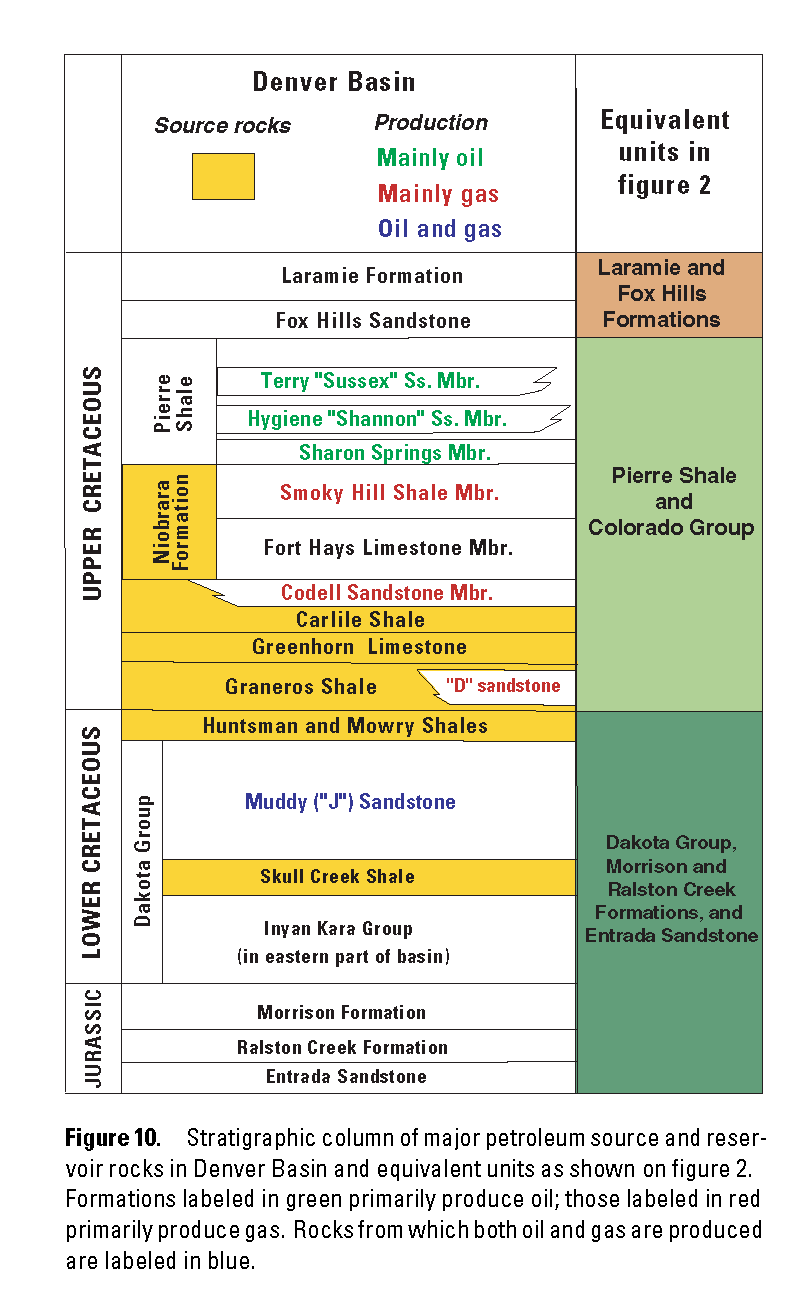
Sedimentary basins routinely contain intervals of marine, terrigenous and land depositional sequences due to transgression and regression.
The D-J Basin has coal production from the Cretaceous Laramie formation, which was deposited as a coastal swamp along the edge of the Western Interior Seaway; and oil production from the deeper and older Pierre Shale and Niobrara Chalk, which were marine deposits in the Western Interior Seaway..
http://www.wsgs.wyo.gov/docs/wsgs-web-db-xsec-cgs.png
” Inorganically sourced methane is massively abundant on Earth and elsewhere in our Solar System and probably throughout our Galaxy.”
Picking nits, but you just got through establishing that methane is clearly an ORGANIC molecule.
Methane is an organic molecule. The C and the 4 H’s can either be sourced from organic or inorganic matter.
“Organic” in this case refers to carbon-based chemistry.
Correct.
The subject called “orgo” in college. The carbon in organic chemistry can come from biotic or abiotic sources.
Yep.
Organic chemistry refers to compounds with at least one hydrogen-carbon bond. While much of organic chemistry is related to life, many simple hydrocarbons are not.
I thought I clearly explained this in the original post.
I thought you did too. But some might have skipped over that part and never have studied chemistry in college.
Yes, the point is that not all organic chemistry is biotic. If Thomas Gold was correct [or partially correct, the processes are not mutually exclusive], bacteria convert abiotic methane to hydrocarbons we percieve as biotic. Modern bogs produce methane that is wildly isotopically fractionated. A typical value is -40PDB. Human cumbustion is about -20. Coal gas has been measured as low as -100.
Hard to imagine how this would work without reprocessing.
Gymno,
The possibility that microbes deep in the crust produce petroleum is a separate issue from its arising from abiotic processes in the mantle, IMO.
This is from the post…
Methane and other simple hydrocarbons don’t have to be sourced from other organic molecules. This is 100% irrelevant to how crude oil forms on the Earth.