…the predicted size makes this the smallest sunspot cycle in about 100 years

(Updated 2012/05/01)
From: http://solarscience.msfc.nasa.gov/predict.shtml
The current prediction for Sunspot Cycle 24 gives a smoothed sunspot number maximum of about 60 in the Spring of 2013. We are currently over three years into Cycle 24. The current predicted size makes this the smallest sunspot cycle in about 100 years.
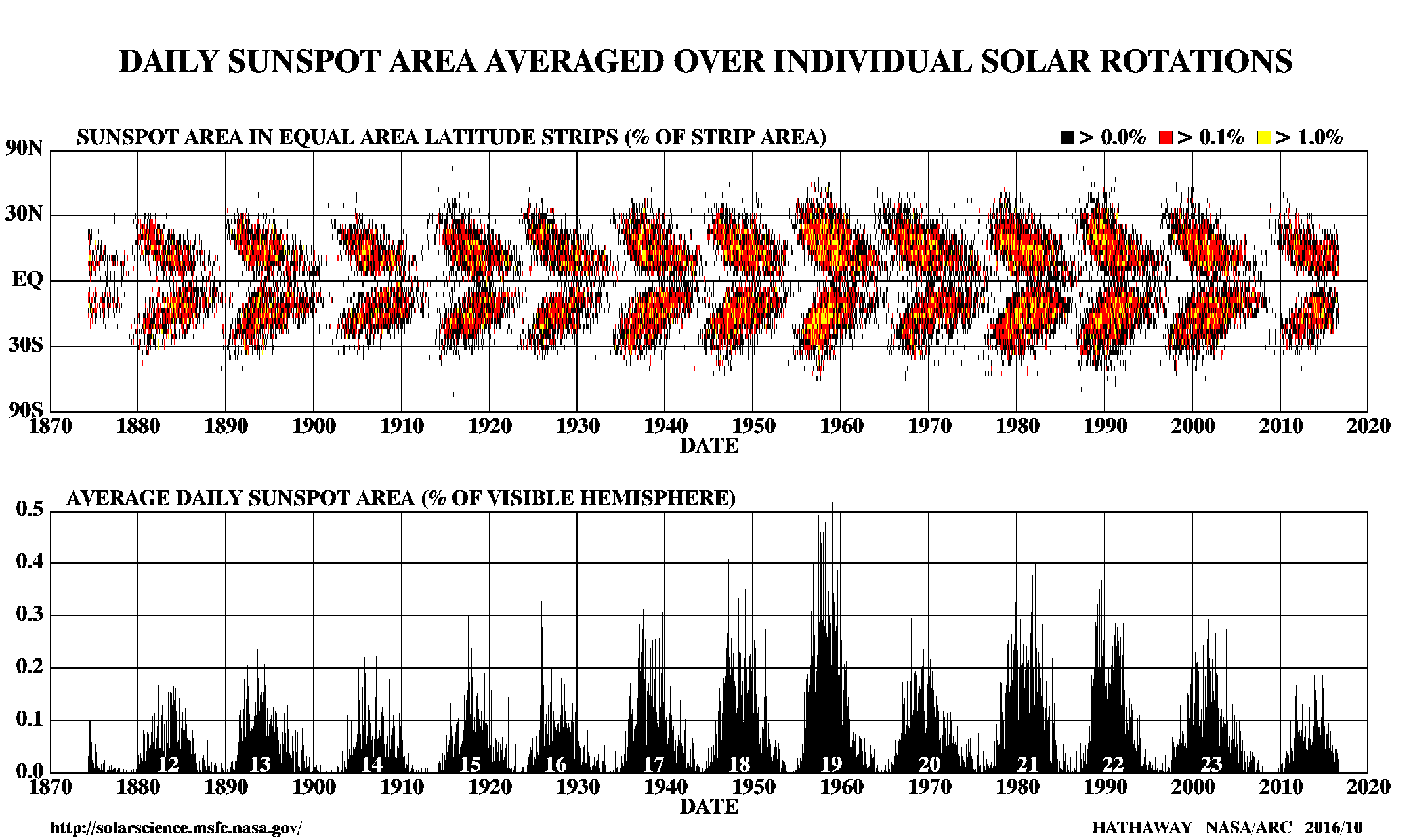
The prediction method has been slightly revised. The previous method found a fit for both the amplitude and the starting time of the cycle along with a weighted estimate of the amplitude from precursor predictions (polar fields and geomagnetic activity near cycle minimum). Recent work [see Hathaway Solar Physics; 273, 221 (2011)] indicates that the equatorward drift of the sunspot latitudes as seen in the Butterfly Diagram follows a standard path for all cycles provided the dates are taken relative to a starting time determined by fitting the full cycle. Using data for the current sunspot cycle indicates a starting date of May of 2008. Fixing this date and then finding the cycle amplitude that best fits the sunspot number data yields the current (revised) prediction.

Click on image for larger version.
Predicting the behavior of a sunspot cycle is fairly reliable once the cycle is well underway (about 3 years after the minimum in sunspot number occurs [see Hathaway, Wilson, and Reichmann Solar Physics; 151, 177 (1994)]). Prior to that time the predictions are less reliable but nonetheless equally as important. Planning for satellite orbits and space missions often require knowledge of solar activity levels years in advance.
A number of techniques are used to predict the amplitude of a cycle during the time near and before sunspot minimum. Relationships have been found between the size of the next cycle maximum and the length of the previous cycle, the level of activity at sunspot minimum, and the size of the previous cycle.
Among the most reliable techniques are those that use the measurements of changes in the Earth’s magnetic field at, and before, sunspot minimum. These changes in the Earth’s magnetic field are known to be caused by solar storms but the precise connections between them and future solar activity levels is still uncertain.
Of these “geomagnetic precursor” techniques three stand out. The earliest is from Ohl and Ohl [Solar-Terrestrial Predictions Proceedings, Vol. II. 258 (1979)] They found that the value of the geomagnetic aa index at its minimum was related to the sunspot number during the ensuing maximum. The primary disadvantage of this technique is that the minimum in the geomagnetic aa index often occurs slightly after sunspot minimum so the prediction isn’t available until the sunspot cycle has started.
An alternative method is due to a process suggested by Joan Feynman. She separates the geomagnetic aa index into two components: one in phase with and proportional to the sunspot number, the other component is then the remaining signal. This remaining signal has, in the past, given good estimates of the sunspot numbers several years in advance. The maximum in this signal occurs near sunspot minimum and is proportional to the sunspot number during the following maximum. This method does allow for a prediction of the next sunspot maximum at the time of sunspot minimum.
A third method is due to Richard Thompson [Solar Physics 148, 383 (1993)]. He found a relationship between the number of days during a sunspot cycle in which the geomagnetic field was “disturbed” and the amplitude of the next sunspot maximum. His method has the advantage of giving a prediction for the size of the next sunspot maximum well before sunspot minimum.
We have suggested using the average of the predictions given by the Feynman-based method and by Thompson’s method. [See Hathaway, Wilson, and Reichmann J. Geophys. Res. 104, 22,375 (1999)] However, both of these methods were impacted by the “Halloween Events” of October/November 2003 which were not reflected in the sunspot numbers. Both methods give larger than average amplitude to Cycle 24 while its delayed start and low minimum strongly suggest a much smaller cycle.
The smoothed aa index reached its minimum (a record low) of 8.4 in September of 2009. Using Ohl’s method now indicates a maximum sunspot number of 70 ± 18 for cycle 24. We then use the shape of the sunspot cycle as described by Hathaway, Wilson, and Reichmann [Solar Physics 151, 177 (1994)] and determine a starting time for the cycle by fitting the latitude drift data to produce a prediction of the monthly sunspot numbers through the next cycle. We find a maximum of about 60 in the Spring of 2013. The predicted numbers are available in a text file, as a GIF image, and as a pdf-file. As the cycle progresses, the prediction process switches over to giving more weight to the fitting of the monthly values to the cycle shape function. At this phase of cycle 24 we now give 66% weight to the amplitude from curve-fitting technique of Hathaway, Wilson, and Reichmann Solar Physics 151, 177 (1994). That technique currently gives similar values to those of Ohl’s method.
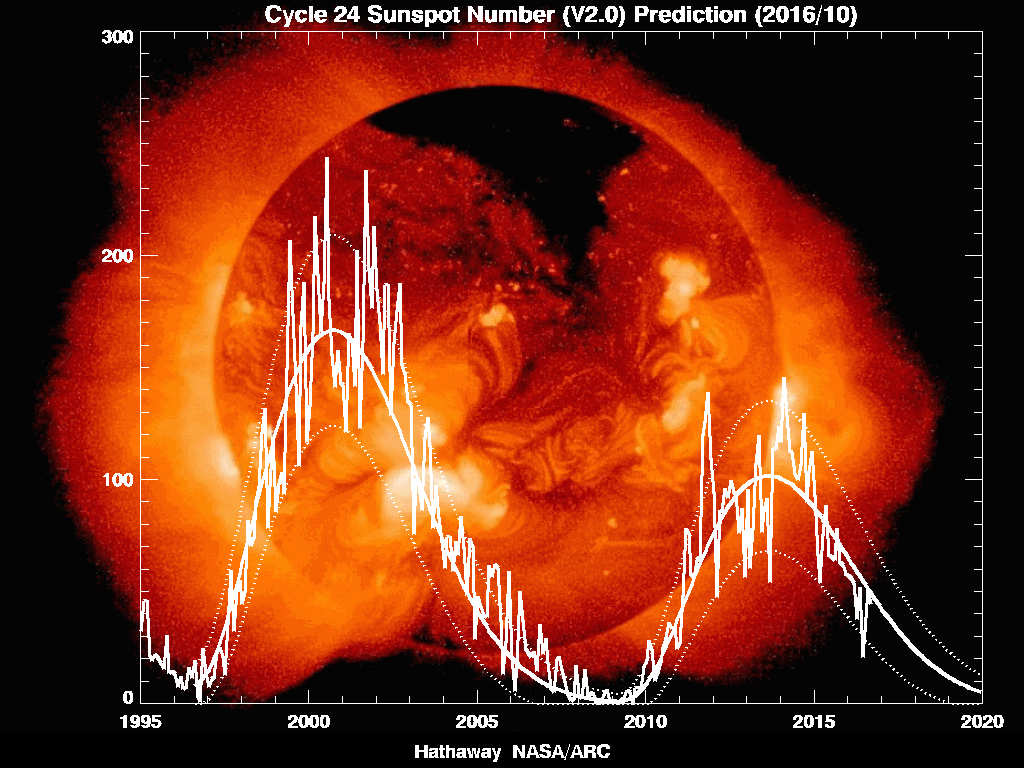
Note: These predictions are for “smoothed” International Sunspot Numbers. The smoothing is usually over time periods of about a year or more so both the daily and the monthly values for the International Sunspot Number should fluctuate about our predicted numbers. The dotted lines on the prediction plots indicate the expected range of the monthly sunspot numbers. Also note that the “Boulder” numbers reported daily at www.spaceweather.com are typically about 35% higher than the International sunspot number.
Another indicator of the level of solar activity is the flux of radio emission from the Sun at a wavelength of 10.7 cm (2.8 GHz frequency). This flux has been measured daily since 1947. It is an important indicator of solar activity because it tends to follow the changes in the solar ultraviolet that influence the Earth’s upper atmosphere and ionosphere. Many models of the upper atmosphere use the 10.7 cm flux (F10.7) as input to determine atmospheric densities and satellite drag. F10.7 has been shown to follow the sunspot number quite closely and similar prediction techniques can be used. Our predictions for F10.7 are available in a text file, as a GIF image, and as a pdf-file. Current values for F10.7 can be found at: http://www.spaceweather.ca/sx-4-eng.php.

I agree, crackpot ideas should be dismissed, but data which are accepted by the world science institutions can not. This is not correlation between price of the US postage and your car’s flat tyre.
This is a correlation between the solar magnetic output as represented by the TSI and change in the magnetic field in Antarctic.
There is no easy way out of it, you got the knowledge and experience, you have to face the challenge, even if goes against the grain. Science expects it from the top people.
vukcevic says:
May 7, 2012 at 3:12 am
There is no easy way out of it, you got the knowledge and experience, you have to face the challenge, even if goes against the grain. Science expects it from the top people.
As I said, spurious correlations do not need an explanation. Especially not when one of the data sets you use is flawed.
Of course, you were entitled to claim that the Wang Lean Sheeley data set is flawed since there was no an independent proxy which could test its accuracy. Now we do have a good proxy in the Antarctic’s magnetic field bi-decadal variability, which not only proves that the WLS data are good but correlation is far from being spurious.
I shall leave it to your to decide if to ignore or take-up the challenge.
vukcevic says:
May 7, 2012 at 6:20 am
Wang Lean Sheeley data set is flawed since there was no an independent proxy which could test its accuracy
That is what the workshop I”m at right now will be solving. It does not look to good for WLS.
I shall leave it to your to decide if to ignore or take-up the challenge.
There is no challenge worth considering
I whish you all luck, if you fail I would be only confirming existing, no fun in that, but if you succeed I shall look forward to opportunity to challenge you. Sincerely hope that you get your ‘SSN ironing’ done. Will look forward to your report.
I cannot believe how people wind up clinging to nonsensical statements such as “Falling or stable global temperatures are caused by the Sun and rising temperatures are down to carbon dioxide alone.” Now I don’t know if the person who said this above was saying it ironically/sarcastically, speaking for the alarmists, or if they really meant it. That doesn’t matter. What matters is such a statement still ignores the established fact that, in the past, temperature started to climb THEN we saw a rise in CO2 that followed. How one can conclude the former was produced by the latter is beyond me, but people actually do believe it passionately.
Mike Jonas – I find a much better answer to those who still advance “science is settled/consensus” arguments is that they’re arguing politics, not science. Facts, truth, logic and science don’t care how many people get it right. They don’t care if NO ONE gets it right. They remain facts, truth, logic and science in any case.
Consensus is a political argument, not a scientific one – that is what all those who worship consensus never figured out, apparently.
@Jimmy Haigh
Are you for real, or just being sarcastic?
“I remember seeing a “prediction” from a while back saying that the next cycle (i.e.: this one) would be the biggest ever.”
Please provide a source. A reliable source. I heard there was a thing called yeti, sasquatch or bigfoot, but I wasn’t foolish enough to believe it.
I also heard, from reliable sources, that this solar cycle was going to be one of the smallest ever. See above for RELIABLE SOURCE.
“Not to worry though: climate (global temperature) has nothing to do with the Sun”
yeahRITE. That’s why everyone who’s ever studied the issue seriously and honestly disagrees with that statement.
Some people say it’s all to do with man made CO2. Has anyone else heard of this or was I hallucinating?
As for your second part, about hallucinating, perhaps if you fill us in on what you had just smoked, injected or ingested we can answer that part more accurately.
As for your first part yeah, I did hear some people make that claim. They’re the same people who openly state they feel it’s appropriate to lie to us to get us to do what they want us to do. They’re the same people who openly admit to deliberately altering data then gloating publicly about the success of their efforts. They’re the same people who will offer a chart that shows that, after temperature rises, CO2 follows yet still say the lagging indicator caused the leading one.
I hope you were being sarcastic. Really.
Bob Roberts – thanks for the comment. That argument may work for you, but to some people no argument works. They typically just say “that many scientists can’t be wrong”, or they invoke the ‘precautionary principle’. It seems there has been a sea change in Australia recently, because of the carbon tax. So in Australia at least the driver is as you say, political not scientific.
There is another thread in progress which may lead to further undermining of the AGW case
http://www.theaustralian.com.au/business/legal-affairs/media-watch-eyes-climate-scientist-death-threat-claims/story-e6frg97x-1226353396751
which while not of the actual science could strike at the credibility of the scientists. Media Watch has previously levelled severe ctiticism at journalists simply for reporting views sceptical of CAGW, so it will be interesting to see where they go with this one.
Coming back to Jan P. Perlwitz – JPP is a NASA scientist http://www.giss.nasa.gov/staff/jperlwitz.html, so my argument for him is necessarily a scientific one. I took on an ex president of the [UK] Royal Society with a similar argument recently, after they wrote a strongly pro CAGW article in a local RS publication, and to my surprise my comment was published straight away. I am waiting for this month’s issue to see what reaction I get (here, as in the UK RS, there are some vehement CAGWers).