…the predicted size makes this the smallest sunspot cycle in about 100 years

(Updated 2012/05/01)
From: http://solarscience.msfc.nasa.gov/predict.shtml
The current prediction for Sunspot Cycle 24 gives a smoothed sunspot number maximum of about 60 in the Spring of 2013. We are currently over three years into Cycle 24. The current predicted size makes this the smallest sunspot cycle in about 100 years.
The prediction method has been slightly revised. The previous method found a fit for both the amplitude and the starting time of the cycle along with a weighted estimate of the amplitude from precursor predictions (polar fields and geomagnetic activity near cycle minimum). Recent work [see Hathaway Solar Physics; 273, 221 (2011)] indicates that the equatorward drift of the sunspot latitudes as seen in the Butterfly Diagram follows a standard path for all cycles provided the dates are taken relative to a starting time determined by fitting the full cycle. Using data for the current sunspot cycle indicates a starting date of May of 2008. Fixing this date and then finding the cycle amplitude that best fits the sunspot number data yields the current (revised) prediction.
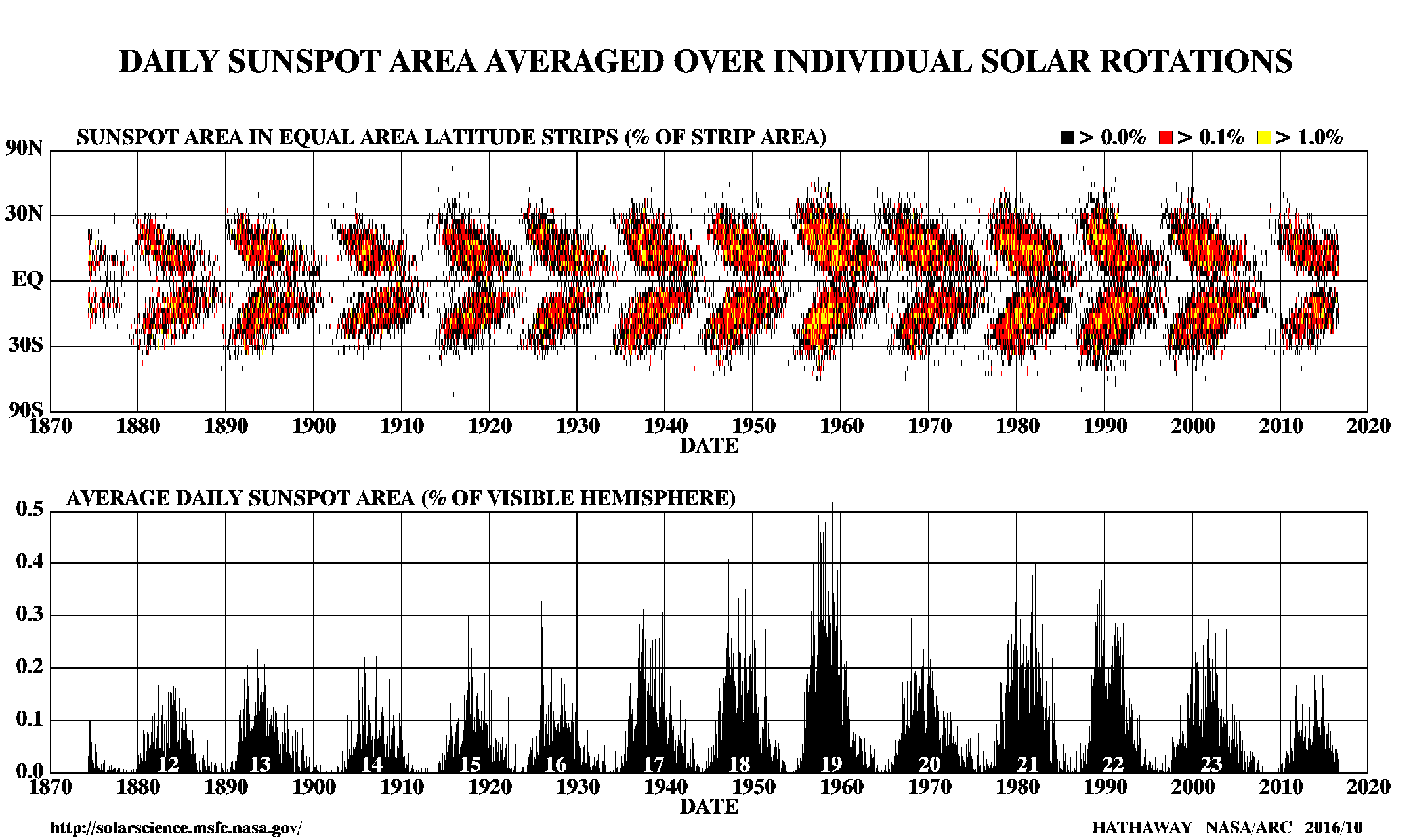

Click on image for larger version.
Predicting the behavior of a sunspot cycle is fairly reliable once the cycle is well underway (about 3 years after the minimum in sunspot number occurs [see Hathaway, Wilson, and Reichmann Solar Physics; 151, 177 (1994)]). Prior to that time the predictions are less reliable but nonetheless equally as important. Planning for satellite orbits and space missions often require knowledge of solar activity levels years in advance.
A number of techniques are used to predict the amplitude of a cycle during the time near and before sunspot minimum. Relationships have been found between the size of the next cycle maximum and the length of the previous cycle, the level of activity at sunspot minimum, and the size of the previous cycle.
Among the most reliable techniques are those that use the measurements of changes in the Earth’s magnetic field at, and before, sunspot minimum. These changes in the Earth’s magnetic field are known to be caused by solar storms but the precise connections between them and future solar activity levels is still uncertain.
Of these “geomagnetic precursor” techniques three stand out. The earliest is from Ohl and Ohl [Solar-Terrestrial Predictions Proceedings, Vol. II. 258 (1979)] They found that the value of the geomagnetic aa index at its minimum was related to the sunspot number during the ensuing maximum. The primary disadvantage of this technique is that the minimum in the geomagnetic aa index often occurs slightly after sunspot minimum so the prediction isn’t available until the sunspot cycle has started.
An alternative method is due to a process suggested by Joan Feynman. She separates the geomagnetic aa index into two components: one in phase with and proportional to the sunspot number, the other component is then the remaining signal. This remaining signal has, in the past, given good estimates of the sunspot numbers several years in advance. The maximum in this signal occurs near sunspot minimum and is proportional to the sunspot number during the following maximum. This method does allow for a prediction of the next sunspot maximum at the time of sunspot minimum.
A third method is due to Richard Thompson [Solar Physics 148, 383 (1993)]. He found a relationship between the number of days during a sunspot cycle in which the geomagnetic field was “disturbed” and the amplitude of the next sunspot maximum. His method has the advantage of giving a prediction for the size of the next sunspot maximum well before sunspot minimum.
We have suggested using the average of the predictions given by the Feynman-based method and by Thompson’s method. [See Hathaway, Wilson, and Reichmann J. Geophys. Res. 104, 22,375 (1999)] However, both of these methods were impacted by the “Halloween Events” of October/November 2003 which were not reflected in the sunspot numbers. Both methods give larger than average amplitude to Cycle 24 while its delayed start and low minimum strongly suggest a much smaller cycle.
The smoothed aa index reached its minimum (a record low) of 8.4 in September of 2009. Using Ohl’s method now indicates a maximum sunspot number of 70 ± 18 for cycle 24. We then use the shape of the sunspot cycle as described by Hathaway, Wilson, and Reichmann [Solar Physics 151, 177 (1994)] and determine a starting time for the cycle by fitting the latitude drift data to produce a prediction of the monthly sunspot numbers through the next cycle. We find a maximum of about 60 in the Spring of 2013. The predicted numbers are available in a text file, as a GIF image, and as a pdf-file. As the cycle progresses, the prediction process switches over to giving more weight to the fitting of the monthly values to the cycle shape function. At this phase of cycle 24 we now give 66% weight to the amplitude from curve-fitting technique of Hathaway, Wilson, and Reichmann Solar Physics 151, 177 (1994). That technique currently gives similar values to those of Ohl’s method.
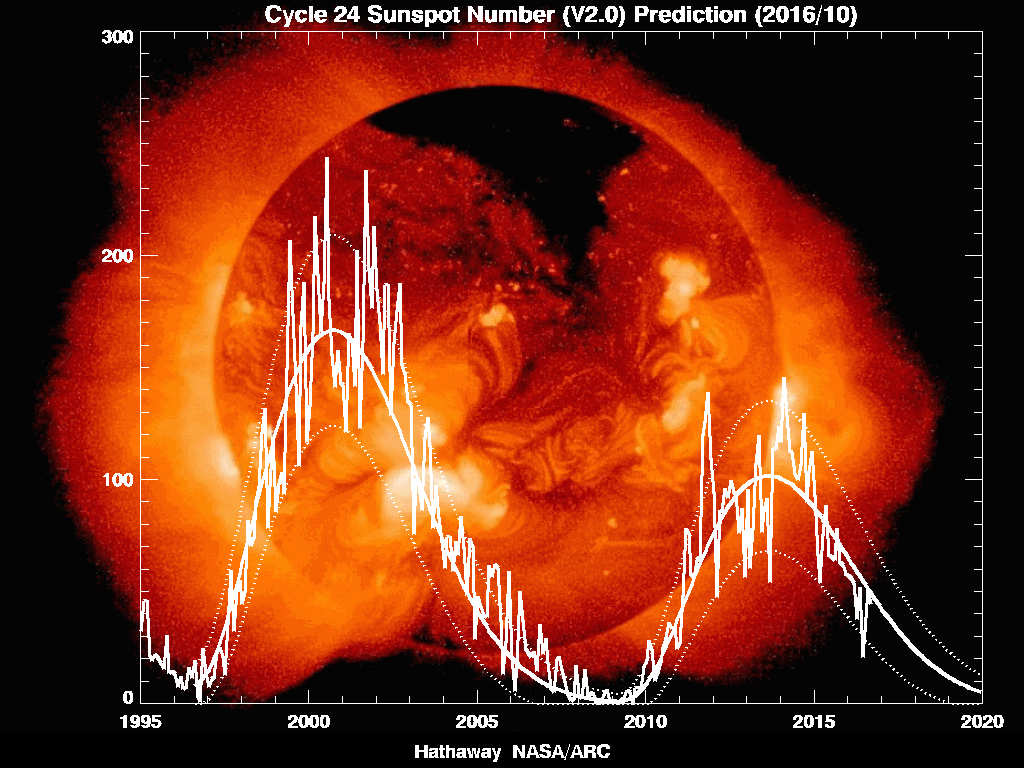
Note: These predictions are for “smoothed” International Sunspot Numbers. The smoothing is usually over time periods of about a year or more so both the daily and the monthly values for the International Sunspot Number should fluctuate about our predicted numbers. The dotted lines on the prediction plots indicate the expected range of the monthly sunspot numbers. Also note that the “Boulder” numbers reported daily at www.spaceweather.com are typically about 35% higher than the International sunspot number.
Another indicator of the level of solar activity is the flux of radio emission from the Sun at a wavelength of 10.7 cm (2.8 GHz frequency). This flux has been measured daily since 1947. It is an important indicator of solar activity because it tends to follow the changes in the solar ultraviolet that influence the Earth’s upper atmosphere and ionosphere. Many models of the upper atmosphere use the 10.7 cm flux (F10.7) as input to determine atmospheric densities and satellite drag. F10.7 has been shown to follow the sunspot number quite closely and similar prediction techniques can be used. Our predictions for F10.7 are available in a text file, as a GIF image, and as a pdf-file. Current values for F10.7 can be found at: http://www.spaceweather.ca/sx-4-eng.php.

Jan P. Perlwitz
On solar impact, the issue is not just TIS, but spectra changes. e.g. see Nigel Fox’s Slide 17 – Cooler sun = warmer earth because of opposite trends in Visible vs UV
David L. Hagen says:
May 4, 2012 at 1:55 pm
The TSI record relies upon the data from many different solar radiometers flown over the last 20 years, whose inherent variability (~0.8%) could affect the prediction of models of global temperature change by as much as 0.8 K.
But they didn’t as the variability was eliminated in the final composite time series that were used in the models.
Leif Svalgaard
David L. Hagen
Jan P. Perlwitz
TSI and clouds variability are far too low to account for major climatic changes such as MWP, LIA and latest GW .
Ocean currents are main distributors of heat from the equatorial to the high latitude regions. Any change in intensity of these currents will be directly reflected in the change of the atmospheric temperature and the associated parameters.
Circumpolar current is a primary pump of the world oceans conveyor belt. Its intensity may be partially function of the ‘South’ magnetic pole’s strength, which in 1700 was 68.5 microTesla while today it is 52.5 microTesla, change of ~ 23%.
However, of more interest is change on the bi-decadal scale, which in its trends closely matches the TSI but with 30 times larger percentage variability as shown here:
http://www.vukcevic.talktalk.net/TMC.htm
Jan P. Perlwitz – that was a lot of material from you to work through.
You start off by saying “I do not see why a somewhat decreased solar activity would have a strong effect on the ocean heat content …..“. I have no trouble believing you (ie, that you cannot see it). But not being able to see is no good reason to dismiss out of hand, when there is plenty of evidence to support it. Clearly the MWP was of comparable temperature to today’s, and the RWP before it. Clearly the LIA was colder. Something had to have caused those temperature changes, and that something appears to have been the sun. Certainly they could not have been caused by man-made CO2.
You do not see it. Maybe, instead of insulting those who question, you should be looking for it.
One very serious possibility, being investigated by Henrik Svensmark and others, is that the sun affects our climate by mechanisms other than simply the direct forcing. He has progressed his theories, backed by laboratory testing by himself and by others, to the point that they are now much more credible than – for example – the cloud feedbacks relied on very heavily by the IPCC. Note that cloud feedbacks are acknowledged by the IPCC to be an artefact of the climate models and that there is no evidence that they occur. A final irony is that they are a supposed indirect effect accepted without any evidence, while the possibility of their being an indirect solar effect is dismissed without discussion.
In a later comment you say “The mindset of most of the “skeptic” crowd is …..“, and proceed with an insanely stupid set of absurd insults dressed up as a massive argument from authority. I cannot speak for ‘most of’ the sceptics, but my perception is that the mainstream science has too many flaws in it to be accepted as settled – and on top of that, that the mainstream scientists are pushing too hard to close down debate, to insult (as you did) those who question, and to prevent alternatives from being heard, in short, they are behaving too unscientifically to be believed.
One day, we will all see it. For now, as you so correctly say, you can’t.
Leif Svalgaard says:
May 4, 2012 at 1:43 pm
Thanks, only goes up to around 2005, the link below updates to near 2010.
Over the recent period where global temperatures haven’t warmed, low levels clouds after declining have stabilized and are especially apparent with more recent data below.
http://www.climate4you.com/images/CloudCoverAllLevel%20AndWaterColumnSince1983.gif
Mid levels clouds have increased over the same period and also contribute to some cooling. Although high levels clouds have also increased and contribute towards a little warming. (still not as high compared at beginning of data set)
Overall after a lengthy period of mid and low level clouds combined declining, there are now after stabilizing recently increasing.
vukcevic says:
May 4, 2012 at 3:48 pm
the ‘South’ magnetic pole’s strength, which in 1700 was 68.5 microTesla while today it is 52.5 microTesla, change of ~ 23%.
There is no physical reason or cause for any such link. Pure coincidence.
Matt G says:
May 4, 2012 at 6:24 pm
Thanks, only goes up to around 2005, the link below updates to near 2010.
And the climate change is only the last 5 years… Please get real
Leif Svalgaard says:
There is no physical reason or cause for any such link. Pure coincidence.
Very odd indeed.
Correlation with the W. L & S. (2005) TSI appear to be even stronger than one with the SSN.
There could be two possible explanations:
– circumpolar temperature wave (8-9 year period) is responding to the (integrated ) TSI and is generating counter EMF, order of few 100s of nanoTesla.
or
– Geomagnetic storms have a far stronger input into the Antarctica then previously thought, with the responding ascend /decay time constant of about a decade.
here shown as a % change
http://www.vukcevic.talktalk.net/TMC.htm
Either way, it appears to be one of the four pillars of the oceanic climate dynamics, together with the North Atlantic, North and the Central Pacific,.
vukcevic says:
May 5, 2012 at 1:13 am
There could be two possible explanations
Again: spurious correlations do not require explanations.
vukcevic says:
May 5, 2012 at 1:13 am
http://www.vukcevic.talktalk.net/TMC.htm
There you claimed that I dittoed your opinion. This is not correct, what I say ditto to was:
Still just hand waving, no quantitative analysis, no numbers, no specific mechanism(s).
Mike, we live on a highly intrinsically variable, dynamic, living planet equipped with its own drivers that come and go in strength and magnitude. Intrinsic variability is by far, the greater source of change needed to create larger climate changes and relatively smaller weather pattern variations within stable climate boundaries.
Leif Svalgaard says:
May 5, 2012 at 6:28 am
………………………….
I thought it referred to a repeat of my sentence just above ‘ditto’, and since I value your opinions I quoted it. But since it did not, it was misunderstanding and I have deleted it; my apology.
Back to the business
I just added a correlation graph, factor of R^2 =0.7718 suggests that it is unlikely to be just a coincidence.
http://www.vukcevic.talktalk.net/TMC.htm
vukcevic says:
May 5, 2012 at 8:33 am
I just added a correlation graph, factor of R^2 =0.7718 suggests that it is unlikely to be just a coincidence.
You do this the wrong way around. Your argument would be correct if you had a valid physical theory [which you don’t] that predicted the curve, then found a high R^2 with the data. If you look around and around and around at many things until you find something that matched [i.e. has a high R^2], the R^2 is meaningless.
vukcevic says:
May 5, 2012 at 8:33 am
I thought it referred to a repeat of my sentence just above ‘ditto’, and since I value your opinions I quoted it.
If you value my opinion you shouldn’t delete it. Apparently the value of my opinion is determined by how much it supports yours.
I don’t remember we ever had an agreement, but that doesn’t mean that our exchanges were wasted, to the contrary. There is detectable disconcert in your post (re R^2), which also indicates that there is more to it than coincidence, ask Professor Norm Sleep on my behalf and for a benefit of many.
Leif Svalgaard says: May 5, 2012 at 8:48 am
You do this the wrong way around. Your argument would be correct if you had a valid physical theory [which you don’t] that predicted the curve, then found a high R^2 with the data. If you look around and around and around at many things until you find something that matched [i.e. has a high R^2], the R^2 is meaningless.
Here is what I said in 2010:
On number of occasions I suggested that the solar activity (mainly the magnetic storms) act as an electro-magnetic brake on the Earth’s rotation, as confirmed by the correlation of the GMF at the North pole and LOD :
http://www.vukcevic.talktalk.net/MF.htm
(check reference: http://wattsupwiththat.com/2010/12/20/a-dalton-minimum-repeat-is-shaping-up/#comment-556127 )
Just didn’t bother to check Antarctica, agree it is sign of a sloppy science.
Thus the Antarctic’s correlation is even stronger than one in the Arctic.
Coincidence for both magnetic poles?
I would not think so.
http://www.vukcevic.talktalk.net/TMC.htm
vukcevic says:
May 5, 2012 at 10:43 am
On number of occasions I suggested that the solar activity (mainly the magnetic storms) act as an electro-magnetic brake on the Earth’s rotation
That is not a valid theory at all. It doesn’t matter how many times you suggest the same thing, it is still fundamentally wrong.
Coincidence for both magnetic poles?
I would not think so.
The dipole is common for both poles, so no wonder there the same wiggles.
vukcevic says:
May 5, 2012 at 10:43 am
There is detectable disconcert in your post (re R^2), which also indicates that there is more to it than coincidence
Not at all, my remarks are standard statistics.
Leif Svalgaard says:
May 4, 2012 at 1:43 pm
Global low [the ones supposedly influenced by cosmic rays] cloud cover is actually decreasing:
http://mclean.ch/climate/Cloud_global.htm
;———————–
http://mclean.ch/climate/Cloud_cover_warning.htm
WARNING – THIS DATA MIGHT NOT BE ACCURATE
These graphs use data from the ISCCP but Evan et al determined that the ISSCP D2 data is prone to errors at the extremities of the vision of the various satellities (see Evan A. T., A. K. Heidinger, D. J. Vimont (2007), “Arguments against a physical long-term trend in global ISCCP cloud amounts”, Geophys. Res. Lett., 34, L04701, doi:10.1029/2006GL028083.). This paper includes a regression map (see below) but as Dr William Rossow of the ISCCP team has said, the paper lacks numerical details in its description of the analysis technique.
Hi doc
Spectral response is almost identical
http://www.vukcevic.talktalk.net/TMC.htm
should make you think again.
Leif Svalgaard says:
May 4, 2012 at 8:51 pm
It may be only another 5 years, but the fact this makes a period of increasing overall cloud levels for more than 10 years may be significant in future. Considering this has occurred at the same time global warming has failed to deliver. Nothing else has changed during this period that can explain the non warming period. Therefore future changes in cloud albedo need to be examined to confirm this theory.
vukcevic says:
May 5, 2012 at 11:34 am
I agree in part Vuks. Increased solar activity (last century) increases the likelihood of more geomagnetic storms hitting Earth. And dare I suggest Earthly warming.. Changes in the radiation belts too..
Not quite seeing the drag-on for LOD but I’ll work on it.
“”March 22, 2012: A recent flurry of eruptions on the sun did more than spark pretty auroras around the poles. NASA-funded researchers say the solar storms of March 8th through 10th dumped enough energy in Earth’s upper atmosphere to power every residence in New York City for two years.””
http://science.nasa.gov/science-news/science-at-nasa/2012/22mar_saber/
Thanks for the comments rbateman, you too Dr. Svalgaard.
vukcevic says:
May 6, 2012 at 11:50 am
Spectral response is almost identical […]
should make you think again.
So what? once the cherry-picked wiggles even roughly matches, the spectral response will too.
Carla says:
May 6, 2012 at 3:00 pm
NASA-funded researchers say the solar storms of March 8th through 10th dumped enough energy in Earth’s upper atmosphere to power every residence in New York City for two years.
So what? You and many others have poor sense of proportions. New York City uses 10 GW, or the amount of sunlight falling on an area of 5 square kilometer [a 1/100,000,000 of the global input]. Trifling.
Carla says:
May 6, 2012 at 3:00 pm
NASA-funded researchers say the solar storms of March 8th through 10th dumped enough energy in Earth’s upper atmosphere to power every residence in New York City for two years.
So what? You and many others have poor sense of proportions. New York City uses 10 GW, or the amount of sunlight falling on an area of 5 square kilometer [a 1/100,000,000 of the global input].
The number is [deliberately] not quite correct [although of correct order of magnitude]. As a useful exercise, try to calculate the number yourself. And report back what you think it should be.
Dr. S
An impartial observer would say your argument doesn’t sound entirely convincing.
Data are accepted as the best available, geographic poles are the best defined locations on the planet. Solar cycle is 11 years, circumpolar temperature wave period 8-9 years, calculating difference in the Bz change across any period between 10 to 30 years produces similar results. Not much there to be cherry picked.
I suspect if Wolf had his magnetic needle in the Antarctic he would have recorded then what I found now in the geomagnetic data.
You are correct about impact of solar storms comparable intensity, but could be there a cumulative effect? If not then, that presents even more exciting alternatives:
– there is commonality to the long term magnetic oscillations within solar system or
– there is an electro and magnetic feedback loop ( sun-J/S magnetospheres) which the Earth regularly transverses.
Obviously I’ll opt for the second (vukcevic strikes again).
I am not entirely convinced that ‘So what?’ alternative as a ‘peer reviewing’ comment would be acceptable to a science paper publisher, you can do better than that.
A convincing counter-argument is required.
vukcevic says:
May 7, 2012 at 12:58 am
I am not entirely convinced that ‘So what?’ alternative as a ‘peer reviewing’ comment would be acceptable to a science paper publisher, you can do better than that.
We have been over this so many times that it has become tedious. Many peer reviews consist of dismissing crackpot ideas right up front. Review works as a filter to weed out such ideas, leaving the better ones for more serious consideration. Call this ‘gate keeping’ if you like, but such is necessary in any field.
A convincing counter-argument is required.
Such is required only if your argument is convincing, which it is not.