
By WUWT regular “Just The Facts”
This format received a positive response in the previous article and apparently encouraged Skeptical Science to take A Big Picture Look at Global Warming, thus this article will be updated on a quarterly basis moving forward. In their article, Skeptical Science argued that “the planet is indeed warming rapidly” and this rate “is expected to increase”. Suggestions as to which data/graphics included below best demonstrate rapid warming are most welcome…
Please note that WUWT cannot vouch for the accuracy of the data/graphics within this article, nor influence the format or form of any of the graphics, as they are all linked from third party sources and WUWT is simply an aggregator. You can view each graphic at its source my simply clicking on it.
Update: John Christy points out via email that RSS and UAH anomalies are not comparable because they use different base periods, i.e., “RSS only uses 1979-1998 (20 years) while UAH uses the WMO standard of 1981-2010. So, March 2012 in RSS has an LT anomaly of -0.03 when based on the 1981-2010 mean annual cycle.”
Global Surface Temperatures:
Generally, when referring to Earth’s “climate” warming, proponents of the Catastrophic Anthropogenic Global Warming (CAGW) narrative, refer to Earth’s Surface Temperature, e.g. “Global warming is the unusually rapid increase in Earth’s average surface temperature over the past century primarily due to the greenhouse gases released by people burning fossil fuels.” NASA Earth Observatory
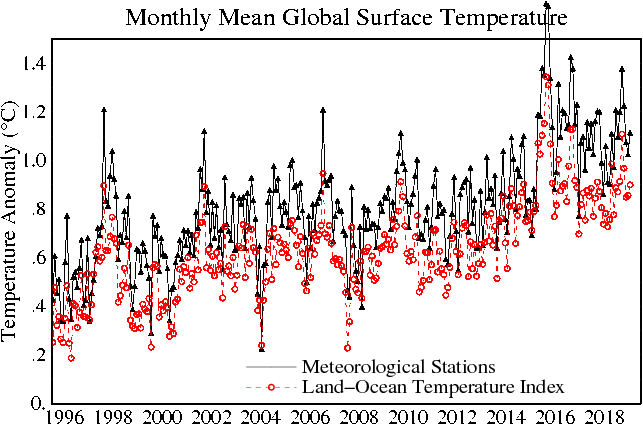
As such, here’s NASA’s Goddard Institute for Space Studies (GISS) Monthly Mean Surface Temperature Anomaly – 1996 to Present;
NOAA’s National Climate Data Center (NCDC) Annual Global Mean Temperature Anomaly Over Land & Sea – 1880 to Present;

Note: The chart above hasn’t been updated with 2011 data for unknown reasons. The chart resides here and the data to update it is here. It appears that a significant decline in temperatures occurred during the last 15 months:
2010 1 0.6335
2010 2 0.6708
2010 3 0.7815
2010 4 0.7518
2010 5 0.7064
2010 6 0.6764
2010 7 0.6581
2010 8 0.5783
2010 9 0.4975
2010 10 0.5655
2010 11 0.7182
2010 12 0.4226
2011 1 0.3962
2011 2 0.4200
2011 3 0.5226
2011 4 0.5894
2011 5 0.5093
2011 6 0.5882
2011 7 0.5687
2011 8 0.5401
2011 9 0.5264
2011 10 0.5739
2011 11 0.4347
2011 12 0.4800
2012 1 0.3630
2012 2 0.3678
(Source: NOAA NCDC)
UK Met Office’s – Hadley Center – Climate Research Unit (CRU) Annual Global Average Land Temperature Anomaly – 1850 to Present;

and the UK Met Office – Hadley Center – Climate Research Unit (CRU) Monthly Global Average Land Temperature – 1850 to Present

Depending on the time frame, it certainly seems that Earth’s surface temperature has increased, though it does not appear to be “warming rapidly”. Furthermore, the surface temperature record is burdened with issues of questionable siting, changes in siting, changes in equipment, changes in the number of measurement locations, modeling to fill in gaps in measurement locations, corrections to account for missing, erroneous or biased measurements, and the urban heat island effect. Thus to see the big picture on the temperature Earth’s temperature, it helps to also look up.
Atmospheric Temperatures:
Since 1979 the temperature of Earth’s “climate” has also been measured via satellite. “The temperature measurements from space are verified by two direct and independent methods. The first involves actual in-situ measurements of the lower atmosphere made by balloon-borne observations around the world. The second uses intercalibration and comparison among identical experiments on different orbiting platforms. The result is that the satellite temperature measurements are accurate to within three one-hundredths of a degree Centigrade (0.03 C) when compared to ground-launched balloons taking measurements of the same region of the atmosphere at the same time.” NASA
The following are 4 Temperature Anomaly plots from Remote Sensing Systems (RSS), each one increases in altitude as is illustrated here:

RSS Temperature Lower Troposphere (TLT) – Brightness Temperature Anomaly- 1979 to Present;

RSS Temperature Middle Troposphere (TMT)- Brightness Temperature Anomaly- 1979 to Present;

RSS Temperature Troposphere / Stratosphere (TTS) -Brightness Temperature Anomaly- 1987 to Present;

RSS Temperature Lower Stratosphere (TLS) – Brightness Temperature Anomaly – 1979 to Present:

According to Remote Sensing Systems, “For Channel (TLT) (Lower Troposphere) and Channel (TMT) (Middle Troposphere), the anomaly time series is dominated by ENSO events and slow tropospheric warming. The three primary El Niños during the past 20 years are clearly evident as peaks in the time series occurring during 1982-83, 1987-88, and 1997-98, with the most recent one being the largest.” RSS
Also, the 2009 – 10 El Niño event is also called out on this RSS Latitudinal Temperature Lower Troposphere (TLT) Brightness Temperature Anomaly from 1979 to Present;

and the 1998 El Niño event, along with the tropospheric cooling attributed to the 1991 eruption of Mt Pinitubo, is called out on this University of Alabama – Hunstville (UAH) Lower Atmosphere Temperature Anomalies – 1979 to Present:

Note that in March the UAH Lower Atmosphere Temperature Anomaly was 0.11 degrees C above the 30 year average, and the RSS Lower Troposphere Brightness Temperature was 0.075 degrees C above the 30 year average. Keep this mind the next time you see claims that recent weather was caused by Global Warming.

There are also regional variations in Lower Troposphere that contribute nuance to the picture. For example, RSS Northern Polar Temperature Lower Troposphere (TLT) Brightness Temperature Anomaly;

shows a .334 K/C per decade increase, whereas the The RSS Southern Polar Temperature Lower Troposphere (TLT) Brightness Temperature Anomaly;

shows a .011 K/C per decade decrease. I am still not aware of a compelling explanation for the significant divergence in the Lower Troposphere temperature trends between the poles.
The satellite record seems to show slow warming of Lower and Middle Tropospheric temperatures, overlaid with the El Niño/La Niña Southern Oscillation (ENSO) cycle, including four comparatively large El Niño events. Lower Tropospheric temperatures appear to have flattened since the large El Niño in 1998 and offer no indication of Earth “warming rapidly”.
Moving higher in the atmosphere, RSS Temperature Troposphere / Stratosphere (TTS) – Brightness Temperature Anomaly- 1987 to Present;
has been incredibly flat since, with a trend of just -.010 K/C per decade. The 1997-98 and 2009 – 10 El Niño events are still readily apparent in the plot, as is a spike from the 1991 eruption of Mt. Pinatubo. Note that the effect of Mt. Pinatubo is the opposite in the Lower and Middle Troposphere versus the Troposphere / Stratosphere (TTS), i.e. “Large volcanic eruptions inject sulfur gases into the stratosphere; the gases convert into submicron particles (aerosol) with an e-folding time scale of about 1 year. The climate response to large eruptions (in historical times) lasts for several (2-3) years. The aerosol cloud causes cooling at the Earth’s surface, warming in stratosphere.”
Ellen Thomas, PHD Wesleyan University
It is interesting that, incorporating the impact of three significant surface driven warming events, Troposphere / Stratosphere Temperatures (TTS) have been quite stable, however there is nuance to this as well.
RSS Northern Hemisphere Temperature Troposphere / Stratosphere (TTS) – Brightness Temperature Anomaly- 1987 to Present;

has been increasing by .046 K/C per decade, whereas the RSS Southern Hemisphere Temperature Troposphere / Stratosphere (TTS) – Brightness Temperature Anomaly- 1987 to Present;

has been decreasing by -.066 K/C per decade.
Moving higher still in the atmosphere, the RSS Temperature Lower Stratosphere (TLS) – Brightness Temperature Anomaly – 1979 to Present;
“is dominated by stratospheric cooling, punctuated by dramatic warming events caused by the eruptions of El Chichon (1982) and Mt Pinatubo (1991).” RSS
The eruptions of El Chichon and Mt Pinatubo are readily apparent in the Apparent Atmospheric Transmission of Solar Radiation at Mauna Loa, Hawaii:

“The stratosphere” … “in contrast to the troposphere, is heated, as the result of near infrared absorption of solar energy at the top of the aerosol cloud, and increased infra-red absorption of long-wave radiation from the Earth’s surface.”
“The stratospheric warming in the region of the stratospheric cloud increases the latitudinal temperature gradient after an eruption at low latitudes, disturbing the stratospheric-troposphere circulation, increasing the difference in height of the troposphere between high and low latitudes, and increasing the strength of the jet stream (polar vortex, especially in the northern hemisphere). This leads to warming during the northern hemisphere winter following a tropical eruption, and this warming effect tends to be larger than the cooling effect described above.” Ellen Thomas, PHD Wesleyan University
The Lower Stratosphere experienced “dramatic warming events caused by the eruptions of El Chichon (1982) and Mt Pinatubo (1991).” RSS “The long-term, global-mean cooling of the lower stratosphere stems from two downward steps in temperature, both of which are coincident with the cessation of transient warming after the volcanic eruptions of El Chichon and Mt. Pinatubo.” … “Here we provide observational analyses that yield new insight into three key aspects of recent stratospheric climate change. First, we provide evidence that the unusual step-like behavior of global-mean stratospheric temperatures is dependent not only upon the trend but also on the temporal variability in global-mean ozone immediately following volcanic eruptions. Second, we argue that the warming/cooling pattern in global-mean temperatures following major volcanic eruptions is consistent with the competing radiative and chemical effects of volcanic eruptions on stratospheric temperature and ozone. Third, we reveal the contrasting latitudinal structures of recent stratospheric temperature and ozone trends are consistent with large-scale increases in the stratospheric overturning Brewer-Dobson circulation” David W. J. Thompson Colorado State University
Above the Stratosphere we have the Mesosphere and Thermosphere, neither of which have I identified current temperature time series for, but of note is that on “July 15, 2010” “A Puzzling Collapse of Earth’s Upper Atmosphere” occurred when “high above Earth’s surface where the atmosphere meets space, a rarefied layer of gas called “the thermosphere” recently collapsed and now is rebounding again.”

“This is the biggest contraction of the thermosphere in at least 43 years,” says John Emmert of the Naval Research Lab, lead author of a paper announcing the finding in the June 19th issue of the Geophysical Research Letters (GRL). “It’s a Space Age record.”
The collapse happened during the deep solar minimum of 2008-2009—a fact which comes as little surprise to researchers. The thermosphere always cools and contracts when solar activity is low. In this case, however, the magnitude of the collapse was two to three times greater than low solar activity could explain.
“Something is going on that we do not understand,” says Emmert.
The thermosphere ranges in altitude from 90 km to 600+ km. It is a realm of meteors, auroras and satellites, which skim through the thermosphere as they circle Earth. It is also where solar radiation makes first contact with our planet. The thermosphere intercepts extreme ultraviolet (EUV) photons from the sun before they can reach the ground. When solar activity is high, solar EUV warms the thermosphere, causing it to puff up like a marshmallow held over a camp fire. (This heating can raise temperatures as high as 1400 K—hence the name thermosphere.) When solar activity is low, the opposite happens.” NASA
In summary, Earth’s Lower and Middle Troposphere appear to have warmed slowly, overlaid with the El Niño/La Niña Southern Oscillation (ENSO) cycle, including four comparatively large El Niño events, and tempered by the cooling effects of the eruption of El Chichon (1982) and Mt Pinatubo (1991). Lower and Middle Tropospheric temperatures appear to have flattened since the large El Niño in 1998 and offer no indication of “warming rapidly”. Tropospheric / Stratospheric temperatures appear to have been influenced by at least three significant surface driven warming events, the 1997-98 El Niño, and the eruptions of El Chichon in 1982 and Mt Pinatubo in 1991, but to have maintained a stable overall trajectory. Stratospheric temperatures appear to have experienced two “dramatic warming events caused by the eruptions of El Chichon (1982) and Mt Pinatubo (1991).”, and “unusual step-like behavior of global-mean stratospheric temperatures” which has resulted in a significant stratospheric cooling during the last 30 years. Lastly, “during deep solar minimum of 2008-2009” “the biggest contraction of the thermosphere in at least 43 years” occurred and “The magnitude of the collapse was two to three times greater than low solar activity could explain.”
Ocean Temperatures:
“The oceans can hold much more heat than the atmosphere. Just the top 3.2 metres of ocean holds as much heat as all the world’s air.” Commonwealth of Australia – Parliamentary Library
As such, changes in Oceanic Oscillations, and Ocean Heat Content are critical to understanding “Earth’s Temperature”. Here is NOAA’s NODC Global Ocean Heat Content from 0-700 Meters – 1955 to Present;

and here is the same from Ole Humlum’s valuable climate data site Climate4you.com, NODC Global Ocean Heat Content – 0-700 Meters – 1979 to Present:

It seems apparent from the plots above that Global Ocean Heat has increased over the last several decades, however Global Ocean Heat doesn’t appear to be “warming rapidly”. Furthermore, there is no evidence or indication of an increasing or accelerating rate, deceleration would appear to be a more accurate label.
Sea Level:
“Global sea level is currently rising as a result of both ocean thermal expansion and glacier melt, with each accounting for about half of the observed sea level rise, and each caused by recent increases in global mean temperature. For the period 1961-2003, the observed sea level rise due to thermal expansion was 0.42 millimeters per year and 0.69 millimeters per year due to total glacier melt (small glaciers, ice caps, ice sheets) (IPCC 2007). Between 1993 and 2003, the contribution to sea level rise increased for both sources to 1.60 millimeters per year and 1.19 millimeters per year respectively (IPCC 2007).” Source NISDC
Global Mean Sea Level Change – 1993 to Present:

Global Mean Sea Level Change Map with a “Correction” of 0.3 mm/year added May, 5th 2011, due to a “Glacial Isostatic Adjustment (GIA)” – 1993 to Present:

Snow and Ice:
A proxy often cited when measuring “Earth’s Temperature” is amount of Snow and Ice on Earth. According to the United States Geographical Survey (USGS), “The vast majority, almost 90 percent, of Earth’s ice mass is in Antarctica, while the Greenland ice cap contains 10 percent of the total global ice mass.” Source USGA However, there is currently there is no generally accepted measure of ice volume, as Cryosat is still in validation and the accuracy of measurements from Grace are still being challenged. Sea Ice Area and Extent are cited as proxies for “Earth’s Temperature” is Sea Ice Area, however there is significant evidence that the primary agents of change in Sea Ice Area and Extent are in fact wind and Atmospheric Oscillations. With this said, here are
Global, Arctic & Antarctic Sea Ice Area from 1979 to Present;

Global Sea Ice Area Anomaly – 1979 to Present:

Northern Hemisphere Sea Ice Area Anomaly, 1979 to Present;

Southern Hemisphere Sea Ice Area Anomaly, 1979 to Present;

Arctic Sea Ice Extent – 15% or greater

Antarctic Sea Ice Extent – 15% or Greater

There appears to have been a negative trend in Northern Hemisphere Sea Ice Area and Extent and a positive trend in Southern Hemisphere Sea Ice Area and Extent, thus the resultant Global Sea Ice Area trend appears to be slightly negative.
In terms of land based data, here is 20 Year Northern Hemisphere Snow Cover with 1995 – 2009 Climatology

Northern Hemisphere Snow Cover Anomalies 1966 – Present

Northern Hemisphere Winter Snow Extent – 1967 to Present:

Northern Hemisphere Spring Snow Extent – 1967 to Present:

Northern Hemisphere Fall Snow Extent – 1967 to Present:

While neither Snow plot offers a global perspective, when looking at the Northern Hemisphere, there appears to have been a slight increase in Snowcover and Winter Snow Extent, a decrease in Spring Snow Extent and no change in Fall Snow Extent over the historical record.
Based on the limited Global Ice and Snow measurements available, and noting the questionable value of Sea Ice Area as a proxy for temperature, not much inference can currently be drawn from Earth’s Ice measurements. However, there does not appear to be any evidence in Earth’s Ice measurements of rapid warming.
Conclusion:
“Earth’s Temperature” appears to have increased during the last several decades, but there does not appear to be any evidence of “rapid warming”.
Additional information on “Earth’s Temperature” can be found in the WUWT Reference Pages, including the Global Temperature Page and Global Climatic History Page
The really interesting thing in all of the above is in the Apparent Atmospheric Transmission of Solar Radiation curve. One wonders if anyone has noticed the distinct downward secular trend in this curve? Using a piece of paper on my screen to fit the secular trend, it looks like transmission has dropped from 0.936 to 0.927 over the 30 year timescale of the curve. That is a 1% drop in transmittivity, and it is proceeding slowly but inexorably down!
I don’t have any good feel for what they are measuring, but the observatories at Mauna Loa are where they are because they are above the clouds most of the time so that this number does not reflect the change in bond albedo that is surely linked to clouds well below its height.
Again, that is 1% taken off the top of global warming! As is the case with an increased albedo, it directly reduces the amount of sunlight that reaches the surface to warm it. We’re talking 1% here plus 2% from the albedo linked decrease or a total of 3% reduction in mean surface radiation. This in turn corresponds to a roughly 3 degree Kelvin expected decrease in Earth’s mean greybody temperature before the GHE kicks in.
Holy Moly! That’s enough to kickstart a return to the ice age cold phase, not just another LIA! Seriously!
I wonder if this is linked to the recently observed decrease in stratospheric moisture. I also wonder just where the missing sunlight is going! Is it warming the stratosphere (decreasing its relative humidity)? Mauna Loa is pretty far up there — losing 1% of the incoming sunlight before reaching it is a pretty big deal!
rgb
Ammonite says:
April 16, 2012 at 3:35 am
Foster & Rahmstorf 2011 (http://www.skepticalscience.com/foster-and-rahmstorf-measure-global-warming-signal.html) calculate the underlying global temperature trend (when known causes of short term volatility are backed out) to be between 0.14C/decade and 0.18C/decade since the beginning of the satellite era. If this were to persist, would any of the readership consider it “rapid”?
=======================================================================
Lol, that depends. If it is the 0.18 C/decade like we’ve seen in the last decade or so….. no. If it was some real measurements, then maybe.
So, I guess it would depend on what is persisting, the temp measurements or the imaginary temp trend of F&R.
Melting is not the only result of nonpermanent snow. Some of it sublimates. A lot of it sublimates actually. How ever much I don’t know exactly and I don’t think there is any measurement or modeling of this process. At least I have never come across it.
“”””” rgbatduke says:
April 16, 2012 at 7:47 am
The really interesting thing in all of the above is in the Apparent Atmospheric Transmission of Solar Radiation curve. One wonders if anyone has noticed the distinct downward secular trend in this curve? Using a piece of paper on my screen to fit the secular trend, it looks like transmission has dropped from 0.936 to 0.927 over the 30 year timescale of the curve. That is a 1% drop in transmittivity, and it is proceeding slowly but inexorably down!
……………………………
Again, that is 1% taken off the top of global warming! As is the case with an increased albedo, it directly reduces the amount of sunlight that reaches the surface to warm it. We’re talking 1% here plus 2% from the albedo linked decrease or a total of 3% reduction in mean surface radiation. This in turn corresponds to a roughly 3 degree Kelvin expected decrease in Earth’s mean greybody temperature before the GHE kicks in.
……………………….
I wonder if this is linked to the recently observed decrease in stratospheric moisture. I also wonder just where the missing sunlight is going! Is it warming the stratosphere (decreasing its relative humidity)? Mauna Loa is pretty far up there — losing 1% of the incoming sunlight before reaching it is a pretty big deal!
rgb “””””
How do you normally do your radiation calculations ? A 3% reduction in gray or BB radiation corresponds to only a 3/4% reduction in Temperature, and taking 288K as the mean earth Temperature (claimed by expert peer reviewed publishing climate scientists; not ignorant physicists) that comes to only 2.16 deg C drop.
As for a loss of 1% of “sunlight” before reaching ML top; let’s hear it for the ozone hole repair. Ozone peels off far more than 1% of the incoming solar spectrum energy. Remember that ozone is absorbing the highest energy solar photons; not the lowest like CO2 does.
So if our new clean CFC free atmosphere is achieving what it is claimed it would do, then a 1% extra solar reduction due to more effective O3 UV blocking sounds quite reasonable to me.
“”””” Goldie says:
April 15, 2012 at 8:46 pm
Maybe I wasn’t clear enough in my earlier comment. I was responding to your comment that you couldn’t understand the difference between arctic and antarctic trends.
………………………..
Has no-one found a difference in CO2 between the hemispheres? “””””
Well Goldie, NOAA/NASA has; but then they have hidden the result. As regards CO2, the two hemispheres aren’t even vaguely comparable. In fact the globe is completely assymmetrical as regards distribution of CO2.
At the south pole (and for most of Antarctica) there is only about a 1 ppm annual cyclic change in atmospheric CO2 abundance; actually -1 ppm since it is opposite in phase from the CO2 annual variations in the northern hemisphere which varies about 18 ppm for the North Pole, and pretty much over the entire arctic. So the northern CO2 variation is 18 times as much as for the Antarctic; which pits the kibosh on claims that CO2 is well mixed in the atmosphere.
Just try swigging 18% alcohol beer, and comparing the result to swigging 1% alcohol (near) beer, if you think 18 times is not a significant difference. Compare to the milli-degree Temperature changes that people go ape about in a year, I would say the hemispheric difference in CO2 is somewhat non negligible.
George E. Smith; says:
April 16, 2012 at 11:37 am
Just try swigging 18% alcohol beer, and comparing the result to swigging 1% alcohol (near) beer, if you think 18 times is not a significant difference. Compare to the milli-degree Temperature changes that people go ape about in a year, I would say the hemispheric difference in CO2 is somewhat non negligible.
I beg to differ. Beer is one thing. But CO2 is quite another.
Over the last 15 years, the CO2 concentration went up about 25 ppm.
Check out the graph below to see how much difference 25 ppm made over the last 15 years according to RSS.
http://www.woodfortrees.org/plot/rss/from:1995/plot/rss/from:1996.83/trend/plot/esrl-co2/from:1996.83/normalise
http://www.longrangeweather.com/ArticleArchives/BlackfeetIndians.htm
Some oral history from the Blackfeet
“”””” Werner Brozek says:
April 16, 2012 at 3:09 pm
George E. Smith; says:
April 16, 2012 at 11:37 am
Just try swigging 18% alcohol beer, and comparing the result to swigging 1% alcohol (near) beer, if you think 18 times is not a significant difference. Compare to the milli-degree Temperature changes that people go ape about in a year, I would say the hemispheric difference in CO2 is somewhat non negligible.
I beg to differ. Beer is one thing. But CO2 is quite another.
Over the last 15 years, the CO2 concentration went up about 25 ppm. “””””
The beer analog for anyone to whom it wasn’t plainly obvious, was to impress on the reader the significance of an eighteen to one difference in behaviour; between two well studied global regions when the party line is that the subject material is well mixed globally.
And for 25 ppm change out of say 392 ppm, the log of the ratio is about 0.095, so one would expect about 0.3 deg C change for the IPCCs 3 deg C per doubling.
And at the north pole, that 18 ppm excess CO2 is removed from the atmosphere in just five months, , so that’s less than a year and a half ro deal with your 25 ppm. So much for 200 year CO2 residence time.
I am amazed at how off course the discussion here has become. Spencer has made it clear on his website, that it is his mission to debunk the idea of AGW. So now he comes up with some mysterious algorithm to show it hasn’t really been getting warmer.
This claim is as ridiculous as it gets. His own UAH data set shows that the rate of warming on average since 1979 has been about 0.14C/decade:
http://en.wikipedia.org/wiki/Temperature_record
and the RSS satellite data shows a similar trend.
The burden of proof is on Spencer to explain how why his analysis of station data deserves to be considered seriously. Wake up people!
REPLY: I’m amazed you had the ‘nads to show up again, tread lightly, there’s a very low tolerance level for you. – Anthony
The claim that temperatures have recently risen faster than at prior times only works on those who have never seen or deny the validity of graphs like the following from NASA showing temperatures in the location of greatest warming (the Arctic) merely recently rose at a fairly similar rate to how they did in the 1920s and 1930s up to the peak of the time:
http://earthobservatory.nasa.gov/Features/ArcticIce/Images/arctic_temp_trends_rt.gif
That period with the peak in the late 1930s can be in turn compared to this National Science Foundation graph showing from around 200 A.D. up to the mid-20th century, showing the 800s and 900s A.D. had as fast temperature rise rates (naturally) as the 1920s-1930s just mentioned:
http://www.nsf.gov/news/mmg/media/images/monsoon1_h.jpg
The above is the northern hemisphere but with that most relevant since there is far less net temperature change in the southern hemisphere.
Roy Spencer’s April 13th article notes the USHCN claims 0.245 degrees Celsius per decade temperature rise.
Proportionally, that would be like around 0.81 degrees Celsius over a 3.3 decade period like 1979-2012, which would be like the following 1979-2012 UAH graph going from its around -0.1 degrees Celsius anomaly in early years to averaging around +0.7 degrees Celsius in recent years … which is blatantly not the case to those capable of really reading graphs, as it rather averages around +0.15 to 0.2 degrees Celsius in the final most recent years in utter contrast to the USHCN:
http://www.drroyspencer.com/wp-content/uploads/UAH_LT_1979_thru_March_2012.png
When writing fast, I don’t think I explicitly noted in the prior comment that USHCN is U.S. and UAH is global, but the point is how misleading a 0.245 degrees Celsius/decade claim is overall when global temperatures have risen in the past three decades at <=~ 0.1 degrees Celsius/decade (a rate like they have naturally in the past long before).
George E. Smith; says:
April 16, 2012 at 4:03 pm
And for 25 ppm change out of say 392 ppm, the log of the ratio is about 0.095, so one would expect about 0.3 deg C change for the IPCCs 3 deg C per doubling.
And at the north pole, that 18 ppm excess CO2 is removed from the atmosphere in just five months,
Of course this then means that the north pole does not permanently have either an excess or a deficiency of 18 ppm but rather a smooth transition. So then at the most, the average difference between the north pole and south pole is 9 ppm. And with regards to the IPCC 3 C per doubling, that assumes positive feedbacks that Spencer and others do not agree with. So if we assume negative feedback and perhaps 0.8 C per doubling and if we use 9 ppm instead of the 25 ppm as used above, then perhaps we have closer to 0.03 C difference. Right?
Eric Adler says:
April 16, 2012 at 5:37 pm
This claim is as ridiculous as it gets. His own UAH data set shows that the rate of warming on average since 1979 has been about 0.14C/decade: Wake up people!
The 0.14/decade was globally, but was Dr. Spencer not discussing U.S. only here?
Douglass and Knox have recently published a paper on Ocean Heat content (OHC) showing that the recent warming rate is essentially zero.
—————————————————————————–
Ocean heat content and Earth’s radiation imbalance. II. Relation to climate shifts
(abstract)
In an earlier study of ocean heat content (OHC) we showed that Earth’s empirically implied radiation imbalance has undergone abrupt changes. Other studies have identified additional such climate shifts since 1950. The shifts can be correlated with features in recently updated OHC data. The implied radiation imbalance may possibly alternate in sign at dates close to the climate shifts. The most recent shifts occurred during 2001–2002 and 2008–2009. The implied radiation imbalance between these dates,in the direction of ocean heat loss, was −0.03 ± 0.06 W/m2, with a possible systematic error of −0.00,+0.09] W/m2.
————————————————————————–
The paper was published on line Feb 17, 2012 in Physics Letters A vol 376 p1226-1229.
We also pointed out that there is no evidence for any “missing heat”.
The paper may be downloaded at
David Douglass
Reply: I believe you meant to add this:
http://www.sciencedirect.com/science/article/pii/S0375960112001600
JTF
“”””” Werner Brozek says:
April 16, 2012 at 8:35 pm
George E. Smith; says:
April 16, 2012 at 4:03 pm
And for 25 ppm change out of say 392 ppm, the log of the ratio is about 0.095, so one would expect about 0.3 deg C change for the IPCCs 3 deg C per doubling.
And at the north pole, that 18 ppm excess CO2 is removed from the atmosphere in just five months,
Of course this then means that the north pole does not permanently have either an excess or a deficiency of 18 ppm but rather a smooth transition. So then at the most, the average difference between the north pole and south pole is 9 ppm. And with regards to the IPCC 3 C per doubling, that assumes positive feedbacks that Spencer and others do not agree with. So if we assume negative feedback and perhaps 0.8 C per doubling and if we use 9 ppm instead of the 25 ppm as used above, then perhaps we have closer to 0.03 C difference. Right? “””””
Well Werner, to be completely open kimono about it, I used the IPCC number solely because that is (purportedly) the “consensus” value. Actually I place no credence in it. I also assume nothing about any feedbacks; which in my view, would affect the actual driving signal; which is the solar input. And If I believed in the concept, I would certainly take Dr Roy Spencer’s input, before any IPCC concensus.
But I also don’t even believe in the concept of a fixed Global Temperature increase for any doubling of atmospheric CO2 abundance. I have an aversion to accepting any premise for which there is neither experimental observational supporting data; nor theoretical physical foundation for.
I do have a degree in mathematics, so I do know what a logarithmic function is, and any purported linkage between mean global surface Temperature, and atmospheric CO2 abundance, is clearly not logarithmic; nor for that matter any other defined mathematical function (known to me).
And since John Christy et al showed that oceanic near surface water Temperatures, and near surface oceanic air Temperatures, are not correlated, I don’t even believe the “data”, let alone the theory.