
By WUWT regular “Just The Facts”
This format received a positive response in the previous article and apparently encouraged Skeptical Science to take A Big Picture Look at Global Warming, thus this article will be updated on a quarterly basis moving forward. In their article, Skeptical Science argued that “the planet is indeed warming rapidly” and this rate “is expected to increase”. Suggestions as to which data/graphics included below best demonstrate rapid warming are most welcome…
Please note that WUWT cannot vouch for the accuracy of the data/graphics within this article, nor influence the format or form of any of the graphics, as they are all linked from third party sources and WUWT is simply an aggregator. You can view each graphic at its source my simply clicking on it.
Update: John Christy points out via email that RSS and UAH anomalies are not comparable because they use different base periods, i.e., “RSS only uses 1979-1998 (20 years) while UAH uses the WMO standard of 1981-2010. So, March 2012 in RSS has an LT anomaly of -0.03 when based on the 1981-2010 mean annual cycle.”
Global Surface Temperatures:
Generally, when referring to Earth’s “climate” warming, proponents of the Catastrophic Anthropogenic Global Warming (CAGW) narrative, refer to Earth’s Surface Temperature, e.g. “Global warming is the unusually rapid increase in Earth’s average surface temperature over the past century primarily due to the greenhouse gases released by people burning fossil fuels.” NASA Earth Observatory
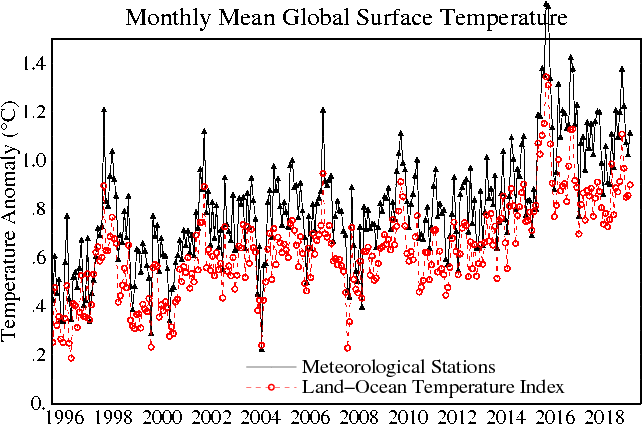
As such, here’s NASA’s Goddard Institute for Space Studies (GISS) Monthly Mean Surface Temperature Anomaly – 1996 to Present;
NOAA’s National Climate Data Center (NCDC) Annual Global Mean Temperature Anomaly Over Land & Sea – 1880 to Present;

Note: The chart above hasn’t been updated with 2011 data for unknown reasons. The chart resides here and the data to update it is here. It appears that a significant decline in temperatures occurred during the last 15 months:
2010 1 0.6335
2010 2 0.6708
2010 3 0.7815
2010 4 0.7518
2010 5 0.7064
2010 6 0.6764
2010 7 0.6581
2010 8 0.5783
2010 9 0.4975
2010 10 0.5655
2010 11 0.7182
2010 12 0.4226
2011 1 0.3962
2011 2 0.4200
2011 3 0.5226
2011 4 0.5894
2011 5 0.5093
2011 6 0.5882
2011 7 0.5687
2011 8 0.5401
2011 9 0.5264
2011 10 0.5739
2011 11 0.4347
2011 12 0.4800
2012 1 0.3630
2012 2 0.3678
(Source: NOAA NCDC)
UK Met Office’s – Hadley Center – Climate Research Unit (CRU) Annual Global Average Land Temperature Anomaly – 1850 to Present;

and the UK Met Office – Hadley Center – Climate Research Unit (CRU) Monthly Global Average Land Temperature – 1850 to Present

Depending on the time frame, it certainly seems that Earth’s surface temperature has increased, though it does not appear to be “warming rapidly”. Furthermore, the surface temperature record is burdened with issues of questionable siting, changes in siting, changes in equipment, changes in the number of measurement locations, modeling to fill in gaps in measurement locations, corrections to account for missing, erroneous or biased measurements, and the urban heat island effect. Thus to see the big picture on the temperature Earth’s temperature, it helps to also look up.
Atmospheric Temperatures:
Since 1979 the temperature of Earth’s “climate” has also been measured via satellite. “The temperature measurements from space are verified by two direct and independent methods. The first involves actual in-situ measurements of the lower atmosphere made by balloon-borne observations around the world. The second uses intercalibration and comparison among identical experiments on different orbiting platforms. The result is that the satellite temperature measurements are accurate to within three one-hundredths of a degree Centigrade (0.03 C) when compared to ground-launched balloons taking measurements of the same region of the atmosphere at the same time.” NASA
The following are 4 Temperature Anomaly plots from Remote Sensing Systems (RSS), each one increases in altitude as is illustrated here:

RSS Temperature Lower Troposphere (TLT) – Brightness Temperature Anomaly- 1979 to Present;

RSS Temperature Middle Troposphere (TMT)- Brightness Temperature Anomaly- 1979 to Present;

RSS Temperature Troposphere / Stratosphere (TTS) -Brightness Temperature Anomaly- 1987 to Present;

RSS Temperature Lower Stratosphere (TLS) – Brightness Temperature Anomaly – 1979 to Present:

According to Remote Sensing Systems, “For Channel (TLT) (Lower Troposphere) and Channel (TMT) (Middle Troposphere), the anomaly time series is dominated by ENSO events and slow tropospheric warming. The three primary El Niños during the past 20 years are clearly evident as peaks in the time series occurring during 1982-83, 1987-88, and 1997-98, with the most recent one being the largest.” RSS
Also, the 2009 – 10 El Niño event is also called out on this RSS Latitudinal Temperature Lower Troposphere (TLT) Brightness Temperature Anomaly from 1979 to Present;

and the 1998 El Niño event, along with the tropospheric cooling attributed to the 1991 eruption of Mt Pinitubo, is called out on this University of Alabama – Hunstville (UAH) Lower Atmosphere Temperature Anomalies – 1979 to Present:

Note that in March the UAH Lower Atmosphere Temperature Anomaly was 0.11 degrees C above the 30 year average, and the RSS Lower Troposphere Brightness Temperature was 0.075 degrees C above the 30 year average. Keep this mind the next time you see claims that recent weather was caused by Global Warming.

There are also regional variations in Lower Troposphere that contribute nuance to the picture. For example, RSS Northern Polar Temperature Lower Troposphere (TLT) Brightness Temperature Anomaly;

shows a .334 K/C per decade increase, whereas the The RSS Southern Polar Temperature Lower Troposphere (TLT) Brightness Temperature Anomaly;

shows a .011 K/C per decade decrease. I am still not aware of a compelling explanation for the significant divergence in the Lower Troposphere temperature trends between the poles.
The satellite record seems to show slow warming of Lower and Middle Tropospheric temperatures, overlaid with the El Niño/La Niña Southern Oscillation (ENSO) cycle, including four comparatively large El Niño events. Lower Tropospheric temperatures appear to have flattened since the large El Niño in 1998 and offer no indication of Earth “warming rapidly”.
Moving higher in the atmosphere, RSS Temperature Troposphere / Stratosphere (TTS) – Brightness Temperature Anomaly- 1987 to Present;
has been incredibly flat since, with a trend of just -.010 K/C per decade. The 1997-98 and 2009 – 10 El Niño events are still readily apparent in the plot, as is a spike from the 1991 eruption of Mt. Pinatubo. Note that the effect of Mt. Pinatubo is the opposite in the Lower and Middle Troposphere versus the Troposphere / Stratosphere (TTS), i.e. “Large volcanic eruptions inject sulfur gases into the stratosphere; the gases convert into submicron particles (aerosol) with an e-folding time scale of about 1 year. The climate response to large eruptions (in historical times) lasts for several (2-3) years. The aerosol cloud causes cooling at the Earth’s surface, warming in stratosphere.”
Ellen Thomas, PHD Wesleyan University
It is interesting that, incorporating the impact of three significant surface driven warming events, Troposphere / Stratosphere Temperatures (TTS) have been quite stable, however there is nuance to this as well.
RSS Northern Hemisphere Temperature Troposphere / Stratosphere (TTS) – Brightness Temperature Anomaly- 1987 to Present;

has been increasing by .046 K/C per decade, whereas the RSS Southern Hemisphere Temperature Troposphere / Stratosphere (TTS) – Brightness Temperature Anomaly- 1987 to Present;

has been decreasing by -.066 K/C per decade.
Moving higher still in the atmosphere, the RSS Temperature Lower Stratosphere (TLS) – Brightness Temperature Anomaly – 1979 to Present;
“is dominated by stratospheric cooling, punctuated by dramatic warming events caused by the eruptions of El Chichon (1982) and Mt Pinatubo (1991).” RSS
The eruptions of El Chichon and Mt Pinatubo are readily apparent in the Apparent Atmospheric Transmission of Solar Radiation at Mauna Loa, Hawaii:

“The stratosphere” … “in contrast to the troposphere, is heated, as the result of near infrared absorption of solar energy at the top of the aerosol cloud, and increased infra-red absorption of long-wave radiation from the Earth’s surface.”
“The stratospheric warming in the region of the stratospheric cloud increases the latitudinal temperature gradient after an eruption at low latitudes, disturbing the stratospheric-troposphere circulation, increasing the difference in height of the troposphere between high and low latitudes, and increasing the strength of the jet stream (polar vortex, especially in the northern hemisphere). This leads to warming during the northern hemisphere winter following a tropical eruption, and this warming effect tends to be larger than the cooling effect described above.” Ellen Thomas, PHD Wesleyan University
The Lower Stratosphere experienced “dramatic warming events caused by the eruptions of El Chichon (1982) and Mt Pinatubo (1991).” RSS “The long-term, global-mean cooling of the lower stratosphere stems from two downward steps in temperature, both of which are coincident with the cessation of transient warming after the volcanic eruptions of El Chichon and Mt. Pinatubo.” … “Here we provide observational analyses that yield new insight into three key aspects of recent stratospheric climate change. First, we provide evidence that the unusual step-like behavior of global-mean stratospheric temperatures is dependent not only upon the trend but also on the temporal variability in global-mean ozone immediately following volcanic eruptions. Second, we argue that the warming/cooling pattern in global-mean temperatures following major volcanic eruptions is consistent with the competing radiative and chemical effects of volcanic eruptions on stratospheric temperature and ozone. Third, we reveal the contrasting latitudinal structures of recent stratospheric temperature and ozone trends are consistent with large-scale increases in the stratospheric overturning Brewer-Dobson circulation” David W. J. Thompson Colorado State University
Above the Stratosphere we have the Mesosphere and Thermosphere, neither of which have I identified current temperature time series for, but of note is that on “July 15, 2010” “A Puzzling Collapse of Earth’s Upper Atmosphere” occurred when “high above Earth’s surface where the atmosphere meets space, a rarefied layer of gas called “the thermosphere” recently collapsed and now is rebounding again.”

“This is the biggest contraction of the thermosphere in at least 43 years,” says John Emmert of the Naval Research Lab, lead author of a paper announcing the finding in the June 19th issue of the Geophysical Research Letters (GRL). “It’s a Space Age record.”
The collapse happened during the deep solar minimum of 2008-2009—a fact which comes as little surprise to researchers. The thermosphere always cools and contracts when solar activity is low. In this case, however, the magnitude of the collapse was two to three times greater than low solar activity could explain.
“Something is going on that we do not understand,” says Emmert.
The thermosphere ranges in altitude from 90 km to 600+ km. It is a realm of meteors, auroras and satellites, which skim through the thermosphere as they circle Earth. It is also where solar radiation makes first contact with our planet. The thermosphere intercepts extreme ultraviolet (EUV) photons from the sun before they can reach the ground. When solar activity is high, solar EUV warms the thermosphere, causing it to puff up like a marshmallow held over a camp fire. (This heating can raise temperatures as high as 1400 K—hence the name thermosphere.) When solar activity is low, the opposite happens.” NASA
In summary, Earth’s Lower and Middle Troposphere appear to have warmed slowly, overlaid with the El Niño/La Niña Southern Oscillation (ENSO) cycle, including four comparatively large El Niño events, and tempered by the cooling effects of the eruption of El Chichon (1982) and Mt Pinatubo (1991). Lower and Middle Tropospheric temperatures appear to have flattened since the large El Niño in 1998 and offer no indication of “warming rapidly”. Tropospheric / Stratospheric temperatures appear to have been influenced by at least three significant surface driven warming events, the 1997-98 El Niño, and the eruptions of El Chichon in 1982 and Mt Pinatubo in 1991, but to have maintained a stable overall trajectory. Stratospheric temperatures appear to have experienced two “dramatic warming events caused by the eruptions of El Chichon (1982) and Mt Pinatubo (1991).”, and “unusual step-like behavior of global-mean stratospheric temperatures” which has resulted in a significant stratospheric cooling during the last 30 years. Lastly, “during deep solar minimum of 2008-2009” “the biggest contraction of the thermosphere in at least 43 years” occurred and “The magnitude of the collapse was two to three times greater than low solar activity could explain.”
Ocean Temperatures:
“The oceans can hold much more heat than the atmosphere. Just the top 3.2 metres of ocean holds as much heat as all the world’s air.” Commonwealth of Australia – Parliamentary Library
As such, changes in Oceanic Oscillations, and Ocean Heat Content are critical to understanding “Earth’s Temperature”. Here is NOAA’s NODC Global Ocean Heat Content from 0-700 Meters – 1955 to Present;

and here is the same from Ole Humlum’s valuable climate data site Climate4you.com, NODC Global Ocean Heat Content – 0-700 Meters – 1979 to Present:

It seems apparent from the plots above that Global Ocean Heat has increased over the last several decades, however Global Ocean Heat doesn’t appear to be “warming rapidly”. Furthermore, there is no evidence or indication of an increasing or accelerating rate, deceleration would appear to be a more accurate label.
Sea Level:
“Global sea level is currently rising as a result of both ocean thermal expansion and glacier melt, with each accounting for about half of the observed sea level rise, and each caused by recent increases in global mean temperature. For the period 1961-2003, the observed sea level rise due to thermal expansion was 0.42 millimeters per year and 0.69 millimeters per year due to total glacier melt (small glaciers, ice caps, ice sheets) (IPCC 2007). Between 1993 and 2003, the contribution to sea level rise increased for both sources to 1.60 millimeters per year and 1.19 millimeters per year respectively (IPCC 2007).” Source NISDC
Global Mean Sea Level Change – 1993 to Present:

Global Mean Sea Level Change Map with a “Correction” of 0.3 mm/year added May, 5th 2011, due to a “Glacial Isostatic Adjustment (GIA)” – 1993 to Present:

Snow and Ice:
A proxy often cited when measuring “Earth’s Temperature” is amount of Snow and Ice on Earth. According to the United States Geographical Survey (USGS), “The vast majority, almost 90 percent, of Earth’s ice mass is in Antarctica, while the Greenland ice cap contains 10 percent of the total global ice mass.” Source USGA However, there is currently there is no generally accepted measure of ice volume, as Cryosat is still in validation and the accuracy of measurements from Grace are still being challenged. Sea Ice Area and Extent are cited as proxies for “Earth’s Temperature” is Sea Ice Area, however there is significant evidence that the primary agents of change in Sea Ice Area and Extent are in fact wind and Atmospheric Oscillations. With this said, here are
Global, Arctic & Antarctic Sea Ice Area from 1979 to Present;

Global Sea Ice Area Anomaly – 1979 to Present:

Northern Hemisphere Sea Ice Area Anomaly, 1979 to Present;

Southern Hemisphere Sea Ice Area Anomaly, 1979 to Present;

Arctic Sea Ice Extent – 15% or greater

Antarctic Sea Ice Extent – 15% or Greater

There appears to have been a negative trend in Northern Hemisphere Sea Ice Area and Extent and a positive trend in Southern Hemisphere Sea Ice Area and Extent, thus the resultant Global Sea Ice Area trend appears to be slightly negative.
In terms of land based data, here is 20 Year Northern Hemisphere Snow Cover with 1995 – 2009 Climatology

Northern Hemisphere Snow Cover Anomalies 1966 – Present

Northern Hemisphere Winter Snow Extent – 1967 to Present:

Northern Hemisphere Spring Snow Extent – 1967 to Present:

Northern Hemisphere Fall Snow Extent – 1967 to Present:

While neither Snow plot offers a global perspective, when looking at the Northern Hemisphere, there appears to have been a slight increase in Snowcover and Winter Snow Extent, a decrease in Spring Snow Extent and no change in Fall Snow Extent over the historical record.
Based on the limited Global Ice and Snow measurements available, and noting the questionable value of Sea Ice Area as a proxy for temperature, not much inference can currently be drawn from Earth’s Ice measurements. However, there does not appear to be any evidence in Earth’s Ice measurements of rapid warming.
Conclusion:
“Earth’s Temperature” appears to have increased during the last several decades, but there does not appear to be any evidence of “rapid warming”.
Additional information on “Earth’s Temperature” can be found in the WUWT Reference Pages, including the Global Temperature Page and Global Climatic History Page
Smokey – “How much is that in Olympic sized swimming pools?”
And how many rubber ducks could float in them?
Thanks for displaying the Arctic Sea Ice Extent to present day, please see: http://nsidc.org/arcticseaicenews/
The Arctic Ice seems to be doing quite well, actually! I’m looking forward to further data later on in this melt season.
Please check out some of the temps in the Arctic here, there are still some COLD temps being reported! http://www.athropolis.com/map2.htm
wrt the chart for the “Northern Hemisphere Spring Snow Extent – 1967 to Present”
It seems to me the current trend is not much different than the late 1980’s thru the early 1990’s. Why not just use an average somewhere around 30.5 or so? Looks like everything would still be about +/- a few points. Although my guess is it’s not linear I don’t believe we have near enough data to even guess what’s happening. The slope of the 1990 chart must have been horrifying. And not to mention 1967 to 1968. Wonder what happened there?
Maybe I wasn’t clear enough in my earlier comment. I was responding to your comment that you couldn’t understand the difference between arctic and antarctic trends.
There is plenty of evidence to show a hemispheric disparity in pollutants, my own monitoring indicates for example that in the 1990s the hemispheric background of ozone in the Northern Hemisphere was trending towards the high 30s ppb (not urban, but that blowing off the ocean), whilst the Southern Hemisphere shows a background of approximately 27 ppb. This is a disparity in background ozone concentration of approximately 10 ppb. see J.J.West et al., Geophysical Research Letters, Volume 34, 2007 for another discussion, which isn’t great because of all the modelling.
The point is that background ozone is merely a marker of the presence (effect) of anthropogenic pollution (in the absence of other contributors). It also indicates that it takes a considerable time for the two hemispheres to mix.
Given the disparity in ozone (and hence other anthropogenic pollutants) between the hemispheres, I am not surprised to find a disparity in hemispheric temperature trends between the Northern and Southern Hemisphere.
At this point I speculate that maybe there is some link between anthropogenic emissions and the differences in warming between the hemispheres, but as I note, proving this is way beyond my ability. I also note that there is a significant difference in Land:Sea Ratios.
Has no-one found a difference in CO2 between the hemispheres?
I followed your link to the SkS article and was thoroughly unimpressed with their account. The global temp graph where they claim that it is possible to cherry pick a flat decade over the entire warming period is hiliarious since the steps they pick get closer together as the warming slows
towards the end of the graph.
They try to claim that a good measure of “rapid warming” is to compare the 1C change over a millenia during an interglacial period which is 0.01C per decade, as they say, with the current 0.08C per decade over the last hundred years! This cherry is so big that they must have invented new equipment to pick it. Is it really OK to compare a trend over a millenium with a trend over a century now?
They prattle on about snow extent, but don’t even bother to make a mention of the southern hemisphere whilst accusing skeptics of ignoring two months. What’s less relevant? Half the world or half the months, guess it’s whatever suits the narrative.
Then of course there is sea ice. Where Antarctic Ice is increasing due to “complex reasons” which of course do not exist when looking at decreasing sea ice, ’cause that’s global warming obviously. As far as I knew we were coming off an unusual high arctic ice extent in historical terms. Or is this wrong?
Lastly we get to heat content, which I confess I know little about, but seems to be an odd way of measuring actual warming, especially since as Willis has shown us with his posts on volcanoes, a change in thermal input doesn’t necessarily equate to a change in surface temperature. I would like to hear other people’s input on the relevance of heat content though and where it fits in the scheme of things.
Allan
It appears that a significant decline in temperatures occurred during the last 15 months:
They say a picture is worth a thousand words. See the graphs below for slopes for four data sets from the start of 2010 to date.
http://www.woodfortrees.org/plot/hadcrut3gl/from:2010/plot/hadcrut3gl/from:2010/trend/plot/rss/from:2010/plot/rss/from:2010/trend/plot/uah/from:2010/plot/uah/from:2010/trend/plot/gistemp/from:2010/plot/gistemp/from:2010/trend
Darn. You mean it isn’t warming much? I was so hopeful that we’d head back to the halcyon days of the Holocene Optimum. I’m beginning to think all the excess CO2 I’m generating isn’t up to the job.
Edit note:
Decrease your use of ‘c’, Increase your use of ‘s’, and cease misspelling ‘cease’ as ‘ceace’.
>:(
Correction: “cease misspelling ‘crease’ as ‘creace’.
;p
We can’t even measure the earth’s temperature. I know that. That was the first thing I learned here and no one can convince me otherwise.
I also know that all my fruit froze again in buds this year, and according to the nearest approved weather station in our small town, a mile away, it was impossible.
the fact these people told us more than a decade ago that AGW had overridden natural variation is prima facia evidence they are basically clueless about what is really going on. There can be no recovery for that claim now. The books are closed on it. They have been proven unreliable.
Roger says:
April 15, 2012 at 6:13 pm
Recommend postees ALWAYS do a spell check. These guys (warmists) will hammer you to no end.
One of ’em took me to task last year for omitting a preposition in the middle of a rather large paragraph. He retreated after I put “[sic]” after each of *his* grammatical goofs.
Goldie says:
April 15, 2012 at 8:46 pm
Has no-one found a difference in CO2 between the hemispheres?
================================================
Yes, they have. But, it leaves one in the same discussion. Land vs water. Here’s some surface temps to play with….. http://www.woodfortrees.org/plot/hadcrut3nh/from:1987/mean:12/plot/hadcrut3sh/from:1987/mean:12/plot/hadsst2nh/from:1987/mean:12/plot/hadsst2sh/from:1987/mean:12
I for one am glad I do not live in the Little Ice Age and have been lucky enough to live in a time when natural climate cycles have bounced the temperature back to the more ‘normal’ levels of the short (~10,000 years) Holocene Period.
Just the Facts has demonstrated what most of us – alarmists excluded – knew already:
1. The Earth has warmed a little over the last century and the global temperature now appears to be stabilising, or even declining.
2. Taking the polar ice cap cover, no big deal here, just a little less than ‘normal’ in the Arctic and a little more than ‘normal’ in the Antarctic. I am a little puzzled by one thing here, WUWT’s charts show an abnormally warm 2011/12 winter for the Arctic, yet ice cover is now more extensive than in recent years.
3. Any global temperature signature induced by the activities of man is almost not apparent. My own belief is that if man has affected global temperature, then agriculture and irrigation are as much to blame as CO2.
4. Ocean levels continue to rise extremely slowly and the rate of increase is nearly constant, although some deceleration is increasingly apparent in recent years.
So what does this all mean?
Any reason for alarm on climate change? As climate change is part of the natural order of things, it is difficult to say “Yes” to that.
Is the global warming industry a hoax perpetuated by self interest? Difficult to say “No” to that.
Do we need to spend trillions of dollars on a non-problem to support the theories of those tainted by issues of self interest (comfortable lifestyles, fame, large salaries, huge grants, etc.)? Difficult to say “Yes” to that.
So either the data is going to have to be seriously adjusted in the usual well-accepted ‘climate science’ way to increase the impression of imminent catastrophe, or the whole global warming industry is going to steadily wither and die.
Why would “global warming” influence Spring Snow Extent, but not Fall or Winter Snow Extent?
It wouldn’t. This is clearly an increased solar insolation effect.
KR says:
“If that energy went into the atmosphere it would have warmed by >40C, two Hiroshima bombs/second, enough energy (over the last 50 years) to boil Sydney Harbor completely dry – every 12 hours from full up”
I guess “Trenberth’s missing heat” isn’t in Sydney Harbor, then.
A lot of sensible people think it is now further away than Alpha Centauri.
Someone left the cake out in the rain…and the bloody icing froze:
http://www.guardian.co.uk/environment/2012/apr/15/karakoram-glaciers-grown-research
More sweet green icing freezing up:
http://www.guardian.co.uk/environment/blog/2012/feb/09/glaciers-ice-melting-climate-change?INTCMP=ILCNETTXT3487
“Earth’s Temperature” appears to have increased during the last several decades, but there does not appear to be any evidence of “rapid warming”.
What constitutes “rapid” and why? The question is perhaps worth some thought. Is rapid twice normal? Ten times? Is rapid less than 100 years to some critical threshold? Is it a rate beyond which key eco-systems may not be able to adapt? Does it imply adverse economic effects due to agricultural stress or infrastructure relocation within 50 years? Clearly, “rapid” will have different meanings depending on the criteria of interest.
Foster & Rahmstorf 2011 (http://www.skepticalscience.com/foster-and-rahmstorf-measure-global-warming-signal.html) calculate the underlying global temperature trend (when known causes of short term volatility are backed out) to be between 0.14C/decade and 0.18C/decade since the beginning of the satellite era. If this were to persist, would any of the readership consider it “rapid”?
Researchers are said to be shocked by a new study published in Nature that has found the world’s largest mountain chain, which stretches from the Himalayas to Tian Shan on the border of China and Kyrgyzstan, has lost no ice over the past decade.
Translation: “Researchers are said to be shocked that Nature would commit climate heresy by publishing a study which found that Himalayan glaciers have lost no ice over the past decade.”
George E. Smith says:
April 15, 2012 at 1:57 pm
Well I would have found the graphs more interesting, if they had not been corrupted by extraneous, and uninformative noise additions. Specifically those silly straight lines imposed on the graphs,
Well said sir! Get ’em off!
Generally, when referring to Earth’s “climate” warming, proponents of the Catastrophic Anthropogenic Global Warming (CAGW) narrative, refer to Earth’s Surface Temperature, e.g. “Global warming is the unusually rapid increase in Earth’s average surface temperature over the past century primarily due to the greenhouse gases released by people burning fossil fuels.” NASA Earth Observatory
—————————-
NO!
Global Warming (GW) is an increase in the earth’s temperature.
Anthropogenic Global Warming (AGW) is the temperature increase being CAUSED BY MAN.
Catastrophic Anthropogenic Global Warming (CAGW) is the increase being caused by man is causing catastrophic devastation upon our earth.
I’d like to know what the people making these stupid decisions (our elected leaders) believe.
It could also indicate a tighter circulation pattern which restricts the extent to more northern latitudes. Less extent doesn’t imply less volume.
Ammonite says:
April 16, 2012 at 3:35 am
“Earth’s Temperature” appears to have increased during the last several decades, but there does not appear to be any evidence of “rapid warming”.
What constitutes “rapid” and why?
You tell us – would the graduations be:
slight warming
gradual warming
steady warming
rapid warming
or similar?
Would “appears to have increased during the last several decades” be more in line with “slight warming”?
In any event, what is happening sure doesn’t match what the CAGW by CO2 folks predicted/projected at all, especially during a time when the atmospheric CO2 levels are “steadily increasing”.
🙂
I cannot buy into any run away warming. The reason is that if that claim is true, and warmer begets even warmer, then El Nino events would trigger even greater warming. Since the earth returns to a norm after El Nino, then there is no apparent run away mechanism in place to
warrant a claim that there is going to be catestrophic global warming. It is clear the oceans are the ruler of global temps and where the oceans get there heat is the answer.
I’ll be keeping my sheep skin coats, etc.
From what I’ve see it looks like the average temp for the earth has been about 12.5C fro the last million years or so. I’d like it warmer, please.