Live at 1PM ET: Nepal Disaster – The Climate Realism Show #214

The Heartland Institute

.
The Heartland Institute

The scenes coming out of Nepal of the glacier collapse and flash flood of mud, ice, and water are horrifying. The amount of devastation is almost hard to fathom, and the landscape is changed forever. Mainstream media outlets are blaming the disaster on climate change, and pointing to human activity warming the globe as the top cause. We will expose the truth.

On Episode 214 of The Climate Realism Show the Heartland Institute’s Sterling Burnett, Jim Lakely, and special guests Craig Rucker of CFACT and Marlo Lewis will also cover some other Crazy Climate News of the Week. Psychology Today says global warming causes child abuse. The White House is ditching climate doom. And are even the green weenies of Europe giving up climate as a political issue?

Join us Friday at 1 p.m. ET on YouTube, Rumble, X, and Facebook. Participate in the show by leaving your comments and questions in the chat.

The climate data they don't want you to find — free, to your inbox.
Join readers who get 5–8 new articles daily — no algorithms, no shadow bans.
5 7 votes
Article Rating
Subscribe
Notify of
51 Comments
August 28, 2026 9:54 am

Paleo-Events: Radiocarbon and cosmogenic radionuclide (10Be) dating across the Himalayas, Karakoram, and Pamir ranges reveal dozens of massive Holocene rock-ice avalanches. Some of these historic slope failures involved volumes exceeding tens to hundreds of millions of cubic meters—orders of magnitude larger than recent events.

Natural River Damming: Over the last 10,000 years, rock and ice collapses have repeatedly dammed major trans-Himalayan river systems (including the Indus, Sutlej, and Trishuli rivers), creating temporary lakes that later failed violently to form massive downstream debris flows. The modern landscape of these valleys is composed largely of ancient, consolidated debris flow terraces left behind by these exact processes. 

Reply to  idbodbi
August 28, 2026 10:37 am

CBS News was on when this broke. My comment was, “Did they blame Climate Change yet?” I was in the other room when I heard “Climate Change” Don’t know what the context was.

claysanborn
Reply to  Steve Case
August 28, 2026 12:23 pm

CBS News? I take it Steve you were monitoring them for their daily lie counts. 🙂
Clearly to me, just as CAGW was strictly political – to usurp American freedoms – the name change to “Climate Change” is political. Democrats do not care about the environment or the climate, or people for that matter, they only care about POWER. They use all manner of fear-mongering, lawlessness and malfeasance to help achieve control of people.

ResourceGuy
Reply to  Steve Case
August 28, 2026 2:54 pm

CBS News? I cut them loose decades ago. Try Ground News, Epoch News, and Straight Arrow News as replacements. And I don’t suggest one of them but many.

Ron Long
Reply to  idbodbi
August 28, 2026 12:19 pm

idbadbi, are you a Geologist? If not, I herein make you an Honorary one.

Hans Henrik Hansen
Reply to  Ron Long
August 29, 2026 8:17 am

He need not be one! 🙃

Reply to  idbodbi
August 29, 2026 12:35 pm

This is right. Such natural catastrophic events in Nepal have been endemic to the region since long. They have been documented and studied abundantly. Since 1998, Nepal has received well over US$100 million of international aid to develop flood monitoring/early-warning systems in the areas prone to such hazards. The UN, in cooperation with governmental and quasi-governmental bodies, consultants and wannabe NGOs successfully spent donors’ funds for modeling workshops, capacity-building, vulnerability assessments, building resilience, community empowerment, social inclusion, gender studies etc. However no properly functioning monitoring/early-warning system has been ever created. From what I hear, in the aftermath of the recent event, some donors have already committed another US$50 million to cope with the challenge. Well-well…

August 28, 2026 11:54 am

The first reports in New Zealand mentioned climate change, but not specifically linked to CO2.

Simon
Reply to  Ozonebust
August 28, 2026 1:14 pm

It is true that the Himalayas are loosing ice at an alarming rate though and it would hard to argue that this is not caused by a warming planet. In Nepal alone, mountains have lost nearly one-third of their total ice volume in just over 30 years. That has got to have an affect.

It is also true that this loss of ice has severe affects on the environment including:
Thawing Permafrost: Rising temperatures melt permafrost—a natural mix of soil, ice, and rock that holds steep slopes together. If they are not being held together, then there is a problem.
Glacier Retreat: As glaciers shrink and meltwater seeps into rock cracks, the mountains become less stable and more prone to sudden collapses.

ethical voter
Reply to  Simon
August 28, 2026 1:56 pm

Perhaps mountain ice has been retreating, more or less, since the end of the little ice age. Mild global warming. Probably. Co2 probably not.

Reply to  Simon
August 28, 2026 2:04 pm

Studies on Swiss glaciers show that the region has been warmer than now for most of the last 10,000 years.

comment image

—————–
.
Treelines are currently significantly lower.

comment image

Reply to  Simon
August 28, 2026 2:17 pm

South west China, also cooler than most of the last 10,000 years

comment image

India also cooler now than around 1700

comment image

Simon
Reply to  bnice2000
August 28, 2026 3:08 pm

India is generally warmer now than it was 1,700 years ago.
About 1,700 years ago (around 326 CE), during the peak of the Gupta Empire, the Indian subcontinent was experiencing a historical period known to paleoclimatologists as the Roman Warm Period. While this era featured naturally elevated global temperatures, modern industrial climate change has pushed today’s temperatures past those historic peaks

Reply to  Simon
August 28, 2026 4:25 pm

Not according to the data I posted above

Tibet is cooler than in the 1800s

Holocene-Cooling-Tibetan-Plateau-Northern-Li-2017.jpg (589×329)

Reply to  Simon
August 29, 2026 2:26 pm

It’s not what you don’t know that gets you in trouble. It’s how much you know for sure that’s just plain wrong.

Reply to  Simon
August 28, 2026 2:36 pm

The likely cause is due to record snowfall last November. This is just another indicator of the early stage of the termination of the interglacial.

Greenland is gaining ice above 2300m. The Himalayas are gaining ice above 5000m.

This is how the northern hemisphere interglacial will terminate. Top down on northern slopes; gradually shifting southward and lower as permanent ice builds.

Ice formation is energy intensive. It needs ocean heat.

Simon
Reply to  RickWill
August 28, 2026 3:06 pm

The Greenland Ice Sheet’s high-elevation interior (generally defined as regions above 2,000 to 2,300 meters) is in an approximate state of mass balance or slightly gaining ice mass from snowfall. However, this localized gain is heavily outweighed by rapid ice loss at lower elevations.

But …the Himalayas as a whole are not gaining ice above 5,000 metres. Instead, the region is experiencing rapid and accelerating ice loss across almost all elevations.

Reply to  Simon
August 28, 2026 4:50 pm

But it is accumulation at altitude that is the important factor. As more ocean surface in the northern hemisphere gets to the 30C limit, the hydrological cycle accelerates. So snowfall increase. The autumn trend is very strongly upward.

Ice is also accumulating above 5000m on the northern slopes of the Himalayas.

Glacial ice forms at high altitude above freezing, and persists because it cannot be melted by sunlight when under fresh snow or when pristine water ice.

The Interglacial will terminate by ice accumulation at altitude preferentially on northern slopes and then flow down and extend south. The process is already under way. The increasing trend in tropical sunlight started in the 13th century so taken a while to have obvious conseqnences.

Reply to  RickWill
August 28, 2026 4:28 pm

Greenland Ice volume is only a tiny bit down from its peak during the LIA

comment image

Reply to  bnice2000
August 28, 2026 4:57 pm

Have a look above 2300m. A large proportion of the plateau is actually gaining elevation.

Glaciers accumulate at the top and melt or calve at the bottom. The accumulation at the top is the more important factor than total balance.

Himalayas have a net ice loss but the northern slopes above 5000m are gaining ice mass.

The time historical horizon of current climate models is to short to offer any true evaluation of climate changed. They are built and operated by cultists, not scientists.

They have created a very dangerous cargo cult that only a few recognise for what it is.

Reply to  Simon
August 28, 2026 3:06 pm

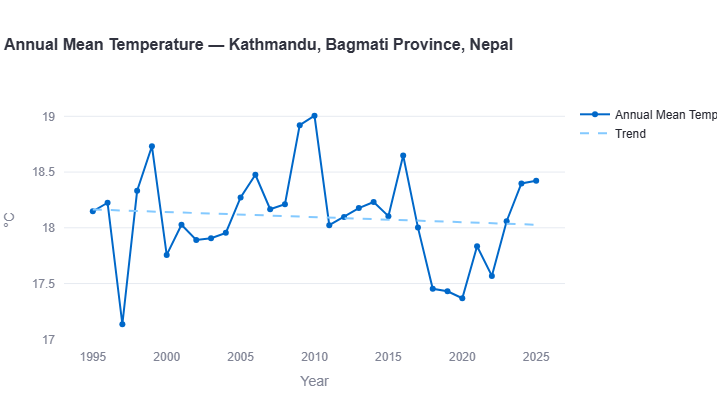
The warming trend in Kathmandu over the last 30 years is slightly down (minus 0.04c). Flat. No warming!

Simon
Reply to  climedown
August 28, 2026 4:43 pm

Don’t know where you get your info from , but The Hindu Kush Himalayan region, surrounding Kathmandu, is warming at a rate faster than many other parts of the world. Maybe you have a direct link for me?

Reply to  Simon
August 28, 2026 11:43 pm

comment image

An excerpt from the first paragraph: unlike every other South Asian capital studied so far, Kathmandu shows almost no annual warming trend at all — and two of its four seasons are actually trending cooler.

Randle Dewees
Reply to  Simon
August 29, 2026 10:49 am

but The Hindu Kush Himalayan region, surrounding Kathmandu

Might want to get your geography right before commenting. The Hindu Kush range is way over past the west end of the Himalaya. The Hind Kush Himalayan region includes the Karakoram range, at its east end, some 800 miles northwest of Kathmandu

Robertvd
Reply to  Simon
August 31, 2026 10:28 am

Every part of this planet is warming at a rate faster than any other part of the world.

CNN

Reply to  climedown
August 28, 2026 7:00 pm

Tibetan plateau cooling for 4000 years.

comment image

Simon
Reply to  bnice2000
August 28, 2026 10:46 pm

Nope.
Any natural cooling trends that occurred in past millennia have been completely overwhelmed by recent warming. Over the last several decades, the Tibetan Plateau has warmed at roughly twice the global average rate. Current temperatures are now higher than at any point observed during the last 1,000 to 2,000 years,

Simon
Reply to  bnice2000
August 28, 2026 11:05 pm

Your graph while interesting does not prove what you say.

  1. It is for a specific month – July, so not annual.
  2. It is one lakes climate, not the plateau.

But good on you for trying.

Reply to  Simon
August 28, 2026 11:45 pm

Hilarious that you think the trend only exists in July.

And that lakes cool while the surrounding areas gets warmer.

You didn’t even try !!

Reply to  Simon
August 29, 2026 6:22 am

It doesn’t include the last 75 years either!

Anthony Banton
Reply to  Simon
August 29, 2026 6:23 am

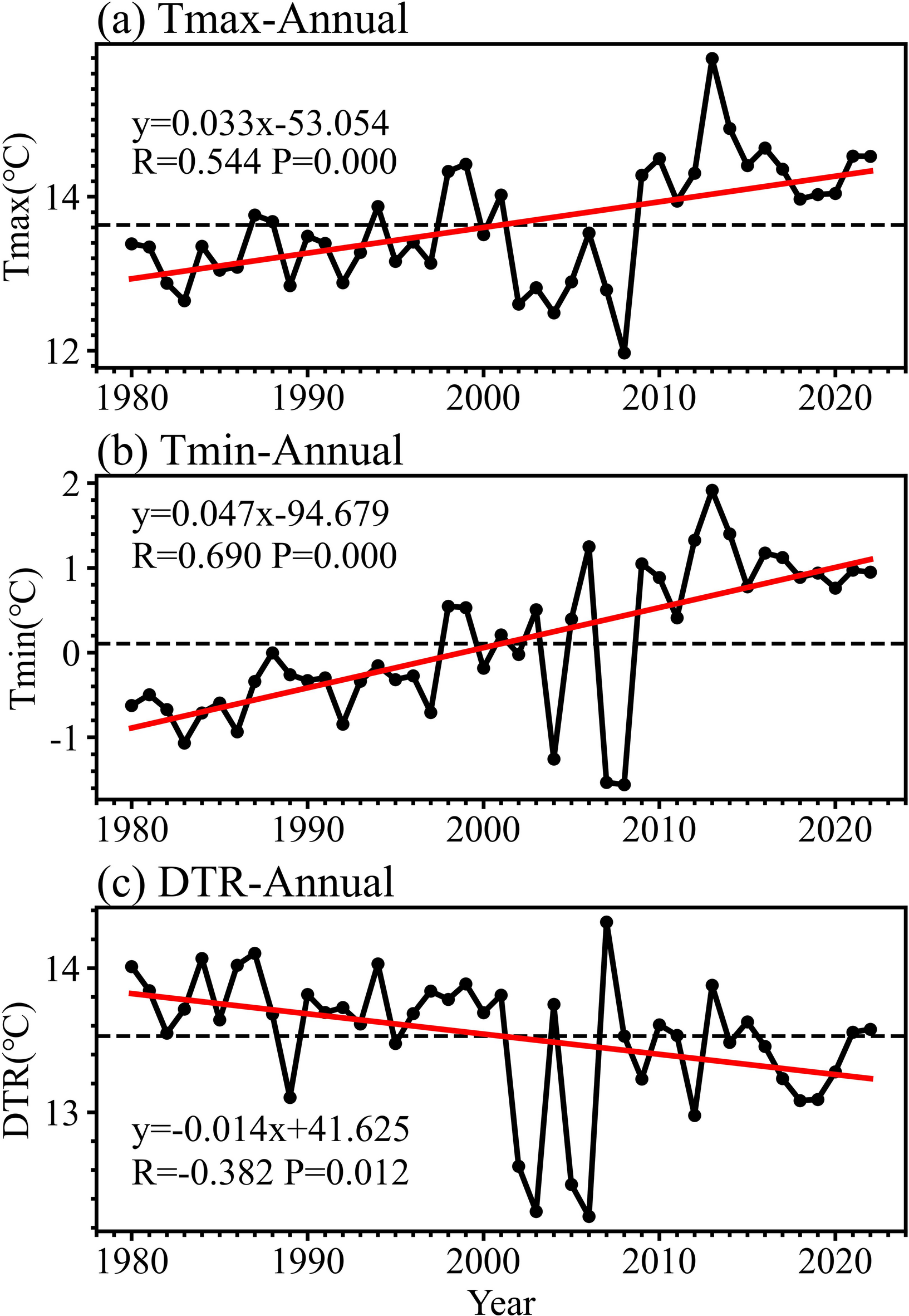
This is the paper you want Simon:

“Change in diurnal temperature range on the Tibetan plateau in the last 40 years and its influencing factors
Mei Chen, Xiaohang Wen, Maoshan Li, Xian Zhu & Juan Feng 
Scientific Reports volume 16, Article number: 13433 (2026)

https://www.nature.com/articles/s41598-026-43200-9

In 1980–2022, the annual mean Tmax and Tmin of TP increase with 0.33 °C/10a and 0.47 °C/10a respectively. The annual mean DTR showed a decreasing trend of − 0.14 °C/10a. The rates of change of Tmax and Tmin are highest during winter, reaching 0.47 °C/10a and 0.59 °C/10a, respectively, whereas the highest rate of change in DTR occurs during summer at − 0.17 °C/10a. The current temperature trend in TP is expected to persist.”

comment image

“Trends in annual mean Tmax (a), Tmin (b) and DTR (d) at TP and nearby stations based on observational data in 2000–2022.”

Simon
Reply to  Anthony Banton
August 29, 2026 11:53 am

Thank you.

Reply to  climedown
August 28, 2026 11:43 pm

News-Making Nepal Region Has Had As-Warm Or Warmer Periods Than The 2000s In The 1600s, 1700s, 1800s

5 or 6 peer-reviewed papers that confirm your comment that is basically no warming for quite a long time.

Some AGW cultists will DENY these peer-reviewed papers and say it is warming twice as fast as everywhere else. D’OH !

And a couple more for good measure..

New Study: The Lowest Tibetan Plateau Glacial Temps Were Still 3°C Warmer Than Today

Tibetan Temperature Reconstruction Shows Medieval Warm Period Was Warmer Than Today!

Simon
Reply to  bnice2000
August 29, 2026 11:15 pm

No Trick Zone. Classy. Why don’t you just quote Mad Magazine?

ethical voter
Reply to  Ozonebust
August 28, 2026 1:50 pm

Yes. I heard that and was disgusted. The morons just can’t help themselves. They will twist any tragedy to push their ignorant agenda.

August 28, 2026 12:02 pm

Regarding the U.S. data the claim is absurdly incorrect. We have the greatest number of fires, and the greatest acreage burned in the last decade.
See: https://www.nifc.gov/fire-information/nfn

Our fire problem has very little to do with climate. The biggest problem is our nation’s massive fuel loads. Please go to theforestmatters.com for more information.

Thanks

August 28, 2026 2:24 pm

blaming the disaster on climate change, and pointing to human activity warming the globe as the top cause

First part could be absolutely correct. The second part is certainly not.

Go back to November and there were records snowfall in Nepal. The upward trend in snowfall is a consequence of the increasing tropical atmospheric moisture, which is caused by increasing sunlight over the tropics.
What Happened in the Nepal Himalayas during Autumn 2025

Then the warmer summers follow and perched snow and water stress the slopes.

Slope failure is common enough in the region that China has established an early warning system but it was ineffective in the recent circumstances.

D Sandberg
Reply to  RickWill
August 28, 2026 9:46 pm

Rick, “This sounds like the kind of reasoning Lindzen would appreciate.” In 2001 he was saying the same thing about increasing sunlight in the tropics from ocean warming.

August 28, 2026 2:27 pm

I vaguely recall there was a Swiss town that basically got wiped out by a similar incident, a landslide into a dam, causing a flood of water over the dam.. Thankfully, the dam didn’t break

Was quite a while ago 1930s ??? and I can’t remember any details.

Swiss towns are regularly evacuated due to landslides and avalanches.

Reply to  bnice2000
August 28, 2026 4:30 pm

ps.. But Swiss town were often removed or buried completely as glaciers expanded leading up to the LIA.

Many towns that existed during the MWP are still somewhere under the glaciers.

Reply to  bnice2000
August 29, 2026 6:39 am

The Swiss village of Blatten was largely destroyed in May 2025 by a collapse of the Birch glacier. The residents were evacuated following some earlier rockfalls in the area and the continued movement of rock formations.

ResourceGuy
August 28, 2026 2:59 pm

I thought Norway monitors cliff and landslide risk based on structural evaluations.

August 28, 2026 3:20 pm

Now they are saying it is not climate change per se. The bedrock under the glacier gave way causing it and the glacier to fall as the cause.

Of course they had to immediately claim climate change as the cause. This is why you cannot trust that side.

https://www.yahoo.com/news/science/articles/climate-nepal-flash-floods-satellite-images-195308479.html

“Geomorphologists Kristen Cook and Dan Shugar said initial images from Nepal were obscured by clouds and dust from the debris, so they could only see that part of a glacier had broken off from Langtang Lirung peak, near the border with Tibet. In clearer images from Thursday, they said they could see that the bedrock underneath the glacier had collapsed, taking the massive chunk of ice down with it and sending boulders and ice into the valley.

“It shows the whole area without anything hidden, and we could see that, yes, it looked like there was not only this glacier that had failed, but a much larger chunk of the bedrock of the mountainside itself that had given way,” said Shugar, associate professor at the University of Calgary. “You have this big bedrock failure that took part of the glacier with it.””

Reply to  GoHome
August 28, 2026 4:31 pm

Blame the LIA….. it was that freezing cold period that built these massive glaciers.

Ice can also cause cracks in bedrock as the ice freezes and expands.

Beta Blocker
Reply to  GoHome
August 28, 2026 5:04 pm

Could an earthquake of some kind, even a small one, be the proximate event which triggered the collapse of the fractured bedrock underlying the glacier?

Nigel King
August 28, 2026 11:53 pm

It is probably impossible to predict rock or glacier failures particularly when an earthquake is involved. However, my understanding is that there was about 15 minutes between that event and the flood.

This is probably because a dam formed in the valley as a result of the material falling. Water will have built up behind the dam and then after about 15 minutes the dam broke creating the deluge that killed so many.

These areas of the Himalayas and Alps need warning systems for dams forming and alerting the lower valleys of impending deluge. My first thought was cameras with AI systems detecting new dams, but that would not work at night. I think the detection system needs to be of water flow which will first decrease before suddenly increasing as a deluge.

It would be good to brainstorm the ideas here.

Nigel King
Reply to  Nigel King
August 29, 2026 8:43 am

It seems that there was no instant dam. The debris from the glacier and mountain collapse went straight down the valley. There was only 7 mins from the collapse to the inundation. Even then a warning system needs to be designed which is triggered by the debris running down the valley.

Randle Dewees
Reply to  Nigel King
August 29, 2026 1:14 pm

I think an effective warning system includes detecting the precursors to a collapse. The situation Nepal and the other Himalayan countries are in is similar to the Pacific nations being at the mercy of earthquake tsunamis’ – before the warning system tsunamis generated even from across the pacific were a bolt from the blue, now there can be many hours warning.

Randle Dewees
Reply to  Nigel King
August 29, 2026 1:07 pm

There are satellites that do radar terrain mapping that can show very small, short term vertical displacements. These are being used to monitor dams, bridges, known land slips. A huge volume of rock has to deflect some before it fails. I’m pretty sure this collapse volume would have shown ominous vertical movement if mapped on a regular basis.

I’m not remotely a geomorphologist, but I know it is possible (possibly already done) to use computer tools to identify potential problem areas. It’s a complex region to be sure, but the attributes for potential collapse are fairly few – vertical relief and volume, glacier volume, maybe rock type and structure, and probably more. Once the problem areas are identified, start monitoring for vertical motion.

August 29, 2026 7:51 am

One must ask the right question, in order to have any chance at a useful answer:
Status of the Rainy Season (2026 Monsoon) in Nepal and surrounding territory?

Robertvd
August 31, 2026 11:12 am

How did the Nepal debris flow get so big, and what’s important about the Border Port video?

TheGeoModels