In April 2017, I noted that the total capacity of existing, under construction, approved and proposed LNG export facilities was 44 billion cubic feet per day (Bcf/d). This is the energy-equivalent of 7.8 million barrels of crude oil per day (mmBOE/d). At the time, Saudi Arabia was exporting about 7.4 mmbbl/d.
Well, the U.S. is still on track to become the Saudi Arabia of natural gas…
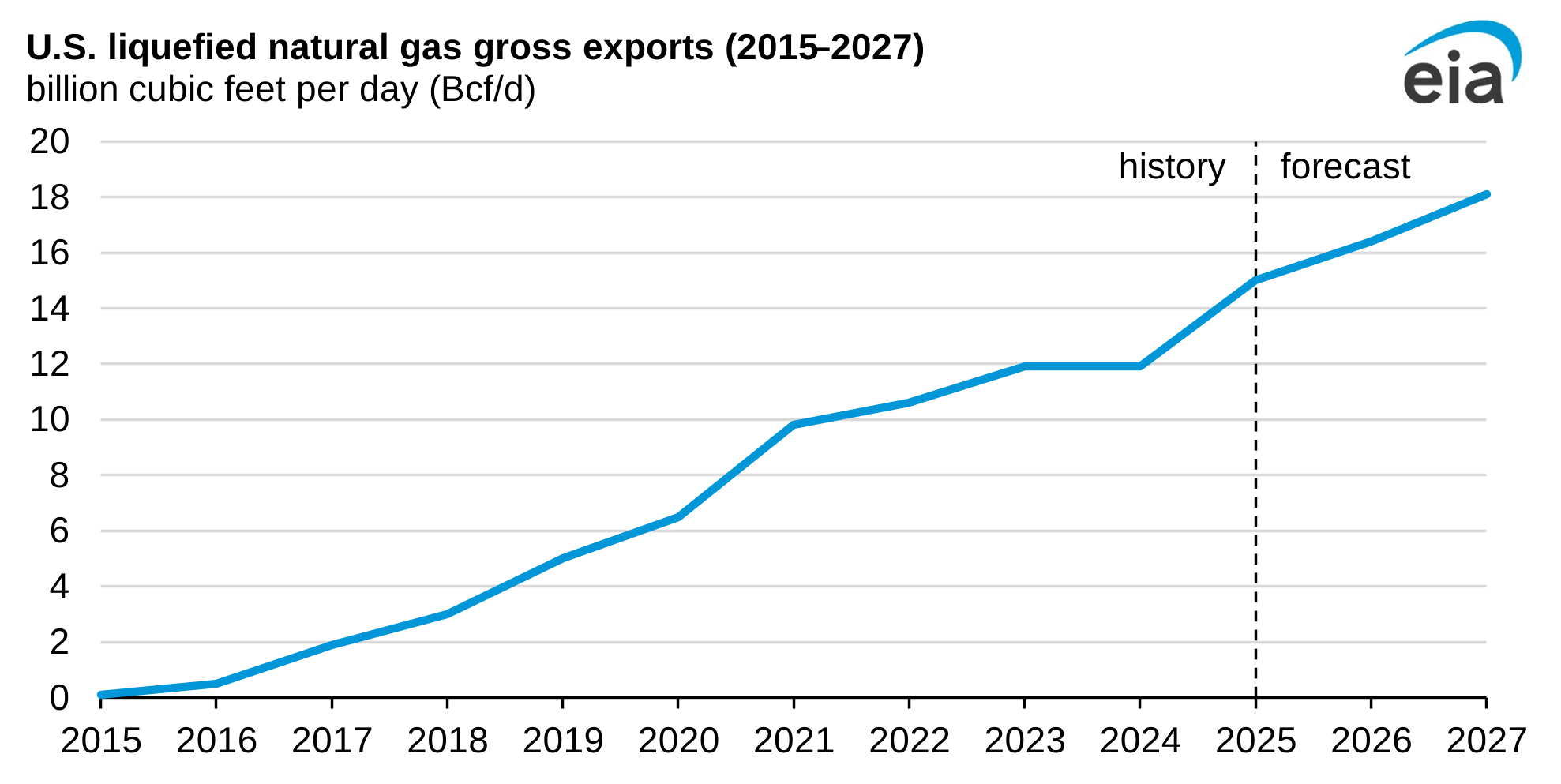
Ten years ago, on February 24, 2016, the first liquefied natural gas (LNG) cargo from the Sabine Pass Terminal was exported from the United States, marking the beginning of a new era in U.S. LNG exports. Today, the United States is the world’s largest LNG exporter, ahead of both Australia and Qatar. LNG exports surged from 0.5 billion cubic feet per day (Bcf/d) in 2016 to 15.0 Bcf/d in 2025, and in our February Short-Term Energy Outlook, we forecast U.S. LNG exports to exceed 18.1 Bcf/d in 2027. LNG exports from the United States increased for several reasons, including abundant natural gas supply and reserves, flexible LNG export contracts, and relatively low feedgas costs. In addition, increasing international demand and a favorable investment climate have supported LNG infrastructure expansions in the United States.
The United States has eight operational LNG export terminals, and by 2031 we expect export capacity to nearly double compared with December 2025. Most recently, an expansion of the Corpus Christi LNG facility shipped its first cargo in March 2025, following the startup of the Plaquemines LNG facility in late December 2024, and Golden Pass LNG is expected to ship its first cargo in early 2026.
This could take LNG exports up to 30 Bcf/d (5.3 mmBOE/d) in just five years. The current total of existing and under construction facilities is 33.67 Bcf/d (5.95 mmBOE/d). An additional 10.25 Bcf/d (1.81 BOE/d) of export capacity is currently approved for construction. In most cases, FEED (front-end engineering design) has been completed and construction contracts have been awarded. This would bring total LNG export capacity up to 43.92 Bcf/d (7.76 mmBOE/d).
Can the U.S. produce enough natural gas to export 44 Bcf/d?
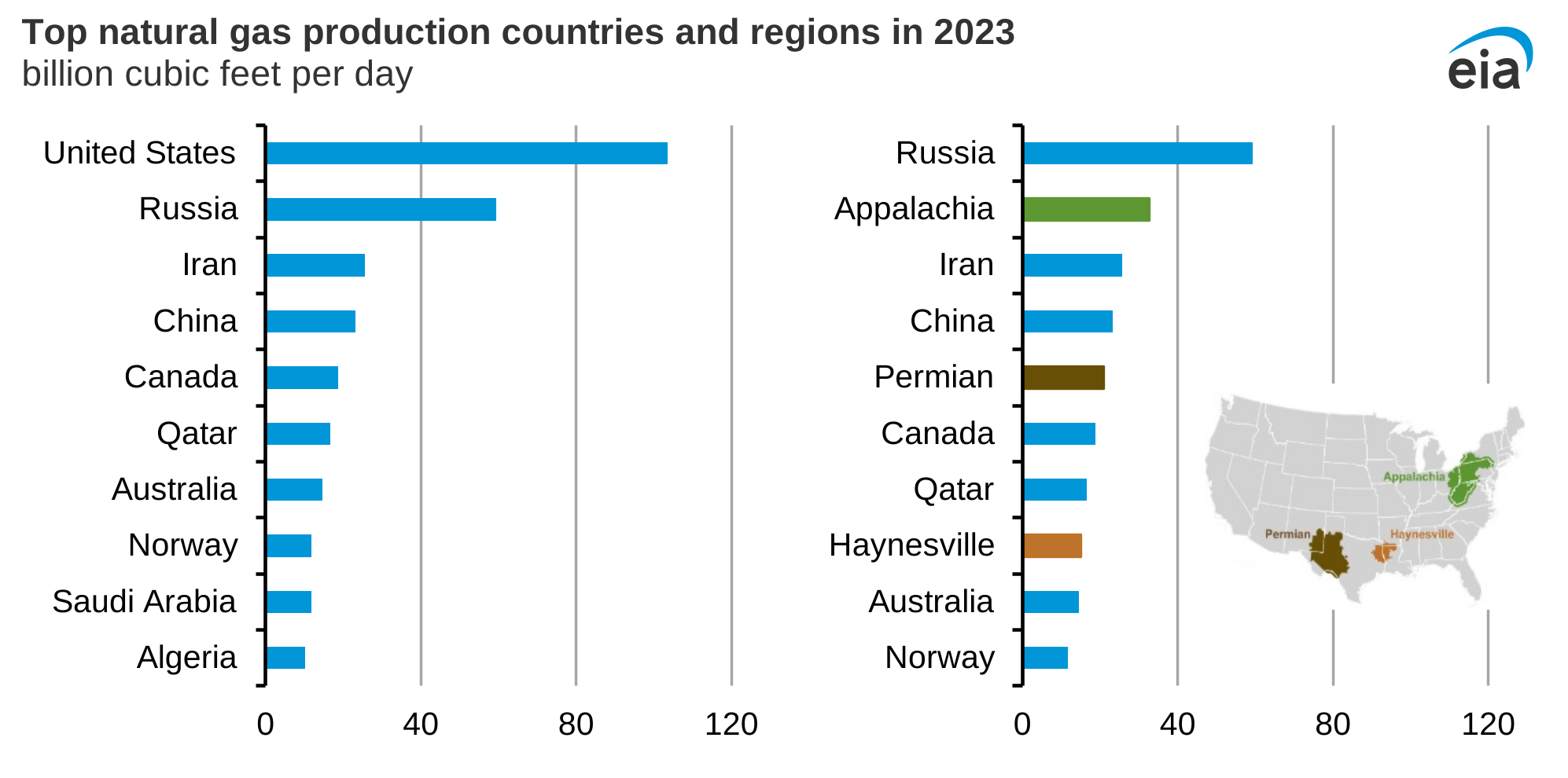
The United States produced 104 billion cubic feet per day (Bcf/d) of natural gas, 75% more than the world’s second-largest natural gas producer, Russia, in 2023, the most recent year for which we have comprehensive worldwide data on natural gas production.
The United States has been the world’s largest producer of natural gas since 2009. More recently, U.S. natural gas production has increased further, averaging 106 Bcf/d for the first half of 2025 (1H2025).
Three regions in the United States are among the top 10 natural gas-producing areas in the world when ranked independently against other natural gas-producing countries:
The Appalachia region, in the northeastern United States, encompasses the Marcellus and Utica shale plays and ranked as the second-largest producer with 33 Bcf/d in 2023. More recently, production from the region has continued to average 33 Bcf/d in 1H2025.
The Permian region, in Texas and New Mexico, ranked fifth worldwide with 21 Bcf/d in 2023. Production from the Permian has since increased to average 25 Bcf/d in 1H2025.
The Haynesville region, in Texas, Louisiana, and Arkansas, ranked as the eighth-largest natural gas-producing area with 15 Bcf/d in 2023. Production from the Haynesville has declined slightly to average 14 Bcf/d in 1H2025.
Brown = Annual Production (mmcf). Blue = Annual Consumption (mmcf). Green = Proved Reserves (Bcf). EIA
In 2024 marketed production was 41,383,893 mmcf (41,384 Bcf, 113 Bcf/d), domestic consumption was 33,055,901 mmcf (33,056 Bcf, 91 Bcf/d). Production exceeded consumption by about 21 Bcf/d. At year-end 2024, proved reserves stood at 603.6 trillion cubic feet (Tcf)… A reserves/production (R/P) ratio of 14.5.
LNG exports drive up natural gas prices… Right?
Wrong!
Natural gas prices were much higher before we began exporting LNG.
Prior to the “shale revolution,” we were a net importer of natural gas.
Blue = Natural Gas Price ($/mcf). Brown = Natural Gas Imports (mmcf). Green = Natural Gas Exports (mmcf). EIA
The U.S. can export LNG without driving up prices because we produce far more natural gas than we consume and the delta between production and consumption is widening. MANGGA!!!
Now for the coup de grâce!
Saudi Arabia’s New U.S. LNG Deal Marks a Stunning Geopolitical Reversal
Simon Watkins
Mon, 23 February 2026
The signing of a 20-year agreement for U.S. gas producer Caturus’s Commonwealth liquefied natural gas (LNG) division to supply one million tonnes per annum of LNG to Saudi Arabia’s Aramco is enormously significant both inside and outside the energy market. At a time when LNG has become the world’s most flexible instrument of energy statecraft, the decision by Aramco to lock in U.S. supply for two decades may speak to a deeper geopolitical recalibration underway in Riyadh. For Washington, meanwhile, the agreement offers a rare opportunity to re-anchor influence in a region where China and Russia have made rapid inroads over the past decade.
[…]
For Washington, this latest LNG supply deal to Saudi Arabia marks an extraordinary reversal of its previous energy dependency on the Kingdom. Since the end of the 2014-2016 Oil Price War, the U.S. has not only become the world’s number one crude oil producer by a long way, but its top natural gas producer, and LNG producer too. In an irony unlikely to be lost on President Trump, U.S. firms have been providing assistance to Saudi Arabia in the development of its landmark Jafurah shale gas development since around 2019.
It is my understanding that NY State does not allow fracking for oil and natural gas within its borders. Think about how much more we could be producing and exporting if the state did allow it in the southwest portion of the state ( its portion of the Appalachia Formation on the map above).
Maybe I’m wrong here, but it seems to me that the state is denying itself a revenue source with the ban.
Correct. My new slogan here in rural NY is Recarbonize NY! We are sitting on huge deposits of natural gas while the State is currently pushing its “Energy” “Plan” which proliferates wind + solar for electricity, with massive battery support, and mandates electrification of building heat and transportation. It is truly insane. Meanwhile, the “DEFR’s” (dispatchable emission free resources) required for electrical system reliability remain imaginary. All this while the state is presently getting 60+ percent of its electricity from natural gas and “dual fuel” facilities – which no doubt are presently on natural gas most of the time.
If New York State politicians would get out of the way our energy prices would plummet. We would have all the natural gas we need and then some. We can hope can’t we?