
More climate change myths need debunking.
There’s so much the alarmists get wrong!
In order not to miss the next video from Stossel TV, sign up here: https://johnstossel.activehosted.com/f/1
Linnea Lueken of the Heartland Institute helps us reveal the data that disproves claims of: worsening drought, worsening wildfires, catastrophic sea level rise and a dying Great Barrier Reef.
You might be surprised by what’s true and what’s not.
If you missed Part 1 you can watch it here: Climate Change Myths Part 1: Polar Be…
Transcript
Climate Change Will Make Earth a Living Hell
A living hell? Give me a break! Our last video debunked some hysterical claims about our warming climate, but there are more. Here’s myth #4.
Across the world, climate change is worsening droughts. Droughts are absolutely not getting worse. Heartland research fellow Linnea Lueken studies extreme weather. The media loves to share stories when there is a major drought somewhere, some very specific location. More of the Northeast is now under extreme drought conditions. But here’s the thing: They will completely ignore previous years where there were record low amounts of drought. Every single individual drought that occurs in the United States or anywhere in the world is not evidence of catastrophic climate change. It’s weather.
Globally, there’s been no increase in drought, and in the US, the EPA acknowledges, the last 50 years have been wetter than average. Drought was way worse in the 1930s. [dust storm] It sure was. Then, part of America was called the “Dust Bowl.” The Dust Bowl belongs on the list of the top 3, 4, or 5 environmental catastrophes in world history.
But somehow, silly people at NBC news now cite climate change as the reason for California wildfires. Historic drought is the perfect fuel for these epic conditions. [fire burning] But it’s climate change creating infernos larger than ever. Definitely not larger than ever, there’s been a modest uptick since the 1980s. But the early 1980s also happen to be the lowest recorded wildfire years in US wildfire history. The alarmists like to start their comparisons during those record low years. This graph shows the increase in the area burnt by fires in the US since 1983. This chart does make it look like wildfires are increasing. But go back just a little further, and you see fires in the past burned much more.
Still: It is warmer now, and that plays a part. One degree of change does not dry out all of the brush in California. The real driver of these issues is mostly going to come down to land management. [chainsaw] [tree falling] Bad land management. California restricts clear cutting—removing most trees in an area—and they don’t let small fires burn. This is the overgrowth that’s been accumulating in these forests for the past century because people have been putting out fires instead of letting them burn, the way they naturally used to. [fire] So, fires grow bigger. And affect more people, not because of climate change, but because: There’s more suburban sprawl. Meaning there are more people out grilling and knocking their Weber over when they’re trying to make hamburgers or whatever and causing grass fires.
[waves] But what about climate change causing sea levels to rise? Yet another bleak picture of what could happen in these United States if global leaders don’t take action to stop climate change. Global leaders, whoever they are, could stop climate change? It’s so dumb it deserves a video by itself, but I’ll limit this to just myth 6: Sea level rise will soon cause catastrophic damage. This is what would happen to the sea level in Florida. The sea level rise is real. Sea level rise is absolutely occurring, but it’s been slow. It’s at about an inch a decade or a foot per century. There’s no way that people wouldn’t be able to adapt to it. Even if it rises 3 feet per century, we can still adapt. More than 100 million people already live below sea level, because their countries did things like build dykes to hold water back. Holland did it years ago, without the modern equipment we have now.
Climate change may cause real problems. But we can adapt to them, rather than get hysterical about myths. The media love to push scare stories, but they’ve been so wrong in the past. In 2004, The Guardian claimed a secret report says: “Major European cities will be sunk beneath rising seas by 2020.” Yes, by 5 years ago. [music] Europe’s still here. In the 80s, so-called “experts” predicted rising seas will “completely cover the Maldives.” But since then: [music] The islands have grown. They’re even building new airports.
Finally, our last myth: Coral reefs are disappearing fast. By 2100, many of the world’s major reef systems may become barren boneyards. They actually cooked. And that’s because the temperatures this time around were so extreme. The Great Barrier Reef is dying. The Great Barrier Reef is doing fine. 2024 actually saw record coverage for the Great Barrier Reef. Not vanishing? Absolutely not. To the contrary. Great Barrier Reef has seen expansion in recent years. Coral did decline for a while, and alarmist scare stories predicted this, but this is what’s actually happened. It’s not surprising at all. Corals thrive in tropical conditions.
As I research this, I’m embarrassed for my profession. They just pump nonsense out. It drives me absolutely batty every time one of these claims is made, and all it takes is a quick Google search to pull up the publicly available data on any of these conditions. If the good news is so obvious, why would they keep reporting bad news? Good news doesn’t grab headlines. It also doesn’t gain research funding and grants. They’re out of business if they don’t find a problem.
Oh, absolutely. It’s taken me many years reporting to realize that the scientists who gave me the most impactful quotes, that make for great TV, were often less accurate. It wasn’t that they lied on purpose. It’s just that, the more you study a problem, the closer you are to it, the more you worry about it. And of course, if it isn’t a problem, you don’t get attention. If you want people to pay attention, you better scare them. We don’t have decades. We hardly have years.
[swoosh] If you’re skeptical that the alarmists are wrong, you can look at the sources yourself, they’re in the description. [music]
Funny, but now I see the other side pretending they’re exposing climate myths- that is, myths by AGW skeptics. Before I started reading this site regularly, and reading books like “Unsettled”- I might have believed what the following site says. But now it’s easy to deconstruct such nonsense. But unfortunately, most people can’t do that- so it seems like reliable information. The climate cult won’t go down easily- it’s struggling for its life. Lots of $$$ and careers depend on it.
On MSN.
“The 9 Most Persistent Climate Myths—and the Data That Destroys Them”
The 9 Most Persistent Climate Myths—and the Data That Destroys Them
Yesterday, at a local hardware store, WWF had set up a table to solicit donations and had at least 3 people to speak to customers.
I was also approached by a woman claiming that she needed gas money to go to Ohio to see her son. I gave her a dollar. Some scams are less costly than others.
Sea urchins are taking over the boiling oceans.
As I research this, I’m embarrassed for my profession. They just pump nonsense out. It drives me absolutely batty every time one of these claims is made..
Yes I pick out some of the constant barrage of media reports we get from the climate change industrial complex among the plethora of stinkers in residence on the taxpayer drip and find a slot for them here. They’re really coming in waves with a Federal Election nigh which has unfortunately developed into an auction of more red ink for the younguns to deal with. Pick the mob that offers you the best personal bundle of goodies it seems while we’re gaslighted with Big Australia-
(169) Australian media finds new housing scapegoat – YouTube
Simple arithmetic be damned and it’s obvious what housing/rental affordability is all about and so much for net zero by whenever the brains trust can manage it. Navel gazers and pen pushers don’t build housing roads schools and infrastructure etc and yet they’re strangling real productivity with expensive fickle energy and battery transport. Utter stupidity but we have a choice between Tweedledumb and Tweedledumber at present.
CC is just a meme to keep information deficient numpties from noticing bureaucratic mismanagement of things like flood barriers, irrigation canals, sea walls, storm sewers, storm path evacuations, basically any weather related issues. We need to be aware, as critics of such talking points, that we don’t become numpties ourselves with too-simple opposing view-points….
Yes, in Colorado we have some of the most poorly maintained roads in the country and vary poorly in general compared to those of Western nations. And yet, our state legislature is more concerned with immigrant rights, trans rights and making sure that porn is not taken out of elementary schools, etc.
“You might be surprised by what’s true and what’s not.”
Unfortunately, I’m far from surprised. Having, myself, worked in laboratories for over 20 years I have seen just how nasty [saintly] people in lab coats can be. And it could be anything from “qualification envy” to plain “utter personal dislike“, never mind “the science”.
Another thing that fails to surprise me is the the way the funding regimes hold it all together. Decent honest scientists cast out if they do not toe the line.
The only thing I can think of that really would surprise me would be reading a headline such as:
UK starts fracking and opens up new fields in the North Sea.
It’s gotta happen eventually. My limited reading of philosophy concluded that it was continental Europeans who tended to be idealists, not Brits who mostly were hard headed realists- and I liked that about them.
For whatever the reasons, Brits need to feel more pain before they give up pushing unicorn farts.
I’m sure the ordinary folks in the UK are watching carefully what happens in America and as our economy grows with new energy policies, they’ll want the same and throw out the climate whack jobs running their nation.
Neil deGrasse Tyson might have been a brilliant astrophysicist, but when he switched to Climastrology, he became a total idiot. Maybe he should have stayed in his lane.
I blame Carl Sagan…
Why? Was he a climatista?
Sagan’s foray into climate science came years before popular terms like “global warming” had caught the public’s eye. In a landmark essay in his book Cosmos, he lays the foundation for how burning ton after ton of fossil fuels is saturating the atmosphere with CO2 and could lead to a “greenhouse effect” that likely gave rise to the atmospheric conditions on Venus
https://www.scu.edu/environmental-ethics/environmental-activists-heroes-and-martyrs/carl-sagan.html
Need I say more?
He was also one of the leading proponents of the nuclear winter as the result of a nuclear war nonsense.
He was a strong advocate of the US disarming, regardless of what the Soviets or Chinese did.
A well meaning fruitloop
Sagan should and could have known better:
Did anyone ever say Tyson is brilliant? He’s mostly just a PR person. Another thing I don’t like about him is that he’s extremely against the idea of UFOs and aliens. Millions of people have seen UFOs and some have seen aliens. I had a perfect view of a UFO, part of the Hudson Valley sightings in the ’80s, seen by thousands of people. I don’t know what it was- maybe a secret military plane, but I doubt it as it was huge, low to the ground, with many lights on the underside of the V shaped craft, and made zero noise. Maybe we are being visited by ET and maybe not. But for Tyson to dismiss this topic so casually – along with his climate BS, leads me to conclude he ain’t brilliant. We could easily conclude he advanced in his career for other reasons.
A quota man?
I think it’s possible for otherwise-smart, and maybe even “brilliant” people to buy into the “climate change” pseudoscience and hype. Why they do though, is a mystery. A character flaw, perhaps. It is emotionalism vs intellectualism, and with Climastrology, it’s all about emotion. I suppose they get caught up in this fantasy that they are helping to “save the planet”. I don’t know. I also suspect that climate change belief can actually make people dumber. Perhaps there’s a research paper in there somewhere.
If you live in a region where the climate cult is very strong- it’s easy to just absorb it into your mindset- like a religion- like here in Wokeachusetts where most people hardly ever hear an alternative view. The few skeptics are portrayed as the nut jobs. And if you want to advance in your career you don’t want that label. So I also more or less believed it despite being a born skeptic of religion and government. I started to have doubts when climate whack jobs started calling for an end to all tree cutting- and with me being a forester, I didn’t appreciate that. Another forester pointed me to this site, Tony Heller’s YouTube channel and others. It finally dawned on me that the skeptics were more intelligent than those pushing the cult. When I first started reading this site maybe 6-7 years go I could barely follow the arguments since I never took a course in climate science. But now, despite still knowing less than most of the regulars here, I can easily deconstruct most climate cult BS.
Astrophysicists are the absolute epitome of how someone can get a Ph.D. on a topic of unreachable, unproveable, unknowable, sciency sounding, very speculative suppositions….and reach a level of entirely unwarranted prominence amongst science media journalists and then the public in general by publishing a book aimed at grade 10 and 11 students. Tyson, Cox, even the renowned Sagan were just guys making sciency sounding talks, well paid for their public speaking engagements….trying to maintain enough income to provide for their celebrity lifestyle. Tyson has basically become a stand-up comedian. Everything they have said or published is just discussion stuff from the grad student lounge…which they dumbed down to a book-of-the-month aisle paperback…. Interesting the first time if you’ve never taken part in grad student lounge discussions. Having had to sit in the grad lounge a few times awaiting their valuable time, I came to the conclusion that only a precious few of the people there were actually useful to humanity…
Tyson was a DEI hire from day one.
He strikes me as a pompous twit.
Certainly over-impressed with himself. That is always a risk growing up in a world of participation trophies.
What discoveries has Tyson made that leads you to believe he might be brilliant? He doesn’t make the top 50 (BBC Sky at Night Magazine) astronomers/astrophysicists list, whereas Sagan does. Is he in the same class as Hubble, Hoyle, or Hale? I suspect that he comes to mind because he is the go to guy for the Media for reasons other than his brilliance.
Climate change is not worsening fires. Well, there were no wildfires in Wisconsin when it was under a mile of ice, so I guess you could say that’s a counterexample: the Wisconsin deglaciation a hundred centuries ago increased wildfire risk there. But manmade climate change is not significantly affecting fire risk.
The main factors affecting fires are land management and forestry practices.[2] Contrary to the shockingly dishonest propaganda from some quarters (like the misnamed factcheck.org site), global warming has negligible impact on wildfires.
NASA satellites monitor fires from orbit, and they’ve measured a decreasing trend in fires. They report that, “…MODIS [satellite instruments have measured] a decrease in the total number of square kilometers burned each year. Between 2003 and 2019, that number has dropped by roughly 25 percent.” The percentage of the globe which burns each year has been declining since 2002. In 2022, the world hit a new record-low of 2.2% burned area.
Here’s a newer graph:
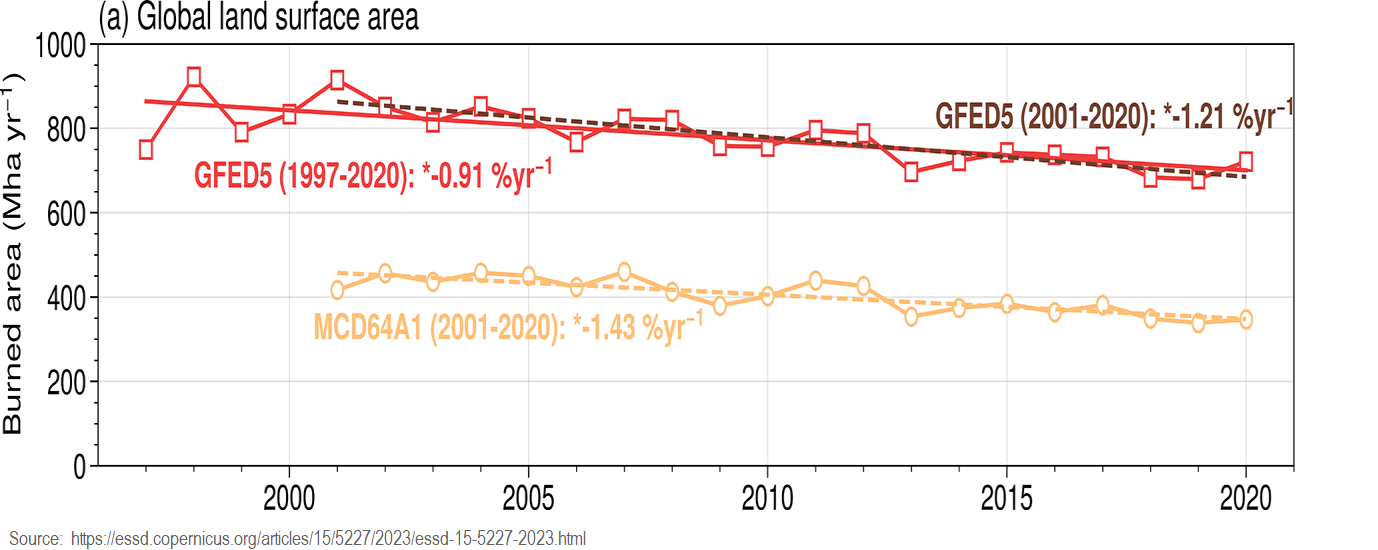
Source:
https://essd.copernicus.org/articles/15/5227/2023/essd-15-5227-2023.html
If warmer temperatures equated to worse fire risks, then in the United States forest fires would mostly occur in the South. But most large U.S. forest fires have been in the North.
The worst forest fire in American history was in chilly Wisconsin, in October, 1871, when the CO2 level (estimated from ice cores) was only about 288 ppmv. That one fire consumed about 1.2 million acres, and it is believed to have killed at least 1200 people. Many of them died of hypothermia, while trying to shelter from the fire in the frigid Pestigo River.
Here are some additional resources on U.S. fires: [1] [2] [3] [4] [5] [6a/6b]
I’ve read (being a forester) that massive fires in the upper Mid West occurred after huge clearcuts- millions of acres – with no effort being made to dispose of slash. The original forests were mostly white and red pine- and they were magnificent forests with very large and valuable trees. These fires were so severe they burned up the soil leaving it mostly sand- which is what it was when the glaciers and much larger lakes retreated. There’s the Menominee tribe in that region with a large track of forest that is very well managed and it looks almost like the original forests. Supposedly you can it easily on satellite photography. A big rectangle of beautiful pine surrounded by inferior forests- mostly aspen and scrub land.
Apparently there is a big forest fire in NJ. Haven’t seen much about it in the news- but up here in Wokeachusetts, we can smell the smoke.
Sustainable forestry – Menominee Tribal Enterprises | Menominee Tribal Enterprises Neopit, Wisconsin
https://scitechdaily.com/inferno-from-orbit-nasa-tracks-15000-acre-wildfire-in-new-jerseys-pine-barrens/
I don’t think much forestry work is done in the barrens. They need to be thinned and with patch clearcuts. That will reduce the fire hazard. There are similar but much smaller pine barrens in SE parts of Wokeachusetts and on Cape Cod. The state is doing such work in those areas. That is, the state fish and wildlife service- with the support of many enviro groups including MA Audubon. For Audubon, it’s not so much for protection from fire but because that state agency has convinced Audubon that doing this work will enhance bird habitat for many species that are becoming less common in recent decades.
Any claims about increasing droughts here in England can soon be put to bed by the real data.
As since 1836 there has been a increasing trend in annual rainfall especially since 1980 and summer rainfall amounts have largely remained unchanged over that time. With 1921 been the driest year by far over that time.
So here in England at least very dry years are on the decline, especially since 1980.
Murphy and Wilbey published a paper “The forgotten drought of 1765-1768. Reconstructing and re-evaluating historical droughts in the British and Irish Isles”
They mention a number of major droughts in England and Wales –
1798-1808, 1854-1860, 1887-1888, 1890-1909, 1921-1922, 1933-1934, 1959, 1976, 1990-1992, 1995-1997.
Another paper by Spraggs et al evaluated droughts in the east of the UK and found the most severe were 1854-60 and 1893-1907 and were characterised by contiguous dry winters and summers.
https://rmets.onlinelibrary.wiley.com/doi/10.1002/joc.6521
in some places. In others, like Alaska, NW US, and others, sea levels are falling (well, the land is rising).
Sea levels compared to the land surface have varied by at least 11,000 m in the past. Marine fossils are found at present altitudes exceeding 6,000 m, and fossil fuel deposits are found more than 5,000 m below the present surface.
I wouldn’t be too worried about the odd cm up or down. Even Mount Everest is currently soaring skywards at about a couple of mm per year, and I suppose that has some effect on sea levels somewhere.
Maybe Willis Eschenbach could plot all the crustal movements above and below sea level, take into account continental lateral movements, and the resultant effect on ocean basin volumes. Assuming that free water mass stays reasonably constant, then sea level movements could be calculated with respect to current land surfaces.
I suppose that additional H2O volume from burning hydrocarbons would need to be taken into account, but of course any excess should be sequestered as carbohydrates as plant life increases (due to more CO2 and H2O in the atmosphere).
Another option might be to accept reality, and try to adapt to whatever Nature dishes out as best we can. If it looks like rain, take an umbrella.
70% of the planet’s “solid surface” is covered by sea bed, another nearly 10% by ice. We have ZERO data on the ground elevation under all that, satellites can’t measure it, nobody takes sea floor soundings to the mm accuracy required for SLR closure calculations. Assumptions are made about constancy of ocean volume adjusted for ice melt and isostatic rebound and how well the buoyant silicate continents float on the iron rich magma below. Basically we have only a glimmer of a hope that our calculations might be right and a fairly large cohort of government employed scientists who maintain that they need more grant money and are worth their paychecks.
The bottom line is that despite the hype, there is no real evidence that CO2 has any effect on our global climate system. There is plenty of scientific rationale to support the conclusion that the climate sensivity of CO2 is effectively zero. The AGW hypothesis has been falsified by science. Mankind does not even know what the optimal global climate actually is let alone how to achievew it. World wide trillions of dollars have been spent tying to fignt climate change yet no one is saying that there has been any improvement. Spending money fighting climate change is a big waste of funds.
How can we control the weather to +/1 0.1C when we cannot control our environmentally controlled environments (aka living rooms) to better than +/1 2F?
FYI, the CO2 levels in your house are much higher than outside (when the windows are closed). Does that make your furniture burn?
Adding CO2 to the atmosphere does not change the thermal insulating proiperties of the atmospher. Hence adding CO2 to the atmosphere does not cause warming. It is straight forward science.
“why would they keep reporting bad news?”
Simple. News media went from being the bearers of the torch of truth to profit centers for large corporations. Sensationalization increases ad revenues.