Guest essay by David Middleton and Andy May
The Geological Society of London recently published a statement on climate change:
Geologists Andy May and David Middleton have spent the past few days reviewing the Geological Society of London Scientific Statement and have assembled a rebuttal to some of the more questionable items in the paper.
Interestingly, the paper includes this disclaimer:
Data availability
Geological Society of London Scientific Statement
Data sharing is not applicable to this article as no datasets were generated or analysed during the current study.
The authors make many claims, but offer up little in the way of supporting material. It is rife with exaggerations and at least a few internal contradictions. It seems to entirely miss the concept of deep time and the loss of resolution in the geological record relative to modern instrumental observations.
Atmospheric CO2
Observations from the geological record show that atmospheric CO2 concentrations are now at their highest levels in at least the past 3 million years.
Geological Society of London Scientific Statement
This is quite possibly true. Atmospheric CO2 concentrations could be, even now, at their highest levels in the past 12 million years.

The geological record of atmospheric CO2 is massively uncertain, and becomes less certain the further back in time we go. This passage from Evolution of the Earth (1976) is just as true today as when we were geology students way back in the Pleistocene…
Unfortunately we cannot estimate accurately changes of past CO2 content of either atmosphere or oceans, nor is there any firm quantitative basis for estimating the magnitude of drop in carbon dioxide content necessary to trigger glaciation. Moreover the entire concept of an atmospheric greenhouse effect is controversial, for the rate of ocean-atmosphere equalization is uncertain.
Dott & Batten, 1976
While methods of estimating past atmospheric CO2 concentrations have improved since the 1970’s, we can’t even be certain that the atmospheric concentration of CO2 during the much warmer Mid-Miocene Climatic Optimum was significantly elevated relative to the extremely low values of the Quaternary Period.
Furthermore, the current speed of human-induced CO2 change and warming is nearly without precedent in the entire geological record, with the only known exception being the instantaneous, meteorite-induced event that caused the extinction of non-bird-like dinosaurs 66 million years ago.
Geological Society of London Scientific Statement
Jeffrey Severinghaus and colleagues would be very surprised to see this statement. They showed that, at the beginning of the Holocene, about 11,700 years ago, Northern Hemisphere temperatures rose “5 – 10ºC” in just a few decades (Severinghaus, Sowers, Brook, Alley, & Bender, 1998).
With regard to CO2, this is possible. There are no geological records of CO2 change that have sufficient resolution to make this claim with any degree of certainty. The only exception would be the Law Dome ice cores in Antarctica, which only go back about 2,000 years. The lack of resolution in pre-industrial era CO2 and temperature estimates greatly limit comparisons of geological history to modern times.
This composite ice core CO2 record (0-800 kyr BP) from Bereiter et al. (2014) appears to present a very convincing Hockey Stick.

This is a composite of the following ice cores:
| -51-1800 yr BP:’ | Law Dome (Rubino et al., 2013) |
| 1.8-2 kyr BP: | Law Dome (MacFarling Meure et al., 2006) |
| 2-11 kyr BP: | Dome C (Monnin et al., 2001 + 2004) |
| 11-22 kyr BP: | WAIS (Marcott et al., 2014) minus 4 ppmv (see text) |
| 22-40 kyr BP: | Siple Dome (Ahn et al., 2014) |
| 40-60 kyr BP: | TALDICE (Bereiter et al., 2012) |
| 60-115 kyr BP: | EDML (Bereiter et al., 2012) |
| 105-155 kyr BP: | Dome C Sublimation (Schneider et al., 2013) |
| 155-393 kyr BP: | Vostok (Petit et al., 1999) |
| 393-611 kyr BP: | Dome C (Siegenthaler et al., 2005) |
| 612-800 kyr BP: | Dome C (Bereiter et al., 2014) |
These ice cores are of vastly different resolutions. Petit et al., 1999 indicate that the CO2 resolution for Vostok is 1,500 years. Lüthi et al., 2008 suggest a CO2 resolution of about 500 years for Dome C. It appears that the high resolution Law Dome DE08 core was just spliced on to the lower frequency older ice cores.
If we apply smoothing filters to the DE08 ice core in order to match the resolution of the lower resolution ice cores, we get a considerably different picture.

The lower frequency ice cores are not capable of resolving century scale CO2 shifts. As such, they cannot be used to rule out the possibility of short duration fluctuations comparable to the industrial era rise in atmospheric CO2 during the early Holocene and Pleistocene. And thus do not contradict the conclusions of Wagner et al., 1999:
In contrast to conventional ice core estimates of 270 to 280 parts per million by volume (ppmv), the stomatal frequency signal suggests that early Holocene carbon dioxide concentrations were well above 300 ppmv.
[…]
Most of the Holocene ice core records from Antarctica do not have adequate temporal resolution.
[…]
Our results falsify the concept of relatively stabilized Holocene CO2 concentrations of 270 to 280 ppmv until the industrial revolution. SI [stomatal index]-based CO2 reconstructions may even suggest that, during the early Holocene, atmospheric CO2 concentrations that were 300 ppmv could have been the rule rather than the exception.
Wagner et al., 1999
Or Wagner et al., 2004:
The majority of the stomatal frequency-based estimates of CO2 for the Holocene do not support the widely accepted concept of comparably stable CO2 concentrations throughout the past 11,500 years. To address the critique that these stomatal frequency variations result from local environmental change or methodological insufficiencies, multiple stomatal frequency records were compared for three climatic key periods during the Holocene, namely the Preboreal oscillation, the 8.2 kyr cooling event and the Little Ice Age. The highly comparable fluctuations in the paleo-atmospheric CO2 records, which were obtained from different continents and plant species (deciduous angiosperms as well as conifers) using varying calibration approaches, provide strong evidence for the integrity of leaf-based CO2 quantification.
Wagner et al., 2004
The GSL authors also presented a stark contradiction.
In short, whilst atmospheric CO2 concentrations have varied dramatically during the geological past due to natural processes, and have often been higher than today, the current rate of CO2 (and therefore temperature) change is unprecedented in almost the entire geological past.
Geological Society of London Scientific Statement
They claim that “the current rate of CO2 (and therefore temperature) change is unprecedented in almost the entire geological past,” but then state the following:
Given the record of past climate change (Section 1), the magnitude of recent observed climate change is not unusual.
Geological Society of London Scientific Statement
Modern climate change is allegedly both unprecedented and “not unusual.” They appear to conflate CO2 and temperature. While they are related, they aren’t interchangeable.
CO2 and sea level
They also make the claim that the geological record depicts a relationship between CO2 and sea level.
The geological record is consistent with predictions that the long-term magnitude and rate of future sea-level rise will be highly sensitive to future CO2 emission scenarios and may include intervals of very rapid rise.
Geological Society of London Scientific Statement
However, there is no relationship between CO2 and sea level in the geological record.


William Galloway, of the University of Texas Jackson School of Geosciences, summarized the depositional history of the Gulf Coast/Gulf or Mexico in this paper…
Depositional history can be generalized in seven phases: (1) Middle-Late Jurassic evaporite and carbonate deposition in a broad, shallow, restricted to open marine basin. (2) Latest Jurassic-Early Cretaceous sand-rich clastic progradation from the northern margins. (3) Late-Early Cretaceous development of a rimmed carbonate shelf. (4) Late Cretaceous mixed clastic and carbonate aggradation of the continental margins. (5) Resurgent Paleogene clastic progradation and filling centered in the NW basin. (6) Miocene progradation and basin filling centered in the central and NE Gulf. (7) Late Neogene climatically and eustatically influenced progradation along the central Gulf margin. In contrast to the broad, progradational sediment wedge of the northern Gulf, the Florida margin is a primarily aggradational carbonate platform.
Galloway, 2008.
Figure 4 clearly demonstrates the importance of climate, atmospheric CO2 and sea level cycles in the depositional history of the US Gulf Coast/Gulf of Mexico; but no correlation of CO2 and sea level. Note that most of the source rock formations were deposited when atmospheric CO2 was above 1,000 ppm and the Earth was considerably warmer than it is today, suggesting more plant life in the warmer, CO2 rich times.
The temperature and CO2 plots have 10 million year resolutions; they are highly smoothed. This particular temperature reconstruction (Royer et al., 2004) includes a pH adjustment, derived from CO2. It demonstrates a relatively good correlation between CO2 and temperature on a geological time scale. However, a cross-plot only yields an equilibrium climate sensitivity (ECS) of about 1.28 °C.

The modern warming period began at the nadir of the Little Ice Age (ca. 1600 AD), the coldest period in the Holocene Epoch. This was 300 years prior to atmospheric CO2 significantly exceeding the assumed normal preindustrial range.

The modern rise in sea level began at the end of neoglaciation. The sea level reconstruction of Jevrejeva et al., 2014 (J14) indicates that sea level was falling in the early 1800’s.


Climate sensitivity
“The IPCC (2014) gave a 66% probability that the ECS value was between 1.5 and 4.5°C. …
To estimate ECS from the geological record, quantitative paired records of atmospheric CO2 and global temperature from proxies are needed …
many studies of the geological past have provided support to the canonical range for ECS of 1.5–4.5°C”
Geological Society of London Scientific Statement
The first modern estimate of ECS, published in the Charney Report, in 1979, was 1.5 to 4.5 degrees C per doubling of CO2 (ECS). In other words, the “canonical range” has not changed in over 40 years. Modern empirical estimates of ECS, based on instrumental data, have ranged from 0.44 degrees C (Lindzen and Choi, 2011) to 1.6 (Lewis and Curry, 2018). These estimates have high resolution CO2 and temperature data. The geological estimates do not.
While geological estimates of ECS may be higher, the GSL says the geological estimates fall in the range of 2.6 to 3.9 degrees, we cannot be comfortable with the accuracy or precision of these estimates. The data, especially the CO2 data are too poor.
Furthermore, the authors present a cartoon, apparently depicting a strong correlation of CO2 and temperature over the Cenozoic Era.


The GSL cartoon indicates a climate sensitivity of nearly 7 °C per doubling of CO2. This would result in about 3.5 °C of warming since the mid-1800’s, which clearly did not occur. Modern high resolution instrumental measurements yield a much lower climate sensitivity.
Parallels in the geological record
The authors try to draw parallels to modern climate change from the geological record.
In the mid Pliocene (3.3–3.1 million years ago), atmospheric CO2 concentrations ranged from 389 (–8 to +38) ppm to 331 (–11 to +13) ppm (de la Vega et al. 2020), which is higher than pre-industrial levels of about c. 280 ppm and slightly lower than modern levels (c. 407.4 ± 0.1 ppm in 2018). Earth’s continental configurations, land elevations and ocean bathymetry were all similar to today (Haywood et al. 2016). The Pliocene was characterized by several intervals in which orbital forcing was similar to that of modern times and so it offers us a close analogue to the climate under modern CO2 concentrations (McClymont et al. 2020). During this interval, global temperatures were similar to those predicted for the year 2100 (+2.6 to 4.8°C compared with pre-industrial) under a business-as-usual scenario (i.e. with no attempt to mitigate emissions). Several lines of work suggest similarities between the model-predicted ocean circulation of the future and that of the mid-Pliocene warm period, with a weaker thermohaline circulation, related to upper-ocean warming and stratification, but also reduced ice sheets and sea ice, a poleward shift in terrestrial biomes and weaker atmospheric circulation (Haywood and Valdes 2004; Cheng et al. 2013; Corvec and Fletcher 2017; Fischer et al. 2018). Pliocene sea-level may have reached 20 m above the present-day value and may have varied, on average, by 13 ± 5 m over Pliocene glacial–interglacial cycles, in association with fluctuations in the extent of the Antarctic ice sheet (Grant et al. 2019).
Geological Society of London Scientific Statement
While “Earth’s continental configurations, land elevations and ocean bathymetry were” more similar to today, during the Pliocene Epoch than they were during earlier time periods, the Mid-Pliocene was significantly warmer than today due to tectonic differences. The Panama Seaway was still open, enabling much more efficient ocean heat transport. Significant uplift episodes in the Rocky and Himalayan Mountains during the Pleistocene Epoch were also driving factors in the deep freeze that Earth has experienced over the past 2 million years.
The geological record informs us that the major climatic shifts of the Cenozoic Era were correlated with tectonic changes.

The temperatures in Figure 9 are derived from δ18O in benthic foraminifera using a no sea ice model. Salinity and ice volume have an effect on the conversion. These temperatures are only applicable to the Lower Tertiary, hot-house climate.
This claim about the Pliocene as a precedent for modern climate change is patently ridiculous:
During this interval, global temperatures were similar to those predicted for the year 2100 (+2.6 to 4.8°C compared with pre-industrial) under a business-as-usual scenario (i.e. with no attempt to mitigate emissions).
Geological Society of London Scientific Statement
They are clearly considering RCP8.5 to be “business as usual”.


When the full range of model forecasts are considered, it is clear that the climate is behaving more like RCP4.5 than RCP8.5.

Even with an additional 0.5 to 1.0 °C of warming by the end of this century, the climate will still be in the range of Pleistocene interglacial stages, well below the Mid-Pliocene.

It all comes down to context and resolution
Bear in mind that the resolution of the δ18O temperature reconstruction is much lower than the instrumental record and would not resolve the HadSST signal. Again, the geological record provides a general picture of past climate change, but cannot be directly compared to high resolution instrumental records without explicitly putting it into context. The Modern Warming only appears anomalous due to the higher resolution of the instrumental record and its position at the tail-end of the time series.
Ljungqvist (2010) clearly explained the problem by directly comparing instrumental data to proxy reconstructions.
The amplitude of the reconstructed temperature variability on centennial time-scales exceeds 0.6°C. This reconstruction is the first to show a distinct Roman Warm Period c. AD 1-300, reaching up to the 1961-1990 mean temperature level, followed by the Dark Age Cold Period c. AD 300-800. The Medieval Warm Period is seen c. AD 800–1300 and the Little Ice Age is clearly visible c. AD 1300-1900, followed by a rapid temperature increase in the twentieth century. The highest average temperatures in the reconstruction are encountered in the mid to late tenth century and the lowest in the late seventeenth century. Decadal mean temperatures seem to have reached or exceeded the 1961-1990 mean temperature level during substantial parts of the Roman Warm Period and the Medieval Warm Period. The temperature of the last two decades, however, is possibly higher than during any previous time in the past two millennia, although this is only seen in the instrumental temperature data and not in the multi-proxy reconstruction itself.
[…]
The proxy reconstruction itself does not show such an unprecedented warming but we must consider that only a few records used in the reconstruction extend into the 1990s. Nevertheless, a very cautious interpretation of the level of warmth since AD 1990 compared to that of the peak warming during the Roman Warm Period and the Medieval Warm Period is strongly suggested.
[…]
The amplitude of the temperature variability on multi-decadal to centennial time-scales reconstructed here should presumably be considered to be the minimum of the true variability on those time-scales.
Ljungqvist, 2010
Direct comparisons of the modern instrumental record to the older proxy reconstructions are not robust because the proxy data are of much lower resolution. The proxy data indicate the “minimum of the true variability on those time-scales.” The instrumental data are depicting something closer to actual variability.
The proxy data lack the high frequency component of the signal. When the high frequency component of a signal is filtered out, it attenuates the amplitude. This is basic signal theory.

The direct comparison of instrumental data to proxy data becomes even more problematic when the record length is extended beyond 2,000 years.

The supposedly “four warmest years on record” have occurred only about 300 years after the coldest century of the past 100 centuries. This could only be described as a “climate crisis” or “climate emergency” by someone who was unversed in the basic scientific principles of Quaternary geology and signal processing.
The longer the record length of the reconstruction, the more important the consistency of the temporal resolution becomes.
“Consistency of the temporal resolution” means that the resolution of the older proxies are consistent with the recent proxies. Temporal resolution is a function of the sampling interval…
We believe the greater source of error in these reconstructions is in the proxy selection. As documented in this series, some of the original 73 proxies are affected by resolution issues that hide significant climatic events and some are affected by local conditions that have no regional or global significance. Others cover short time spans that do not cover the two most important climatic features of the Holocene, the Little Ice Age and the Holocene Climatic Optimum.
[…]
We also avoided proxies with long sample intervals (greater than 130 years) because they tend to reduce the resolution of the reconstruction and they dampen (“average out”) important details. The smallest climate cycle is roughly 61 to 64 years, the so-called “stadium wave,” and we want to try and get close to seeing its influence. In this simple reconstruction, we have tried to address these issues.
Andy May WUWT.
For additional reading on resolution, see: Resolution and Hockey Sticks, Part 1.
Discussion
While geological data is very helpful in studying climate, as the GSL says, interpreting the significance of modern climate change will probably not benefit from geological input. The warming over the 20th century is only about one degree and the warming since 1950, used as a benchmark by the IPCC, is only about 0.7 degrees. Geological timeframes are greater than 1,000 years, as the GSL paper states, and consequential warming and cooling events in the geological record are greater than five degrees. The geological data we have is very low resolution and unlikely to improve. The main problem is that recent warming is insignificant at a geological scale.
As described above, the CO2 data is lower resolution and less accurate than the temperature data. We have seen that comparing temperature proxy data over the past 2,000 years to modern instrumental data is inappropriate and it is even less appropriate to compare geological data to the modern instrumental record. Neither the magnitude of recent warming nor recent CO2 concentration changes are unusual over geological time periods.
Geoscientists have a responsibility to convey the geological context of climate change, rather than claiming that every observation not resolvable in the geological record is unprecedented and grounds for economically destructive government policies. It should be sufficient to say that anthropogenic CO2 emissions have probably been the cause of most of the rise from ~280-400 ppm over the past 200 years and that this has a net warming effect on the atmosphere. Although just about every recent observation-based estimate indicates that the warming effect is minimal.
While, there is no “climate emergency,” economically viable pathways exist to reduce the carbon intensity of our energy production and restrain the ultimate growth in atmospheric CO2 to ~600 ppm by the end of this century. This would keep us in the Cenozoic “noise level.”


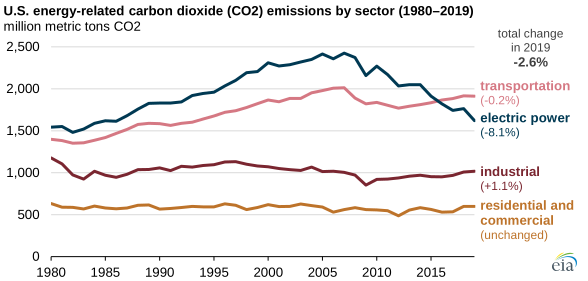
Rather than setting deadlines for “net-zero emissions” and other unattainable and arbitrary criteria, the focus should be on reducing the carbon intensity of energy production in an economically sustainable manner. The United States, largely through our private sector, has been doing this. U.S. CO2 emissions from electricity generation have fallen to 1980’s levels, mostly due to the replacement of coal-fired with natural gas-fired electricity generation.
Geoscientists will play a vital role in this process by continuing to find economically recoverable oil & gas reserves, improving methods of geological carbon capture & storage, leading the way in expanding our access to the vast array of mineral resources required for the expansion of “renewables” (wind & solar), battery and other storage technologies, promoting the safe geological disposal of nuclear waste products and doing all of this in the safest manner, with as little environmental impact as possible. Economic geoscientists in the oil & gas and minerals sectors are particularly well-positioned to lead the way, due to our experience with project economics.
Energy, economics and environment are inextricably linked. Without affordable, reliable energy, a society cannot have the economic means to protect the environment. Nothing more strongly correlates to human prosperity and a clean environment than cheap access to energy (May, Climate Catastrophe! Science or Science Fiction?, 2018, p. 7, 18). For a discussion on energy and poverty, see here.
Texas State Geologist and Director of the Bureau of Economic Geology Scott Tinker summed it up very well in this OEd on carbon pricing:
Aug 23, 2019
Carbon Pricing Is Not a Fix for Climate Change
By: Scott TinkerThere is much talk today about carbon pricing to reduce CO2 emissions and address climate change. Unlike many environmental pollutants that have a local or regional impact, carbon dioxide (CO2) is global — there is only one atmosphere. If actions taken to reduce atmospheric emissions in one region result in increased emissions elsewhere, then the one atmosphere suffers.
Some form of carbon pricing — carbon tax, carbon trading, carbon credits — is favored by many politicians, NGOs, academics and even some in industry. But the reality is that a price on carbon will not be imposed by developing and emerging economies because it makes their energy more expensive, and they are too busy trying to build their economies and lift themselves from poverty.
In the developed world, carbon pricing increases the cost of manufacturing and products, which in turn drives manufacturing to developing nations where it is more affordable because of lower labor costs and less stringent environmental regulations and emissions standards. Global emissions rise in the one atmosphere.
Said differently, the good intentions of carbon pricing have an unintended negative impact on climate change. This is not hypothetical. It is happening.
If carbon pricing won’t work, what will? Energy science tells us how to actually lower CO2 emissions into the one atmosphere in the time frame needed. Unfortunately, those who are the most passionate about addressing climate change seem to not like the answers from the energy experts.
[…]
So what options does energy science suggest will have a major impact on climate change?
Natural gas and nuclear replacing coal for power generation in major developing nations such as India, China and Vietnam would have a major impact. Carbon capture, utilization and storage; direct carbon capture from the atmosphere; and perhaps nature-based solutions such as increasing the size of forests would help, especially in fossil fuel producing regions such as the U.S., Russia, China and the Middle East.
[…]
These scientifically sound and economically underpinned energy solutions present a problem. Many are not favored by people who are the most concerned about climate change. Thus, politicians seeking climate votes continue to passionately promote programs and policies that won’t actually address climate change.
But we have a remarkable opportunity. The right can acknowledge the need to tackle climate change. The left can acknowledge the energy science needed to accomplish real global emissions reductions into the one atmosphere. And developing and emerging nations can continue to climb out of energy poverty.
Unfortunately, this appears to be far from happening. Climate politics seems to trump energy solutions in Europe and the U.S., and the developing world continues to burn coal.
Scott Tinker is the Allday Endowed Chair of Subsurface Geology and director of the Bureau of Economic Geology at The University of Texas at Austin.
UT News
To the extent that climate change is a problem, we can only tackle it, if we pursue economically viable pathways that preserve access to affordable, reliable energy and enable the further expansion of human prosperity. And the private sector is far better at doing this than any government.

References
Bereiter, Bernhard. Sarah Eggleston, Jochen Schmitt, Christoph Nehrbass-Ahles, Thomas F. Stocker, Hubertus Fischer, Sepp Kipfstuhl and Jerome Chappellaz. 2015. Revision of the EPICA Dome C CO2 record from 800 to 600 kyr before present. Geophysical Research Letters. . doi: 10.1002/2014GL061957. LINK
Bereiter et al. (2014), Revision of the EPICA Dome C CO2 record from 800 to 600 kyr before present, Geophysical Research Letters, doi: 10.1002/2014GL061957. Data
Berner, R.A. and Z. Kothavala, 2001. GEOCARB III: A Revised Model of Atmospheric CO2 over Phanerozoic Time, American Journal of Science, v.301, pp.182-204, February 2001.
Charney, J., Arakawa, A., Baker, D., Bolin, B., Dickinson, R., Goody, R., . . . Wunsch, C. (1979). Carbon Dioxide and Climate: A Scientific Assessment. National Research Council. Washington DC: National Academies Press. doi:https://doi.org/10.17226/12181
Dott, Robert H. & Roger L. Batten. Evolution of the Earth. McGraw-Hill, Inc. Second Edition 1976. p. 441.
Galloway, William. (2008). “Chapter 15 Depositional Evolution of the Gulf of Mexico Sedimentary Basin”. Volume 5: Ed. Andrew D. Miall, The Sedimentary Basins of the United States and Canada., ISBN: 978-0-444-50425-8, Elsevier B.V., pp. 505-549.
Jevrejeva, S., J. C. Moore, A. Grinsted, and P. L. Woodworth (2008). “Recent global sea level acceleration started over 200 years ago?”. Geophys. Res. Lett., 35, L08715, doi:10.1029/2008GL033611.
Jevrejeva, S. , J.C. Moore, A. Grinsted, A.P. Matthews, G. Spada. 2014. “Trends and acceleration in global and regional sea levels since 1807”. Global and Planetary Change. %vol 113, 10.1016/j.gloplacha.2013.12.004 https://www.psmsl.org/products/reconstructions/jevrejevaetal2014.php
Lear, Caroline H., Pallavi Anand, Tom Blenkinsop, Gavin L. Foster, Mary Gagen, Babette Hoogakker, Robert D. Larter, Daniel J. Lunt, I. Nicholas McCave, Erin McClymont, Richard D. Pancost, Rosalind E.M. Rickaby, David M. Schultz, Colin Summerhayes, Charles J.R. Williams and Jan Zalasiewicz. Geological Society of London Scientific Statement: what the geological record tells us about our present and future climate.
Journal of the Geological Society, 178, jgs2020-239, 28 December 2020, https://doi.org/10.1144/jgs2020-239
Lewis, N., & Curry, J. (2018, April 23). The impact of recent forcing and ocean heat uptake data on estimates of climate sensitivity. Journal of Climate. Retrieved from https://journals.ametsoc.org/doi/10.1175/JCLI-D-17-0667.1
Lindzen, R., & Choi, Y.-S. (2011, August 28). On the Observational Determination of Climate Sensitivity and Implications. Asia-Pacific Journal of Atmospheric Sciences, 47(377). Retrieved from https://link.springer.com/article/10.1007/s13143-011-0023-x#citeas
Ljungqvist, F.C. 2010. “A new reconstruction of temperature variability in the extra-tropical Northern Hemisphere during the last two millennia”. Geografiska Annaler: Physical Geography, Vol. 92 A(3), pp. 339-351, September 2010. DOI: 10.1111/j.1468-459.2010.00399.x
MacFarling-Meure, C., D. Etheridge, C. Trudinger, P. Steele, R. Langenfelds, T. van Ommen, A. Smith, and J. Elkins (2006). “Law Dome CO2, CH4 and N2O ice core records extended to 2000 years BP“. Geophys. Res. Lett., 33, L14810, doi:10.1029/2006GL026152.
May, Andy. Climate Catastrophe! Science or Science Fiction? American Freedom Publications LLC, 2018.
Miller, Kenneth & Kominz, Michelle & V Browning, James & Wright, James & Mountain, Gregory & E Katz, Miriam & J Sugarman, Peter & Cramer, Benjamin & Christie-Blick, Nicholas & Pekar, S. (2005). “The Phanerozoic Record of Global Sea-Level Change”. Science (New York, N.Y.). 310. 1293-8. 10.1126/science.1116412.
Moberg, A., D.M. Sonechkin, K. Holmgren, N.M. Datsenko and W. Karlén. 2005. “Highly variable Northern Hemisphere temperatures reconstructed from low- and high-resolution proxy data”. Nature, Vol. 433, No. 7026, pp. 613-617, 10 February 2005.
Nerem, R. S., B. D. Beckley, J. T. Fasullo, B. D. Hamlington, D. Masters, G. T. Mitchum. “Climate-change–driven accelerated sea-level rise”. Proceedings of the National Academy of Sciences. Feb 2018, 115 (9) 2022-2025; DOI: 10.1073/pnas.1717312115
Pagani, Mark, Michael Arthur & Katherine Freeman. (1999). “Miocene evolution of atmospheric carbon dioxide”. Paleoceanography. 14. 273-292. 10.1029/1999PA900006.
Royer, D. L., R. A. Berner, I. P. Montanez, N. J. Tabor and D. J. Beerling. “CO2 as a primary driver of Phanerozoic climate”. GSA Today, Vol. 14, No. 3. (2004), pp. 4-10
Severinghaus, J. P., Sowers, T., Brook, E. J., Alley, R. B., & Bender, M. L. (1998, January 8). Timing of abrupt climate change at the end of the Younger Dryas interval from thermally fractionated gases in polar ice. Nature, 391, pp. 141-146. Retrieved from http://shadow.eas.gatech.edu/~jean/paleo/Severinghaus_1998.pdf
Terando, A., Reidmiller, D., Hostetler, S.W., Littell, J.S., Beard, T.D., Jr., Weiskopf, S.R., Belnap, J., and Plumlee, G.S., 2020, Using information from global climate models to inform policymaking—The role of the U.S. Geological Survey: U.S. Geological Survey Open-File Report 2020–1058, 25 p.,
https://doi.org/10.3133/ofr20201058.
Tripati, A.K., C.D. Roberts, and R.A. Eagle. 2009. “Coupling of CO2 and Ice Sheet Stability Over Major Climate Transitions of the Last 20 Million Years”. Science, Vol. 326, pp. 1394 1397, 4 December 2009. DOI: 10.1126/science.1178296
Wagner F, et al., 1999. Century-scale shifts in Early Holocene CO2 concentration. Science 284:1971–1973.
Wagner F, Kouwenberg LLR, van Hoof TB, Visscher H, 2004. Reproducibility of Holocene atmospheric CO2 records based on stomatal frequency. Quat Sci Rev 23:1947–1954. LINK
Zachos, J. C., Pagani, M., Sloan, L. C., Thomas, E. & Billups, K. “Trends, rhythms, and aberrations in global climate 65 Ma to present”. Science 292, 686–-693 (2001).
Someone please share this with the AAPG – as they seem to be selling the entire industry they represent down the river to appease the deep green left. probably because they are good people just trying to get along. That attitude has no place in science. Geologists know better. The AAPG should know better. And if the O&G industry is wrecked , with them complicit because they didn’t defend their own industry, then society as whole will be worse off because of it.
AAPG has become too focused on STEM and geoscience students. Their most recent climate change statement was painfully nebulous… https://wattsupwiththat.com/2020/05/18/aapg-announces-new-climate-change-statement/
Agreed – It pains me as a member ( as I am sure it pains you too as a member).
Jeffrey Severinghaus and colleagues would be very surprised to see this statement. They showed that, at the beginning of the Holocene, about 11,700 years ago, Northern Hemisphere temperatures rose “5 – 10ºC” in just a few decades (Severinghaus, Sowers, Brook, Alley, & Bender, 1998).
————
I don’t think they’d be surprised at all. One data point at the top of Greenland is a pretty poor representation of the entire NH. Back a few years Andy wasn’t surprised either.
https://wattsupwiththat.com/2017/06/18/global-versus-greenland-holocene-temperatures/?TB_iframe=true&width=921.6&height=921.6 His ‘Artic’ reconstruction showed no such spikes.
The climate events that caused the GISP 2 spikes were undoubtedly real and dramatic: Ice-dam breaks, the abrupt starting and stopping of the thermohaline circulation system, bolide, a combination…but they were by no means indicative of the wholoe hemisphere let alone global
Abrupt, modern global warming has an equally dramatic global explanation.
Loydo, what is that global explanation and what paper/s do you cite as evidence? I note from previous posts that you have been challenged on this point but remain steadfastly elusive in rising to the challenge. I’d love to see you stick it to all your doubters.
It just isn’t happening.
The current beneficial warming is a minor blip compared the the warming out of the last main Ice Age and the Younger Dryas swings in temperature..
They were MUCH LARGER, much FASTER and MUCH MORE SUSTAINED.
Current warming has been in small steps at El Nino events.. which are absolutely NOTHING to do with CO2.
And of course, you KNOW that the highly beneficial slight warming, out of the COLDEST period in 10,000 years has no proven human CO2 causation, don’t you Loy-dumb
No evidence AT ALL..
Yep, DRAMA, play-acting , that is all it is…
\
Hollywood actors partake with glee……
…. never science.. never evidence.
The Loy-satte way. !!
Loydo,
Read the posts and the papers first, then you won’t look so ridiculous in your comments. Severinghaus, et al. are referring to:
As for Figure 1 in my Arctic reconstruction, the jump they are referring to is off-scale on the left end. Remember 11,700 years ago is ~ 9,750 BC. Both the Northern Hemisphere and the Arctic reconstructions go off scale. You are not with the data here. Every bit of data in the NH indicates a very abrupt warming at about that time.
To the authors:
You say there is evidence that CO2 can cause warming of some amount. For this to be true then there must be two answers to the question of how much energy it takes to raise the temperature of a mass of dry air 1 degree. Thermodynamics says the energy can be in “any form”. You are saying if infrared involved a different amount is needed.
I find no mention of this warming capability in specific tables, the Shomate equation, or NIST data sheet on CO2.
I add that Anthony’s CO2 jar experiment demonstrated that raising the amount of CO2 didn’t cause an increase in temperature.
This is from May 11, 2013:
The Spencer Challenge to Slayers/Principia
Anthony Watts
Dr. Roy Spencer has made a challenge to the Slayers/Principia folks who keep insisting the greenhouse effect doesn’t exist at all. For example, see the front page claim at right from the Principia web page where they claim the greenhouse effect is “bogus”.
My view has always been that it exists. and has been effectively modeled as well as observed/measured (up to a point, so far I don’t know of a full scale measurement being done for the entire vertical column of the atmosphere), but likely isn’t the catastrophic issue portrayed by alarmists due to climate sensitivity likely being low.
Dr. Spencer’s challenge is quite simple and rooted in science; to prove their case, he simply wants them to make a simple model like this one below to demonstrate the absence of a greenhouse effect, while at the same time handling the measured energy budget of the Earth.
So far, he’s attracted lots of blowback rhetoric, but no serious takers. I doubt there will be.
Dr. Spencer sums it up pretty well as to why a cogent rebuttal is not likely:
And later in comments:
As he says its “put up or shut up” time. Read it all here:
I doubt the Slayers/Principia folks will learn anything from Dr. Spencer’s challenge, as they’ve reached almost a cult like status in this belief, and once it reaches that status, minds start closing to the possibility of the central idea being wrong. Most of the belief is predicated on a simple misinterpretation of the Second Law of Thermodynamics and how the greenhouse effect in the atmosphere (a misnomer) actually operates, slowing the transfer of Long Wave Infrared from the surface of the Earth to the top of the atmosphere. You’ll see the “a colder object can’t heat a warmer object” argument being bandied about as proof of their belief, but it is a strawman argument that doesn’t represent what actually goes on in the GHG slowing of LWIR transfer to TOA.
Time for the Slayers to Put Up or Shut Up
I doubt the Slayers/Principia folks will learn anything from Dr. Spencer’s challenge, as they’ve reached almost a cult like status in this belief, and once it reaches that status, minds start closing to the possibility of the central idea being wrong. Most of the belief is predicated on a simple misinterpretation of the Second Law of Thermodynamics and how the greenhouse effect in the atmosphere (a misnomer) actually operates, slowing the transfer of Long Wave Infrared from the surface of the Earth to the top of the atmosphere. You’ll see the “a colder object can’t heat a warmer object” argument being bandied about as proof of their belief, but it is a strawman argument that doesn’t represent what actually goes on in the GHG slowing of LWIR transfer to TOA.
In fairness, I’ll borrow a phrase from a skeptic movie title: “Not evil, just wrong“.
These folks mean well, but they’ve latched onto an idea that just doesn’t work. Some of the main players, such as Doug Cotton and John O’Sullivan have gotten so entrenched and angry that they have made persona non gratas of themselves here and at some other blogs.
Like Dr. Spencer, if and when they are able to provide a simple working model of the atmospheric energy balance that matches their theory with observations, I’ll be happy to take another look at the idea here.
In the meantime, it’s just a Sisyphus style table pounding time sink, and one has to know when to step away from the argument until such time something of substance is presented.
Radiative gasses affect the transmissivity of the atmosphere but that does not mean there is a “Greenhouse Effect”.
Earth’s energy balance is controlled by two powerful process – sea ice formation at -2C to prevent heat loss from ocean surface and cloudburst that prevents ocean heat uptake above 29C. There is very little ocean surface warmer than 30Cand no open ocean above 32C. Just a few nooks and crannies like the Persian Gulf where the cloudburst cycles is disrupted that regularly exceed 32C.
It is no accident that the average surface temperature sits close to the middle of the two extremes at 15C. Clouds control the maximum temperature and they are highly responsive to sea surface temperature. If oceans were internally heated to 34C then there would be perpetual cloud. The cloudburst cycle would continue without ever exposing clear sky. The loss of surface sunlight is much more significant than the loss in OLR due to the very low radiating power of the cloud tops.
Attached chart is actual data for January 2020 over the tropical oceans. All oceans reach the same maximum temperature in their warm pools.
Here is a link to the actual “air in a jar” experiment:
https://wattsupwiththat.com/gore-and-bill-nye-fail-at-doing-a-simple-co2-experiment/
Gore, Nye, etc, faked the experiment and falsely claimed that the the temperature in the jar with CO2 rose faster than the jar without. This isn’t even how the greenhouse effect works.
Anthony then added this update:
David,
I’m curious if there has been any suggestion for an experiment to test the correct proposed physical mechanism? I’m not even sure what form such an experiment would take.
I know that Willis has posted on how he thinks the most commonly held view of the physical mechanism is wrong… But I don’t know what sort of experiment could be conducted.
Thank you, I suspected that might be the case. It seems to me it would be a rather difficult experiment to devise.
The “elevator speech” answer from Willis Eschenbach is here:
https://wattsupwiththat.com/2012/01/13/a-matter-of-some-gravity/
A little difficult to do that as real life experiment, but the reasoning is superb…
Further, there is real proof of the back radiation caused by CO2, which even shows the seasonal amplitude of the CO2 levels in the back radiation seasonal amplitude:
https://newscenter.lbl.gov/2015/02/25/co2-greenhouse-effect-increase/
Dave and Tony, No one has measured the greenhouse effect in nature. The best estimate, using observations, IMHO is the one Nic Lewis and Judith Curry did in 2018.
Lots of theoretical estimates are out there and they are all over the map.
Due to laboratory work, all things being equal, which they never are, we can speculate that adding CO2 to the atmosphere will cause some warming. So Roy Spencer is probably correct, but he can’t prove his case either.
After some initial warming, due to greenhouse gases, there will be feedbacks. Speculating that these feedbacks are positive is a stretch. Positive feedbacks are very rare in nature for obvious reasons. The feedbacks are likely negative, leading to more cloud cover (Lindzen and Choi, 2011) or more ocean transport of thermal energy to the deep ocean or more plant life and cooling transpiration (Happer).
No evidence of any danger, lots of evidence that very little warming will occur and that the additional CO2 will be beneficial.
It’s also important to keep in mind that when the IPCC state that the sensitivity is likely in the 1.5-4.0 C range, they are referring to equilibrium climate sensitivity. Theoretically, only 1/2 to 2/3 of the warming is simultaneous with the CO2 rise (transient climate response). The other 1/3 to 1/2 dribbles out over ~500 years as “Trenberth’s missing heat” finds its way back out of the oceans.
While the underlying theories are relatively solid, very little of this has actually been measured. Nor is it amenable to controlled experiments. The only way to test the various hypotheses is by comparing the models to observations as they unfold.
The “Greenhouse Effect” is an fairytale. Earths temperature is thermostatically controlled to a narrow range by powerful ocean processes. Sea ice formation at the low end occurs at -2C. Cloudburst at the top end that takes ocean energy uptake negative above 29C.
The only way ocean surface gets above 29C is where the cloudburst cycle is disrupted by the local geography; like in the Persian Gulf – has the warmest ocean surface on Earth and the only subtropical water above 27C that does not experience cyclones. Cyclones are seeded by cloudburst. Convective potential is essential for spinning up cyclones but rarely develops over the Persian Gulf.
Attached chart shows how increased SW reflection trumps reduced LW transmission.
Their own statement makes it pretty clear that CO2 is not the driver of temperature.
I also saw no mention in their statement, or David and Andy’s rebuttal, of the lag of CO2 to proxified temperature in the ice cores over all time scales.
I speak for myself, but on this Dave probably agrees with me. CO2 is not a driver of temperature, at most it is a minor influence, probably so small it cannot be detected in nature. Doubling CO2, from 400 ppm to 800 ppm, might increase global temperatures as much as a degree. This is the direct warming effect, although Happer might have shown that it is much less than that. Lindzen thinks that net of all feedbacks, the warming will be less than half a degree.
The problem is, it has never been measured. Natural variability is over 0.5 degrees, so how can we see the signal over the noise?
We have an unknown effect and much of the world is screaming the end is nigh! So, for political reasons, not because there is any evidence of a problem, something might have to be done to curtail CO2. If so, let’s not kill our economy in the process. I think that is what Dave means with the section of the post you are referring to.
I agree with Andy. If the transient climate response is 1.6 C, 800 ppm would yield about 2.4 C of warning relative to 280 ppm. Would that be a problem? I doubt it. But we really don’t know what the sensitivity is. Lindzen & Choi and Spencer & Braswell put TCR at about 0.5 C. Christy & McNider put it at 1.1 C. I think Lewis & Crok had it at 1.35 C.
My thoughts on restraining growth to 600 ppm is that it would keep us in the noise level of the past 20-30 million years and that it would be fairly easy to achieve without denting our economy. It’s not so much that I see a “crisis” or an “emergency” above 600 ppm. It’s just that the unknowns expand rapidly from 800 to over 1,000 ppm. Accelerating toward unknowns doesn’t strike ne as a great idea. If there are economically sustainable ways to slow down the rise in atmospheric CO2, it’s prudent to do so. But it has to be economically sustainable in the real world… Not in the minds of academics.
The “consensus” assert that RCP8.5 is business as usual and it has CO2 at 900 ppm in 2100. Reality tells us that RCP6 is closer to business as usual and it has CO2 at 600 ppm in 2100. Temperatures are behaving more like RCP4.5. My suggestion to hold it below 600 ppm, is basically consistent with what we are already doing.
Who knows what the world and technology will be like in 2100? Predicting anything that far in the future is almost meaningless.
David and Andy say:
I vehemently disagree. Adaptation is, and always has been, the most logical course of action when dealing with inexorable natural forces. Trying to control the weather is a fool’s errand.
There is no evidence that more CO2, in our conceivable future, will cause any kind of catastrophe. Just as there is no evidence that a climate catastrophe is happening right now, as we’re constantly told by the media.
Great article, Andy and David. You guys are real assets to the WUWT community.
This article causes me to ask the question: How is all this affected if Dr. Willam Happer’s new research is correct and the CO2 in the atmosphere at current levels (415ppm) is essentially saturated and has little ability to raise atmospheric temperatures at higher concentrations?
If true, that would end the CO2 crisis, I would think.
It would have a secondary effect of allowing all the alarmists to save face and to claim they had the science right in the past, they just didn’t know about the CO2 saturation part of the equation. They didn’t know that CO2 will only raise the temperatures so much, but no higher.
So then, all of us, skeptics and alarmists, can agree that CO2 is no longer a problem for humanity, and we can go about our merry ways.
It sounds like a plan to me. Now, we just need varification of Dr. Happer’s research. My money is on Dr. Happer being correct.
Tom, I agree and I have Dr. Happer’s paper and have started studying it. But, it is hard to understand and I have to spend much more time on it. Like most of his work, he is likely correct, the general thesis sounds right, but it is tough going.
I’ve skimmed through that paper… And I just don’t know how correct it is.
Perhaps someone (like David Middleton?) can explain to me why, when the level of CARBON in the atmosphere is at 0.04% and that has been that way since the Carboniferous period, when giant bugs were everywhere, and (as David Middleton pointed out to me a while back), the oxygen level (at 30%) was so HIGH that wildfires were common — WHY these people are so dead set on trying to control something over which they have ZERO control?
Since the oxygen level is (and has been since the dinosaurs took up housekeeping) 20%, and CO2 is a trace gas – always has been – it seems (logical) to me that these people, who are fussing about something over which they have ZERO control, either truly believe they can control the CO2 level (they can’t) or they know it’s a scam and all they want is Your Money.
I found a good article about how some people are studying fossilized brachiopods to find out if they stored oxygen in their shells. (They look like scallop shells.) I’d like to know what they find out.
Not one of the geniuses who fuss about CO2 levels has come up with the real reason for a drop of a full third in the level of oxygen, from 30% to 20%. I doubt that they have an explanation for it, but it certainly does seem almost as if they are leaning toward raising the O2 level to 30%, which WILL give all land animals (except bugs) hyperoxia, and the result of that is widespread mortality,
I am always wary of people who want to fiddle with a stable system. They seem to have a need to control something that is uncontrollable.
Sincerely,
Sara (A Cynic)
Their alleged composite shows a CO₂ level ranging from 175ppm to 200 ppm around 1910-1920.
That low level is the nadir of a CO₂ graphed plummet from a peak 270ppm around 1830.
A result that proves mankind does not affect CO₂ levels. Since “Bereiter et al. (2014)” proves atmospheric CO₂ levels were unaffected by the immense human population explosion(s) during that period and the majority of the Industrial Revolution.
Typical alarmist sophistry where alarmists want their dire appearing graphics, tea and cake, but ordinary citizens are forced into suffering or kept in suffering.