Hokkaido University

Even though the deeper layers of the ocean are warming at a slower pace than the surface, animals living in the deep ocean are more exposed to climate warming and will face increasing challenges to maintain their preferred thermal habitats in the future.
Reporting in the journal Nature Climate Change, an international team of scientists, led by the University of Queensland in Australia and involving Hokkaido University, analyzed contemporary and future global patterns of the velocity of climate change across the depths of the ocean. Their metric describes the temporal rate and direction of temperature changes, as a proxy for potential shifts of marine biota in response to climate warming.
Despite rapid surface warming, the team found that global mean climate velocities in the deepest layers of the ocean (>1,000 m) have been 2 to nearly 4-fold faster than at surface over the second half of the 20th century. The authors point to the greater thermal homogeneity of the deep ocean environment as responsible for these larger velocities. Moreover, while climate velocities are projected to slow down under scenarios contemplating strong mitigation of greenhouse gas emissions (RCP2.6), they will continue to accelerate in the deep ocean.
“Our results suggest that deep sea biodiversity is likely to be at greater risk because they are adapted to much more stable thermal environments,” says Jorge Garci?a Molinos, a climate ecologist at Hokkaido University’s Arctic Research Center, who contributed to the study. “The acceleration of climate velocity for the deep ocean is consistent through all tested greenhouse gas concentration scenarios. This provides strong motivation to consider the future impacts of ocean warming to deep ocean biodiversity, which remains worryingly understudied.”
Climate velocities in the mesopelagic layer of the ocean (200-1000 m) are projected to be between 4 to 11 times higher than current velocities at the surface by the end of this century. Marine life in the mesopelagic layer includes great abundance of small fish that are food for larger animals, including tuna and squid. This could present additional challenges for commercial fisheries if predators and their prey further down the water column do not follow similar range shifts.
The authors also compared resulting spatial patterns of contemporary climate velocity with those of marine biodiversity for over 20,000 marine species to show potential areas of risk, where high biodiversity and velocity overlap. They found that, while risk areas for surface and intermediate layers dominate in tropical and subtropical latitudes, those of the deepest layers are widespread across all latitudes except for polar regions.
The scientists caution that while uncertainty of the results increases with depth, life in the deep ocean is also limited by many factors other than temperature, such as pressure, light or oxygen concentrations. “Without knowing if and how well deep ocean species can adapt to these changes, we recommend to follow a precautionary approach that limits the negative effects from other human activities such as deep-sea mining and fishing, as well as planning for climate-smart networks of large Marine Protected Areas for the deeper ocean,” says Garci?a Molinos.
###
Nice.
No escape even on the moon
http://phzoe.com/2020/04/12/lunar-warming/
Thank you Zoe.
Here is my version of it.
https://tambonthongchai.com/2020/04/13/the-incredible-warming-power-of-being-human/
Sadly, this is also true for Mars.
CAGW is destroying the entire solar system and very likely most of the galaxy 🙁
It already destroyed 97% of the universes in the multiverse. The consensus of destroyed universes is clear.
Obviously the diabolical results of modern colonialism!
Indeed! CAGW is racist.
Those universes had too many black holes, black dwarfs, brown dwarfs, and dark matter.
Does that include the Underverse? Riddick needs to know.
I have been told that the cosmic microwave radiation is rising and now is close to 6 K.
The ‘deep sea biodiversity’ is not as silly as the authors think and the creatures will do just as they always have over millennia and just move around until they find an environment to their liking. The writers at Hokkaido University have done much the same and have arrived at a spot where they receive grants and funding for ‘studies’ like this.
……Isaac Brito-Morales, David S. Schoeman, Jorge García Molinos, Michael T. Burrows, Carissa J. Klein, Nur Arafeh-Dalmau, Kristin Kaschner, Cristina Garilao, Kathleen Kesner-Reyes & Anthony J. Richardson
I thought Hokkaido was in Japan. I smell funding chasers and after reading the abstract, it stinks.
Mike,
firstly the work is a collaboration between 10 different universities and according to the press
release it was “lead” by the University of Queensland and involved the University of Hokkaido.
Secondly the great thing about science is that it is international and just as no-one would be surprised if a Chinese or Japanese academic worked at an Australian or Amercian University so no one should be surprised if European born scientists moved to Japan to work.
This provides strong motivation to consider the future impacts of ocean warming to deep ocean biodiversity, which remains worryingly understudied.
╬╬╬╬╬╬╬╬╬╬╬╬╬╬╬╬╬╬╬╬╬╬╬╬╬╬╬╬╬╬╬╬╬╬╬╬╬╬╬╬╬╬╬╬╬╬╬╬╬╬
The ‘stench’ of “We want more money”
The Journal abstract page is here.
“animals living in the deep ocean are more exposed to climate warming and will face increasing challenges to maintain their preferred thermal habitats in the future”
Yes sir. I know what you mean. Amazing how deep is the reach of the impacts of human activity. The whole of the planet is now at the mercy of human activity.
https://tambonthongchai.com/2020/02/27/a-co2-nightmare-hydrothermal-vents/
https://tambonthongchai.com/2019/10/01/agw-oceans/
https://tambonthongchai.com/2018/10/06/ohc/
“Climate velocities” another one for bullshit bingo.
“Matt_S May 25, 2020 at 10:36 pm
“Climate velocities”
another one for bullshit bingo”
Thank you Matt. My English vocabulary just expanded. It now includes bullshit bingo.
Me too! Thanks Matt
I’m waiting for Climate Specific Gravity. It will, of course, be measured in Twaddells.
You’d need to be talking about Climate Density then. Climate Specific Gravity would, by definition, be unit-less as it would be the ratio of observed Climate Density divided by Climate Density at nominal temperature.
Climate Density is better. It should be applied to people who write papers. I’ll give this paper 6 twaddle density.
incorrect, the unit is Twatts
I, too, was wondering what “global mean climate velocities” means.
How does climate have a velocity? Perhaps they are confused with the velocity of unicorn flatulence
Warming is bad. Send grant money. Being a “scientist” is so tough these days.
There is no way to escape rising water levels. All fishes will drown! We are doomed!
So maybe we should change “global warming” to “universal warming”. Mars look out, we´re coming.
We need some rates of temperature change to assess whether this is BS or not.
BS = believable science ?
“We need some rates of temperature change…”
My first thought too.
It would be nice to see a 2-D plot of the heat from source of vent to a distance where the heat is insignificant. The heat dissipation must be dependent on deep ocean current and change dramatically more and faster, than the grant seekers’ anticipated global warming.
But I guess it is President Trump’s fault.
“We need some rates of temperature change…”
My first thought too.
..and mine.
I recently walked into a store advertising ” 40% off everything “. Eyeing a sleeveless shirt I asked if the sleeves had been 40% of the shirt? Behind a cold-eyed stare I was told that it was a ladies shirt that didn’t have sleeves. I never did find out off what was the 40%, there were no prices displayed.
I rest my case
Cheers
Mike
”This suggests that while mitigation could limit climate change threats for surface biodiversity, deep-ocean biodiversity faces an unavoidable escalation in climate velocities, most prominently in the mesopelagic (200–1,000 m).”
Someone make it stop!
Doesn’t NOAA put the whole of ocean warming at some 0.08ºC in 60 years
Obviously time to PANIC !!!!!!
A level of accuracy that comes not from measurements, but from….’models ‘
Still, a VERY SCARY amount of warming, wouldn’t you agree! 😉
fred250
Well, on a scale of 0 to 9, one can’t get much bigglier than an 8!
“A level of accuracy that comes not from measurements, but from….’models ‘”
Yes, we need to keep that in mind. These are computer geek guesses.
Are we still using RCP8.5? I thought that had been shown to be a completely unrealistics scenario?
Claiming CO2 has the ability to make all these changes in the oceans is patently ridiculous. Only in the computer models.
NOAA says cooling
and La Niña starting soon.
Even before the onset of La Nina we appear to be cooling fast. All it took was for the recent El Nino to end.
“The acceleration of climate velocity for the deep ocean is consistent through all tested greenhouse gas concentration scenarios …”.
Is “acceleration of velocity” a tautology or do they mean a change in the rate of change of velocity.
Whatever; the ocean temperatures at 200 -1000 m have been measured for only 16 or so years, far too short a period of reliable data to infer anything.
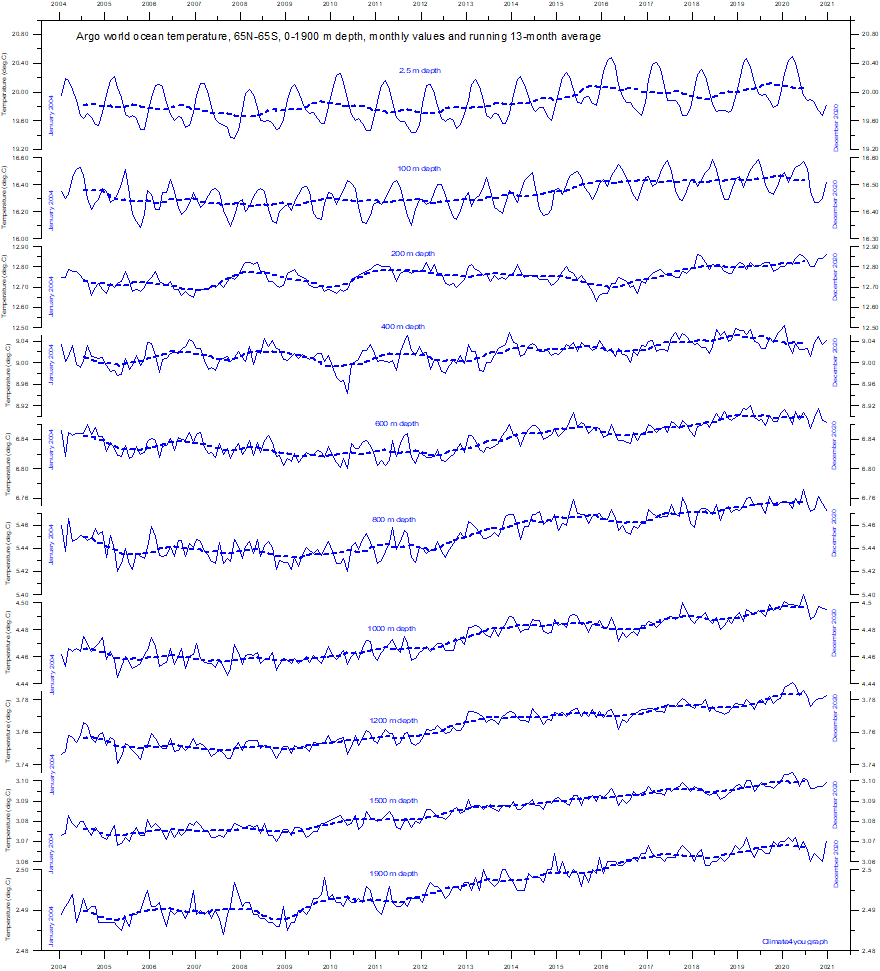
According to Argo data since 2004 the overall global ocean temperatures at 200m depth have increased around 0.05C and at 1000m around 0.03C.
I expect they mean change in the rate of change of velocity. Since the change is very small, there’s a small denominator. That makes it easier to find increases in the rate of change. If someone bothers to look at the article, I expect the numbers to be ridiculously small. That’s probably the reason they were not prominently featured.
Its ‘headlines ‘ which matter not facts , a fairly standard climate ‘science ‘ approach
We are talking about a scale of hundredths of degrees per decade. (and tidal gauges indicate a near linear slow ocean warming trend for the last 150 years of records).
How is this taken seriously?
Obviously, none of the 10+ authors and reviewers know the meaning of velocity and acceleration.
‘ IMAGE: Climate velocity (km decade-1) for contemporary (1955-2005)’
The ‘data’ for the baseline(contemporary) image stops conveniently before Argo data was available (3000 floats by nov. 2007) . So what are these findings based on? And wouldn’t it makes more sense to use the 2007-2019 limited data, rather then 1955 – 2005 virtually non-existent data?
Other than some circular reasoning i see nothing of intrest in this article.
(Circular reasoning being that if you program a computer simulator to warm with an increase in co2, you run some scenarios and the results are more warming with increasing co2 that only proves that your simulator does what you told it to do. Nothing else!
To see if that result is useful one needs to compare the simulation with reality.
The apparent omission of the only semi-useful data we have on the deep ocean(well up to 1000m at least) and therefore the only chance of validating the simulation, means that this article has no scientific value at all. No matter how many universities cooperated on it.
(Rant-off, sorry i need more coffee)
Stay sane,
Willem
I haven’t seen any media representations of Argo data for quite awhile. I would guess that means it isn’t scary enough.
“The magnitude of contemporary climate velocity is relatively fast in the surface layer, slower in the mesopelagic layer, but becomes fastest in the bathypelagic and abyssopelagic layers (Table 1 and Fig. 1). This contrasting pattern with depth arises because the rate of warming (the numerator of climate velocity) is presently greatest at the surface and declines with depth but the spatial gradient (the denominator of climate velocity) becomes gentler (flatter) with depth (see Extended Data Fig. 1 and Supplementary Table 1).”
A gentle denominator will take care of it. Wasn’t in my physical oceanography course so I need this translated.
Has to be the third derivative of climate, with climate velocity being the first derivative:
ACV = C”’
However, they failed to state what variable the derivatives are with respect to.
Grade = F
Carlo
Wasn’t time implied?
Yes, missed it the first time through.
“According to Argo data since 2004 the overall global ocean temperatures at 200m depth have increased around 0.05C and at 1000m around 0.03C”
A very small increase, if it is even an increase . Hundreths of a degree accuracy? Only in computer models.
And of course, the measuring instruments only measure a small portion of the ocean to begin with.
Usually the temperature difference along a thermal probe itself is more than .05 C, and the temperature difference in 10 feet vertical depth of ocean can be significant too. Saying the ocean temperature has changed by an average of .03 C is like saying the average surface wind speed has increased by 0.03 miles per hour. Insignificant to the point of being an aberration in measurement method, location, instrument accuracy, and result interpretation. Besides, keeping track of ocean temperatures is only of secondary importance for those sub tracking floaties, and is simply a means to justify more of them.
DMac
I wouldn’t be surprised to discover that the claimed average temperature change is of the same order of magnitude as the uncertainty, were they to be intellectually honest enough to cite the uncertainty.
What is the truth about deep ocean temperatures?
The trick for obtaining grants seems to be to hypothesise that something is happening in an inaccessible location, mention Climate Change and wait for the money to roll in, justified by the cost of reaching the aforementioned location.
I have a model which suggests that the lack of increased temperatures at seal level is due to the heat sinking down through the Earth’s crust until it impacts the Mohorovičić discontinuity. I will require upwards of 20bn to revive the old MoHo project, from a location somewhere off the Bahamas….
What the #@ur momisugly%#@ur momisugly%£ 🥵 is climate velocity the term isnot defined either in the abstract or in the article presumeably the term is well known by the climate cogniscenti and as i am not a Climate Scientisr it is impertinent of me to ask. Will someone supply a definition
Climate is going to hell (vector) as fast as humanly possible (speed).
The caption for the Danger! graphic indicates climate velocity = kilometers per decade: Thus the units of climate are kilometers!
The units of acceleration of climate velocity are therefore kilometers per cubic decade.
This makes sense to someone? Anyone?
The speed at which the money comes in, divided by the number of times you have to think up excuses for your predictions not according with reality…
I have been watching that Atlantic La Nina form up since around the middle of April. It has now grown quite extensively since then, and deep cold pockets are forming over large areas of the North Atlantic. This is the coldest I have seen this ocean region since I started using earthnull. That is going to have future consequences. … https://earth.nullschool.net/#current/ocean/surface/currents/overlay=sea_surface_temp_anomaly/orthographic=-88.62,26.84,593/loc=-43.765,44.487
It will be very interesting to see what UAH temperature anomaly does this month.
The tropics have been cooling over the month due to El Nino coming to an end. However, UAH tends to lag El Nino by several months and the Arctic has continued to be warm as has Siberia. This will limit any cooling. I’m thinking the May UAH value is going to see only a marginal drop. Still, likely a drop and likely not the end of the downward trend.
The Arctic and Siberia will likely cool more in June and July. I’m thinking we could see values less than .2 C by August and/or Sept. even before any La Nina effects come into play. If this does occur it would essentially mean the pause is still in effect.
“…analyzed contemporary and future global patterns of the velocity of climate change across the depths of the ocean…”
S.L.B.T.M.
“Climate velocity” — or how far you have to travel in order to keep mean temperatures *exactly the same*.
The estimated warming of the ocean waters is trivial, so how to stoke alarmism? Certainly not by publicizing the fractions of a degree involved. Instead, you take advantage of the water not varying nearly as much by latitude, showing that marine life would have to travel much further to avoid that dreaded fraction of a degree increase than they would to avoid a larger increase at the surface of the ocean.
Left as an exercise for the reader is to wonder whether any marine life actually needs to avoid such a tiny increase in the first place, or how far they would have to travel vertically instead of horizontally to maintain the exact same temperature. Or for that matter, comparing the variability experienced of actual temperatures to the change of mean temperature. The important thing is to have something dramatic to publicize, not to admit that the long-term anomaly change is trivial compared to the actual temperature swings already handled by the living things on the planet.
But the global average temperature (for what it is worth) has not increased significantly this century, despite CO2 doing so. How does the deep heat get into the deep oceans without being recorded in the shallows seas (SST)?
And if CO2 is not increasing temperatures as it should, how does it cause climate change?
I have asked this question many times in the past and never, ever gotten any kind of an answer.
My only conclusion is that the AGW alarmists think there is a big Star Trek “transporter” somewhere in space that is transporting the heat directly to the deep ocean.
Tim
It must be our descendants in the future trying to remove heat from the surface to make their world more habitable.
Must be a sci-fi story in there somewhere. Sounds like something “Doc” Smith would write.
Oh come on, hasn’t ‘The Twilight Zone’ occurred to any of you? Do do do do do do…
What if the deep ocean warming cause was geothermal?
I think it is caused by a lot of hot air.
..or it is caused by the run off of Climate Change drivel.
Of course the same can be said about a cooling ocean. How did life in sea survive the 90 Ka cold periode? How did the rapid sea level rise of 120 meters at the beginning of the Holocene affect this zone? The only way to warm the ocean surface as far as I know is by direct sunlight. Even so a warmer ocean would have more evaporation > more clouds > more cooling.
More utter, utter BS. If oceans are warming, good, it may delay the inevitable next glaciation.
future global patterns , or keep rolling the dice until you get the number you need to win .
Meanwhile given 2/3 of the planet is Ocean the range or measurements that exist on it are like using one grain of sand on one beach to analysis all the worlds beaches .
And best thing about the deep ocean is that it is ‘deep’ so you claim all things of things are in it , lost cities , sea monsters , space craft and ‘heat’ knowing it is very unlikely others can prove you wrong .
knr what you say resonates on so many levels. CAGW is designed to create feelings of fear and doom, they have been so manipulated they have lost sight of the joys in life. So many have already wasted years of waiting for long past predictions to come true and they have learned nothing, and wasted their life in fear. After more then fifty years of end of world predictions and 100% of them have not eventuated.
We know less about the ocean than we know about deep space. I choose to believe climate realists. It is arrogant to believe that human beings can influence climate to the extent that they claim and climate has not in fact changed to the extent that they proclaim.
To instill fear in people is to control them. To live in fear is not living at all.
Climate velocity, definition :
– Speed at which a climate pseudo-scientist eventually crashes into the wall of stupidity. Kind of measure of nonsense applied to the climate pseudo-science.
Example :
– Most of the climate clowns are dreadfully increasing their climate velocity.
Lol
Climate has a velocity now; not just a rate of change -well who knew. Please can we all have some money to join in this game. Just get a dictionary and flick the pages and stop it by inserting a digit at random on a page, reading the world found at the fingertip. So far I have discovered terrifying new evidence of its much worse than we thought:
climate lovechild
climate rout
climate twangle
climate languor
But I think the film ” Apocalypse Now” had the best word we can all die for , which was something like
climate Boomdang!