Guest “liar, liar, pants on fire” by David Middleton
Hat tip to Dr. Willie Soon…
America Misled: How the fossil fuel industry deliberately misled Americans about climate change
Over the past few decades, the fossil fuel industry has subjected the American public to a well-funded, well-orchestrated disinformation campaign about the reality and severity of human-caused climate change. The purpose of this web of denial has been to confuse the public and decision-makers in order to delay climate action and thereby protect fossil fuel business interests and defend libertarian, free-market conservative ideologies. The fossil fuel industry’s denial and delay tactics come straight out of Big Tobacco’s playbook. As a result, the American public have been denied the right to be accurately informed about climate change, just as they were denied the right to be informed about the risks of smoking by the tobacco industry. While fossil fuel companies attacked the science and called on politicians to “reset the alarm,” climate-catalyzed damages worsened, including increased storm intensities, droughts, forest damage and wildfires, all at substantial loss of life and cost to the American people.
This report explores the techniques used to mislead the American public about climate change, and outlines ways of inoculating against disinformation.
George Mason University Center for Climate Change Communication
The authors of this malicious and defamatory pack of lies are:
- John Cook, Center for Climate Change Communication, George Mason University
- Geoffrey Supran, Department of the History of Science, Harvard University
- Stephan Lewandowsky, School of Psychological Science, University of Bristol, and CSIRO Oceans and Atmosphere, Hobart, Tasmania, Australia
- Naomi Oreskes, Department of the History of Science, Harvard University
- Edward Maibach, Center for Climate Change Communication, George Mason University
This reads like a particularly idiotic Skeptical Science blog post.
The 97% Consensus Lie

Cook 2014 and its cooked consensus
Cook 2014 was nothing but the second hand opinions of Skeptical Science bloggers. Most of the surveys listed in figure 1 are similar second hand opinion exercises. These sorts of papers consist of abstract reviews. The authors’ then tabulate their opinions regarding whether or not the abstracts support the AGW paradigm. As Legates et al., 2013 pointed out, Cook defined the consensus as “most warming since 1950 is anthropogenic.” Cook then relied on three different levels of “endorsement” of that consensus and excluded 67% of the abstracts reviewed because they neither endorsed nor rejected the consensus.


The largest endorsement group was categorized as “implicitly endorses AGW without minimizing it.” They provided this example of an implied endorsement:
‘…carbon sequestration in soil is important for mitigating global climate change’
Carbon sequestration in soil, lime muds, trees, seawater, marine calcifiers and a whole lot of other things have always been important for mitigating a wide range of natural processes. I have no doubt that I have implicitly routinely “endorsed” the so-called consensus based on this example.
The second largest endorsement group was categorized as “implicitly endorses but does not quantify or minimize.” Pardon my obtuseness, but how in the heck can one explicitly endorse the notion that “most warming since 1950 is anthropogenic” without quantification? This is the example Cook provided:
‘Emissions of a broad range of greenhouse gases of varying lifetimes contribute to global climate change’
By this subjective standard, I have probably explicitly endorsed AGW a few times in WUWT posts.
Doran 2009 was a 97% consensus among 79 respondents
Doran and Kendall Zimmerman, 2009 was a survey of Earth Scientists listed in the American Geosciences Institute directory. The AGI includes AGU, AAPG and numerous other Earth Science societies. . This survey sample was limited to academic and government Earth Scientists. It excluded all Earth Scientists working in private sector businesses. The two key questions were:
1. When compared with pre-1800s levels, do you think that mean global temperatures have generally risen, fallen, or remained relatively constant?
2. Do you think human activity is a significant contributing factor in changing mean global temperatures?
I am a member of two AGI affiliated societies, AAPG and SEG, but not in the directories of academic institutions or government agencies. So, there was as zero-point-zero percent chance of me and about 50,000 other geoscientists being surveyed.
Had I been surveyed, I would have answered risen to #1 and my answer to #2 would have depended on the meaning of “human activity is a significant contributing factor.” If I realized it was a “push poll,” I would have answered “no.”
Interestingly, government and academic economic geologists and meteorologists were the most likely to answer “no” to question #2…
The two areas of expertise in the survey with the smallest percentage of participants answering yes to question 2 were economic geology with 47% (48 of 103) and meteorology with 64% (23 of 36).
The authors derisively dismissed the opinions of geologists and meteorologists…
It seems that the debate on the authenticity of global warming and the role played by human activity is largely nonexistent among those who understand the nuances and scientific basis of long-term climate processes.
No discipline has a better understanding of the “nuances” than meteorologists and no discipline has a better understanding of the “scientific basis of long-term climate processes” than geologists.
The authors close with a “no schist, Sherlock” bar chart:

If a survey was conducted of active publishers of abiotic oil papers, it would probably also yield a consensus. The same could be said of UFO researchers. Doran 2009 was an example of expertise cherry-picking and a total non sequitur… The conclusion doesn’t follow from the survey questions.
Stenhouse 2014 was a 52% “consensus”
The 97% claim from Stenhouse et al., 2014 was also contrived via expertise cherry-picking. These were the actual survey results:

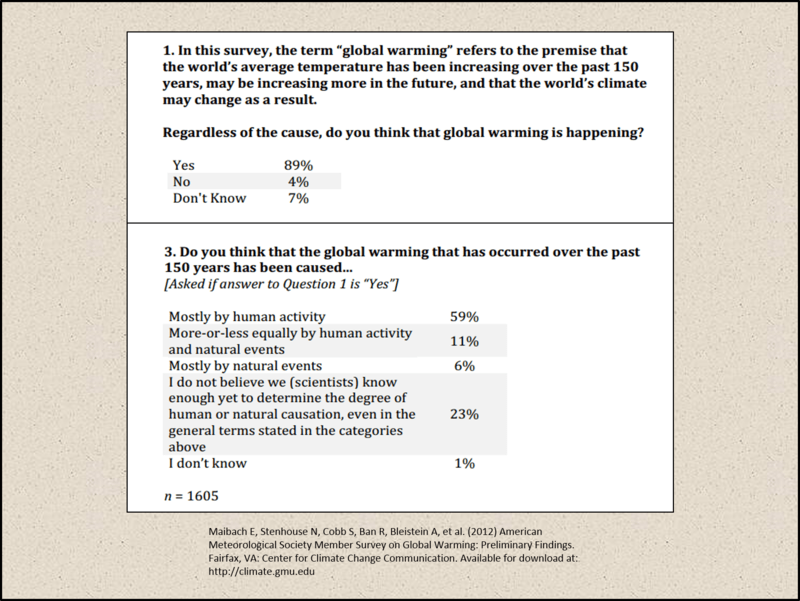

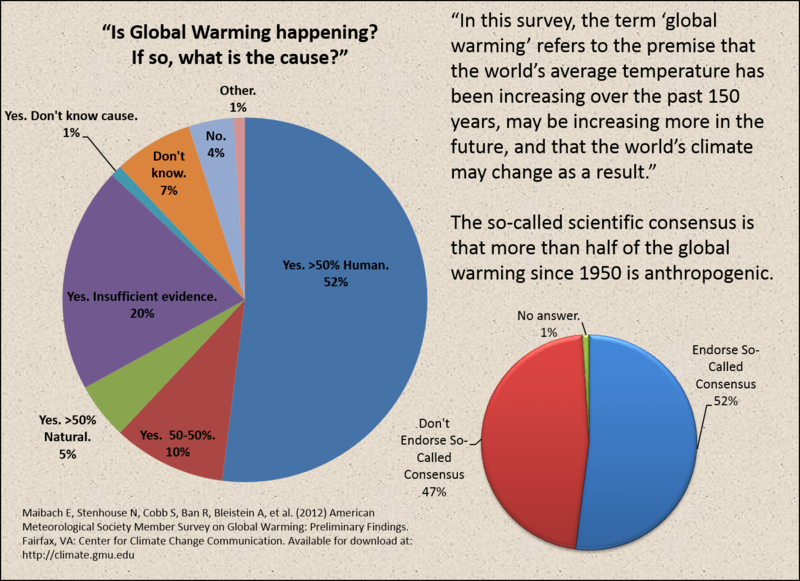
When self-described “climate scientists” and meteorologists/atmospheric scientists are segregated the results become even more interesting…


Only 45% of meteorologists and atmospheric scientists endorse the so-called consensus. Even self-described climate scientists only reach 78%.
The 52% overall “consensus” among the membership of the American Meteorological Society was explained away as being due to “perceived scientific consensus,” “political ideology,” and a lack of “expertise” among non-publishing meteorologists and atmospheric scientists…
While we found that higher expertise was associated with a greater likelihood of viewing global warming as real and harmful, this relationship was less strong than for political ideology and perceived consensus. At least for the measure of expertise that we used, climate science expertise may be a less important influence on global warming views than political ideology or social consensus norms. More than any other result of the study, this would be strong evidence against the idea that expert scientists’ views on politically controversial topics can be completely objective.
Finally, we found that perceiving conflict at AMS was associated with lower certainty of global warming views, lower likelihood of viewing global warming as human caused, and lower ratings of predicted harm caused by global warming.
So… Clearly, 97% of AMS membership would endorse the so-called consensus if they were more liberal, more accepting of unanimity and published more papers defending failed climate models. No schist, Sherlock!
On top of all that, Stenhouse didn’t even ask the right questions. The so-called consensus is that humans have caused more than half of the warming since 1950. Stenhouse asked about the past 150 years.
Why did the misleaders omit Maibach et al., 2016?
Maibach is one of the authors of the pack of lies, yet they failed to even mention his 2016 AMS survey.
This survey told us that atmospheric scientists were very divided about climate change since 1950.
The questions also eerily correlate with this infamous Tweet…
Ninety-seven percent of scientists agree: #climate change is real, man-made and dangerous. Read more: http://t.co/4lEEBYtVqf
— Barack Obama (@BarackObama) May 16, 2013
“Climate change is real”

“Man-made”

“And dangerous”


“And today, there’s no greater threat to our planet than climate change.”
So climate change can no longer be denied – or ignored. The world is looking to the United States – to us – to lead.
–Former (thankfully) President Barack Hussein Obama, April 18, 2015


Climate Change…

Why did the misleaders omit Stenhouse 2017?
Stenhouse et al., 2017 tells us that there is conflict within the American Meteorological Society on the subject of climate change.
This article analyzes open-ended survey responses to understand how members of the American Meteorological Society (AMS) perceive conflict within the AMS over global warming. Of all survey respondents, 53% agreed that there was conflict within the AMS; of these individuals who perceived conflict, 62% saw it as having at least some productive aspects, and 53% saw at least some unproductive aspects. Among members who saw a productive side to the conflict, most agreed as to why it was productive: debate and diverse perspectives enhance science. However, among members who saw an unproductive side, there was considerable disagreement as to why. Members who are convinced of largely human-caused climate change expressed that debate over global warming sends an unclear message to the public. Conversely, members who are unconvinced of human-caused climate change often felt that their peers were closed-minded and suppressing unpopular views. These two groups converged, however, on one point: politics was seen as an overwhelmingly negative influence on the debate. This suggests that scientific organizations faced with similar conflict should understand that there may be a contradiction between legitimizing all members’ views and sending a clear message to the public about the weight of the evidence. The findings also reinforce the conclusion that attempts by scientific societies to directly address differences in political views may be met with strong resistance by many scientists.
The #ExxonKnew Secret Science Lie
Apart from the bit about defending “libertarian, free-market conservative ideologies”, this is a pack of lies:
Over the past few decades, the fossil fuel industry has subjected the American public to a well-funded, well-orchestrated disinformation
Cook et al., 2019
campaign about the reality and severity of human-caused climate
change. The purpose of this web of denial has been to confuse the public and decision-makers in order to delay climate action and thereby protect fossil fuel business interests and defend libertarian, free-market conservative ideologies 1. The fossil fuel industry’s denial and delay tactics come straight out of Big Tobacco’s playbook. As a result, the American public have been denied the right to be accurately informed about climate change, just as they were denied the right to be informed about the risks of smoking by the tobacco industry. While fossil fuel companies attacked the science and called on politicians to “reset the alarm,” climate-catalyzed damages worsened, including increased storm intensities, droughts, forest damage and wildfires, all at substantial loss of life and cost to the American people 2.


The cartoon of a climate model is from the 1978 Black presentation:

The fossil fuel industries couldn’t have denied the American public “the right to be accurately informed about climate change” if we had tried.
Everything oil companies allegedly knew came from publicly available government and/or academic sources
One of the allegedly most damning documents was the 1968 Robinson Report for the American Petroleum Institute (API).
In 1968, scientists with the Stanford Research Institute reported to the American Petroleum Institute about their research on atmospheric pollutants of interest to the industry. Summarizing the available science, the scientists saved their starkest warnings for carbon dioxide (CO2). They cautioned that rising levels of CO2 would likely result in rising global temperatures and warned that, if temperatures increased significantly, the result could be melting ice caps, rising sea levels, warming oceans, and serious environmental damage on a global scale.
1968 “THE ROBINSON REPORT”
A page reproduced from this damning report referenced Möller (1963) as the source of a 1-7 °F rise in temperature due to a 25% increase in atmospheric CO2…
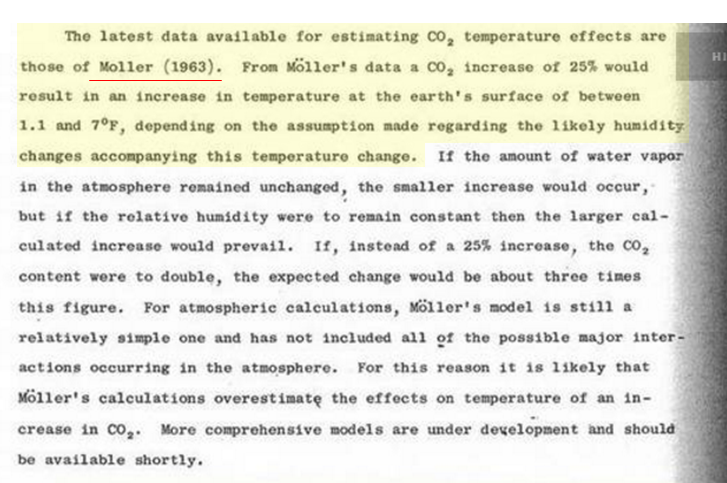
Unless Exxon owned the American Geophysical Union back then, Möller (1963) was not a secret document…
On the influence of changes in the CO2 concentration in air on the radiation balance of the Earth’s surface and on the climate
F. MöllerAbstract
Journal of Geophysical Research
The numerical value of a temperature change under the influence of a CO2 change as calculated by Plass is valid only for a dry atmosphere. Overlapping of the absorption bands of CO2 and H2O in the range around 15 μ essentially diminishes the temperature changes. New calculations give ΔT = + 1.5° when the CO2 content increases from 300 to 600 ppm. Cloudiness diminishes the radiation effects but not the temperature changes because under cloudy skies larger temperature changes are needed in order to compensate for an equal change in the downward long-wave radiation. The increase in the water vapor content of the atmosphere with rising temperature causes a self-amplification effect which results in almost arbitrary temperature changes, e.g. for constant relative humidity ΔT = +10° in the above mentioned case. It is shown, however, that the changed radiation conditions are not necessarily compensated for by a temperature change. The effect of an increase in CO2 from 300 to 330 ppm can be compensated for completely by a change in the water vapor content of 3 per cent or by a change in the cloudiness of 1 per cent of its value without the occurrence of temperature changes at all. Thus the theory that climatic variations are effected by variations in the CO2 content becomes very questionable.
From the full paper…
In this case, we must distinguish between the assumptions that the water vapor content (in cm l.e.) remains unchanged in spite of heating (cooling) of the atmosphere and that it increases (decreases). Constant absolute humidity means that the relative humidity (f) decreases from 75 to 70.34 per cent with a 1° or lowered by 4.66 per cent per deg. According to the above-mentioned calculations, an increase in CO2 from 300 to 600 ppm gives us a temperature change ΔT = +1.5° for Δf = -4.66 per cent per deg, and a temperature change ΔT = +9.6° for Δf = 0.
[…]
We recognize that for Δf = 0.8 per cent per deg the temperature change becomes infinite. Very small variations effect a reversal of sign or huge amplifications.
It is not too difficult to infer from these numbers that the variation in the radiation budget from a changed CO2 concentration can be compensated for completely without any variation in the surface temperature when the cloudiness is increased by +0.006 or the water vapor content is decreased by -0.07 cm l.e.
[…]
These are variations in the cloudiness by 1 per cent of its value or in the water vapor content by 3 per cent of its value. No meteorologist or climatologist would dare to determine the mean cloudiness or mean water content of the atmosphere with such accuracy; much less can a change of this order of magnitude be proved or its existence denied. Because of these values the entire theory of climatic changes by CO2 variations is becoming questionable.
Möller (1963)
So, as far back as 1963, Exxon knew exactly what we know today:
“The entire theory of climatic changes by CO2 variations is questionable.“
The infamous 1978 Black presentation was just a review of government and academic publications on the so-called greenhouse effect.
Here’s what Exxon knew in 1978…


Black’s allegedly proprietary climate model was just another cartoon based on publicly available literature.


I added HadCRUT4 to highlight how Hansen-ian it was in its wrongness.
This allegedly proprietary Exxon climate model is a cartoon derived from a 1979 National Research Council publication…

I plotted HadCRUT4 and MLO CO2 on it at the same scale… The models were wrong back then and are not much better now.
By 1978, Exxon knew that Gorebal Warming was 97% horst schist and that future climate models would fail miserably.
By 1982, Exxon’s “brilliant climate modelers” (/SARC) predicted that, apart from the recent El Niño, HadCRUT4 would remain within the “range of natural fluctuations (climatic noise) for at least the next 40 years.

An amazing feat, considering that “the first-ever synthesis of land and marine temperature data – i.e., the first global temperature record” didn’t exist before 1989.
References
Cook, J., Supran, G., Lewandowsky, S., Oreskes, N., & Maibach, E., (2019). America Misled: How the fossil fuel industry deliberately misled Americans about climate change. Fairfax, VA: George Mason University Center for Climate Change Communication. Available at https://www.climatechangecommunication.org/america-misled/
Cook, J., Nuccitelli, D., Green, S. A., Richardson, M., Winkler, B., Painting, R., et al. (2013). Quantifying the consensus on anthropogenic global warming in the scientific literature. Environmental Research Letters, 8, 024024.
Doran, P., & Zimmerman, M. (2009). Examining the scientific consensus on climate change. EOS. Transactions of the American Geophysical Union, 99, 22–23.
Legates DR, Soon WW-H, Briggs WM et al. (2013) Climate consensus and “misinformation”: a rejoinder to “agnotology, scientific consensus, and the teaching and learning of climate change”. Sci Educ. doi:10.1007/s11191-013-9647-9.
Maibach, E., Perkins, D., Francis, Z., Myers, T., Englbom, A., et al. (2016). A 2016 National Survey of American Meteorological Society Member Views on Climate Change: Initial Findings. George Mason University, Fairfax, VA: Center for Climate Change Communication.
Möller, F. (1963). “On the influence of changes in the CO2 concentration in air on the radiation balance of the Earth’s surface and on the climate”. J. Geophys. Res., 68(13), 3877–3886, doi:10.1029/JZ068i013p03877.
National Research Council. 1979. “Carbon Dioxide and Climate: A Scientific Assessment”. Washington, DC: The National Academies Press. https://doi.org/10.17226/12181.
Stenhouse, N., and Coauthors, 2014: Meteorologists’ views about global warming: A survey of American Meteorological Society professional members. Bull. Amer. Meteor. Soc., 95, 1029–1040, doi:https://doi.org/10.1175/BAMS-D-13-00091.1.
Stenhouse, N., A. Harper, X. Cai, S. Cobb, A. Nicotera, and E. Maibach, 2017: Conflict about Climate Change at the American Meteorological Society: Meteorologists’ Views on a Scientific and Organizational Controversy. Bull. Amer. Meteor. Soc., 98, 219–223, https://doi.org/10.1175/BAMS-D-15-00265.1
Further Reading
What did ExxonMobil Know and when did they know it? (Part 1)
What did ExxonMobil Know and when did they know it? (Part Deux, “Same as it ever was.”)
What did ExxonMobil Know and when did they know it? (Part 3, Exxon: The Fork Not Taken
“Smoke & Fumes”… The dumbest attack on ExxonMobil evah’
Even dumber than the dumbest attack on ExxonMobil evah’
What Did Shell Know and When Did They Know It?
HuffPost: The Dumbest #ExxonKnew Article… EVAH!
NY Attorney General Defies Judge’s Order in Exxon Case
ExxonKnew Epic Fail: Oil Companies DID NOT build “their rigs to account for sea-level rise”
Defending Mann’s Hockey Stick because #ExxonKnew
Kamala Harris Lied About #ExxonKnew Lies
The simple fact is truth is defined by consensus. It does not matter if 7 billion people say something is true, that does not make it true. This is the logical fallacy called ad populum. Whenever people say “but 97%” or something similar, I say so what. 100 scientists refuted Albert Einstein, and he remarked that if they were right, only one was needed. Miasma theory was once consensus, geocentric theory was once consensus, flat earth was once consensus. All wrong. Saying something is true does not make it true.
Consensus does make something a paradigm. It also reflects a level of confidence. Outliers are sometimes the right answer, but statistically they are usually wrong.
Although, you are correct, it doesn’t make something true or factual.
They harp on the 97% consensus lie because most sane people would require a high level of confidence regarding the “climate crisis” in order to surrender their prosperity and liberty to the government in a Quixotic effort to “save the planet.”
“Over the past few decades, the fossil fuel industry has subjected the American public to a well-funded, well-orchestrated disinformation campaign about the reality and severity of human-caused climate change”
I must have missed something from back in the days when they were called “Filling Stations” and tank trucks drove around with names like Magnolia (my father drove one for a short time) and even in the self-service era. Where and when was this propaganda first posted? What better place than the pump? Or on the now rare Flying Red Horse or Sinclair Dinosaur?
It’s subliminal messaging. You know that whistling sound the pump makes when you are filling the gas tank? It isn’t just whistling Dixie.
““Over the past few decades, the fossil fuel industry has subjected the American public to a well-funded, well-orchestrated disinformation campaign about the reality and severity of human-caused climate change”
“Where and when was this propaganda first posted?”
The only ads Oreskes et al. can point to are those of Mobil Oil in the 1980s and 1990s, IIRC. Thereafter, she must be insinuating that skeptical bloggers and commenters are on the take, which isn’t true. (Unless one relies on Gleick’s phony Heartland Strategy document.) This is crazy conspiratism.
‘Hat tip to Dr. Willie Soon…’
According to David Suzuki cited here:
https://www.desmogblog.com/willie-soon
“U.S. oil and coal companies, including ExxonMobil, the American Petroleum Institute, Koch Industries, and the world’s largest coal-burning utility, Southern Company, have contributed more than $1 million over the past decade to his (Dr Soon’s) research. According to Greenpeace, every grant Dr. Soon has received since 2002 has been from oil or coal interests.”
So perhaps Dr Soon is not entirely an unbiased observer here?
‘Hat tip to Dr. Willie Soon…’
Gee Griff, you failed to address the post itself about the numerous lies and B.S. by known climate charlatans, to concentrate on Dr. Soon who isn’t a part of the blog post.
You write this howler:
“So perhaps Dr Soon is not entirely an unbiased observer here?”
It was DAVID MIDDLETON who wrote the blog post with his expose of known climate charlatans, your boring and irrelevant funding attack on Dr. Soon arrived as being dead on arrival…….. irrelevant.
Do you have anything to say about the blog post itself?
Snicker…………
No bar is too low for poor Griffy to trip over.
Stop mocking the afflicted. Actually I’ll join you, griff is mentally challenged.
Willie sent me the link to Cook et al’s pack of lies. Hence the hat tip.
According to Greenpeace, according to David Suzuki, according to Desmogblog… Griff is funny.
1) No attempt to refute anything, just an attempt to impugn the person who brought this article to David’s attention.
2) That lie has been dealt with many times. Those groups never donated a penny to Dr. Soon’s research. In the decade prior they gave a million dollars to Heritage Foundation (just a few percent of Heritage’s income during that time period). Most of the donations were ear-marked for projects having nothing to do with Dr. Soon. If Greenpeace could document that charge, they would.
..One million in 10 years ? Climate Charlatans get that per year ! D’OH !
Actually the grants were to the institution Dr. Soon belongs to, not to Dr. Soon.
We’re awaiting your apology.
They were also made prior to Dr. Soon joining that institution.
Again with the smears, huh?
These literal know-nothings truly do believe that people like Soon, Lindzen, etc.:
1) actually believe in CAWG but
2) will say they don’t for a price
There is nothing in their experience, as they have been taught no critical thinking that would lead to believe:
3) they don’t believe in CAWG and
4) want to get the word out
As I believe Lindzen has said (paraphrasing): he gives the same presentation that he would give to Greenpeace if they only asked…
Greta is not being paid off by big oil…….we should believe her (-:
This David Suzuki?
https://fairquestions.typepad.com/rethink_campaigns/my-unexpected-encounter-with-david-suzuki-1.html
Griff, you should check the facts before printing LIES you READ about but do not check out.
I think that a legal campaign should be started against the United States government for allowing citizens of this country to breathe air with oxygen, which is a known agent of human cell destruction leading to aging.
Breathing oxygen-infested air kills.
The US government knew!
The fact that the Warmist Gestapo have made sure that nobody *ever* gets paid for a second research paper that says “no, it isn’t happening” pretty much negates about 90% of that “97% consensus” right from the start.
RICO anybody?
From the shitz for brain “stupid ideas” contest, the winner is…..
“How electric airplanes could help reduce air travel emissions”
https://www.theweathernetwork.com/ca/news/article/how-electric-airplanes-could-help-reduce-air-travel-emissions
Half the population suck at driving cars in good weather, can you imagine them flying little planes in bad weather along the “Highway in the Sky” ! LOL…..
Step one, find a sample of people who agree with you.
Step two, ask them all a question about the subject on which you already agree.
Step three, declare that since everybody who agrees with you, agrees with you, a consensus has been reached and therefore nobody is allowed to disagree with you from now on.
Climate Science in a nutshell
But, but, but David, Rhys Jaggar says authors like you mention ARE the experts, and no one should listen to you, Anth*ny & others on WUWT:
https://wattsupwiththat.com/2019/10/22/who-are-the-experts-on-climate-change/#comment-2829095
Typo in the title: it’s Lewandowsky (with an a)
Fixed.
See my WUWT guest thread, “Notes From Skull Island – why climate skeptics aren’t ‘well funded and well organized’”
If our side were well funded and well organized, as warmists charge, it would have the following 22 characteristics–which it doesn’t.
https://wattsupwiththat.com/2012/12/16/notes-from-skull-island-why-skeptics-arent-well-funded-and-well-organized/
PS: Warmist ,groups like Greenpeace misleadingly and knowingly and continually claim that^ $*** million goes to climate change denial groups,^ when only a tenth of that amount gets spent on climate contrarianism. These think tanks etc. are pro-business organizations that spend 90% of their donations on other topics.
In what scientific discipline other than the one in question does the following apply: If the data does not support the theory, change the data?
Here is an article from Manabe & Möller (1961) :
https://www.researchgate.net/publication/278665889_On_the_radiative_equilibrium_and_heat_balance_of_the_atmosphere
They clearly stated that CO2 has a cooling effect (and so has WV – see Chapter on Heat Budget).
These results are also in Kondratyev 1969 – Radiation in the atmosphere, chap.11.
Dr Murry Salby elaborated a Cross – correlation diagram between 40 years of CO2 concentration (data from Mauna Loa) and of global mean T (I presume, data from UAH) :
https://www.youtube.com/watch?v=5g9WGcW_Z58
The right part of the diagram shows that T is a driver of the CO2 concentration with a mean lag of 9 to 10 months.
Conversely, the left part of the Cross – correlation diagram, if any, shows that CO2 is (even if weakly) anti correlated with T (CO2 tends to counteract T variations with a lag of some 1,5 year) :
– this positively destroys any global warming hypothesis based on CO2 concentration increase, since there is not even a positive correlation between CO2 concentration and T variation, but if any, it’s quite the opposite.
One plausible hypothesis would be :
– T increase induces an increase of CO2 concentration with a lag of 10 months (see Prof Salby presentation to this respect),
– CO2 concentration increase tends to counteract the T increase : the CO2 acts as a negative feedback with respect to T variations.
This hypothesis is consistent with what discovered Möller, Manabe, Kondratyev and many others decades ago with respect to the global cooling effect of CO2.
The public believes that extreme weather is caused by climate change. The IPCC says not changes have yet to be detected.
Are scientists responsible for misleading the public?
“Are scientists responsible for misleading the public?”
The scientists of the IPCC have said there is no evidence CO2 is enhancing extreme weather events.
Climate alarmist activists on the other hand misconstrued what the IPCC has said about CO2 and weather and they are the ones misleading the public. It’s kind of funny: In order to refute the claims of the activists, all one has to do is refer then to the IPCC. The activists pretend to be quoting the IPCC but obviously they are not if you read what the IPCC has to say on the subject.
One way the IPCC scientists may be misleading people is in them not correcting the climate alarmist activists when they lie about the IPCC results. Remaining silent allows the lie to continue.
Tom Abbott
“The scientists of the IPCC have said there is no evidence CO2 is enhancing extreme weather events.”
Where did you get this idea? What do you mean by “extreme weather events”? It must be different from what the IPCC means.
Kristi wrote: “Where did you get this idea [that the IPCC doesn’t promote CO2-enhanced weather events]?”
I got it from the IPCC:
https://wattsupwiththat.com/2018/09/16/the-washington-posts-slander-on-hurricanes-and-climate-change/
“Similarly, the IPCC reported in 2013: “No robust trends in annual numbers of tropical storms, hurricanes and major hurricanes counts have been identified over the past 100 years in the North Atlantic basin.”
In spite of all those facts, a national scientific poll commissioned by Just Facts in 2017 found that 69% of U.S. voters believe that the global “number and intensity of hurricanes and tropical storms have generally increased since the 1980s,” including 90% of Democrats and 46% of Republicans. This disconnect between perception and reality accords with a mass of global warming-related misinformation spread by the press.”
end excerpt
See what I mean, Kristi? Activists are saying things about the climate that are not backed up by the IPCC.
Kristi wrote: “What do you mean by “extreme weather events”? It must be different from what the IPCC means.”
I mean that activists claim that CO2 is making extreme weather even more extreme. There is no evidence for this. For every extreme weather event today, we can find one in the past, before CO2 was an issue, that was just as strong or stronger.
Tom Abbott,
I see. You are defining “extreme weather events” differently from the way the IPCC does. The IPCC considers Tmax and Tmin, precipitation events, dryness, floods, El Nino, etc. There is a bunch of charts with overviews here:
https://www.ipcc.ch/report/managing-the-risks-of-extreme-events-and-disasters-to-advance-climate-change-adaptation/changes-in-climate-extremes-and-their-impacts-on-the-natural-physical-environment/
I also found an interesting page looking at observations and models of hurricane intensity and frequency here:
https://www.gfdl.noaa.gov/global-warming-and-hurricanes/
To me it seems an honest summary of what has been found in the research on the subject. This in particular caught my eye, being something I’d never read before: “Both the increased warming of the upper troposphere relative to the surface and the increased vertical wind shear are detrimental factors for hurricane development and intensification, while warmer SSTs favor development and intensification.”
As to the fact that activists claim things for which there is little or no evidence, that should be nothing new to any of us. This is true, though, on both “sides” of the issue, since there are also plenty of AGW “denier” activists who make claims that aren’t backed up by the majority of the evidence (or they claim such evidence is fudged/faulty for one reason or another).
I think your comment is more important for its implication that the scientific claims made by the IPCC don’t generally support activists simply out of a desire to make a case for some political or ideological cause, as some have asserted (notice, please, I talk about scientific claims, rather than assertions about policy, which are arguably more liable to political/ideological influence because there are no inherent mechanisms to minimize bias). In other words, we can rely on an IPCC report to summarize the general state of knowledge at the time it was written, always taking into account the ratings it provides as to the confidence levels (reflecting amount of data available and the agreement among studies) and likelihoods (reflecting the statistical strength of trends). For instance, regarding flood attribution, there is low confidence that anthropogenic influence has affected the magnitude and frequency of floods on a global scale, but medium to high confidence that humans have affected components of flooding such as snowmelt and precipitation. Furthermore, the regional impacts may have different assessments than global ones, partly because of differences in data quality/quantity. One should also keep in mind that just because a trend is not demonstrated with the data we already have doesn’t mean it will never be demonstrated, as more and better data come to light. Drought is a good example, since people have defined drought in different ways, and there are different aspects of drought one can measure (length and severity, for instance), and they should be applied relative to the background climate (drought in Minnesota means something different from drought in California).
While one incidence of extreme weather does not make a trend, a trend would never exist without those single incidents. For instance, dismissing every record high temperature incident as “weather, not climate” is not useful if that means ignoring the fact that high temperature records have been abnormally common in the last decade or two.
Now for your link….From the original editorial slammed by the WUWT post: “Yet when it comes to extreme weather, Mr. Trump is complicit. He plays down humans’ role in increasing the risks, and he continues to dismantle efforts to address those risks. It is hard to attribute any single weather event to climate change. But there is no reasonable doubt that humans are priming the Earth’s systems to produce disasters.”
This talks about increasing risks, and Trump dismantling efforts to address those risks (a legitimate complaint, IMO) – that is the context of “complicit,” while the WUWT post suggests he is “complicit in Hurricane Florence,” something very different. It is misleading. So is, “Thus, to blame Trump for Hurricane Florence or any other hurricane in the past or future is absurd;” again, that is not what the WaPo article suggests.
WaPo: “Human activities may have already caused other changes in tropical cyclone activity that are not yet detectable due to the small magnitude of these changes compared to estimated natural variability, or due to observational limitations.”
This is important. Hurricanes are naturally highly variable, and the record is not very good in its initial decades. That makes long term (more than 50 years) trend detection and attribution problematic for statistical reasons. Just as we cannot yet conclude that humans have had an effect in the 100+ year record, nor can we conclude they haven’t.
“…the authors jump to the assumption that record-high ocean temperatures “likely” increased Harvey’s “size and intensity” and “contributed substantially to the flooding caused by rainfall on land.” This is irrational, because there is a significant difference between: (a) finding that a storm absorbed and released a certain amount of heat from the ocean, and (b) concluding that the storm absorbed more heat than it otherwise would have because the ocean was warmer than normal.” That this is”likely” is irrational? The author of the WUWT post provides no other explanation to account for the observation. The physics seem to me to be on fairly solid grounds: warmer oceans mean higher evaporation rates.
“The authors also write that “increases in Atlantic hurricane activity in the 20th century have been attributed mainly to the increases” in sea surface temperatures, which are “primarily driven by human increases in greenhouse gas concentrations….” Once again, the IPCC and Geophysical Fluid Dynamics Laboratory have found no detectable increase in Atlantic hurricane activity over the 20th century.” However, in the paragraph alluded to, Trenbreth et al. discuss observations since 1970, not for the whole 20th C, and that changes things, since there has been a significant trend during this period (incidentally, the one with the best data available).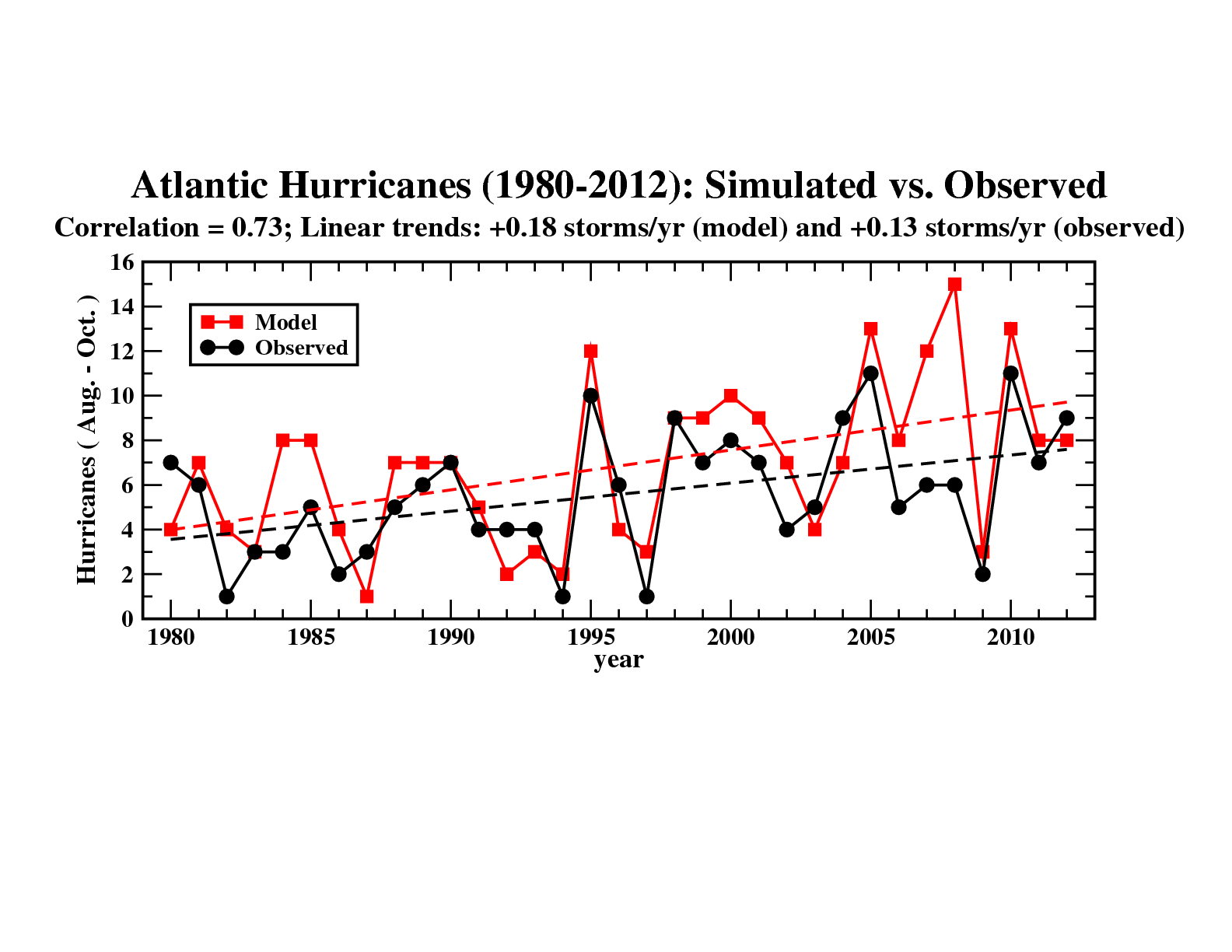 This is another example of misconstruing the text.
“The authors also declare that “a warming ocean will” cause “more rainfall and flooding, which is well supported by the Harvey case.” Concrete, comprehensive data also deflates that assertion: A 2015 paper in the Journal of Hydrology analyzed rainfall measurements “made at nearly 1,000 stations located in 114 countries” and found “no significant global precipitation change from 1850 to present.”’ Regional precipitation variation is known and expected; it signifies nothing in relation to tropical cyclones, which is the context of the Trenbreth reference – once again, misconstrued as applying generally.
The WUWT post makes some valid points, such as the disconnect between what the public thinks and what is demonstrated. However, given the fact that the author has misconstrued every quote I have looked it, it makes me question how well he has accurately summarized the meaning of the many other short quotes in the post. It takes this sort of follow-up to assess the quality of such claims.
I still don’t have an answer to this: when it’s as obvious as steak and fries on your plate, that the warm periods over the last 600,000 years are consistently shorter than the cold periods, how come no one is looking at that?
Why is this being ignored? Not enough money in that kind of research, or something?
If there is going to be a change, it will be toward a colder climate, whether those money-grubbing tooters like it or not.
I just do not think the right things are being looked at, that’s all.
Forecast for next Tuesday is snow showers in my AO. That’s a little earlier than usual, ahead of Hallowe’en. Fall is coming to an end early. I’ll put the geraniums into the shed for the winter and say so long to Summer.
“… in order to delay climate action and thereby protect fossil fuel business interests and defend libertarian, free-market conservative ideologies. ”
This was all done to protect a free-market ideology? What exactly do they want?
“The fossil fuel industry’s denial and delay tactics come straight out of Big Tobacco’s playbook. As a result, the American public have been denied the right to be accurately informed…”
Nobody was uninformed about tobacco. Everybody knew that it caused lung cancer. But guess what, now that we are informed, people still smoke.
But how is it that one industry can keep the public “denied the right to be informed”? Anybody can speak, and for God’s sake they’ve been screaming it from the top of their soap box for 30 years now. How is this even plausible?
The Black presentation is the sort of scientific report that you do in highschool. A proper one explores why it might be wrong.
The Black presentation was basically just a review of the current scientific literature. Exxon (and/or Mobil) was trying to assess if or how the science might affect policy.
I have been banned from 4 sites. I must have asked the correct question.
Gerald
Take solace in the fact that you must be doing something right.
Careful using the word “liar”.
I was careful.
There is a simple solution to the “97%” problem. Conduct a valid study that comes up with a different number. Bellyaching about the current crop of studies on blogs doesn’t invalidate any of the published studies. Oh…and after you conduct the study, make sure it’s published in the same journals as the “97%” studies are.
Cook et al. 2014 states in the abstract that “Among abstracts expressing a position on AGW, 97.1% endorsed the consensus position that humans are causing global warming. ” There is no quantification of how much global warming in this consensus position.
‘As Legates et al., 2013 pointed out, Cook defined the consensus as “most warming since 1950 is anthropogenic.”’ Where???
To quantify the % of abstracts that endorse AGW vs. not, it makes absolutely no sense to include the “no position” abstracts.
The second half of the study, in which authors of the rated papers were asked to rate them, is not mentioned. This is a key part of the study, since it represents an independent confirmation of the original estimates by those whose abstracts were being rated. I’m aware there are those who’ve said their papers were wrongly scored as an endorsement (akin to “false positive”), but it’s probable there were “false negatives,” too.
If you are going to berate the work of citizen science done for Cook et al., you might as well hold the same level of disrespect for those who did it for Anthony in his work on temperature station siting.
Doran, 2009…It’s fair enough to criticize the “97%” graphic in the main article. But what Middleton leaves out is, “Results show that overall, 90% of participants answered “risen” to question 1 and 82% answered yes to question 2” based on the answers of 3146 respondents. It’s not 97%, but it is a vast majority.
Middleton said, “No discipline has a better understanding of the “nuances” than meteorologists and no discipline has a better understanding of the “scientific basis of long-term climate processes” than geologists.” That’s opinion. Why is it so certain that either meteorologists or economic geologists have such a wealth of understanding of long-term climatic processes, especially if they haven’t done much research and publishing on the topic? Meteorologists focus on a different processes in a time frame, and my impression is that economic geologists mostly focus on processes deep within the earth and how the results come to the surface. I’m not sure why either would be expected to be experts in the nuances of long-term climate process.
………………………………………
The captions to several of the graphs presented are not accurate representations of what was asked. For instance, nothing was asked about respondents’ willingness to “destroy the economy.” This is loaded language meant to evoke an emotional response, which, along with political/ideological bias and misleading information presented, are the key defining traits of propaganda.
Then there’s “Clearly, 97% of AMS membership would endorse the so-called consensus if they were more liberal, more accepting of unanimity and published more papers defending failed climate models.” This is another misrepresentation. This issue is not necessarily whether someone is liberal, but whether someone lets political ideology affect one’s perception of climate change. Unanimity is not the same as consensus, and disbelief in the scientific consensus could affect how people view the science. Publishing papers about climate science is not the same as defending climate models, “failed” or not. There is plenty of climate research that has nothing to do with models.
Nowhere in Middleton’s essay is a discussion of the ways in which the fossil fuel industry attempted to impact public opinion, which is the focus of the article with which the post begins. Nothing is said about internal memos or advertisements, either in the article of not. One of my “favorite” internal memo excerpts is:
“Victory Will Be Achieved When…Those promoting the Kyoto Treaty on the basis of extant science appear to be out of touch with reality.
“Unless clmate change becomes a non-issue, meaning that the Kyoto Treaty becomes and non-issue and there are no further initiatives to thwart the threat of climate change, there will be no moment when we declare victory for our efforts.”
http://www.climatefiles.com/trade-group/american-petroleum-institute/1998-global-climate-science-communications-team-action-plan/
Another example is a memo describing a pilot ad campaign meant to spread uncertainty about the science, complete with a Chicken Little cartoon. http://www.climatefiles.com/denial-groups/ice-ad-campaign/
Other documents on the site document are reports by researchers working for the fossil fuel industry (particularly ExxonMobil) that clearly point to the fact that they believed climate change a concern, and that the fossil fuel industry plays a significant role in it.
Criticisms of publications about climate science like “America Mislead” are sometimes warranted, and it’s fair enough to draw them to the public’s attention. But the motives and credibility of a critic become questionable when he commits the same errors, such as bias in presentation, as those he is criticizing.
Regarding Cook’s fraudulent follow up survey…
https://iopscience.iop.org/article/10.1088/1748-9326/8/2/024024
A 14% response rate to their cherry picked invitees.
Regarding the idiotic comment about the captions…It’s called humor and the captions were geared toward readers familiar with arithmetic. The “Family Feud” meme and matching the questions to Obama phrases should have served as hints regarding the humor.
Regarding your math impairment:

Figure 9. Only 50% of “scientists” characterized climate change as being dangerous (primarily or exclusively harmful impacts) over the next 50 years.
47% + 3% = 50%
Figure 10. Only 18% of “scientists” thought that there was any point in destroying our economy in order to prevent the weather from changing. Fully 41% of “scientists” indicated that climate change might as well be “ignored.”
18% + 1% = 19%… This group thinks that most or all additional climate change can be averted. The effort to do this would destroy our economy.
25% + 9% + 6% + 1% = 41%… This group thinks that only a small amount, at most, of additional climate change can be averted… So it might as well be ignored. Or, more appropriately, adapted to as it occurs. The only questionable thing is in counting the 6% who said they don’t know. I gave them the benefit of the doubt that they wouldn’t want to destroy our economy on the basis of “I don’t know.”
Regarding the #ExxonKnew fraud, please feel free to cite other “documents” and I will easily point out your failure to comprehend them.
Exxon *still* doesn’t know if CO2 is bad for the Earth’s atmosphere. Nobody knows.
The first thing those suing Exxon must prove is that CO2 affects the Earth’s weather in a detrimental fashion, or at all. That’s not going to happen in the courtroom. People have been trying to find evidence for this for decades and haven’t found it yet. Again, speculation is not evidence.
The “haven’t found it yet” and “*nobody*, including Exxon, understands the relationship between CO2 and the Earth’s atmosphere” parts will win the case for Exxon. Especially if they let Dave give the court a presentation of the facts! I suppose you could give that presentation via skipe, David, if you think your presence in the courtroom would be too disruptive.. 🙂
David,
You don’t think 1200 respondents a reasonable sample size? What “cherry-picking”?
What math impairment do I have?
“Figure 9. Only 50% of “scientists” characterized climate change as being dangerous (primarily or exclusively harmful impacts) over the next 50 years”…in their area, with a full 19% saying they don’t know.
“Destroying the economy” is not humorous when you suggest that people are willing to do it. You don’t have any idea what those people think are reasonable methods of averting “a large additional amount of climate change,” and it is certainly not appropriate to assume they would support a $240/gallon gas tax. Nor is it valid to include those that don’t know in your calculations of those that think climate change “might as well be ignored,” which is another phrase putting words in others’ mouths – that is not what the survey asks.
Why should I have trust in your ability to comprehend documents, when you twist people’s words for the sake of conveying your own biased ideas? Even the fact that you put “documents” in quotation marks sends a message. This is not an attack on you (not like suggesting I have a math impairment), but a criticism of what you are doing. You have some important points to make, but you undermine your own credibility, at least among those who are looking for dispassionate, unbiased presentation of information. That’s why I usually ignore your posts (not that you care, of course) and got turned off WUWT in general. This has just reminded me why I did so in the first place. Waste of time. Makes me sad, though, that so many others get sucked in. It’s a problem for our country as a whole no less than the fact that others get sucked in by the likes of Al Gore and many in the media. “Alarmism” and “skepticism/denial” are two sides of the same problem, both based on bias and misleading commentary.
Good fracking grief! 18% of the respondents stated that all or most future climate change could be averted. Assuming they know anything about the subject matter, that would entail following the recommendations of IPCC SR1.5.
https://dailycaller.com/2018/10/09/limiting-global-warming-cost/?utm_medium=push&utm_source=daily_caller&utm_campaign=push
It’s not feasible because it would wreck our economy and wouldn’t have any measurable affect on the weather.
I don’t give a rat’s @ur momisugly$$ what you do or don’t trust. My objective is not to educate Gorebots, it’s to ridicule them. However, I didn’t twist anyone’s words. The exact words of the question and response choices are on the fracking chart from the fracking paper that was reproduced in this post.
Assuming that the IPCC, etc. are right (they aren’t) you can’t avert all or most future climate change without destroying the economy.
This particular bit of idiocy deserves special ridicule…
This is another fabricated 97% lie…
Setting aside their endorsement criteria, which would have many of my WUWT posts endioirsing it…
https://iopscience.iop.org/article/10.1088/1748-9326/8/2/024024/pdf
Out if 29,083 authors, they directly surveyed only 8,547… 29.4%.
Of the 8,547 surveyed authors, only 1,200 replied… 14.0%
They tossed out 11 responses, leaving 1,189 out of 29,083 authors… 4.1%
96.4% of the 1,189 authors agreed with their ratings… 1,146
1,146 is 3.9% of the authors.
There’s a lot of difference between 97% and 3.9%.
Yes, I know I’m stating the obvious. Sometimes it is necessary. Some alarmists have a hard time getting things through their thick heads.
So next time an alarmists falls back on their favorite argument that 97% percent of scientist agree with their view, you can reply that it wasn’t actually 97% who agree with their view, it is actually only 3.9%. I can hear the howls from the alarmists now! You have just taken away their only argument.
Alarmist Climate Science = A Pack of Lies
Tom Abbott,
Howls of laughter, you must mean. David has in no way taken away their argument, he has shown the utter ridiculousness of his own argument, and you have shown that you didn’t notice how fatuous it is. See my reply to his post.
It really amazes me that so many people have such low opinions of scientists that they think they are completely brainless. It seems to be a sign arrogance that these people think they know more about doing the kind of research for which the scientists often spent a decade in training, and decades more practicing in the course of their career. It’s so easy to say climate science is a pack of lies when you have no experience doing it. It’s like me saying meteorology is a pack of lies because the weatherman isn’t always right.
Well, you got one thing right: “There’s a lot of difference between 97% and 3.9%.” I doubt many alarmists would disagree with that. Good luck convincing them of the rest.
Funny, I’ve found much the same thing in my personal life.
Most of the people with whom I agree about anything also agree with me on the same things. I’d say its true almost 97% of the time.
Just saw a Facebook posting from a young man I know who is in first year math at university (yes, not all of them are taking sociology or gender studies). Scary thing: he was a climate change protest.
So either the math will take, or the kook-aid will take. I’m hoping for the math…
Anytime anyone agrees with me about anything, they instantly become suspect.
Russian double agents….
…suspect…but verify.
That’s my motto.
David,
“1,146 is 3.9% of the authors.”
Yes, you’ve shown that you can figure out percentages. Well done! Is there a point to this little exercise, or are you just demonstrating your math skills?
You wouldn’t want to survey all 29,083 authors because you would be getting multiple responses about individual papers, which is not what you want when your aim is to estimate the accuracy of the first part of the research.
14% is a rather low response rate, but 1189 is still enough to draw reasonable conclusions about accuracy, and the estimate they found was very close to the original.
Are you suggesting that 96.4% is not close enough to 97%, and is therefore a lie?
Your math seems to be better than your reasoning here.
The 96.4% was not confirming 97%. It was confirming 0.54%.
Furthermore, unlike Doran, Maibach and Stenhouse, and it wasn’t a survey of scientists. Only Stenhouse 2014 and Maibach 2016 specifically asked about human activities being responsible for >50% of recent climate change. The respective results were 52% and 67%. Beyond that nebulous attribution, opinions diverged widely on how climate change has or will affect people and what should be done about it. Stenhouse 2017 found that 53% of AMS members thought there were significant disagreements about climate change.
That said, if the transient climate response is 1.2 K (very likely), humans are responsible for about 70% of the warming since 1976.
Science News, March 1, 1975…
If the climate models are accurate (they aren’t), without AGW, it would currently be colder than The Ice Age Cometh…
Thank the “fossil fuel industry” for the fact that you aren’t freezing in the dark.
There is nothing false or misleading in either of these documents.
David,
The point is motive. The point is that industry would spend millions of dollars trying to convince the public that the science is uncertain. Not that there are uncertainties about some things, but that it’s uncertain as a whole. The Chicken Little ad is meant to convey the idea that people concerned about AGW are worrying for no reason. The Minnesota winter ad is meant to convey the idea that if it still gets cold, it’s silly to worry about climate change.
The motive is to counteract the science through spreading disinformation, distrust of the consensus, and eliciting an emotional reaction, as the Chicken Little cartoon does. “Reposition global warming as theory, not fact.” This is not an advertisement selling a good or service, but an idea. The funding bodies are disguised by the front group, “Informed Citizens for the Environment.” I’d say this qualifies as propaganda. The fact that Rush Limbaugh reads the radio ads supports the idea that it is aimed at conservatives.
There was a time when both Democrats and Republicans believed the same things about AGW. That changed dramatically in a relatively short time period, when Republicans began to doubt, while Democrats became more supportive (which makes sense, with the increase in evidence). Apparently, politics began to interfere with the way people saw the science. It this was indeed the strategy, it was a stroke of genius, since making it political would result in people digging in their heels, and the divisiveness would lead to a stalemate. (There are ties to the campaigns of Big Tobacco, including personnel overlap.)
“Nothing false or misleading”? So, apparently you believe there is no hard evidence that there is global warming, and the underlying physics is open to debate. That shows just how effective such campaigns were.
The science is massively uncertain. There’s little more certainty now than there was in 1978. 95% of the models have consistently predicted more warming than has occurred.

Exxon’s 1978 cartoon…
UAH, RSS and HadCRUT4 vs models…

HadCRUT4 vs RCP’s

RSS vs models…

The “industry” doesn’t collectively spend money on anything. To the extent that ExxonMobil and other companies fund think tanks like Cato, Heritage and the Competitive Enterprise Institute, it’s peanuts compared to the billions spent by the US government and left-wing (basically Communist) environmental activist groups (AKA the Climatariat). No business or industry could out-spend the Climatariat.
Unlike governments, academia and nonprofit organizations, businesses are legally bound to protect the fiduciary interests of their owners/shareholders. Spending large sums of shareholders’ money for purposes not directly related to increasing shareholder value is not consistent with this fiduciary responsibility. The purpose of a business is to generate a profitable return for its owners/shareholders.
Governments, academia and nonprofit organizations are free to spend every bit of their income on AGW propaganda. Furthermore, governments have the power to confiscate business earnings and spend it on AGW propaganda.
Brulle (2013) found that 91 climate change counter-movement (CCCM) organizations had a combined annual income of about $900 million/yr, with $64 million/yr coming from “foundation support” (AKA industries).
The total average annual income of 91 “CCCM” organizations was ~$900 million from 2003-2010. An average of $64 million per year of that total came from philanthropic foundations. About 5% of the $64M/yr came from Koch affiliated foundations and about 1% came from the ExxonMobil Foundation.
The CCCM’s include the Heritage Foundation, American Enterprise Institute, Cato and just about every pro-business libertarian/conservative think tank in the US. While all of these organizations devote at least a fraction of their resources to protecting the US economy from Gorebots, greenhadists and enviromarxists, the only ones primarily focused on the AGW fraud are Heartland Institute and the Competitive Enterprise Institute, which receive a whopping 2-3% of ~$64 million per year from as many as 140 different foundations.
As of March 2017…
The Natural Resources Defense Council is totally dedicated to the imposition of Enviromarxism in the USA and religiously devoted to the AGW myth. Their annual income ($100 million) is more than the combined income of the American Enterprise Institute ($45 million), Cato Institute ($29 million), Heartland Institute ($5) and Competitive Enterprise Institute ($6 million).
The Columbia Earth Institute (run by Marxist economist Jeffrey Sachs) has an annual budget of ~$130 million…
$130 million per year to teach liberal arts majors to sound “sciencey” when spouting Enviromarxist psychobabble.
As of 2014, our Federal government was spending least $12 billion (more like $21 billion) on the AGW myth. Here’s the just “tip of the climateberg”…
http://www.gao.gov/key_issues/climate_change_funding_management/issue_summary
While the billions spent by Enviromarxist terrorist groups (NRDC, WWF, Greenpeace, Sierra Club, etc.), academia and government pushing the AGW fraud are at least an order of magnitude larger than CCCM spending, the cost of mostly pointless regulations is at least 3 orders of magnitude (1,000 times) greater than CCCM spending.
The Climatariat demonstrate even more mental deficiency when they babble on about ExxonMobil, the Koch Brothers than they do when they babble about the 97% consensus supporting their 95% failed hypothesis.
Unmitigated horst schist.
https://www.congress.gov/bill/105th-congress/senate-resolution/98
There has been no increase in the evidence since 1998. If anything, the models have become more wrong since 1998 and estimates of the climate sensitivity to CO2 derived from direct instrumental observations are about half of what the 1998 estimate was.
The “underlying physics” are fine. CO2 is a greenhouse gas. Its infrared absorption spectrum can be directly measured. Everyhing beyond that was mostly speculation in 1963 and remains mostly speculation today.
There is no “hard evidence” that anthropogenic carbon emissions have caused any significant climate change. Nor can there be any “hard evidence” regarding what might happen in the future.
Furthermore, if the left-wing enviro-nitwits really believed that carbon emissions are an existential threat, they would be pushing to replace coal with energy sources that would materially reduce carbon emissions: Nuclear power and natural gas.
What do you think sedimentary geology is?
https://sedimentary-geology-store.com/catalog/book/climate-controls-stratigraphy
https://www.sciencedirect.com/science/article/pii/S1464343X17303801
https://blogs.ei.columbia.edu/2014/07/11/what-geology-has-to-say-about-global-warming/
https://www.sciencedaily.com/releases/2019/01/190116185224.htm
“I’m not sure why either would be expected to be experts in the nuances of long-term climate process.”
To Kristi,
I, on the other hand, am not sure why you expect people who start out with a predetermined conclusion are doing anything akin to science.
The people you seem to have great faith in have demonstrated an utter lack of skill regarding their understanding of the atmosphere.
Not being one to mince words, I will say what I think in plain language: Kristi, You have no idea what you are talking about.
Nicholas,
Well, that was a helpful, informative, thoughtful post. Thanks for your insight. I’ll keep it in mind.
David,
They referred specifically to economic geologists, and so did I – not geologists in general. (You broadened the geological scope, but then that wasn’t what the researchers were talking about, so yours was a moot point.) But my understanding of what comprises economic geology is vague, so you may have a point. On the other hand, I don’t know why any geologists would have a better understanding of the nuances of climate science than scientists in some other fields.
Economic geology is the geology of mineral resources: Oil, gas, coal, groundwater, mineral ores. Petroleum geologists are sedimentary geologists. Coal geologists are sedimentary geologists. Groundwater geologists (hydrologists) are generally sedimentary geologists. Many, if not most mining geologists are sedimentary geologists.
The Society of Sedimentary Geologists, the SEPM, was originally the Society of Economic Mineralogists and Paleontologists.
Doran only surveyed academic and government economic geologists. 53% answered “no” to the vaguely worded second question.
If a survey was conducted of active publishers of abiotic oil papers, it would probably also yield a consensus. The same could be said of UFO researchers. Doran 2009 was an example of expertise cherry-picking and a total non sequitur… The conclusion doesn’t follow from the survey questions.
https://www.google.com/search?q=ufo+union+airways&oq=UFO+Union+airw&aqs=chrome.
:: Simple Flying
18 Oct 2019 · Germany’s UFO cabin crew union has threatened strike action … The airline
– UFO: Union of Flying attendance Organisation
– would give a non sequitur