There is no [statistically significant] snow cover trend due to global warming since 1972 in the Northern Hemisphere

From the “alarmists and their cats are grumpy over this” department.

There’s been some recent hubbub over decreasing snowfall in the northern hemisphere by the usual suspects, who claim that AGW is reducing snow cover.

And then of course, there’s Dr. David Viner of CRU, who famously said in a story in the UK Independent titled: Snowfalls are now just a thing of the past:

However, the warming is so far manifesting itself more in winters which are less cold than in much hotter summers. According to Dr David Viner, a senior research scientist at the climatic research unit (CRU) of the University of East Anglia,within a few years winter snowfall will become “a very rare and exciting event”.

“Children just aren’t going to know what snow is,” he said.

It got disappeared from the Internet, but I saved a copy here: One of the longest running climate prediction blunders has disappeared from the Internet

That’s opinion, then there’s data, such as this data from the highly respected Rutgers Snow Lab, as plotted by climate scientists Ole Humlum.

No trend, period.

Northern hemisphere weekly snow cover since January 1972 according to Rutgers University Global Snow Laboratory. The thin blue line is the weekly data, and the thick blue line is the running 53 week average (approximately 1 year). The horizontal red line is the 1972-2017 average. Last week shown: week 52 in 2018. Last figure update 11 January 2019. Graph by Ole Humlum


Don’t believe it? Plot it yourself: use this link to download the original data.

More here: http://www.climate4you.com/SnowCover.htm


Added: Willis Eschenbach writes in comments

Hmmm … I took you up on your invitation to plot it myself. Actually, there is a trend … in fact, there are two trends.

Here’s the first trend, starting in 1972 …

As you can see, there’s a slight negative trend overall, about a tenth of a million square km. per decade. However, an examination of the blue Gaussian average in the bottom panel shows a faster drop to 1990, then a slow rise to the present. So I took a closer look at the post 1990 data.

As you can see, since 1990 the snow area has been increasing at about a quarter million square km per decade.

Go figure …

w.


Steve Mosher writes in comments: (and I reply)

Jeez

You cant say there is NO trend or zero trend. FFS

Here

library(dplyr)
library(ggplot2)

nhURL <-“https://climate.rutgers.edu/snowcover/files/moncov.nhland.txt&quot;

N <- tbl_df(read.table(nhURL, header=F))
N % rename(Year=V1, Month=V2, Extent=V3) %>%
mutate(Extent=Extent/1000000)%>% dplyr::filter(Year > 1971)

A % group_by(Year) %>% summarise(Average=mean(Extent))

ggplot( A, aes(x=Year,y=Average))+geom_line()+geom_smooth(method=”lm”) +
ggtitle(“Global Snow Extent Annual Average”)+
labs(y= “Average Snow Extent (millions sq km”) +
scale_x_continuous(breaks=seq(min(A$Year),max(A$Year),2))+

theme( axis.text.x = element_text(angle=90, vjust=0.5, size=10))

Call:
lm(formula = Average ~ Year, data = A)

Residuals:
Min 1Q Median 3Q Max
-2.02403 -0.44104 0.03122 0.30382 1.91688

Coefficients:
Estimate Std. Error t value Pr(>|t|)
(Intercept) 54.005641 15.978734 3.38 0.00151 **
Year -0.014501 0.008009 -1.81 0.07690 .

Signif. codes: 0 ‘***’ 0.001 ‘**’ 0.01 ‘*’ 0.05 ‘.’ 0.1 ‘ ’ 1

Residual standard error: 0.7448 on 45 degrees of freedom
Multiple R-squared: 0.0679, Adjusted R-squared: 0.04718
F-statistic: 3.278 on 1 and 45 DF, p-value: 0.0769

  • Your p-value is 0.0769 or ~0.08

    A definition of p-values says:

    – A small p-value (typically ≤ 0.05) indicates strong evidence against the null hypothesis, so you reject the null hypothesis.

    – A large p-value (> 0.05) indicates weak evidence against the null hypothesis, so you fail to reject the null hypothesis.

    – p-values very close to the cutoff (0.05) are considered to be marginal (could go either way). Always report the p-value so your readers can draw their own conclusions.

    Source: https://www.dummies.com/education/math/statistics/what-a-p-value-tells-you-about-statistical-data/

    So at 0.08 no statistically significant trend. I’ve added to the title to reflect that.

[UPDATE] I thought I might add one more plot. Here are the trends of the Rutgers snow data by quarter.

As you can see, there is no significant trend in the winter data. Snow in the fall has increased, snow in the spring and summer have decreased.

w.

0 0 votes
Article Rating

Discover more from Watts Up With That?

Subscribe to get the latest posts sent to your email.

144 Comments
Inline Feedbacks
View all comments
ren
January 12, 2019 9:59 am

Another major snowstorm is ahead for the northern Alps, especially across northern and western Austria, southern Germany and east-central Switzerland. With already an extreme amount of snow in many regions (locally 300-500 cm based on the latest reports), an additional 100-120 cm (locally even more) of fresh snow is expected through Tuesday morning, Jan 15th. Life-threatening situation with major snow avalanche threat will worsen once the snowfall intensifies this weekend.

ralfellis
January 12, 2019 11:17 am

Perhaps I should repeat my warning and salutary lesson about scientists blithely pontificating that snow would be a ‘thing of the past’.

After that headline news from Dr David Viner, a respected scientist, in a respected newspaper, what airport manager is going to invest in the $30 million of new snow-clearing equipment that the airport desperately needs?

Any manager ‘wasting’ so much money on non-existsnt snow would be pilloried in the press, and lose their job in an instant. Try explaining that employment gaffe to the wife and kids. The result was that no equipment was purchased.

And the long-term result was that ten years later Heathrow was paralysed by snow and closed for three full days, causing hundred(s) of million(s) dollars or more in airport and airline losses. The only people laughing were the local hotels, who I am sure paid Dr David Viner to make his stupid assertion about no snow.

And this was not an isolated incident. Local councils up and down the country also failed to invest in new snow clearing equipment, and so our road and rail networks all ground to a halt.

An entire nation paralysed by one deranged scientist….! Think about it – lSlS could not have done more damage to the UK economy if they tried. So who is paying Dr Viner and the CRU?

And did the CRU ever repay UK plc for the damage they caused? No, they just went on to make even more absurd and unsubstantiated assertions about dire climate change.

R

Reply to  ralfellis
January 12, 2019 1:07 pm

What happened was exactly what Viner predicted, that because snow in the South-east of england was becoming so infrequent the occasional snowstorm in the future would cause chaos! However, no significant snow for 18 years and then a relatively minor snow fall caused chaos exactly as Viner predicted.
By the way Viner didn’t write the article or come up with the headline, he was just interviewed to comment on the reduced frequency of snow fall in the South-east and London and was very much on the mark. Why don’t you ever criticize the author of the article, do you even know who it was?
I would venture to suggest that no authority would maintain snow ploughs and salt supplies for 18 years between snowfalls, the tax payers would be moaning like crazy, so you keep the bills low for 18 years and put up with complaints when the storm does hit.
“Johnson (London, 2009) defended his decision to suspend London’s bus network, saying while everything possible had been done to clear the roads, the capital simply could not cope with heavy snow. He also argued that the rarity of heavy snow in the capital meant it would be uneconomical to buy the kind of snowploughs that clear New York’s streets.”
I suggest you read my post:
https://wattsupwiththat.com/2019/01/11/there-is-no-snow-cover-gain-or-loss-trend-due-to-global-warming-since-1972-in-the-northern-hemisphere/#comment-2585999

Editor
January 12, 2019 12:19 pm

I’ve added a plot of quarterly trends in snow cover to the head post, viz:

w.

Bart Tali
Reply to  Willis Eschenbach
January 12, 2019 1:35 pm

Thanks for doing that. That is the fairest way to show the data. A zero-based graph is honest and doesn’t magnify trends.

It’s also good to include all the seasons like you did.

This is consistent with more warming, which would cause increases in some seasons from increased precipitation, but also less in other seasons due to increased melt.

Russ R.
Reply to  Bart Tali
January 12, 2019 4:15 pm

Yes. We have established with absolute certainty that whatever happens it is “consistent with more warming”.

Scott W Bennett
Reply to  Bart Tali
January 12, 2019 4:40 pm

“This is consistent with more warming, which would cause increases in some seasons from increased precipitation, but also less in other seasons due to increased melt. – Bart Tali”

Accept for the unexpected discovery two decades ago of decreases in measured pan evaporation, known as the ‘pan evaporation paradox.

If climate is warming, a more energetic hydrologic cycle is expected implying an increase in evaporation. However, observations of pan evaporation across the U.S. and the globe show a decreasing trend in pan evaporation. – J.A. Ramirez, Colorado State University

There is lots of discussion about this and it seems the best answer is that there is negative feedback between potential and actual evapotranspiration.

*Hobbins, Mike & Ramirez, Jorge & Brown, Thomas. (2004). Trends in pan evaporation and actual evapotranspiration across the conterminous U.S.: Paradoxical or complementary?. Geophysical Research Letters. 31. 10.1029/2004GL019846.

Bart Tali
Reply to  Scott W Bennett
January 12, 2019 8:16 pm

I don’t quite understand this paradox.

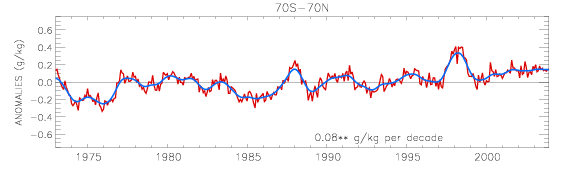
HadCRUH says humidity is increasing at 0.08 g/kg per decade.

comment image

The humidity is coming from somewhere. So, perhaps the pan evaporation paradox is a regional thing, and the loss in some regions is made up by gains in others?

Scott W Bennett
Reply to  Bart Tali
January 12, 2019 9:54 pm

Some of the annual variations are five to six times the “trend” on that graph (1973-74,1976-77,1997-98). Even without error bars, eyeballing it suggest that it is flat both statistically and otherwise.

And if anything it is slightly less humid than it was at the start to the chart in 1973!

I’m inclined to trust the pan observations because they are global and the negative trend is large and very long – now in decline for almost 60yrs.

Bart Tali
Reply to  Scott W Bennett
January 12, 2019 11:14 pm

The humidity in the atmosphere has gone up. This is indicated by almost every single type of measurement done, including satellites which would have excellent coverage of the entire Earth.

This paper lists several measurements all over the world using different instruments, and they all agree that humidity has increased.

https://agupubs.onlinelibrary.wiley.com/doi/full/10.1002/2016JD024917

The pan evaporation paradox is only a measurement problem. It doesn’t imply the humidity isn’t there. It’s just that they had trouble accounting for it by measuring evaporation.

In 1998, it was claimed the paradox was solved (link from Wikipedia article on pan evaporation).

http://pages.jh.edu/news_info/news/home98/nov98/paradox.html

“But Parlange and Brutsaert found that decreasing pan evaporation does not necessarily mean that less evaporation is occurring in the surrounding landscape. A key reason is that the interpretation of the pan measurements has not taken into account the role of humidity in the air or the moisture that is already present in or missing from the surrounding landscape. For example, a pan of water placed outside in a hot, dry desert would evaporate very quickly. But put the same pan in a cool rain forest, and the water would evaporate much more slowly. Thus, evaporation figures may drop in some areas merely because more rain and snow have saturated the terrain. This “regional land-surface moisture” must be factored in when climate researchers interpret raw measurements from evaporation pans, the researchers say.“

The reasoning makes sense to me.

In any case, pan evaporation is a moot point. The humidity has increased. It will affect precipitation, including snowfall. And apparently it does, because we see greater extents in the fall and winter. Unless you can come up with a better alternate explanation, I’m sticking with increased precipitation from warming.

Scott W Bennett
Reply to  Bart Tali
January 13, 2019 2:33 am

“The reasoning makes sense to me. – Bart Tali”

It shouldn’t make sense to you! Because the pan records are not moving, they are are continuous long-term records of the places they are in i.e “dry desert” and “rain forest.” Unlike Argo buoys, they don’t float with the currents!

As for humidity, It depends on who you are listening to. If it is the usual activist “scientists” and sources… and their climate models, then yes! However, various comprehensive and authoritative studies report that it ‘just ain’t so.’ Here is one from the U.S for example:

There have been no long-term changes in dewpoint temperatures or specific humidity but rather there has been a decreasing (1947–79) and then an increasing (1980–2010) trend in both variables.

*Paula J. Brown* and Arthur T. DeGaetano – Journal of Applied Meteorology, 2013: Trends in U.S. Surface Humidity, 1930–2010, https://doi.org/10.1175/JAMC-D-12-035.1

Bart Tali
Reply to  Scott W Bennett
January 13, 2019 9:26 am

> There have been no long-term changes in dewpoint temperatures or specific humidity

Your paper was only for the US.

And it makes perfect sense, because the US temperatures have been relatively flat compared to the rest of the world.

Try again, this time with global numbers.

Scott W Bennett
Reply to  Bart Tali
January 13, 2019 11:40 pm

The size of the trend is”quite small” globally and less for Australia where both issues are still up for debate.

“There is no trend over the Southern Hemisphere. Conversely, trends in RH are of either sign and not significant except for in the Southern Hemisphere (where they are negative) and some seasonally averaged trends. – Willett et al. 2007*”

“Globally, an upward trend in observed near-surface humidity has been noted (e.g. Trenberth et al. 2007), although as a general rule the datasets upon which this calculation rests have not been homogenized. The magnitude of this reported trend (in specific humidity) is quite small, around 0.06 to 0.07 g kg-1/decade. This value is more robust over the ocean. As noted earlier, Willett et al., 2007* confirmed this global trend with homogenized data, but their results indicated that the humidity trend in Australia was negative over many areas, the opposite of the reported global trend which was computed from 1974. – Lucas, 2010**”

“The true trend value remains uncertain; the confidence intervals are quite large. …As suggested earlier, the final value of this small trend is highly dependent on the start and end times chosen. Willett et al., 2007* showed negative trends for much of Australia; however, this was likely because of the choice of the starting time of the trend.

*Willet, K. M. 2007: Creation and analysis of HADCRUH: A new global surface humidity data set. Ph D. thesis, 198 pp.
**Lucas, Chris, 2010: A High-quality Historical Humidity Database for Australia, CAWCR Technical Report; 24, ISBN: 9781921605864

Nylo
Reply to  Willis Eschenbach
January 12, 2019 9:20 pm

Thanks a lot Willis, this adds support to a discussion that I had above.

Reply to  Willis Eschenbach
January 13, 2019 6:26 pm

Willis,
I personally think a running average of the seasonal NH snow cover shows more detail and fluctuations than the linear trends. Green lines on plot are 10 year centered running average and show a potential 9-year quai-oscillation. Just my cyclomanic opinion.
https://imgur.com/a/pniZX1t

Reply to  Renee
January 13, 2019 8:44 pm

Willis,
Your winter and fall (red and purple) time series shows 7-8 year quasi-oscillations quite well prior to about 1998. Here is a link to the plot of the periodicity and wavelet analysis that also shows this prominent oscillation in the NH snow cover data.
https://imgur.com/a/sJEEbf9
https://imgur.com/a/f43oTpS

Editor
January 12, 2019 12:21 pm

I got into this with Mosh on Twitter. I said that there was a slight negative trend since start of data, and a slight positive trend over the last 30 years.

Mosh accused me of cherry picking…..

January 13, 2019 1:09 am

Has anyone done a monthly or weekly assessment of the data. To me it looks like autumn is finishing earlier and summer is beginning earlier. If the the decline in Spring cover is due to melting in the last week or month then should I be worried? If the numer of weeks above 60% of a erage maximum remain fairly constant should I be concerned?

Anthony Banton
January 13, 2019 1:40 am

“If the the decline in Spring cover is due to melting in the last week or month then should I be worried? ”

It is indicative of the direction of travel.
Worried?
As this place demonstrates daily … ya takes yer money and takes yer choice.

https://www.nps.gov/subjects/climatechange/springonset.htm

Vicus
January 13, 2019 10:52 am

Hello everyone,

I pulled up the archives for the article in question. I strongly urge to save off site.

Leftists are taking down archive sites (Wayback deletes on request [Joy Reid getting caught bashing gays] and the was takeover of the servers hosting Archive.Is and were notified the whole thing will be closed) and we all know what happened to Alex Jones…

https://tinyurl.com/ycmqlfgh

Enjoy!

Alba
January 14, 2019 8:03 am

Snowbanks in the news: Link to a news items about the towering snowbanks on North Mountain, Cape Breton, Canada:
https://www.ctvnews.ca/lifestyle/selfie-takers-flock-to-cape-breton-for-towering-snowbanks-1.4250387

Scroll down to see pictures people have posted on social media.

https://www.cbc.ca/news/canada/nova-scotia/giant-snow-drifts-once-again-make-cape-breton-s-north-mountain-impassable-1.4969882

Alexander G
January 14, 2019 8:28 am

This is nice 😉

“The End of Snow?”
by Porter Fox, The New York Times, Feb. 7, 2014:
https://www.nytimes.com/2014/02/08/opinion/sunday/the-end-of-snow.html