In a world where climate alarmists constantly cry “unprecedented” at every warm weather anomaly, here’s a genuinely rare meteorological story that deserves the term on its own merits —
*Florida, of all places, has now seen two consecutive winters with measurable snow.
For anyone who’s lived in the Sunshine State, snow has traditionally been an oddity — an occasional flurry once every decade or two, sometimes only seen in the air, never on the ground. Those rare events were curiosities: photo-ops for tourists and a few bewildered locals staring at the white stuff before it melted away. But that casual oddity has now become something far more noteworthy.
Winter 2025: Record-Shattering Snowfall
In January 2025, Florida’s Panhandle was walloped by what the National Weather Service would characterize as a historic winter storm. This wasn’t a tiny dusting — this was accumulating, measurable snow in the double digits in a state better known for 90°F summers and palm trees. Near Milton, nearly 9 inches of snow were recorded — easily doubling the previous statewide record that stood for decades. Pensacola and other Gulf Coast cities also reported multi-inch accumulations, with flights canceled, schools shuttered, and highways rendered hazardous. (National Weather Service)

This was not sleet mischaracterized by hype machines. These were verified measurements, official snowfall totals from NWS and cooperating observing networks — the same networks used to document snow in Anchorage or Minneapolis.
Winter 2026: Another Snow Event
Just a year later — in January 2026 — another winter system produced measurable snow across parts of the Florida Panhandle and central regions, including reported accumulations over 1 inch in spots such as Marianna, along with numerous lighter totals farther east and even as far south as Naples. (Wikipedia) While not as dramatic as 2025’s record blizzard, it was measurable snow over broad portions of the state — enough to put the lie to the perception that snow in Florida is a once-in-a-generation fluke.
What Makes This Truly Unprecedented?
The word “unprecedented” has become cheap in public discourse — routinely used to describe routine warm spells or single-day temperature records. But here’s a situation that truly matches the definition: measurable snowfall occurring in Florida in two consecutive winters — the first time this has been instrumentally verified since systematic recordkeeping began.
Even skeptics should appreciate this from a purely factual standpoint:
- Modern observing networks confirm the data. These are official NWS and NOAA reporting stations, using standardized instruments — the same ones that tell us how much snow fell in Denver or Buffalo.
- The 2025 event didn’t just squeak by — it smashed old records that had stood for generations and forced emergency responses from state authorities.
- 2026 followed up with another event, making this more than a bizarre one-off. Rare? Yes. Unprecedented in context? Absolutely.
Why It Matters
From a climate science perspective, extreme cold and snow events in lower latitudes are statistically unusual — rarities shaped by particular jet stream patterns and atmospheric setups. That Florida could see major snow one year and measurable snow the next is remarkable, and it highlights that weather variability runs both ways.
Climate models have long struggled to portray regional extremes with precision, especially unusual cold spells or snow in subtropical regions. Yet the press often emphasizes warm anomalies while downplaying equally valid cold extremes. That asymmetry in coverage distorts public perception about what is truly “unprecedented.”
If we are going to use strong language like “unprecedented,” it should be reserved for events documented with solid measurements — not just the politically charged highlights of warm weather records. Florida’s consecutive winter snowfall is exactly that kind of event.
Conclusion
Florida — the state synonymous with sunshine, beaches, and palm trees — is now also a footnote in meteorological history: two back-to-back winters with measurable snowfall, including one that rewrote state snow records.
That’s the sort of unexpected data point both weather nerds and policy makers should pay attention to, because it speaks to the complexity and variability of the Earth’s climate system — not simplistic narratives.
In a media environment quick to cry “unprecedented” at every warm spike, Florida’s snowfall deserves the term for a weather phenomenon that was truly unusual, firmly documented, and objectively remarkable.
We lived in Florida for 4 years in the early 80’s. Our house used groundwater to support the heat pump, which worked great for cooling in summer. One year we had a freeze. No snow, but we had to buy electric heaters to keep our 3 daughters (all single-digit ages) from freezing, since the heat pumps did NOT warm us in those temperatures. Unprecedented? Of course, that was before the big CO2 ‘disaster’ was hoaxed – discovered…
We’ve vacationed a few times in Florida (Tampa area).
I remember being surprised that the water heater in the condo was in the unheated garage.
Seems like that would be a problem for the plumbing if not the water heater itself.
A tip from someone who lives in an area where winters are cold, let your cold and hot water tap drip. Not run but just drip. What that does it give the pressure from the expanding ice a place to go rather than bursting the pipes. (The supply side of the freeze will back into supply lines.)
It also helps to leave the cabinet doors open below any tap on an outside wall.
Lol … no, no, no.
Our corrupt ABC has this situation all covered: “The Weather’s gone crazy due to climate change”.
They trot this line out whenever their warming narrative falls apart.
The climate modellers have now recognised that they got snow wrong. Warmers oceans means more snow, not lass as they originally predicted.
Eventually they will realise more snow makes winter tougher. So they want to deprive you of the best available heating source to stop climate change that they do not have a clue about.
Any person who can connect facts soon realises that warmer oceans means more snowfall, which will eventually accumulate. It is how the interglacial of the NH comes to an end. AND THIS ALL NATURAL
“not lass as they originally predicted.”
She’s a fine little lass hasn’t she.. er.. isn’t she.
h/t Benny Hill.
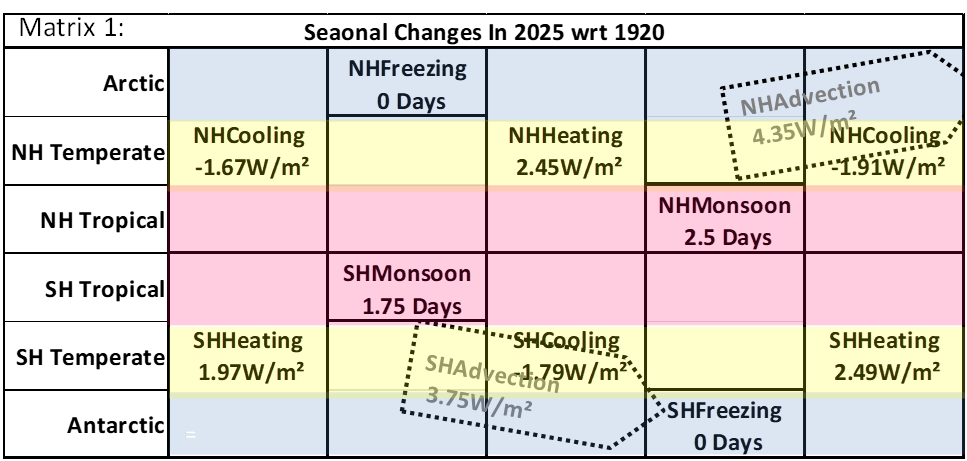
I predicted this boreal winter would have above trend snowfall. It will be equaled in 2033/34 and eclipsed in 2037/38. It is due to higher than trend advection. The result of orbital changes and solar intensity that caused high sunlight in the heating season followed by low sunlight in the cooling season.
 ?resize=768%2C366&quality=75&ssl=1&_jb=closest
Climate models do not include solar power. The NH currently takes 8 to 9 days longer to get its dose of energy than the SH. The solar power makes a difference.
To abuse the Clinton campaign slogan… “It’s the SUN, stupid.”
Has WWA released it’s analysis of this weather event and shown that it is more probable owing to Climate Change?
“released it’s analysis”
Pedant alert! Should be “its”, not “it’s” (it is). 🙂
Wait until the 2030s and 2040s when it will be considerably much colder! according to what Melankovich observed about the Earth´s climate logic!
Might have to move citrus groves to Cuba.
“Since 1886, there have been over 80 months where at least a trace of snow was reported somewhere in the state. ”
And likely long gaps in news reports of snow years are just because no one found it newsworthy.
The iguanas are falling from the trees…….. yet gain!
Don’t forget to defrost the iguanas.
I live in sort of a concrete jungle so I missed the big show, but I did come across this little guy.
This is even worse than the 1970s and 1980s when we were entering a new ice age?
Wasn’t it back in the 70s when Fla had some very bad freezes, causing severe citrus crop damage? Anita Bryant was all up in arms.
I don’t suppose this has anything to do with chem trails? which produce snow that doesn’t melt – where is Lee Zeldin – hiding out with Waldo I suppose
Hmm. Shirley you can point out some of this un-meltable snow.
It’s nice and warm in the Pacific Northwest.
We had snow one day at Fort Hood, I really appreciated it.
I believe the probability character of the snow described is a Bounded Pareto distribution. Zero is a lower bound, but there is a long tail to the plus side. All too often people think of the Normal Distribution that doesn’t fit the extreme/excess measurements of natural events.
{This stuff is vaguely remembered from long ago college days. It was beyond my skill level then, and more so now.}