Public Release: 19-Nov-2018
The research is the first to show how the melting of the Antarctic ice sheet will affect future climate
University of Arizona

As the Antarctic ice sheet melts, warming of the atmosphere will be delayed by about a decade but sea level rise will accelerate, according to new research scheduled for advance online publication in the journal Nature.
The study is the first to project how the melting of the Antarctic ice sheet will affect future climate, said first author Ben Bronselaer of the University of Arizona, adding that current climate models do not include the effects of melting ice on the global climate.
The entire Earth will continue to warm, but the atmosphere will warm more slowly because more of the heat will be trapped in the ocean, he said
“Warming won’t be as bad as fast as we thought, but sea level rise will be worse,” said Bronselaer, a postdoctoral research associate in the UA Department of Geosciences.
Observations show that the Antarctic ice sheet has been melting faster in recent years.
The UA-led team found that by the year 2100, sea level could rise as much as 10 inches more than the previous estimate of approximately 30 inches by 2100.
“No one had looked at the big picture of what Antarctic ice sheet melting means for the global climate,” he said.
To figure out whether the melting of the Antarctic ice sheet would affect global climate, the research team modified one of the most current climate computer models to include the ice melt.
Adding the melted ice into the team’s model indicated that the global temperature would increase by 2 degrees C (3.6 F) by the year 2065, rather than the year 2053, the team writes.
In addition to slowing warming and increasing sea level, the melting of the Antarctic ice sheet will change precipitation regimes because the tropical rain belt will shift north, said senior author Joellen Russell, who holds the Thomas R. Brown Distinguished Chair of Integrative Science and is an associate professor of geosciences at the UA.
“Our projections indicate the tropical rain belt will shift toward the Northern Hemisphere, making it slightly wetter in the Northern Hemisphere and slightly drier in the Southern Hemisphere than previously predicted,” Russell said.
The team’s research paper, “Change in future climate due to Antarctic meltwater,” is scheduled for online publication in the journal Nature on Nov. 19. A complete list of coauthors and their affiliations is at the end of this release.
The research is part of the National Science Foundation-funded Southern Ocean Carbon and Climate Observations and Modeling (SOCCOM) Project. The National Oceanic and Atmospheric Administration and NASA also funded the research.
Russell leads the part of SOCCOM that is charged with improving how the Southern Ocean is represented in the computer models of global climate. The Southern Ocean is the ocean that surrounds Antarctica.
Researchers previously thought the melting of the Antarctic ice sheet would affect only sea level, not the entire climate system.
To test that idea, Bronselaer ran a climate model with and without the ice- sheet melting included. The team included researchers from NOAA’s Geophysical Fluid Dynamics Laboratory in Princeton, New Jersey and from Princeton University. The scientists used NOAA GFDL’s climate model called ESM2M and tested the simulation over the time period from 1950 to 2100.
In addition, they set the level of greenhouse gas emissions for the 21st century using the scenario known as RCP8.5, sometimes called the “business-as-usual” scenario.
Russell and Bronselaer were both surprised by their findings. They did not expect the Antarctic meltwater to affect the global climate system.
Ocean circulation moves heat from the equator to the poles. The heat is then released into the atmosphere, Russell said. However, the team’s new research reveals that the additional freshwater from the melting ice sheet acts like a lid on the waters around Antarctica and slows the release of heat.
“It’s the first new identified feedback on climate in 20 years,” she said. “The melting delays warming – it’s still warming but it will warm less steeply and give us another 15-year grace period.”
Another SOCCOM team that has deployed robotic floats throughout the Southern Ocean that are gathering temperature, salinity, and biological and chemical information about the ocean.
Russell said her next steps are evaluating climate models against the observations from the SOCCOM floats to see what else the models might be missing.
###
Bronselaer and Russell’s coauthors on the paper, “Change in future climate due to Antarctic Meltwater,” are Michael Winton of the NOAA GFDL in Princeton, New Jersey; Stephen M. Griffies of NOAA GFDL and Princeton University; William J. Hurlin of NOAA GFDL; Keith B. Rodgers of Princeton University; Olga V. Sergienko of NOAA GFDL and Princeton University; and Ronald J. Stouffer of the University of Arizona and NOAA GFDL.
How do they propose that the ice sheet will melt in significantly sub-zero temperatures?
If they were honest or capable they would be investigating volcanism’s effect in western Antarctica, where certain glaciers overlying volcanic hotspots are melting. I believe the eastern part and the continent overall are gaining ice.
I agree with you there are a number of volcanoes that are having effect and some scientists are saying we are going into colder weather apparently the solar system apparently warming and no sunspots according to NASA and other scientists
OHGEE
Another study that can be utilized to “Push The Goal Posts” out another 15 years
15 years, Conveniently beyond the professional life of the writers and editors
https://www.sciencealert.com/a-mysterious-geothermal-heat-source-is-melting-antarctica-from-below
The ocean’s been rising at a frightful rate Mosh.
Now that’s fresh news – published today. Thank you. That’s the first I’ve seen on the subject.
I do take issue with this:
Since when is volcanism necessarily static, never changing? As you know, the 91 volcanoes there were only recently discovered, so I think it’s safe to say that not much is known about their history or current state of activity.
And this is why the melt slows atmospheric warming?
Don’t panic Mosher. The East Antarctic Ice Sheet has survived nearly 30MY. I’m confident it isn’t going anywhere soon.
Eastern? … east of what? It’s a circumpolar continent.
Penguins are offended by your normalization of equatorial privilege.
I apologize and repent of my directionist insensitivity, that was wrong of me.
PS: could you please ask them to make less brown on the ice, we can see it from space.
That drives me nuts too.
I think they mean the Eastern longitude lines. But you of course are correct. East and West on a circumpolar continent are just directions of travel, not locations.
eastern Antarctica = Antarctica in the eastern hemisphere.
So once you get to the eastern hemisphere, is there any more east beyond that?
Where does the Eastern Hemisphere start and end?
By convention, if the Prime Meridian is up, East is to the right.
Scientists are well aware of volcanism. There havnt been any significant changes to volcanoes in Antarctica. The ice is melting mostly where it meets the sea due to the AGW driven rise in sea temperature as referred to the article.
AGW – a blast from the past!
Scientists don’t even know for sure the sign of the continental ice mass balance, yet you talk about the ‘reason’ of the hardly detectable mass change. I just love the being-on-message.
Yeah I don’t care about the volcanic melt. I don’t give a damn on the ‘melting Antarctica’. As long as the sea level barely nudges from its centennial pace.
They discovered 91 new volcanoes within the last few years (47 others were already known). How do you know there hasn’t been any significant changes? How do you know the volcanic-melted glacial water flowing downhill to the sea isn’t responsible for the ice melt?
Red herring.
When will the people on this site take Yes for an answer? (or in this case, slowing of global warming)
Whataboutisms, moving the goal posts, etc. have gotten really tiresome. Does the proposed cause – in this case, increased melting of the Antartic ice cap – drive the proposed consequences (slowed global warming and increased sea-level rise)? That is the question I’d like to see debated.
Oh, and please (a) document statements of (proported) facts with references to peer-reviewed journals, and (b) state your qualifications if you strongly disagree (e.g., someone lacking experience with simulations should have training and experience in modeling and simulation)
thanks. 🙂
I don’t see how this study is a yes.
Where is this evidence that the 1) The Antarctic ice cap is melting and 2) CO2 is responsible?
I agree Mark, Chris has not proved the case.
“As the Antarctic ice sheet melts,…”(second paragraph) is unproved thus a false premise. Assuming the answer to an unasked question (Is Antarctica melting?)is called begging the question. Two logical fallacies to start with. It may well be a humdinger of a computer model, but it will tell you what you make it say. So, melting may well cause XYZ, but is it melting Y/N?
NCDC shows 8 reporting grid cells for all of Antarctica, 5 of which show colder by 1 to 5 degrees C. The paucity of data leaves me unimpressed.
Take your hand off it, chris, or you will get blisters – your appeal to authority is just bleating from a lost sheep.
To illlusrate, if say a house is north an south poles melting, and say termites being Global Warming, insted of watching how the termites are destroying the house would it not be better just to destroy the the termites and be done with it?
Russel
I am sure you refer to to the termites as being the volcanic activity below the Antarctic that is causing some of that melt.
How do you want to kill that termite?
henryp
My interpretation of Russell’s confusing post is that the termites are global warming.
Unless I’m much mistaken he’s suggesting we stop all warming activity, natural or otherwise, around the planet, to stop the north and south poles melting.
Quite what purpose frozen poles serve is beyond me, other than to have scientists crawling all over them in order to confuse themselves.
The planet has jogged along happily for 80% of it’s existence with no frozen poles. Our current interglacial period is abnormal.
I wondered if God sequestered CO2 to create a cold environment, then begot man when he realised he screwed up with atmospheric CO2 hitting 180 ppm risking all life on the planet. His bright idea was to provide man the intelligence to make fire and burn all that fossil fuel he created to recover the planet. 🙂
No madder a theory than AGW.
So … when gawd’s got enough CO2 … what happens to us? Stratigraphy?
@ur momisugly#$%&
refusing or declining comment, I think we can safely assume that Russell is clueless?
WXcycles – George Carlin had a theory that the Earth created Man because it wanted plastic. Now that it has some it doesn’t really need us any more.
I assume the same goes for God needing the CO2 released.
~¿~
Maybe he is referring to the 4000 year old network of termite mounds the size of the UK discovered in Brazil recently.
” […] if say a house is north an south poles […]”
Termites in the north and south pole…hm?
The parameters of this experiment, seems a bit ah…a bit..off. Have you considered using Penguins and igloos instead?
Russell, care to try again only this time try and make some semblance of sense? Thanks.
I do so love ridiculous analogies. I’ll play your game:
What course of action would you take if efforts to kill the termites would merely sicken the people living in that house and the rest of the neighbourhood, having very little effect on the termites? How about if better historical studies had shown that the house had periodically appeared in danger of collapse in the recent past, but it never came to that and the house was just fine? Continued study may show that it had been a mistake to just blame termites, and that there were woodlice and numerous types of beetles that had been appearing cyclically, which were having a much bigger effect on the house than the termites. At the time everyone was just working on projected termite populations and other feedback mechanisms supposedly caused by the termites, but these never showed themselves at the actual house.
Warming is slower than we thought. In other words, the previous “thought” was wrong. Now we’re supposed to believe the current “thought”?
“Warming of the atmosphere will be delayed…”
Really!! I was unaware that the atmosphere had an agenda and schedule to complete, and now climate change is buggering that up as well.
Add yet another item to the list that climate change is causing: Climate change is causing a delay in…climate change!
Another Climate Explainer study – what was funding source??
They’re 97% positive… THIS time.
BINGO!
Antarctica is well below freezing nearly everywhere nearly all of the time. It can’t melt. It can lose or gain ice which is a function of snowfall and calving of bergs decades or centuries later. They claim that it is melting from warm ocean water eating away at the grounding line which induces acceleration of the calving events. Follow this image link
http://cdn.antarcticglaciers.org/wp-content/uploads/2014/05/PIG.ai_-768×440.jpg
to see how they say that works.
It requires that warm water make its way under the sea ice*, then under the floating ice shelf to finally melt the base of the glacier at the grounding line. Really quite a simple concept.
*Their diagram doesn’t show the sea ice but it certainly must be there most of the time.
“It requires that warm water make its way under the sea ice*, then under the floating ice shelf to finally melt the base of the glacier at the grounding line. Really quite a simple concept. ”
Geothermal-melted glacial water discharging into the ocean under the ice shelf would have the same effect.
icisil – “Geothermal-melted glacial water discharging into the ocean under the ice shelf would have the same effect.”
You are implying that the circumpolar deep warm water melting at the ice sheet grounding lines concept is correct. Here’s another diagram.
But yes, geothermal would do some melting, but the circumpolar concept implies that this goes on all the way around Antarctica.
Volcanism is local it shouldn’t be an issue regarding sea level rise.
“But yes, geothermal would do some melting, but the circumpolar concept implies that this goes on all the way around Antarctica. ”
Are they observing melting all the way around Antarctica? No, only where certain glaciers in the west meet the ocean (that I am aware of). It seems rather specific and localized.
How much change in sea level is there when an ice shelf breaks off. I don’t think very much. I believe that most of the weight of the ice is floating already, with the attachment to the ground based ice sheet only bearing a substantially smaller percentage of the total weight. I do not believe the ice is strong enough to cantilever itself out over the sea for 100 km (or however far each individual ice shelf extends past the shore or grounding line).
I guess there can also be melting of ice that is grounded but past the shore line if the sea water is warm enough.
Admad
Exactly. It is one thing to calculate that a sheet will melt, another entirely to explain how the air temperature will rise from -40 to +2 in order to melt at all.
There is absolutely no evidence that Antarctica will warm by 40 degrees in the next few years at any location.
If the rain belt moves north into the Sahara, which is quite reasonable, it will open up tens of millions of ha of new farmlands, sufficient to feed many billions of people. That is something I look forward to.
“How do they propose that the ice sheet will melt in significantly sub-zero temperatures?”
Because the ocean currents are not sub zero.
Chris
That’ll be sea ice the ocean currents ‘might’ melt, not the land bound ice, which will make no difference to sea levels whatsoever.
Then there’s the problem of the constantly growing glaciers that move out into the sea because of the weight of snow inland, they don’t just instantly melt the moment they touch seawater.
As has been said elsewhere, volcanic activity beneath the ice might have some effect but it hasn’t so far, as far as we humans are aware.
simple
https://www.theguardian.com/environment/climate-consensus-97-per-cent/2018/may/09/global-warming-is-melting-antarctic-ice-from-below
Ice shelves melt first
Steven
no, unfortunately it is not as simple as that.
What makes you think there is no volcanic activity below the Antarctic ice?
Click on my name to read that it cannot be due to AGW?
Because that would be an inconvenient truth.
Except where they don’t.
https://news.nationalgeographic.com/2018/02/ross-ice-shelf-bore-antarctica-freezing/
DHR
Top post.
After reading that report a while back I examined the underwater topography beneath the Ross Ice shelf to try to figure out what is going on (because I think some areas of it are melting). There’s a couple of large glaciers feeding that area, and the underwater topography extending from the mouths of those glaciers (especially the westernmost one) suggested to me the possibility that geothermal melt water would be channeled away from where that test was conducted (where ice is forming under the ice shelf).
Small correction. Not only the underwater topography, but the land topography beneath the glaciers as well.
Mosher,
Oh, the Guardian! Then the statement, “With global warming, BOTH of the poles are warming quite quickly, and this warming is causing ice to melt in BOTH regions.”, MUST be true. There is no source of science information more reliable than the Guardian.
The ice shelves are also mostly floating you really think you can extend a piece of ice out kilometers and not break it off if it wasn’t supported and because they are floating they have almost no effect on sea level.
https://en.wikipedia.org/wiki/Ice_shelf
LdB,
“When sodium chloride dissolves in water to make a saturated solution there is a 2.5 per cent reduction in volume.”
Therefore, when fresh water mixes with salt water, I would expect that there would be a small decrease in the effective volume of the admixed fresh water, reducing the effect that you quote above. But, that effect is only applicable to fresh water derived from glaciers. Pack ice around Antarctica, created from freezing sea water, will still contain brine and salt in it, therefore having the same weight as the original volume of sea water that froze. So, if the above calculation didn’t differentiate pack ice from ocean water from glacier ice, then the 4 cm estimate is too high.
But, what do I know about things affecting climatology? I’m only a geologist.
I believe that when sea water freezes, the freezing process forces some of the salt out of the solid ice creating a supersaturated and very cold dense brine that sinks to the bottom in rivulets. Benthic creatures in the path of these rivulets are frozen in place almost instantly. The ice left afloat will therefore contain somewhat less salt than the seawater it originated from. I forgot the source of my understanding but perhaps you could find it in a Google search.
Every year, in the southern hemisphere summer, more than 3/4 of Antarctic sea ice melts. The reason sea level doesn’t rise is that nearly the same amount of water freezes in the northern hemisphere.
This article is not talking about sea ice. It is talking about Antarctic land ice. AGW scientists assumed that land ice was melting (“As Antarctic ice melts…”) because of the movement of Antarctic glaciers, and of course AGW had to be the culprit. But their premise is blown up by the discovery that the glacier movement was facilitated by volcanic activity.
So the article is fallacious because it assumes under the RCP 8.5 scenario, AGW will cause more Antarctic land ice will melt to begin with and then simply predicts higher sea level rise. Wonder which of the IPCC’s wildly inaccurate 100+ climate models they are using to predict melting of the Antarctic land ice.
Volcanoes are only under some of the Western part of Antarctica. Yet all the the glaciers are flowing faster into the sea so volcanic activity can’t be the primary cause.
Volcanoes run the entire length of the western coast. From the tip of the peninsula to Victoria Land. It is the largest area of volcanoes in the world. The areas with the highest heat fluxes are where most of the melting is occurring.
Dan, melting sea ice cannot raise the sea level to any degree at all. It’s floating!
RCP8.5? The sure sign of bullcrud. Into the bin.
This is a good point. I think the only possible way Antarctica can produce significant sea level rise is by grounded ice beyond the shore line melting (if sea currents bring warmer water in), and maybe some continental ice melting on the Antarctic Peninsula (it does extend quite far North, I think as far as S61°, similar to Lillehammer Norway in the Northern Hemisphere).
Ice shelves calve, they don’t melt. Ice shelves can’t form in climate warm enough for significant melting.
Ice shelves can both calve and melt.
The sea is not generally at sub zero temperatures for starters.
This another non-science article on the effects of purported climate change. Science requires a hypothesis which is then tested against empirical data. But here a theory is turned into a computer model that spits out predictions which are pretended to be data—-but they are not data, just predictions. Scientus interruptus. Typical CAGW pseudoscience. Non-science that is non-sense.
You mean YOU can’t figure out how 5 degrees of “glow bull warming” will melt a Continent where the average daily temperature is MINUS 59 degrees F? Boy, do you need re-education! Sarc off
The water underneath the floating ice shelves is 32 degrees F
No. It’s a complex salt water-fresh water mix.
If i take a well-mixed bucket of salt water, put it in a stagnant (not stirred or mixed!) small bucket in a “perfect freezer” of well-mixed air (so the air temperature is uniform all around the bucket and water surface), I can measure the freezing temperature of that salt water mix, right?
But I actually have very cold air (of constantly changing temperatures very far below freezing (0.0 C or 32.0 F)) being randomly blown across a very rough, irregular surface of sea ice, then a constantly changing thickness of sea ice of varying thermal conductivity and varying thermal mass with varying speeds of salt water at verying temperatures and salinity moving with random velocities below the sea ice as varying “globs” of salt water move around and below the irregular sea ice lower boundary. At individual crystals at the boundary, salt water is forced out the ice crystal martix above, and the salt forced into the brackish water right below the crystal grain border. So that little bit of water is now more brackish (heavier) and tends to fall away from the bottom of the new sea ice, but new warmer water less saline water replaces the previously cooled and heavy salt-laden water. The new sea ice is mostly fresh water, but ice crystal boundaries have trapped salt and salt water right above the new boundary. Those melt little bubbles of salt water in the fresh water crystals, but at -2 to -4 degrees freezing points, these little bubbles will remain liquid for a while as the ice around them cools as it loses heat to the very cold air above. The bottom of the sea ice “generally” has a salt water boundary water temperature of -2 to -4 degrees. “Lab conditions” of “average” sea water show it freezes about -4 degrees.
And they know for sure how all these mechanisms inter-relate, down to the order of years? Wow, hubris!
Ah yes the University of Arizona – garbage in garbage out.
“To test that idea, Bronselaer ran a climate model”
There’s the garbage you were referring to.
I have a model that says 1.5 degrees c cooler by 2030.
Guy, does your model say 1.5 degrees cooler will happen because of excess CO2 in he atmosphere? AGW theory WILL predict that (if it happens, cannot be adjusted away, and after the actualization, of course).
1.5 C is quite a bit. I think your model exaggerates a little. Wouldn’t be the first model to do that.
My model agrees with his model…
My model agrees with who ever is paying the most.
Don’t most of the models do that MarkW? At least your model is honest about it 🙂
Yes. The U of A an akamedia institution.
What Antarctic ice sheet melting?
Ice mass has been growing.
https://www.nasa.gov/feature/goddard/nasa-study-mass-gains-of-antarctic-ice-sheet-greater-than-losses
Paul
They are just covering all the bases so they can point to a ‘peer reviewed’ (~ahem~) study to support any argument they care to make.
There’s no increase in sea level rise either.
Paul: Please don’t confuse them with facts. They are only happy when looking at their models.
Paul
In the article you link they indeed acknowledge Antarctic mass growth, but dismiss this by saying “but in a few decades (our models show) it will start shrinking again”.
This seems to be good enough to keep the trillion dollar CAGW heist on the road.
Yes, the freeze positive melt ratio means latent heat of fusion in Antarctica is a net energy loss to the atmosphere and a net loss of ocean mass.
So they are half right…
‘modified one of the most current climate computer models’ – Yeah, that’ll teach that rascally ice sheet!
It seems it is quite easy to modify ” the most current climate computer models”. I hope they are keeping the model in a locked storage and have comprehensive insurance. A child might accidentally touch and modify it. No one wants this model to be useless in projecting into the future.
“Adding the melted ice into the team’s model indicated that the global temperature would increase by 2 degrees C (3.6 F) by the year 2065, rather than the year 2053, the team writes.”
Is this the defininitive ‘jumping the shark’ moment?
A prediction for 47 years in the future of a system as complex and chaotic as the Earth’s climate. Why isn’t this sort of nonsense simply laughed out of court?
Correction to my previous comment. These bozos are actually making predictions for 82 years, not 47 years ahead.
“The UA-led team found that by the year 2100, sea level could rise as much as 10 inches more than the previous estimate of approximately 30 inches by 2100.”
‘Russell said her next steps are evaluating climate models against the observations from the SOCCOM floats to see what else the models might be missing.’ = Send more money!
Now we are getting somewhere. I don’t mind models if they can be shown to be validated against reality. But in the climate ‘science’, that is difficult. It takes time (30 years?)
Trying to manufacture a way to kick the reality can down the road and rationalize lack of warming. The smell of desperation is in the air.
More utter nonsense!
Well not a total waste. They got this part right IMHO: “they set the level of greenhouse gas emissions for the 21st century using the scenario known as RCP8.5, sometimes called the “business-as-usual” scenario.”
Unless China and India change, and that is highly unlikely, we will be at or above BAU.
What do you mean?
RCP 8.5 is not “business as usual”. It’s more like “the worst we could come up with our imagination”. Citing climate models fed with RCP 8.5 is just gigo science. Publishable, but of no value other that pushing fearmongering.
There haven’t been much melt at the Antarctica. Should the situation change, it would be interesting, but they’re talking about “the melt” in a manner which misleads the great public.
Currently -46F at station DOME A about 700mi inland to the south of the coast to the north, where present temperatures range from 3F to 21F…oops, there’s on 36F site northwest coast. Summer is almost there! This frozen wasteland will ALWAYS be frozen as it almost always has for millions and millions of years. These ‘scientists’ are fools….but I repeat myself.
“RCP 8.5 is not “business as usual”. It’s more like “the worst we could come up with our imagination”
“Business as Usual” is the worst-case scenario. By “business as usual” the IPCC means that current and future fossil fuel burning will *not* be curtailed (business as usual) and will result in the highest proportion of CO2 being pumped into the atmosphere, as compared to scenarios which attempt to restrict fossil fuel burning to one extent or another.
RCP 8.5 is much worse than business-as-usual. Quote Fabius Maximus here.
https://fabiusmaximus.com/2018/06/02/fix-the-mistakes-that-killed-the-climate-change-campaign/
“RCP8.5 is not just a “high warming scenario” but the worst-case scenario of the four used in AR5, aka IPCC 2013 (details here). As a worst-case scenario should, it assumes ugly changes in important long-term trends – such as tech (from progress to stagnation) and fertility (slow or stopping the decline in emerging nations). Each is unlikely; the combination is very unlikely.”
I agree with this.
Surface temperatures aren’t rising fast enough to support the CAGW narrative. First we had Trenberth’s theory that the heat was hiding in the ocean. That’s pretty dodgy. link
The climate isn’t behaving the way the models say it should. The trick is to explain that without destroying the CAGW narrative. We had this WUWT story from a few days ago where they found gobs more heat in the ocean and then had to admit their math was wrong. I think the alarmists will continue to be ‘creative’. For sure they won’t admit they were wrong.
Cause “Models” Right?
No. I think they were using the wrong entrails from the wrong chicken.
“However, the team’s new research reveals that the additional freshwater from the melting ice sheet acts like a lid on the waters around Antarctica and slows the release of heat” ?
Why would water on top of water “act like a lid” ?
I thought the oceans were absorbing heat.
Lower thermal conductivity for freshwater.
This is just one more pathetic attempt to try and keep the wheels from falling off CAGW and save their jobs. If this is the quality of scientist our universities are now churning out we are in big trouble. Their faith in their models is truly amazing and in the face of so much observational data that is contrary to what the models say. One has to wonder if any of these people has ever gone outside their computer labs to see what is happening in the real world. How sad….
“In addition, they set the level of greenhouse gas emissions for the 21st century using the scenario known as RCP8.5, sometimes called the “business-as-usual” scenario.”
Only by those who don’t know what they are talking about.
Their arrogance knows no limits. It must be nice to be able to draw conclusions that can’t be verified or proven wrong until everyone is long since gone.
It stinks more of desperation than arrogance …. and does it stink.
One might say, “it stinks on ice.”
~It must be nice…~
And to think: they also #get paid# too! It is like having a university department focussed on sussing out Nostradamus’ prognostications in ever finer detail. Whip out those crystal balls, boys. Buff ’em up good.
The ocean ate my heat, again! Will it ever stop?
I have a nit to pick about the headline. It makes it sound as if WUWT is reporting this as an established fact, when it’s really only a press release of another in an endless chain of climate “studies” which establish nothing.
Right: the first word in the title should be “Claim:”
A 30-inch real (not relative) sea level rise by 2100 requires an average annual real sea level increase of about 9.5 mm/year. beginning now. Tide gauges show a rise rate of about 1.6 mm/year to date going back as far as about 150 years. Recent satellite sea level height measurements show a rise rate of about twice that; a difference that remains unexplained, at least to me.
So when are we to begin observing a rise rate of 9.5 mm/year?
” Recent satellite sea level height measurements show a rise rate of about twice that;”
“Recent” since when? Since they started using satellite data to measure sea level? Just curious.
???????
The clown show at Colorado University.
Many of us have watched with a mixture of horror and amusement as the satellite derived sea level rates have gone up, up, up over the years.
It used to be the rate was 2.1 mm/yr. Then 2.2 mm/yr. Next, they discovered GRACE gravity measurements over Antarctica, and “corrected” the data. Then they discovered isostatic rebound caused by ice loss, purportedly measured by GRACE again. All told, the corrections drove the rate all the way to 3.3 mm/yr. Then they tacked on another 0.1 mm/year hitting the high water mark of 3.4 mm/yr.
I just surfed over there and and they are now back down to 3.1 mm/year.
From their introduction at the top of the page:
“As new data, models and corrections become available, we continuously revise these estimates (about every two months) to improve their quality.”
“Corrections” based on “models” says it all.
Here it is, in all of its “glory”.
http://sealevel.colorado.edu/
TonyL November 21, 2018 at 6:56 am
???????
The clown show at Colorado University….
Last January they changed their sea level data to show higher levels from 1992 to 1998. This had the effect of inducing an acceleration curve which they then extrapolated out 8 decades to claim 0.65 meters of sea level rise by 2100. LINK
They stopped revising their data every two months. You can come up with whatever reason for that on your own.
I saw that. They are sooo desperate to find an acceleration in sea level data.
So there are no surprises here at all. After I saw what they did, I was playing with the idea that with my higher order polynomial fits and maybe a data tweak or two, perhaps I could get above a 10 meter SLR by 2100. Then I could put them to shame for their paltry 0.65 meter SLR.
Nonetheless, the ground truth of SLR is the tide gauges. Regardless of relative SLR at any individual gauge, either you see acceleration or you do not. So far, we do not. In spite of all their thunder and noise, acceleration just is not happening.
TonyL…I was playing with the idea that with my higher order polynomial fits and maybe a data tweak or two, perhaps I could get above a 10 meter SLR by 2100. Then I could put them to shame for their paltry 0.65 meter SLR.
Ten meters? Dr. James Hansen says five meters by 2100 is possible
http://www.columbia.edu/~jeh1/mailings/2011/20110118_MilankovicPaper.pdf
Nonetheless, the ground truth of SLR is the tide gauges. Regardless of relative SLR at any individual gauge, either you see acceleration or you do not. So far, we do not. In spite of all their thunder and noise, acceleration just is not happening.
Over the short run since the ’70s you can claim acceleration. Over the long run no. Here’s a little graphic that shows that for some long running tide gauges around the world:
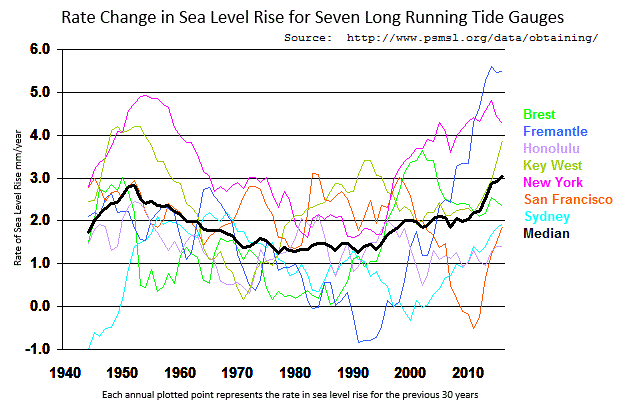
Is there an undulating 60 year cycle? Only time will tell.
If by New York you mean The Battery, about 2/3 of the gauge increase at least in recent years is due to land subsidence as shown by the GPS sensor(s) at that location. The GPS record is only about 8 years long so it is only suggestive of a long term issue. The tide gauge record goes back over 200 years.
@ur momisugly steve case:
“Over the short run since the ’70s you can claim acceleration.”
Actually, no. I look at the Boston tide gauge in detail. There is a sine wave in the data. The sin wave passes through the linear fit, going below, right at 1971. Then it arcs up, looking like acceleration. But it is not. The sine wave is due to the nodal precession of the moon, and is well known among people who study these data sets. The period of the precession is 18.60 years, and the total length of the sine wave in the Boston data is 74.4 years. Why the wave is exactly 18.6 * 4 = 74.4, I do not know, but there it is. Also of note is that the apsidal precession of the moon is 8.0 years.
So we could say the sine wave is (nodal * apsidal / 2) = 74.4
I note here that the Boston data goes back to Jan., 1921 and is complete. Therefor it contains the whole cycle and then some, on both ends. Other records are similar.
In any event, when I found out what was the likely cause of the sine wave, I measured it by determining the points where it crosses the linear trend. I was able to determine the period of the nodal precession +/- 10 days! Not bad for a monthly data set.
Now, I always thought you needed a telescope to do astronomy, and here we are doing astronomy with a tide gauge.
A while back, I saw that the folks at NASA GISS did what you suggest. That is to show some tide gauge data from 1970 on, and claim acceleration.
Two possibilities suggest themselves.
A) NASA GISS does not know that the tides are governed by the moon. (!)
B) They are lying through their teeth.
Either way, it does not look good for them.
Here is the image I made a while back, click through if it does not display.

(click to embiggen)
1993
Using satellites to measure sea level changes is uselessly inaccurate and is only used by the alarmists to show a doubling of sea level rise which is fictitious. Many WUWT articles on this have shown that the old system of measuring water marks that show only a 1.8mm per year rise as in the last 8000 years is the reality. Alarmist scientists in the government agencies will stop at nothing to try to prove their global warming meme.
You may be interested in a report by Larsen, et al. “A search for Scale in Sea-Level Studies”, Journal of Coastal Research, July 2006. Larson concluded that sea level along the North Eastern US coast has risen at a rate of 1.3 to 1.4 mm/year for the past 6,000 years. Delaware Bay locations show an increase of about 2 mm/yr suggesting slight land subsidence over the period.
You just don’t understand how modern science is done. The main contribution of satellite altimetry are measurements in the middle of oceans. That’s where the sea level rises most – and that’s why any comparison with tide gauges is meaningless. 🙂
Check PSMSL.org. There are many tide gauges on islands in the Pacific and Indian Ocean near the equator. There are also hundreds or perhaps thousands of tide gauges on coastlines throughout the Tropics. If you choose to look at any, also check the GPS data, included with many but not all sites, for elevation changes.
DHR,
You asked, “So when are we to begin observing a rise rate of 9.5 mm/year?” AFTER the 10-year delay in warming, and then the rate will have to be much greater than 9.5 mm/yr. All very probable — IF you are gullible.
“So when are we to begin observing a rise rate of 9.5 mm/year?”
It has to warm up first.
Currently the temperatures are cooling globally. This Antarctic melting requires that the temperatures be much higher than they are today. Until the temperatues go higher, we don’t have anything to worry about. The “Business as Usual” scenario they use is not even close to reality, so we shouldn’t put much faith in a new study that is based on the Business as Usual scenario.
“The entire Earth will continue to warm, but the atmosphere will warm more slowly because more of the heat will be trapped in the ocean, he said”
Ah…more of the heat will be trapped in the ocean meme which is where it has been hiding. And then they say “Warming won’t be as bad as fast as we thought, but sea level rise will be worse,” I suppose from thermal expansion of the hiding heat. But then they say the Earth won’t hit an extra 2 C until 2065, rather than the year 2053, the team writes. Odd numbers…why not 2064 rather than 2052? Clearly a clairvoyant, must have a crystal ball.
If science is supposed to verified by observation, then for their science to be correct, we have to wait until 2065 now to see if we ever do hit an extra 2 C. By then most of us will be long gone. It may be more accurate to conduct the services of an astrologer since this isn’t science either.
How is this legitimate science, without a forward that this is purely speculation based upon a model, that has no credibility in future prediction. Even the IPCC admits this. This is the kind of science that should be de-funded although with all the kids going into climate science, and they have to publish or perish, is this the new normal for science papers? Weird.
I love that neat trick of heat diving straight into the ocean, barely touching the atmosphere. Defying the laws of physics. Is there nothing climate change can’t do?
“Speculation”. It seems to be the main product of climate science and the MSM in their attempts to entertain and misinform their audience making claims and forecasts that never happen, without consequences, so they continue speculating.
Replies also to ScottyP. As reported on WUWT some time ago, the term you are looking for, for heat diving right down to the abyssal ocean, is Immaculate Convection.
Is nice, I like! 🙂
I watch Great Lakes temperature quite closely and see no evidence they are trapping any heat. Temperature just varies with the seasons, same thing, year after year after year, some years a little warmer, some a little colder. I dont understand why the oceans should be any different.
@ur momisugly Earthling2 – November 21, 2018 at 5:02 am
I wasa in bout the middle of reading your above post when the statement you quoted got me ta thinking about the Post-Glacial Sea Level Rise that began like 21,000 YBP …… and with all the glacial ice melting caused sea levels to rise 130+ meters (427 feet).
This quote, to wit:
Well “DUH”, all that heat that showed up beginning 21,000 YBP that melted all that glacial ice is technically still “trapped” in the ocean water, …… right?
Yes, for the most part, you are right Sam. The only heat that would have went missing, would have been that which was transferred to the atmosphere, which ultimately would have exited to space by LWIR. But the vast ocean in a full blown ice age may have had an average temperature of .9 C while the Interglacial ocean now has an average temp of 3.5 C. Plus there is also the extra 130 meters (427 feet) of additional liquid water in the ocean that is no longer ice that was maybe previously an average temp of -25 C when in the ice sheet. Although much of the ocean rise was a result of thermal expansion from .9 C to 3.5 C, not all additional water. So the heat since 21,000 YBP had to first warm that cold frozen ice to melting point, and then the entire ocean had to keep acquiring heat over the millennium’s to raise the entire average ocean temp to 3.5 C. That is a lot of heat that is still hiding in the ocean since the peak of the last ice age. But I suspect this is a trick question, so go ahead and pounce.
@ur momisugly Earthling2 – November 21, 2018 at 9:39 am
Of course I was RIGHT, ….. Earthling2, ….. I knew that before I posted it. Try harder, next time tell me something that I’m not already aware of. And it will likely hafta be quite new …… because I have been a “student” of the natural world for the past 70+ years.
Earthling2, no trick question involved. It was a straight-forward question that you either had to IGNORE or respond to with a affirmative “Yes” ………. or explain in detail such as you did.
And that was pretty much an excellent explanation of the ocean‘s post-glacial accumulated “hidden heat”.
Instead of you and others suspecting devious intentions as prompting my postings, it would behoove ya’ll to pay closer attention to the context/content of my commentary. Common sense thinking, logical reasoning and intelligent deductions cannot be learned from a book, but they do require above average “memory recall” abilities. Mimicry of “book learning” does not a research scientist make.
Iffen I had posted, and I could have, what you posted, but probably not as eloquent as you did, ……. you and others would have surely just ignored it, …… probably because of that age-old problem of NIH.
“DUH”, for several years now, the “funded-interest” climate scientists and their loyal fans have been trying to CTA’s by claiming that the “heat” responsible for their predicted temperature increase “is hiding in the ocean”, …… and Earthling2, most every one of you per se “experts” just ridiculed, laughed and/or poked fun at them ……. instead of pointing out that the ocean has been per se “hiding” a majority of the increase in solar energy ever since the current interglacial began.
Far too many people think that once they graduate from their “school-of-choice” that they don’t need to learn anything from anyone that is not “pre-approved” by their mentors and/or associates. Those persons who “believe” only what their mentors and/or associates tell them, ….. will always be stuck in a “rut” of ignorance.
Iffen learned individuals are automatically “suspect” of what they hear, read or are told, without first questioning its validity and/or worthiness, ……. then why in hell should said learned person expect the masses of unlearned, uneducated and/or miseducated populace to believe what the per se “learned” individual tell them?
Cheers
That ocean heat is super-sneaky. It crept up out of the water and melted the glaciers, then jumped back in before the atmosphere even noticed.
They also didn’t check the sea level rise since Jason 3 took over sea levels have slowwwwed. So this would be like thee accelerated sea level rise your having when you aren’t.
http://sealevel.colorado.edu/
seems like they stole 1st, 2nd and Third base with the “when the Antarctic ice sheet melts” assumption …
Oh wait – I see more faeries** dancing.
Really I do.
(That is a *slight* lie, haven’t seen any *yet*. Am actually inside Meadowhall Sheffield and going to see Bohemian Rhapsody. Plenty zombies tho, a great number of them queueing inside McDonalds – waiting for the Cheeseburger Level to rise. Sod the sea level.
Priorities eh, where would we be without them?##
**Queen fans would murder me for saying that…
## Up to our necks in cheese perhaps?
Mmmmmmmmmmm
I hear that the Moon is made of cheese – any comment please NASA?
Remember, dance like no-one’s watching.
😀
NASA: Of course it’s not. We’ve been there and brought some of our back. It’s made of hard gray rock.
Me: Ahah! But what happens to cheese when you leave it out for a long time? It goes hard. And gray!
‘said first author Ben Bronselaer of the University of Arizona, adding that current climate models do not include the effects of melting ice on the global climate.’
Confirming ALL climate models to date are junk.
What unknown unknowns will be known tomorrow?
It takes energy to melt ice. It only took them 40 years to figure that out.
‘The UA-led team found that by the year 2100, sea level could rise as much as 10 inches more than the previous estimate of approximately 30 inches by 2100.’
When is this supposed to start? We’re 30 years into alleged global warming, yet the seas haven’t started to rise more rapidly.
10 PLUS 30 = 40 inches.
1016mm. A meter plus. 12.4mm per year starting NOW.
This is an absurdity.
Well, who lives, sees. I just hope someone documents the level of hysteria so that the future generations can compare what was said to what happened.
The trackrecord is not always so good.
“I just hope someone documents the level of hysteria so that the future generations can compare what was said to what happened.”
I hope Trump or someone at the EPA will set up a group to do that, and fund it well. We must not let this teachable moment go down the memory hole.
Stunning. They discovered phase change!
Recalling the phase diagram for water, there is no pressure at which ice will melt at a temperature below about -20C (and that’s at about 2000 atmospheres). In the same week we heard that Antarctic temperatures are reaching historic lows.
Well anyway, the usual nonsense delivered in the usual way. *yawn*
East Antarctica isn’t and won’t be melting.