Guest Post by Willis Eschenbach [See update at the end.]
Let me start explaining the link from Picasso to climate science by looking at what Dr. Nir Shaviv called “the most boring graph I have ever plotted in my life”.
This is the graph of the changes in the best estimate of the range of what is called “climate sensitivity” over the last forty years or so.
What is climate sensitivity when it’s at home? To explain that, I’ll have to take a slight detour. First, downwelling radiation.
“Downwelling” in climate science means headed down towards the planetary surface. Downwelling radiation is the total radiation going downwards towards the surface. It is composed of sunshine (shortwave) plus thermal radiation from the atmosphere (longwave). In climate science, this quantity, total downwelling radiation, is called “forcing”, abbreviated “F”
The central paradigm of modern climate science is that if you change the amount of downwelling radiation (forcing), that the surface temperature perforce will change. The claim is that everything else averages out, and if the forcing increases, then surface temperature needs to change to maintain the global energy balance. It has to change. It must.
In short, the central paradigm of modern climate science is the following:
In the long run, global temperature change is proportional to global forcing change.
The putatively constant proportion between the two, which is the temperature change divided by forcing change, is called the “climate sensitivity”.
“Climate sensitivity” is often expressed as the assumed change in temperature given a change of 3.7 watts per square metre (W/m2) in downwelling radiation. The determination of this so-called “climate sensitivity” is a central question arising out of the paradigm that temperature change is proportional to temperature change.
Which leads me to the most boring graph below. It shows the changes over time in the estimate of the value of the climate sensitivity.

Figure 1. Changes over time in the estimate of the climate sensitivity parameter “lambda”. “∆T2x(°C)” is the expected temperature change in degrees Celsius resulting from a doubling of atmospheric CO2, which is assumed to increase the forcing by 3.7 watts per square metre. FAR, SAR, TAR, AR4, AR5 are the UN IPCC 1st, second, third, fourth and fifth Assessment Reports giving an assessment of the state of climate science as of the date of each report
It is worth noting that since 1979, entire new scientific fields like DNA analysis have first been envisioned, then have come into being, and now have reached amazing levels of development … and during that same time, what Dr. Shaviv rightly calls “the most important question in climate” has gone nowhere. No progress at all.
Since 1979, the amount of computing power that we have available, both as individuals and large organizations, has skyrocketed. My trusty PowerMac has more computing ability than most universities had available in 1979. The cost has dropped as well, from $100,000 per “MIPS” (million instructions per second) to less than $1 per MIPS today. And the speed has gone through the roof, with supercomputers running climate models at more than a trillion floating point operations (which have the lovely name of “TeraFLOPs”) every second. The number of people investigating the value of climate sensitivity has also grown over time. And billions and billions of dollars have been spent on trying to answer the question.
So … since the Charney report on climate sensitivity in 1979 we’ve had huge, stupendous increases in:
• Computing power working on the question
• Hours of intensive research applied to the question
• Discussion, debate, and interest in the question
• Money spent on the question
And despite those huge increases in time, work, discussion, and computer power, the investigation of the question of the value of climate sensitivity has gone exactly nowhere. No progress.
How can we understand this scientific oddity? What is the reason that all of that valuable time, money, and effort has achieved nothing? I mean zero. Nada. No movement at all. The most boring graph.
Let me suggest that climate science is the victim of what I call the “Picasso Problem”. Pablo Picasso once said something that has stuck with me for a long time. He said:
“What good are computers? They can only give you answers.”
Now, I wrote my first computer program in 1963, more than half a century ago. I was sixteen. It ran on a computer the size of a small room. I’ve been programming computers ever since then. I’ve written programs to do everything from designing fabric patterns for huge catenary tents, to calculating next year’s tides from this year’s tide tables, to making the plasma-cutting files to guide the cutting of the steel parts for building 25-metre fishing boats, to analyzing the data and doing the math and creating the graphics for this very post. And over the years I’ve made big bucks with my succession of computers.
So when I read that Picasso was dissing computers with that statement, my initial response was to say “Whaa? Computers are great! What is this mad artist on about? I’ve made lots of money with my computer. How can they be no good?”
But upon more mature reflection, I realized that Picasso was right. Here’s what he meant:
Even the best computer can’t give you the right answer unless you ask it the right question.
To me, this was a crucial insight, one that has guided many of my scientific peregrinations—don’t focus too much on the answers. Put some focus on the questions as well.
So regarding climate science, what is the wrong question, and what is the right question? Once again, please allow me to get side-tractored a bit.
I first got interested in climate science around the turn of the century because of the increase in serial doomcasting regarding some rumored upcoming Thermageddon™. So I started with the basics, by learning how the poorly-named “greenhouse effect” was keeping the earth far warmer than the temperature of the Moon, which is at the same distance from the sun.
However, along the way, I read that the best estimate of the warming over the entire 20th century was on the order of 0.6 degrees Celsius. When I read that, I thought … “Whaa … less than one degree??? All this fuss and the temperature has changed much less than one degree?”
I was surprised because of my experience repairing machinery which had a governor, and my experience with solar energy. I viewed the climate as a giant solar-driven heat engine, wherein the energy of the sun is converted into the ceaseless movement of the atmosphere and the ocean working against the brake of friction against the mountains and shores and the endless turbulent losses.
When one analyzes the efficiency or other characteristics of a heat engine, or when one uses tools like the Stefan-Boltzmann equation to convert temperature into the equivalent amount of thermal radiation, you have to use the Kelvin temperature scale (abbreviated “K”). This is the scale which starts at absolute zero. Temperature is a function of the motion of the molecules or atoms involved. And absolute zero is where molecular motion stops entirely.
You can’t use degrees Celsius or Fahrenheit for these calculations, because °C and °F have arbitrary zero points. You have to use the Kelvin scale, it’s the only one that works. Kelvin has the same size units as Celsius, just a different zero point, which is at minus 273.15°C (minus 459.67°F).
Now, the average surface temperature of the Earth is on the order of 14° Celsius, which is 57° Fahrenheit … or 287 Kelvin. And with that average global temperature of 287 Kelvin, the global temperature variation of 0.6 K over the 20th century is a temperature variation of a fifth of one percent.
This was the oddity that shaped my investigation of the climate … during a hundred year period, the temperature had varied by only about one fifth of one percent. This was amazing to me. I’d had lots of experience with governed systems because of my work with electrical generators. These need to be tightly governed so that their speed remains constant regardless of the changing load on the system. And what I’d found in my work with mechanical governors is that it’s quite hard to regulate a mechanical system to within one percent.
Yet despite droughts and floods, despite huge volcanic eruptions, despite constantly changing global cloud cover, despite all kinds of variations in the forcing, despite the hemispheric temperatures changing by ~ 13°C twice over the course of each and every year, despite the globe being balanced on a greenhouse effect which is holding it on the order of ~ 50°C warmer than the moon … despite all of those variations and changes, the average temperature of the Earth didn’t vary by a quarter of one percent over the entire 20th century.
That is amazingly tight regulation. Here’s a real-world example of why I was surprised by that stability.
I was looking at the speedometer today with my truck on “cruise control”. Cruise control in your car is a governor that keeps the speed of the vehicle the same regardless of changes in load on the truck. I set it for 50 miles per hour. Up and down hills it varied by plus and minus one mile per hour. That’s a computer-controlled engine that is speed-regulated to within ±2%, pretty tight regulation … but the Earth’s temperature is far better regulated than that. It stays within less than plus or minus one tenth of a percent.
To me at the time, that thermal stability was a clear sign of the existence of some unknown of natural thermostatic processes that acted in a very efficient manner to maintain the Earth’s temperature within those narrow bounds. So my own quest in the field of climate science was to find out what the natural phenomena were that explained the tight regulation of century-long planetary surface temperatures.
Which left me in a curious position. All of the established climate scientists were, and still are, trying to find out why the temperature is changing so much. They spend time looking at graphs like this, showing the variations in the Earth’s surface temperature:

Figure 2. HadCRUT global average surface temperature anomaly.
On the other hand, because I’m someone with an interest in heat engines and governors, I was trying to find out why the temperature has been changing so little. I spent my time looking at the exact same data as in Figure 2, but expressed in graphs like this:

Figure 3. HadCRUT global average actual surface temperature (the same data shown in Figure 2) and also the approximate average lunar temperature, in kelvin.
And that brings me back, after plowing that distant field, to the question of climate sensitivity and to Picasso’s prescient question, viz: “What good are computers? They can only give you answers.”.
I say that we have made zero progress in four decades of attempting to measure or calculate climate sensitivity because we are using our awesome computer power to investigate why the global temperature changes so much.
For me, this is entirely the wrong question. The question that we should be asking is the following:
Why does the global temperature change so little?
After much thought and even more research, I say the reason that global average temperature changes so little is that temperature is NOT proportional to forcing as is generally believed. As a result, the so-called “climate sensitivity” is not a constant as is assumed … and since it is not a constant, trying to determine its exact value is a fool’s errand because it has none. That’s why we can’t make even the slightest advance on measuring it … because it’s a chimera based on a misunderstanding of what is happening.
Instead, my hypothesis is that the temperature is maintained within narrow bounds by a variety of emergent phenomena that cool the earth when it gets too hot, and heat it up when it gets too cool. I have found a wide variety of observational evidence that this is actually the case. See the endnotes for some of my posts on my hypothesis.
But hey, that’s just my answer. And I freely agree that my answer may be wrong … but at least it is an answer to the right question. The true mystery of the climate is its amazing thermal stability.
Finally, how did an entire field of science get involved in trying to answer the wrong question? I say that it is the result of the 1988 creation of the Intergovernmental Panel on Climate Change (IPCC) by the United Nations.
In 1988, the field of climate science was fairly new. Despite that, however, the UN was already convinced that it knew what the problem was. Typical bureaucratic arrogance. As a result, in the UN General Assembly Resolution 43/53 from 1988, the Resolution which set up the IPCC, it says that the UN General Assembly was:
Concerned that certain human activities could change global climate patterns, threatening present and future generations with potentially severe economic and social consequences,
Noting with concern that the emerging evidence indicates that continued growth in atmospheric concentrations of “greenhouse” gases could produce global warming with an eventual rise in sea levels, the effects of which could be disastrous for mankind if timely steps are not taken at all levels,
And in response, it jumped right over asking if whether or not this was scientifically correct, and went straight to taking action on something that of course, the General Assembly knew nothing about. The Resolution says that the General Assembly:
… Determines that necessary and timely action should be taken to deal with climate change within a global framework;
Calls for action always make bureaucrats happy. So the IPCC, an expressly political “Intergovernmental” organization, became the defacto guiding light for an entire field of science … which turned out to be a huge mistake.
Now, up until that time, and since that time as well, every other field of science has managed to make amazing strides in understanding without any global “Intergovernmental” panel to direct their efforts. We’ve had astounding successes with our usual bumbling catch-as-catch-can scientific method, which involves various scientists working fairly independently around the planet on some scientific question, sometimes cooperating, sometimes competing, without needing or wanting anyone to “summarize the science” as the IPCC claims to do.
And given the lack of progress shown by the “Most Boring Graph” at the top of this post, I’d say that the world should never again put a bunch of United Nations pluted bloatocrats in charge of anything to do with science. If we had set up an “Intergovernmental Panel on DNA Analysis” when the field was new, you can be certain that long ago the field would have gone uselessly haring down blind alleys lined by nonsensical claims that “97% of DNA scientists agree” …
Over at Dr. Judith Curry’s excellent blog, someone asked me the other day what I didn’t like about the IPCC. I replied:
Here are some of the major reasons. I have more.
First, it assumes a degree of scientific agreement which simply doesn’t exist. Most people in the field, skeptics included, think the earth is warming and humans may well have an effect on it. But the agreement ends there. How much effect, and how, and for how long, those and many other questions have little agreement.
Second, it is corrupt, as shown inter alia by the Jesus Paper.
Third, it generally ignores anything which might differ from climate science revealed wisdom.
Fourth, it is driven by politics, not by science. Certain paragraphs and conclusions have been altered or removed because of political objections.
Fifth, in an attempt to be inclusive of developing countries, it includes a number of very poor scientists.
Sixth, any organization that ends up with Rajendra Pachauri as its leader is very, very sick.
Seventh, they’ve ignored actual uncertainty and replaced it with a totally subjective estimate of uncertainty.
Eighth, it lets in things like the Hockeystick paper and the numerous “Stick-alikes” despite them being laughably bad science.
Ninth, it makes “projections” that have little to no relationship to the real world, like Representative Concentration Pathway 8.5 (RCP 8.5).
Tenth, it generally excludes skeptics of all types, either directly or because skeptics know better than to associate with such an organization.
Eleventh, anyone making “projections” that go out to the year 2100 is blowing smoke up your fundamental orifice.
Twelveth, it is far, far too dependent on untested, unverified, unvalidated climate models.
Thirteenth, the IPCC generally thinks without thinking about it that warming is bad, bad, bad … which is the opposite of the actual effects of the warming since the Little Ice Age.
Fourteenth, the IPCC was given the wrong task at its inception. Rather than setting out to find what actually controls the climate, it was given the task of finding out how much CO2 we could emit before it became dangerous. That tasking assumed a whole host of things which have never been established.
Fifteenth … aw, heck, that’s enough. I have more if you are interested.
So … that’s the climate Picasso Problem. The field of climate science is trying to use computers to find an answer to the wrong question, and as a result, the field is going nowhere.
[UPDATE]
In the comments below, someone brought up the following graphic of recent estimates of climate sensitivity and said that it showed I was wrong about the climate sensitivity.

Here is my answer from below:
Thanks, David. The discrepancy in your first graph is much more apparent than real. Here are the recent ECS estimates overlaid on the Charney/IPCC data:

As you can see, the only ones outside the IPCC uncertainty limits are the estimates at 5 & 6 °C per doubling of CO2.
Here’s a boxplot of the recent estimates

The recent estimates are not at all unusual given the Charney/IPCC estimates.
Finally, you still haven’t grasped the nettle. The surface temperature is NOT a function of the forcing. For example, in large areas of the Pacific, the surface temperature controls the amount of sunshine. Here’s a plot showing that result.

Correlation between the solar radiation at the surface, and the surface temperature. This is calculated on a 1° x 1° gridcell basis.
Now, the areas in green and blue are areas in which, as the temperature goes UP, the amount of sunshine hitting the ground goes DOWN.
So here’s the question. What is the “climate sensitivity” in those areas?
The answer, of course, is that in such a situation the entire concept of climate sensitivity goes out the window. In those areas, the temperature is NOT a function of the forcing, linear or otherwise. Instead, in those areas, the forcing is a function of the temperature.
That’s the point I’ve been trying to make. The fundamental idea underlying modern climate science is incorrect—temperature is NOT a function of forcing.
So yes, people can calculate the putative “climate sensitivity” and get various answers … but it is a meaningless quest, and the results carry no weight at all.
My best to you,
w.
Here, we’re still in haze and smoke from the Camp Fire, and the number of fatalities is over seventy. I’m wearing an N95 mask when I go outside. Here’s the latest smoke map … Anthony Watts is up in Chico, in the bright red spot at the top, over 100 micrograms per cubic metre of smoke. I’m near the coast to the west of Santa Rosa, north of San Francisco, where it’s much better but still bad.

Keep a good thought over the fire victims, it’s hard times for all.
My best wishes to every one,
w.
PS—As usual, I ask that when you comment, please quote the exact words you are discussing, so we can all understand both who and what you are replying to.
FURTHER READING: These are some of my posts explaining my hypothesis regarding why the global temperature is so stable, and providing evidence for the hypothesis
The Thermostat Hypothesis 2009-06-14
Abstract: The Thermostat Hypothesis is that tropical clouds and thunderstorms actively regulate the temperature of the earth. This keeps the earth at a equilibrium temperature.
Which way to the feedback? 2010-12-11
There is an interesting new study by Lauer et al. entitled “The Impact of Global Warming on Marine Boundary Layer Clouds over the Eastern Pacific—A Regional Model Study” [hereinafter Lauer10]. Anthony Watts has discussed some early issues with the paper here. The Lauer10 study has been controversial because it found that…
The Details Are In The Devil 2010-12-13
I love thought experiments. They allow us to understand complex systems that don’t fit into the laboratory. They have been an invaluable tool in the scientific inventory for centuries. Here’s my thought experiment for today. Imagine a room. In a room dirt collects, as you might imagine. In my household…
Further Evidence for my Thunderstorm Thermostat Hypothesis 2011-06-07
For some time now I’ve been wondering what kind of new evidence I could come up with to add support to my Thunderstorm Thermostat hypothesis (q.v.). This is the idea that cumulus clouds and thunderstorms combine to cap the rise of tropical temperatures. In particular, thunderstorms are able to drive…
It’s Not About Feedback 2011-08-14
The current climate paradigm believed by most scientists in the field can be likened to the movement of balls on a pool table. Figure 1. Pool balls on a level table. Response is directly proportional to applied force (double the force, double the distance). There are no “preferred” positions—every position…
Estimating Cloud Feedback From Observations 2011-10-08
I had an idea a couple days ago about how to estimate cloud feedback from observations, and it appears to have panned out well. You tell me. Figure 1. Month-to-month change in 5° gridcell actual temperature ∆T, versus gridcell change in net cloud forcing ∆F. Curved green lines are for…
Sun and Clouds are Sufficient 2012-06-04
In my previous post, A Longer Look at Climate Sensitivity, I showed that the match between lagged net sunshine (the solar energy remaining after albedo reflections) and the observational temperature record is quite good. However, there was still a discrepancy between the trends, with the observational trends being slightly larger…
Forcing or Feedback? 2012-06-07
I read a Reviewer’s Comment on one of Richard Lindzen’s papers today, a paper about the tropics from 20°N to 20°S, and I came across this curiosity (emphasis mine): Lastly, the authors go through convoluted arguments between forcing and feed backs. For the authors’ analyses to be valid, clouds should…
A Demonstration of Negative Climate Sensitivity 2012-06-19
Well, after my brief digression to some other topics, I’ve finally been able to get back to the reason that I got the CERES albedo and radiation data in the first place. This was to look at the relationship between the top of atmosphere (TOA) radiation imbalance and the surface…
The Tao of El Nino 2013-01-28
I was wandering through the graphics section of the TAO buoy data this evening. I noted that they have an outstanding animation of the most recent sixty months of tropical sea temperatures and surface heights. Go to their graphics page, click on “Animation”. Then click on “Animate”. When the new…
Emergent Climate Phenomena 2013-02-07
In a recent post, I described how the El Nino/La Nina alteration operates as a giant pump. Whenever the Pacific Ocean gets too warm across its surface, the Nino/Nina pump kicks in and removes the warm water from the Pacific, pumping it first west and thence poleward. I also wrote…
Slow Drift in Thermoregulated Emergent Systems 2013-02-08
In my last post, “Emergent Climate Phenomena“, I gave a different paradigm for the climate. The current paradigm is that climate is a system in which temperature slavishly follows the changes in inputs. Under my paradigm, on the other hand, natural thermoregulatory systems constrain the temperature to vary within a…
Air Conditioning Nairobi, Refrigerating The Planet 2013-03-11
I’ve mentioned before that a thunderstorm functions as a natural refrigeration system. I’d like to explain in a bit more detail what I mean by that. However, let me start by explaining my credentials as regards my knowledge of refrigeration. The simplest explanation of my refrigeration credentials is that I…
Dehumidifying the Tropics 2013-04-21
I once had the good fortune to fly over an amazing spectacle, where I saw all of the various stages of emergent phenomena involving thunderstorms. It happened on a flight over the Coral Sea from the Solomon Islands, which are near the Equator, south to Brisbane. Brisbane is at 27°…
Decadal Oscillations Of The Pacific Kind 2013-06-08
The recent post here on WUWT about the Pacific Decadal Oscillation (PDO) has a lot of folks claiming that the PDO is useful for predicting the future of the climate … I don’t think so myself, and this post is about why I don’t think the PDO predicts the climate…
The Magnificent Climate Heat Engine 2013-12-21
I’ve been reflecting over the last few days about how the climate system of the earth functions as a giant natural heat engine. A “heat engine”, whether natural or man-made, is a mechanism that converts heat into mechanical energy of some kind. In the case of the climate system, the…
The Thermostatic Throttle 2013-12-28
I have theorized that the reflective nature of the tropical clouds, in particular those of the inter-tropical convergence zone (ITCZ) just above the equator, functions as the “throttle” on the global climate engine. We’re all familiar with what a throttle does, because the gas pedal on your car controls the…
On The Stability and Symmetry Of The Climate System 2014-01-06
The CERES data has its problems, because the three datasets (incoming solar, outgoing longwave, and reflected shortwave) don’t add up to anything near zero. So the keepers of the keys adjusted them to an artificial imbalance of +0.85 W/m2 (warming). Despite that lack of accuracy, however, the CERES data is…
Dust In My Eyes 2014-02-13
I was thinking about “dust devils”, the little whirlwinds of dust that you see on a hot day, and they reminded me that we get dulled by familiarity with the wonders of our planet. Suppose, for example, you that “back in the olden days” your family lived for generations in…
The Power Stroke 2014-02-27
I got to thinking about the well-known correlation of El Ninos and global temperature. I knew that the Pacific temperatures lead the global temperatures, and the tropics lead the Pacific, but I’d never looked at the actual physical
Albedic Meanderings 2015-06-03
I’ve been considering the nature of the relationship between the albedo and temperature. I have hypothesized elsewhere that variations in tropical cloud albedo are one of the main mechanisms that maintain the global surface temperature within a fairly narrow range (e.g. within ± 0.3°C during the entire 20th Century). To…
An Inherently Stable System 2015-06-04
At the end of my last post , I said that the climate seems to be an inherently stable system. The graphic below shows ~2,000 climate simulations run by climateprediction.net. Unlike the other modelers, whose failures end up on the cutting room floor, they’ve shown all of the runs ……
The Daily Albedo Cycle 2015-06-08
I discussed the role of tropical albedo in regulating the temperature in two previous posts entitled Albedic Meanderings and An Inherently Stable System. This post builds on that foundation. I said in the latter post that I would discuss the diurnal changes in tropical cloud albedo. For this I use…
Problems With Analyzing Governed Systems 2015-08-02
I’ve been ruminating on the continuing misunderstanding of my position that a governor is fundamentally different from simple feedback. People say things like “A governor is just a kind of feedback”. Well, yes, that’s true, and it is also true that a human being is “just…
Cooling And Warming Clouds And Thunderstorms 2015-08-18
Following up on a suggestion made to me by one of my long-time scientific heroes, Dr. Fred Singer, I’ve been looking at the rainfall dataset from the Tropical Rainfall Measuring Mission (TRMM) satellite. Here’s s the TRMM average rainfall data for the entire mission to d…
Tropical Evaporative Cooling 2015-11-11
I’ve been looking again into the satellite rainfall measurements from the Tropical Rainfall Measurement Mission (TRMM). I discussed my first look at this rainfall data in a post called Cooling and Warming, Clouds and Thunderstorms. There I showed that the cooling from th…
How Thunderstorms Beat The Heat 2016-01-08
I got to thinking again about the thunderstorms, and how much heat they remove from the surface by means of evaporation. We have good data on this from the Tropical Rainfall Measuring Mission (TRMM) satellites. Here is the distribution and strength of rainfall, and thus …
Where the Temperature Rules The Sun
I’ve held for a long time that there is a regulatory mechanism in the tropics that keeps the earth’s temperature within very narrow bounds on average (e.g. ± 0.3°C over the 20th Century). This mechanism is the timing and amount of the daily emergence of the cumulus cloud field, and the timing and emergence of thunderstorms.
Where the Temperature Rules The Total Surface Absorption
Reflecting upon my previous post, Where The Temperature Rules The Sun, I realized that while it was valid, it was just about temperature controlling downwelling solar energy via cloud variations. However, it didn’t cover total energy input …

Is there a climate sensitivity?
https://tambonthongchai.com/2018/09/25/a-test-for-ecs-climate-sensitivity-in-observational-data/
Chaamjamal
The URL you provided is nothing more
than mathematical mass-turbation
of monthly temperature data
(meaningless data mining
and a waste of time).
The correct answer to
“Is there a climate sensitivity (to CO2)?”
is that a lot of people think so,
based on laboratory experiments,
but the actual effect of CO2
in the real world, is unknown.
Unfortunately, saying the right answer
(“We don’t know”) does not get attention
and science grants.
So scientists publish their guesses
of TCS and ECS.
One could arbitrarily blame
all the warming since 1950 on CO2,
extrapolate that warming rate
into the future, and estimate a
WORST CASE TCS for CO2,
based on actual measurements —
— about +1.0 degrees C. per doubling —
but that would mean CO2
was harmless and boring,
and that simple calculation
is too logical for anyone
with an advanced science degree
(I only have BS degree,
so can’t think like those
pesky PhDs).
There is nothing
in the temperature record
since 1950,
that even suggests
the minor variations
since 1950
were not natural
climate change,
unrelated to CO2.
In fact, the minor temperature change
since 1850 is an unusually stable climate,
compared to what we have reconstructed
about the past, from ice core proxies.
My climate science blog:
http://www.elOnionBloggle.Blogspot.com
Richard, the 3-sentence paragraphs are good but you need to take the hard returns out of your essays.
Pat
I have a serious vision problem
that can’t be corrected,
and have difficulty reading
anything but narrow columns,
like in most newspapers.
I would love to post
narrow justified columns here
if any confuser expert
can tell me
how to do that!
Cutting and pasting
a “proper”
justified column
typed on my laptop
ends up looking
like what you see!
I think the moderators should be generous and help Richard in that.
I once wrote a Word macro the would run through a highlighted paragraph (except the not-highlighted last words) and delete all the Returns.
(It got lost when I upgraded my version of Word—something I’ll avoid doing in the future.)
@richard Greene
I like it. It reads almost like a poem.
There most certainly is a climate sensitivity, except that its dimensions are not degrees per W/m^2 which is highly nonlinear owing to the T^4 relationship between temperature and W/m^2. The proper metric is the linear metric of W/m^2 of surface emissions per W/m^2 of forcing and this is what’s incredibly constant across the satellite record and from pole to pole.
The value is 1.62 W/m^2 of surface emissions per W/m^2 of forcing and this value applies to each and every W/m^2 of forcing from the Sun. The IPCC purposefully uses degrees per W/m^2 in order to obfuscate this undeniable fact because to acknowledge it means that they can’t substantiate the 4.3 W/m^2 of surface emissions per W/m^2 of forcing that’s required to support the nominal ECS of 0.8C per W/m^2, much less the higher sensitivities considered in the various junk science scenarios.
BTW, the IPCC doesn’t presume strict linearity between W/m^2 and degrees, they only presume approximate linearity around the average temperature. Considering this from an incremental point of view allows them to ignore the T^4 relationship which makes the actual sensitivity go as 1/T^3 which varies from pole to pole.
co2isnotevil November 19, 2018 at 1:57 pm
The temperature of the planet went from ~ 13.5°C to ~ 14.3°C since 1850. The difference between considering that as a linear function of radiation in W/m2 and considering it as an R^1/4 function of radiation is meaninglessly small.
Nor is it “constant from pole to pole”. In fact, there are large areas whereas the temperature goes up, the forcing goes down.
So I fear your entire comment is not correct.
w.
Willis,
“The difference between considering that as a linear function of radiation in W/m2 and considering it as an R^1/4 function of radiation is meaninglessly small.”
You’ve fallen into the approximate linearity trap. Yes, over the narrow range of T that the global average has varied, the assumption of approximate linearity seems valid. However; it’s not a valid approximation over the range of T from pole to pole and across seasons from which the average is computed. As I pointed out, it also obfuscates the fact that when the ECS is expressed as degrees per W/m^2, it has a 1/T^3 dependency which means that the sensitivity decreases as the temperature increases and can not possibly be more than 0.3C per W/m^2. This limit is the sensitivity of the Earth’s surface temperature to incident solar energy when the next 1.62 W/m^2 of incremental surface emissions arising from the next W/m^2 of forcing is converted into an incremental change in temperature.
The problem is that the linearity approximation trap allows decoupling the average ECS from the incremental ECS, when in fact, they must be the same. There’s no possible way for the climate system to distinguish the next Joule from the average Joule so that the next one can be so much more powerful at warming the surface than the average and this is a non negotiable requirement for any sensitivity greater than about 0.3C per W/m^2 starting from 288K.
When I say constant from pole to pole, I’m referring to the effect on the averages of constant latitude slices of the planet from pole to pole. The ECS is limited by the path from the surface to space and this scatter diagram shows us what this limit is. Each little dot is 1 month of data covering 3 decades plotting the average output emissions (X) against the average surface temperature (Y) for each 2.5 degree slice of latitude. The green line represents the case of exactly 1 W/m^2 of planet emissions per 1.62 W/m^2 of surface emissions. The larger dots are the averages across all 3 decades of satellite data. Even the monthly averages are within 1% of conformance, varying equally on either side of the mean ECS of 1.62 W/m^2 per W/m^2 of forcing. Note that the slope of this relationship at the current average of about 288K is about 0.3C per W/m^2.
You should note that your plot is reflecting behavior along the input path which varies over a much wider range in order to conform to the limitations set by the output path which is the ultimate limiter on the ECS and this limiter is constant from pole to pole.
If the surface temperature vs. solar forcing is plotted, we can quantify the TCS which becomes 1 W/m^2 of surface emissions per W/m^2 of forcing as seen here, where the red dots compare the input forcing to the surface temperature and the yellow dots representing the ECS limiter are shown for reference. The magenta line is the prediction of 1 W/m^2 of surface emissions per W/m^2 of forcing and once more, the average conforms, albeit with the expected larger variability. Note the relatively narrow range of dots along the output path, relative to the input path. The tight distribution along the output path is why the averages are so stable.
The current pattern of the polar vortex in the lower stratosphere is not favorable for California. The vortex will now be divided into two centers compatible with the magnetic field centers in the north.
https://earth.nullschool.net/#current/wind/isobaric/70hPa/orthographic=-95.40,86.86,296
http://www.geomag.nrcan.gc.ca/mag_fld/arctics-en.php
Very low solar activity.
http://www.n3kl.org/sun/images/noaa_satenv.gif?
The pattern of the polar vortex in the lower stratosphere promotes stratospheric intrusions in the US.

http://www.cpc.ncep.noaa.gov/products/stratosphere/strat_int/
When the solar wind is strong, the polar vortex pattern has a more round shape because the wind speed increases in the vortex.
Ren I am in complete agreement with your assertions. I think all the signs are now in and the climate which has been cooling for the last year or two will continue.
Awesome post Willis..but what is side-tractored ? lol
Marcus November 18, 2018 at 12:20 am
It’s like when you get side-tracked, but with much more force so you can’t resist it …
w.
I agree with Marcus. It’s a very well written and thought provoking article.
A few typos, “truce” should be “truck” and what is “pluted” in “pluted bloatocrats?”
It is short for “polluted” as in drunk…as in “drunk with power”.
It’s a spoonerism.
It’s a linguistic jape about bloated plutocrats. 🙂 And well-done, too.
Willis, just a thought, but maybe another point Picasso was making was that joy comes from investigating the question.
Willis, and @Patrick Guinness Frank November 18, 2018 at 12:56 pm
I think Picasso was just trying to say that computers discourage thinking outside the box. You won’t get any wild and crazy ideas, some of which sometimes occasionally turn out to be brilliant masterpieces, or inventions, or whatever field you’re in, if you only look for what the computer tells you. Even if you can be certain you asked your computer the right question.
Like “Gorge Jershwin’s Blapsody in Rhue” or Mozart’s “Eine neine Klachtmusik” or, in sentences, “Does he have whin-chiskers?” “No, he’s sheen-claven.” An art-form derived from an accident. I do like “pluted bloatocrats” even if Spel-Chek doesn’t.
“pluted bloatocrats” – excellent!
Enjoyed while on a well-boiled icicle. Geoff
Awesome post Willis..but what is side-tractored?
That’s when Farmer Jim sampled too much of the product out of his still just before he plowed his field.
By 1988 climatology was very well advance and sophisticated. It is based on the statistical study of climate. What we don’t know are the mechanisms of atmospheric physics, which has nothing to do with climatology.
Thanks, Donald. Me, I’d say that even today the study of climate is only in its youth.
Nobody knows why the Roman and Medieval times were unusually warm, or why it was cooler between those times.
Nobody knows why temperatures dropped over a couple of centuries to the Little Ice Age.
Nobody knows why the temperatures didn’t keep dropping into a real glacial period.
Nobody knows why the temperatures have gradually warmed over the ~ three centuries since the Little Ice Age.
Until we can answer all of those questions, I wouldn’t say that “climatology is very well advanced and sophisticated” …
Best regards,
w.
So, there is a lot of good research topics for climate scientist without CAGW. Trump and others does not need to fire them, just redirect the research questions. Politicians can say these things aloud without being ridiculed.
Yeah. Trying to account for the LIA or the Medieval Warm Period is probably why the MBH98 paper was so popular with the IPCC.
If the answer is “What LIA”?, no problem.
I remember Jerry North, a climate modeler at Texas A&M, saying how euphoric were the modelers when Mann published his hockey stick, Tom, because their models had all been producing a flat line historical air temperature followed by a steep rise with modern CO2 emissions.
Mann’s HS validated the models. Its widespread acceptance was then a shoe-in.
Warm and cold periods might just be random, statistical fluctuation. Consider a series of coin tosses. If one flips a coin many times, is not unusual to get a series of five heads or five tails all in a row. In several hundred flips it’s not unusual to see a series of eight in a row. Think of the heads as warm periods and the tails as cold periods. There is no reason other than random fluctuation for there to be extended warm or cold periods. Maybe we will never have a better answer than that.
Willis Eschenbach
In my 21 years of climate science reading,
it is rare that an article, or study,
conveys so much wisdom and information
in simple English.
And easy to read too.
However, I have several
recommendations
for improvement,
from an A, to an A+:
(1)
The correct message,
that TCS and ECS are unknown,
is suggested by the huge range
of estimates on the “boring graph”,
but should have been stated directly.
(2)
“FURTHER READING:
should have been one URL link,
not such a long, self-serving list, and
(3)
You should have mentioned Picasso
in the title, and then never mentioned
him again, just to see if people
really take article titles seriously, and
(4)
Nothing rhymed
(heh heh)
You’re a pretty smart guy,
for someone who lives
in California.
Willis,
All of those temperature changes show that your thermoregulatory engine just doesn’t work. Or at best there is only a minor range of forcings that it can compensate for. The timescales are all wrong — you claim that there is a local and immediate response to a temperature change which keeps the global temperature constant. Yet over a year the average global temperature changes by 3.6 degrees and over a period of a few years the el nino -la nina cycle can change the global temperature by a degree or so. So any feedback mechanism must be slower than those cycles. And over the past century the temperature has increased by about 1 degree so again the feedback mechanism is either not working or is slower than a century.
w is correct. And here’s another way of looking at it:
We don’t know how the sun affected climate in the past and we don’t know what the sun will do in future, so we absolutely cannot predict its effect on climate.
We don’t know what clouds will do in future, so we can’t predict their effect on climate.
We don’t even know what the oceans will do in future, so we can’t predict their effect on climate.
We don’t know how Milankovitch cycles operate on climate, so even though we can predict the Milankovitch cycles, we can’t predict their effect on climate.
We haven’t found out why the Antarctic’s climate is so out of phase with the rest of the planet, ie. we obviously don’t know even the basic physics of Earth’s climate, so the idea that we can predict climate at all is preposterous.
… and the list goes on … and on. We cannot predict Earth’s climate. Period.
“so we absolutely cannot predict its effect on climate.”
…
Actually we can precisely predict the effect of the sun on the climate. Milankovitch cycles are extremely accurate, and the variation in insolation from orbital precession is known very accurately. Ice core data shows the effect of the delta-w/ms.
Dave Burton
– “Actually we can precisely predict the effect of the sun on the climate“. I think not. And that’s because we can’t predict what the sun will do. We can’t even predict one sunspot cycle ahead.
– “Milankovitch cycles are extremely accurate, and the variation in insolation from orbital precession is known very accurately“. That’s true. But we don’t yet know how those changes led to the (proxily) observed past climate changes. There seems to be a bit of a correlation with insolation at 65N, but it doesn’t quite work and there isn’t a known mechanism. So we can’t predict what effect future Milankovitch cycles will have on Earth’s climate.
Mike,
The claim that we cannot predict the climate is the exact opposite of what Willis is
claiming. He believes that there is a thermo-regulatory engine at work that keeps the
climate stable to within +/- 0.6 degrees. Or at least that is what I can gather from his posts.
This is a climate model that makes predications about the future and states that the climate
is predictable and stable.
I think you will find that Willis is saying that future changes in Earth’s climate will be very much smaller than the IPCC forecasts, because of the stabilising effects that he describes. I don’t think you will find that w is arguing that the climate won’t change at all, but rather that future changes will happen just like past changes happened and for similar reasons.
Mike,
If Willis is claiming that ” future changes in Earth’s climate will be very much
smaller than the IPCC forecast” then he is predicting the Earth’s climate which is
what you are claiming is impossible. A prediction that nothing will change despite
a large change in radiative forcing is just as much a prediction as one that states that
the earth will warm by X degrees.
Percy Jackson. What major change is that? Going from 3 molecules out of 10000 all the way to 4?
Can anyone venture a guess as to what percentage of climate scientists actually have advanced education/experience in meteorology? I get the impression (false or not, I don’t know) that a good number of them are mathematicians/physicists/programmers who seem to pay more attention to statistics and reductionist science rather than to the vast complexities of the weather system.
From what I have seen the field of climate science is simply computer modelling. There is no real science. There is little knowledge of real climate factors, such as meteorology, just those embedded in models by the originators of those models.
The “experiments” we see are virtual and have nothing to do with the real world. The field is more akin to gaming than to actual science.
“There is no real science”
That seems to be the prevailing paradigm. Science conforms theory to observations, whereas climate scientists justify doing the opposite (ignore observations that don’t support theory). For example:
https://twitter.com/AndrewDessler/status/1060635302669238275
Richard M:
Politicians (and religious leaders too)
have USED predictions of a coming disaster
to control people, for many centuries.
The coming disasters” are usually imaginary:
— You will go to hell if you mis-behave, or
— Earth will become hell if we add more CO2 to the air.
It’s all nonsense
with an ulterior motive,
(sorry, I’m an atheist)
whether coming from
religious leaders
or political leaders.
Of course computer “models” are nothing
more than the opinions of the “programmers”,
converted to complex math, to impress laymen.
And the outputs of “models” are not data.
And when the “model” outputs
are wrong predictions,
for over thirty years,
we know for sure that
the “models” are nothing more
than failed prototypes
that are not real models
of the climate on this planet.
Real science and climate model junk science
have almost nothing in common, except
that people with science degrees are
working in both “fields”.
My climate science blog:
http://www.elOnionBloggle.Blogspot.com
I would agree. As a Meteorologist I see climate scientists making basic errors in their claims that most atmospheric/weather scientists know is either unlikely or can not happen. It is a bit like scientists claiming that airline turbulence will increase due to a warmer earth, but with the differential warming of the poles warming faster than the equator, the thermal gradient driving these Jet streams weakens as do the Jet streams and as do the storms below the Jet streams. So where do they get this idea from? The tropical hot spot I suspect, but that does not seem to exist in real life either. More droughts with more water vapour in the atmosphere….makes no sense. Obs back this up as well. Weather becoming more extreme when thermal gradients are weakening…obs show less extreme weather….the list goes on.
“the global temperature variation of 0.6 K over the 20th century is a temperature variation of a fifth of one percent.”
Thank you for adding a good talking point. It is essential to explain climate change to a six year old. For you and me IPCC’s reports reveal fundamental flaw. Unfortunately the policy makers don’t read them, can not comprehend them. CAGW is a powerful narrative for lobbyists, cronies exploiting the political power. Antidote for that is down to earth explanation for ordinary people.
Looking out of the window: let’s make Europe warm again.
A good post. But, like most of us here, you have been banging your head against the brick wall of corrupt political bureacracy for over 10 years, all to no avail.
We need more Donalds to drain the swamp of corruption. Or we need some serious global cooling.
As far as I’ve seen, Donald has done almost nothing to drain that swamp. While he has pulled back a lot of wasted money, nothing has been done to rid NASA or NOAA of climate corruption.
I don’t think Global Cooling will change much. When I was in high school (’68-’72) the talk was all the coming ice age, and that CO2 was the driver. Now that the term Climate Change has been adopted to express that humans are responsible for whatever weather occurs, it’s still covered. IPCC will still be driving the CO2 is evil narrative.
+KaliKook, they were not saying during the global cooling worries of the seventies that CO2 is the driver. Reid “father of climatology” Bryson and George Kukla both said it was part of a natural cycle as our interglacial wound down, and neither ever reversed his position. Now, I admit you had disgraceful scientists (intellectual prostitutes) like Stephen Schneider saying man made pollution would obscure the skies and cause a full blown ice age in only fifty years before he flip-flopped into the new global warming camp about 1976, but I consider Schneider to be more of a political activist than a credible scientist.
If you are saying that this is there central belief then they are dead in the water, it’s wrong at science.
This was dealt with when groups wanted to deploy more and more computer power to try to predict Weather. The naive old answer was that classical chaos theory stopped you but that simply isn’t true as you would be able to model the start conditions. It was finally pointed out to them that the main exchanges occur in Radiative Transfer in the QM domain and no matter what you do there are time limits to any predictions which can be shown.
Anyone who thinks the effect is minor can have a go at doing this experiment
https://www.youtube.com/watch?v=zcqZHYo7ONs&vl=en
Even two layers that simply polarize it changes everything so much that classical physics breaks down.
There are a myriad of these QM effects at play and it is the lack of coverage of those QM effects that ultimately breaks your predictive ability.
Now we have 4Billion years worth of data so there is a chaotic range the temperature will wobble around within as both the classical and quantum domains obey the conservation of energy laws. However the idea that if you somehow measure a classical forcing and predict the long term outcome is just funny and flies in the face of all known science.
THE most banal idea is that natural living flora and fauna are just passengers caught in the wash of climate changes. Life on this planet has means and ways of controlling both weather and climate! To ignore these natural feedbacks and effects, is to regard anything but the sterile mechanistic view as unworthy of research. As natural life has been on this planet for so long it is surely foolish to disregard life as a another governing factor of what affects both weather and climate, and maybe governs much of it.
Life takes solar energy and sequesters it away with chemical activity building new chemical structures. A tree is not just the sum of it’s chemical constituents but also of the solar energy it has gathered over it’s lifetime. The human population has grown dramatically over the past million years with increasing consumption of solar energy stored in our food. So where is any of that in T&K’s daft energy cartoon? With life, solar ‘energy in’ hardly ever equals ‘energy out’.
This planet, through life acquires, stores, redistributes, and releases energy with the timing life commands, it does not follow the notion of ‘energy in’ = ‘energy out’ until life itself expires — when entropy has the final say.
Also of note is that forests, depending on the majority of tree types, can and do bend the prevailing weather/climate patterns with local changes in released VOCs, NOx, H2O, CO2, Ozone levels and more, variably over the seasons for many decades. I dare say that if ever investigated many plants will be found able to do these simple natural tricks.
Isn’t what you describe what Lovelock called the Gaia hypothesis?
Lovelock can call it what he wishes. I don’t read his drivel.
@Tim Ball,
Let me explain better.
I do not rate so called ‘scientist’ who do so little science while playing their computer games. IMO real science is done by those who get off their fat complacency and go and measure, observe and record the real effects of nature. All others are just fantasists, and yes there are some fantasists who can restrain themselves from veer off into the unlike, the unbelievable but their effort are for nought if their suppositions are not backed by measurements and observations.
All to much of science today is done by these fantasist type and not enough by the foot-sloggers measuring and recording the actuality.
Lovelock is such a fantasist and the Gaia hypothesis is a fantasy with so little to back it up. I’m asking that science back-up or falsify the Gaia supposition. Make it real or cast it out!
“The claim is that everything else averages out, and if the forcing increases, then surface temperature needs to change to maintain the global energy balance. It has to change. It must.” What I don’t believe is the everything averages out. They don’t have the data to prove this. By claiming this it falsely converts energy to T. Even if you except the noble gas law applies they only use T in their calculations and ignore the other variables.
I’m beginning to understand, thanks to many of Willis’ postings and my own understanding of Thermodynamics and Heat Transfer and Fluid Flow and Etc. acquired in pursuit of a B.S. in Mechanical Engineering (for which I did graduate, BTW), that this quote could only be true if the only thing that could change was the forcing, which would mean that the air molecules of the atmosphere could not move, they were nailed rigidly in place as if they were atoms of a solid. And that simply ain’t true. End of story.
The black body calculation assumes a solid body so I agree
Ideal Gas Laws?
Thanks, Willis!
You managed to articulately frame in writing my sentiments about this issue.
I always tell people to look at this from a wider perspective. You added the different angle.
BTW, As soon as one quotes either the IPCC or the Consensus I feel a knot in my belly.
I am going to adopt the comparison you made between DNA and climate science… 🙂
Moons average surface temperature has been measured at 197K by Diviner. (Its Effective temperature is ~270K !!!)
So the real question is :
why is the average surface temperature on Earth ~90K higher than that on the moon.
Next question is : why are the deep oceans some 75K warmer than the average surface temperature on the moon.
Realize that whatever mechanism heats the surface of the oceans, its influence is limited to the upper 300-400m.
http://www.climate4you.com/images/ArgoTimeSeriesTemp59N.JPG
or
http://research.cfos.uaf.edu/gak1/gak1_MonthlyT.png
So no, surface heat does NOT travel down into the deep oceans.
And no, the atmosphere does not increase Earths average surface temperature some 90K above that of the moon.
Could it be that the Earth’s core is providing some warmth, whereas the Moon’s core is very much cooler?
Harry Passfield November 18, 2018 at 5:16 am
The entire crust on Earth is heated from below. Only the upper ~10m or so is heated by the sun.
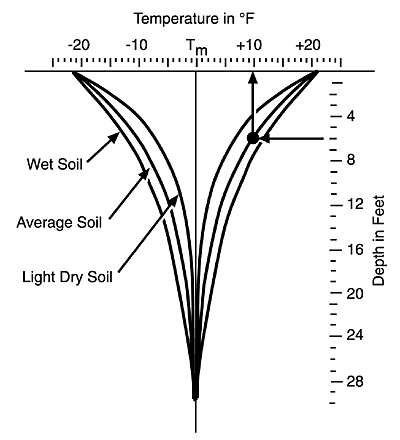
Typical profile over a year:
Going down the temperature increases like this:
https://www.researchgate.net/figure/5-Earths-Crust-Temperature-Profile-in-Different-Places-Adopted-from-Armani-2012_fig3_263250276
The same holds true for our oceans. Heat content below ~500m is completely supplied from inside the Earth.
On the moon the sun only warms the upper 50 cm or so of the surface layer. During the day temperatures rise according the incoming radiation (with a little lag). During the night the surface cools down to (far) below 100K.
Some craters near the poles have a constant temperature of ~25K. This is most probably the energy from the internal heat being radiated away to space.
see https://www.diviner.ucla.edu/science
Thanks, Ben.
“Next question is : why are the deep oceans some 75K warmer than the average surface temperature on the moon.”
Just guessing but I would think that it has (in part) something to do with the structure of solid versus liquid water that causes ice to float.
For the same reason the atmosphere is the temperature it is. The sun warms the oceans and the land (and some of the atmosphere as well). That absorbed heat must be released to space from both the oceans and land, but also from the radiative part of the atmosphere. On a daily basis, on the entire earth, all of that absorbed energy is released to space, but not more than was absorbed generally. The oceans and the atmosphere are reservoirs of energy that would only cool down to the black body temperature in the absence of the sun. One can surmise that it would not take awfully long for that to happen, since we know much energy is radiated to space each day. The first day with no sun would be equivalent to the previous day, minus a small amount since the radiation rate would continuously decrease as the cooling happened. I’d suggest a swag of 30 days to get to black body temperature. No, CO2 has nothing to do with keeping the temperature above the black body temperature.
John Shotsky November 19, 2018 at 10:35 am
How does the sun heat the DEEP oceans?
Without sun the Earth would cool down to the temperature required to radiate away the small geothermal flux.
Would be around 40K or so.
I did not suggest that the sun warms the deep 0ceans. It warms the surface, where it strikes the surface, of course. Same as it heats the land. Afteer 8 years riding submarines in the Navy, I know quite a lot about the thermal conditions of oceans, and can tell you that in the absence of warming currents, the base temp at deep ocean depth is just above 0C…and it stays that way.
John Shotsky November 19, 2018 at 1:23 pm
Great. One would think this to be totally obvious. Yet the greenhouse believers (must) claim that the atmosphere warms the deep oceans, otherwise their whole house of cards crashes.
We DO need an explanation however how the deep oceans became so warm (~275K).
They are ~20K above the famous 255K and ~80K above the average surface temperature of our moon.
RichDo November 19, 2018 at 10:15 am
Don’t see how this would work.
To me its obvious that the oceans are so hot (~275K) for the same reason the crust is hot:
geothermal heat.
Thanks Willi for a clear explantation of what has become a very complicated subject. I wonder if that is deliberate, , similar to Doctors playing at being “God”.
As I am now in my 92 nd yeaar a clear explanation is greatly appr iciated.
MJE
Hi Willis,
You mentioned the Camp Fire. In Australia we have developed a major problem with bushfires. First the greenies say there can be no back burning in winter because it releases CO2 pollution. Then the fuel load builds up over a few years and we have disastrous fires in Summer. The greenies then say the fires prove global warming is true and we need to stop burning coal.
Regards,
Carl
In the word question, there is a clear indication of a quest; a search for a solution. Therefore an excellent question is an excellent start. Is there a relation between a relative weak electro-magnetic output of the sun and a wavery disorganised polar jet stream on the Northern hemisphere? As an active (polar) jet stream is pushing the highs and lows in the atmosphere the residence times of e.g. highs at a specific geographical location is probably smaller than when a weak disorganised polar jet stream is present. View the current cold and stable airmasses in the Eurasia and the North America land masses.
“but expressed in graphs like this:” (graph in Kelvin, fig 3)
Physists like to talk of absolute 0. WTF is that? And what has living to do with -273? (or -1,273)
I usually live between -20 and 60 and am most comfortable between 10 and 35 (given some insulation and food and liquid water). I do know ice and steam.
I think that the “fig 3” graph is silly and is not helpful. It is very reasonable to plot between -20 and 60, or to plot anomalies.
As to the point of the article, “The Picasso Problem”, I am struggling to understand. I was no good at art.
Sorry, I got carried away.
Because one is Reality and the other is only perception.
Perception does work very well with fundimental Physics.
Simply put, you can measure around room temperature all you want, but you can’t do calculations on it. You have to convert to degrees K, or else you’re just left with a hopeless mess. Kind of like what happens when you talk to warmists.
When you put degrees in front of K you shot yourself in the foot.
Re foot-shooting, yes. There was a book about that:
Degrees Kelvin: A Tale of Genius, Invention, and Tragedy Paperback – International Edition, February 10, 2004
https://www.amazon.com/Degrees-Kelvin-Genius-Invention-Tragedy/dp/0309096189
robl, as Willis explained, absolute zero is the point at which everything stops. When molecular activity stops, everything stops. Whether -273.15°C is real or only hypothetical I wouldn’t know; I’m no physicist. What I do understand is that when you are trying to calculate any aspect of the temperature of anything you need to relate it to a zero point and the zero point of the universe is the “absolute” starting point!
This is important if only to challenge the weatherperson who tells us that “this week is going to be twice as hot as the same week last year” which even by their numbers only applies if they are talking Celsius. And as Willis forces us to face is untrue in any case!
The “Picasso Problem” is only a sophisticated version of “garbage in, garbage out”.
You end up getting the ridiculous statement that 1 degree C is 1000 times hotter than 0.001 degree C and you get a completely different answer if you convert those temps to fahrenheit. Kelvin must be used.
The article reviews very well the “utter stagnation” in “climate sensitivity science”, with billions in funds, time and computer power wasted….a dead
end street and additional funds, time and computer power will not better
this situation. Everybody by now should notice that there is a major flaw within this system: The pecularities and perturbations of the Earth orbital move around the Sun are kept static and are not taken into account. The Earth orbit is the true “climate culprit” by varying the climate forcing externally.
This fact was still open at the time of AR3. In preparation of AR4, the IPCC
decided in 2006 to collude to remove all hints pointing to the climatic effects of the Earth orbit, keeping climate internal (atmospherical, tropospherical) and solar.
Earth orbital fundamentals are provided in
http://www.knowledgeminer.eu/climate papers.html
Part 8 (for 1600 – 2050) of this 10,000 year Holocene analysis series explains the orbital climate forcing.
Progress can only be achieved by starting to include Earth orbital pecularities in climate analysis.
I’d like to thank Willis for the teraflops note. Now we can make many more errors and generate useless results much, much faster to make major errors much, much faster.
Regarding the UN- They are totally open with this fiasco. Still on the UN Website are all the details. When some scientists first started looking at why some temperatures were changing a Canadian oil magnate built his fortune and political connections and went to the UN to become the father and first Director of the United Nations Environmental Program. It has many founding statements and has done some very good things(great reductions in the amount of subsistence poverty of about 1.5 billion since ~1995). It also adopted climate and environment positions base on “human caused effects”. CO2 was chosen because it did absorb long wave light, could be theorized to cause heating in the atmosphere, and was difficult if not impossible to substantiate. There is a quote from these first meetings(which I mislaid) to the effect of “….CO2 is something that looks like it should cause warming and affect the climate and it would be relatively easy to set up programs to tax it in various ways to produce money to subsidize financial aid programs in undeveloped countries…..” and implicitly graft and corruption.
That led to the Rio Convention in 1992, the IPCC, and a numerous tax-payer funded meetings to discuss how to start many different tax-payer funded meetings and programs, including the IPCC reports. Actual climate research was never considered including orbital effects and perturbations and lack of any fundamental understanding of the climate.
I defy you to directly connect the two. I will go so far as to say any reduction in subsistence poverty was accomplished in spite of, not because of, any Programme of the U.N., and may have been achieved only by modifying the definition of “subsistence poverty” over the years.
Mr Eschenbach, can you imagine having to live in that polluted atmosphere you are currently “enjoying” INDOORS every day of every year as the very poor who use open fires for cooking have to do?
That is the catastrophe that the UN/IPCC total waste of money perpetuates.
It is a stain on humanity’s recent history and current morality, exactly the opposite of the reasons for founding the UN in the first place.
Thankyou for an interesting read.
“How can we understand this scientific oddity? What is the reason that all of that valuable time, money, and effort has achieved nothing? I mean zero. Nada. ”
The answer is simple. If the range is significantly broadened, they have to admit that they know less today than they did before. If the range is significantly narrowed, they run to high a risk of later observations invalidating the projections. Ergo, the range basically has to stay the same.
Or, they may have gotten it right the first time. (:-))
Or, narrowing the range would invalidate most of those model runs. They can’t have the runs projecting disaster eliminated, leaving only runs that project “no problem”.
SR
Because any research based on reality has only reduced the ECS, which would reveal the whole CO2 charade as the complete non-problem it has always been. So rather than raise the white flag and admit they have been wrong all along, they simply reject all of this research, without even a reason, really, simply refusing to acknowledge it exists, and stick with the original pulled-out-of-their-ether range of climate sensitivities, in order to keep the Subsidies and Mandates Forever™ flowing!
With regard to the views of Picasso, one should also bear in mind the notable contributions by Douglas Adams on the design of computers, the questions that are asked of computers and on the answers that we receive from computers.
42
That deserves a round of applause Willis. This essay should be essential reading for anyone with even a passing interest in the debate.Outstanding effort.
I agree. Corker of a post. Hopefully it gets shared to catastrophist blogs. They could really benefit from a dose of the truth.
Now go inside and put a jumper on.
Michael Mann in a talk at MIT:
“I have a reputation out there as some sort of climate alarmist, but I think there is a missing negative feedback.”
Yes Mickey.. its called the clouds and the Sun.
Mickey is wise enough to know there is a cooling trend coming that will make the AGW meme look very silly.
Its called “covering one’s butt”, and we will start to see more and more of it over the next few years.
Sure. Just around the corner, it has already started as of 13:30 EET.
I thought it was at 24:01 GMT
“42”, “thanks for all the fish” and “mostly harmless”.
Ha ha!
“Finally, how did an entire field of science get involved in trying to answer the wrong question? I say that it is the result of the 1988 creation of the Intergovernmental Panel on Climate Change (IPCC) by the United Nations.”
I say that it is the result of the 1988 creation of the Supra-Governmental Panel on Climate Change (SPCC) by the United Nations. – there, fixed it for you.
With le Petit, Macron, talking Supra-Govenrmental Empire at the WWI celebration, and Merkel chiming in, it really looks like the last gasp of even CO2 Empire. With Brexit, even Britain is fed up with empire.
Time to move on to the BRI – Belt and Road Initiative with China, India, Russia, and the USA (Pence notwithstanding))
As regards the Nietzsche-enthralled Picasso, see Picasso: Creator and Destroyer by Arianna Stassinopoulos
Huffington Simon and Schuster, New York, 1988 .
He took to his ultimate conclusion the negative vision of the modernist world …
Why was this apotheosis of evil rewarded with tons of money, adulation, to the point of being quoted here?
And there’d been me thinking that TeraFlops was the technical name for an Earth science climate model.
Bloke down the pub for the WIN!
Sixth, any organization that ends up with Rajendra Pachauri as its leader is very, very sick.
First chuckle of the day (-:
But seriously
From above:
I should like to know what the expected temperature change in degrees Celsius resulting from a doubling of atmospheric Methane, CH4,….is.
Knowing what that is, and it certainly must have a value, is central to understanding the IPCC’s Global Warming Potential value for methane of 84 or 86 or some other number at some other time or other concentration of CO2.
And when you get done thinking about that mess, you can add it in as your fifteenth or umpteenth reason to what you don’t like about the IPCC.
Reference:
Here ya go
https://wattsupwiththat.com/2014/04/11/methane-the-irrelevant-greenhouse-gas/
methane times more powerful co2
EPA: 20 times more powerful
EDF: 84 times more powerful
thinkprogress: 34 times more powerful
onegreenplanet: 100 times more powerful
psehealthyenergy: 20 times more powerful
global-warming-forecasts: 72 times more powerful
https://wattsupwiththat.com/2015/10/11/scientific-urban-legends/
More powerful per unit, but in reality their effect is minor minor.
Here are the formulas used in climate sciencfor the forcing due to GHGs:
# https://www.esrl.noaa.gov/gmd/ccgg/aggi.html
# Trace Gas Simplified Expression
# Radiative Forcing, ΔF (Wm-2) Constant
# CO2 ΔF = αln(C/Co) α = 5.35
# CH4 ΔF = β(M½ – Mo½) – [f(M,No) – f(Mo,No)] β = 0.036
# N2O ΔF = ε(N½ – No½) – [f(Mo,N) – f(Mo,No)] ε = 0.12
# CFC-11 ΔF = λ(X – Xo) λ = 0.25
# CFC-12 ΔF = ω(X – Xo) ω = 0.32
# *IPCC (2001)
#
# The subscript “o” denotes the unperturbed (1750) abundance
#
# f(M,N) = 0.47ln[1 + 2.01×10⁻⁵ (MN)0.75 + 5.31×10⁻¹⁵M(MN)1.52]
#
# C is CO2 in ppm, M is CH4 in ppb
# N is N2O in ppb, X is CFC in ppb
# Co = 278 ppm, Mo = 722 ppb, No = 270 ppb, Xo = 0
Using those, we determine that the forcing from a doubling of atmospheric methane, from 722 to 1444 parts per billion, is 0.14 W/m2 … compared to 3.7 W/m2 from a doubling of CO2.
Best regards,
w.
Using those, we determine that the forcing from a doubling of atmospheric methane, from 722 to 1444 parts per billion, is 0.14 W/m2 … compared to 3.7 W/m2 from a doubling of CO2.
Thanks for all of that, I appreciate it. But you know what? Ordinary folks and I’m in that group relate to temperature. Watts per square meter? Doesn’t do it but (Yes another but), I know that the sensitivity of CO2 is 1.2°C per doubling of CO2* and 0.14 W/m2 divided by 3.7 W/m2 comes to 0.038 and that times 1.2°C per doubling of CO2 comes to about ~0.045°C. I’d like to know if that’s totally wrong or not.
I’ve asked this question before, and I get a variety of results, (see links from Gary) and my own attempts to work backwards from the 1.2°C per doubling of CO2 results in yet some more numbers.
Someplace I saw a W/m² to temperature conversion – but I didn’t bookmark or copy it – Duh!
*8.6.2.3 What Explains the Current Spread in Models’ Climate Sensitivity Estimates?
In the idealised situation that the climate response to a doubling of atmospheric CO2 consisted of a uniform temperature change only, with no feedbacks operating (but allowing for the enhanced radiative cooling resulting from the temperature increase), the global warming from GCMs would be around 1.2°C (Hansen et al., 1984; Bony et al., 2006).
Sixth, any organization that ends up with Rajendra Pachauri as its leader is very, very sick.
Courtesy of George W Bush, no sooner was he president than the oil industry approached him to get rid of the IPCC chairman who had been a thorn in their side. Replaced him with Pachauri.