Guest Opinion: Dr. Tim Ball
I get many emails from people asking for tips on how to explain to others, including their friends and family, what is actually going on with the global warming issue. I also hear from many people about how they lost family and friends because of being a global warming skeptic. It is harsh, but it appears that the English Philosopher, Herbert Spencer’s (1820-1903) observation, is the situation today. He said,
“The ultimate result of shielding men from the effects of folly is to fill the world with fools.”
Uninformed is a better word than “fools,” but the challenge remains the same. This is not a new problem but seems more virulent in today’s so-called information age. Michael Crichton was correct when he more accurately called it the age of misinformation. As Bertrand Russell said,
“The whole problem with the world is that fools and fanatics are always so certain of themselves, and wiser people so full of doubts.”
Voltaire suggested a place to start.
“If you wish to converse with me, define your terms.”
I would add if you wish to converse with me have a modicum of understanding of the facts. During a recent interview, I became exasperated with the interviewer who kept saying I was wrong and a liar, so I finally challenged him to explain the greenhouse effect for the audience. He couldn’t! He did not even know that the greenhouse theory could result in a colder world. This misconception is a result of the words used. The public associate a greenhouse, and therefore the word, with higher temperatures. The concept automatically infers warming. It is why the analogy was chosen for the political agenda and deception of anthropogenic warming. Several other analogies, most implying energy balance, such as the filling and draining of a bathtub, were suggested over the years but did not replace it. The same misdirection of using a word or catchphrase to create a mental image was used in the ozone deception. There it was the phrase “holes in the ozone.” There are no holes, only an area of thinning, but the phrase implies something is leaking or broken.
Because of this deliberate use of words to mislead, it is incredible how many people hold intractable views on global warming without even a basic understanding. It creates the unsolvable dilemma of trying to have logical discussions about illogical things.
Then, there is the added problem of technical jargon. It is estimated the average English-speaking person has a vocabulary of about 9000 words and about 100 of those words they use repeatedly. Most don’t believe these numbers, as evidenced by the fact that they think they need to learn every word in a foreign language to be conversant in that language. I understand Shakespeare used 24,000 words in his plays and sonnets and introduced 1700 new words into the language. I jokingly told my students that this was about right, 9000 to 24,000, because most people understand about one-third of Shakespeare. The Oxford English Dictionary lists 171,476 words but acknowledges this does not include many areas such as scientific and academic jargon. However, they conclude,
“This suggests that there are, at the very least, a quarter of a million distinct English words, excluding inflections, and words from technical and regional vocabulary not covered by the OED, or words not yet added to the published dictionary, of which perhaps 20 percent are no longer in current use. If distinct senses were counted, the total would probably approach three quarters of a million.”
A university professor has, on average, a vocabulary of 40,000 words, but a majority of them are jargon. The first thing a student learns in a first-year course in any subject is the ‘language’ of the discipline. Some of this is done because the area of study requires unique words, but often a different meaning to a common word is used and creates confusion. The best example appeared early in the anthropogenic global warming (AGW) debate when those scientists, who correctly challenged the theory using the scientific method, were called skeptics. Michael Shermer explained.
“Scientists are skeptics. It’s unfortunate that the word ‘skeptic’ has taken on other connotations in the culture involving nihilism and cynicism. Really, in its pure and original meaning, it’s just thoughtful inquiry.”
All this came into focus again this week because I was involved in discussions with a group who want to arrange a debate. I am totally in support of debate and free expression of ideas and opinions, but here is the problem. If you have a debate between two scientists on the subject, most of the public would not understand because they don’t know the jargon and have different meanings for some of the words. If the debate is between a scientist and an environmentalist, or even an ordinary citizen, it quickly devolves into an emotional, fact-free argument.
The shameful truth is the courts will not entertain a scientific case because they don’t understand the jargon at even the most basic level. My challenge in finding a defense lawyer was to get one who could follow the basic science. I did it by using knowledge gained from former students who went to law school. They told me most lawyers are Arts students and the biggest failure percentage was in a Taxation course, usually in the second year. I obtained a list of defamation lawyers and asked them how they did in Taxation. The one who said he was top of the class and very proud of his 84% became my lawyer. So far it is working.
The problem with illiteracy about numbers extends to the public at large. Figure 1 shows the number of 15-year-old students with science skills.

Figure 1
The highest level is Finland with approximately 18 %, which means that 82% lack science skills. The average for the countries identified is about 10%. It is reasonable to assume that this reflects the percentages in society, so, 90% are incapable of understanding the Summary for Policymakers designed explicitly for the general public, let alone the Science Reports of Working Group I of the Intergovernmental Panel on Climate Change (IPCC).
Despite that inability they are imbued with the absolutism, perfection, and immutability of numbers. This evolved from a movement in the 1920s called logical positivism defined as,
…characterized by the view that scientific knowledge is the only kind of factual knowledge and that all traditional metaphysical doctrines are to be rejected as meaningless.
In response to this, mathematician and philosopher A. N. Whitehead (1861-1947), wrote,
There is no more common error than to assume that because prolonged and accurate mathematical calculations have been made, the application of the result to some fact of nature is absolutely certain.
People are so imbued with logical positivism that they can’t believe there are different types of numbers and therefore data. I learned early in my career when doing a study of energy inputs into the formation of a beach for my Masters’ degree that they can be discrete or continuous. In many statistical applications, the difference is critical to the validity of your results. Most people don’t even know that there are imaginary numbers used in some parts of mathematics.
At the same time as logical positivism was emerging, statistics were being applied to society and especially humans and human behavior. I wrote about this in a previous article “Standard Deviation, The Overlooked But Essential Climate Statistic.” Climate, the average of the weather, was studied and understood by the Greeks but slipped into history until the first part of the 20th century. In response to demands from pilots in WWI for forecasts, meteorology became what everybody knew in relation to weather. It is still true today, but few people know that meteorology is restricted to the study of physics of the atmosphere. Climate only occurred in national weather offices because somebody, often a person tired of forecasting, had to compile daily, weekly, and monthly averages. This is why it was and remains the World Meteorological Organization (WMO). After 1947, the list of its duties was still dictated by the needs of aviation weather, so weather stations continued mostly at airports and the only reference of obligations directed to all the agencies under the umbrella of the WMO was “climatological statistics.”
All this began to change when Reid Bryson (1920-2008) and Hubert Lamb (1913-1997 began studying climatology seriously. Bryson set up the University of Wisconsin-Madison’s meteorology department and Center for Climatic Research in 1948. Lamb established the Climatic Research Unit (CRU) in 1972 but need for reconstructing climate data and long-term records from the past germinated long before then. Lamb’s obituary in the Independent explains.
At around the same time (1950), Lamb – and climatology – experienced a huge slice of luck. He was posted to the Meteorological Office’s moribund climatology department, where he was able to indulge his fascination, with little interruption, in what was probably the most complete, and unstudied, meteorological archive in the world. He set about reconstructing monthly atmospheric circulations over the North Atlantic and Europe back to the 1750s, confirming his growing conviction of the reality of climate change on time-scales of significance to modern humankind. He also started to make the first connections between sea-surface temperatures and the atmospheric circulation.
It is ironic that there is a major effort today to understand such connections, because of the significance of links between ocean circulations and the overlying atmosphere, much of it with the computer techniques Lamb felt were used in an uncritical way right to the end of his life.
Lamb was correct about the computers and their use, but he was also correct about the problems inherent in researching a generalist subject in which there were so many sub-disciplines. This is why climatology was traditionally taught in the original integrative discipline (chorology) of Physical Geography.
“This modern field of study is regarded as a branch of the atmospheric sciences and a subfield of physical geography, which is one of the Earth sciences.”
Many try to put me down as obtaining my Ph.D., in Geography. It was one of the lines trotted out by the interviewer who called me a liar. The only climatology options outside Physical Geography at the time were Bryson or Lamb’s programs. I communicated with Wisconsin but could not afford to attend. Instead, I did my degree through Queen Mary College at the University of London, where my supervisor, Dr. Bruce Atkinson, specialized in Urban Heat Island studies. He arranged several visits for me with Professor Lamb at East Anglia. There I witnessed even then the disgraceful way those, under the control of Tom Wigley and Phil Jones, who later dominated the CRU and the IPCC, spoke about and treated him. Fortunately, their actions and behaviours were disclosed in the emails leaked in November of 2009.
A few disciplines, such as people studying systems analysis understand the fundamental problem at the centre of the AGW issue. Figure 2 is a simple systems diagram of the atmosphere produced by Kellogg and Schneider in 1974. The so-called Climate Scientists don’t understand. The more arrogant among them believe, because they have degrees in mathematics or physics, they are superior and understand, while the rest of us trying to put even the major pieces of the system in place are stupid. It is the inevitable extension of logical positivism.

Figure 2
The arrogant few who bully the rest of us don’t even realize the difference between generalization and specialization. They don’t know that for every area on the diagram there is a different specialist, each using different jargon. Just ask them if they know the meaning of the word yazoo used by experts who study the overland flow of “precipitation” on the diagram.
Now you know why there is a Glossary with every IPCC Report, including the Summary for Policymakers (SPM). Here is their definition of sequestration.
The uptake (i.e., the addition of a substance of concern to a reservoir) of carbon containing substances, in particular carbon dioxide (CO2), in terrestrial or marine reservoirs. Biological sequestration includes direct removal of CO2 from the atmosphere through land-use change (LUC), afforestation, reforestation, revegetation, carbon storage in landfills and practices that enhance soil carbon in agriculture (cropland management, grazing land management). In parts of the literature, but not in this report, (carbon) sequestration is used to refer to Carbon Dioxide Capture and Storage (CCS). {WGIII}
There, now you know. The trouble is that it is not the most common use among the public. The Oxford English Dictionary provides the following definition;
· The action of sequestrating or taking legal possession of assets.
‘if such court injunctions are ignored, sequestration of trade union assets will follow’
1. 1.1 The action of taking forcible possession of something; confiscation.
‘he demanded the sequestration of the incriminating correspondence’
M1.2 The action of declaring someone bankrupt.
‘in Scotland there were 1,908 sequestrations of individuals’
M2 The action of chemically sequestering a substance.
So, most of the public is no better informed and another specialization, lawyers, understand something very different.
The task is to produce a few simple points of challenge to AGW, in the most common and widely understood English available. Of course, you have to overcome a classic. the numerically and linguistically inaccurate claim that, “The consensus is that 97% of all scientists agree.” Good luck.
My discussion with anyone who doesn’t really follow the science of climate, but only reads the headlines, reveals that they:
1) believe there is an easily measured current temperature of the earth
2) believe there is an easily measured historical temperature of the earth
3) scientists subtract 1) from 2) to get a temperature difference
4) 3) means we are heading toward climatic Armageddon so we should shut our lights off every year for an hour, and stop using straws. Or something, it gets a little confusing after that.
“3) scientists subtract 1) from 2) to get a temperature difference
4) 3) means we are heading toward climatic Armageddon so we should shut our lights off every year for an hour, and stop using straws. Or something, it gets a little confusing after that.”
If it was twice as much temperature difference, it would not matter.
1] We are living in an Ice Age
2] the average temperature of our ocean is cold.
3] The average ocean surface temperature is 17 C- and 17 C [62.6 F] is not warm, you would have to neurotic to set the thermostat to 62.6 F.
4] the average global land temperature is about 10 C- which colder than 17 C.
5] what controls global average temperature of 15 C is having 70% of the Earth surface [ocean surface] be 17 C- for the average global temperature to increase the 17 C ocean surface has to warm. And 18 C [64.4 F] is still not warm.
Increasing average global temperature is not about making hot summer days warmer, rather it’s mostly about making cold winter days, warmer.
So all the fuss about polar regions getting warmer is actually related to global warming- a warmer world has to have a warmer polar region. And places like Canada would have increase in terms of average temperature. The average temperature of Canada is currently about – 4 C [24.8 F]. So is the world going to end if Canada’s average temperature warms to freezing: 0 C [32 F]?
Or the southern 1/2 of Canada gets well above freezing, or becomes vaguely like the US with average 48 states having average yearly temperature of about 12 C.
Russia is also about -4 C. Europe is about 9 C, and China about 9 C. And India average is about 24.5 C. How is one most densely population of Earth survives for thousands of years with +20 C average yearly temperature. Could Canadians survive if the average temperature was half way between the average temperature of 48 states and Alaska [average temperature of -3.5 C ].
Of course obviously we get fear of ice caps melting. Greenland average temperature is -17 C. And not a problem were it -12 C ? And Antarctica is not warming, but it’s about -50 C. And they say Antarctica is not suppose to warm due to global warming- but if -40 C, it doesn’t do anything in terms of melting ice caps.
Sea level in last 100 years has risen by about 7″ and hasn’t accelerated. But suppose instead is increased by 1 foot- it wouldn’t make much difference. Nor would make much different if somewhat sea rise increase to 1 foot in next century [in two two centuries increases by 19″].
What has been significant is rises or falling region of land- which has exceeded 19″ in last 2 centuries [risen or fallen]. Or New Orleans is sinking about 1″ per year- or if continues 100 inches [2.54 meters] per century. So that local problem not resolvable or insignificantly affected by any global sea level rise. The City should do something about, but it’s been known for decades and politicians have ignore it and probably will continue to do so.
Dr. Ball summarizes very nicely the problem of expecting non-scientists (and a lot of scientists) to understand the quality and meaning of evidence behind such a complex field as climate sufficiently that they are able to see through the massive misrepresentation inherent in the current “consensus” model of climate change. What seems to be the case however is that when that model translates into policy and the policy begins to cause harm to the quality of life of those most affected, they begin to ask hard questions and start voting for something else. It is easy to believe in unicorns until your own welfare depends on them and they fail to show up. Maybe we should focus more on what people are agreeing to when they fall for the scam and how it will affect them directly. There is plenty of evidence worldwide of what harm befalls those who drink the Kool-Aid.
THE PROBLEM IS MUCH WORSE THAN DR. BALL HAS DELINEATED.
The problem with climate science today and indeed all of science is that THERE IS GENERALLY a gross misuse of statistics. Statistics is a necessary discipline because all scientists collect data. Only data can lead one to reject a null hypothesis. Only data can be used to project a future scenario (unless one believes in the fantasy world of computer climate models). So assuming that the scientists has collected enough reliable data, he/she then has to interpret what the data mean. Most scientists have a poor understanding of exactly what the “p ” statistic or confidence intervals mean. Even the IPCC ignores basis tenets of statistics. Ex: They make statements such as the following table taken from the IPCC 5th assessment Technical Summary .
“The following terms have been used to indicate the assessed likelihood, and typeset in italics:
Term*
Likelihood of the outcome
Virtually certain
99–100% probability
Very likely
90–100% probability
Likely
66–100% probability
About as likely as not
33–66% probability
Unlikely
0–33% probability
Very unlikely
0–10% probability
Exceptionally unlikely
0–1% probability”
Based on the above definitions the IPCC then goes on to make numerous statements about the probability of certain events happening. Statistics DOES NOT GIVE YOU THAT POWER. The researcher only has the power to chooses his confidence interval and based on that choice this then reflects on whether certain statistics will lead him or her to reject or not reject the null hypothesis. Climate science does not even use the null hypothesis scientific method. You cannot use a confidence interval to make deductions on a probability of an event happening. The reason is that you the researcher chose the confidence interval based on how many standard deviations that you want included in your confidence level. That confidence level is only relevant to the confidence that the true mean of the population data falls within the range of your confidence interval. IT DOES NOT MEAN THAT YOU CAN PREDICT AN OUTCOME WITH A PROBABILITY OF THAT CONFIDENCE INTERVAL Ex: confidence interval of 95%. Because the IPCC and 97% of climate scientists and most of all the social scientists think that they have that power of prediction doesnt make it scientifically accurate. It is bogus science.
The other BIG problem with climate science is that climate scientists do not understand the meaning between accuracy and precision. Precision is the error bars of accumulated rounding operations ( millions or billions of them). Accuracy is the error of the fundamental misapplication of the basic science. The charts you see of the greyed error area in climate science graphs ARE NOT ACCURACY ERRORS. They are rounding or precision errors. The actual accuracy greyed area of an Ex: temperature projection is so huge that it it would dwarf the chart. Of course you are never shown that. You are simply shown the greyed precision error. Climate scientists don’t understand the difference.
These classifications were introduced into the Summary for Policymakers by that great charlatan Stephen Schneider. This is the same Schneider who told Discover magazine in 1989:
“On the one hand we are ethically bound to the scientific method, in effect promising to tell the truth, the whole truth, and nothing but& which means that we must include all the doubts, caveats, ifs and buts. On the other hand, we are not just scientists, but human beings as well. And like most people, wed like to see the world a better place, which in this context translates into our working to reduce the risk of potentially disastrous climate change. To do that we have to get some broad-based support, to capture the publics imagination. That, of course, entails getting loads of media coverage. So we have to offer up scary scenarios, make simplified, dramatic statements, and make little mention of any doubts we might have. This double ethical bind which we frequently find ourselves in cannot be solved by any formula. Each of us has to decide what the right balance is between being effective and being honest. I hope that means being both.”
Yessah.
And that is all based on the erroneous assumption that the playing field is level. So that an average of the outcomes represents the most likely place for the result to end up.
Let’s say that a mole has been at the putting green. We all aim for the hole, and end up around it, but the molehill is right in front of it representing the LEAST likely place for our balls to end up.
Or take another example. Lets have a binary star, system and a planetoid that approaches it., Its going to end up in orbit around one star, or the other or swinging violently off in a hyperbolic trajectory almost anywhere., The average of these possibilities is that it goes between the two stars so exactly that its path is a simple straight line.
That however is the LEAST likely position for it to be anywhere NEAR.
Anyone who follows hurricane tracking at NOAA will know that several models may predict radically different trajectories. The hurricane seldom follows the average of these ensembles – it nearly always tracks one or another model quite closely, or often does something entirely different yet again. That is the nature of fairly chaotic phenomena – averaging out the models gets you nowhere at all of any use.
It is just a confidence trick.
On the other had if you have a hundred thermometers that have been calibrated reasonably well, averaging out the readings, because we assume a justifiable random distribution of calibration errors does indeed get us a better result. Here the playing field is level and the variability is known.
It’s just more examples of the third rate intellects inability to understand his own one dimensional thinking process, that what applies in one case can be extrapolated to another case although the two situations are in no way comparable.
Take that popular word ‘diversity’. Is diversity good? well if one route gets blocked having diverse alterantives is good. But how about one generating technology?
Yes if its all coal and coal runs out, its good to have gas.
But what about if coal doesn’t run out? Or uranium or whatever. What then is the value of – say a bunch of windmills that are not needed ever, because the cost of ensuring that uranium doesn’t run out is far far less than the cost of making provision for when it may do.
The cost of driving your car without a spare wheel and a jack and wheel brace and having an account with a breakdown firm who will if needs be come out with a new tyre and fit it, or trailer you to where you are going and your care to the nearest tyre service centre is less than the cost of carrying a spare and the tools, and a set of clothes to put on so you don’t get covered in grease and and and…
Diversity is not necessarily a Good Thing ™. In fact well engineered standard kit is better than lots of different designs. Diversity in terms of redundancy is good, but even there, beware of what you wish for. At one point the UK internet split itself into two halves despite “diverse” routing from North to South using different carriers. The reason? They all used the same optical fibres that a digger half way up the country had just sliced through…
It’s just symptomatic of the appallingly low grade of intellect that one finds in the climate change and leftward leaning side of these debates.
Ruthless extrapolation of simple and often silly ideas well outside their pay grade. By people who like to think they are smart but really really are not.
Four legs good, two legs bad.
95% is based on a popular vote,
and has nothing to do with real science,
similar to the rest of modern climate “science”
from the IPCC !
There were 20 scientists and activists in the
IPCC room — 19 of the 20 agreed with each other,
while number 20 was asleep, but to be honest,
no one would vote for him to get to 100%
( and besides, 100% seems too certain, like the fix was in).
So, for those who slept through math,
19 “agrees” out of 20 people = 95% confidence!
I have heard that the next IPCC (fictional) report
will move to 105% confidence — over 100% is
possible when everyone agrees (100%) and one
scientist is SO CERTAIN, that he votes twice,
for a total of 21 “agrees” out of 20 people = 105%
With 105%, even if one scientist later changes his mind,
and stops agreeing, the 105% will be reduced to 100%,
unless the guy who voted twice
changed his mind, then they are back to 95%.
Only 95% confidence at the next IPCC party
would mean there was no scientific progress
since the last IPCC party, er meeting,
which would be a HUGE catastrophe
for the global warmunists!
The “confidence” percentage must go up ,up, up.
just like the average temperature.
This is the real truth, not made up
like the Brett Kavanaugh women
Notice how “certain” replaced “likely.” Standard propaganda word smithing.
Alan,
“Based on the above definitions the IPCC then goes on to make numerous statements about the probability of certain events happening. Statistics DOES NOT GIVE YOU THAT POWER.”
If that were true, you could never calculate the likelihood of rolling a snake-eyes with a couple dice.
You apparently don’t know how the probabilities are calculated.
https://stephenschneider.stanford.edu/Climate/Climate_Impacts/WhatIsTheProbability.html
I don’t know why Dr. Ball calls Schneider a charlatan. His comments in the Discover article are couched in terms of ethical behavior. “On one hand, we are ethically bound to the scientific method…We are scientists, but we are humans as well.” This clearly differentiates between the need for professionalism in science, while at the same time the desire to be effective activists. This is honest. Dr. Ball should be the last one to call someone a charlatan for “scary scenarios” and “simplified, dramatic statements.”
“The other BIG problem with climate science is that climate scientists do not understand the meaning between accuracy and precision.”
Precision is the amount by which multiple measurements are close to each other. Rounding error shouldn’t “accumulate.”
Accuracy is how close the measurement is to the true value.
Error bars (or the gray area) are a measure of the scatter of the data, and have no inherent relationship to either accuracy or precision.
“Accuracy is the error of the fundamental misapplication of the basic science.” I don’t know what you mean by this.
It seems to me that scientists have a better understanding of precision and accuracy than you.
Candidate Trump used computer jargon with he said Hillary “acid washed” emails. (Although an expert would say that servers were acid washed, not emails.)
He was strongly criticized for it by “fact checkers”.
So many Donald Trump should use only simple, common words to make it easier for journolists.
I saw an interview with Donald Rumsfeld once, where in response to a question about FactCheck, he said dismissively: “Yeah, fat cheque!” ;-(
To my mind if only 80% of people understand science terminology then even if the argument in the press were to change to a threat of global cooling then 80% of people wouldnt understand that either.
I think no matter what, with science, the likes of WUWT followers are always going to be frustrated by the understanding of the majority.
I would just like to be able to have reasoned debate with my friends or even family on climate. But even my scientifically minded, masters degree son will not engage with me on climate. He has been totally brain washed by the Bristol University climate community and will not listen to a counter argument …….at all. Which shows a lack of scientific rigour within the University lecturers. As a for instance he told me of a rapid increase recently in acid rain!! so, thinking he was trying to engage me in conversation I said I hadnt heard that and what was his source as I wanted to read about it. His reaction told me that he probably didnt have a reliable source and that actually he didnt know what he was talking about……length of conversation and debate – about 30 seconds before he angrily stormed off.
No, if we want acceptance and gratitude for our rigour and scientific application I dont think any of us will get it outside of our interest group. Sad isnt it?
Not speaking the same language, … don’t get me started. Well, you did, so here goes:
Terms with different meanings for different people trying to talk to one another:
* climate — probably lots of people just think this is another word for “weather”, and so when some people talk “climate”, they mean “weather”
“climate change” — some people are speaking of the old United Nations improperly fabricated definition that means ONLY changes in climate caused by humans, whereas other people mean the general, more proper definition that includes ANY changes in long-term weather patterns.
“temperature” — some people are mistakenly talking about black-body-calculated temperature and instrument-measured-statistically-refined “temperature” as the same metric, resulting in the absurd comparison of a black-body-calculated, planetary-emission temperature with an instrument-measured-non-black-body-gas-temperature ensemble, refined statistically, using entirely different math.
“greenhouse” — still the most misleading (to the general reader), continuing, false analogy used in the whole field of climate “science”.
“heat trapping” — NOTHING “traps” heat, just as NOTHING “traps” velocity or “traps” color.
Lots of really bad language habits infect the whole discussion.
Remember that before it became “climate change” it was “global warming”.
Another excellent essay by Dr. Tim Ball. Good look at the bigger picture and how the elephant can get lost in the room (or hidden).
Fig 2 is notable. I’m pondering as to how it could be expanded in that same format for an even greater communication tool. Maybe using it as a form of ‘graphical outline’ and using ‘outlined blocks” to break some of the various concepts/processes apart for further presentation/explanation using the same format?
I am not sure this thread is still active, but in the event it is, I have some thoughts about which I would be interested in hearing thoughts of others.
I have been thinking a bit about the climate science conversation and am coming to think the conversation has a fundamental misunderstanding (at least to me) underlying it concerning the nature of climate science.
My field is physics and I have been one of those in the past concerned about the apparent absence in climate science of following the paradigm of physics (a la Feynman): 1) guess the theory, 2) express it in non-arbitrary calculatable terms and calculate non-arbitrary quantitative predictions, 3) compare predictions to experiment. If the theory and experiment do not agree to the accuracies required, the theory is wrong, period.
I have seen heated conversations about whether climate science, in particular the theory of AGW, meets this requirement. Many times have I seen people ask for an empirical confirmation of the basic phenomenon of CO2 warming of an ambient, realistic atmosphere/earth system. Many other phenomena seem also difficult to fit to the paradigm, such as melting ice, statistical behavior of temperature indexes, precipitation, turbulent storm activity etc.
Lately, I am beginning to think that perhaps climate science cannot be held to the same standard, unfortunately. In particular, it seems to me that climate science may be an intrinsically explanatory science and not a predictive one in the sense that physics is (as well as biology and chemistry). By explanatory, I mean that climate science attempts to explain observations in terms of laboratory measurements of experiments that definitely do not replicate the theory, but rather establish underlying physics, chemistry or biology. Then climate science seems to try to explain climate phenomena assuming that the basic laboratory measurements relate somehow to the interaction of the whole climate system.
It seems to me that climate science is more like astronomy or astrophysics than physics. A fundamental assumption made in that discipline is that lab measurements such as of atomic and molecular spectra, nuclear cross sections, relativistic effects, basic quantum mechanics, and even larger scale experiments such as nuclear weapon detonations, all demonstrate physics that holds also anywhere in the universe. In other words, the universe at large obeys the same physics locally that we measure here. With this assumption we can develop a theory of say, stellar evolution and collapse, which we then compare against observations. The astrophysics theory never gets to predict an experiment, but is instead held to the standard that it must explain as wide a set of observations as possible. We are unlikely in the near future to be able to experimentally measure the properties of neutron star or black hole constituent properties but we nevertheless use the theory to explain observations.
In this sense, it seems to me that arguments about the degree to which climate science has met a test of experimental confirmation are at cross purposes. A consistent theme in positions I have seen advocated by some climate scientists is that the validity of climate theory is based on its (or their) ability to explain observations based on some underlying principle. I have even seen them claim that climate science is fundamentally non-predictive and that climate models are necessarily non-falsifiable. This latter argument is made by claiming that the models are fundamentally explanatory and not intended to be predictive. Which seems to me to be somewhat similar to astrophysics and perhaps other theories such as evolution of people or planets.
If this is a valid distinction, it seems a heavier burden falls on rigorous statistics since climate observations and quantities (e.g. temperatures, precipitation, turbulent activity, biosphere phenomena, etc etc.) are necessarily confounded by large background phenomena, cross-correlations, and intrinsic non-normality of underlying distributions. Further, many of the quantities of interest, such as global average of local temperatures, do not have a direct relation to well defined quantities within physics. In addition, the theory should explain as wide a net as possible of observations and not fall prey to the “cherry-picking” syndrome. Observations that the theory fails to explain should be taken as a need to modify the theory. If the theory needs to be twisted too much, then it is time to change the theory. Etc. I have often heard the claim made that climate science is just physics (and hence since physics is sooo right, then climate science must be also), but clearly it is not physics in the same way that astrophysics, cosmology, or stellar evolution are not just physics, but an explanatory extension of underlying basic sciences.
In sum, it seems to me a lot of the back and forth on climate science results from lack of clarity on what the nature of climate science is and how it relates to the more basic sciences. I would be interested in thoughts of climate scientists.
fah
A brilliant comment
from someone named
“fah”.
I’m afraid you are confusing
wild guess predictions of
the future climate with
real science.
This here “climate science”
calculates an average temperature
of our planet’s surface by wild guessing
the numbers for most of the surface
because those grids have no thermometers.
To measure sea surface temperatures,
sailors used to throw a wood bucket overboard,
haul up water from some unspecified depth,
then use a glass thermometer, before or after
they smoked a cigarette. The measurement
methodology changed about five times and
no one ever tried to measure the same area
of the sea, at the same time, to estimate the
differences between all five SST measurement
methodologies.
Only a fool would mistake
this climate politics for real science.
My climate science blog:
http://www.elOnionBloggle.Blogspot.com
I have often heard the claim made that climate science is just physics (and hence since physics is sooo right, then climate science must be also), but clearly it is not physics in the same way that astrophysics, cosmology, or stellar evolution are not just physics, but an explanatory extension of underlying basic sciences.
… the claim that climate science is just physics, eh?
My impression, from various discussions in various places, is that climate science tends to be BAD physics, misapplied physics, misunderstood physics, twisted physics– in other words, physics done by people who probably should review what the basics of their discipline is and this time understand it correctly.
I think it mighty be worse than you imagine, in that misconceptions are happening at the most basic level, and then a chain of ever elaborate errors is being built on these basic misconceptions and codified in stilted technical-looking, politically-socially-acceptable language and pretty diagrams that are all very, very convincing, but ultimately are bogus.
“climate science tends to be BAD physics, misapplied physics, misunderstood physics, twisted physics”
“Prevention” by drugs in medicine tends to be bad medical science, misapplied statistics, misunderstood studies, twisted experiments.
fah,
Nice essay. I’m not a climate scientist, but I will comment anyway. (I wish there were more often climate scientists who commented here!)
I would disagree with one particular: “Observations that the theory fails to explain should be taken as a need to modify the theory. ” If you take the greenhouse effect as the theory, there is no need for modification. Since climate so complex and is affected by much more than the theory behind GHG, such “unexpected” observations (such as “the Pause”) entail not changing the theory, but explaining them through other factors that influence climate. Volcanic eruptions, anthropogenic aerosols, solar variation, albedo, natural processes like ENSO and AMOC, land use… there are many potential explanations for observations that don’t fit the basic physical theory that increasing greenhouse gases lead to global warming. This relationship is not expected to produce steady, inexorable temperature increase. The challenge then becomes one of first documenting and measuring these other processes then relating them in a quantifiable way to climate.
On the other hand, you could take a wider view of the theory, one that goes beyond The Greenhouse Effect and turn it into one that encompasses all of climate, which is essentially what the general climate models do.
” I have even seen them claim that climate science is fundamentally non-predictive and that climate models are necessarily non-falsifiable. This latter argument is made by claiming that the models are fundamentally explanatory and not intended to be predictive. Which seems to me to be somewhat similar to astrophysics and perhaps other theories such as evolution of people or planets.”
I have often thought the same thing. This doesn’t mean that climate models can’t be tested as to their skill at simulation, though, and they have been, repeatedly. “Predictive” needs defining. Climate models can’t predict when certain states will happen. They cannot predict the weather. They are more useful for “projecting” long-term trends, given assumptions about what is likely to take place. So, scientists can’t just input past and current data and expect the models to show what will happen; instead, they must include data about expected trends in CO2 (and land use and, I suppose, other factors – I’m no expert!!!! The cryosphere? Ocean heat sink?)
I completely agree that climate science is not just physics. Biology and chemistry play important roles.
“In sum, it seems to me a lot of the back and forth on climate science results from lack of clarity on what the nature of climate science is and how it relates to the more basic sciences.” A lack of clarity among whom?
Anyway, nice comment. Food for thought.
Ms Silber,
Several points merit clarification.
The distinction between a predictive paradigm discipline such as physics, chemistry, or biology and an explanatory one should not be underestimated, in my view. Within the predictive paradigm of physics, a theory makes a non-arbitrary, experimentally measureable, quantitative prediction of the outcome of any and all future experiments. This allows one to determine if the theory is wrong (in Feynman’s sense). Wrong-ness of a theory is not viewed as a “bad” thing, in fact it is a wonderful thing because it means there is new physics to learn. A physicist relishes discovering that theories are wrong.
As an example, right now I am teaching the undergraduate classical mechanics class. One aspect of that theory predicts that relatively small masses in the vicinity of a large mass such as the earth experience the same acceleration regardless of the mass of the small object. This is the thing observed in the famous Galileo Tower of Pisa experiment. The students do a lab in the course in which they incline an air track and measure the velocity of gliders of various masses moving down the track without friction. If the theory (acceleration = constant independent of glider mass) is not wrong, then the velocity change with respect to time of the gliders of all masses should not be different, within experimental uncertainties, from g*sin(theta) where theta is the angle of the incline and g is the local acceleration of gravity. Time measurements along the track are quite accurate, coming from photogates, and the major sources of uncertainty are the measurements of the dimensions of the apparatus, the incline, photogate locations, etc. In any event, the students plot the velocity of each glider versus time and extract the acceleration, then compare it to g*sin(theta). It turns out that the experiments yield values for which the theory is not demonstrated to be wrong, within the experimental uncertainties, i.e. the accelerations are indeed quite close to being the same and equal to g*sin(theta).
In this example, one would call the “effect” gravity, and the “theory” the prediction that a measurement of acceleration of a small mass near the earth would yield a constant independent of the small body mass, within experimental uncertainties. In this sense, an “effect” is not a theory, the prediction/measurement connection is.
Now if we turn to climate science and in particular think about the “greenhouse effect” we need to be clear about what is the “effect” and what is the “theory.” The “effect” seems to be the notion that changes in the amount of certain constituent gases in the atmosphere result in a net change in the thermodynamic energy of the global earth/air/water system. This is analogous to the notion that masses exert an attractive force on each other in proportion to the masses of the objects. The question becomes, what is the “theory” incorporating the “greenhouse effect.” In other words what is the quantitative prediction one can make about changes in the thermodynamics of the earth as a function of changes in the amount of certain gasses within the atmosphere.
If climate science were such that it followed the predictive paradigm of physics, it would be simple, one would first clearly state what the theory was, i.e. what measurable change in a specific thermodynamic property of the earth should result from a controlled change in only the amount of the gas or gasses in question. Then the experimental uncertainties could be compared to the predicted and measured changes and one could state something about the wrong-ness of the theory.
However, it seems that climate science, and hence theories that involve a “greenhouse effect” can not follow the predictive paradigm of physics, largely because the system is so large, inhomogeneous, non-equilibrium, and complex that it is impossible to hold “all other things constant” so as to isolate the influence of the “greenhouse effect” from other phenomena with respect to the necessarily global and difficult to measure properties of the global thermodynamic system. Further, even if we could hold all other things constant, we can not make controlled changes (whose uncertainties we can know) to the amounts of constituent gasses to see what the measured results are.
Climate science seems to be attempting the next best thing, within an explanatory (not predictive) paradigm, by hypothesizing that certain quantities constructed from measurements, such as temperature indexes, should be affected in a dominant way by the measured amounts of certain gasses in the atmosphere. A number of factors make quantitative evaluation of this hypothesis, in an analogous way to the evaluation of the theory within physics, a difficult task. First is the fact that, as I mentioned elsewhere in this thread, and Kip Hansen explored in another thread, temperature indices are not very robust indicators of the thermodynamics of the global system. They have large, purely statistical uncertainties and variations that typically are not explicitly expressed in analyses and they are intrinsically not thermodynamic quantities. One aspect of lack of clarity in communication is the use of the word “temperature.” It is important to keep in mind that what is usually assumed for this word is “temperature index” but what the word itself suggests is “thermodynamic energy.” They do not have the same physical meanings. Second, even when one tries to explain the behavior of such indices in terms of amounts of constituent gasses, one finds quantitative deviations that usually result in references to things other than the theory (that changes in certain gasses quantitatively dominate changes in thermodynamics), such as volcanism, aerosols from whatever source, solar energy output and spectral content, albedo, land use, cryosphere, ocean heat sinks and the like, to “explain” deviations from the basic theory. An open mind would also consider the possibility that the basic hypothesis may be wrong (in Feynman’s sense, not in a bad-good sense) as equally possible. “Wrong” here means simply that changes in the amounts of certain gasses in the atmosphere do not quantitatively dominate changes in the thermodynamics of the global system. An analogy in the physics paradigm would be Einstein’s consideration of the hypothesis that the speed of light should be dependent on the inertial frames of the emitter and measurement apparatus. In that case, experiments kept showing that hypothesis to be wrong and the special theory of relativity was the result of considering that possibility.
Now, the statement that climate science is not “just physics” or “just physics, chemistry, and biology” refers not to the effects considered, but rather to the paradigm by which the disciplines proceed. Explanatory disciplines like climate science do indeed incorporate effects from physics, chemistry, and biology, but what they do not incorporate is the predictive paradigm on which physics, chemistry, and biology are founded. It is by not incorporating that paradigm that explanatory disciplines would be said to not be “just physics, chemistry, or biology.” In other words, explanatory disciplines are not physics, chemistry, or biology because the explanatory disciplines do not test theories against controlled future experimental outcomes. The use of some other paradigm for determining wrong-ness of theories is the sense in which explanatory disciplines are not just physics, chemistry, or biology.
As to clarity to whom, the clarity sought is among the participants of the conversation. I think all who take time to discuss this kind of issue have found difficulties communicating solely due to different interpretations of terms, different assumed meanings and definitions of quantities, etc. Clarity in this sense is not intended to be a good-bad kind of thing in the sense that this person or that person has a view that lacks clarity. It is the communication process that lacks clarity if the thoughts of one person are not understood in the same way that the other person understands. There is no “fault” on either side at all, it is simply that the communication channel needs to be improved.
As far as taking a “wider view of the theory,” a danger of an explanatory discipline is in becoming a curve fitting exercise. A theory that incorporates a wide variety of underlying effects, each of which is impossible to individually verify experimentally, runs the risk of simply including enough variables such that they can be fit to whatever one chooses to observe at a particular time. What often winds up happening in such cases is that the theory fits some quantity well, but not another, so it is parametrically tweaked a bit to fit the other one. Then yet another is not well fit, so the theory is tweaked again, and an endless cycle of tweaking occurs as new observations come to light. A good example of this is the epicycle theory of planetary motion incorporated in the Hipparchian and Ptolemaic astronomy systems. (Note that this an example of an explanatory discipline.) In that theory, the observed motions of the planets were explained by a geometric model of planets moving on circles within circles centered on a point close to the earth. It turns out the theory worked quite well mathematically essentially because of the Fourier result that any function can be approximated to arbitrary accuracy with a large enough number of periodic components. Eventually of course the Kepler/Newton synthesis produced the simple theory based on the simple gravitational attraction concept. Oddly enough, the epicycle approach (of successive tweaking of a complex model to fit observations) has come to be associated in a derogatory sense with the notion of “bad science.”
fah,
“First is the fact that, as I mentioned elsewhere in this thread, and Kip Hansen explored in another thread, temperature indices are not very robust indicators of the thermodynamics of the global system. They have large, purely statistical uncertainties and variations that typically are not explicitly expressed in analyses and they are intrinsically not thermodynamic quantities.”
I think I know the thread of Kip’s you are talking about. The problems is, he doesn’t know how uncertainty is handled in reanalyses; it’s much more complex than the way he describes. And anomalies are the ONLY way to look at trends if you want to filter out spatial and temporal variance of the data. I just wrote a post about it.
How much do you know about modeling of complex, dynamic systems, just out of curiosity? When I was in my 20s I helped with a model of forest dynamics. It included soil characteristics, seedling species and density, shrub species, identity and size, tree species identity, mapping, size and age, light at ground level… not nearly as complex as climate, but not simple, either. Modeling in ecology is quite common. It’s an accepted way of practicing science, and it’s not just explanatory.
“In other words, explanatory disciplines are not physics, chemistry, or biology because the explanatory disciplines do not test theories against controlled future experimental outcomes.”
You are right that they do not test theories against “controlled” future outcomes in the normal sense, but climate models can be tested against past outcomes, and they have been skillful.
They are also able to keep all variables but one the same, and see how well they simulate the past. This is one source of evidence for the theory that CO2 is one of the main (or the main) driving factors in recent warming: it was only by adding in this source of variation that they were able to simulate the historical temperature record – even if the model is tuned to pre-20th C parameters.
But I’m not going to debate this right now. I’m too tired.
I appreciate you taking the time to reply, and will think about it more when my mind is fresh.
All the best,
Kristi
Ms. Silber,
With regard to “how much do you know about modeling of complex, dynamic systems”.
In my view, the question is irrelevant to scientific discussions. I ascribe to the views of Richard Feynman, which he famously summarized in his 1964 lectures at Cornell: “It doesn’t matter how beautiful your theory is, it doesn’t matter how smart you are who made the guess or what his name is, if it doesn’t agree with experiment it’s wrong. In that simple statement is the key to science.” In that discussion (which is on youtube and easily findable) he was speaking of how theories in physics are developed and judged to be wrong or not. Although he spoke of the key to science, he was in large part talking about physics, which in my language here we would call a predictive discipline in that it proceeds with the benefit of predicting controlled experiments. The statement could easily be modified to change ‘experiment” to “observation” for an explanatory discipline. His view would naturally include the predictive disciplines of chemistry and biology. In this view the only thing that matters in a conversation about science is the science itself, not who is participating in the discussion. He also famously said that “science is the belief in the ignorance of experts.” I believe he did not mean this in a pejorative sense about experts, but rather that regardless of whoever constructs a scientific analysis, the analysis stands or falls on its own merit, regardless of how famous may be a person who makes a counter-argument or how obscure may be the person who is constructing the analysis in question.
Far too much intellectual energy is wasted, in my view, in attacking or extolling the personal bona fides, or in some cases even the ethics or morality, of participants in the climate science conversation. Such issues are irrelevant to the analysis itself and only distract from the technical conversation. So rather than trot out my (or your) bona fides, I prefer to simply address the analysis at hand.
I will take some time to address the issue of “temperature indices” sometime over the next few days. I suspect we are in different time zones. For now, I only want to clarify what I mean by explanatory versus predictive disciplines. It is quite simple, if the discipline can and does test its theories in toto with controlled laboratory experiments, then it is predictive. If the discipline does not or cannot do so, it is explanatory. Neither is “better” or “worse” than the other, just different. The reason I think the difference is important to keep in mind is that the test for the “wrong-ness” of a theory is somewhat different in each case, that is all. Too many criticisms are leveled against climate science by saying that it does not have experimental confirmation (e.g. the oft espoused request for a controlled experimental confirmation of greenhouse gas warming of the earth’s complex earth/ocean/atmosphere system). I believe that kind of criticism is a misplaced red herring or perhaps strawman that misses the point that climate science is not a predictive discipline (perhaps the modifier “yet” should be added here).
In an explanatory paradigm, such as the forest dynamics you describe, one seems to construct a model and then compare the results of the model with observations of the system in operation, but not operating as a controlled experiment. That is perfectly fine analytically and much science progresses that way. But it is explanatory not predictive in the sense I mean. Not all complex, dynamic systems are inherently non-predictive. An example might be the operation of a nuclear weapon. The evolution of such a system takes a relatively short time, but spans phenomena including chemical detonation of high explosive and propagation of the detonation front, multiscale and multiphase hydrodynamics (meaning detailed evolution through complete equations of state), radiation transport, nuclear reaction cross sections, etc. However, such devices have been experimentally constructed, instrumented extensively, and detonated so as to compare predictions of the theory (and computer models) used to design them with the measurements of the “controlled” experiment. In that sense those particular complex, dynamic systems have progressed via a predictive paradigm. Similar systems, such as collapsing astrophysical objects are in many ways similar, but necessarily explanatory, not predictive. Another example would be cosmology, for example explanatory theories of the evolution of the early big bang. It would not be reasonable to criticize cosmology for reliance on models or failure of direct experimental confirmation. Some areas seem to be in transition, particularly in biology. For example, understanding the etiology of squamous skin cancer seems close to a predictive ability encompassing formation of pyrimidine dimers via UV exposure, lyase repair, erythemal responses, immunosuppression, and tumor genesis. Of course, the experiments are confined to animal exposures, particularly mice, due to ethical issues with human experiments (some have ethical issues with animal experiments as well), but the theory is close to being able to be quantitatively expressed and experimentally tested. Application to humans seems unlikely to be more than explanatory, although in vitro experiments may be somewhat useful.
By no means do I intend the meaning of “explanatory” to be dismissive or derogatory. On the contrary, it simply recognizes the manner in which the discipline progresses, period. Holding such a paradigm to some perceived standard of a predictive approach is unproductive to consideration of its merits.
Further, comments here should not be meant to demonstrate that either I or you (or anyone else) are “right” or “wrong” and thereby accrue some “points” in some comment-land game. Instead the goal should be progression of mutual understanding and communication, which I thought was the gist of this thread.
fah,
Oh, dear. I would love to continue this conversation, but it’s 5:30 in the morning and I have yet to go to bed! I’m afraid the thread will be closed to comments soon. I’ll try to follow up tomorrow, though (or later today, actually).
fah,
There’s a lot to address.
The upshot is that global temperature anomaly indexes are far more representative of the nuances of statistical manipulation than underlying physics.
Why does temperature change not represent underlying physics? Did you happen to read my post in Kip’s thread about anomalies? If at a station in Des Moines, IA you have in April 1988 a 0.05 departure from the April avg., and in 1989 a 0.14 C departure, and in 1990 a 0.10 departure, and then a 0.17, 0.16, 0.19, 0.21, would you not see a trend in the change in April temps for Des Moines?
Now imagine you add the baseline average back, say 17 C, to get the absolute temperature. Then imagine you have the same trend in anomalies for Miami, but a baseline of 26 C, and the same trend at the top of a mountain in Peru, with a baseline of 5 C. Then imagine the same trends for all three, but in August. Miami and Des Moines would have hotter baselines and Peru a colder one. How would you deal with this statistically? If you plotted 30 sites in the NH and 30 in the SH in each month from April to August (4500 points in each year), you’d see the trend but the scatter would be so large that you’d be lucky to find it significant. The variance would be due to geographical and seasonal variation, not to measurement uncertainty. But if you plotted anomalies, you’d see no scatter within a year. Each point would represent a departure from the norm for that month and site. Of course, in the real world sites would all have different departure from the baseline from year to year, but if they were still generally the same, you could average them and identify the trend (at least, if you looked at enough years).
Does that just make it more confusing?
Would the data not reflect physical change thermodynamic quantities?
” It is not at all clear that movement of such an index down or up over some time interval represents any thermodynamic quantities at all, but instead is simply a reflection of changing statistical details. In other words, the notion of “warming” as used in discussions of climate science, i.e. that it is evidenced by an upward trend in the index, lacks a solid quantitative link to thermodynamics.”
I’m not sure what you mean by this. This is based on solid theoretical grounds. In a classic paper by Nils Ekholm from 1901, he predicts a range of warming for a tripling of CO2 as well as many effects of it. (http://nsdl.library.cornell.edu/websites/wiki/index.php/PALE_ClassicArticles/archives/classic_articles/issue1_global_warming/n5._Ekholm__1901.pdf). Evidence includes the amount of IR leaving the atmosphere, which can be measured by satellite. Accounting for the solar radiation, if the heat leaving the atmosphere diminishes over time, it must be getting “trapped” somehow. Including CO2 is the only way to account for the changes since about 1940, given the other possible forcings (which include mid-century aerosols that had a cooling effect). Prior to that time, solar radiation is the likely the greater cause of warming. This is, anyway, what many scientists suggest; I’m sure there are some that believe different variations on the theme.
I keep meaning to get my uncle’s take on the aerosol idea. He’s a physicist who spent his career measuring atmospheric aerosols, mostly at Mauna Loa. (When I was a kid I got to see the LIDAR in action. Pretty cool. He invented the camera lidar and a polar nephelometer that measures the light scattering characteristics of aerosols, which resulted in the only patent for that year in all of NOAA. Last year he took me to NOAA at Boulder, where he works now. He arranged a private showing of Science on a Sphere, which was also way cool. I also saw a prototype of a new way of sampling atmospheric gases, and part of an ice core. I’ve always been in awe of physicists.)
From that perspective, talking about “how much warming is due to humans” begs the question of whether we actually know thermodynamic “warming” is occurring and in what quantity. It is not too hard to do some back of (largish) envelope calculations”>>> It would be for me!!!<<< …It is unclear that the global temperature indexes can reliably say anything quantitative about “warming” or “cooling” in the thermodynamic sense. Not that they might be unaffected, rather that they may not be very robust indicators of the actual thermodynamics of the global system. The key word here is quantitative."
Hmmm. Have people not quantified this stuff? The heat sinks, thermodynamics of evaporation, effects of aerosols on radiation, etc.?
"What all this means is that even starting a conversation asking to what the 'warming' is attributable begs the question of what do we mean by 'warming.' It gets even more tenuous, since, if climate science is essentially explanatory and not predictive, then a vagueness in the quantities to be explained makes the prospect of rigorous physics and mathematics explaining the 'warming' or 'cooling' even less hopeful."
Hmmm. It kind of depends on what you mean by "vague." Part of the problem here for me is that I don't know who you are, what you study, or how familiar you are with the literature.
…"Coupled with the wide spatial and temporal variations about the globe, it seems to me it would improve the discussion a great deal to call variables what they are and not use words suggestive of something they are not. For example, 'warming' should more rightly be called 'a correlation in the global temperature anomaly index' or some such language."
But the globe as a whole is warming. That's the concept and the trend. Then there is climate change, which encompasses the regional variation.
"Also, the global mean temperatures should be called something like global T statistics. It strikes me the behavior of such things would reduce a bit of the heated (pun intended) discussion about warming and who or what is to blame."
"Statistics" makes it sound complicated and beyond understanding for a lot of people. What's wrong with temperature? That doesn't have anything to do with who/what is the blame. …That brings in the whole psychology of the issue, which is another topic altogether. I am of the belief that propaganda on both sides has had an enormous impact on how people see this topic, and that science is seen through the filter of policy.
Climate science is experimental, in a sense. The Earth is the control against which the experiments are tested: do the models agree with observations? Do the observations support hypotheses? People can look at the biotic angle through experiments into CO2 sequestration and how plant growth is affected by different scenarios. People can make hypothesis about how freshwater melting from sea ice and ice caps will influence ocean circulation and see whether it happens based on observation. There aren't always replicates.
Oh, my. My brain is fried from lack of sleep. I'm not thinking well. This post probably doesn't make any sense.
Here it is in simple straightforward words: the Catastrophic Anthropogenic Global Warming theory is false. Whatever slight warming we are observing at present, is neither “catastrophic,” nor “anthropogenic,” nor “global,” nor even “warming” above what is expected from natural climate and weather variability.
Suffice to look at [1], a plot of “Average Number of Days exceeding 90F 1895-2017 for 1117 USHCN Stations in the Conterminous United States,” to realize that we are being lied to by the warm-monger propaganda, and how it is done: by removing the left side of the graph. In other words, by not telling us that the 1930s were in fact much warmer, throughout the whole of the Conterminous USA, than today!
[1]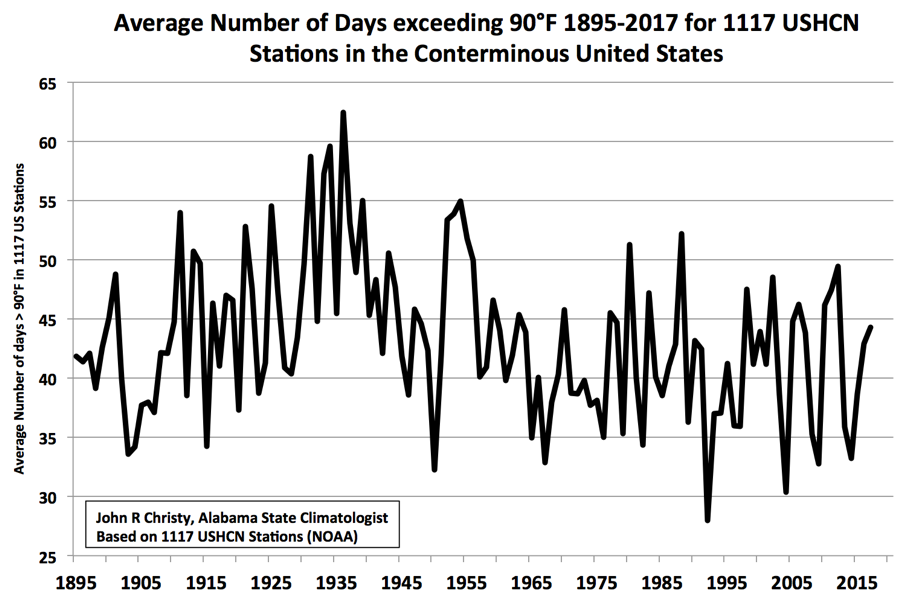
Gus, that chart is the US only
“>>> that chart is the US only<<<"
Yes, I know. But there are similar results for many other places on Earth, e.g., Australia, China, Mediterranean, Antarctica, all published in peer reviewed professional journals. The alleged global warming is not really global. Note that the only trustworthy data that is truly global is the satellite data and it does not go back to before 1979.
Back when I graduated from High School the requirements were 4 years of English, 1.5 years of Math and 1.5 years of Science. It is quite obvious our school overlords did not consider math and science important. Just a WAG on my part but after taking 4 years of English, Math and Science I would say only about 1/4 of my classmates took more then the minimum required courses. Now this was back in the 80’s so requirements might of changed but by the lack of understanding amongst todays youth, I don’t think so. It also appears they stopped teaching critical thinking somewhere along the line.
Should add we had two Math teachers and two for Science but we had an entire wing dedicated to teaching English. Considering that ratio of teachers to students I don’t suppose more than a 1/4 of my class could of taken more Math and Science even if they wanted to.
Greenhouse Gas Theory is False
Published on July 13, 2013
Written by Dr. Pierre R Latour
Pierre R Latour, PE, PhD Chemical Engineer, July 11, 2013
https://principia-scientific.org/greenhouse-gas-theory-is-false/
1.GHGT science is settled, consensus is established, skeptics and deniers are crackpots. Wrong.
2.GHGT effect 15C – (-18C) = 33C is wrong.
3.GHGT says atmosphere acts like a blanket. False.
4.CO2 is green plant food.
5.GHGT neglects the effect of absorbing CO2 on incoming solar irradiance.
6.Kiehl-Trenberth Energy Budget back radiation is false.
7.Thermostat adjusting fossil fuel combustion will never work.
8.Modeling temperature data is worthless.
Robert,
I’m afraid that WUWT is not too friendly to principea-scientific or anybody associated with it (and visa versa).
Which is a shame. There can even be infighting among those guys, and so even they have clubs within clubs. All “sky dragons” are not created equal. (^_^)
Robert, I’m not opposed to Principia Scientifica.
I’m opposed to the junk that they publish claiming that it is science. Take just point 3 above, which is:
I know of no reputable scientist claiming that the atmosphere is actually physically acting like a blanket. That’s just a straw man … and sadly, this kind of nonsense abounds at Principia Scientifica.
w.
It is not what reputable climate scientist are claiming, it is what the general public and 99.99 percent of politicians are made to believe.
Most people (99% or more) don’t even know that WUWT exists.
The most used picture when they talk about CO2 in the news is the picture of water vapour leaving a chimney.
https://futuroverde.org/2018/05/19/podemos-limpiar-el-co2-de-la-atmosfera/
For most people, even scientist who are not climate related , THAT looks like a blanket.
Explaining Global Warming to the Public is Impossible Because We Are Not Talking the Same Language
Explaining climate science or vaccine science doesn’t matter. A child would see through the fog of lies and pseudo science of both, by intuition. Because climatists stomp and scream “weather is not climate” and then “billions of $ of damage from climate events”. Because vaxxists say “a judicial decision that vaccine caused X disease (autism, MS, you name it)” proves nothing, that decision process isn’t science. Then “a shaken baby is a baby that was shaken and not damaged by medical drugs, we know it because many bad parents have been jailed for shaking their babies, based on sound medical analysis of their shaken baby syndrome, that judicial process is inherently scientific and if you don’t believe it I will repeat my argument”.
Most people don’t care about microbiology or radiation bands. They don’t need to.
I don’t think we should try to do better than a 12 years old! A child can see that officials, people in power and academics are obviously on the run after escaping a madhouse, or something. It’s also terrifying.
w.
Same old trash talk – zero science.
A blanket works per Q = U A dT which is exactly why the surface is warmer than ToA. S-B BB has nothing to do about it.
To move a fluid through an hydraulic resistance requires a pressure difference.
To move current through an electrical resistance requires a voltage difference.
To move energy, i.e. heat, through a thermal resistance requires a temperature difference.
Physics is physics.
Robertvd,
LOL!
“5.GHGT neglects the effect of absorbing CO2 on incoming solar irradiance.”
That’s because IT DOESN’T! That abysmal error alone is enough to show that this guy has no idea what he’s talking about.
I vividly remember watching and hearing Carl Sagan on TV ridiculing Velikovsky’s prediction that the atmosphere of Venus would turn out to be very hot . Sagan authoritatively maintained in that broadcast that the venutian atmosphere must be icy cold because its perpetual cloud cover prevented the sun’s rays from penetrating it. At the time, the first space probe had not yet reached Venus.
Shortly after the he was proven completely wrong, I saw him on TV again, this time to claim that he always knew the atmosphere of Venus would be hot. I apologize for not remembering his new explanation.
I hardly think that Professor Sagan could ever be termed “misinformed”, nor did he appear to be a fool. He certainly knew how to market his meager talents. I think self-serving dishonesty by the assertive and sheepish conformity by the masses are the real culprits in this scenario. And no amount of information will fix this.
I’m a bit surprised to see a reference to the Logical Positivists. Philosophers (like me) know about them, but hardly anyone else does. The main thing to know about them is that they claimed principle P:”Only sentences which are empirically verifiable or which are tautological are meaningful sentences”. Then they realised that P was neither empirically verifiable nor tautological.
Everything else you need to know about them can be found here:
http://existentialcomics.com/philosopher/Rudolf_Carnap
The biggest issue is actually poor communication skills of many scientists. By this, I mean inability to explain science in non-technical language.
I did a PhD in cancer research 30 years ago and once a year the institute opened for the local fundraisers. I was shocked and appalled to see senior scientists drop into jargon and fundraisrs eyes glaze. I proved aged 21 that I could explain things in simple language, something observed with surprise by others. Why, I still have no idea….
Reality is that the best scientists and engineers are often dyslexic or otherwise impaired in communication, perhaps studying science as they were poor at more verbal subjects.
Therefore, they should not be the evangelists.
You need technically trained, literate people to engage the public.
The wuestions asked and answered must be simple. Examples are:
1) How do scientists measure ‘global temperature’?
Now there is a one hour lecture for starters.
2) What happens to the energy of the sun when it arrives at the earth?
3) what data sets exist for temperature around the globe and how long have they been maintained?
As soon as you answer that honestly, no sentient member of the public will assume climate science is settled!
4) How do scientists make indirect estimates of temperature going back millions of years?
Ice cores, deep sea cores etc etc.
5) Do weather/climate patterns show any cyclical behaviour and if so, over what time periods?
Solar, lunar, oceanic influences. Hale cycles, Gleissberg cycles etc.
6) What is natural variability of weather and climate over different time periods?
That should eliminate any belief that doomsday is about to occur…
The reality is scientists want more grants so must maintain an aura of fog and superiority. Politicians who can use climate scares will.
The public just wants effects of weather on their lives to be as mimimal as possible.
Best hope is a 24 week series in a serious journalism outlet. 30 minutes a week for six months.
A proper communicator could do it.
Charlatans and verbally challenged cannot.
Rhys Jaggar: ‘I did a PhD in cancer research 30 years ago and once a year the institute opened for the local fundraisers. I was shocked and appalled to see senior scientists drop into jargon and fundraisers eyes glaze. I proved aged 21 that I could explain things in simple language, something observed with surprise by others. Why, I still have no idea….’
My PhD about 20 years ago was based on looking at a potentially useful approach to developing a meningitis vaccine. An 80 year-old friend of the family wanted to know what my PhD was about. He was an ex-military man, who in civilian life became the manager of a large organisation and later set up and ran his own real estate business.
In response to his request, out came pencil, paper, and in a matter of about ten minutes he understood fully the concepts behind antibody structure, the interaction with antigens, and what I was attempting to do. I’m firmly of the opinion that explanations which don’t use jargon, and are clear and pictorial can be understood by most people.
Before my laboratory days, I was a registered nurse, and I always found that patients understood what was happening to them if a clear explanation, free of medical terminology, was offered using a pencil and paper. It’s not necessary to have a medical degree to understand the essentials.
re: Rhys Jaggar and Carbon500’s contention that a clear, simple explanation of a scientific reality can make any layman understand.
Please explain how it took almost two decades, with clear evidence and a simple explanation in hand, to persuade the world’s medical community that helicobacter pylori causes peptic ulcers and that these can be healed with antibiotics? I’d like to understand that.
otropogo: regarding helicobacter pylorii – this wasn’t my area of work interest and I’m not a physician, but hopefully someone out there will have first-hand knowledge and be able to give you a detailed answer to your query.
That said, the short answer to your question re. helicobacter pylori is that nothing is as simple or straightforward as it seems.
Below is a link to an article in a scientific journal from 1982. I’ve copied and pasted part of it. As you see, eliminating this bacterium is not necessarily always desirable, it may have health benefits, and in some cases treatment can worsen an underlying problem, or be ineffectual.
https://academic.oup.com/cid/article/35/3/298/409319
What Is the Clinician to Do?
There is, seemingly, much to be gained by eradicating H. pylori. However, eliminating H. pylori as a human pathogen may come at some public health cost. The incidence of esophageal cancer in the United States has been rising rapidly since 1970 [59], and Barrett esophagus (a lesion that precedes esophageal cancer) is less common among people who are infected by H. pylori [60], particularly strains that produce the CagA protein [61, 62]. Furthermore, there is no consensus that eradication of H. pylori results in improvement in the symptoms of non-ulcer dyspepsia, which is one of the most common health problems seen by primary care doctors. At best, only ∼20% of patients with non-ulcer dyspepsia experience substantial relief after eradication of H. pylori [63], a proportion that is not inconsistent with a placebo effect. At worst, gastroesophageal reflux symptoms can be provoked or intensified by H. pylori eradication therapy [64].
The health benefits of H. pylori (prevention of gastroesophageal reflux disease and of esophageal adenocarcinoma), although intriguing, have yet to be quantified and must be balanced against the well-substantiated risks of both gastric cancer and peptic ulcer disease, as well as of other diseases putatively linked to infection. Studies looking at all-cause mortality related to H. pylori eradication are under way. In the absence of these data, there is little call to screen all patients for H. pylori infection. However, if infection is documented in an asymptomatic subject, the physician and patient will need to carefully balance the risks and benefits for that individual, including factors such as race/ethnicity, age, family history, anxiety about infection with a potential carcinogen, and presence of other risk factors, before making a decision about therapy.
don’t you wish otropogo had asked the question you answered?
carpe tedium!
Amen!
I wish I had asked why the WHO, EPA and Health Canada each have different mitigation thresholds for radon, and why they all endorse the use of measuring procedures and “instrumentation” that would be laughable if they didn’t cause homeowners endless grief on the housing market and billions of dollars for “mitigation” for which there is not a shred of scientific justification and for which there is no economically feasible assessment procedure.
Surely all of the eminent medical “scientists” who concocted this bogeyman can’t all be misinformed or fools. I’ll bet they’ve even seen the evidence for radon hormesis and they certainly must know that their extrapolation from industrial scale exposure to normal household exposure levels is without any scientific basis.
And finally, how do they get away with the totally unproven claim that 20% of lung cancers are cause by radon exposure (ie. all lung cancers not caused by smoking tobacco)?
Kristi Silber September 26, 2018 at 6:10 pm
I give up. You seem to think that using an uncentered PC is a “minor statistical error”. That is a load of bollocks. It is a huge and stupid newbie error, one which is sufficient in itself to totally falsify his conclusions.
And that doesn’t even count his post-facto proxy selection or his use of a method that actively mines for hockey sticks to such an extent that it will generate them out of red noise.
But then you wouldn’t understand any of that. You are a foolish child playing in an adult game, and you truly don’t seem to have a clue about the profound depth of your ignorance.
Go do your homework and then go bother some other blog. I’m done with you. Your ignorance coupled with your belief that you know what you are babbling about and your unwillingness to notice when you are not just off the rails but on another planet is just too strong for me to deal with.
As Shakespeare remarked, “This disease is beyond my practice.”
Go well, stay well,
w.
“one which is sufficient in itself to totally falsify his conclusions”
…
However, as of today it hasn’t been retracted, so Willis, your opinion doesn’t matter.
…
I have an idea for you Willis….why don’t you collect all the proxy data you can find, and generate a graph using standard statistical techniques that invalidate Mann’s work? Then get it published. Thos would be a much more effective strategy than moaning and complaining about it in blogs.
Remy Mermelstein September 26, 2018 at 8:24 pm Edit
I never claimed my opinion mattered, and I don’t give a rat’s okole if it is retracted. Serious researchers in the field know it is bogus, and even alarmists dissed it in the Climagate emails.
“Moaning and complaining”? Say what? That’s just the voices in your head. I’m simply stating facts—facts like an uncentered PC is a newbie math error … but then it appears you don’t understand that or the effects that it would have.
Nice try, though. Vanna, what prize do we have for our unsuccessful contestants?
w.
Willis,
Perhaps you would like to comment on the discussion here:
https://andthentheresphysics.wordpress.com/2013/07/10/debunking-the-hockey-stick/
If you can convince me that all this is wrong, I will listen. I knew about the claim about red noise, and I’ve also read the comments of many who believe M&M made their own errors.
If the original hockey stick error was so large, why have others been able to approximately reproduce it using their own methods? An error doesn’t falsify conclusions. M&M did not set out to provide a better, more robust model of past temperatures, they set out to tear apart someone else’s.
I don’t deny my ignorance. I rely on those who know more than me, and take their evidence (and motivations) into consideration. I look at how they present their evidence, whether they have doubts and caveats and humility. I look at the way they talk about others.
Your insults and certainty detract from your credibility.
I don’t mind being corrected where it’s appropriate, but you have no right to tell me to go elsewhere. If you’re “done with me,” that’s up to you. I don’t really care.
Kristi Silber September 26, 2018 at 9:58 pm
No, I wouldn’t like to comment, not in the slightest. Despite interacting with you a number of times pointing out your errors, despite many others pointing out exactly where your claims were wrong, you’ve never shown even the slightest interest in learning something new.
Instead, in every case I’ve seen, you’ve continued to repeat your often ludicrous claims. So I’ll pass. I’m many things, but I’m not a masochist.
Sorry, but I don’t believe that for one moment. It has NEVER been true in the past, and I’d be an idiot to think it is true now.
As I said before, “This disease is beyond my practice”. I have exactly zero interest in interacting with you.
I wish you all the best in future endeavors, and I truly hope that someday you learn how to learn.
w.
climate change is willy nilly scientific term- fails vigorous assessment 30 year change is super arbitrary. – Climate Change in politics is the super vague term for anything bad to do with weather things.