
From ECOLE POLYTECHNIQUE FÉDÉRALE DE LAUSANNE and the “adjusting the past” department:
The oceans were colder than we thought
A team of EPFL and European researchers has discovered a flaw in the way past ocean temperatures have been estimated up to now. Their findings could mean that the current period of climate change is unparalleled over the last 100 million years.
According to the methodology widely used by the scientific community, the temperature of the ocean depths and that of the surface of the polar ocean 100 million years ago were around 15 degrees higher than current readings. This approach, however, is now being challenged: ocean temperatures may in fact have remained relatively stable throughout this period, which raises serious concerns about current levels of climate change. These are the conclusions of a study conducted by a team of French researchers from the French National Center for Scientific Research (CNRS), Sorbonne University and the University of Strasbourg, and Swiss researchers from the Swiss Federal Institute of Technology in Lausanne (EPFL) and the University of Lausanne. The study has just been published in Nature Communications.
“If we are right, our study challenges decades of paleoclimate research,” says Anders Meibom, the head of EPFL’s Laboratory for Biological Geochemistry and a professor at the University of Lausanne. Meibom is categorical: “Oceans cover 70% of our planet. They play a key role in the earth’s climate. Knowing the extent to which their temperatures have varied over geological time is crucial if we are to gain a fuller understanding of how they behave and to predict the consequences of current climate change more accurately.”
How could the existing methodology be so flawed? The study’s authors believe that the influence of certain processes was overlooked. For over 50 years, the scientific community based its estimates on what they learned from foraminifera, which are the fossils of tiny marine organisms found in sediment cores taken from the ocean floor. The foraminifera form calcareous shells called tests in which the content of oxygen-18 depends on the temperature of the water in which they live. Changes in the ocean’s temperature over time were therefore calculated on the basis of the oxygen-18 content of the fossil foraminifera tests found in the sediment. According to these measurements, the ocean’s temperature has fallen by 15 degrees over the past 100 million years.
Yet all these estimates are based on the principle that the oxygen-18 content of the foraminifera tests remained constant while the fossils were lodged in the sediment. Indeed, until now, nothing indicated otherwise: no change is visible to the naked eye or under the microscope. To test their hypothesis, the authors of this latest study exposed these tiny organisms to high temperatures in artificial sea water that contained only oxygen-18. Using a NanoSIMS (nanoscale secondary ion mass spectrometer), an instrument used to run very small-scale chemical analyses, they then observed the incorporation of oxygen-18 in the calcareous shells. The results show that the level of oxygen-18 present in the foraminifera tests can in fact change without leaving a visible trace, thereby challenging the reliability of their use as a thermometer: “What appeared to be perfectly preserved fossils are in fact not. This means that the paleotemperature estimates made up to now are incorrect,” says Sylvain Bernard, a CNRS researcher at the Paris-based Institute of Mineralogy, Materials Physics and Cosmochemistry and the study’s lead author.
For the French and Swiss team of researchers, rather than showing a gradual decline in ocean temperatures over the past 100 million years, these measurements simply reflect the change in oxygen-18 content in the fossil foraminifera tests. And this change appears to be the result of a process called re-equilibration: during sedimentation, temperatures rise by 20 to 30°C, causing the foraminifera tests to re-equilibrate with the surrounding water. Over the course of some ten million years, this process has a significant impact on paleotemperature estimates, especially those based on foraminifera that lived in cold water. Computer simulations run by the researchers suggest that paleotemperatures in the ocean depths and at the surface of the polar ocean have been overestimated.
For Meibom, the next steps are clear: “To revisit the ocean’s paleotemperatures now, we need to carefully quantify this re-equilibration, which has been overlooked for too long. For that, we have to work on other types of marine organisms so that we clearly understand what took place in the sediment over geological time.” The article’s authors are already hard at work.
###
This study was conducted by a consortium of researchers from the Institute of Mineralogy, Materials Physics and Cosmochemistry (IMPMC – Sorbonne University, CNRS, the French National Museum of Natural History, and the Pierre and Marie Curie University), the Laboratory of Hydrology and Geochemistry of Strasbourg (LHyGeS – School and Observatory of Earth Sciences, CNRS and the University of Strasbourg) and the Laboratory for Biological Geochemistry (LGB – EPFL and the University of Lausanne).
Reference
Bernard S., Daval D., Ackerer P., Pont S., Meibom A., “Burial-induced oxygen-isotope re-equilibration of fossil foraminifera explains ocean paleotemperature paradoxes“, Nature Communications, 26 October 2017.
Discover more from Watts Up With That?
Subscribe to get the latest posts sent to your email.
It looks like another case like Mann’s treemometer. Sucky proxies only prove they are sucky proxies.
Actually a hundred million years ago, the Temperatures were exactly what we thought they were; it’s just we weren’t so good at reading thermometers in those days.
g
+1k xD
They didn’t have to go so far back in time. In fact, the oceans are doing global cooling as we speak.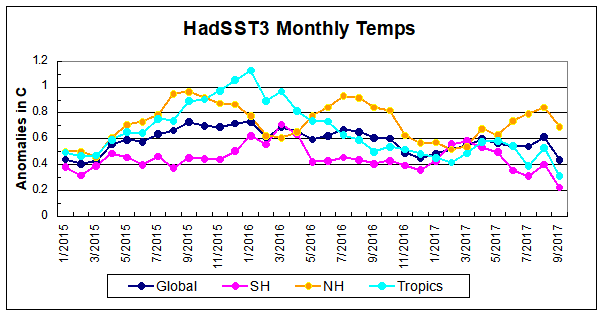
https://rclutz.wordpress.com/2017/10/26/global-ocean-cooling-in-september/
Ron Clutz
It’s just that when you do go back in time, you get a slightly different perspective on what Ron calls ‘global cooling’.
http://oi65.tinypic.com/wlzkuv.jpg
Yup. How low will it go?
The assumption that we have meaningful measures of paleoclinate accurate to that claimed in your graph is hilarious.
Good point hunter. One reason for focusing on recent patterns of SSTs is that the Global Drifter Array is providing us with much better measurements of SST changes, definitely cooling at the moment.
hunter
That graph doesn’t show palaeoclimate data; it shows anomalies based on thermometer measurements of sea surface temperatures.
Ron Clutz
Given the scale of other recent post-El Nino drops, probably to around 0.38 C above the 1961-90 average. Possibly a bit further if there is a large volcanic eruption.
Has the cooling trend since the HCO been reversed?
Oxygen-16 is 99.757% of the stable isotopes of Oxygen.
https://www.webelements.com/oxygen/isotopes.html
Wouldn’t the foramnifera fossils tend to lose oxygen-18 instead of gaining it?
Oxygen-18 comprises a whopping 0.205% of atmospheric oxygen.
Their experiment seems ludicrous because it could never happen naturally.
Gee, I thought all the science was settled, yet here we are challenging decades of climate research!
Not so much the “adjustocene” as the “plasticene” when it comes to Mann, IMO.
It sounds to me like they have a lot more study to do before reaching conclusions.
And a lot more grant money!
Right, I could absolutely believe that their initial premise is correct, that the O18 ratio in fossils can alter with time, but to jump to the completely unsubstantiated claim that ocean temperatures were stable over 100 millions completely ignores the mounds of supporting proxy data that was developed over decades.
If anything, I’ve always thought that the O18 isotopes underestimate the range of temperature change on the planet, since it’s sort of hard to believe that if the planet were just 8 degrees cooler we’d have glaciers in Nebraska.
Me too. I can well believe that many isotope-based thermal proxies are built on shaky assumptions, if not sand. But someone who shows one of them to be unreliable has merely shown previous conclusions to be unreliable, not anything new.
For those that care to look, there are previous articles in the literature casting doubt on the utility of delta[18O] to accurately represent local temperatures in carbonate deposits. http://www.sciencedirect.com/science/article/pii/S0012821X13003154
The role of biology, and carbonic anhydrase in particular, in the carbon cycle appears to be largely ignored by climate scientists. Probably because most of them are just talking out of their cloaca.
I agree. I think there is plenty of room to justifiably question the validity of proxies when we can never know the actual measurable temperatures from the geologic past, however this paper just raises a possible concern but one which may have been created as much by their own methods as by any issue with the proxy in question. That said what relevance would this have to CAGW caused by CO2 emissions? How do radiative (“greenhouse”) gases in the atmosphere cause warming or cooling of the oceans when we know the relevant infrared radiation can’t penetrate beyond the most superficial skin of the oceans and heating of oceans is primarily from direct solar radiation +/- some uncertain geothermal component?
Well as oceans were higher by 1 to 2 meters in the current interglacial, one would presume the oceans were warmer on the recent past.
According to these guys we don’t know what the temperature was, so therefore it must have been warmer.
Colder
Whichever one keeps the grant money flowing.
Well actually the Global average Temperature has been between +12 deg. C and +24 deg. C for the last 650 million years, so it has never ever been 15 deg. C colder or warmer than at any other time then or now.
G
From the article in question, George, I’m not certain we can say that with confidence
The 15 degrees C difference is for the surface of polar seas.
For larger portions of the current interglacial there was no polar ice in the summer.
I think it’s fair to be skeptical of the scientific definiteness of all proxy measures of deep past temperatures and ancient atmospheric CO2 concentrations. And 100 million years, though just a tiny fraction of the Earth’s full age, is far beyond grasping by the human mind (as we perceive our life and observe changes on mere decade-long scales) for the changes to life and planet that have occurred in that immense time.
And after all, the science is not settled on climate.
“if we are right”. When you start the study with a predetermined result, chances are you’re wrong.
Maybe I’m missing something, but this doesn’t make sense. They argue that a short-lived temperature increase during sedimentation alters the oxygen-18 content but that a period of 100 million years of (whatever) temperatures does not. Looks to me like they are trying to have it both ways – they set up an extreme experiment to show that the oxygen-18 content can be changed, and then cherry-pick the possible change that suits them.
Climate Séance 101.
EPFL is a heavily biased in favor of “Global warming”. It regularly plasters the Swiss papers with such findings.
15 degrees on which scale, K, C, or F?
Well earth’s Temperature has never been 15 K.
G
Might have been when it was in bits floating in interstellar space….
That far back, the cosmic background radiation might have been well over 15K. It was several billion years ago.
The solar system started forming some five billion years ago (5.0 Ga).
This observation measured the temperature of the universe 7.2 Ga at only 5.08 K, v. 2.73 K now.
https://scitechdaily.com/astronomers-measure-the-temperature-of-the-universe-7-2-billion-years-ago/
So even the dust from which Earth formed didn’t experience 15 K. It was colder than that before the material of our planet started accumulating.
Obviously, the universe cooled a lot more rapidly in its first 6.6 billion years than in the past 7.2.
I think we can safely say that the ocean temperature has never been less than 273.15K and never greater than 373.15K.
Hey, but didn’t Gore or someone say the oceans were “BOILING”
That makes the greater than 373.15K.
Late Cenomanian SSTs in the equatorial Atlantic Ocean (~33°C) were substantially warmer than today (~27-29°C) and the onset of Oceanic Anoxic Event 2 coincided with a rapid shift to an even warmer (~35-36°C) regime.
http://adsabs.harvard.edu/abs/2006AGUFMPP33C..04F
The mid-Cretaceous was also remarkably equable, ie warm at the poles as well as the equator. Marine reptiles lived at high latitudes, the seas were so warm.
https://bonesharpesite.wordpress.com/2017/02/11/arctic-mosasaurs-2/
Mosasaurs are related to snakes and lizards, so were cold-blooded. Indeed they evolved rapidly from land lizards, and lived when ocean temperatures were lower than during the mid-Cretaceous.
The Arctic during the Santonian, 83.6 to 86.3 Ma, with some marine reptile fossils:
 ?w=840
surely you mean KFC, in a bucket, to feed the scientists as they work this problem, all paid for by the tax payer
No doubt they prefer sushi on their expense accounts.
I saw what you did, there….
This was already known about and is adjusted for in all serious temperature reconstructions.
The oxygen-18 isotopes change through time due to diagenesis. We don’t know why it happens but it certainly happens. As the dates of the cores goes further back in time, the diagenesis becomes more and more acute. The data predicts something like +60C temperatures at 500 million years ago while this study only went back 100 million years ago.
Typically, the trend in the oxygen-18 isotopes is removed and then a pretty realistic temperature trend consistent with what we know about historical temperatures in the ancient past emerges. It is a fairly simple correction. Not all climate scientists take this into account – Hansen knows about the problem but doesn’t adjust for it in his material for example.
There is some discussion of this in Sheilds Veizer 2002 and Royer Berner 2004.
http://discovery.ucl.ac.uk/43794/1/43794_Shields%2520and%2520Veizer_2002.pdf
https://www.geosociety.org/gsatoday/archive/14/3/pdf/i1052-5173-14-3-4.pdf
If you don’t adjust for the diagenesis, you end up with a temperature line like the blue one here. +15C to +20C at 100 million years ago, but it was really more like +9.0C or +10C.

Many of the temperature reconstructions you see will be on the blue line. This is out be a factor of two for the Eocene.

read the paper
Steven, instead of just reading; how about understanding. The paper just explains how the diagenesis occurs.
If the study would have went back even farther than 100 million years, they would have discovered the rest of the puzzle, which I am afraid, they missed completely.
For example, how do you get the Ordovician ice age at 443 million years ago, combined with the Ordovician extinction due to the cold, when temperatures are at +20C to +25C in the non-diagenesis-corrected oxygen-18 isotopes.
No Carboniferous ice age, no Snowball Earth(s) (which we know occurred), and one even gets +100C ocean temperatures at a billion years ago without the correction (as in Venus when we know temperatures were fairly moderate at the time.
This paper explains a reasonable mechanism for why it occurs which I don’t think has been proposed before. Holds together for me but then one has to be objective and have worked with the data to get the picture.
Bill Illis, could you produce your ‘Bill Illis Temperature Estimates’ graph for part of the 527 million years period: for the last 50 or 100 million years or for both periods? I would like to have a more detailed image for that time frame, a graph comparable to the graph for 60+ million years that you showed below your own graph just above. Thanks in advance.
Bill Illis,
Meibom is an instrumental isotope specialist. If I remember correctly, 20 years ago he was in charge of the operation of Stanford’s SQUID instrument. I don’t know how broad his geology background is. I believe he worked under Robert Coleman of Stanford.
More rigging of ‘evidence’ in favour AGW. Imagine my surprise.
Round up the usual suspects.
So… If the oceans were no warmer than they are today 100 million years ago (Middle Cretaceous), then CO2 levels of 800-2,000 ppm are no big deal…

Link please
Link to what?
The Cambrian through Cretaceous are drawn from Berner and Kothavala, 2001 (GEOCARB), the Tertiary is from Pagani, et al. 2006 (deep sea sediment cores), the Pleistocene is from Lüthi, et al. 2008 (EPICA C Antarctic ice core), the “Anthropocene” is from NOAA-ESRL (Mauna Loa Observatory) and the CO2 starvation is from Ward et al., 2005.
https://wattsupwiththat.com/2012/12/07/a-brief-history-of-atmospheric-carbon-dioxide-record-breaking/
Berner, R.A. and Z. Kothavala, 2001. GEOCARB III: A Revised Model of Atmospheric CO2 over Phanerozoic Time, American Journal of Science, v.301, pp.182-204, February 2001.
Illis, B. 2009. Searching the PaleoClimate Record for Estimated Correlations: Temperature, CO2 and Sea Level. Watts Up With That?
Lüthi, D., M. Le Floch, B. Bereiter, T. Blunier, J.-M. Barnola, U. Siegenthaler, D. Raynaud, J. Jouzel, H. Fischer, K. Kawamura, and T.F. Stocker. 2008. High-resolution carbon dioxide concentration record 650,000-800,000 years before present. Nature, Vol. 453, pp. 379-382, 15 May 2008. doi:10.1038/nature06949
Pagani, M., J.C. Zachos, K.H. Freeman, B. Tipple, and S. Bohaty. 2005. Marked Decline in Atmospheric Carbon Dioxide Concentrations During the Paleogene. Science, Vol. 309, pp. 600-603, 22 July 2005.
Ward, J.K., Harris, J.M., Cerling, T.E., Wiedenhoeft, A., Lott, M.J., Dearing, M.-D., Coltrain, J.B. and Ehleringer, J.R. 2005. Carbon starvation in glacial trees recovered from the La Brea tar pits, southern California. Proceedings of the National Academy of Sciences, USA 102: 690-694.
David, Lance won’t even look at the links, he’s just being an ass.
David Middleton – You have just destroyed CAGW – “If the oceans were no warmer than they are today 100 million years ago (Middle Cretaceous), then CO2 levels of 800-2,000 ppm are no big deal…” – subject of course to the proviso by Bernard S., Daval D., Ackerer P., Pont S., Meibom A. : “If we are right“.
We don’t rely solely on 18O as oceanic paleothermometers, but also on temperature proxies such as alkenones, foraminiferal Mg/Ca ratios and planktonic foraminiferal assemblages, ie cold-loving v heat-loving species.
The conclusion that mid-Cretaceous seas were hot, hot, hot is robust. Far from being unusually warm, today’s SSTs are colder than for most of the past 100 million years, although, as in all interglacials, warmer than for much of the past 2.6 million years, since the onset of the Pleistocene NH glaciations.
And life thrived during those boiling ocean eras, growing some of the biggest animals that ever lived on earth.
G
Yup, including marine reptiles which couldn’t live in the Arctic or Southern Oceans today.
I think d18O is fairly reliable over the past 3,000 years… And we’re still cold, cold, cold…

The proxy data are probably more accurate than HadCRU’s alleged instrumental record, if less precise.
Radiolarian, diatom, and coccolith assemblages have been used to cross-check the foram proxies.
The previously thought the oceans were warmer than today because they thought the oxygen-18 content didn’t change and since it was related to temperature, it gave them an accurate record of paleo-temperatures. Instead, they’ve found that the oxygen-18 content changes after sedimentation. The proper statement is that they can’t determine paleo-temperatures from the oxygen-18 concentration in these particular shells. Not that it means paleo-temperatures were higher than previously thought. They just don’t know. Instead, they follow the climate alarmist default playbook and if they can present it in a way that supports apocalyptic anthropogenic climate change, then that’s what they do.
“Actually, we really wouldn’t have a clue,” is a most unsatisfying position for people who want answers. The expectation that scientists provide answers, for most people, happily trumps the dodgy data and speculative conclusions that dominate modern texts. Heavily, but accurately, qualifying these conclusions would create the impression that we don’t really know much at all.
Just look at stuff published, say, 25 years ago in fields such as medicine, paleontology, cosmology, geomorphology and (of course) climatology — to name but a few. There must be considerable doubt that current wisdom will appear any more impressive in another 25 years.
A couple of questions come to mind. Is this a valid experiment when water only containing O18 was used, and the role of partial pressure is not considered? Why do the former calculations reflect temperatures much higher than today’s temperatures, or temperatures in the intermediate interval? It is conceivable that the tests might re-equilibrate if a substantially higher temperature prevailed recently, but this isn’t going to be an instantaneous process.
This research is a little far afield from what his interests were when I met him 20 years ago. At the time, his interests seemed to focus on ultramafic rocks and associated PGMs.
How does 16O change into 18O just by changing the Temperature 15 Deg. Rankine ??
g
Valid? Possibly, but applicable is another question. The experimental conditions introduce a host of new variables that mind produce the change.
That concerned me too.
In order to run a controlled trial all the initial conditions have to be the same as the conditions, say 100 million years ago in the oceans.
The formenifera results, apparently from comments above, have been compared to other proxies.
The author is aware of this
For Meibom, the next steps are clear: “To revisit the ocean’s paleotemperatures now, we need to carefully quantify this re-equilibration, which has been overlooked for too long. For that, we have to work on other types of marine organisms so that we clearly understand what took place in the sediment over geological time.”
However the analysis he uses is that his experiment is valid, only needs to be ‘quantified’ so a bench mark for all other proxies.
From a biological point of view it needs to be run again under a range of conditions to be validated.
What I am not sure about is the sign of the correction pointed to , or its quantum.
The other biological problem is that animals can look the same phenotypically, over hundreds of millions of years, but be genetically quite different, varying over time.
They could, for arguments sake, live in deeper strata where heavier water is concentrated or less well mixed, so the initial amounts of heavy oxygen may vary, or feed from different substrates that are exposed to varying levels of isotopic oxygen.
An estimate would have to be made for such variation or error.
.
Ocean temperatures have remained relatively stable in the current warming period, so I’m not sure why the possibility of past temperature stability should “raise concerns about current levels of climate change”. The OHC change measured by Argo, once translated into degrees C, is miniscule.
“If we are right, our study challenges decades of paleoclimate research,” says Anders Meibom, the head of EPFL’s Laboratory for Biological Geochemistry and a professor at the University of Lausanne. Meibom is categorical: “Oceans cover 70% of our planet…”
Well, it’s a big “if” they might be right, and it would be a huge surprise if they were since no one else has been and the estimates keep changing. The only thing consistent seems to be the direction of the change.
As far as overall oceanic coverage, well that’s also been subjected to change. That’s two strikes. One more and you’re out.
“If we are right, our study challenges decades of paleoclimate research”
The astonishing part is this seems to be written with such trembling excitement, as if challenging “decades” of “paleoclimate research” was some sort of rare and miraculous event…
Oh good, more “the oceans ate my global warming” nonsense. Just in time for COP23 too. How convenient.
If you’re a climate scientist and you don’t like the data,
correct the data.
As has been famously said ” If you change the information, you can change minds. Why, what do you do?”
Or something.
Ahhhhhh another wonderfully done “climate study” full of ifs and assumptions….. seems the “formula” for all catastrophic climate studies is the same……
(Catastrophic Wild Arse Guess) + (we have no idea what the reality is) + (something that changes) = (Oh My It Is Way Worse Than We Thought)
and it is all “man’s” fault, send lots more money fast!!
Cheers!
Joe
Sounds like foraminiferometer is disassembling the carbon dioxide conjecture.
So if this is unprescedented, in 100 million years, what happened 16000 years ago, and if you compare that to today’s change in ocean temps..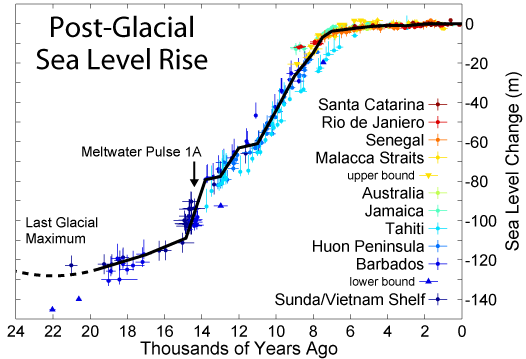
I don’t use the word sc4m lightly..
unless you believe coming out of a glacial maximum has little affect on ocean temp chances that is 😀
Ugh, typo city today.. 🙁
What happened?
CO2 concentrations dropped so low during the LGM, that all the vegetation in northern China died. This caused a vast CO2 desert in the Gobi region, which spread dust clouds across the northern hemisphere – as demonstrated by both the dust flux on the Loess Plateau and on the remaining Greenland ice sheets.
This dust lowered the albedo of the Laurentide ice sheet. And when combined with the new Milankovitch maximum, this provided enough insolation and insolation absorption, to melt the entire Laurentide ice sheet. So yes, CO2 does cause global warming. But only by getting so low, that CO2 deserts are formed.
You will note that there was never a northeast Asia ice sheet, because this region had always been too dusty, from the perennial Taklamakan aridity desert.
Ralph
ralfellis October 26, 2017 at 12:33 pm: “You will note that there was never a northeast Asia ice sheet, because this region had always been too dusty, from the perennial Taklamakan aridity desert”.
WR: Interesting! I ever saw on maps that in the beginning of the glacial Northeast Siberia DID have an ice sheet. Later the ice sheat disappeared. In Eurasia only the ice sheet centered on Scandinavia remained: being subject to westerlies from the Atlantic Ocean. Without dust.
Ralph,
Geologists aren’t sure about an east Siberian ice sheet. Some reconstructions show one. But there was definitely extensive mountain glaciation:
http://www.sciencedirect.com/science/article/pii/S0277379115301827
Not to denigrate the importance of dust in the cold, dry and windy world or the LGM.
Beringia of course was largely ice free, but for mountain glaciers in northern and southern Alaska and far eastern Siberia.
Here are some competing reconstructions.
This one is probably more in line with present “consensus”:

This one might now be considered outdated:
http://web.gccaz.edu/~lnewman/gph111/topic_units/glacial/pleistocene_icesheets.jpg
It may we’ll be that foram isotope temperature proxies are inaccurate, or indeed can be improved upon. However, as alluded to in numerous comments above, the idea that the polar regions in particular weren’t significantly warmer in the late-Mesozoic than today is pure nonsense. Witness from Antarctica (which was broadly in the same part of the globe as it is today):
1) the paleo-botanical evidence that modern tropical type vegetation covered at least significant tracts of land; and
2) the fossils of marine reptiles which, if they existed today, would need tropical, not polar, seas to survive.
It was significantly warmer in the upper Mesozoic and no amount of “reimagining” of the available data is going to change that.
Exactly!. Using as many separate lines of evidence is almost always a good idea.
Cretaceous forest 120 Million years ago on the Antarctic Peninsula: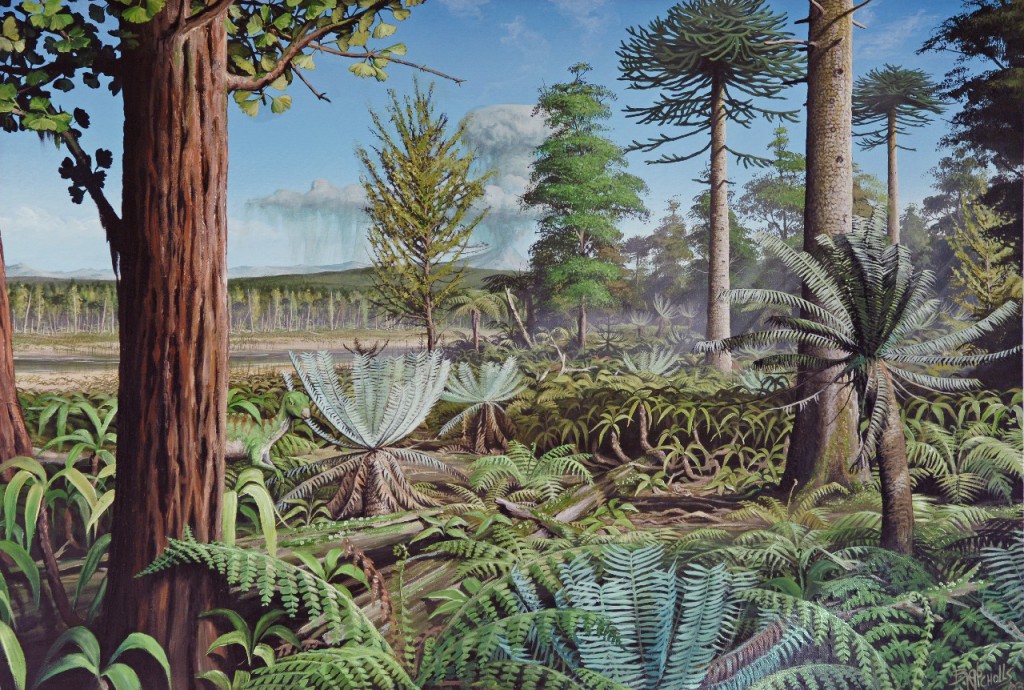
“Beautiful plant fossils are found preserved in abundance within sandstones and mudstones of the Antarctic Peninsula, most notably the Cretaceous (145–65 million years ago) rocks from Alexander Island and the South Shetland Islands.
The diverse assemblage of plant fossils has made it possible to reconstruct an Antarctic forest — with pine trees; and ferns and mosses in the undergrowth. Fossil ginkgoes and the Southern Hemisphere cycads are also present.
Flowering plants (the angiosperms) appear later on (~100 million years ago), and include the southern beech Nothofagus. Given that this part of Antarctica was positioned at roughly 70°S at this time, the plants present — similar to those found in New Zealand and Tasmania today — suggest that the climate was relatively warm and temperate in the Late Mesozoic.”
Source: https://www.bas.ac.uk/data/our-data/collections/geological-collections/fossils-from-the-antarctic/
Here’s the Late Cretaceous paleomap from Scotese:
http://www.scotese.com/images/094.jpg
Notice how much less of the continental crust is emergent, and consequently how much more is inundated with shallow warm seas, especially in the temperate zones.
Correct. Shallow deep warm water producing seas is what present day’s cold Earth is missing. They are the main reason the present earth is in an Ice House State with only short escapes into a warmer Interglacial. Warm periods as the one (Holocene) we now are living in.
Different constellations of continents and oceans / seas create a different ‘general background temperature’ against which all other climatological processes develop. Because of our present cold deep oceans, glacials can develop as soon as less than optimal orbital situations exist (with a certain time lag).
94 Million years ago, seas were that warm that Antarctica could not develop an ice sheet.
Putting the plankton shells in 100% O18 hot salt water!!!! This is an idiot’s experiment. O16 on the surface of the shell is more “mobile” than O18 – it is the underlying reason for it making a thermometer. The CaCO3 shells have a miniscule solubility in water so in distilled water, you would see some dissolution of the shell and have O16 in solution as a complex ion HCO3^-, CO3^-2, etc. In pure O18 hot “sea” water, the shell will tend to give up O16 and take on O18.
“In pure O18 hot “sea” water, the shell will tend to give up O16 and take on O18.”
WR: What would have happened, when in the experiments pure O16 (and not O18) water was used? And what kind of conclusions would have to be drawn?
And which ratio of O16/O18 met the foraminafera in the buried waters of the sediment?