By Larry Kummer. From the Fabius Maximus website
Summary: 2017 has been a good year for news about climate change. Here is more good news, courtesy of the Dutch government. This should be headline news, but it ruins the narrative! Break the blackout and pass it on, for there is too little good news these days.
“Now this is not the end. It is not even the beginning of the end. But it is, perhaps, the end of the beginning.”
— Churchill’s speech on 10 November 1942, after the British victory at El Alamein.

“Trends in global CO2 and total greenhouse gas emissions.“
Since 2011 the global economy has grown while growth of CO2 emissions slowed.
By J.G.J. Olivier et al. of the PBL Netherlands Environmental Assessment Agency.
Excerpt from the Summary, 28 September 2017. Red emphasis added.
“In 2016, total global greenhouse gas (GHG) emissions continued to increase slowly by about 0.5% (±1%) ….Taking into account that 2016 was a leap year, and therefore 0.3% longer, and together with the 0.2% increase in 2015, the 2016 emission increase was the slowest since the early 1990s, except for global recession years. This is mainly the result of lower coal consumption from fuel switches to natural gas and increased renewable power generation; in particular, in wind and solar power.
“Most of the emissions (about 72%) consist of CO2, but methane (CH4), nitrous oxide (N2O) and fluorinated gases (F-gases) also make up substantial shares (19%, 6% and 3%, respectively). These percentages do not include net emissions from land use, land-use change and forestry (LULUCF), which are usually accounted for separately, because they show large interannual variations and are very uncertain. …
Figure 1 Click to enlarge.

“The trend in global CO2 emissions excluding those from LULUCF has remained more or less flat, over the last two years (±0.5%), see Figure 1. Non-CO2 greenhouse gases retained an annual growth rate of about 1%. In contrast, CO2 emissions from LULUCF show a highly varying pattern that reflects the periodically occurring strong El Niňo years, such as in 1997–1998 and 2015–2016 (Figure 1). …
“Over the past two years, total global greenhouse gas emissions (excluding those from LULUCF, thus also from forest and peat fires) have shown a slowdown in growth, …with calculated increases of 1.0%, 0.2% and 0.5%, in 2014, 2015 and 2016, respectively (see Figure 1). Note that 2016 was a leap year and, therefore, about 0.3% longer than a normal year. Since the early 1990s, such slow annual emission increases have only occurred during the economic crisis in 2008–2009, and the major global financial crisis in 1998 that resulted from the Asian financial crisis.
“Non-CO2 GHG emissions originate from many different sources and are much more uncertain than CO2 emissions (their uncertainty on a global level is of the order of 30% or more, whereas for CO2 this is about ±10% or less). Over the past three years, non-CO2 GHG emissions have continued to grow somewhat faster than CO2 emissions, namely by 1.5% (2014), 1.2% (2015) and 1.0% (2016), whereas CO2 over the same period increased by a respective 0.8%, -0.2% and 0.3%. Note that, due to limited statistical data for 2015 and 2016 for these sources, the annual trends in the emission of CH4, N2O and F-gases are much more uncertain than those in CO2. …
The declining growth in annual CO2 emissions since 2011 has continued over the past years, with 0.6% in 2012, 1.8% in 2013, and 0.8% in 2014, followed by -0.2% in 2015 and 0.3% in 2016 (±0.5%). …The energy intensity of the economy, defined as total primary energy use (TPES1) per unit of GDP, shows similar negative annual growth levels (i.e. annual energy efficiency improvement of the economy) compared to the pre-crisis period. From this can be deduced that …the economy as a whole has maintained its annually decreasing energy intensity. ”
The Agency will release the full report by the end of October. See their previous “Trends in Global CO2” reports.
—————————————–
Conclusions.
“The world may still be doomed, but it is not quite as doomed as the climatologists have repeatedly told us.”
— From “Global warming predictions may have been too gloomy” by Ben Webster (environment editor) in The Times.

The graph below shows the emissions of CO2 by industry and from burning fossil fuels. The lines represent the four scenarios — Representative Concentration Pathways (RCPs) — used in the IPCC’s AR5 report. The graph is from the RCP Database. RCP 3 (aka RCP 2.6) is the most optimistic, with negative emissions after 2020. The steep brown line is RCP 8.5, which describes a nightmarish future of rapid population growth and technological stagnation — with coal the fuel of the late 21 st century (as it was in the late 19thC). Click to enlarge.

Years of propaganda have convinced many people that the world is doomed, that RCP8.5 (with its unlikely assumptions) is the “business as usual scenario”, that we are certain to follow it unless massive public policy changes are made — even making drastic revisions to our economic system (as urged by Naomi Klein
Events are already falsifying the narrative of climate activists, echoed by their journalist-enablers: new energy sources, improvement in energy efficiency, and substitution of natural gas for coal. These are trends already happening, yet still in their early stages. We might follow the red (RCP 6.0) and blue (RCP 4.5) lines until 2040. We can only guess what energy technology will be rolling out by then. We might be seeing steep declines in emissions, perhaps leading to negative emissions in the following decades (i.e., falling CO2 levels).
This does not mean that the world is saved. It does not mean that no public policy changes are needed to get us through the difficult decades ahead — as economic growth and population growth (perhaps to 10 billion people) puts immense stress on Earth’s ecology.
It does mean that the doomsters’ certainty is exaggerated, as is their belief we can only save the world by changing America society to suit their ideology. It means that we are on the right path, and that our normal economic and political processes are working.
Why we don’t hear more good news?
Two weeks ago, I wrote about a milestone for climate science: That to was ignored by climate activists and journalists. There are two reasons for this. First, they have committed to a “we’re doomed” narrative — trying to gain support by a relentless focus on the bad news about climate change plus forecasts of disasters. Good news to them is like Holy Water to vampires. Too bad that focusing on worst case climate scenarios should not work and does not work.
Second, journalists know we prefer bad stories. “If it bleeds, it leads.” This creates the “crisis crisis“, described in one of the best articles even in Playboy. People prefer exciting stories cheering our side’s angelic warriors — and hissing at our foes, Satan’s minions. Good news does not get big traffic. We love scary stories. The reason why reveals a secret about America.

For More Information
Other recent good news about climate: a successful 10-year forecast of global temperature. Also see “Emission budgets and pathways consistent with limiting warming to 1.5 °C“ by Richard J. Millar et al. in press at Nature Geoscience — reported here in the WaPo (the NYT ignored it). Progress of a different kind is the new policy requiring data publication for papers by the American Geophysical Union.
For more information about this vital issue see the posts about the RCPs, about the keys to understanding climate change and these posts about the politics of climate change…
- Good news! Coal bankruptcies point to a better future for our climate.
- Good news from America about climate change, leading the way to success.
- Good news for the New Year! Salon explains that the global climate emergency is over.
- Stratfor gives us good news: Red China Goes Green.
- Stratfor gives us good news, showing when renewables will replace fossil fuels.
- The IPCC gives us good news about climate change, but we don’t listen.
And here I was worried.
And here you were worried. Me too, but that was about 20 years ago.
The idea I’d forward this to my friends, most of whom are scientists themselves, is sort of absurd. I’m not sure Larry really “groks” that. Telling people I know that the world’s CO2 production is in decline won’t make them happy. In fact it would only prove to them that I’m a drooling idiot.
I’m not sure Larry is fully connected to reality.
Based on previous posts it is clear Larry believes in AGW. I guess it is Anthony Watt’s way of allowing warmistas to post so there are two sides to the discussion.
You might have felt as though were a stranger in a strange land if you had forwarded this to your friends indeed!
You might have felt as though were a stranger in a strange land if you had forwarded this to your friends indeed!
world co2 production is
not “in decline.” it’s holding
steady for the last 3 yrs
As basil fawlty would say ” oh hooray the cat lives”. Lol
I believe that’s Basil Fawlty, one of the 20th century’s great philosophers.
+Eleventy gazillion!
Life on Earth needs more CO2 not less. There is a chronic shortage of this gas.
And what would be the optimum CO2 level for a healthy world ?
Well, if we use scientific experiment, somewhere between 1200 and 2000 ppm. At least according to botanists, who actually study this sort of thing.
FAR higher than now.
280ppm is subsistence level only. Anything lower is towards planet death.
The economic limit appears to be between 600 and 700 ppm. By this I mean the planet lacks sufficient fossil fuel resources we can extract and burn to drive atmospheric concentration above that level. As we run out the fossil fuel prices increase, it takes more energy to extract them, and this drives energy efficiency and replacement by other energy sources.
Cases such as the EPA’s which assume an emssions profile similar to RCP8.5 are bogus. Unfortunately, most Republicans are cornucopians (think fossil fuel resources are endless), and the Trump administration has failed to dig into this issue because they are dogmatically tied to cornucopian beliefs. It would make much more sense to review and dismiss the Obama EPA climate models, which were prepared using cornucopian fossil fuel resources, and thus dismiss the clean power plan cost versus benefits economics. This in turn leads to dismissal of the clean power plan. And thus the USA can develop a much better energy policy.
fernandoleanme – October 4, 2017 at 3:35 am
Fernando, ….. Mother Nature doesn’t care one (1) twit about your “economic limit”, …. so, …… try to remember that anthropogenic (fossil fuel burning) emissions have extremely little to no effect whatsoever on atmospheric CO2 ppm quantities.
For most of the history of life on earth, CO2 levels bounced between 3000ppm and 7000ppm.
@Samuel
You entirely misapprehend fernadoleanme’s point. He’s saying there aren’t enough gigatonnes of carbon fuels in the ground to drive the atmospheric concentration above 600-700 ppm. Additionally, I believe you are incorrect that burning fossil fuels has no effect on atmospheric concentration. There is sufficient work extant to suggest that about half the anthropogenic CO2 generated per year sticks around on a semi-permanent basis. I do not see this as a priori a bad thing.
fernandoleanme,
“By this I mean the planet lacks sufficient fossil fuel resources we can extract and burn to drive atmospheric concentration above that level.”
That’s an important and too often-ignored factor when projecting emissions over the 21st C.
However, the calculation of economically feasible reserves is complex. Some key factors cannot be reliably predicted. See this explanation from 1975 by the great mining expert Sir Ronald Prain.
This also explains why the “running out of oil” story was and is bogus.
Greenhouses around the world use about 1600 ppm to spur maximum plant growth and crop production. They arrived at their numbers the old fashioned way. They did actual experiments. Their employees suffer no ill effects from the increase.
Ernest,
Gain maxes out by 1200 ppm. Commercial greenhouses keep their CO2 around 1000 ppm, unless maybe for some special C3 plant species.
See Figure 1:
http://www.omafra.gov.on.ca/english/crops/facts/00-077.htm
D. J. Hawkins – October 4, 2017 at 7:14 am
Now D. J. Hawkins, …… fernado neither made or offered a “point” of any importance because he/she doesn’t have a clue about the total quantity of carbon fuels remaining in the ground.
DJH, you need to cease with your avid beliefs in “junk science” tripe n’ piffle. “DUH”, you can also claim that you believe your exhaled breath has an effect on atmospheric CO2 concentration.
OH GOOD GRIEF, ….. DJH, ….. termites alone emit 10X more CO2 than humans do and their emissions are not detectable in the atmospheric CO2 measurements.
fernandoleanme wrote: “The economic limit appears to be between 600 and 700 ppm. By this I mean the planet lacks sufficient fossil fuel resources we can extract and burn to drive atmospheric concentration above that level”
not true at all, by a factor of about 10.
you can easily see this because
earth atmospheric co2 levels were
once around 6000 ppm.
that carbon is still in the system.
I agree Robertv – see #4 below.
“4. CO2 is the feedstock for carbon-based life on Earth, and Earth’s atmosphere and oceans are clearly CO2-deficient. CO2 abatement and sequestration schemes are nonsense.”
Fossil fuels comprise about 85% of global primary energy, whereas green energy provides less than 2%, despite trillions of dollars in squandered subsidies. Imagine how much better the world’s poor would be if these vast sums had been spent intelligently on clean water, sanitation and efficient energy systems.
Cheap, abundant reliable energy is the lifeblood of society – it IS that simple. When politicians fool with energy policy, real people suffer and die. That is the tragic legacy of global warming alarmism.
Regards, Allan
https://wattsupwiththat.com/2017/09/07/the-making-of-a-climate-skeptic-at-university/#comment-2603130
Reference:
https://wattsupwiththat.com/2015/06/13/presentation-of-evidence-suggesting-temperature-drives-atmospheric-co2-more-than-co2-drives-temperature/
Observations and Conclusions:
1. Temperature, among other factors, drives atmospheric CO2 much more than CO2 drives temperature. The rate of change dCO2/dt is closely correlated with temperature and thus atmospheric CO2 LAGS temperature by ~9 months in the modern data record. [published on icecap.us in January 2008]
2. CO2 also lags temperature by ~~800 years in the ice core record, on a longer time scale.
3. Atmospheric CO2 lags temperature at all measured time scales.
4. CO2 is the feedstock for carbon-based life on Earth, and Earth’s atmosphere and oceans are clearly CO2-deficient. CO2 abatement and sequestration schemes are nonsense.
5. Based on the evidence, Earth’s climate is insensitive to increased atmospheric CO2 – there is no global warming crisis.
6. Recent global warming was natural and irregularly cyclical – the next climate phase following the ~20 year pause will probably be global cooling, starting by ~2020 or sooner.
7. Adaptation is clearly the best approach to deal with the moderate global warming and cooling experienced in recent centuries.
8. Cool and cold weather kills many more people than warm or hot weather, even in warm climates. There are about 100,000 Excess Winter Deaths every year in the USA and about 10,000 in Canada.
9. Green energy schemes have needlessly driven up energy costs, reduced electrical grid reliability and contributed to increased winter mortality, which especially targets the elderly and the poor.
10. Cheap, abundant, reliable energy is the lifeblood of modern society. When politicians fool with energy systems, real people suffer and die. That is the tragic legacy of false global warming alarmism.
Allan MacRae, P.Eng. Calgary, June 12, 2015
Today’s problem is BIG Progressive government and not CO2. And BIG government can only exist if they create the need for it . Progressives need misery to be in power so they will NEVER be the solution.
Well said sir. I agree totally with all ten points.
#4 – Bingo
Every carbon atom in your body was once CO2 in the atmosphere.
That’s a true statement, and it’s surprising how many people don’t know that.
Well said Mr Macrae, the last two decades have been tragic indeed that so many could be sucked in by crap science. Alas it is not the first time in history.
Allan MacRae – October 4, 2017 at 12:58 am
Allan, mimicry of the above stated “Observations and Conclusions” will get you into trouble iffen you try to explain the 6 month or bi-yearly cycling of atmospheric CO2 as defined by the Keeling Curve Graph.
Hello Samuel,
The seasonal CO2 “Keeling curve” also clearly supports my conclusion, but is removed in my 2008 paper to show the longer-term annual and multi-decadal relationship. Atmospheric CO2 clearly lags temperature at the seasonal scale, and ranges from ~16ppm in amplitude at Barrow Alaska to ~2ppm at the South Pole.
When I first published my paper in 2008, it was just deemed WRONG!!! Then, someone finally reviewed the math, and it was incontrovertible. Now the climate science community try to dismiss it as a “feedback effect”. That is apparently the best they’ve got, and it is nonsense. However, their alternative explanation – that the future is causing the past – is also nonsense. To both their specious hypos, Ockham says hokum. 🙂
It is long past time that climate scientists recognized the fact that climate sensitivity to increasing atmospheric CO2 must be very low, or this strong Temperature Lead/CO2 Lag relationship would not exist.
Regards, Allan
Summary
I proved in January 2008 (published that CO2 lags temperature at all measured time scales, from ~~300 to 800 years in the ice core record to ~9 months in the modern data record, on a shorter time cycle.
http://icecap.us/images/uploads/CO2vsTMacRae.pdf
The proof is that dCO2/dt changes ~contemporaneously with global Temperature, and its integral atmospheric CO2 lags Temperature by about 9 months. Here is an approximation of the dCO2/dt vs Temperature relationship :
http://www.woodfortrees.org/plot/esrl-co2/from:1979/mean:12/derivative/plot/uah5/from:1979/scale:0.22/offset:0.14
If ECS was significant, CO2 would not lag temperature at all measured time scales and this close relationship would not be apparent in the data record. This is just one of several lines of evidence which demonstrate that ECS is very low – less than 1C/(2xCO2) and probably considerably less. Thus, the alleged global warming crisis is a fiction and does not exist in scientific reality.
My conclusion does NOT mean that current temperature change is the only or even the primary driver of increasing CO2 – other major drivers of increasing CO2 could include fossil fuel combustion, deforestation, deep ocean exsolution of CO2, etc., and any or all of these could explain the observed increase in atmospheric CO2.
Humlum et al published a conclusion similar to mine in January 2013, but the climate science community is only now starting to openly discuss this subject – I think it is important, far too important to be ignored.
Humlum et al 2013
http://www.sciencedirect.com/science/article/pii/S0921818112001658
Highlights of Humlum:
– Changes in global atmospheric CO2 are lagging 11–12 months behind changes in global sea surface temperature.
– Changes in global atmospheric CO2 are lagging 9.5–10 months behind changes in global air surface temperature.
– Changes in global atmospheric CO2 are lagging about 9 months behind changes in global lower troposphere temperature.
– Changes in ocean temperatures explain a substantial part of the observed changes in atmospheric CO2 since January 1980.
– Changes in atmospheric CO2 are not tracking changes in human emissions.
******************
Thank you all for your kind comments.
Robertv wrote:
“Today’s problem is BIG Progressive government and not CO2.”
I agree Robert. Today’s typical politicians are foolish busybodies who think they can and should dictate the lives of others, when they are utterly incompetent on both scientific and social issues. These people are imbeciles who should not even opine on energy policy, let alone formulate it.
Maybe it is because of our education system, which is dominated by leftist ideologues who have little real-life experience. These imbeciles cling to Harpo-Marxist fantasies that killed several hundred million people during the 20th Century and destroyed the freedoms of billions more.
We need much less intrusive governments. I will vote for someone who says ”I’ll do a whole lot LESS for you!”
Regards, Allan
Allan MacRae – October 4, 2017 at 7:05 am
Dear Alan, me thinks you need to “proofread” your writing before posting it.
“DUH”, neither the Keeling Curve Graph or NOAA’s Mauna Loa CO2 Record supports your claim that …… CO2 lags temperature by ~9 months in the modern data record. So I don‘t know what you think “you proved” via your January 2008 publication .
To wit, the “seasonal (biyearly) cycle” is 6 months, ….. steady and consistent just like “clockwork” for the past 59 years, ….. and would be the same for the past 100+- years iffen measurements had been taken.
http://i1019.photobucket.com/albums/af315/SamC_40/keelingcurve.gif
And the seasonal amplitude is an average 6 ppm at Mauna Loa because of its nearness to the equator and the high altitude of the Observatory.
And “Yes”, the seasonal amplitude is an average 16 ppm at Barrow Alaska simply because it is located at a high northern latitude and air samples are taken at an extremely low altitude, ….. which corrupts the “samples” due to seasonal human CO2 emissions and extreme seasonal variation in H2O vapor content, Why do you think Keeling built his laboratory atop Mauna Loa?
And Alan, ….. “ice core” CO2 interpolations and extrapolations don’t impress me in the least because I am not a fan of “junk science”.
Alan, here is some factual data for your consideration, to wit:
Maximum to Minimum yearly CO2 ppm data – 1979 thru 2016
Source: NOAA’s Mauna Loa Monthly Mean CO2 data base
@ur momisugly ftp://aftp.cmdl.noaa.gov/products/trends/co2/co2_mm_mlo.txt
CO2 “Max” ppm Fiscal Year – mid-May to mid-May
year mth “Max” _ yearly increase ____ mth “Min” ppm
1979 _ 6 _ 339.20 …. + …… __________ 9 … 333.93
1980 _ 5 _ 341.47 …. +2.27 _________ 10 … 336.05
1981 _ 5 _ 343.01 …. +1.54 __________ 9 … 336.92
1982 _ 5 _ 344.67 …. +1.66 __________ 9 … 338.32
1983 _ 5 _ 345.96 …. +1.29 El Niño __ 9 … 340.17
1984 _ 5 _ 347.55 …. +1.59 __________ 9 … 341.35
1985 _ 5 _ 348.92 …. +1.37 _________ 10 … 343.08
1986 _ 5 _ 350.53 …. +1.61 _________ 10 … 344.47
1987 _ 5 _ 352.14 …. +1.61 __________ 9 … 346.52
1988 _ 5 _ 354.18 …. +2.04 __________ 9 … 349.03
1989 _ 5 _ 355.89 …. +1.71 La Nina __ 9 … 350.02
1990 _ 5 _ 357.29 …. +1.40 __________ 9 … 351.28
1991 _ 5 _ 359.09 …. +1.80 __________ 9 … 352.30
1992 _ 5 _ 359.55 …. +0.46 Pinatubo _ 9 … 352.93
1993 _ 5 _ 360.19 …. +0.64 __________ 9 … 354.10
1994 _ 5 _ 361.68 …. +1.49 __________ 9 … 355.63
1995 _ 5 _ 363.77 …. +2.09 _________ 10 … 357.97
1996 _ 5 _ 365.16 …. +1.39 _________ 10 … 359.54
1997 _ 5 _ 366.69 …. +1.53 __________ 9 … 360.31
1998 _ 5 _ 369.49 …. +2.80 El Niño __ 9 … 364.01
1999 _ 4 _ 370.96 …. +1.47 La Nina ___ 9 … 364.94
2000 _ 4 _ 371.82 …. +0.86 La Nina ___ 9 … 366.91
2001 _ 5 _ 373.82 …. +2.00 __________ 9 … 368.16
2002 _ 5 _ 375.65 …. +1.83 _________ 10 … 370.51
2003 _ 5 _ 378.50 …. +2.85 _________ 10 … 373.10
2004 _ 5 _ 380.63 …. +2.13 __________ 9 … 374.11
2005 _ 5 _ 382.47 …. +1.84 __________ 9 … 376.66
2006 _ 5 _ 384.98 …. +2.51 __________ 9 … 378.92
2007 _ 5 _ 386.58 …. +1.60 __________ 9 … 380.90
2008 _ 5 _ 388.50 …. +1.92 La Nina _ 10 … 382.99
2009 _ 5 _ 390.19 …. +1.65 _________ 10 … 384.39
2010 _ 5 _ 393.04 …. +2.85 El Niño __ 9 … 386.83
2011 _ 5 _ 394.21 …. +1.17 La Nina _ 10 … 388.96
2012 _ 5 _ 396.78 …. +2.58 _________ 10 … 391.01
2013 _ 5 _ 399.76 …. +2.98 __________ 9 … 393.51
2014 _ 5 _ 401.88 …. +2.12 __________ 9 … 395.35
2015 _ 5 _ 403.94 …. +2.06 __________ 9 … 397.63
2016 _ 5 _ 407.70 …. +3.76 El Niño __ 9 … 401.03
The above data is proof-positive of an average 5 to 6 ppm decrease in CO2 that occurs between mid-May (5) and the end of September (9) of each calendar year …… and that there is an average 7 to 8 ppm increase in CO2 that occurs between the end of September (9) and mid-May (5) of the next calendar year.
And the average “annual increase” of 2 ppm in CO2 is a direct result of the ocean water warming up following the end of the LIA.
The “Max” CO2 occurred at mid-May (5) of each year … with the exception of three (3) outliers, one (1) being in June 79’ and the other two (2) being in April 99’ and 2000.
The “Min” CO2 occurred at the very end of September (9) of each year … with the exception of eleven (11) outliers, all of which occurred within the first 7 days of October. (And today is October 4, 2017 and the atmospheric CO2 has surely already started its upward trend to a 2017/2018 “max” at mid-May 2018.)
And Alan , the following graph depicts the 1979-2013 UAH satellite global lower atmosphere temperatures …. on which is plotted the yearly “Max” mid-May CO2 ppm data as is listed above.
http://i1019.photobucket.com/albums/af315/SamC_40/1979-2013UAHsatelliteglobalaveragetemperatures.png
Alan, study that graph and then tell me if you OBSERVED any associations or correlations between near-surface air temperatures and increases/decreases in atmospheric CO2 ppm.
And every carbon atom in the millions of cubic miles of limestone was once atmospheric CO2, essentially taken out of service. Makes one wonder if the engineer in charge of that particular process intentionally included a self termination feature.
Now for those not aware of the effect that an El Nino year and a La Nina year has on the annual increase in atmospheric CO2 ppm, (see above listed years)……. the scientifically factual reason is, ….. to wit:
When the ocean surface waters “heat up” during El Nino years there is a greater outgassing than ingassing of CO2 into the atmosphere as per defined by Henry’s Law.
Whereas, when the ocean surface waters “cool down” during La Nina years there is a greater ingassing than outgassing of CO2 from the atmosphere as per defined by Henry’s Law.
The surface temperature of the Southern Hemisphere ocean water is the “control knob” for the bi-yearly and annual increases/decreases in atmospheric CO2 ppm quantities as defined on the KC Graph.
Cheers
Allan, brilliant!
Samuel, clearly you are incapable of doing simple math, or you would not comment as you have done.
Your lengthy treatise is unworthy of response. It is imbecilic.
Ah so, Allan MacRae, after looking hard and long you couldn’t find a single “item” in my postings that you could disprove or discredit, …… could you, could you?
So, to CYA for all of your posted “junk science” claims you have opted to launch a “personal attack” against my good name and reputation in hopes that doing so will distract others from realizing just how pathetically deficient your miseducation really is.
Anyone that publicly states or implies that the Mauna Loa CO2 Record and/or the Keeling Curve Graph are totally FUBAR has a really serious anti-science mental problem that is rooted in their Religious nurturing.
Cogar wrote:
“Anyone that publicly states or implies that the Mauna Loa CO2 Record and/or the Keeling Curve Graph are totally FUBAR …”
The above statement is false. I have no issues with the Mauna Loa CO2 record or the Keeling curve. The CO2 data and the UAH temperature data form the basis of my hypothesis.
Cogar has re-affirmed that he is an imbecile.
Samuel, go away. You initiated this exchange with your abusive nonsense.
Allan MacRae – October 6, 2017 at 6:22 am
Allan MacRae, have you been diagnosed with having a “split” personality, ……. a misnurtured belief that you are never wrong no matter what ……… or are you inferring that someone noninfrequently posts commentary on WUWT via your “screen name” and E-mail address?
Alan, why the ell do I have to remind you what ….. forms the basis of your hypothesis …. when you explicitly stated said as the following quote confirms, …… to wit:
Alan, just what the hell are you referring to as … “the modern (CO2) data record” ….. if you are not referring to the Mauna Loa CO2 Record?
Alan, prove to the world that your claimed modern data record that defines ….. “9 months CO2 lagging temperatures” ……. actually exists by citing a url “link” to the actual data file of measured CO2 ppm quantities.
Alan, it is apparent that you consider everyone an “imbecile” that disagree with your delusional beliefs and/or junk-science rhetoric.
Don’t these people realise that we actually today live in an ice age and that temperatures should be much higher.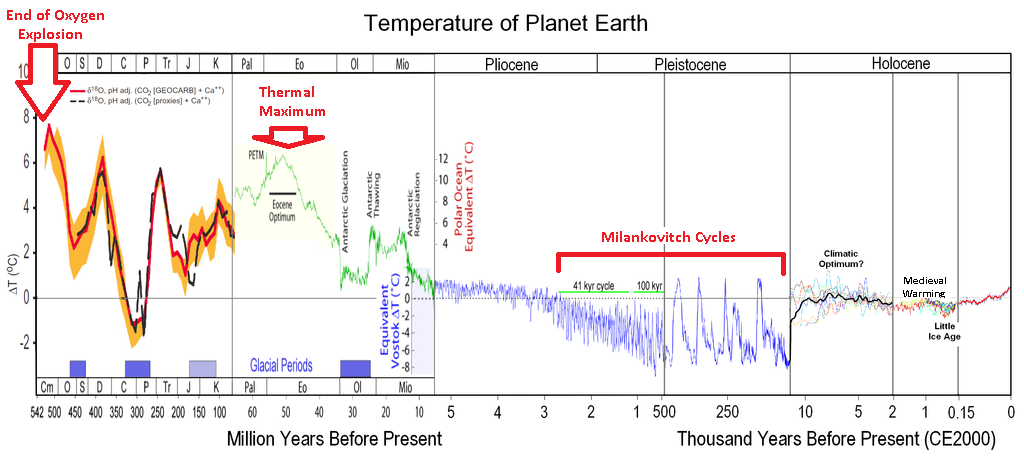
“temperatures should be much higher”
For whom? That right third of your graph is the period of evolution of mankind. And it’s already as warm or warmer than the maximum in that time.
Nick
you do realise that the graph is a moving scale and the temperature to the left of present are smoothed and still higher than today in every warming period during mans evolution?
I have asked you this a hundred times, but I will try again, DO YOU really think there is a C in AGW?
Actually, we need to warm up 1 to 2C before we could reach the average for the last 25K years.
Current temperatures are clearly colder than optimum for humanity.
Our species evolved in the tropics, and have moved to colder climes where we only survive through clothing, housing, and the combustion of fuels to keep warm.
Cold weather kills about 20 times more people than hot weather in the world today*.
Clearly, humanity would be better off if global temperatures were a few degrees warmer.
My greatest climate concern is not global warming, it is imminent moderate global cooling, similar to the period from ~1940 to ~1975 or cooler. Humanity and the environment suffer during cooling periods.
Regards, Allan
*Reference:
“Cold Weather Kills 20 Times as Many People as Hot Weather”
by Joseph D’Aleo and Allan MacRae, 4 September 2015
https://friendsofsciencecalgary.files.wordpress.com/2015/09/cold-weather-kills-macrae-daleo-4sept2015-final.pdf
This is not good news. CO2 is immensely beneficial to the planet. We should try to get it up to 600 ppm
BINGO
Agreeing that a slow down in CO2 emissions is somehow good news is buying into the notion that it represents a problem. It dos NOT represent a problem.
Controlling the language controls the debate … Saul Alinsky.
In an earlier posting, you said that every carbon atom in our bodies was once part of CO2 in the atmosphere. Just wondering whether you can substantiate that because it’s something no-one has pointed out before as far as I’m aware and it does seem to be a biggie in terms of countering the fearmongers.
you named his game. but he’ll be back with a variation on the same old song and dance cuz he will never give up. that’s the fabian way.
Come now. You are what you eat. Where do we get our food? Plants and animals. Where do plants get their carbon? CO2 fixed during photosynthesis. Where do animals get their food? Plant and other animals. Ergo, our carbon comes from CO2 in the atmosphere.
Thank you TC and Oeman50 for making my point.
I have no idea what gnomish is trying to say.
gnomish is referring to the Roman general Fabius Maximus’ strategy of fighting the Carpathian army via retreat from unprofitable combat, attrition through guerrilla warfare, and denial of resources.
TC another way of putting this is perhaps: “See, it’s working! Now continue to trash your economies with expensive energy and unreliable renewables and don’t forget to buy lots of batteries etc from China while you’re at it and feel good cos your saving the planet!”
I came saw and left @ur momisugly 6:33 – tanks fer splainen it to me
Gnomish is in fact referencing the “Fabian strategy” method to implement socialism into non-socialist countries (I believe which originated in Britain).
Clearly some of you merely just InvestiGoogled “Fabian” and found the top Wiki result re: Romans.
I would go even further, and suggest 800 to 1200 ppm. That would be very beneficial for the well being of the biosphere, and it would flourish under such conditions.
Now if only by some happy chance, increasing CO2 emissions would lead to some warming, that would be a real win win scenario.
I read some articles on CO2 use in greenhouses for food production and the recommended level is 1000 ppm, apparently after that some people find breathing difficult. So perhaps we should aim a bit lower than that. What do you think?
Your claim that people have trouble breathing when CO2 concentrations go above 1000ppm is strange,
Here’s a WUWT article from a few years ago that cites actual studies.
Some quotes from the article.
We try to keep CO2 levels in our U.S. Navy submarines no higher than 8,000 parts per million, about 20 time current atmospheric levels. Few adverse effects are observed at even higher levels. – Senate testimony of Dr. William Happer, here
Data collected on nine nuclear-powered ballistic missile submarines indicate an average CO2 concentration of 3,500 ppm with a range of 0-10,600 ppm, and data collected on 10 nuclear-powered attack submarines indicate an average CO2 concentration of 4,100 ppm with a range of 300-11,300 ppm (Hagar 2003). – page 46
Sorry, block quote didn’t work.
Mark W.,
Thanks for posting that info. I’ve seen this discussion about breathing elevated CO2 levels, but never so well debunked.
Gnomish is in fact referencing the “Fabian strategy” method to implement socialism into non-socialist countries (I believe which originated in Britain).
Clearly some of you merely just InvestiGoogled “Fabian” and found the top Wiki result.
I hate WordPress comments. Placed in wrong spot.
I agree that we should listen to and share good news when we hear them, especially in times when the horrific news dominate. Signs showing that the rise in the global CO2 emissions are slowing down are indeed good news. The emissions in the wealthiest nations have already peaked and they will probably peak soon in China too. The big uncertainties now are India and other developing nations.
However, the worst outcome is not that India and other developing counties copy Chinas economic success and pollution problems; the worst outcome for the world is if India and other developing countries fail to grow their economic output per capita so that a large part of the worlds population remains in desperate poverty.
The emission from the poorest counties will have to continue to rise to allow economic development there.
/Jan
China is committed to doubling its CO2 emissions between now and 2030. India is committed to tripling its CO2 emissions.
It would be optimistic to take a per capita emission of around 5 to 6 mt. So as China, India and others develop, one can expect to see a substantial increase in CO2 emissions just because of the size of their populations, although at least China is trying to roll out nuclear which will curb its CO2 emissions.
Richard,
“China is committed to doubling its CO2 emissions between now and 2030.”
Most of what I see suggests otherwise. They are pushing nuclear and renewables very hard.
For an overview see “Red China Goes Green” by Stratfor, 17 March 2017.
Also see this article about China’s renewable energy programs at the World Resources Institute by Ranping Song and Miao Hong, 27 April 2016.
For example, see their programs to shift to electric cars. WSJ: “China, With Methodical Discipline, Conjures a Market for Electric Cars” — “Nearly half of all plug-in vehicles are sold in China, driven by relentless subsidies and regulations.” MIT Tech Review: “China’s New Electric Car Rules Are Amazingly Aggressive.”
Much media attention to coal misrepresents as a shift to coal what is in fact rapid closing of dirty and inefficient older coal plants with new ones. Their data is unclear, but their increase in coal consumption is slowing fast — and may be close to peaking (or even have peaked).
Well lets see… India has put new coal plant on hold and committed to having 175GW capacity in solar and wind by 2022 and also announced plans to move to electric vehicles.
New solar is far cheaper than new coal plant.
Economy flourishing
“India has put new coal plant on hold…”
Did you mean “a new coal plant” or “all new coal plants”? Wording is unclear. Repent and pay thine syntax.
lol, at widespread use of electric vehicles in india griff. i take it you have never been there ?
Griff hasn’t been outside his British council flat … but he has read about it all on the net.
Meanwhile the answer to why the power stations builds where suspended lies in the business data
https://www.bloomberg.com/news/articles/2017-06-06/india-s-looming-power-surplus-signals-slow-electrification-pace
They have a glut of power because demand has dropped away there are a number of factors at play
1.)India’s slowing economic expansion may be a challenge to the country hitting the CEA’s power demand growth estimates.
2.) “However, due to reasons like breakdown of transformers, inadequate transmission capacity and distribution infrastructure, we’re forced to switch off our generation.”
3.)”Most of India’s provincial electricity retailers lose money selling below cost to poor and agricultural customers and through power theft. State-run distributors held combined debt of 4.3 trillion rupees ($67 billion) as of September 2015, the latest year of available data.”
There are renewables coming online as part of the Indian government strategy and it is just feeding in to an already saturated market.
So Griff is either racist or stupid (possibly both) in that India being unable to stabilize it’s economy and power grid is somehow a good news story.
Griff,
Hahahahaha!!
https://www.oilandgas360.com/coal-in-india-2017-a-comprehensive-analysis-on-trends-outlook-of-coal-sector-research-and-markets/
“In India’s energy sector, coal accounts for the majority of primary commercial energy supply. With the economy poised to grow at the rate of 8-10% per annum, energy requirements will also rise at a reasonable level. Coal will continue to be a dominant commercial fuel two decades from now and beyond, despite our nuclear energy programme, development of natural gas supplies, increased hydropower generation, and emphasis on renewables.
The Indian coal industry aspires to reach the 1.5 billion tonne (BT) mark by FY 2020. In fore-coming years, the industry will naturally need to focus on building on the success, and be on track for reaching the FY 2020 goal. One of the primary goals of the Government of India is to ensure that it is able to meet the country’s power generation needs. Another aim is to lower the country’s reliance on coal imports by boosting the coal production quickly. India imports about 25% of its coal demand, much of which comes from Indonesia.
The government expects that by 2017-19, it will not have to import coal, except to feed power plants located along the coast. Coal imports have shrunk by around 9% this year, according to the government, which is a positive trend. The success of coal block auctions carried out by the new government has proved that its decision to conduct a fair and transparent’ bidding for coal mines has benefited the country in a big way. India’s investment in new coal-fired generation capacity will support an increase in coal use. India has plans to almost double its production to one billion tonnes by 2020 to meet its growing requirements.”
India’s coal IMPORTS are down because their own coal PRODUCTION is up!! And they PLAN to double that production by 2020 to meet their growth requirement!!
Why Jan, why do you thing that less CO2 emissions are good for us and the planet? There are no proofs that CO2 emissions are bad for the planet, only the opposite…
The problem is that there os at least 800 000 years since last time we had 400 ppm CO2. That, in combination with the annual rise of 2 to 3 ppm rise a large “unknown unknowns”, i.e. both effects and consequeces are unknown, and that is inself a great reason for worry.
Today we have two “knowns”, namely global warming and ocean acidification, but others may show up when we pass 500, 600 and 700 ppm.
We will surely at least pass 500 ppm before the concentration stabilise, but I cannot think of any reason for not wanting a slower rise to that level.
Jan
Jan,
“At least 800,000 years since last time we had 400 ppm CO2”.
And yet it’s been WARMER than today several times in that 800,000 year time frame. So using your “fact”, it wasn’t CO2 that caused that warming.
If “both effects and consequences are unknown”, then what exactly is there to worry about?
“Two knowns”
The globe is warming-yep. It does that during interglacial periods. Good thing too…or death and starvation would be catastrophic “knowns”.
The ocean is “acidifying”- nope. Becoming less alkaline does not make it “acidic”. And ocean cores show it’s been both more and less alkaline in the past without human influence.
Neither one of your “knowns” have been proven to be unnatural or negative. And here’s another known- the effect of CO2 on temperatures in the atmosphere is logarithmic. That means that it takes more and more of it over time to cause an increase.
Aphan
Warming can be caused by many factors, we know that, and no one think that previous warm periods was caused by CO2 emissions alone. Nevertheless, we also know that CO2 cause some warming. Although it is not known exactly how much warming the present 400 ppm gives, we can expect that much higher levels will give more it.
The atmospheric CO2 level has just passed 400 PPM and it will probably pass 500 ppm sometime between 2050 and 2070.
I think it would be better if that happen in 2070 than in 2050.
I cannot see any reason for thinking that at slower rise is bad, therefore lower CO2 emissions is good news
/Jan
“Nevertheless, we also know that CO2 cause some warming.”
REALLY ??????????
Provide a paper that proves empirically that CO2 causes warming in our convection controlled atmosphere.
The manmade CO2 emissions reduced just when the hottest September evaahhh was crayoned on the chart? Funny, whether or not it originates from the misanthropogenic climate movement so far proven unable to name itself sustainably.
The idea of a “greenhouse gas” is scientific nonsense.
It is an emotive word, and presently there is no empirical observational data backing up the use of that expression. It is correct to call it out.
Scientifically, these gases should be referred to as radiative gases, or IR absorbing gases.
If they absorb, they must emit, unless they transfer energy kinetically first. That is the real physics. nor may they heat warmer molecules. End of story, radiatively. Convection, that is another ketil of fish altogether….
Can someone please describe the radiative process? I understand that energy is transferred by molecular vibration, but what governs IR radiative transfer? Is it immediate, or is it dependent upon some other factor(s)?
“how many percent increase of down IR”
As GHG increases, there are two effects that increase down IR. One is simply that the air is warmer. That means that all GHGs, including water, radiate more.
The other is that the lower boundary of the CO2 emission zone is lower in altitude, and so warmer. This is separate from the effect of warming of the atmosphere.
It does seem like good news, although the presentation of numbers is not clear. I kept wondring, % of what? Why no mention of Gtons? Maybe because they are total GHG, but still, Gtons of CO2 would help. There is some help in Fig 1. I think the headline figure of 0.5% is the % of the previous year.
“Events are already falsifying the narrative of climate activists”
No, the report says:
“This is mainly the result of lower coal consumption from fuel switches to natural gas and increased renewable power generation; in particular, in wind and solar power.”
You’ve even put that in red. These are exactly the kinds of measures activists were seeking, and the report says they seem to be effective.
Oops, please ignore first two paras. They were from a previous comment.
“please ignore first two paras”
Please ignore the first FOUR paragraphs.
Mindless AGW pap !!
I think Larry was referring to RCP 8.5 and the doomsday narrative as being falsified.
But RCP8.5 was never a prediction. It was a possible choice, as were RCPs 6, 4.5 and 2.6. And the good news in this report seems to be that we have chosen not to follow 8.5 (as activists recommended), and it seems to be working fairly well.
RCP 8.5 has frequently been cited as “business-as-usual” and other variations of the reference or expected case.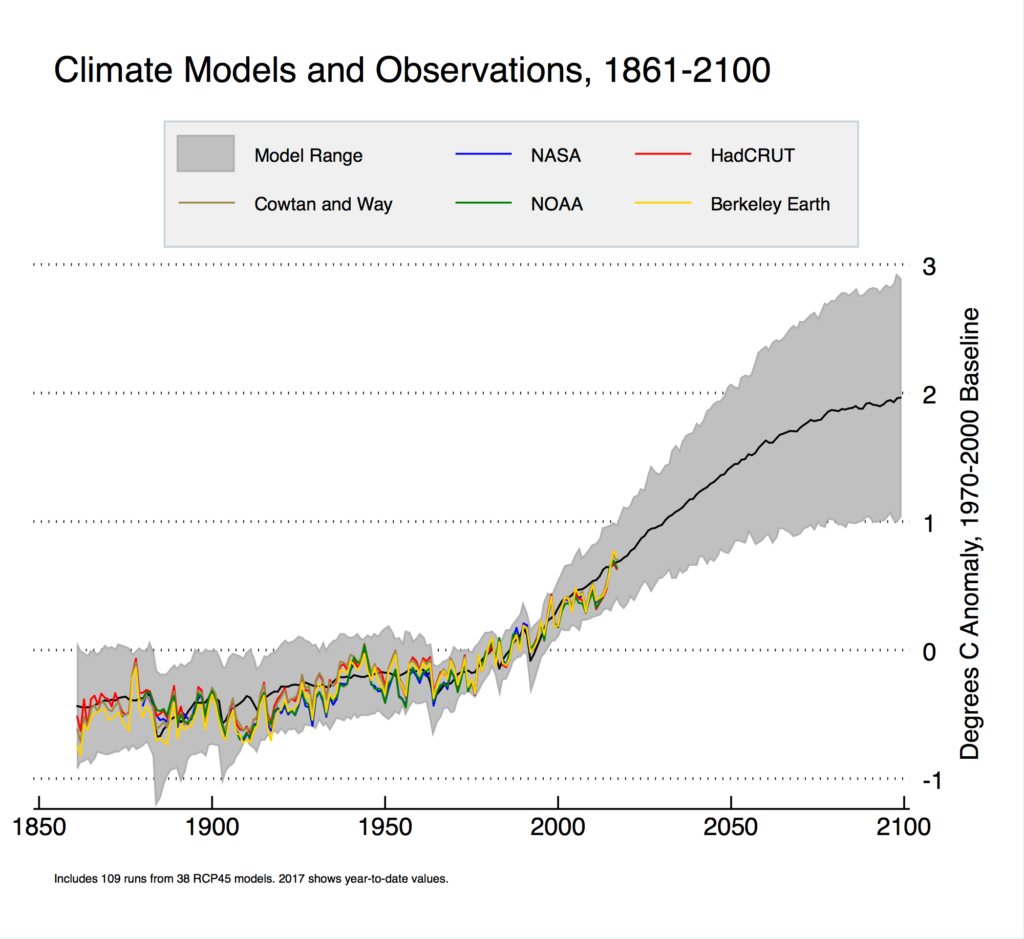
Our emissions have always been tracking RCP 6.0 and the observed temperatures have consistently tracked between RCP 2.6 and 4.5… irrespective of what we’ve done. Natural gas replacing a little bit of coal in the generation mix is the only significant thing we have done to reduce emissions growth.
RCP 4.5 runs a little hotter than the observations and it yields a 50% chance of staying below 2°C and about a 25% chance of staying below 1.5°C… And this is the closest approximation of “business-as-usual.”
Replace a little more coal with natural gas and nuclear power… and RCP 2.6 will become the closest approximation of “business-as-usual.”
Nick,
Always a reliable source of Reading FAILs!
“But RCP8.5 was never a prediction. ”
Let’s replay the tape to see what I said was falsified: “Events are already falsifying the narrative of climate activists,” So, Nick. I never said that RCP8.5 was a prediction.
“we have chosen not to follow 8.5 (as activists recommended),”
You just delightfully. Nobody with a 3 digit IQ wanted a world with rapid population growth and stagnant technological progress. That we haven’t done so in the past few years has little or nothing to do with “activists” — everything to do with normal economic and social processes. Especially new technology.
I wonder if activists like yourself take credit for the sun rising in the morning (just as you recommend it does).
“And the good news in this report seems to be that we have chosen not to follow 8.5 (as activists recommended), and it seems to be working fairly well.”
Please Nick, what you call ‘working fairly well’ has happened IN SPITE of the activists. The only way 8.5 could have possibly happened was if the activists had been successful at creating a one-world government. The resulting socialist dystopia might have generated an 8.5 scenario of stagnant technology and rapidly expanding population. The reality is that 97% (yes…I made that number up. It seems to be the thing to do these days.) of the things that are ‘working fairly well’ are the result of (relative) capitalism, which is generally despised by the activists.
Building a few windmills and taking credit for things ‘working fairly well’ is no different than throwing a virgin into a volcano and taking credit for it not erupting.
Editor
“Let’s replay the tape to see what I said was falsified”
It isn’t clear. I was replying to David Middleton, who suggested it was RCP8.5. But the “narrative” was that if you greatly increase CO2 in the air, bad things will happen. Their corollary suggestion was, don’t do it. You are reporting that we now do seem to be putting less CO2 in the air. That doesn’t falsify any narrative. It is just, as you say, good news.
“has little or nothing to do with “activists””
I said that we did not follow RCP8.5, and activists recommended that we shouldn’t. I didn’t say that the deviation from 8.5 was caused by that advice. That is your reading fail. What I did say was that if activists suggest a course of action, and then it happens, this does not falsify their “narrative”.
Nick,
(1) “But the “narrative” was that if you greatly increase CO2 in the air, bad things will happen.”
False. That’s not what I said. My point was obvious, and David correctly stated it: “Larry was referring to RCP 8.5 and the doomsday narrative as being falsified.” I’ll repeat the entire section, to show you what was falsified.
(2) “we have chosen not to follow 8.5 (as activists recommended),”
False. Activists said that we would follow RP8.5 unless we implemented the large-scale public policy changes they recommended. America mostly ignored their recommendations, with a few exceptions. The largest changes in US emissions resulted from increased efficiency — and fracking (nat gas replacing coal). These resulted mostly from normal capitalism plus new tech. Activists opposed — and still oppose — fracking.
Nick,
“These are exactly the kinds of measures activists were seeking, and the report says they seem to be effective.”
You are always here with the easily falsifiable comments. Reduced coal consumption is the largest contributor, as the share of wind and solar remain microscopic. The largest driver of reduced coal consumption has been increased natural gas usage. The largest contributor to that has been fracking — which “activists” oppose. Fiercely.
Read the news. Facts are your friend!
That is correct .. even Germany still is burning coal at exactly the same rate it always has.
In 1995 they were using 275 Million tons (roughly 50% lignite, 50% hard) and today they are using 250 Million tons (roughly 45% lignite 55% hard)
Given the 2017 June financial year end reports imports of 54.6 million tonnes for the year and going on last years numbers they will be using 245 Million tons this year.
You can look the numbers up on any source you choose .. the facts don’t lie.
The fun begins now that number is supposed to drop [by] 25% by 2020, 50% [by] 2022 mainly by switching off coal fire power stations .. .watch this space.
arg “drop to” should be “drop by”
I consider that claims made in articles like this should be taken with a pinch of salt.
I very much doubt that it has anything to do with an increase in wind and solar since the German experience clearly demonstrates that ever greater use of wind and solar results in diminishing returns and one soon comes up against a buffer whereat wind and solar do not reduce CO2 emissions at all.
German has gone hell for leather with the roll out of wind and solar, and yet in the electricity generation sector of its market, it has been unable to decrease CO2 emissions since 2009. In fact, the last couple of years has seen an increase in CO2 emissions.
The experience suggests that a little bit of wind and solar initially results in the reduction of CO2 so long as the backup that they require comes from the spare capacity that the grid had. So for example, in the UK, the grid use to run with a spare capacity of about 10% over and above what was needed at peak demand. This spare capacity has now dropped down to around 2 to 3% with the concurrent reduction in CO2. I strongly suspect that the reduction that is seen with CO2 emissions is down to the fact that the spare capacity of western nation’s grids has gradually been reduced down from around 6 to 10%, to 2 to 4%. It is this reduction in spare capacity of around 5% that has resulted in the observed reduction in CO2, but now many country’s are experiencing difficulties with their grids as a consequence of the compromise in spare capacity. The last couple of years the UK grid has been critical during the winter months.
Like others I am sceptical of the claim that there has been a real reduction in CO2 emissions from the electrical generation sector. I strongly suspect that either the figures estimated contain a margin of error equal to (or more than) the claimed reduction in CO2 emissions and/or that China (and her ilk) are not accurately declaring their emissions.
Germany has increased transport CO2 emissions and not reduced heat emissions, plus has had to compensate for removing nearly 505 of its nuclear capacity overnight in 2011.
your conclusions on German CO2 need to take those special factors into account.
Meanwhile look how much the K has done to reduce its CO2, by closing coal plant and building wind power
“Meanwhile look how much the K has done to reduce its CO2…”
And the quantifiable impact on global mean temperature has been what? And the actual cost has been what?
@Griff
i have already provided you with this information before on previous articles.
We are dealing with electricity production. Wind and solar have nothing to do with other sectors of the economy, eg., transport. Presently there are no wind or solar powered cars, trains, buses, aeroplanes etc.
Nuclear is base load, not back up, so it makes no difference that Germany is replacing its nuclear generators. The problem is that wind and solar require 100% backup and if this is provided by fossil fuel generation (which is generally the case) then there is no significant reduction in CO2 emissions when using wind and solar.
The reason why Germany is having to build lots of coal generators is because wind and solar require backup.
Unfortunately this table (from Wikipedia) does not copy well:
Energy in Germany [3]
Capita Primary energy Production Imports Electricity CO2 emissions
million TWh TWh TWh TWh Mt
2004 82.5 4,048 1,582 2,509 580 849
2007 82.3 3,853 1,594 2,344 591 798
2008 82.1 3,899 1,560 2,453 587 804
2009 81.9 3,705 1,478 2,360 555 750
2010 81.8 3,807 1,528 2,362 590 762
2012 81.8 3,626 1,444 2,315 579 748
2012R 81.9 3,635 1,435 2,321 585 755
2013 82.1 3,694 1,400 2,411 576 760
You need to move the columns under their headings. But it will be noted that this is just electricity production and in 2009 Germany emitted 750 tons of CO2, and in the following years this was 762 mt, 748 mt, 755 mt and 760 mt of CO2.
Germany has come up against the buffer, and can no longer reduce CO2 by utilising more and more wind and solar. To the contrary, its CO2 emissions have gone up from 750 mt to 760 mt.
Wind and solar does have an effect on CO2 emissions. Tariffs and subsidies for that garbage drives power costs up and drives the economy into the crapper, resulting in lower emissions of fossil fuels.
Griff
Germany got rid of a bunch of really inefficient [soviet-era]
society eracoal generating facilities. That is the only thing they have done that has reduced their CO2 emissions. You know it, I know it and everyone here knows it, your BS not with standing.“@Griff
i have already provided you with this information before on previous articles.”
You can keep providing Griff with correct information until the cows come home and it will not prevent him posting the same lies time after time after time, he has absolutely zero interest in actually finding out the correct information.
For example, he will still be posting his ludicrous porky pies about the Arctic ice disappearing even if the glaciers return and reach as far south as Scotland.
Trying to scare the uninformed by lying on assorted blogs and comment boards by making exaggerated claims about how the oceans are going to turn to concentrated sulphuric acid and we’re all going to be burned alive by the evil man-made CO2 is what makes him his beer money.
The dutch are massive green supporters. They spend taxpayer’s money protecting greenpiss who fly their people from southern Europe every week.
No we are not. They let you believe it.
Larry, dare I suggest you’re exhibiting signs of “Stockholm Syndrome” in this article?
You apparently subscribe to the unproven assertion that CO2 has anything at all to do with climate, therefore any perceived reduction in the human production of that gas is somehow “good”?
There’s no scientific evidence to support the assertion CO2 effects Erth’s climate. None at all. So celebrating a “reduction” in the production of that gas is simply silly.
Bingo – Buying into the enemy’s bullshit propaganda isn’t a good strategy.
Good essay.
The hopeful point is not the “science” behind the apocalyptic claptrap. The good news is that media may finally start getting tired of apocalyptic claptrap dressed up as climate science.
Further to my above post regarding the German experience which confirms that wind and solar do not effectively reduce CO2 emissions, notrickzones is carrying an article on the comments of University of Magdeburg economics professor Joachim Weimann. See http://notrickszone.com/2017/10/03/leading-german-economics-professor-calls-germanys-energiewende-an-energy-policy-calamity/#sthash.XH3MRYgL.dpbs
It would also have been useful to include a graph of the aCO2 concentration that should show the overall impact of our reductions on the global measurements.
graph Atmospheric CO2 continues to rise unabated.
What if our emissions go down and increased plant life consumes way more CO2 and atmospheric CO2 continues to rise?
–> commieBob October 4, 2017 at 4:33 am
You link doesn’t work
–> What if our emissions go down and increased plant life consumes way more CO2 and atmospheric CO2 continues to rise?
Then obviously natural factors like oceans and volcanoes (land and ocean floor) are putting way more CO2 into the atmosphere than currently estimated.
Keitho,
“been useful to include a graph of the aCO2 concentration that should show the overall impact of our reductions on the global measurements.”
This discusses only the Summary to the full report, which they say will be out by the end of October. Perhaps that will have that info.
It is, as you say, important info to put these trends in a larger context.
I’ll just leave this here.
http://www.woodfortrees.org/plot/esrl-co2/from:2000
~¿~
CommieBob,
It’s the intentions that matter. Haven’t you been paying attention? Clap harder and Tinkerbell will fly again and the planet will begin to heal and the oceans will start to recede…
Why is it just assumed that 10 billon people will be a problem? If we can stop the green movement from trying to force sustainability poverty on Africa and parts of Asia and fell poverty on everyone else I see no reason to view 11 to 12 people (about the likely maximum growth that will occur) as anything other than a chance to organize the planet in a balanced ways, in which all peoples can have a good standard of life. Especially as Africa promises enough potential for food resources for us all on its own.
Look at the U.K., arguably over-populated in terms of food production but an environment that is getting better by the year and for most of the population a good place to live. There are of course problems; perhaps if we were not wasting billions lining the pockets of a lying through its teeth green movement that has persuaded the Scottish Parliament to ban fracking yesterday and fritter more money on wind subsidy farming we could tackle more real issues.
It all depends on attitude – to the eco-warrior who hates people, 10 billion or any number, is a problem. Sensible people view human beings as an asset.
…Cross…,
Unstated assumptions for your statements are that people prefer to live close to lots of other people and have little interest in a world that hasn’t been modified to the extreme by those people. That tends to be true for urbanites, but not for everyone. Meanwhile, urban areas tend to have higher crime rates than rural areas, and are absolutely dependent on others to feed them and produce the natural resources they need. According to a quote by Ian McHarg (40 years ago), 4/5ths of those living in Manhattan have serious neuroses and 3/5ths have serious psychoses. The kind of atrocities that happened in Nice and recently in Las Vegas are more probable where large numbers of people congregate. Epidemics and pandemics are more probable with large population densities.
As with most dynamic systems, there is probably an optimal population. However, the attitude of, “Welcome aboard, we can always find more room on the lifeboat!”, leads to the kind of tragedies that have happened all too frequently with refugees crossing the Mediterranean.
11 or 12 people would be good too, but should be billions. The “fell” should be “force”.
I hate the spell-checker I’ve got as it seems to have a delayed action. sorry.
We have both seen these rate reductions before, and have been expecting them now. We also know our efforts are irrelevant, even more so than those of termites and ants. The oceans would rule, if not for the sun.
This is measured by the incredibly friendly, not always lying Chinese, always committed to the truth and the general human well-being. And this is spread by the incredibly blue-eyed and good-humored Dutch. So play a hand in the other.
Apart from this, China’s economy has just undergone a crisis in 2016 and 2017. Export bills are no longer being bought in this way, and consumption and production have also declined within China.
China’s growth rate in 2016 apparently was only a paltry 6.7%, and in the 2nd quarter this year a dismal 6.9% . . . Thankfully the major western economies are growing at a much slower rate. . . . !
Hogg: If you believe the chinese numbers. You do not have to see in China alone the economic growth, which includes services, but production, which is responsible for the largest share of CO2 emissions. And in this, china undoubtedly had a crisis in 2016 and 2017. The service sector could still rise by 500 per cent in order to come close to Western services. An increase of 3 percent in this area is meaningless. The rest is production crisis.
Moreover, as described above, no figures of a communist or post-communist regime ever believed. More lies do not go. We Germans have experience in it. Just yesterday was reminded again.
According to experts, the additional transfer from the state to the territory of the former GDR amounted to 2 trillion euros in 1990 (reunification) until 2014.
http://www.zeit.de/2014/44/wiedervereinigung-kosten-wende
And from 2015 to 2017 there is still no weakening of the financial needs. And even before this, the Federal Republic of #Germany has always helped the German democratic republic (GDR). Even the arch-conservative Franz Josef Strauss was not a pity to train the GDR with a billion loan (then still in German Mark) in order to save it from premature collapse. Despite officially announced rates of annual economic growth in the former GDR of 6-7 percent. How did these figures come about? Lying and more lies. Bent statistics that even the beams arc. So much for the numbers of communist regimes.
Appeal to authority Hans.
Who really are these “experts”? How do they have economic data access from the Chinese government in which to audit?
U.N weapons inspectors are also “experts” and fail miserably, daily
I bet the next surprise will be that atmospheric CO2 maintains its upward march at an undiminished rate…
I think that the renewables have nothing to do with the slowing of the CO2 concentration growth, their contribution simply is way too small with about 1% or 2% in total of global energy. Going from a 1.50 % renewables share to a 1.51% share the next year is completely neglible in terms of CO2 concentration growth effect.
The elephant in the room is the CO2 fertilization (natural sinks). The planet has been increasingly greening in the recent decades. This is why the CO2 sinks have been steadily growing. So each year a higher portion of our emissions are absorbed by the biosphere. Once we limit our emissions not to grow in total, a new equilibrium will be found at a certain CO2 concentration. The way to this equilibrium is not linear as supposed by climate models, it is logarithmic due to the adaptation of the biosphere.
Clive Best has done a good analysis on this issue: http://clivebest.com/blog/?p=8059
They do not know what they are talking about. The primary so called greenhouse gas in the Earth’s atmosphere is H2O so much so that the other so called greenhouse gases are trivial. Much more H2O enters the Earth’s atmosphere each year then any other so called greenhouse gas. If they are concerned about the gas in the Earth’s atmosphere that holds the most heat energy that would be N2 by far and N2 holds onto its heat energy much better than the so called greenhouse gases because N2 is such a poor LWIR radiator to space compared to the so called greehouse gases which are all good LWIR radiators.
It’s estimated by measuring the fuel consumption, we know the number of carbon atoms in the fuel, so we know fairly well how much CO2 is generated.
And how exactly do you measure fuel consumption?
fuel manufactured and delivered, assume its consumed
MarkW wrote:
“And how exactly do you measure fuel consumption?”
because people pay for it.
after that
it’s just a matter of
accounting
Hey this is not good news. Think of Canada! We could do with a little warming and an extended growing season.
No one. These numbers are made up guesstimates based upon a long string of assumptions.
Pure economics (EVs, revolutionary nuclear power technolgies) guarantees lower CO2 emissions, as well as all other types of emissions. So you can stop errecting those stupid wind turbines, folks,
and stop allowing power to get dumped onto the grid without persmission or need.
Imagine a world where an international body decides the ideal CO2 emissions level and then redistributes money around the globe from excess emitters to those countries who are being “harmed”. Problem solved.