A growing movement in higher education responds to a shortage of health professionals and researchers trained in climate change and health
Columbia University’s Mailman School of Public Health
The Global Consortium on Climate and Health Education (GCCHE) today announced that, since its launch earlier this year, 125 health professions schools and programs around the world have joined and committed to ensure future health professionals are educated on the health impacts of climate change. These impacts include more deadly heat waves, flooding, and wildfires; greater spread of disease vectors like ticks and mosquitos; and growing food and drinking water insecurity.
The Consortium so far includes member schools and programs representing an estimated 90,000 students from 15 countries on 6 continents (all health professions schools around the world are invited to join). Columbia University Medical Center, including its schools of medicine, nursing, dental, and public health, is the first complete academic medical center to join the GCCHE.
Faculty members in the Climate and Health Program at Columbia University’s Mailman School of Public Health, the first academic program in climate and health in the U.S., lead the Consortium, with input from an international, multi-sectoral Advisory Council and Coordinating Committee.
“The science is unequivocal: Not only are global temperatures rising, but human health around the world is threatened by the changes to the climate system,” says Jeffrey Shaman, director of the GCCHE and the Climate and Health Program at the Mailman School. “Yet today there are far too few health professionals with the necessary training to address this growing crisis. The GCCHE exists to build this expertise.”
To enable training of health professionals on the health impacts of climate change, the GCCHE is creating a living knowledge bank of curricular content for use by health professions schools worldwide. This content is made up of a growing body of knowledge and best practices, for example, the latest techniques in drought forecasting or early warning systems for heatwaves, as well as other ways of building community resiliency and response, including medical interventions to climate-related health crises. The GCCHE also supports learning about planetary health, a new field dedicated to studying the interdependencies of human and natural systems.
“There is plenty of evidence that many climate change mitigation policies can greatly improve public health, such as by reducing air pollution or traffic injuries, or increasing physical activity,” says Carlos Dora, coordinator, Public Health and the Environment, World Health Organization and a member of the GCCHE Advisory Council. “What is missing is training for health workers to integrate this knowledge into daily practice, to enhance individuals’ and communities’ action to protect their own health while helping save the planet.”
“While climate change is a huge threat, it also presents an opportunity,” says Kim Knowlton, a Mailman School faculty member who helps lead the GCCHE. “Our goal is to foster educational programs that can accelerate the development of ways to protect health, build climate resiliency, and treat those in need of healthcare, all with special attention to the most vulnerable populations, including the elderly and people in low-income communities.”
“We see every day how violent storms, air pollution, and other environmental factors harm our health,” says Michael Myers, managing director, Rockefeller Foundation and a member of the GCCHE Advisory Council. “The rapid growth and robust action of this consortium of leading institutions shows that help is on the way.”
About the Global Consortium on Climate and Health Education
Launched in February 2017 with start-up support from the Rockefeller Foundation, the Global Consortium on Climate and Health Education (GCCHE) is an international forum for health professions schools committed to developing and instituting climate change and health curricula, in order to ensure a future cadre of highly trained health professionals who will be able to prepare and protect society from the harmful effects of climate disruption. The GCCHE serves as a living knowledge bank for its members to share training materials, news and opportunities on climate and health events, partnerships, and opportunities. Representatives of health professions schools are invited to join the GCCHE online by completing this form.
###
Disclaimer: AAAS and EurekAlert! are not responsible for the accuracy of news releases posted to EurekAlert! by contributing institutions or for the use of any information through the EurekAlert system.
What we need is a cracking good cold spell. Break out the woolies!
Health planning should be on the basis of observed demand. There is no reason to act on speculation about possible distant futures. Trying to predict the most effective cocktail of flu vaccines for the coming season is legitimate. Planning for an ageing population is prudent. Planning to divert scarce resources away from known needs to hypothetical needs reveals the fallacy at the heart of the so-called “precautionary principle”. There is no such principle. It is the very opposite of precaution; it is imprudent. It consumes resources before you know they’re not needed for something else.
It does us all well to remember that like climate change you should always put your trust in university trained and qualified health professionals and their peer review process-
https://www.albawaba.com/editorchoice/uae-psychologist-will-help-women-accept-being-second-wives-1027352
although there does appear to be a wee contradiction allowing Saudi women to drive CO2 belching monsters at the same time California gals are being lectured not to, but the Green men know best.
Jeffrey Shaman’s hockey stick is unequivocally straight grained. It’s first class climate history miseducation.
https://www.statnews.com/2017/04/24/climate-change-human-civilization/
Id like the list pf what cretins have signed their schools onto this rank stupidity
i kept hassling our council re the CIGIAR memberships and why the hell we paid their fees and who signed us up? why werent the ratepayers asked about joining at all?
they evaded replies for 2 or 3 yrs
however i now see our council is OFF the list of Aussie council areas as members;-)
“…….Columbia University Medical Center, including its schools of medicine, nursing, dental, and public health, is the first complete academic medical center to join the GCCHE…..”.
Dental schools? I didn’t know my teeth were affected by climate change. The alarmists come up with something new everyday. And who needs evidence?
This is simply Columbia virtue-signaling its commitment to Climate Change alarmism by institutionalizing its resistance to the Trump administration and it policies. Creating formal structures of this type makes them harder to remove when rational thought prevails.
“Creating formal structures of this type makes them harder to remove when rational thought prevails.”
OTOH, maybe then they’ll be twisting in the wind in embarrassment.
The Program promises research money from the millions and millions willing to spend public funds …. if one is a mosquito researcher, one can get all the money one needs for research by simply mentioning Climate Change in any grant request.
The Gangs of New York never really went away. They just got accreditation.
These are all weather events, not climate change… a drought is a weather event, a storm is a weather event… bah!
Making whole careers out of imaginary or duplicative “benefits” seems a bit top heavy, society-wise. But I can see the moral self congratulation from my front porch.
People occasionally will claim that the climate fear movement is being laid to rest. But developments like this are pictures of the snowball picking up mass along with momentum as it rolls down the hill of mankind’s historic fear of weather and those who exploit / live off of it.
Nah. Death throes. CAGW is a dead ideology walking.
Oh great, now they are going to take time away from learning something learning in order to be indoctrinated on climate change.
Future patients to suffer the consequences.
learning something useful in order to be indocrinated
A time-honored but forgotten way to cope with any health risk: leeches.
Columbia University? Harvard is #1 in climate change. Is Professor Oreskes asleep?
There may be something to this, as I was recently looking at a paper on simulated shrimp. Tastes horrible, don’t know about their parasites. Seriously, how many biology departments have classical parasitologists? Old school epidemiology still works, even better with some new technology. Check out what biodiversity has really produced.
Simulated shrimp has parasites? Are they simulated as well?
At least they could improve the simulated taste.
I would hope that doctors would be able to treat and understand the human body regardless of what’s happening outside. Would an ER doc throw up his hands if he had a gunshot victim but had no specific training with GSR wounds? Is that going to be another tick box on the intake form “was your condition a result of climate change?”. When will this lunacy end?
“While climate change is a huge threat, it also presents an opportunity,” says Kim Knowlton, a Mailman School faculty member who helps lead the GCCHE.
Yes, indeed. A great opportunity to foist their drivel upon impressionable minds and breed more activists for their agenda, whilst making a nifty sum from government grants.
Never let a crisis (real or not) go to waste!
I began to pay much closer attention to the whole CAGW game when I kept hearing about the spread of arthropod vectors and the diseases they carry. When we pointed out the history of yellow fever and how two epidemics took place in Philadelphia and Boston during the Little Ice Age, most of the CAGW crowd were very briefly kept quiet. Yet then we had the Zika scare, carried by the same vectors that carry yellow fever, Aedes aegypti and Aedes albopictus, the news media almost immediately became beating the AGW drum again. West Nile did come to the USA because of global warming, but most probably in a refrigerated vile of mosquitoes from the Middle East. Zika had been present in Africa for decades until the Soccer World Cup in Brazil. Yellow fever, dengue and malaria were all but eliminated in the USA by good and professional mosquito control. Yet such mosquito vectored diseases are only an airplane flight or illegal border crossing away. As for tick vectored diseases, well Lyme disease started in the “cold” NE and has spread south and has far more to do with every expanding white tail deer and mouse populations than global warming.
Just look how global temperatures affected malaria!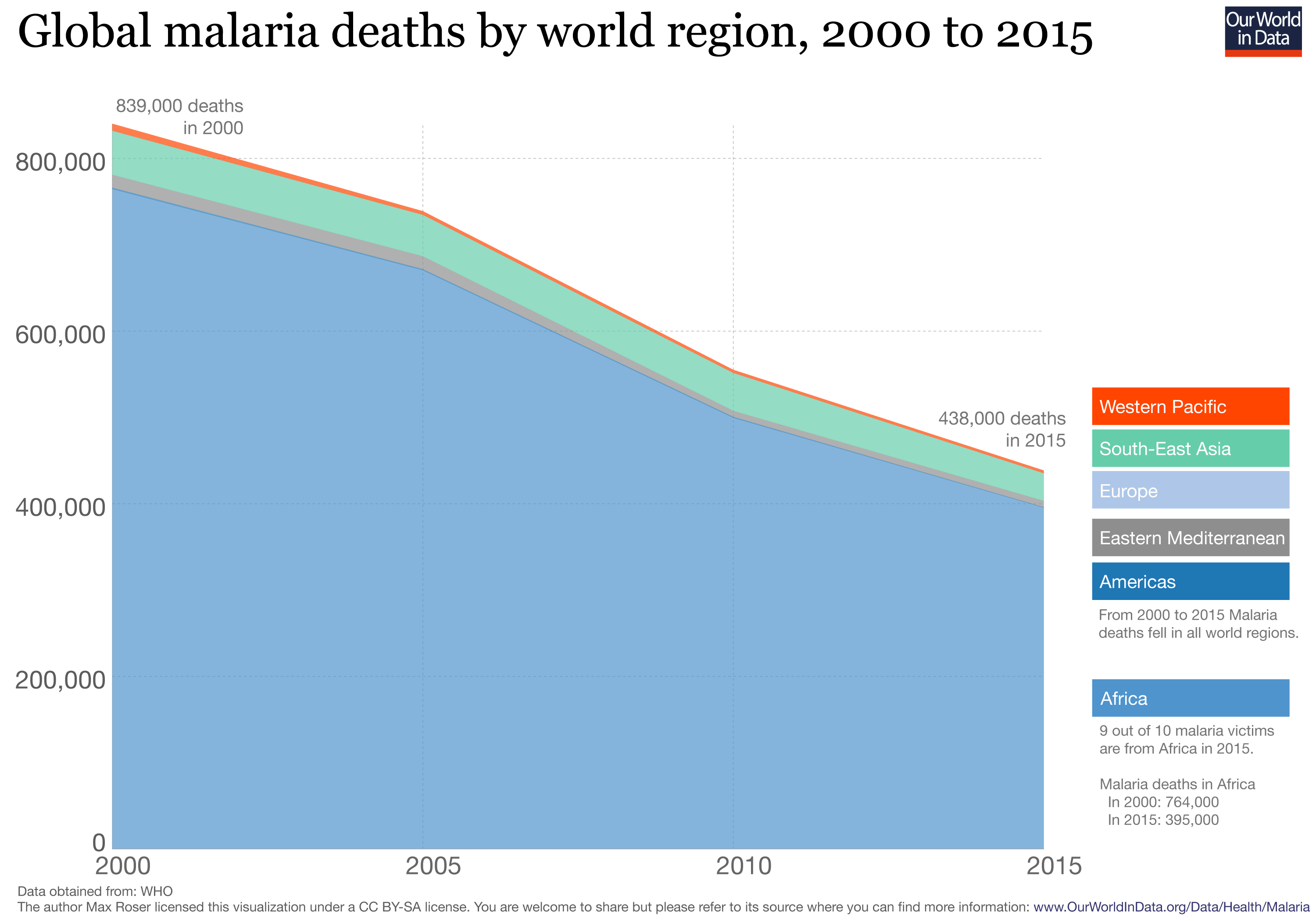
I need a doctor to treat my psychological disorder related to the massive increase in climate alarmism based on false narratives. Oh, and while you’re at it, I need a lawyer who is willing to sue climate alarmists for fraud.
Oh, and another lawyer to sue all educators for being complicit in the fraud by teaching our youth the wrong facts, thereby rendering them brain dead to the truth — which is child abuse on a mass scale.
This is one big lie. History shows that during periods of cold climate, crop failure and low crop yields caused millions to die of starvation, and suffer from malnutrition. During the Medieval Warm Period when temperatures were similar to today, humans thrived. It was a time of plenty when starvation and malnutrition went away due to longer growing seasons and high yields. This period was arguably the greatest in history, spawning the Renaissance. When obtaining food was no longer all consuming, people had time to create, were healthier and stronger, and disease reduced.
This seems to be an educratic justification for tying weather disasters, and the emotional baggage of the deaths caused by them, to alarmist climate dogma. If we just reverse this argument, we see how silly such scientific malpractice is.
Would any school seriously teach that IF we stop driving SUVs, humans can stop all deaths from hurricanes, tornadoes, wildfires? No. But that, in essence, is the argument being made. Our educational systems are slowly going insane in their efforts to pump out good, obedient Progressives.
I always find it a bit bizarre that the CAGW alarmists are acting as if we are suddenly going to have an increase in the Earth’s average temperatures in the 100 degrees F (37 C). I know it is a propaganda sales tactic, but still. Even more bizarre at this point is that there is anyone that still believes any of the tripe.
What product the Global Consortium (GCCHE) will market seems a bit murky. Its executive director has academic training in international relations and history and business skills in strategic planning for Pfizer low-tier markets and a shoe company. Experience in climate science appears nowhere in Sebastian Fries’ vita. The stated purpose of the GCCHE is to enable the teaching of health risks due to climate warming.
My takeaway from this statement is the GCCHE plans to sell teaching materials that describe so-called climate change related health risks and how to respond to them. The study of climate science appears not to be included in the curriculum. I have two huge problems with this message. GCCHE assumes (1) out-of-control global warming is a given, and (2) a host of health issues and weather-related events are due to global warming. Neither assumption would stand up to objective scientific scrutiny.
I call this the “What If?” syndrome that afflicts too many present-day undertakings. Research studies and businesses are started that in the real world would only be warranted if a hypothesis had been tested and found to be true. In the fake world of out-of-control global warming, the bar has been lowered. All that a start-up requires is a proposed hypothesis that an event that might occur. The justification to undertake the project becomes: If such and such might happen, then so and so should be done now. Undertakings like these can only exist with taxpayer-funded subsidies. Think boondoggles.
The GCCHE’s intention is not to develop education centers to train healthcare professionals how to respond to climate problems. Plainly stated, their intention is to setup a worldwide network of indoctrination centers to promote the message of CAGW alarmists. The possible consequences of the GCCHE plans are scary. Call it a stretch, but I can visualize indoctrination centers not unlike those of the Nazis in the 1930s and the present-day indoctrination programs of North Korea. I can not visualize a beneficial relationship developing between the education of healthcare professionals and GCCHE teaching materials.