Interdisciplinary studies reveal relationship between solar activity and climate change

INSTITUTE OF ATMOSPHERIC PHYSICS, CHINESE ACADEMY OF SCIENCES
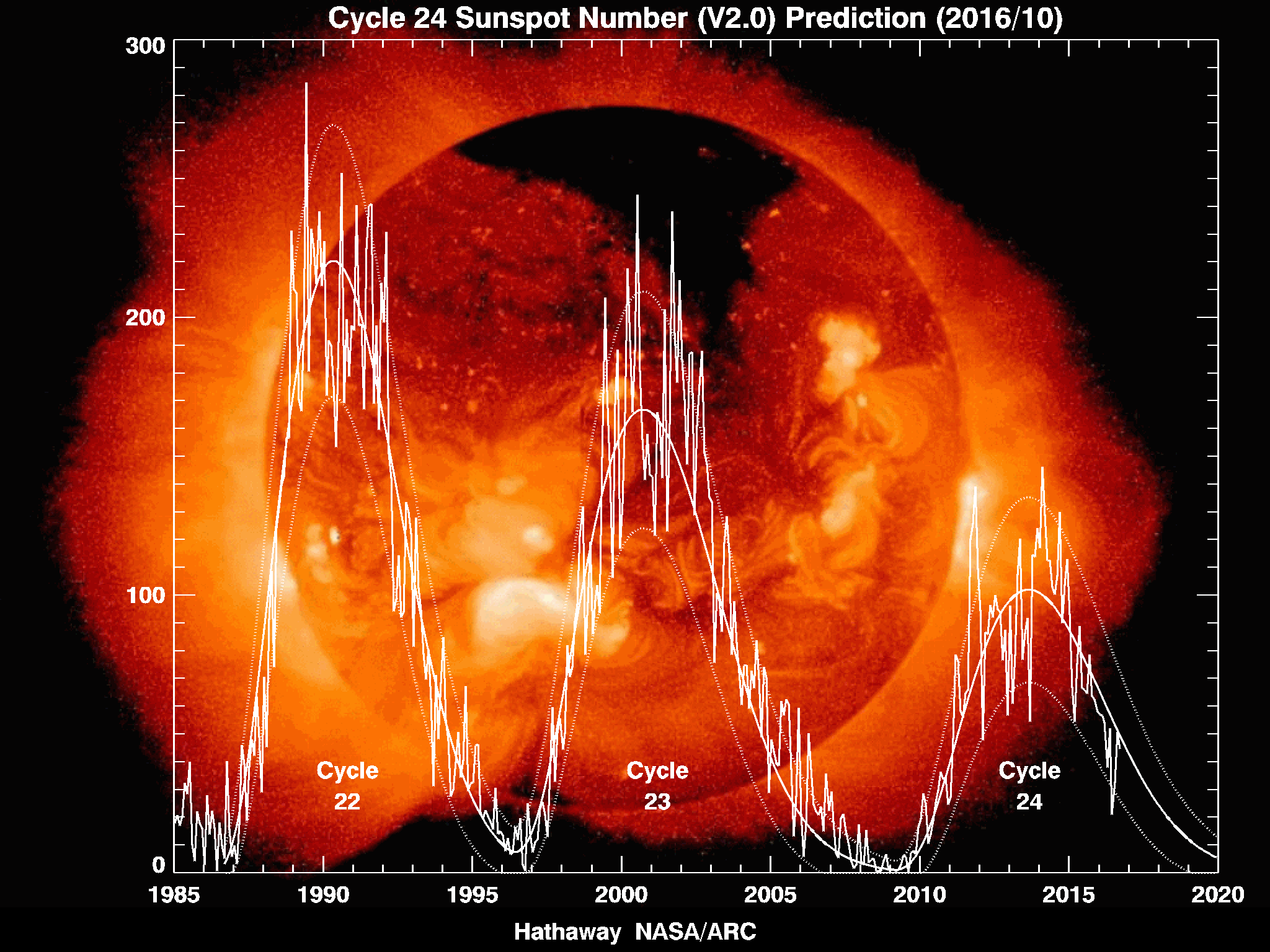
The solar flux is considered the fundamental energy source of earth’s climate system on long time scales. In recent decades, some studies have noted that the tiny variations in solar activity could be amplified by the nonlinear process in climate system. Therefore, the astronomy factors, such as solar activity, present intriguing and cutting-edge questions to better understand climate change.
Due to the interdisciplinary nature of this subject, studies in this field were insufficient in China. In 2012, China’s National Basic Research Program examined the impacts of astronomy and earth motion factors on climate change. Led by Prof. Ziniu XIAO (Institute of Atmospheric Physics, Chinese Academy of Sciences), this five-year research program that involved scientists in different research fields has greatly advanced understanding of this topic.
One of the major achievements by the multidisciplinary team is that a robust relationship between solar wind speed and North Atlantic Oscillation was found not only on a day-to-day time scale but also from the perspective of year-to-year variation, suggesting a much faster mechanism of solar influence on atmospheric system compared to the ozone destruction. Moreover, the team improved the collision and parameterization scheme and qualitatively evaluated the effects of solar energetic particle flux on cloud charge. Hence the team proposed that the solar wind and electric-microphysical effect was the key mechanism of solar activity on climate.
With the help of observations and model simulations, the team also found that the solar signal is more significant and detectable on an interdecadal time scale in some more sensitive regions, especially the tropical Pacific (eg. lagged dipolar convection pattern in tropical western Pacific; lagged El Nino Modoki-like pattern on tropical ocean surface) and monsoon regions (eg. rainband during the Mei-Yu season; north boundary of East Asian summer monsoon). Then a physical model is developed by the team to depict the interdecadal response of the air-sea system to solar activity.
The results above have been published in Atmospheric and Oceanic Science Letters, Journal of Applied Meteorology and Climatology, Journal of Geophysical Research, Journal of Meteorological Research, Journal of the Meteorological Society of Japan, Journal of Climate, and Advances in Space Research.
The follow-up research by the team is currently in progress and focuses on two main aspects: one is the effects of solar radiative forcing and solar energetic particles on climate in middle-high latitudes through modulating polar stratospheric-troposphere coupling, and the other is the response of a tropical Pacific air-sea system to interdecadal variation in solar activity and how this response propagates into middle latitudes through East Asian monsoon activity.
A program report is recently published in Atmospheric and Oceanic Science Letters.
Its almost as if the earth’s magnetic field was created by inducing a current in the large molten mass of plasma on the inside…
Do you know why the major ozone hole is over the south pole? Polarity.
the large molten mass of plasma on the inside
There is a large molten mass of [mostly] iron on the inside…
You been in there to analyse it,no one is sure what is in the middle.
The point is that it is not a ‘plasma’. The case for ‘iron’ is very strong.
http://www.bbc.com/earth/story/20150814-what-is-at-the-centre-of-earth
http://astroclimateconnection.blogspot.com.au/2016/03/evidence-that-sun-has-always-had.html
Evidence that the Sun has always had an important influence upon climate change
Abreu et al. [2012] wrote:
“The parameter that best represents the role of the solar magnetic field in deflecting cosmic
rays [and hence, the overall level of solar activity] is the solar modulation potential , which can be derived from either the 10Be or the 14C production rates.”
and
“….spectral analysis [of the solar modulation potential over the last ~ 9400 years] identifies a number of distinct periodicities (Stuiver & Braziunas 1993), such as 88 yr (Gleissberg), 104 yr, 150 yr, 208 yr (de Vries), 506 yr, 1000 yr (Eddy), and 2200 yr (Hallstatt) [cycles]…”
The top figure in the following diagram shows the Fourier transform of the variation in the solar modulation potential time series over the last 9400 years [Abreu et al. 2012]. This figure shows that potential has distinct spectral peaks at 88 years (Gleissberg Cycle), 104 years, 133 years, 150 years, 210 years (de Vries Cycle), 232 years, 356 years and 504 years.
Below this is a second figure showing amplitude spectrum of variations in the North American temperature time series over the last ~ 7000 years. The temperature time series is obtained from tree ring data obtained from Bristle Cones on the Southern Colorado Plateau [for the details of the source of this data see: Could This Be The Climate Smoking Gun? and Salzer and Kipfmeuller (2005). The lower figure shows clear spectral peaks at approximately 88, 106, 130, 148, 209, 232, 353 and 500 years.
This seems to be strong evidence that Sun has always had an important influence upon climate conditions [such as temperature] at a regional level. Why are some many people ignoring this obvious climate connection?
Try to divide 1024 by 1, 2, 3, 4, …
and you get a sequence close to containing the years you cite, so most of those peaks are probably only harmonics of a non-sinusoidal variation of 1024 years, which if present by accident for a few thousand years. Just numerology.
The trouble is Leif is that it is not numerology and you are going to look really silly once we get our paper through peer review. These specific periods appear in geological strata that as over 93 million years old (this will be published by another research group soon), and they also appear in another driver that influences climate. You will have to wait for our paper to come out before it can be discussed in the open.
our paper to come out before it can be discussed in the open
Science can always be discussed ‘in the open’.
It is normal to discuss findings and tentative results long before publication. At conferences and seminars or on a preprint server [like arxiv.org].
If you don’t do that, you are suspect from the get go.
Now, being wrong is not being ‘silly’, as you will soon find out.
Ian
Thanks for sharing that.
I am sure Anthony will allow your paper – or the essence of it – to be discussed here on WUWT and I look forward to seeing it!
most surely I am an avid supporter of yours since you discovered that warming causes more CO2 rather than that the CO2 causes warming…..
Years ago I identified you as a sophist. You haven’t changed. Most researchers do not discuss the details of their most recent research if they know that there is a chance that others might steal their results and then beat them into print. The only person who is suspect are the one who deny this obvious fact. As for being wrong – the beauty of science is that this depends on the evidence and the facts and not reputations.
know that there is a chance that others might steal their results
You are assuming there is something worth stealing…
Fear not.
Open review is becoming more and more accepted.
That is the way to go.
http://publications.copernicus.org/services/public_peer_review.html
Ok. I believe you. What is a sophist, exactly.
henryp, The comments that I posted above are addressed too Leif and not you. Thank you for your kind words. However, I think you are referring to the other Ian Wilson who sometimes posts here. It is confusing sometimes to know which of us is posting because we have the same name.
lsvalgaard: so most of those peaks are probably only harmonics of a non-sinusoidal variation of 1024 years, which if present by accident for a few thousand years.
And what if “present by non-accident”? What then? And if it is “present by accident” for several thousand of the last several thousand years, does it still count as having been “present”?
If you flip a coin many times and flip #4 is a head, then heads at flip #4 was present.
The point is that there are not ten independent peaks, which if there were would be highly significant, but only one real peak [occurring by accident]. If all the other peaks [or most of them] were just harmonics of the real peak, then there would not be ten independent peaks. Harmonics occur naturally if the ‘wave’ is asymmetric.
lsvalgaard: If you flip a coin many times and flip #4 is a head, then heads at flip #4 was present.
Does the flip have consequences for Earth’s climate? If flip #4 turns up heads “by accident”, do the consequences to Earth’s climate then occur?
You wrote: so most of those peaks are probably only harmonics of a non-sinusoidal variation of 1024 years, which if present by accident for a few thousand years.
Are you saying that the non-sinusoidal variation in solar modulation did not occur, but the evidence appeared independently of the sun or any consistent mechanism?
I’m saying that if several asymmetric variations with maxima space 1000 years apart, even from different causes, then the harmonic peaks at 500, etc year will appear in the power spectrum all by themselves. No cycles at those periods are required.
It would be miracle if the variations were a pure sine wave, so there is almost always SOME asymmetry, and hence always some harmonics. The various variations don’t even need to have the same cause as long as they occur approximately with the same spacing in time.
To illustrate the point here is a variation that repeats every 1000 years but is asymmetric as shown in the grey insert. The power spectrum [red curve] has a peak at 1000, and at 1000/2, 1000/3 1000/4 etc:
http://www.leif.org/research/1000-yr-harmonics.png
But there are actually not any cycles with periods 1000/2, 1000/3, 1000/4, … years
lsvalgaard: To illustrate the point here is a variation that repeats every 1000 years but is asymmetric as shown in the grey insert.
Let me rephrase my question: Does the evidence support the hypothesis that a variation with a period of ca. 1000 years occurred? I appreciate that extra periods appear in the Fourier spectrum if the process has a period of 1000 years but a non-sinusoidal shape. Does the variation with a period of ca. 1000 years have a non-sinusoidal shape (more properly, does the process generating if have a period of 1000 years but a non-sinusoidal shape?)
Does the evidence support the hypothesis that a variation with a period of ca. 1000 years occurred?
A bit too strongly phrased. ‘Period’ implies too much. As does ‘a’ variation, namely that it is the same phenomenon that occurs regularly. To ‘explain’ the spectrum it is enough that some variations [perhaps even due to different, independent causes] occurred at roughly 1000 years apart for a while. Now, if there were hundreds of such variations all occurring about 1000 years apart, that would be strong evidence for a single, real phenomenon, but that does not jump out of the data.
For example, here is an analysis of a process with a period of 24 hours but a non-sinusoidal shape:
M. R. Marler, P. Gehrman, J. E. Martin, S. Ancoli-Israel, The Sigmoidally-transformed Cosine Curve: A Simple Mathematical Model for Circadian Rhythms with Symmetric Non-sinusoidal Shapes. Statistics in Medicine, 25:3893-3904, 2006, presented at the poster session at the Joint Statistical Meetings, Aug 2005.
lsvalgaard: A bit too strongly phrased.
However you phrase the description, did the process persist for a few thousand years? Of course it “does not jump out” at you, it’s measurable effects are “on the order of 1%,” if it happened.
If CO2 has an effect “on the order of 1%” (as it does) and is considered important (as it is), then there is no good reason to dismiss other effects merely because they are on the order of 1%. It’s an ambiguous region of statistical inference, so to speak, with small effects and studies/analyses with low power.
Sirius effects are on a much smaller order.
If CO2 has an effect “on the order of 1%” (
You are much too vague. 1% of what? Of temperature? If so, 1% of 288 K is 3 degrees and I’m not so sure that the effect of CO2 has been of that order.
The 1% of the UV did not refer to the size of the effect on temperature, but to the effect on clouds [I think] and that translates to a much smaller effect on temperature [and so can be dismissed as insignificant], so the two 1%’s are not the same.
lsvalgaard: If so, 1% of 288 K is 3 degrees and I’m not so sure that the effect of CO2 has been of that order.
I used your explication of “order of 1%”, which is the range 0.2% – 5%. Estimates are in that range.
A change in cloud cover “on the order of 1%” can produce a temperature change at the surface “on the order of 1%”, but it depends on the timing.
can produce a temperature
The temperature change is only a quarter of the radiation change.
‘can’ is a weasel word. The question is if it ‘does’, and there is no evidence for the cloud cover changing as a function of the UV change, independent of the change in TSI.
lsvalgaard: The question is if it ‘does’, and there is no evidence for the cloud cover changing as a function of the UV change, independent of the change in TSI.
That is what is being investigated. The effect is likely “on the order of 1%”, so lack of evidence so far is an ambiguous result. I am expecting that it will take 20 more years to resolve all these issues with respect to effects “on the order of 1%.” Meanwhile, “on the order of 1%” does not imply negligible, unless CO2 be taken as negligible, which I think might be true but should not be strongly asserted.
seems to me the variation of the Gleissberg (88 years) is in the order of about -0.01K/annum since 2000
[as far as minima is concerned]
how much% is that?
not too much
but I was still able to identify it……
The point is that the effect has not been demonstrated.
That it is “being investigated” is not an argument for existence, but rather an admission that nothing has been found.
Cosmic rays penetrate the atmosphere and they come in as clouds of cosmic rays.
Random radiation clouds found in atmosphere at flight altitudes
February 8, 2017 by Bob Yirka
https://phys.org/news/2017-02-random-clouds-atmosphere-flight-altitudes.html
(Phys.org)—A large team of researchers with members from several institutions in the U.S., Korea, and the U.K. has found evidence of random radiation clouds in the Earth’s atmosphere at elevations used by aircraft. In their paper published in the journal Space Weather, the team describes how they discovered the clouds and offers a theory for their existence.
For several years, NASA has been conducting a project called Automated Radiation Measurements for Aerospace Safety (ARMAS)—devices are placed aboard aircraft that measure radiation levels during flights; readings are recorded in a database for study. In this new effort, the researchers accessed the database and examined data from 265 flights during the period 2013 to 2017. In so doing, they found mostly what was expected—higher than ground levels of radiation. But they also found unusual readings—six instances of high altitude and high latitude flights during which radiation levels rose to twice the normal level for several minutes. The researchers described the events as flying through a radiation cloud.
Radiation Belt depletions
http://services.swpc.noaa.gov/experimental/images/van-allen-lshell.png
http://www.swpc.noaa.gov/products/van-allen-probes-radiation-belt-plots
Natural. Because what we see are not the primary Outer Space cosmic rays, but the secondary rays created by the primary: a cascade of particles spread out in space and time:
http://cdn.antarcticglaciers.org/wp-content/uploads/2014/11/Crshower2_nasa.jpg
The NAIRAS model predicts atmospheric radiation exposure from galactic cosmic rays (GCR) and solar energetic particle (SEP) events. GCR particles are propagated from local interstellar space to Earth using an extension of the Badhwar and O’Neill model, where the solar modulation has been parameterized using high-latitude real-time neutron monitor measurements at Oulu, Thule, Lomnicky, and Moscow. During radiation storms, the SEP spectrum is derived using ion flux measurements taken from the NOAA/GOES and NASA/ACE satellites. The cosmic ray particles – GCR and SEP – are transported through the magnetosphere using the CISM-Dartmouth particle trajectory geomagnetic cutoff rigidity code, driven by real-time solar wind parameters and interplanetary magnetic field data measured by the NASA/ACE satellite. Cosmic ray transport through the neutral atmosphere is based on analytical solutions of coupled Boltzmann transport equations obtained from NASA Langley Research Center’s HZETRN transport code. Global distributions of atmospheric density are derived from the NCEP Global Forecasting System (GFS) meteorological data.
http://sol.spacenvironment.net/nairas/Dose_Rates.html
The Most Recent Full-Day Total Ozone Map for the Globe.
http://exp-studies.tor.ec.gc.ca/ozone/images/graphs/gl/current.gif
The next time you step onto an airplane, consider the following: In any given year, the pilot of your aircraft probably absorbs as much radiation as a worker in a nuclear power plant.
However, Earth’s poles are where the radiation problem can be most severe. Our planet’s magnetic field funnels cosmic rays and solar energetic particles over the very same latitudes where airlines want to fly. On a typical day when the sun is quiet, dose rates for international flights over the poles are 3 to 5 times higher than domestic flights closer to the equator.
https://science.nasa.gov/science-news/science-at-nasa/2013/25oct_aviationswx/
lsvalgaard April 24, 2017 at 7:28 pm
Natural. Because what we see are not the primary Outer Space cosmic rays, but the secondary rays created by the primary: a cascade of particles spread out in space and time:
Yes, Dr. S., particle cascades, clouds of energetic particles.
Sept. 28, 2016
NASA’s Van Allen Probes Spot Electron Rainfall in Atmosphere
https://www.nasa.gov/feature/goddard/2016/nasa-s-van-allen-probes-spot-electron-rainfall-in-atmosphere
“””However, on Jan. 17, 2013, NASA’s Van Allen Probes were in just the right position to watch a drop-out in progress and resolve a long-standing question as to how the lower region of the belts close to Earth loses high-energy electrons – known as ultra-relativistic electrons for their near-light speeds. During a drop-out, a certain class of powerful electromagnetic waves in the radiation belts can scatter ultra-relativistic electrons. The electrons stream down along these waves, as if they are raining into the atmosphere. A team led by Yuri Shprits of University of California in Los Angeles published a paper summarizing these findings in Nature Communications on Sept. 28, 2016.”””
Solar Storms Can Drain Electrical Charge Above Earth
APRIL 10, 2017
https://www.jpl.nasa.gov/news/news.php?feature=6804
“””The storm initially produced patches of extra electrons in the ionosphere over northern Greenland, as usual. But just south of these patches, the scientists were surprised to find broad areas extending 300 to 600 miles (500 to 1,000 kilometers) where the electrons were “almost vacuumed out,” in the words of Per Hoeg of the National Space Research Institute at the Technical University of Denmark, Lyngby. These areas remained depleted of electrons for several days.”””
Thanks ren, whether cascades or clouds of enhanced radiation, Earth magnetic field strength variation, at points determine access to the lower most levels of the atmosphere. And whether or not the cosmic ray cloud theory works or some other climate effect is occurring, (also at the same time).
ren April 25, 2017 at 5:39 am
“The cosmic ray particles – GCR and SEP – are transported through the magnetosphere using the CISM-Dartmouth particle trajectory geomagnetic cutoff rigidity code,”
Cutoff rigidity at the North and South pole isn’t a complete global picture.
The picture needs to depict areas of weaker Earth magnetic field strengths, magnetic Null points etc..
Then, we might able to see the cosmic radiation/high energy particle precipitation into the atmosphere locations affecting pressure and wind.
Cutoff rigidity at the North and South pole isn’t a complete global picture.
The picture needs to depict areas of weaker Earth magnetic field strengths, magnetic Null points etc
The code takes all that into account.
The cutoff rigidity is not a global measure. It is a local value that for a given location determine what cosmic rays can be observed.
For instance ren, magnetic null/neutral points. Huge magnetic null point in the equatorial pacific ocean.
Big one in the Atlantic too.
http://geokov.com/Images/topography/declination-map.jpg
http://geokov.com/education/magnetic-declination-inclination.aspx
Geomagnetic cutoff rigidity.
http://sol.spacenvironment.net/raps_ops/current_files/rtimg/cutoff.gif
http://sol.spacenvironment.net/raps_ops/current_files/globeView.html
The atmosphere provides material shielding from incident cosmic rays, which depends on the overhead atmospheric depth. The AIR model is parameterized by atmospheric depth in units of g/cm2. Sub-daily global atmospheric depth is determined from pressure versus
geopotential height data and pressure versus temperature data derived from the National Centers for Environmental Prediction (NCEP) / National Center for Atmospheric Research (NCAR) Reanalysis 1 project [Kalnay et al., 1996]. The NCEP/NCAR Reanalysis 1 project uses a state-of-the-art analysis/forecast system to perform data assimilation using past data from 1948 to the present. The data products are available 4x daily at 0, 6, 12, and 18 UT. The spatial coverage is 17 pressure levels in the vertical from approximately the surface (1000 hPa) to the middle stratosphere (10 hPa), while the horizontal grid is 2.5 degree x 2.5 degree covering 90N to 90S and 0E to 357.5E. The NCEP Reanalysis data are provided by the NOAA/OAR/ESRL PSD, Boulder, Colorado, USA, from their Web site at http://www.cdc.noaa.gov/, which can also be obtained via anonymous ftp. Column abundance (or atmospheric depth in our units) is determined at each NCEP Reanalysis pressure surface by integrating atmospheric density over vertical height. Atmospheric depth (g/cm2) is obtained at any specified commercial airline altitude by
interpolating column densities at the NCEP Reanalysis pressure levels linearly in log
pressure, using the geopotential height and temperature data at each NCEP pressure
surface.
The data format for the NCEP Reanalysis 1 products is netcdf. We have developed
Fortran routines to read the netcdf files and process the geopotential height and
temperature data to produce sub-daily global distributions of atmospheric depth. As an example, Figure 5 shows the global distribution of NCEP Reanalysis pressure data at 12 km and at 17 UT on January 1, 1998 and on July 1, 1998. Figure 5 illustrates the seasonal variability in pressure at a given altitude due to the relative expansion and contraction of atmosphere, respectively, in the summer and winter hemispheres.
http://sol.spacenvironment.net/nairas/docs/AIAA-2008-463-638.pdf
Carla
“Where electrons move upwards, the mirror force is no problem–on the contrary, it helps push the electrons away from Earth, towards weaker magnetic fields. However, it is a different story where electrons come down. With radiation belt particles, the mirror force keeps them safely away from the atmosphere–but here, those electrons better reach the upper layers of the atmosphere (where the current can continue horizontally to the other branch). If not, the electric circuit remains unclosed!
So what happens? In our homes no electric currents will not flow unless a sort of electric pressure pushes them on–a pressure we call “voltage.” In the home it measures 110 volt, average value (actually it fluctuates, being AC). Space currents also have a voltage pushing them, something like 40,000 volts.
In the home, if an obstacle is placed in the circuit–an electric resistance, such as a lightbulb–the voltage concentrates there to helps push the current through the bottleneck. Same thing in space! There the bottleneck is the mirror force at the ends of the field line, and to overcome it, something like 5000-15,000 volts are concentrated there, pushing those electrons through. The voltage speeds them up to about 1/10 the velocity of light, and when they hit the top of the atmosphere, they produce a bright glow. That is the polar aurora!”
https://www-spof.gsfc.nasa.gov/Education/aurora.htm
It’s a dynamic equilibrium – the ozone content in stratosphere remains somewhat constant for short periods of time – but does vary over periods of a decade.
Also, the 2 reactions occur at different rates at different altitudes – and vary with the latitude and UV content.
The highest ozone content is in the stratosphere above the equator – with very little ozone over the poles.
There are only 2 gases in the atmosphere which can trap heat – ozone and water vapor – those are gases that drive the weather and hence the climate.
Ozone has a dramatic impact on the weather and hence the climate.
Carbon dioxide absorbs heat but the excited state decays in nano seconds – the heat percolates to the stratosphere.. It’s called a greenhouse gas because green is the color of money.
The zone hole above Antarctic is as natural as sunshine.
If only they hadn’t said, robust.
Heh, jk, the meaning of that one has marched right out of science. More, it has left science. The term makes one immediately suspect a messaging signal, as if the writer wants it ‘sciencey’, with the imprimatur and authority of Real Science. Sadly, the term has, we nearly need to say had, a logical and scientific meaning. Badly sadly.
================
I don’t know what the current situation is with our albedo? is it increasing or decreasing?
Does anyone here know ?
In any case, about 25-30% of incoming radiation is send back to space by the atmosphere.
As far as I remember, Trenberth had a report that showed that ozone on its own is responsible for almost 25% of all that is being back radiated. But going through that report I found that he never looked at the peroxides and N-oxides that are also being formed TOA by the most energetic particles coming from the sun. If it were not so, we would all be dead dead dead; everyone in the ozonehole would be exposed to severe radiation. That is why going to Mars without first creating an atmosphere there is a waste of time.
My thinking is that above the SH oceans there are more OH radicals hence I predict that you will find peroxide being made preferentially to ozone. Now look at the spectra of ozone and peroxide and what do you see? Peroxide does the same thing as ozone…..the same type of radiation that is back radiated by the ozone is also back radiated by the peroxide. Amazing, is it not? Maybe this is Trenberth’s missing energy? It is the peroxides and N-oxides.
So, this is why am always asking: how much peroxide did you or anyone measure inside the ozone ‘hole’?
Ionospheric response to the 2009 sudden stratospheric warming over the equatorial, low- and mid-latitudes in the South American sector.
Conclusions
In the present investigation, VTEC measurements from dual frequency GPS
receivers over 17 GPS locations covering a large geographical area from 2.8oN to 53.8oS latitudes and 36.7oW to 67.8 437 oW longitudes in the South American sector have been used to study the ionospheric response to the January-February 2009 SSW event. The ionosonde measurements over two typical anomaly crest locations have also been used. The main objective of the present study is to
simultaneously investigate the ionospheric response at equatorial, low and mid-latitudes as well as the variability in the EIA characteristics. The results observed in the present investigation are summarized below.
a) After the occurrence of the peak in the stratospheric temperature in the present 2009 SSW event, a large disturbance has been observed at all of the 16
different locations from equator to the low latitudes in the Southern Hemisphere.
These disturbances are found to be retained for a long duration of about five to six
days.
b) In general, the strength of the EIA crest shows large day-to-day variability
and the EIA is found to be suppressed during the SSW event.
c) The ionosonde measured h’F and foF2 also show significant deviations from
the mean quiet day variations. These deviations are largest in the afternoon-
evening hours, reaching 50-70km for h’F and 5-6 MHz for foF2. These American-
longitude disturbances are found to be stronger than those reported by Sumod et
al., (2012) in the Indian sector.
d) The VTEC variations in the southern mid-latitudes (53.8oS, Magnetic 43.6oS) have also shown significant disturbances during the present Northern SSW
event. This highlights the importance of the investigations on ionospheric response
to the stratospheric warming since the SSW event in one hemisphere can creat strong perturbations in the ionosphere from one pole to the other.
https://core.ac.uk/download/pdf/41154419.pdf
Indeed, a faster mechanism can explain for instance why within the boreal winter season, periods of relatively hemispheric mild temperatures are experienced ( 1030 hPa HP range) and suddenly a period of very high pressure ( 1050 to 1070 hPa) leading to colder air masses expelled through Mobile Polar Highs takes over for a week or two. Few pulses like these occur during every season (winter and summer of course, winter ones being for us “borealers” synonymous of cold waves, snow that we do remember quite well). Clearly, it cannot be linked to pressession or orbital parameters.
The complexity and intensity of the various jets that results form the lower layers action is quite visible.
The NAO being only the statistical translation of synoptic situations that should reveal much more of the mechanism involved. It is great news to see this kind of research proceed.
In this work a new explanation for the depletion-recovery cycles of the ozone layer in polar latitudes is presented based on the interaction between the Earth’s magnetic field and gaseous molecules paramagnetic or diamagnetic in nature. Thus, molecules forming part of gaseous substances like NOx, O2, ClOx, are paramagnetic and upon interaction with the Earth’s magnetic field they would be continuously transported from the geographic areas where they are produced by natural or human activities towards the North and South poles following the direction of the force lines of the magnetic field. Likewise, the diamagnetic ozone molecules would tend to become shifted by the magnetic field towards equatorial latitudes. Eventually, superimposed to this continuous flux, diffusion and/or convection (winds) driven fluxes may also play a role. During polar winters, the presence of high concentrations of gases formed by paramagnetic molecules, like NOx and ClOx, accumulated by the continuous transport induced by the terrestrial magnetic field, would chemically attack ozone molecules present in those latitudes, significantly depleting its concentration. Furthermore, the rate of the ozone depleting reaction is known to become enhanced by the presence in the atmosphere of little ice needles formed as consequence of the low temperatures and which act as necessary third bodies receiving the excess energy released during the chemical or photochemical reaction of conversion of ozone in oxygen. Therefore, the oxygen concentration would increase during the whole winter time due both, to its formation as a product of the ozone depletion reaction and also as a consequence of the paramagnetic nature of the oxygen molecules and their consequent magnetic induced transport towards the poles. Simultaneously, the ozone concentration becomes depleted without disposing of any mechanism of regeneration, since no photons reach the polar latitudes during the polar night, whose presence could induce the photochemical reactions necessary for the ozone formation. Thus, at the beginning of the spring time some photons reach the polar latitudes and, in the presence of high concentrations of oxygen, a photochemical regeneration reaction of ozone begins, which becomes accelerated the longer the days are and, therefore, the longer the illumination times. Furthermore, at higher temperatures a decrease of the number of ice needles in the air would determine a corresponding decrease of the third body effect and, therefore of the rate of the ozone degradation reactions. In this way, it can be understood the sudden recovery of the ozone layer detected at the beginning of the summer in both poles. The process would compete with photochemical degradation reactions of the ozone layer. In autumn, the illumination times begin to become shorter, so that less and less ozone is formed by photochemical reactions, whereas the chemical destruction reactions of ozone continue, explaining the new decrease of ozone concentrations measured at that time.In summary, according to the arguments expressed above, the ozone layer is submitted, in polar latitudes, to annual depletion-recovery cycles, which can be explained as consequence of transport mechanisms of gases formed by molecules paramagnetic and diamagnetic in nature. If this were the cause of the ozone cycle detected, any influence of solar winds on the local intensities of the Earth’s magnetic field should produce corresponding variations in the formation and degradation’s rate of ozone. In general, any variation measured in the Earth’s magnetic field, whatever would provoke it, should lead to measurable effects on gases transported polaror equatorial-wards.
http://file.scirp.org/Html/3-5500060_21743.htm
A satellite map showing an exceptionally low concentration of ozone, called the ozone hole, that forms above the South Pole in the local spring. In October 1990 it had an area larger than the Antarctic continent, shown in outline below the hole. Eventually spring warming breaks up the polar vortex and disperses the ozone-poor air over the rest of the planet. (Courtesy of NASA.)
ren
you don’t mention peroxides, simply formed from OH radicals and the most energetic particles from the sun.
Above the big warmer oceans they are prevalent high up in the sky and I suspect that the HxOx is formed preferentially to ozone.
now take a look at the difference of the spectra between H2O2 and O3 and what do you see?
That is… interesting.
In the speculative very-long-term of which climate engineering is mainly concerned, I wonder if this might mean that a solar shade would require less mass to affect the temperature of the planet. It might even decrease the cost of such a megaproject from “insane” to merely “terrifying.”
I have found results which support the finding in this paper, that climate variation, is to large extent directly forced through electromagnetic variability. Solar wind variability affects not only global temperature short term but it also is a factor in ENSO forcing.
http://global-warming-and-the-climate.com/climate-forcing.html