UPDATES have been added: see below. Not only does Tobis have bupkis, he’s been caught out in a Janus moment from 2010 where he says the exact opposite. – Anthony
I wrote a post yesterday pointing out how a WWF zealot immediately linked a heavy snowfall event in Moscow, Russia to ‘global warming’. Marc Morano of Climate Depot pointed out this hilarity at the secular Tobis Planet 3.0 blog in an email: Warmist Tobis says heavy snow is agw: calls anyone who mocks ‘clueless’ Logic Fail Logic Fail
Here’s what Tobis thinks:
It is interesting that most deniers seem to live in warm climates.
They cannot conceive of the possibility that unusually heavy winter snow is connected with less than usual winter cold in cold zones, something that pretty much all of us who grew up in frigid zones understand perfectly well. They are so confused that they find this perfectly ordinary fact of mundane reality grounds for mockery.
It’s quite a spectacle.
(Igloos in DC are another matter. A rare snow event in a non-snowy zone is not evidence of a warming trend. Of course, there’s more to climate disruption than just warming, but at least they are making some semblance of sense in that case, at least polemically, as the relationship is a bit complicated.)
But to mock a connection between heavy snow in February in Moscow and global warming is pretty much clueless.
![michael_tobis-medium[1]](http://wattsupwiththat.files.wordpress.com/2013/02/michael_tobis-medium1.jpg?quality=83 "Michael Tobis")
 So, let’s look at some data.The popular warmist theory is that reduced summer sea ice causes the enhanced snow effect, and that sea ice reduction is caused by global warming, but it isn’t cut and dried proof. Then there is the months-long lag problem between reduced sea ice and weather.Dr. Judith Curry has discussed the science in her paper from Georgia Tech here: http://judithcurry.com/2012/03/05/impact-of-declining-arctic-sea-ice-on-winter-snowfall/ (h/t to Mosher)Joe D’Aleo also posted a critique to the Liu and Curry paper on WUWT here:http://wattsupwiththat.com/2012/03/02/increasing-winter-cold-in-recent-years-and-the-arctic/From a previous WUWT essay by Willis Eschenbach, who points out that neither essay compared sea ice and snow area, I repost this graph. Readers (and Tobis too) should find the correlation between Arctic sea ice and Snow area.

Figure 2. Arctic sea ice area (blue) and Northern Hemisphere snow area (red). Upper panel shows actual data. Lower panel shows the anomalies of the same data, with the same units (note different scales). The R^2 of the snow and ice anomalies is 0.01, meaninglessly small. The R^2 of the first differences of the anomalies is 0.004, equally insignificant. Neither of these are significantly improved by lags of up to ± 6 months. SNOW DATA ICE DATA
Willis wrote then:
I’m not going to say a whole lot about this graph. It is clear that in general the arctic ice area has been decreasing for twenty years or so. It is equally clear that the northern hemisphere snowfall has not been increasing for the last twenty years. Finally, it is clear that there is no statistical relationship between decreased ice and increased snow.
Speaking of statistical relationships, here’s a couple.
The graph below plots annual snowfall vs December to April temperature, for all Colorado USHCN stations which have been continuously active since at least 1920.

The Colorado USHCN Stations plotted are:
BOULDER, CANON CITY, CHEESMAN, CHEYENNE WELLS, DEL NORTE 2E, DILLON 1 E, EADS, FT COLLINS, FT MORGAN, FRUITA, GUNNISON 3SW, HERMIT 7 ESE, LAMAR, LAS ANIMAS, MANASSA, MONTROSE #2, ROCKY FORD 2 SE. STEAMBOAT SPRINGS, TRINIDAD, and WRAY
And for those that would say that is too small a sample size, let’s take it up a notch. Below is all USHCN station temperatures for December-April in the CONUS versus snowfall.

Here is all USHCN stations annual temperature in the CONUS versus snowfall.

Clearly snowfall increases with decreased temperature. The three graphs above were plotted by Steve Goddard.
But back to Tobis’ main point, in which is he’s claiming (bold mine):
They cannot conceive of the possibility that unusually heavy winter snow is connected with less than usual winter cold in cold zones, something that pretty much all of us who grew up in frigid zones understand perfectly well. They are so confused that they find this perfectly ordinary fact of mundane reality grounds for mockery.
Well, there’s data for that question too.
![tn27612_1yr[1]](http://wattsupwiththat.files.wordpress.com/2013/02/tn27612_1yr1.gif)
Note the middle graph in particular, showing below normal temperatures to the present. All temperatures in Celsius.
Source: http://www.cpc.ncep.noaa.gov/products/global_monitoring/temperature/tn27612_1yr.gif h/t to WUWT reader “J”.
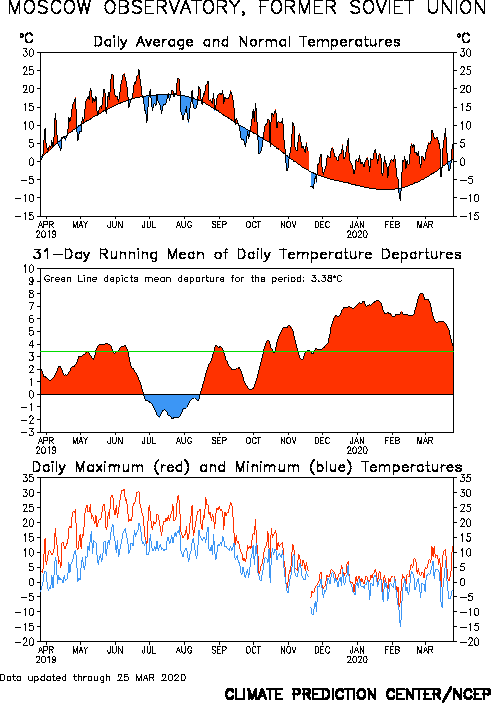
It really is rather hard to make a claim that “global warming did it” when data says otherwise.
So other than an angry rant basically saying “global warming caused it cuz we say it does”, what has Tobis got in the way of a factual argument? Where is his supporting data? And he didn’t answer the question: “If global warming caused this snowfall event, what caused the heavy snow 100 years ago when CO2 levels were below Hansen’s “safe” 350ppm?”
His two commenters didn’t answer the question either. They also offered no supporting data.
They and Tobis (and the WWF zealot with the original comment) have bupkis.
For the record I grew up in the midwest, and faced the great blizzard of 1978 with its exceptionally cold temperatures and huge snowfalls, plus the Chicago Blizzard of 1979 (to name a couple I experienced firsthand). Tobis and friends seem to think that living in Northern California now somehow disqualifies me from understanding snow and temperature. That’s probably the lamest argument ever put forth by that guy. Imagine if I made the same argument because Tobis lives in Austin, TX. where “snowfall is rare“.
Should you care to visit Tobis’ blog, here’s the link: http://planet3.org/2013/02/05/logic-fail-logic-fail/
Good luck trying to get a factual word in.
Sidebar: The WWF zealot (Kokorin) who made the claim about AGW and snow in the original newspaper article has an interesting view of the world. See this comment from WUWT Larry Huldén
Larry Huldén says:
Alexei Kokorin, director of the climate and energy program at WWF Russia, is the same person who claimed that malaria never occurred in Russia before late 20th century warming. He claimed that malaria for the first time entered Russia because of global warming in 1990′s.
That checks out, see this NPR story: Russian Scientists Fear Warming May Bring Disease
Mr. KOKORIN: (Through translator) There were no registered cases of malaria in the Moscow region until the 1970s. Since then, we’ve seen 400,000 cases of so-called three-day malaria. That’s like a bad flu for healthy adults but can be very serious for children and the elderly. It’s far too many cases.
Three day Malaria? Must be the Vodka.
But the truth about the cause says otherwise, from the World Health Organization report on Malaria in Russia (which they almost eradicated in the 1960s) here.
Profound socioeconomic changes in the newly independent states (NIS) in the 1990s had a negative impact on the malaria situation in the Russian Federation. Epidemics in Azerbaijan and Tajikistan in the early 1990s, along with intensive population movement from these countries into the Russian Federation, brought about an increase in malaria cases.
Not one mention of warming or temperature in that article, only socioeconomic causes.
Looks like the WWF zealot has bupkis too.
UPDATE: Within a few minutes of publication Mr. Tobis posted a rebuttal comment here (because unlike his blog, it is easy to post a comment here immediately) that said:
mtobis (@mtobis) says:
You’re missing the point. Obfuscation aside, the point is that excessive February snow in Moscow means that February in Moscow is more likely to be anomalously warn than anomalously cold. Which you ought to know.
Here is my reply:
Tobis writes: “February in Moscow is more likely to be anomalously warn[sic] than anomalously cold.”
But it isn’t, the data I presented from the Moscow Observatory shows a below normal temperature in January into February. And, this is a single event we are talking about in the newspaper article, not a trend, not a long term climate issue.For more on snow and temperature see this: http://ww2010.atmos.uiuc.edu/%28Gh%29/guides/mtr/fcst/prcp/rs.rxml
The claim about this snow event being driving by AGW is the same logical fallacy you and your buddies embraced with the Moscow heat wave in 2010, which was a weather event, not a climate event. And, that’s not just my opinion, NOAA shares it too.
http://wattsupwiththat.com/2011/03/09/noaa-findsclimate-change-blameless-in-2010-russian-heat-wave/
Further to your claim, let’s look at long term snow trends for that part of the world. Rutgers Snow Lab offers some helpful plots. First all months of data back to the beginning of their record:

Source: http://climate.rutgers.edu/snowcover/chart_anom.php?ui_set=0&ui_region=eurasia&ui_month=12
Now, the month of February.

Source: http://climate.rutgers.edu/snowcover/chart_anom.php?ui_set=1&ui_region=eurasia&ui_month=2
If global warming was creating more snow in that area, wouldn’t there be an upwards trend?
Ya still got bupkis Mike. – Anthony
UPDATE2: I recalled on the drive into the office today that Tobis made this claim in 2010 related to lack of snow at the winter Olympics:
“But there’s another lesson here, too. Don’t overreach. Is there anything in any particular weather event (except prehaps [sic] ones far more bizarre than this one) that offers strong evidence for or against any theory of climate change?
…
But big snowstorms in the mid-Atlantic or the South, particularly in El Nino years, are not evidence in favor of anthropogenic climate change either. They are not the sort of thing we particularly expect more of because of human interference. At best it seems to me that the case is uncertain.”
http://init.planet3.org/2010/02/hill-of-snow.html
Besides having bupkis, Mike Tobis can’t make up his mind about snow and AGW, like the weather itself, he’s fickle. – Anthony
UPDATE3: My response to Mr. Tobis in comments:
@mtobis.
You really shouldn’t try to cover up errors with more errors and some added lies.
Maybe you think you are being unclear, but your choice of words reveals that you are just being a sanctimonious fool and using the issue as an excuse to slog off on skeptics in general. Your comments about “deniers” and where they live and warm climate etc, have no basis in reality, and your insistence of “all I said was” doesn’t jibe with your original printed claims.
There’s no connection that you’ve demonstrated between the snow in Moscow and global warming, and you’ve offered nothing but sputtering rhetoric and condescension instead of substance to back up your ridiculous claims. This was a weather event, formed in the clash of air masses, cold and dry -vs- moist and warm, just as snow has formed since weather on Earth began. It is a simple case of patterns, much like the Russian heat wave during the summer of 2010.
Here in the image below, we have a meridional S-N flow pattern, pulling in warm air and moisture ahead of a low, which has been fairly persistent throughout the winter. Moscow has received several similar episodes of overrunning precipitation, with Moscow wedged between strong high pressure to its east and low pressure to its west. Its a persistent pattern driven funnel effect, nothing more.
If there was zonal flow instead, no big snow events would be happening in Moscow. As it stands, warmer moister air must be drawn northward to produce that sort of snow event.
This image from WeatherBell.com is a GFS model forecast, and it shows more snow to likely hit Moscow Friday as warmth/moisture from low pressure driven advection is drawn northward. Rinse, repeat, and you have a snow machine.

It was not a climate event, because as I demonstrated, there is no evidence of a longer trend for more snow in the area. There is also no evidence that the pump was “primed” for more snow by global warming.
The only reason this is an issue now is that you and others are losing the climate sensitivity argument due to lack of observed warming, and you and others are looking for linkages where there are none to be had. If you have something of substance (data, graphs, etc) to prove your point, you are welcome to post them here.
Otherwise your comments are just opinionated noise from somebody who doesn’t get the difference between weather events and climate, except when it suits you.
My experience (37 yrs) in the midwest US is that the biggest snows are the result of a really cold front coming in, so the temps drop as the snow comes in to the point that kids won’t go sledding on the 1 foot of snow we just got, whereas a warmer front coming from the south only drops some snow, not the really big ones. Of course I am talking depth, not area.
The real fallacy of Tobis is that years with a big snow AREA anomaly must include snow being farther south, which means it must be colder than average or those areas would have had rain.
When water vapour condenses or crystallizes, it dumps its latent heat into the surrounding air (where else?). The fallen snow thereafter causes cooling, as mentioned above by several. But during the snow event, the snow is causing local warming. Exactly (as usual) the reverse causality direction to that touted by warmists like Tobin and his ilk.
Note that this latent heat transfer is consistently acting as negative feedback. Air cooled → condensed or crystallized water vapour → rewarmed air. Air heated → standing/flowing water evaporates → re-chilled air. Latent heat exchange is a huge buffer that keeps temps within (our preferred livable) range.
typo: Tobis
TobinThis appears to be another of those “teachable moments” that someone whould take advantage of. What finally “falls” may be rain, snow, sleet, or freezing rain depending on a number of factors. Any comments on the Bergeron Process, the environmental lapse rate, super-cooling, phase changes, etc.?
The latest heavy snow fall in Moscow is not just a single weather event but part of an entire winter trend in Russia which already started in November and could go to February and March. A negative AO is part of this cold weather cause.
November 2012 snow storm
Moscow’s City Hall said it expects the snowstorm, which is due to continue at least until Friday morning, to be the biggest in November in 50 years.
http://www.rte.ie/news/2012/1129/355850-moscow-snowfall/
December 2012 cold weather[-30 Cin Moscow]
Coldest in 70 years in Eastern Russia.[temperatures hit -50C in Siberia
”In the end of 2012, Russia saw extreme winter not witnessed since 1938. The coldest-ever December in Russia led to the evacuation of hundreds of people in Siberia, where temperatures fell below -50 degrees Celsius; Moscow also saw its coldest night ever for the season.”
http://www.theage.com.au/world/brutally-cold-russian-winter-kills-123-people-20121226-2bvlx.html
January 2013 snow storm
Norilsk (Photo from bigpicture.ru)
On Friday, Moscow was on a verge of traffic collapse as more than 10 inches of snow fell on the city, which is more than half of January’s average.
http://rt.com/news/winter-snow-russia-weather-275/
Doug says:
February 6, 2013 at 6:23 pm
Gail Combs,
Re.’Global Warming’ is, and always was, a policy for genocidal reduction of the world’s population.”
There’s now a hitch in the population/climate argument giddyup. New research suggests that the globe’s population will soon level off and begin declining (see below).
>>>>>>>>>>>>>>>>>>>>>>>>>>
Yes, modern civilization leads to reduced birth rates, unfortunately that does not stop Paul Ehrlich, Obama’s Science Czar’s co-author, from believing that overpopulation imperils the Earth’s future. link
Facts are never allowed to get in the way of a good ‘crisis’ that can be used as propaganda.
Kelly says:
February 6, 2013 at 6:31 pm
I too trudged through those snows in 1978 at Purdue….
>>>>>>>>>>>>>>>>>>>>>>>
I bough my first down jacket after having to hike around Purdue’s campus. BRRrrrr.
Arctic sea ice is an important component of the global climate system. The polar ice caps help to regulate global temperature by reflecting sunlight back into space. White snow and ice at the poles reflects sunlight, but dark ocean absorbs it. Replacing bright sea ice with dark ocean is a recipe for more and faster global warming. The Autumn air temperature over the Arctic has increased by 4 – 6°F in the past decade, and we could already be seeing the impacts of this warming in the mid-latitudes, by an increase in extreme weather events. Another non-trivial impact of the absence of sea ice is increased melting in Greenland. We already saw an unprecedented melting event in Greenland this year , and as warming continues, the likelihood of these events increase.
Just to keep things in perspective . Ottawa, Ontario, Canada’s capital had 432 cm of snow during the 2007/2008 winter. Ottawa gets about 236 cm of snow annually. By the end of January 2008, it had 223 cm to compare with Moscows 216 cm by the same date this year . No one blamed this on global warming , nor should they . Nature sometime exceeds it’s typical annual amounts , An examination of snow falls for any region will clearly demonstrate the variability of the snowfall over an extended period .This has absolutely nothing to do with global warming . I think some of these alarmist climate scientists were only born yesterday and know nothing about climate outside their own little crib.
Charity U. Stout says:February 7, 2013 at 10:16 pm
The ocean dumps heat at the north pole when the water is exposed. The only time it gets sun is in the summer when it has ice. The angle of incidence of the sun is too low to have an impact at other times of the year. We do not have an increase in extreme weather events.
To add a bit more to the Eugenics angle.
Wikipedia has a fair entry on the history of the Poor Laws in England.
This history is fairly well documented back to the 1400s, with the economic tides following the Black Plague.
Christians have always accepted charitable activity as a component of showing the fruits of living in Christ. Back in the day, just about everyone in Europe was Christian by faith, social influence, or royal decree. Christianity includes the concept of the sojourner – who we are to treat decently, since the Israelites were once sojourners in Egypt.
So, the villagers of the various hamlets had some sort of mandate to provide charitable relief to vagabonds, vagrants, wanderers, etc.
At a certain point, possibly as a some level of general wealth and economic stability emerged following the Plague, you could be a vagabond and have a pretty good life. At the expense of the locals.
Do an odd job here and there.
Swipe a loaf of bread or skip a meal check when opportunity presented itself.
So, you eventually wore out your welcome. You were arrested or run out of town.
Poor Laws, and Poor Houses, and Alms Houses, developed as a more formal way to deal with the undesirable vagrants. A legal system was declared, with the local magistrate in charge of seeing that things were in place as dictated by law, and the actual plan was aassigned to the local vicar. Various revenue-raising schemes were used – yes, taxes. This diverges from Christianity. But the vicar had the legal mandate nonetheless. Yes, close integration of church and state. The local vicar was a natural, having the Biblical view and mandate.
At first, alms-houses were shelters, but evolved to offer shelter and meals in the evening, but requiring work. The value of decent roads was being realized, and that was often accomplished with crushed rock. Guess who was offered the job of crushing rocks by sledgehammer?
Hence the tradition of “breaking rocks” assigned to the community of ne’er-do-wells.
Poor houses were settings for care that were delivered with a mix of charity and contempt. There are plenty of speeches and editorials noting how these vagrants and ne’er-do-wells were lazy, inclined to pilfer, and how the females were inconsiderate toward the local society in the way they would express fertility. Also, they spread disease.
And people soon figured out that these interventions – forcing hard work in hopes that they woudl climb up the economic ladder to easier better paying work – did not work at all. A decent poor-house system would attract vagabonds.
These laws kept being modified. Including declarations of residency claim by family or tenure – at least have people helping “their own,” versus vagrants from far away.
Largely, the rhetoric was not racial – these were all whites.
The rhetoric was class-based.The working and productive class were bothered to support the lazy, pilfering, reproducing class. The rhetoric was moral – not contributing, not living a proper Godly life.
Along comes science, and, as noted above in an earlier comment, Galton. Galton and the scientifick-y zeitgeist claimed that the laziness, the tendency to theft, and the fecundity were genetically based matters of natural science.
Galton coined the term ‘Eugenics,’ in the late 1800s, around the time that the Poor Laws were being abolished. Frank socialism was coming of age back then to replace it. But eugenics held promise to FINALLY rid the good people of merry old England of these pesky ne’er-do-wells.
So, the sentiment was the same, the social/policy issue was the same, but the solutions were no longer moral, but scientific: identifiy the less-fit, encourage birth control, and other interventions came along. All justified as “scientific.”
Fast forward to today. Our leading missions in the world are to make birth control and abortion widely available in the dependent-class countries. We cover our classism with a scientifick-y mantle of “over-population,” “demography,” etc., and still with noble, moral concepts of nobless oblige and charity, optimistically delivered by the progressive ideal of the promise of “science.”