UPDATES have been added: see below. Not only does Tobis have bupkis, he’s been caught out in a Janus moment from 2010 where he says the exact opposite. – Anthony
I wrote a post yesterday pointing out how a WWF zealot immediately linked a heavy snowfall event in Moscow, Russia to ‘global warming’. Marc Morano of Climate Depot pointed out this hilarity at the secular Tobis Planet 3.0 blog in an email: Warmist Tobis says heavy snow is agw: calls anyone who mocks ‘clueless’ Logic Fail Logic Fail
Here’s what Tobis thinks:
It is interesting that most deniers seem to live in warm climates.
They cannot conceive of the possibility that unusually heavy winter snow is connected with less than usual winter cold in cold zones, something that pretty much all of us who grew up in frigid zones understand perfectly well. They are so confused that they find this perfectly ordinary fact of mundane reality grounds for mockery.
It’s quite a spectacle.
(Igloos in DC are another matter. A rare snow event in a non-snowy zone is not evidence of a warming trend. Of course, there’s more to climate disruption than just warming, but at least they are making some semblance of sense in that case, at least polemically, as the relationship is a bit complicated.)
But to mock a connection between heavy snow in February in Moscow and global warming is pretty much clueless.
![michael_tobis-medium[1]](http://wattsupwiththat.files.wordpress.com/2013/02/michael_tobis-medium1.jpg?quality=83 "Michael Tobis")
 So, let’s look at some data.The popular warmist theory is that reduced summer sea ice causes the enhanced snow effect, and that sea ice reduction is caused by global warming, but it isn’t cut and dried proof. Then there is the months-long lag problem between reduced sea ice and weather.Dr. Judith Curry has discussed the science in her paper from Georgia Tech here: http://judithcurry.com/2012/03/05/impact-of-declining-arctic-sea-ice-on-winter-snowfall/ (h/t to Mosher)Joe D’Aleo also posted a critique to the Liu and Curry paper on WUWT here:http://wattsupwiththat.com/2012/03/02/increasing-winter-cold-in-recent-years-and-the-arctic/From a previous WUWT essay by Willis Eschenbach, who points out that neither essay compared sea ice and snow area, I repost this graph. Readers (and Tobis too) should find the correlation between Arctic sea ice and Snow area.

Figure 2. Arctic sea ice area (blue) and Northern Hemisphere snow area (red). Upper panel shows actual data. Lower panel shows the anomalies of the same data, with the same units (note different scales). The R^2 of the snow and ice anomalies is 0.01, meaninglessly small. The R^2 of the first differences of the anomalies is 0.004, equally insignificant. Neither of these are significantly improved by lags of up to ± 6 months. SNOW DATA ICE DATA
Willis wrote then:
I’m not going to say a whole lot about this graph. It is clear that in general the arctic ice area has been decreasing for twenty years or so. It is equally clear that the northern hemisphere snowfall has not been increasing for the last twenty years. Finally, it is clear that there is no statistical relationship between decreased ice and increased snow.
Speaking of statistical relationships, here’s a couple.
The graph below plots annual snowfall vs December to April temperature, for all Colorado USHCN stations which have been continuously active since at least 1920.

The Colorado USHCN Stations plotted are:
BOULDER, CANON CITY, CHEESMAN, CHEYENNE WELLS, DEL NORTE 2E, DILLON 1 E, EADS, FT COLLINS, FT MORGAN, FRUITA, GUNNISON 3SW, HERMIT 7 ESE, LAMAR, LAS ANIMAS, MANASSA, MONTROSE #2, ROCKY FORD 2 SE. STEAMBOAT SPRINGS, TRINIDAD, and WRAY
And for those that would say that is too small a sample size, let’s take it up a notch. Below is all USHCN station temperatures for December-April in the CONUS versus snowfall.

Here is all USHCN stations annual temperature in the CONUS versus snowfall.

Clearly snowfall increases with decreased temperature. The three graphs above were plotted by Steve Goddard.
But back to Tobis’ main point, in which is he’s claiming (bold mine):
They cannot conceive of the possibility that unusually heavy winter snow is connected with less than usual winter cold in cold zones, something that pretty much all of us who grew up in frigid zones understand perfectly well. They are so confused that they find this perfectly ordinary fact of mundane reality grounds for mockery.
Well, there’s data for that question too.
![tn27612_1yr[1]](http://wattsupwiththat.files.wordpress.com/2013/02/tn27612_1yr1.gif)
Note the middle graph in particular, showing below normal temperatures to the present. All temperatures in Celsius.
Source: http://www.cpc.ncep.noaa.gov/products/global_monitoring/temperature/tn27612_1yr.gif h/t to WUWT reader “J”.
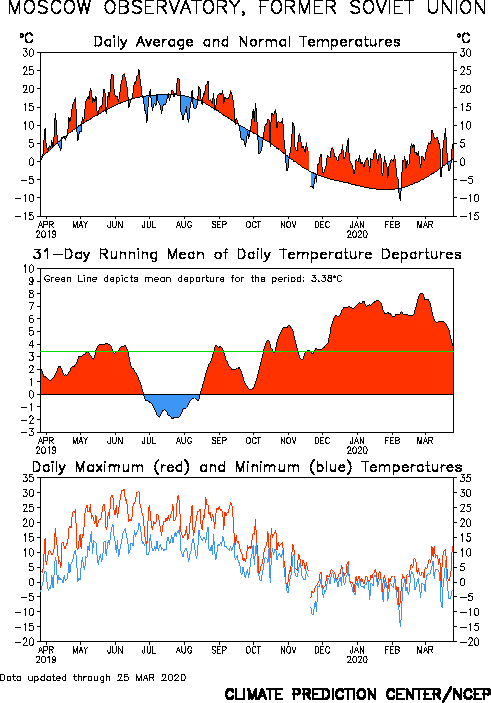
It really is rather hard to make a claim that “global warming did it” when data says otherwise.
So other than an angry rant basically saying “global warming caused it cuz we say it does”, what has Tobis got in the way of a factual argument? Where is his supporting data? And he didn’t answer the question: “If global warming caused this snowfall event, what caused the heavy snow 100 years ago when CO2 levels were below Hansen’s “safe” 350ppm?”
His two commenters didn’t answer the question either. They also offered no supporting data.
They and Tobis (and the WWF zealot with the original comment) have bupkis.
For the record I grew up in the midwest, and faced the great blizzard of 1978 with its exceptionally cold temperatures and huge snowfalls, plus the Chicago Blizzard of 1979 (to name a couple I experienced firsthand). Tobis and friends seem to think that living in Northern California now somehow disqualifies me from understanding snow and temperature. That’s probably the lamest argument ever put forth by that guy. Imagine if I made the same argument because Tobis lives in Austin, TX. where “snowfall is rare“.
Should you care to visit Tobis’ blog, here’s the link: http://planet3.org/2013/02/05/logic-fail-logic-fail/
Good luck trying to get a factual word in.
Sidebar: The WWF zealot (Kokorin) who made the claim about AGW and snow in the original newspaper article has an interesting view of the world. See this comment from WUWT Larry Huldén
Larry Huldén says:
Alexei Kokorin, director of the climate and energy program at WWF Russia, is the same person who claimed that malaria never occurred in Russia before late 20th century warming. He claimed that malaria for the first time entered Russia because of global warming in 1990′s.
That checks out, see this NPR story: Russian Scientists Fear Warming May Bring Disease
Mr. KOKORIN: (Through translator) There were no registered cases of malaria in the Moscow region until the 1970s. Since then, we’ve seen 400,000 cases of so-called three-day malaria. That’s like a bad flu for healthy adults but can be very serious for children and the elderly. It’s far too many cases.
Three day Malaria? Must be the Vodka.
But the truth about the cause says otherwise, from the World Health Organization report on Malaria in Russia (which they almost eradicated in the 1960s) here.
Profound socioeconomic changes in the newly independent states (NIS) in the 1990s had a negative impact on the malaria situation in the Russian Federation. Epidemics in Azerbaijan and Tajikistan in the early 1990s, along with intensive population movement from these countries into the Russian Federation, brought about an increase in malaria cases.
Not one mention of warming or temperature in that article, only socioeconomic causes.
Looks like the WWF zealot has bupkis too.
UPDATE: Within a few minutes of publication Mr. Tobis posted a rebuttal comment here (because unlike his blog, it is easy to post a comment here immediately) that said:
mtobis (@mtobis) says:
You’re missing the point. Obfuscation aside, the point is that excessive February snow in Moscow means that February in Moscow is more likely to be anomalously warn than anomalously cold. Which you ought to know.
Here is my reply:
Tobis writes: “February in Moscow is more likely to be anomalously warn[sic] than anomalously cold.”
But it isn’t, the data I presented from the Moscow Observatory shows a below normal temperature in January into February. And, this is a single event we are talking about in the newspaper article, not a trend, not a long term climate issue.For more on snow and temperature see this: http://ww2010.atmos.uiuc.edu/%28Gh%29/guides/mtr/fcst/prcp/rs.rxml
The claim about this snow event being driving by AGW is the same logical fallacy you and your buddies embraced with the Moscow heat wave in 2010, which was a weather event, not a climate event. And, that’s not just my opinion, NOAA shares it too.
http://wattsupwiththat.com/2011/03/09/noaa-findsclimate-change-blameless-in-2010-russian-heat-wave/
Further to your claim, let’s look at long term snow trends for that part of the world. Rutgers Snow Lab offers some helpful plots. First all months of data back to the beginning of their record:

Source: http://climate.rutgers.edu/snowcover/chart_anom.php?ui_set=0&ui_region=eurasia&ui_month=12
Now, the month of February.

Source: http://climate.rutgers.edu/snowcover/chart_anom.php?ui_set=1&ui_region=eurasia&ui_month=2
If global warming was creating more snow in that area, wouldn’t there be an upwards trend?
Ya still got bupkis Mike. – Anthony
UPDATE2: I recalled on the drive into the office today that Tobis made this claim in 2010 related to lack of snow at the winter Olympics:
“But there’s another lesson here, too. Don’t overreach. Is there anything in any particular weather event (except prehaps [sic] ones far more bizarre than this one) that offers strong evidence for or against any theory of climate change?
…
But big snowstorms in the mid-Atlantic or the South, particularly in El Nino years, are not evidence in favor of anthropogenic climate change either. They are not the sort of thing we particularly expect more of because of human interference. At best it seems to me that the case is uncertain.”
http://init.planet3.org/2010/02/hill-of-snow.html
Besides having bupkis, Mike Tobis can’t make up his mind about snow and AGW, like the weather itself, he’s fickle. – Anthony
UPDATE3: My response to Mr. Tobis in comments:
@mtobis.
You really shouldn’t try to cover up errors with more errors and some added lies.
Maybe you think you are being unclear, but your choice of words reveals that you are just being a sanctimonious fool and using the issue as an excuse to slog off on skeptics in general. Your comments about “deniers” and where they live and warm climate etc, have no basis in reality, and your insistence of “all I said was” doesn’t jibe with your original printed claims.
There’s no connection that you’ve demonstrated between the snow in Moscow and global warming, and you’ve offered nothing but sputtering rhetoric and condescension instead of substance to back up your ridiculous claims. This was a weather event, formed in the clash of air masses, cold and dry -vs- moist and warm, just as snow has formed since weather on Earth began. It is a simple case of patterns, much like the Russian heat wave during the summer of 2010.
Here in the image below, we have a meridional S-N flow pattern, pulling in warm air and moisture ahead of a low, which has been fairly persistent throughout the winter. Moscow has received several similar episodes of overrunning precipitation, with Moscow wedged between strong high pressure to its east and low pressure to its west. Its a persistent pattern driven funnel effect, nothing more.
If there was zonal flow instead, no big snow events would be happening in Moscow. As it stands, warmer moister air must be drawn northward to produce that sort of snow event.
This image from WeatherBell.com is a GFS model forecast, and it shows more snow to likely hit Moscow Friday as warmth/moisture from low pressure driven advection is drawn northward. Rinse, repeat, and you have a snow machine.

It was not a climate event, because as I demonstrated, there is no evidence of a longer trend for more snow in the area. There is also no evidence that the pump was “primed” for more snow by global warming.
The only reason this is an issue now is that you and others are losing the climate sensitivity argument due to lack of observed warming, and you and others are looking for linkages where there are none to be had. If you have something of substance (data, graphs, etc) to prove your point, you are welcome to post them here.
Otherwise your comments are just opinionated noise from somebody who doesn’t get the difference between weather events and climate, except when it suits you.
“Under normal conditions of the past few millennia, continental high latitude locations get most of their snow in late fall and early spring.”
This is not supported by the data.
Here is the average monthly snowfall for a whole bunch of US cities: http://www.ncdc.noaa.gov/oa/climate/online/ccd/snowfall.html
Looking at cities listed for Maine, Massachusetts, Michigan and Minnesota (because they are all listed right there together) virtually every one has their highest snow total in January or February. I think I saw one that was December, and you could possibly argue that is technically Fall I suppose.
That one statement tells me you have no idea what you are talking about.
Two fairly opposing claims in a single day, Michael, lets not strain yourself there.
Malaria!!!
Never let facts get in the way of your ‘hidden’ agenda.
The old malaria Scarum again. I quote from The history of malaria in England, by Mary Dobson.
http://malaria.wellcome.ac.uk/doc_WTD023991.html
This was at the height (depth?) of the Little Ice Age, making the neccessary link between malaria and global warming look doubtful.
See also From Shakespeare to Defoe: Malaria in England in the Little Ice Age by Paul Reiter of the Centers for Disease Control.
http://wwwnc.cdc.gov/eid/article/6/1/pdfs/00-0101.pdf
Famous science writer and AGW advocate John Gribbin even speculates that King James (he of Bible fame) may have died of malaria in 1625.
If you’ve got a map to hand, locate Murmansk in Russia. Then google “Murmansk Malaria” and start reading …
Pointman
rgbatduke says:
February 6, 2013 at 8:41 am
……We could probably do this without the vaccine if we put one tenth of the money we’ve wasted on carbon trading and ameliorating AGW into the aggressive treatment of the disease and the aggressive economic development of the impoverished peoples of the parts of the world where the disease thrives….
>>>>>>>>>>>>>>>>>>>>>>>>>>>>
You are missing the point entirely. The idea is to kill off the surplus human population, the ‘useless eaters’ and Malaria does that quite nicely.
No that is not sarcasm unfortunately. Eugenics has been with us for over a century and was still practiced in the USA in to the late seventies AFTER the ban on DDT. As the last excerpt shows Eugenics is still not dead and buried.
Eugenics was the brainchild of Charles Darwin’s cousin Francis Galton. Fabian founder Beatrice Webb said eugenics was “the most important question” of all.
Having a member of the Eugenics Society as the Director-General of the United Nations Educational, Scientific, and Cultural Organization (UNESCO) certainly helps explain why not much progress has been made in lifting third world countries out of poverty despite seventy years of pour tax paper dollars into the effort.
Eugenics was not restricted to the UK either. From our home state of North Carolina there was the North Carolina Eugenics Board and Margaret Mead, president of the American Association for the Advancement of Science.
Elaine Dewar wrote in Toronto’s Saturday Night magazine crediting Maurice Strong with starting the Global Warming Hoax.
Others credit Mead
This recent articles show Eugenics has just morphed into “overpopulation imperils the Earth’s future” or “Global Swarming”
As the first article sited states:
pat says: @ur momisugly February 6, 2013 at 8:46 am
And then there is his certain knowledge of where skeptics live.
This is not a serious person.
>>>>>>>>>>>>>>>>>>>>>>>>>>>>
Actually his comment about where skeptics live is vastly entertaining. Think about it. Anthony, I and Gallopingcamel to name just a few have MOVED SOUTH.
Certainly says something about our fears of Global Warming (or our hatred of shoveling snow)
As for blizzards, I almost died due to a blizzard and whiteout conditions when walking home from the school bus stop at age six. I still have problems from the frost bite. So bring on the warming it sure beats the heck out of cold!
So, mtobis seems to be claiming that because of global warming, the snow is warmer now than it was in the past.
And why precisely, is that a bad thing?
> From the 15th century onwards, malaria was endemic along the coasts and estuaries of south-east England, the Fenlands, and estuarine and marshland coastal areas of northern England.
A most peculiar observation. Having lived in the Fenlands for more than two years, and another four years in the estuarine areas of Scotland, I have not once been bitten by a mosquito. I have seen some, but they were not of the blood-sucking kind. Nobody around here uses mosquito screens and they are not even sold at stores. I realise the fens were drained centuries ago, but there is still a lot of water everywhere that from the looks of it would make any mosquito happy. And the climate is so mild they could breed all year round. It is very puzzling that they don’t, and nobody I asked could give me an answer.
That’s a very pleasant contrast to all other places I lived in and visited, where harassment by mosquitoes was the norm.
thomaswfuller2 says:
February 6, 2013 at 9:51 am
Well, this is a first. I actually think (and have commented at P3) that I think Tobis may be correct and you may be wrong. Growing up in Decatur Illinois we often heard the phrase ‘too cold to snow.’ Usually with an expletive involved.
>>>>>>>>>>>>>>>>>>>>>>>>>>>>>
SWAG
Humidity modifies the temperature so the day/night temperature swings are much shallower therefore you are going to have much colder nights when it is dry. It is not that it is too cold to snow, it is that the moisture causes the temperature to be higher.
Anthony could probably tell you if I am correct.
This SWAG is based on the quick look at actual data in a desert and a rain forest at these comments:
comment 1
comment 2
comment 3
During the period 1900-2012 there were 29 winters in Moscow that had annual mean winter temperatures of -10 C or lower.and there was a lot of snow . One cold winter every four years . During the 1920’s , 6 of the 10 years were that cold .There have been none since 1987. So as soon as we get back to some winters that are closer to the past norm for an entire century for Moscow, suddenly global warming is being blamed on the extra snow. Well we better get used to this colder weather and extra snow that comes with it . There will be more of this for the next 20-30 years , not every year but much more frequently than the last 2 1/2 decades . Global warming had very little to do with this cold weather and the occasional extra heavy snow levels 100 years ago and it has little to do with it now . What nonsense.
In 2001, the much-vaunted authority on all things climate, the IPCC stated that “Milder winter temperatures will decrease heavy snowstorms”.
But now that Mother Nature has refused to cooperate, the Alarmists have reversed themselves.
It seems that what they really meant was that they will actually increase them and make them more severe.
Same game, different rules, and new goal posts. Must be nice.
@mtobis.

You really shouldn’t try to cover up errors with more errors and some added lies.
Maybe you think you are being unclear, but your choice of words reveals that you are just being a sanctimonious fool and using the issue as an excuse to slog off on skeptics in general. Your comments about “deniers” and where they live and warm climate etc, have no basis in reality, and your insistence of “all I said was” doesn’t jibe with your original printed claims.
There’s no connection that you’ve demonstrated between the snow in Moscow and global warming, and you’ve offered nothing but sputtering rhetoric and condescension instead of substance to back up your ridiculous claims. This was a weather event, formed in the clash of air masses, cold and dry -vs- moist and warm, just as snow has formed since weather on Earth began. It is a simple case of patterns, much like the Russian heat wave during the summer of 2010.
Here in the image below, we have a meridional S-N flow pattern, pulling in warm air and moisture ahead of a low, which has been fairly persistent throughout the winter. Moscow has received several similar episodes of overrunning precipitation, with Moscow wedged between strong high pressure to its east and low pressure to its west. Its a persistent pattern driven funnel effect, nothing more.
If there was zonal flow instead, no big snow events would be happening in Moscow. As it stands, warmer moister air must be drawn northward to produce that sort of snow event.
This image from WeatherBell.com is a GFS model forecast, and it shows more snow to likely hit Moscow Friday as warmth/moisture from low pressure driven advection is drawn northward. Rinse, repeat, and you have a snow machine.
It was not a climate event, because as I demonstrated, there is no evidence of a longer trend for more snow in the area. There is also no evidence that the pump was “primed” for more snow by global warming.
The only reason this is an issue now is that you and others are losing the climate sensitivity argument due to lack of observed warming, and you and others are looking for linkages where there are none to be had. If you have something of substance (data, graphs, etc) to prove your point, you are welcome to post them here.
Otherwise your comments are just opinionated noise from somebody who doesn’t get the difference between weather events and climate, except when it suits you.
So, when did Al Gore land in Russia?
Sounds like the Gore effect to me.
cn
davidmhoffer says:
February 6, 2013 at 9:13 am
++++++++++++++++++++++++++++++++++++++++++++++++++++++++++++++++++++++++++++
Good comment on the insulating value of snow. I used to collect ground temperature information for designing foundations, road, water and sewer systems. I helped write a few design manuals for my company and a some government agencies. We used to monitor ground temperatures to depth in various ground conditions, under roadways, in the ditch and in shoulders and at bridges. The frost depth clearly correlated with snow depth. Under roadways in one location where I was doing studies the winter frost often reached 13 feet under highways where the snow was cleared and in the adjacent ditch it would seldom exceed 5 feet. In sheltered areas with trees and good snow cover it would be even less. On the farm, snow cover makes a huge difference to the soil temperature in the spring, lack of snow cover makes the soil temperatures recover more slowly as the frost takes longer to come out of the ground. And I still shovel snow against some of the walls of my house and over my window wells in the walkout basement to enhance insulation even though the walls are over a foot thick with 8 inches of insulation.
Great thread overall.
Gail Combs,
Re.’Global Warming’ is, and always was, a policy for genocidal reduction of the world’s population.”
There’s now a hitch in the population/climate argument giddyup. New research suggests that the globe’s population will soon level off and begin declining (see below).
“About That Overpopulation Problem
Research suggests we may actually face a declining world population in the coming years.”
By Jeff Wise
Slate Magazine
Wednesday, Jan. 9, 2013
http://www.slate.com/articles/technology/future_tense/2013/01/world_population_may_actually_start_declining_not_exploding.html
I too trudged through those snows in 1978 at Purdue. The snow on either side of the streets and sidewalks was a meter high or more. Coming from Northern Indiana in the shadow of Lake Michigan I was used to snow and cold but that was something completely other. I remember breathing as fast as possible, hoping the extra CO2 I exhaled would warm up the atmosphere a bit.
Do you think overdid it?
Perfectly summed up in Anthony’s 6:04 post. It doesn’t even take someone with climate/weather background to punch hole after hole in his tripe. I’m just an engineer with google skills and I think I fairly comprehensively debunked his “continental high latitude locations get most of their snow in late fall and early spring” BS.
Like the drunk clinging to the lamp post for support, rather than illumination …
Nowhere on this planet where humans can live is it “too cold to snow”.
It’s not evidence FOR it either, as you have been attempting to imply. It’s only evidence that once in a while, conditions are right for a whopper of a snow.
This all strikes me as not one, but at least two logical absurdities.
The first one begins with:
“Within a few years winter snowfall will become a very rare and exciting event. Children just aren’t going to know what snow is.”
— Dr David Viner, senior research scientist at the climatic research unit (CRU) of the University of East Anglia
And continues to the point where snow is most common between a fairly narrow temperature band about the freezing point of water. It then suffers from a known condition, a boundary condition between fronts (there is a meteorological term, Anthony, help me out here) where, if I remember correctly, there is a compression zone between the two fronts. Raise the pressure of a gas and what happens Charles Gay, Lussac? Then bring on the snow.
On Christmas Eve 1982, a few friends and I had ripped up Peaks to Peaks highway in Colorado’s Front Range in T-shirt 70’s temps on our big sportbikes. The next morning I awoke to not just a white Christmas in downtown Denver, but 5 feet of it. If 8C converts to 14.4F and we take the ambient temps we were experiencing in our T-shirts sitting at some 8,000 feet altitude, then the temperature had to drop a few multiples of 8C to get temperatures low enough to deposit such a think blanket of snow, and keep it there for weeks…….
That is the first logical absurdity which includes the subsurdities of children not knowing what snow is say in Europe, Britain over the past few winters, and yes Moscow now, or simply that you cannot have it both ways, Both cannot be right. Another subsurdity is that the contact band between two fronts is commonly compressive, which would leave one to suspect, that if the gas laws are right, air heats when compressed, and this globe-trotting geologist has experienced this all over the planet. I tend to be surprised when I do not note this phenomenon during a frontal passage. The final subsurdity here is that I see your 8C and raise you 2x8C at ~8,000 feet. My hole card being that Denver is ~3,000 feet lower, meaning I might have another 8C (making 3 of them) left to bet.
The second logical absurdity lies in the 4th dimension, time. In laying full claim to this being an absurdity, we will first assume that you are correct, now, not sometime in the past. But since this is about this new variable time, we are obligated to consider perhaps when we live. At a roughly half-precession old extreme interglacial. Five of the last six interglacials have each lasted about half a precession cycle. In order to test your hypothesis, we will now take a short excursion in time to the last interglacial, MIS-5e or the Eemian. Next we will dissemble a few choice quotes from the abstract of just one paper:
http://eg.igras.ru/files/f.2010.04.14.12.53.54..5.pdf (you might have to copy and paste that link in your browser)
“…the end of the Last Interglacial seems to be characterized by evident climatic and environmental instabilities….”
Environmental instabilities…….hmmmmm. Did Moscow just experience one of those? And “evident ” ones at that!
“sequences indicate simultaneously a strong increase of environmental oscillations during the very end of the Last Interglacial and the beginning of the Last Glaciation.”
So the last interglacial experienced strong environmental oscillations right at its very end. So Mr. Tobis, would the recent Moscow strong environmental oscillation at the half-precession old Holocene remotely suggest that….
“The pronounced climate and environment instability during the interglacial/glacial transition could be consistent with the assumption that it is about a natural phenomenon, characteristic for transitional stages.”
?
But the time domain is not yet done with us, is it? We have an engineering problem to solve at the climate poker table. The IPCC raised the stakes in the game to +0.59M sea level rise by 2100 (AR4, 2007). The consensus Anthropogenic worst case signal. Until AR5 comes out, you just went all in, didn’t you? I look over my post-MPT cards. I make some climate noise when I see your +0.59M rise by 2100 and raise you +6.0M at the end-Eemian.
You, with your 2007 AR4 worst case scenario of +0.59M by 2100, are all in. In my stash, I can still raise you to at least +21.3M (http://si-pddr.si.edu/jspui/bitstream/10088/7516/1/vz_Olson_and_hearty_a_sustained_21m_sea-level_highstand_during_mis_1.pdf) if not +45M (http://www.uow.edu.au/business/content/groups/public/@web/@sci/@eesc/documents/doc/uow045009.pdf).
The signal to noise ratio is informing. If we round up the IPCC AR4 worst case estimate to +0.6M, it still comes in at just 10% of what was most recently end extreme interglacial climate noise, if you will. That appears to be the minimum natural end-extreme-interglacial climate noise. If we use the worst case estimate for the end-Eemian of +45M, the signal to noise ration drops to just 1.333…% I could even allow you to raise your debt limit to +45M, and still be able to raise you to possibly +52M, making the anthropogenic signal to end-extreme interglacial noise almost 1% (http://lin.irk.ru/pdf/6696.pdf)
Which necessarily means that if you are 100% correct your best current consensus bet comes in at just 1-10% of the normal, natural end-extreme interglacial climate pot. You need to up your game in AR5, at least that much is a given.
Great post. With all the discussion surrounding temperatures during the snow storms, how come nobody ever mentions that precipitation is an exothermic event? I remember introduction to chemistry in high school. We actually quantified how much energy was released by a mole of h2o transitioning from a vapor to a liquid. A snow storm that huge must release a lot of heat. In fact, the hydrological cycle must be an immense heat pump when you factor in all those tropical clouds…
“So, let’s look at some data.”
Oh Anthony really, *data*, its like you haven’t got a model with pre-agreed answers that you can use instead…….
Sheesh you deniers always data,data,data…..
/sarc for all you non-english….
Looks like a lot of snow for us in the Northeast – great news for the skiers…
—
Blizzard to Bury New England at Week’s End
Two storms will merge quickly enough to bring colder air, heavy snow and increasing wind to New England. Some areas will be hit with an all-out blizzard and a couple of feet of snow.
The worst of the storm will hit the Boston-area late Friday and Friday night and will wind down Saturday morning. However, lingering effects from blowing and drifting snow, blocked roads and other travel delays are likely to linger into much of the weekend.
http://www.accuweather.com/en/weather-news/blizzard-to-bury-new-england-at-the-end-of-week/5673457