
By WUWT regular “Just The Facts”
I recently came across a January 21st, 2012 Peter Gleick article 2011 Climate Change in Pictures and Data: Just the Facts, which appears to mimic the format and approach of my January 1st, 2012 article A Big Picture Look At “Earth’s Temperature”.
What I find particularly amusing about Peter’s article is that a week after noting that, “Lost in this verbal debate are often the simple facts and data of climate change and the immense and definitive global observations of the ways in which our climate is actually changing around us.” Peter Gleick was perpetrating Fakegate. Why, if the “simple facts and data” support his viewpoint, would Peter resort to subterfuge and fakery?
If you read through Gleick’s article, you’ll see some of his “immense and definitive global observations”, like “anyone watching or reading the news or looking out the window probably had a sense that 2011 was a weird year with one bad, extreme weather disaster after another”…
Anyway, in honor Peter’s reinstatement as President of the Pacific Institute I figured that an update on the “simple facts and data” was in order.
Please note that WUWT cannot vouch for the accuracy of the data/graphics within this article, nor influence the format or form of any of the graphics, as they are all linked from third party sources and WUWT is simply an aggregator. You can view each graphic at its source by simply clicking on it.
Global Surface Temperatures:
Generally, when referring to Earth’s “climate” warming, proponents of the Catastrophic Anthropogenic Global Warming (CAGW) narrative, refer to Earth’s Surface Temperature, e.g. “Global warming is the unusually rapid increase in Earth’s average surface temperature over the past century primarily due to the greenhouse gases released by people burning fossil fuels.” NASA Earth Observatory
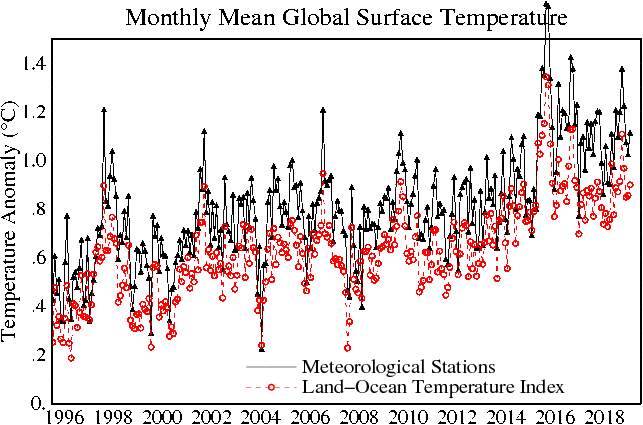
As such, here’s NASA’s Goddard Institute for Space Studies (GISS) Monthly Mean Surface Temperature Anomaly – 1996 to Present;
NOAA’s National Climate Data Center (NCDC) Annual Global Mean Temperature Anomaly Over Land & Sea – 1880 to Present;

Note: The chart above hasn’t been updated with 2011 data for unknown reasons. The chart resides here and the data to update it is here.
It appears that a significant decline in temperatures occurred during the last 17 months:
2010 1 0.6335
2010 2 0.6708
2010 3 0.7815
2010 4 0.7518
2010 5 0.7064
2010 6 0.6764
2010 7 0.6581
2010 8 0.5783
2010 9 0.4975
2010 10 0.5655
2010 11 0.7182
2010 12 0.4226
2011 1 0.3962
2011 2 0.4200
2011 3 0.5226
2011 4 0.5894
2011 5 0.5093
2011 6 0.5882
2011 7 0.5687
2011 8 0.5401
2011 9 0.5264
2011 10 0.5739
2011 11 0.4347
2011 12 0.4800
2012 1 0.3630
2012 2 0.3678
2012 3 0.4477
2012 4 0.6514
(Source: NOAA NCDC)
UK Met Office’s – Hadley Center – Climate Research Unit (CRU) Annual Global Average Land Temperature Anomaly – 1850 to Present;

and the UK Met Office – Hadley Center – Climate Research Unit (CRU) Monthly Global Average Land Temperature – 1850 to Present

Depending on the time frame, it certainly seems that Earth’s Surface Temperature has increased, but it does not appear to be warming rapidly and there is no indication of acceleration. Furthermore, the surface temperature record is burdened with issues of questionable siting, changes in siting, changes in equipment, changes in the number of measurement locations, modeling to fill in gaps in measurement locations, corrections to account for missing, erroneous or biased measurements, and the urban heat island effect. Thus to see the big picture on the temperature “Earth’s Temperature”, it also helps to look up.
Atmospheric Temperatures:
Since 1979 Earth’s “temperature” has also been measured via satellite. “The temperature measurements from space are verified by two direct and independent methods. The first involves actual in-situ measurements of the lower atmosphere made by balloon-borne observations around the world. The second uses intercalibration and comparison among identical experiments on different orbiting platforms. The result is that the satellite temperature measurements are accurate to within three one-hundredths of a degree Centigrade (0.03 C) when compared to ground-launched balloons taking measurements of the same region of the atmosphere at the same time.” NASA
The following are 4 Temperature Anomaly plots from Remote Sensing Systems (RSS), each one increases in altitude as is illustrated here:
RSS Temperature Lower Troposphere (TLT) – Brightness Temperature Anomaly- 1979 to Present;

RSS Temperature Middle Troposphere (TMT)- Brightness Temperature Anomaly- 1979 to Present;

RSS Temperature Troposphere / Stratosphere (TTS) -Brightness Temperature Anomaly- 1987 to Present;

RSS Temperature Lower Stratosphere (TLS) – Brightness Temperature Anomaly – 1979 to Present:

According to Remote Sensing Systems, “For Channel (TLT) (Lower Troposphere) and Channel (TMT) (Middle Troposphere), the anomaly time series is dominated by ENSO events and slow tropospheric warming. The three primary El Niños during the past 20 years are clearly evident as peaks in the time series occurring during 1982-83, 1987-88, and 1997-98, with the most recent one being the largest.” RSS
Also, the 2009 – 10 El Niño event is also called out on this RSS Latitudinal Temperature Lower Troposphere (TLT) Brightness Temperature Anomaly from 1979 to Present;

and the 1998 El Niño event, along with the tropospheric cooling attributed to the 1991 eruption of Mt Pinitubo, is called out on this University of Alabama – Hunstville (UAH) Lower Atmosphere Temperature Anomalies – 1979 to Present:

Note: Per John Christy, RSS and UAH anomalies are not comparable because they use different base periods, i.e., “RSS only uses 1979-1998 (20 years) while UAH uses the WMO standard of 1981-2010.”
The May UAH Lower Atmosphere Temperature Anomaly was 0.29 degrees C above the 30 year average. Keep this mind the next time you see claims that recent weather was caused by Global Warming.
There are also regional variations in Lower Troposphere that contribute nuance to the picture. For example, RSS Northern Polar Temperature Lower Troposphere (TLT) Brightness Temperature Anomaly;

shows a .337 K/C per decade increase, whereas the The RSS Southern Polar Temperature Lower Troposphere (TLT) Brightness Temperature Anomaly;

shows a .011 K/C per decade decrease. I am still not aware of a compelling explanation for the significant divergence in the Lower Troposphere temperature trends between the poles.
The satellite record seems to show slow warming of Lower and Middle Tropospheric temperatures, overlaid with the El Niño/La Niña Southern Oscillation (ENSO) cycle, including four comparatively large El Niño events. Lower Tropospheric temperatures appear to have flattened since the large El Niño in 1998 and offer no indication of Earth warming rapidly.
Moving higher in the atmosphere, RSS Temperature Troposphere / Stratosphere (TTS) – Brightness Temperature Anomaly- 1987 to Present;


has been incredibly flat since, with a trend of just -.010 K/C per decade. The 1997-98 and 2009 – 10 El Niño events are still readily apparent in the plot, as is a spike from the 1991 eruption of Mt. Pinatubo. Note that the effect of Mt. Pinatubo is the opposite in the Lower and Middle Troposphere versus the Troposphere / Stratosphere (TTS), i.e. “Large volcanic eruptions inject sulfur gases into the stratosphere; the gases convert into submicron particles (aerosol) with an e-folding time scale of about 1 year. The climate response to large eruptions (in historical times) lasts for several (2-3) years. The aerosol cloud causes cooling at the Earth’s surface, warming in stratosphere.”
Ellen Thomas, PHD Wesleyan University
It is interesting that, incorporating the impact of three significant surface driven warming events, Troposphere / Stratosphere Temperatures (TTS) have been quite stable, however there is nuance to this as well.
RSS Northern Hemisphere Temperature Troposphere / Stratosphere (TTS) – Brightness Temperature Anomaly- 1987 to Present;

has been increasing by .046 K/C per decade, whereas the RSS Southern Hemisphere Temperature Troposphere / Stratosphere (TTS) – Brightness Temperature Anomaly- 1987 to Present;

has been decreasing by -.066 K/C per decade.
Moving higher still in the atmosphere, the RSS Temperature Lower Stratosphere (TLS) – Brightness Temperature Anomaly – 1979 to Present;
“is dominated by stratospheric cooling, punctuated by dramatic warming events caused by the eruptions of El Chichon (1982) and Mt Pinatubo (1991).” RSS
The eruptions of El Chichon and Mt Pinatubo are readily apparent in the Apparent Atmospheric Transmission of Solar Radiation at Mauna Loa, Hawaii:

“The stratosphere” … “in contrast to the troposphere, is heated, as the result of near infrared absorption of solar energy at the top of the aerosol cloud, and increased infra-red absorption of long-wave radiation from the Earth’s surface.”
“The stratospheric warming in the region of the stratospheric cloud increases the latitudinal temperature gradient after an eruption at low latitudes, disturbing the stratospheric-troposphere circulation, increasing the difference in height of the troposphere between high and low latitudes, and increasing the strength of the jet stream (polar vortex, especially in the northern hemisphere). This leads to warming during the northern hemisphere winter following a tropical eruption, and this warming effect tends to be larger than the cooling effect described above.” Ellen Thomas, PHD Wesleyan University
The Lower Stratosphere experienced “dramatic warming events caused by the eruptions of El Chichon (1982) and Mt Pinatubo (1991).” RSS “The long-term, global-mean cooling of the lower stratosphere stems from two downward steps in temperature, both of which are coincident with the cessation of transient warming after the volcanic eruptions of El Chichon and Mt. Pinatubo.” … “Here we provide observational analyses that yield new insight into three key aspects of recent stratospheric climate change. First, we provide evidence that the unusual step-like behavior of global-mean stratospheric temperatures is dependent not only upon the trend but also on the temporal variability in global-mean ozone immediately following volcanic eruptions. Second, we argue that the warming/cooling pattern in global-mean temperatures following major volcanic eruptions is consistent with the competing radiative and chemical effects of volcanic eruptions on stratospheric temperature and ozone. Third, we reveal the contrasting latitudinal structures of recent stratospheric temperature and ozone trends are consistent with large-scale increases in the stratospheric overturning Brewer-Dobson circulation” David W. J. Thompson Colorado State University
Above the Stratosphere we have the Mesosphere and Thermosphere, neither of which have I identified current temperature time series for, but of note is that on “July 15, 2010” “A Puzzling Collapse of Earth’s Upper Atmosphere” occurred when “high above Earth’s surface where the atmosphere meets space, a rarefied layer of gas called “the thermosphere” recently collapsed and now is rebounding again.”

“This is the biggest contraction of the thermosphere in at least 43 years,” says John Emmert of the Naval Research Lab, lead author of a paper announcing the finding in the June 19th issue of the Geophysical Research Letters (GRL). “It’s a Space Age record.”
The collapse happened during the deep solar minimum of 2008-2009—a fact which comes as little surprise to researchers. The thermosphere always cools and contracts when solar activity is low. In this case, however, the magnitude of the collapse was two to three times greater than low solar activity could explain.
“Something is going on that we do not understand,” says Emmert.
The thermosphere ranges in altitude from 90 km to 600+ km. It is a realm of meteors, auroras and satellites, which skim through the thermosphere as they circle Earth. It is also where solar radiation makes first contact with our planet. The thermosphere intercepts extreme ultraviolet (EUV) photons from the sun before they can reach the ground. When solar activity is high, solar EUV warms the thermosphere, causing it to puff up like a marshmallow held over a camp fire. (This heating can raise temperatures as high as 1400 K—hence the name thermosphere.) When solar activity is low, the opposite happens.” NASA
In summary, Earth’s Lower and Middle Troposphere appear to have warmed slowly, overlaid with the El Niño/La Niña Southern Oscillation (ENSO) cycle, including four comparatively large El Niño events, and tempered by the cooling effects of the eruption of El Chichon (1982) and Mt Pinatubo (1991). Lower and Middle Tropospheric temperatures appear to have flattened since the large El Niño in 1998 and offer no indication of warming rapidly or warming at an accelerating rate. Tropospheric / Stratospheric temperatures appear to have been influenced by at least three significant surface driven warming events, the 1997-98 El Niño, and the eruptions of El Chichon in 1982 and Mt Pinatubo in 1991, but to have maintained a stable overall trajectory. Stratospheric temperatures appear to have experienced two “dramatic warming events caused by the eruptions of El Chichon (1982) and Mt Pinatubo (1991).”, and “unusual step-like behavior of global-mean stratospheric temperatures” which has resulted in a significant stratospheric cooling during the last 30 years. Lastly, “during deep solar minimum of 2008-2009” “the biggest contraction of the thermosphere in at least 43 years” occurred and “The magnitude of the collapse was two to three times greater than low solar activity could explain.”
Ocean Temperatures:
“The oceans can hold much more heat than the atmosphere. Just the top 3.2 metres of ocean holds as much heat as all the world’s air.” Commonwealth of Australia – Parliamentary Library
As such, changes inOcean Heat Content are important in understanding Earth’s “Temperature”. Here is NOAA’s NODC Global Ocean Heat Content from 0-700 Meters – 1955 to Present;

and here is the same from Ole Humlum’s valuable climate data site Climate4you.com, NODC Global Ocean Heat Content – 0-700 Meters – 1979 to Present:

It seems apparent from the plots above that Global Ocean Heat has increased over the last several decades, however Global Ocean Heat doesn’t appear to be warming rapidly. Furthermore, there is no evidence or indication of an accelerating rate.
Sea Level:
“Global sea level is currently rising as a result of both ocean thermal expansion and glacier melt, with each accounting for about half of the observed sea level rise, and each caused by recent increases in global mean temperature. For the period 1961-2003, the observed sea level rise due to thermal expansion was 0.42 millimeters per year and 0.69 millimeters per year due to total glacier melt (small glaciers, ice caps, ice sheets) (IPCC 2007). Between 1993 and 2003, the contribution to sea level rise increased for both sources to 1.60 millimeters per year and 1.19 millimeters per year respectively (IPCC 2007).” Source NSIDC
Global Mean Sea Level Change – 1993 to Present:

Global Mean Sea Level Change Map with a “Correction” of 0.3 mm/year added May, 5th 2011, due to a “Glacial Isostatic Adjustment (GIA)” – 1993 to Present:

Snow and Ice:
A proxy often cited when measuring “Earth’s Temperature” is amount of Snow and Ice on Earth. According to the United States Geological Survey (USGS), “The vast majority, almost 90 percent, of Earth’s ice mass is in Antarctica, while the Greenland ice cap contains 10 percent of the total global ice mass.” Source USGA
However, there is currently there is no generally accepted measure of ice volume, as Cryosat is still in validation and the accuracy of measurements from Grace are still being challenged. Sea Ice Area and Extent are cited as proxies for “Earth’s Temperature”, however there is significant evidence that the primary influences on Sea Ice Area and Extent are in fact wind and Atmospheric Oscillations. With this said, here are
Global, Arctic & Antarctic Sea Ice Area from 1979 to Present;

Global Sea Ice Area Anomaly – 1979 to Present:

Northern Hemisphere Sea Ice Area Anomaly, 1979 to Present;

Southern Hemisphere Sea Ice Area Anomaly, 1979 to Present;

Arctic Sea Ice Extent – 15% or greater

Antarctic Sea Ice Extent – 15% or Greater

There appears to have been a negative trend in Northern Hemisphere Sea Ice Area and Extent and a positive trend in Southern Hemisphere Sea Ice Area and Extent, thus the resultant Global Sea Ice Area trend appears to be slightly negative.
In terms of land based data, here is 20 Year Northern Hemisphere Snow Cover with 1995 – 2009 Climatology from NCEP/NCAR;

Northern Hemisphere Snow Cover Anomalies 1966 – Present from NCEP/NCAR;

Northern Hemisphere Winter Snow Extent – 1967 to Present from Rutgers University;

Northern Hemisphere Spring Snow Extent – 1967 to Present:

Northern Hemisphere Fall Snow Extent – 1967 to Present:

While none of the Snow plots offers a global perspective, when looking at the Northern Hemisphere, there appears to have been a slight increase in Snowcover and Winter Snow Extent, a decrease in Spring Snow Extent and no change in Fall Snow Extent over the historical record.
Based on the limited Global Ice and Snow measurements available, and noting the questionable value of Sea Ice Area as a proxy for temperature, not much inference can currently be drawn from Earth’s Ice and Snow measurements. However, there does not appear to be any evidence of rapid warming in Earth’s Ice and Snow measurements.
Conclusion:
“Earth’s “Temperature” appears to have increased during the last several decades, but there does not appear to be any evidence of rapid or accelerating warming.
Additional information on “Earth’s Temperature” can be found in the WUWT Reference Pages, including the Global Temperature Page and Global Climatic History Page
Mike says:
June 11, 2012 at 10:36 am
@ur momisugly Smokey,
The topic of this thread is whether or not the warming has accelerated. It of course depends on the time interval used. You have basically conceded, by trying to change the subject, that over the period 1880-2010 there has been an acceleration.
The warming acceleration over the past decade has been negative.
In simpler terms, it’s been *cooling*.
Dr. Jay Cadbury, phd. says:
June 11, 2012 at 8:55 am
here is another question I would love Anthony or somebody smart to answer.
For the past 600 millions years, GAT was 22C. Currently, it is about 15C.
So in realville, earth is 7 degrees Celsius below average temperature. WHY THE HELL DOES NOBODY USE THIS STATISTIC?
furthermore, earth is below avearge atmospheric co2. SAME QUESTION!
_____________________________
Dr. Jay, I do not use the first statistic (not a physicist) but I do use the gradual cooling over the Holocene, however lets face it we are STILL in an ice age, just a warmer part of an ice age. After all that is what an “Interglacial means”
The other reason for not using that statistic is it gives the CAGW warmists ammo. “SEE the Earth can warm another whole 7C we are going to fry” – while running around like the headless chickens they are.
furthermore, earth is below avearge atmospheric co2. SAME QUESTION!
Now THAT I do use.
Plants are pretty close to starvation levels. A wheat study showed an open field of wheat sucked the CO2 levels down to 300 ppm +/- 5 ppm every day during growing season. Other studies show C3 type plants (most food crops) cease growing at 200 ppm. Another website shows the USA has increased from producing 100 bushels of wheat on 5 ac (1930) to 100 bushels of wheat on 3 ac (1975)
How anyone can demonize such a beneficial gas is beyond me. Next there will be a campaign for the EPA to regulate dihydrogen monoxide. After all dihydrogen monoxide has been documented as the cause of many human deaths and is very closely linked to changes in the weather/climate. (snicker)
Bill Tuttle says:
June 11, 2012 at 11:24 am
….The warming acceleration over the past decade has been negative.
In simpler terms, it’s been *cooling*.
__________________________________
The “warming acceleration” over the past ten millenia has also been negative. GRAPH
Can’t win the argument at either time scale.
Mike says:
June 11, 2012 at 10:48 am
@ur momisugly Babsy ,une 11, 2012 at 8:20 am
“They expect us to abandon the economic engine of the Western world when all they can muster is ‘partly’? ”
No serious person is proposing anything like what you suggest. It is a straw-man augment you are making.
___________________________________
GEEZ, do you even bother to read the news?
Poles refuse to set greenhouse-gas reduction targets for after 2020.
Environment ministers on Friday (9 March) were unable to adopt conclusions on the European Commission’s low-carbon roadmap for 2050 after Poland wielded its veto.
Poland objected to the roadmap’s identification of milestones beyond what has already been agreed – a 40% reduction in greenhouse-gas emissions by 2030 and a 60% reduction by 2040. The EU has committed itself to a 20% reduction by 2020 and to reduce emissions by 80% by 2050.…..
That means reducing our civilization to below the energy use of the 1800s!!!
I did the analysis Here
It is all about ushering in global Governance not about the Environment.
We get all types of “Soothing” crap from the propaganda machines and economic model projections about how it really is going to be “painless”
Up until the 1850′s dung and wood were the major source of energy. http://dieoff.org/page199_files/image002.gif
In other words for the USA to use HALF the energy per person that was used in 1800 we must abandon ALL factories and 90% of the population must return to subsistence farming using animals.
In the USA even if you reduced the energy use per capita to the level in 1800 you would still be DOUBLE that target of 80% reduction ~ PER CAPITA. The figures are probably worse since the USA in 1790 was 90% self sufficient farmers with very little industry unlike the UK where the first industrial revolution started in the mid 1700’s.
It only takes a day trying to clear brush from land with loppers and a buck saw to really appreciate a tractor or bulldozer and the harsh reality of what labor saving devices really are all about. For comparison in 1987 it only took 3 labor-hours to produce 100 bushels of wheat from 3 acres of land (Ain’t CO2 fertilization great) with tractors, 35-foot sweep disk, 30-foot drill, and a 25-foot self-propelled combine. By 1970 one American farmer was supplying over 75 people with food.
Wayne says:
June 11, 2012 at 9:42 am
One of these days I am gonna have to take time to read through all the comments
I just did and it made me think of something I read earlier.
http://www.smalldeadanimals.com/archives/020413.html
Mike says:
June 11, 2012 at 10:43 am
@ur momisugly Dr. Jay Cadbury, phd.
….The issue today is whether we are causing artificial climate change that will be ecologically or economically disruptive and what we should or should not do about this.This thread was initially about whether the warming trend of the last 100 hundred years shows an acceleration. The “skeptics” have basically conceded that it does. The possible implications of this go will beyond the scope of this thread.
___________________________________
NO WE HAVE NOT!
We have agreed that there was a natural cyclical warming from the depths of the Little Ice Age that ended in 1850. ~ A period of Famine, Rebellion and the Black Death.
There has been no “ACCELERATION” that is no real change in “the rate of change” It is natural and the same until about fifteen years ago when we saw a DECELERATION. This despite all the manipulations of the data bases to exaggerate the warming by decreasing the value of old temperatures and increasing the values of new temperatures. EXAMPLE 1 and Example 2
…The Climate Conversation Group (CCG) said this morning that NIWA’s confession that it lost the Schedule of Adjustments (SOA) for the official New Zealand temperature record is the latest event in a long-running scandal….
@ur momisugly Gail Combs says:
June 11, 2012 at 12:55 pm
“The EU has committed itself to a 20% reduction by 2020 and to reduce emissions by 80% by 2050.…. That means reducing our civilization to below the energy use of the 1800s!!!”
That is a reduction in emissions not energy. Some energy use reduction will be derived from higher efficiency and conservation. But I think most of the emissions reduction are to be achieved through new energy sources and nuclear power. You may disagree with this goal or think it cannot be obtained. The current flight from nuclear power may indeed undermine this goal. But that is a different question.
“There has been no “ACCELERATION” that is no real change in “the rate of change” It is natural and the same until about fifteen years ago when we saw a DECELERATION.”
As I have said before whether or not there is an acceleration depends on the time interval used. It you use 1880-2010 there is an acceleration. What this means is a separate issue.
@smokey, http://curryja.files.wordpress.com/2011/12/14.jpg
Your chart shows an acceleration over the last 100 years. That is the period of human emissions of CO2. That may or may not be a coincidence but it is a fact. This acceleration may or may not be a natural variation. The recent pause in surface warming may or may not be part of a new longer term trend. One cannot tell from a data plot. For these questions one needs to consider the physical mechanisms involved.
You seem to have this idea the Earth’s temperature is bouncing back from the LIA. But thermal systems don’t bounce. The physics is not the same as mass-spring systems. Any warming or cooling must have a cause in the energy flow. It is clear that natural causes can cause temperature change. But the specific analysis by most climate scientists shows that the current warming is not natural. If they are right then the mild warming we have seen will increase over the next century to levels that will likely be disruptive. Longer term proxy studies with their “hockey stick” shapes support but do not in themselves prove this hypothesis.
Also I have no idea what source for your chart is.
Mike says:
“It you use 1880-2010 there is an acceleration.”
Wrong. There is no acceleration. Do you not even look at all the links posted here, because they flatly contradict your belief system?
The Wood For Trees graph above shows the long term temperature trend line, back to the mid-1800’s. Notice that despite CO2 levels rising from ≈280 ppmv to more than 390 ppmv, there has been no acceleration in the gradually rising temperature trend. Temperatures have remained within clearly defined parameters, thus falsifying your assertion that the trend is, or ever was, accelerating. The rise in global warming is due to the recovery from the LIA. There is no measurable indication that the increase in CO2 has added to the natural warming trend.
Mike, you are just not paying attention to the extensive charts, graphs, and peer reviewed papers posted here by Gail Combs and others, which absolutely refute your wrong-headed belief that global warming since the LIA has accelerated.
The failure of temperatures to accelerate when CO2 has risen by ≈40% means that CO2 does not have the effect claimed. In fact, there is no testable, measurable evidence showing that CO2 has any effect [although I personally think it has a small – and wholly beneficial – effect].
Time to stop digging, Mike. The ultimate Authority – Planet Earth – is proving you wrong.
Smokey says:
June 11, 2012 at 2:19 pm
“…The failure of temperatures to accelerate when CO2 has risen by ≈40% means that CO2 does not have the effect claimed. In fact, there is no testable, measurable evidence showing that CO2 has any effect [although I personally think it has a small – and wholly beneficial – effect]….”
Absolutely, Smokey – but the likes of Mike don’t seem to grasp that!
I can’t see the likes of Mike doing anything but burrowing deeper into their holes. There’s none so blind as those that will not see! But of course, THEY think we are the ones who cannot see! The funny thing is, there is flip all for us to see – otherwise we’d all be believers too! We skeptics are not trying to say there is no warming – we are saying that the warming is clearly NOT directly and solely related to CO2 (and hence, by default, any CO2 restrictions are pointless – as well as being destructive to various economies, etc).
Now, if Mike wants to provide the allegedly ‘conclusive’ proof – something which has yet to be shown by ANYBODY – perhaps, we can have a proper debate?
http://www.ncdc.noaa.gov/sotc/service/global/global-land-ocean-mntp-anom/201001-201012.gif
Do a parabolic fit and you’ll see the concavity is positive. That is called acceleration. If you do a linear fit of course it will have zero concavity. If you do a cubic fit like Spencer does you’ll see a period of positive concavity followed by a period of negative concavity. Which if any of these is physically significant depends on the physical processes involved.
Mike clearly does not comprehend that what others are discussing about acceleration is simply not what he misunderstands acceleration to be.
Mike, acceleration would be a positive change in the rate of change. On a graph that would give you a line that curved upwards, a bit like a hockey stick some might say.
What you are observing on the graph is a simple small but constant positive trend. Which shows no acceleration in the rate of positive change.
and then there is the small matter that there is no empirical evidence or testable replication to show that CO2 is doing anything but respond to that warming ( which I personally think is a simple matter of ocean sinks being less able to sequester as much CO2 as the volume of cold water needed to hold it is slightly reduced by a positive temperature anomaly trend [which is not an acceleration either for your information ])
There. Hope that helps.
Speaking of the Big Picture – is there an easy to digest graph of average solar irradiance over several Milankovitch cycles? I would love to see where we are in the expected impact of the Milankovitch (and other) orbital cycles impact on average incoming radiation.
justthefacts,
you wrote upthread in reply to Mosher,
Your sources do not quantitatively support your emphasis. Eg,
Influence of winter and summer surface wind anomalies on Summer Arctic sea ice extent Ogi and Wallace (2009)
That was the only reference I could find amongst your sources to an estimate of contribution. The focus of many of the studies you linked is on factors aside from temperature increase, so naturally the emphasis is on (winds, AO or whatever). Some papers focus on less than five years of data. None that I could see give an estimate as to the percentage contribution of various factors to long-term sea ice decline. Highlighting these papers could give the casual reader the impression that this is the balance of understanding of multidecadal Arctic sea ice decline. But the fact is that while other factors contribute, temperature changes are understood to be a major, if not the primary, factor. Eg,
http://www.seas.harvard.edu/climate/seminars/pdfs/comiso_etal_2008.pdf
In a couple of your cites, and others i’ve read, it is suggested that sea ice transport has increased in recent years. This may well be a result of long-term temperature-forced sea ice decline/thinning (also suggested here and there). The possible increased effectivenes of wind-driven ice transport may itself be a result of Arctic warming.
I found one source that nearly corroborates your view of GHG/temperature forcing being a minor player in Arctic sea ice trends.
http://www.cgd.ucar.edu/staff/mholland/papers/Polyak_2010_historyofseaiceArctic.pdf
Finally, Arctic sea ice decline has definitely accelerated, as testified in several of the papers and articles you cite. This is so for global sea ice also, despite the slight Antarctic increase.
Barry says:
“Finally, Arctic sea ice decline has definitely accelerated…”
Wrong, Barry. Go stand in the corner with Mike and JohnB. We have another dunce cap just for you, too.
As has been shown in numerous articles here over the last couple of years, Arctic ice cover is always cyclical. It is affected by wind and currents, not by CO2. It has been both greater and less during recorded history. The North Pole was ice free only a few decades ago. Today’s Arctic ice is well within its historical parameters, thus the null hypothesis remains unfalsified, and your alternate conjecture is falsified by the null parameters, which have not been exceeded. Not to mention your blatant cherry-picking of only one Hemisphere.
The Antarctic contains close to ten times more ice than the Arctic, and the Antarctic is steadily gaining ice. Therefore “carbon” has nothing to do with it. Pointing to cyclic Arctic ice cover is pure desperation. It is the ultimate in cherry-picking, because you never mention the Antarctic.
Antarctica is losing land ice. As Berry said there has been as increase in Antarctic sea ice. On net the cryosphere is losing mass.
[REPLY:
1. This is still an invalid e-mail address.
2. Citations for assertions are good.
3. Your Climate Change page lists only 4 skeptic websites, including Foxnews(?????). WUWT is not one of them. It would be decent of you to repair the oversight as we are one of the most viewed and influential blogs on the net.
4. I did mention that site policy requires a valid e-mail address to comment….
Thank you. -REP]
barry says: June 11, 2012 at 5:10 pm
you wrote upthread in reply to Mosher,
I wrote that, “the primary influences on Sea Ice Area and Extent are in fact wind and Atmospheric Oscillations.”, not that ” winds explain all of the decline from 1979 on.” Clearly there are numerous secondary influences, including atmospheric and sea surface temperatures, however the body of evidence indicates that the primary influences are in fact wind and Atmospheric Oscillations, not atmospheric and sea surface temperatures.
Your sources do not quantitatively support your emphasis. Eg,
“the combined effect of winter and summer wind forcing accounts for 50% of the variance of the change in September Arctic sea ice extent from one year to the next ( Δ SIE) and it also explains roughly 1/3 of the downward linear trend of SIE over the past 31 years..”
Influence of winter and summer surface wind anomalies on Summer Arctic sea ice extent Ogi and Wallace (2009)
This reference only refers to the wind component and it attributes roughly 33% “of the downward linear trend of SIE over the past 31 years to wind forcing.” The inclusion of the contribution from Atmospheric Oscillations supports my assertion that “the primary influences on Sea Ice Area and Extent are in fact wind and Atmospheric Oscillations”, i.e.:
“The decreases in recent decades, which are also partially due to circulation-driven ice export through the Fram Strait between Greenland and Svalbard (Vinje, 2001), have coincided with a positive trend in the NAO, with unusually high index values in the late 1980s and 1990s. During this period, the variability of ice motion and ice export through the Fram Strait was correlated strongly with the NAO; r∼ 0.86 for the ice area flux (Kwok and Rothrock, 1999) and r∼ 0.7 for the ice volume flux (Hilmer and Jung, 2000), although the relationship was insignificant (r∼ 0.1) before the mid 1970s (Hilmer and Jung, 2000). Deser et al. (2000) analysed a 40-yr gridded data set (1958–97) to determine the association between arctic sea ice, SAT and SLP, concluding that the multidecadal trends in the NAO/AO in the past three decades have been ‘imprinted upon the distribution of Arctic sea ice’, with the first principal component of sea-ice concentration significantly correlated (r∼−0.63) with the NAO index, recently cause-and-effect modelled by Hu et al. (2002). None the less, our calculations and those of Deser et al. (2000) indicate that, even in recent decades, only about one third of the variability in arctic total ice extent and MY ice area (Johannessen et al., 1999) is explained by the NAO index ”
” The decadal-scale mode associated with the Arctic Oscillation (AO) and a low-frequency oscillation (LFO) with an approximate time scale of 60-80 years, dominate. Both modes were positive in the 1990s, signifying a prolonged phase of anomalously low atmospheric sea level pressure and above normal surface air temperature in the central Arctic. Consistent with an enhanced cyclonic component, the arctic anticyclone was weakened and vorticity of winds became positive. The rapid reduction of arctic ice thickness in the 1990s may be one manifestation of the intense atmosphere and ice cyclonic circulation regime due to the synchronous actions of the AO and LFO. Our results suggest that the decadal AO and multidecadal LFO drive large amplitude natural variability in the Arctic making detection of possible long-term trends induced by greenhouse gas warming most difficult.”
Igor V. Polyakov and Mark A. Johnson, 2000
http://ruby.fgcu.edu/courses/twimberley/EnviroPhilo/Decadal.pdf
“Hilmer and Jung (2000) note a secular change in the relationship between the Fram Strait ice flux and the NAO; the high correlation noted by Kwok and Rothrock (1999) from 1978 to 1996 was not found in data prior to 1978. We expect our overall results to be more robust given the strong relationship between the AO and SIM over the Arctic, as compared to the weaker relationship between the north–south flow through Fram Strait and the AO. Even if one ignored the effect of the AO on the flux of ice through Fram Strait, the divergence of ice in the eastern Arctic would be still be ;50% greater under high-index conditions than under low-index conditions, and the heat flux would be ;25% greater.”
” We have shown that sea ice provides memory for the Arctic climate system so that changes in SIM driven by the AO during winter can be felt during the ensuing seasons; that is, the AO drives dynamic thinning of the sea ice in the eastern Arctic during winter, allowing more heat to be released from the ocean through the thinner ice during spring, and resulting in lower SIC during summer and the liberation of more heat by the freezing of the ice in autumn. The correlations between the wintertime AO and SIC and SAT during the subsequent seasons offers the hope of some predictability, which may be useful for navigation along the Northern Sea route.”
http://www.drroyspencer.com/wp-content/uploads/Response-of-Sea-Ice-to-the-Arctic-Oscillation-2002-J-Climate.pdf
Some papers focus on less than five years of data.
This is true, but also misleading in that several of the papers focus on a shorter research period in order to demonstrate a longer-term effect, .e.g. in this article associated with one of the papers I cited:
” Extreme changes in the Arctic Oscillation in the early 1990s — and not warmer temperatures of recent years — are largely responsible for declines in how much sea ice covers the Arctic Ocean, with near record lows having been observed during the last three years, University of Washington researchers say.”
“It may have happened more than a decade ago, but the sea ice appears to still “remember” those Arctic Oscillation conditions, according to Ignatius Rigor, a mathematician with the UW’s Applied Physics Laboratory.”
http://www.sciencedaily.com/releases/2004/12/041220010410.htm
But the fact is that while other factors contribute, temperature changes are understood to be a major, if not the primary, factor. Eg,
However, the fact that over the past few years, sea ice coverage has continued, overall, to decline despite changes in the modes of the AO and NAO and in the predominant wind patterns suggests that at this point the warming conditions may be overriding the oscillations.
http://www.seas.harvard.edu/climate/seminars/pdfs/comiso_etal_2008.pdf
I am certainly not arguing that ocean and atmospheric temperatures are not significant influences, however I’ve seen no evidence to support them as the primary influences, furthermore there is significant evidence that some variations in Atmospheric and Sea Surface Temperatures are driven by Atmospheric and Oceanic Oscillations, e.g.
A dominant mode of Arctic variability is the Arctic Oscillation (AO), and its strong positive phase during the 1990s may account for much of the recent decrease in Arctic ice extent. The AO explains more than half of the surface air temperature trends over much of the Arctic [Rigor et al., 2000].
http://www.atmos.umd.edu/~kostya/Pdf/Seaice.30yrs.GRL.pdf
“We present area-averaged time series of temperature for the 100–150 m depth layer of the Barents Sea from 1900 through 2006. This record is dominated by multidecadal variability on the order of 4_C which is correlated with the Atlantic Multidecadal Oscillation Index.”
http://www.leif.org/EOS/2009GL039847.pdf
Thus efforts to ascribe the Arctic warming and Sea Ice decline to anthropogenic greenhouse gas emissions is even more tenuous.
Finally, Arctic sea ice decline has definitely accelerated, as testified in several of the papers and articles you cite. This is so for global sea ice also, despite the slight Antarctic increase.
Firstly, my conclusion is that ‘“Earth’s “Temperature” appears to have increased during the last several decades, but there does not appear to be any evidence of rapid or accelerating warming.’ and thus I’ve made no assertions in terms of the rate of change in Sea Ice. Secondly, my argument here is that temperature is likely a secondary influence on Arctic Sea Ice, and thus the change in Arctic Sea Ice offers no support to the erroneous assertion that Earth is warming rapidly and that this warming is accelerating. As such, do you accept my conclusion that “there does not appear to be any evidence of rapid or accelerating warming” on Earth, or can you present any evidence to refute it?
Mike says:
June 11, 2012 at 8:23 pm
“Antarctica is losing land ice. As Berry (sic) said there has been as increase in Antarctic sea ice. On net the cryosphere is losing mass.”
Wrong as always, Mike:
http://www.robertb.darkhorizons.org/seaice.anomaly.Ant_arctic.jpg
[Reply: Provide a legitimate email address, “Mike”, or have your future comments deleted. ~dbs, mod.]
Mike says:
June 11, 2012 at 2:08 pm
@smokey, http://curryja.files.wordpress.com/2011/12/14.jpg
Your chart shows an acceleration over the last 100 years. That is the period of human emissions of CO2. That may or may not be a coincidence but it is a fact. This acceleration may or may not be a natural variation. The recent pause in surface warming may or may not be part of a new longer term trend.
1. A positive trend line is not an acceleration.
2. A “pause” in acceleration means acceleration has ceased.
3. A *cooling* trend is not an acceleration in *warming*.
4. If you’re looking around for your lunch, Smokey and Gail have already eaten it — go back to the kitchen and make a new one.
Smokey said The North Pole was ice free only a few decades ago.
As REP mentioned : Citations for assertions are good.
Rob Dekker,
You can start here.
@ur momisugly Gail Combs says:
June 11, 2012 at 12:55 pm
“The EU has committed itself to a 20% reduction by 2020 and to reduce emissions by 80% by 2050.…. That means reducing our civilization to below the energy use of the 1800s!!!”
_______________________________
Mike says:
June 11, 2012 at 1:33 pm
That is a reduction in emissions not energy. Some energy use reduction will be derived from higher efficiency and conservation. But I think most of the emissions reduction are to be achieved through new energy sources and nuclear power. You may disagree with this goal or think it cannot be obtained. The current flight from nuclear power may indeed undermine this goal. But that is a different question.
________________________________
Mike, the anti-nuke people are normally the same as the anti-coal, gas, oil people so nuclear has never been in the cards. You are not going to run our current level of civilization on pixie dust, unicorn farts, biofuel, wind and solar power. Ain’t gonna happen. You can perhaps keep the elite in the comfort they wish to be and maybe some hospitals but that is it.
The freezing deaths of the old folks in the UK show I am correct when you look at the real world.
If those pushing CAGW are wrong and we are actually headed into a Bond Event (Dansgaard-Oeschger events) then the madness of politically enforced “Energy Poverty” is going to kill thousands if not millions. You are going to see rebellion and blood running in the streets. That was bad enough a few centuries ago (1/2 bond event) when the temperature dipped and the world saw the French and American revolutions then all humans had guns. Now with nukes and other nasty weapons it could get really bad.
“The course of a D-O event sees a rapid warming of temperature, followed by a cool period lasting a few hundred years.” …Hmmm… A cold spike, then a warm spike, then a few hundred years of cold…. D-O events are warming on a 1500 year cycle. Bond Events are cold on a 1500 year cycle. Heinrich Events are cold just before a 1500 year warming event. (He predicts a bond event at 2025 just in time for the sun to really sink into a solar Grand Minimum) Sound familiar as the temperature plateaus and Tibet has its livestock freeze to death?
I am all for moving to nuclear for most of our power requirements. However civilizations all run on power, slave, animal, wind, solar, oil, gas, coal or nuclear, those are our choices to date. I prefer Nuclear and saving petrochemicals for use by the chemical industry. Wind and solar are good for niche markets such as pumping water or electrifying farm fence where mass generate electricity is unavailable they are terrible for mass power generation because they can not provide a constant output.