
By WUWT regular “Just The Facts”
I recently came across a January 21st, 2012 Peter Gleick article 2011 Climate Change in Pictures and Data: Just the Facts, which appears to mimic the format and approach of my January 1st, 2012 article A Big Picture Look At “Earth’s Temperature”.
What I find particularly amusing about Peter’s article is that a week after noting that, “Lost in this verbal debate are often the simple facts and data of climate change and the immense and definitive global observations of the ways in which our climate is actually changing around us.” Peter Gleick was perpetrating Fakegate. Why, if the “simple facts and data” support his viewpoint, would Peter resort to subterfuge and fakery?
If you read through Gleick’s article, you’ll see some of his “immense and definitive global observations”, like “anyone watching or reading the news or looking out the window probably had a sense that 2011 was a weird year with one bad, extreme weather disaster after another”…
Anyway, in honor Peter’s reinstatement as President of the Pacific Institute I figured that an update on the “simple facts and data” was in order.
Please note that WUWT cannot vouch for the accuracy of the data/graphics within this article, nor influence the format or form of any of the graphics, as they are all linked from third party sources and WUWT is simply an aggregator. You can view each graphic at its source by simply clicking on it.
Global Surface Temperatures:
Generally, when referring to Earth’s “climate” warming, proponents of the Catastrophic Anthropogenic Global Warming (CAGW) narrative, refer to Earth’s Surface Temperature, e.g. “Global warming is the unusually rapid increase in Earth’s average surface temperature over the past century primarily due to the greenhouse gases released by people burning fossil fuels.” NASA Earth Observatory
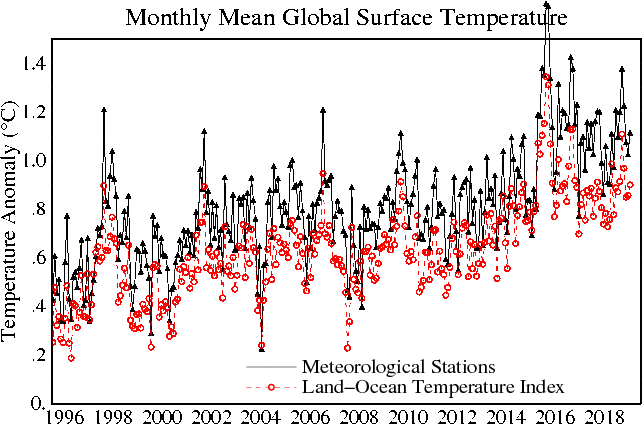
As such, here’s NASA’s Goddard Institute for Space Studies (GISS) Monthly Mean Surface Temperature Anomaly – 1996 to Present;
NOAA’s National Climate Data Center (NCDC) Annual Global Mean Temperature Anomaly Over Land & Sea – 1880 to Present;

Note: The chart above hasn’t been updated with 2011 data for unknown reasons. The chart resides here and the data to update it is here.
It appears that a significant decline in temperatures occurred during the last 17 months:
2010 1 0.6335
2010 2 0.6708
2010 3 0.7815
2010 4 0.7518
2010 5 0.7064
2010 6 0.6764
2010 7 0.6581
2010 8 0.5783
2010 9 0.4975
2010 10 0.5655
2010 11 0.7182
2010 12 0.4226
2011 1 0.3962
2011 2 0.4200
2011 3 0.5226
2011 4 0.5894
2011 5 0.5093
2011 6 0.5882
2011 7 0.5687
2011 8 0.5401
2011 9 0.5264
2011 10 0.5739
2011 11 0.4347
2011 12 0.4800
2012 1 0.3630
2012 2 0.3678
2012 3 0.4477
2012 4 0.6514
(Source: NOAA NCDC)
UK Met Office’s – Hadley Center – Climate Research Unit (CRU) Annual Global Average Land Temperature Anomaly – 1850 to Present;

and the UK Met Office – Hadley Center – Climate Research Unit (CRU) Monthly Global Average Land Temperature – 1850 to Present

Depending on the time frame, it certainly seems that Earth’s Surface Temperature has increased, but it does not appear to be warming rapidly and there is no indication of acceleration. Furthermore, the surface temperature record is burdened with issues of questionable siting, changes in siting, changes in equipment, changes in the number of measurement locations, modeling to fill in gaps in measurement locations, corrections to account for missing, erroneous or biased measurements, and the urban heat island effect. Thus to see the big picture on the temperature “Earth’s Temperature”, it also helps to look up.
Atmospheric Temperatures:
Since 1979 Earth’s “temperature” has also been measured via satellite. “The temperature measurements from space are verified by two direct and independent methods. The first involves actual in-situ measurements of the lower atmosphere made by balloon-borne observations around the world. The second uses intercalibration and comparison among identical experiments on different orbiting platforms. The result is that the satellite temperature measurements are accurate to within three one-hundredths of a degree Centigrade (0.03 C) when compared to ground-launched balloons taking measurements of the same region of the atmosphere at the same time.” NASA
The following are 4 Temperature Anomaly plots from Remote Sensing Systems (RSS), each one increases in altitude as is illustrated here:
RSS Temperature Lower Troposphere (TLT) – Brightness Temperature Anomaly- 1979 to Present;

RSS Temperature Middle Troposphere (TMT)- Brightness Temperature Anomaly- 1979 to Present;

RSS Temperature Troposphere / Stratosphere (TTS) -Brightness Temperature Anomaly- 1987 to Present;

RSS Temperature Lower Stratosphere (TLS) – Brightness Temperature Anomaly – 1979 to Present:

According to Remote Sensing Systems, “For Channel (TLT) (Lower Troposphere) and Channel (TMT) (Middle Troposphere), the anomaly time series is dominated by ENSO events and slow tropospheric warming. The three primary El Niños during the past 20 years are clearly evident as peaks in the time series occurring during 1982-83, 1987-88, and 1997-98, with the most recent one being the largest.” RSS
Also, the 2009 – 10 El Niño event is also called out on this RSS Latitudinal Temperature Lower Troposphere (TLT) Brightness Temperature Anomaly from 1979 to Present;

and the 1998 El Niño event, along with the tropospheric cooling attributed to the 1991 eruption of Mt Pinitubo, is called out on this University of Alabama – Hunstville (UAH) Lower Atmosphere Temperature Anomalies – 1979 to Present:

Note: Per John Christy, RSS and UAH anomalies are not comparable because they use different base periods, i.e., “RSS only uses 1979-1998 (20 years) while UAH uses the WMO standard of 1981-2010.”
The May UAH Lower Atmosphere Temperature Anomaly was 0.29 degrees C above the 30 year average. Keep this mind the next time you see claims that recent weather was caused by Global Warming.
There are also regional variations in Lower Troposphere that contribute nuance to the picture. For example, RSS Northern Polar Temperature Lower Troposphere (TLT) Brightness Temperature Anomaly;

shows a .337 K/C per decade increase, whereas the The RSS Southern Polar Temperature Lower Troposphere (TLT) Brightness Temperature Anomaly;

shows a .011 K/C per decade decrease. I am still not aware of a compelling explanation for the significant divergence in the Lower Troposphere temperature trends between the poles.
The satellite record seems to show slow warming of Lower and Middle Tropospheric temperatures, overlaid with the El Niño/La Niña Southern Oscillation (ENSO) cycle, including four comparatively large El Niño events. Lower Tropospheric temperatures appear to have flattened since the large El Niño in 1998 and offer no indication of Earth warming rapidly.
Moving higher in the atmosphere, RSS Temperature Troposphere / Stratosphere (TTS) – Brightness Temperature Anomaly- 1987 to Present;


has been incredibly flat since, with a trend of just -.010 K/C per decade. The 1997-98 and 2009 – 10 El Niño events are still readily apparent in the plot, as is a spike from the 1991 eruption of Mt. Pinatubo. Note that the effect of Mt. Pinatubo is the opposite in the Lower and Middle Troposphere versus the Troposphere / Stratosphere (TTS), i.e. “Large volcanic eruptions inject sulfur gases into the stratosphere; the gases convert into submicron particles (aerosol) with an e-folding time scale of about 1 year. The climate response to large eruptions (in historical times) lasts for several (2-3) years. The aerosol cloud causes cooling at the Earth’s surface, warming in stratosphere.”
Ellen Thomas, PHD Wesleyan University
It is interesting that, incorporating the impact of three significant surface driven warming events, Troposphere / Stratosphere Temperatures (TTS) have been quite stable, however there is nuance to this as well.
RSS Northern Hemisphere Temperature Troposphere / Stratosphere (TTS) – Brightness Temperature Anomaly- 1987 to Present;

has been increasing by .046 K/C per decade, whereas the RSS Southern Hemisphere Temperature Troposphere / Stratosphere (TTS) – Brightness Temperature Anomaly- 1987 to Present;

has been decreasing by -.066 K/C per decade.
Moving higher still in the atmosphere, the RSS Temperature Lower Stratosphere (TLS) – Brightness Temperature Anomaly – 1979 to Present;
“is dominated by stratospheric cooling, punctuated by dramatic warming events caused by the eruptions of El Chichon (1982) and Mt Pinatubo (1991).” RSS
The eruptions of El Chichon and Mt Pinatubo are readily apparent in the Apparent Atmospheric Transmission of Solar Radiation at Mauna Loa, Hawaii:

“The stratosphere” … “in contrast to the troposphere, is heated, as the result of near infrared absorption of solar energy at the top of the aerosol cloud, and increased infra-red absorption of long-wave radiation from the Earth’s surface.”
“The stratospheric warming in the region of the stratospheric cloud increases the latitudinal temperature gradient after an eruption at low latitudes, disturbing the stratospheric-troposphere circulation, increasing the difference in height of the troposphere between high and low latitudes, and increasing the strength of the jet stream (polar vortex, especially in the northern hemisphere). This leads to warming during the northern hemisphere winter following a tropical eruption, and this warming effect tends to be larger than the cooling effect described above.” Ellen Thomas, PHD Wesleyan University
The Lower Stratosphere experienced “dramatic warming events caused by the eruptions of El Chichon (1982) and Mt Pinatubo (1991).” RSS “The long-term, global-mean cooling of the lower stratosphere stems from two downward steps in temperature, both of which are coincident with the cessation of transient warming after the volcanic eruptions of El Chichon and Mt. Pinatubo.” … “Here we provide observational analyses that yield new insight into three key aspects of recent stratospheric climate change. First, we provide evidence that the unusual step-like behavior of global-mean stratospheric temperatures is dependent not only upon the trend but also on the temporal variability in global-mean ozone immediately following volcanic eruptions. Second, we argue that the warming/cooling pattern in global-mean temperatures following major volcanic eruptions is consistent with the competing radiative and chemical effects of volcanic eruptions on stratospheric temperature and ozone. Third, we reveal the contrasting latitudinal structures of recent stratospheric temperature and ozone trends are consistent with large-scale increases in the stratospheric overturning Brewer-Dobson circulation” David W. J. Thompson Colorado State University
Above the Stratosphere we have the Mesosphere and Thermosphere, neither of which have I identified current temperature time series for, but of note is that on “July 15, 2010” “A Puzzling Collapse of Earth’s Upper Atmosphere” occurred when “high above Earth’s surface where the atmosphere meets space, a rarefied layer of gas called “the thermosphere” recently collapsed and now is rebounding again.”

“This is the biggest contraction of the thermosphere in at least 43 years,” says John Emmert of the Naval Research Lab, lead author of a paper announcing the finding in the June 19th issue of the Geophysical Research Letters (GRL). “It’s a Space Age record.”
The collapse happened during the deep solar minimum of 2008-2009—a fact which comes as little surprise to researchers. The thermosphere always cools and contracts when solar activity is low. In this case, however, the magnitude of the collapse was two to three times greater than low solar activity could explain.
“Something is going on that we do not understand,” says Emmert.
The thermosphere ranges in altitude from 90 km to 600+ km. It is a realm of meteors, auroras and satellites, which skim through the thermosphere as they circle Earth. It is also where solar radiation makes first contact with our planet. The thermosphere intercepts extreme ultraviolet (EUV) photons from the sun before they can reach the ground. When solar activity is high, solar EUV warms the thermosphere, causing it to puff up like a marshmallow held over a camp fire. (This heating can raise temperatures as high as 1400 K—hence the name thermosphere.) When solar activity is low, the opposite happens.” NASA
In summary, Earth’s Lower and Middle Troposphere appear to have warmed slowly, overlaid with the El Niño/La Niña Southern Oscillation (ENSO) cycle, including four comparatively large El Niño events, and tempered by the cooling effects of the eruption of El Chichon (1982) and Mt Pinatubo (1991). Lower and Middle Tropospheric temperatures appear to have flattened since the large El Niño in 1998 and offer no indication of warming rapidly or warming at an accelerating rate. Tropospheric / Stratospheric temperatures appear to have been influenced by at least three significant surface driven warming events, the 1997-98 El Niño, and the eruptions of El Chichon in 1982 and Mt Pinatubo in 1991, but to have maintained a stable overall trajectory. Stratospheric temperatures appear to have experienced two “dramatic warming events caused by the eruptions of El Chichon (1982) and Mt Pinatubo (1991).”, and “unusual step-like behavior of global-mean stratospheric temperatures” which has resulted in a significant stratospheric cooling during the last 30 years. Lastly, “during deep solar minimum of 2008-2009” “the biggest contraction of the thermosphere in at least 43 years” occurred and “The magnitude of the collapse was two to three times greater than low solar activity could explain.”
Ocean Temperatures:
“The oceans can hold much more heat than the atmosphere. Just the top 3.2 metres of ocean holds as much heat as all the world’s air.” Commonwealth of Australia – Parliamentary Library
As such, changes inOcean Heat Content are important in understanding Earth’s “Temperature”. Here is NOAA’s NODC Global Ocean Heat Content from 0-700 Meters – 1955 to Present;

and here is the same from Ole Humlum’s valuable climate data site Climate4you.com, NODC Global Ocean Heat Content – 0-700 Meters – 1979 to Present:

It seems apparent from the plots above that Global Ocean Heat has increased over the last several decades, however Global Ocean Heat doesn’t appear to be warming rapidly. Furthermore, there is no evidence or indication of an accelerating rate.
Sea Level:
“Global sea level is currently rising as a result of both ocean thermal expansion and glacier melt, with each accounting for about half of the observed sea level rise, and each caused by recent increases in global mean temperature. For the period 1961-2003, the observed sea level rise due to thermal expansion was 0.42 millimeters per year and 0.69 millimeters per year due to total glacier melt (small glaciers, ice caps, ice sheets) (IPCC 2007). Between 1993 and 2003, the contribution to sea level rise increased for both sources to 1.60 millimeters per year and 1.19 millimeters per year respectively (IPCC 2007).” Source NSIDC
Global Mean Sea Level Change – 1993 to Present:

Global Mean Sea Level Change Map with a “Correction” of 0.3 mm/year added May, 5th 2011, due to a “Glacial Isostatic Adjustment (GIA)” – 1993 to Present:

Snow and Ice:
A proxy often cited when measuring “Earth’s Temperature” is amount of Snow and Ice on Earth. According to the United States Geological Survey (USGS), “The vast majority, almost 90 percent, of Earth’s ice mass is in Antarctica, while the Greenland ice cap contains 10 percent of the total global ice mass.” Source USGA
However, there is currently there is no generally accepted measure of ice volume, as Cryosat is still in validation and the accuracy of measurements from Grace are still being challenged. Sea Ice Area and Extent are cited as proxies for “Earth’s Temperature”, however there is significant evidence that the primary influences on Sea Ice Area and Extent are in fact wind and Atmospheric Oscillations. With this said, here are
Global, Arctic & Antarctic Sea Ice Area from 1979 to Present;

Global Sea Ice Area Anomaly – 1979 to Present:

Northern Hemisphere Sea Ice Area Anomaly, 1979 to Present;

Southern Hemisphere Sea Ice Area Anomaly, 1979 to Present;

Arctic Sea Ice Extent – 15% or greater

Antarctic Sea Ice Extent – 15% or Greater

There appears to have been a negative trend in Northern Hemisphere Sea Ice Area and Extent and a positive trend in Southern Hemisphere Sea Ice Area and Extent, thus the resultant Global Sea Ice Area trend appears to be slightly negative.
In terms of land based data, here is 20 Year Northern Hemisphere Snow Cover with 1995 – 2009 Climatology from NCEP/NCAR;

Northern Hemisphere Snow Cover Anomalies 1966 – Present from NCEP/NCAR;

Northern Hemisphere Winter Snow Extent – 1967 to Present from Rutgers University;

Northern Hemisphere Spring Snow Extent – 1967 to Present:

Northern Hemisphere Fall Snow Extent – 1967 to Present:

While none of the Snow plots offers a global perspective, when looking at the Northern Hemisphere, there appears to have been a slight increase in Snowcover and Winter Snow Extent, a decrease in Spring Snow Extent and no change in Fall Snow Extent over the historical record.
Based on the limited Global Ice and Snow measurements available, and noting the questionable value of Sea Ice Area as a proxy for temperature, not much inference can currently be drawn from Earth’s Ice and Snow measurements. However, there does not appear to be any evidence of rapid warming in Earth’s Ice and Snow measurements.
Conclusion:
“Earth’s “Temperature” appears to have increased during the last several decades, but there does not appear to be any evidence of rapid or accelerating warming.
Additional information on “Earth’s Temperature” can be found in the WUWT Reference Pages, including the Global Temperature Page and Global Climatic History Page
I wasn’t going to comment on JohnB’s post since several others corrected him very effectively. And I haven’t posted on this thread, I was just enjoying reading the comments. But then JohnB dragged me into the discussion for no reason that I can see, with his comment: “Cue Smokey’s cherry-picks and inappropriate linear trends…”
Not being one to turn the other cheek, I will take this opportunity to set JohnB straight. Not that it will make any difference to JohnB – his mind is closed – but the following links may help other readers understand some of the scare tactics employed by the alarmist crowd. JohnB says:
“Really, take another look at those graphs (e.g. 2nd, 3rd and 4th graphs) and tell me, honestly, that you cannot see that late 20th century to present day warming is not ‘anomalous’.”
There is nothing unusual happening regarding the late 20th Century. It has all happened routinely in the past, as we see here.
The planet has been gradually warming since the Little Ice Age [LIA] along the same long term trend line [thus falsifying JohnB’s accusation of “cherry-picks”]. That long term trend has not accelerated, as ‘justthefactswuwt’ states in the article:
Depending on the time frame, it certainly seems that Earth’s Surface Temperature has increased, but it does not appear to be warming rapidly and there is no indication of acceleration.
So what about those scary charts that have convinced JohnB that runaway global warming is occurring? The answer is that just like you can lie with statistics, you can also lie with charts.
A chart showing a long term trend should not use an arbitrary baseline, such as zero [or any specific temperature number]. It should just show the long term trend line [like the green line in this chart].
Using an arbitrary baseline chart fools the eye by making recent temperature rises appear more significant than they are. Look at the top and bottom charts here. They contain the same data. But the top chart uses a zero baseline, which makes it appear that temperatures are accelerating. In reality, the rise in global temperatures since the LIA is well within its long term parameters, with no acceleration taking place.
That is not to say there is no global warming. The planet is still recovering from the LIA – one of the coldest episodes in the entire 10,000 year Holocene.
The recent warming is a natural recovery from the LIA. If CO2 has any effect, it is too minuscule to measure. And if CO2 had the effect claimed by the alarmist crowd, then the ≈40% rise in that beneficial trace gas would certainly have caused accelerated global warming – which is shown to be not accelerating at all. Quite the opposite.
And even if the [natural] 0.8ºC rise over the past century and a half worries folks like JohnB, it’s best to take a step back and look at the data realistically.
I’ve often wondered.. if the concentration of CO2 goes up by say 50ppm, that must mean that the combined concentration of other gases must come down by 50ppm.
Does the O2 concentration drop by 50ppm (oh no, we are running out of oxygen ;-))
Or is it spread equally among the main gases?
Any data about this anywhere?
Gleick? Who is Gleick?
http://www.lethbridgeherald.com/opinions/base-climate-change-on-facts-and-not-emotion-6912.html
Smokey says:
June 10, 2012 at 3:13 pm
I wasn’t going to comment on JohnB’s post since several others corrected him very effectively.
And I haven’t posted on this thread, I was just enjoying reading the comments. But then JohnB dragged me into the discussion for no reason that I can see, with his comment: “Cue Smokey’s cherry-picks and inappropriate linear trends…”
Not being one to turn the other cheek, I will take this opportunity to set JohnB straight…..
__________________________________________
Talking of graphs, I have always liked Lucy Skywalker’s Super Flick Graph for putting the whole ridiculous mess into perspective.
However I really like your graphs too. Much easier to understand what is going on if you can look at a graph.
Possibly the the best statistical graphic ever drawn is Charles Joseph Minard map of the losses suffered by Napoleon’s army in the Russian campaign of 1812 (Little Ice Age strikes again). Note that these losses were do to the bitterly cold winter and the map ties the loses to temperature and time scales. http://www.edwardtufte.com/tufte/graphics/poster_OrigMinard.gif
I have a copy of the map framed and hung BTW.
Smokey says:
There is nothing unusual happening regarding the late 20th Century. It has all happened routinely in the past, as we see here.
=====================================================
The great Myth of Global Warming is that there even is such a thing as “normal” global climate and that Man is somehow messing with it.
JohnB says:June 10, 2012 at 9:54 am
said: “So, is this the first sighting of a new “skeptic” meme?”
Ha ha John, speaking of memes, I predict that your next statement will be;
“97% of climate scientists agree…”
🙂
AndyG55 (from down-under) says:
June 10, 2012 at 3:38 pm
I’ve often wondered.. if the concentration of CO2 goes up by say 50ppm, that must mean that the combined concentration of other gases must come down by 50ppm.
Does the O2 concentration drop by 50ppm (oh no, we are running out of oxygen ;-))
Or is it spread equally among the main gases?
Any data about this anywhere?
_______________________________
It would be spread evenly. Think about it the relative humidity (water vapor) varies between near zero and 4%. Also an increase in CO2 increases photosynthesis all else remaining the same. Photosynthesis uses the carbon atom to make sugars/starches and chucks out the two oxygen atoms as O2 so an increase in CO2 + sunlight => more food and more oxygen to breath.
What’s not to like? Even if it means a slight increase in temperature, that means a faster water cycle, more rain and more crops. Isn’t the human picture of paradise a tropical island? It is the DECREASE in temperature that is the major problem as in famine, rebellion and civilization collapses. ChiefIO documents them HERE and HERE
JohnB says:
June 10, 2012 at 9:54 am
So, is this the first sighting of a new “skeptic” meme? “Yes, it’s warming, but at least it’s not getting any faster”.
justthefactswuwt says:
June 10, 2012 at 1:17 pm
The only HadCRUT4 chart I’ve seen is this one;
Global warming stopped between 10 years and 8 months to 15 years and 6 months ago, depending on your data source. And this includes Hadcrut4. See my analysis at the bottom.
On all data sets, the different times for a slope that is flat for all practical purposes range from 10 years and 8 months to 15 years and 6 months. Following is the longest period of time (above 10 years) where each of the data sets is more or less flat. (For any positive slope, the exponent is no larger than 10^-5, except UAH which was 0.00103655 per year or 0.10/century, so while it is not significant, it could be questioned whether it can be considered to be flat.)
1. RSS: since November 1996 or 15 years, 6 months (goes to April)
2. HadCrut3: since January 1997 or 15 years, 3 months (goes to March)
3. GISS: since March 2001 or 11 years, 2 months (goes to April)
4. UAH: since October 2001 or 10 years, 8 months (goes to May)
5. Combination of the above 4: since October 2000 or 11 years, 6 months (goes to March)
6. Sea surface temperatures: since January 1997 or 15 years, 4 months (goes to April)
7. Hadcrut4: since December 2000 or 11 years, 5 months (goes to April using GISS. See below.)
See the graph below to show it all for #1 to #6.
http://www.woodfortrees.org/plot/hadcrut3gl/from:1997/trend/plot/gistemp/from:2001.16/trend/plot/rss/from:1996.83/trend/plot/wti/from:2000.75/trend/plot/hadsst2gl/from:1997/trend/plot/uah/from:2001.75/trend
For #7: Hadcrut4 only goes to December 2010 so what I did was get the slope of GISS from December 2000 to the end of December 2010. Then I got the slope of GISS from December 2000 to the present. The DIFFERENCE in slope was that the slope was 0.005 lower for the total period. The positive slope for Hadcrut4 was 0.004 from December 2000. So IF Hadcrut4 were totally up to date, and IF it then were to trend like GISS, I conclude it would show no slope for at least 11 years and 5 months going back to December 2000. (By the way, doing the same thing with Hadcrut3 gives the same end result, but GISS comes out much sooner each month.) See:
http://www.woodfortrees.org/plot/hadcrut4gl/from:2000/to/plot/hadcrut4gl/from:2000.9/trend/plot/gistemp/from:2000/plot/gistemp/from:2000.9/to:2011/trend/plot/gistemp/from:2000.9/trend
atarsinc says:
June 10, 2012 at 12:31 pm
You also say, “It appears that a significant decline in temperatures occurred during the last 17 months…” Could you please provide a baseline reference for that statement?
Here is how I would answer that:
2012 in perspective so far
With the UAH anomaly for May at 0.289, the average for the first five months of the year is (-0.089 -0.111 + 0.111 + 0.299 + 0.289)/5 = 0.0998. If the average stayed this way for the rest of the year, its ranking would be 12th. This compares with the anomaly in 2011 at 0.153 to rank it 9th for that year. (1998 was the warmest at 0.428.)
With the RSS anomaly for April at 0.333, the average for the first third of the year is (-0.058 -0.12 + 0.074 + 0.333)/4 = 0.05725. If the average stayed this way for the rest of the year, its ranking would be 21st. This compares with the anomaly in 2011 at 0.147 to rank it 12th for that year. (1998 was the warmest at 0.55.)
With the GISS anomaly for April at 0.56, the average for the first third of the year is (0.34 + 0.39 + 0.46 + 0.56)/4 = 0.4375. If the average stayed this way for the rest of the year, its ranking would be 13th. This compares with the anomaly in 2011 at 0.514 to rank it 9th for that year. (2010 was the warmest at 0.63.)
With the Hadcrut3 anomaly for April at 0.482, the average for the first four months of the year is 0.2995. If the average stayed this way for the rest of the year, its ranking would be 14th. This compares with the anomaly in 2011 at 0.34 to rank it 12th for that year. (1998 was the warmest at 0.548.)
With the sea surface anomaly for April at 0.292, the average for the first four months of the year is 0.242. If the average stayed this way for the rest of the year, its ranking would be 14th. This compares with the anomaly in 2011 at 0.273 to rank it 12th for that year. (1998 was the warmest at 0.451.)
So on all five of the above data sets, for their latest anomaly average, the 2012 average is colder than their 2011 average value.
Gleick is to believability, as Madoff is to shares.
Gleick is the ideal man for any organization that needed a man like him. The Pacific Institute must desperately need the skills of a dishonest man like him.
JohnB says:
June 10, 2012 at 1:33 pm
Oops.
“tell me, honestly, that you cannot see that late 20th century to present day warming is anomalous”
I see no difference between the last 30 years and a period of 30 years 70 years ago on the following:
http://www.woodfortrees.org/plot/hadcrut3gl/from:1900/plot/hadcrut3gl/from:1912.33/to:1942.33/trend/plot/hadcrut3gl/from:1982.25/to:2013/trend
AndyG55 (from down-under) says:
June 10, 2012 at 3:38 pm
Does the O2 concentration drop by 50ppm (oh no, we are running out of oxygen ;-))
Oxygen gets used up. See
http://www.disclose.tv/forum/atmospheric-oxygen-levels-fall-as-carbon-dioxide-rises-t29534.html
“…we are losing nearly three O2 molecules for each CO2 molecule that accumulates in the air.
“if the oxygen level in such an environment falls below 19.5% it is oxygen deficient, putting occupants of the confined space at risk of losing consciousness and death.”
Smokey,
Like “CAGW”, “runaway global warming” is a phrase only used by “skeptics”. Reality is that the world is warming, as even JTF acknowledges, the warming is anomalous, which is why we now have a hockey league, not just a single stick, and CO2 is almost certainly the cause, as the vast majority of climate scientists, looking at the overwhelming evidence, recognize. When will you guys join the real debate on what we do about it? Maybe “nothing” or “just wait” is the right answer. But you can’t take part in that debate as long as you continue to ignore reality.
John
JohnB says:
June 10, 2012 at 1:33 pm
Honestly, no.
I’ve been hanging around these parts (WUWT) looking at graphs for what–4 years now? Before that, and to this day, I’ve been “eyeballing” more graphical trends than the 99%. And this 1-percenter can’t see anything anomalous. Honest!
But I’m simply echoing several others above who have taken you to task, JohnB. Which should either leave you in a rage that you’ve wasted–what–two to three decades laboring over the (dishonest) catastrophic implications of your “anomalosity” (but a waste nonetheless), or your current employment somehow–either directly or from a guilty conscience–prompts you to believe.
So really, the counter question boils down to this: What drives YOU to think this current temperature trend is anomalous? And the corrollary–what is your vested interest in your participation?
Personally, I have no past income directly or indirectly linked to earth’s temperature; I’m currently unemployed and the employment I secure in the future will also have no link to this discipline. My own participation is simply driven by the pursuit of truth.
But what is yours? And what is your vested interest?
JohnB says:
June 10, 2012 at 4:55 pm
Don’t confuse science with engineering, John. The “science” must first be established before engineering can be engaged (and I have master’s degrees in both science and engineering).
Because if this temperature trend (may I call it a “bubble” because it went up for a couple of decades, it has stayed at the top of the bubble for more than a decade, and all indications are that it will slide down the other side of the bubble for the next several decades, but we’ll see) isn’t a problem, there’s no reason to spend time and resources on a non-problem. (We face far more pressing problems.)
But accusing most of us that post here of “ignoring reality” is laughable. It won’t work except to counter your prior argument.
@Smokey: Picking thermometer data from a few cities and picking one proxy data set from Greenland is called cherry picking. Scientists look at as much of the data as they can. I will grant that the statical tools used to blend data sets are tricky and reasonable experts will not always agree on which methods are most suited. But they all – even Wigman – show hockey stick patterns.
That in itself does mean this is trend will continue, is human caused or that it is bad. Those are separate issues.
@Andy,
Yes. We are converting O2 into CO2. But the decline in O2 is not, as far as I know, biologically significant.
vukcevic says:
June 10, 2012 at 11:05 am
Climate science view:
“Polar amplification is thought to result primarily from positive feedbacks from the retreat of ice and snow. There are a host of other lesser reasons that are associated with the atmospheric temperature profile at the poles, temperature dependence of global feedbacks, moisture transport, etc.”
Or in short they don’t know.
Nor do they appear to understand how the climate works.
The primary determinant of whether the Earth’s climate is warming or cooling is the rate of heat loss from the oceans. Remove the ice from the Arctic sea surface and you remove an effective insulator. The atmosphere above it will warm, but this is because the ocean is losing heat more rapidly.
They have cause and effect the wrong way round. The warmer Arctic atmosphere results from the loss of ice.
Note figure 1 in the link below. Near surface atmospheric warming in autumn and winter, and a complete absence of mid to upper troposphere warming, the supposed signature of GHG warming.
http://www.skepticalscience.com/print.php?r=67
JohnB says June 10, 2012 at 4:55 pm
Reality is that the world is warming, as even JTF acknowledges
Clearly warmer.
the warming is anomalous
On what basis? You haven’t replied to my comment here;
http://wattsupwiththat.com/2012/06/10/a-big-picture-look-at-earths-temperature-peter-gleick-edition/#comment-1006084
where I provided an opportunity for you to demonstrate the existence of anomalous warming. I want to be convinced, please show us some evidence of this anomalous warming.
“and CO2 is almost certainly the cause, as the vast majority of climate scientists, looking at the overwhelming evidence, recognize”
That is so pathetic JohnB – an appeal to the authority of some nameless vast majority of climate scientists who have some imaginary overwhelming evidence of causation that they never show.
If it’s so overwhelming, why don’t you post it? You’ll be the first.
Anthony the ABC in Australia have this morning been trumpeting a new multi nation study that proves that man has definitely changed ocean temps over the last 50 years. This is from the CSIRO and others and has been published in Nature climate change, but their links don’t work for me.
http://www.abc.net.au/am/content/2012/s3522242.htm
Just thought others should know about this new study especially those with a lot more expertise than myself.
JohnB says:
June 10, 2012 at 4:55 pm
Smokey,
Like “CAGW”, “runaway global warming” is a phrase only used by “skeptics”. Reality is that the world is warming, as even JTF acknowledges, the warming is anomalous, which is why we now have a hockey league, not just a single stick, and CO2 is almost certainly the cause, as the vast majority of climate scientists, looking at the overwhelming evidence, recognize. When will you guys join the real debate on what we do about it? Maybe “nothing” or “just wait” is the right answer. But you can’t take part in that debate as long as you continue to ignore reality.
==============================================================
Reality is that the hockey sticks are being snapped as quickly as they’re made.
Now, how are Hansen’s predictions about man-added CO2 and temperatures holding up?
That is the bottom line, isn’t it?
ferd berple said (June 10, 2012 at 9:42 am), referring to the post “…Lastly, “during deep solar minimum of 2008-2009″ “the biggest contraction of the thermosphere in at least 43 years” occurred and “The magnitude of the collapse was two to three times greater than low solar activity could explain…”
“…It cannot be explained if you rely on TSI as the measure of solar activity.
The sun varies in wavelength more than it varies in intensity…”
True. And I’ve yet to hear any of the “climate scientists” refer to the data coming in from the SORCE satellite (especially the SIM, spectral irradiance monitor). This satellite has proven that while the TOTAL irradience remains relatively constant, the SPECTRAL irradience changes drastically (especially the IR and UV portions).
Mentioned here: http://www.nasa.gov/topics/solarsystem/features/solarcycle-sorce.html
“…Some of the variations that SIM has measured in the last few years do not mesh with what most scientists expected. Climatologists have generally thought that the various part of the spectrum would vary in lockstep with changes in total solar irradiance.
However, SIM suggests that ultraviolet irradiance fell far more than expected between 2004 and 2007 — by ten times as much as the total irradiance did — while irradiance in certain visible and infrared wavelengths surprisingly increased, even as solar activity wound down overall.
The steep decrease in the ultraviolet, coupled with the increase in the visible and infrared, does even out to about the same total irradiance change as measured by the TIM during that period, according to the SIM measurements.
The stratosphere absorbs most of the shorter wavelengths of ultraviolet light, but some of the longest ultraviolet rays (UV-A), as well as much of the visible and infrared portions of the spectrum, directly heat Earth’s lower atmosphere and can have a significant impact on the climate…”
So it will be interesting to see not only a full solar cycle, but possibly a rare, diminished one (Maunder style), and how the full spectrum behaves over that period.
After all, that’s what science is all about…
For those that want to examine the SORCE data for themselves, look here:
http://lasp.colorado.edu/sorce/data/ssi_data.htm
JohnB says:
June 10, 2012 at 4:55 pm
“Like “CAGW”, “runaway global warming” is a phrase only used by “skeptics”. Reality is that the world is warming, as even JTF acknowledges, the warming is anomalous, which is why we now have a hockey league, not just a single stick, and CO2 is almost certainly the cause, as the vast majority of climate scientists, looking at the overwhelming evidence, recognize. When will you guys join the real debate on what we do about it? Maybe “nothing” or “just wait” is the right answer. But you can’t take part in that debate as long as you continue to ignore reality…”
Exatly as I expected, JohnB has once again exhibited a closed mind. May I deconstruct? Thank you:
1. “Runaway global warming” was a phrase widely [and seriously] used by Algore and his ilk – until the planet stopped cooperating. Then the goal posts were moved to “climate change” and “climate disruption”. The only use of ‘runaway global warming’ by scientific skeptics was as a term of derision and ridicule. Skeptics still use it that way. And Kevin Trenberth is still scratching his head, wondering where that runaway global warming ran away to. He’s sure it’s in a pipeline somewhere. But as ‘Just The Facts’ accurately notes: “…there does not appear to be any evidence of rapid or accelerating warming.”
2. The word ‘anomalous’ simply means a deviation from the average. In either direction.
3. Mann’s ‘Hokey Stick’ paper was so thoroughly debunked by McIntyre & McKittrick that Nature was forced to publish a rare Correction. And the UN/IPCC can no longer publish Mann’s original hockey stick chart. See my post above explaining exactly why zero baseline charts, like Mann’s hockey stick chart, misrepresent the real world. They purport to show accelerating warming. But that is just an artefact of zero baseline charts. When the actual trend line is shown, the artefact vanishes.
4. JohnB has an unsupported opinion that CO2 is “the cause” of rising temperatures. Not part of the cause, but the cause. Even über-alarmist Phil Jones admits that the [natural] warming since the LIA has repeatedly occurred the same way at different times; times when CO2 levels were far different. Therefore, CO2 cannot be “the” cause of global warming. QED
5. There is no “vast majority of scientists” that accept the CO2=CAGW conjecture. Many scientists accept that CO2 may cause some warming. How much, if any, is endlessly debated. But after a 40% increase in CO2, the fraction of warming is still too small to measure. In addition, the rise in CO2 has been a net benefit. It has caused no global harm. None. So the sensible course of action is: no action.
6. JohnB writes about debates as if his side doesn’t run and hide out from any public debate. But they refuse to debate. They are terrified of any real debate, because they do not have the facts supporting their belief system. And back when they were willing to debate, they always lost. Why? Because they don’t have the facts to support their arguments.
7. There is not only no “overwhelming evidence” that CO2 causes a measurable rise in temperature. There is no testable, empirical evidence at all. That is why CO2=AGW is a conjecture, and not a hypothesis; a hypothesis must be testable. JohnB cannot accept that, so as we see, he writes opinion posts based on his beliefs.
It is amazing to me that every assertion JohnB made in his comment above is factually wrong. Most people are embarrassed if they get even one fact wrong.
JohnB probably really believes that the ‘vast majority’ of scientists believe what he believes. But it is a fact that the alarmist contingent of scientists is relatively small. It would be smaller still, but many are bought and paid for. And they have consistently failed to get more than a small fraction of the 31,000 signatures collected by the OISM Petition Project, despite several attempts. The reality is, for what it’s worth, that the real “consensus” thinks the AGW scare is mostly hype, driven by $billions in annual grants.
Of course, none of this will pry open JohnB’s mind. History teaches us that when religion is involved, facts don’t matter.
JohnB says:
June 10, 2012 at 4:55 pm
John,
Just out of curiosity, what should the temperature be at Dallas Love Field at 2330 UTC on September 4?