From the National Science Foundation: Threading the Climate Needle: The Agulhas Current System

Increased Agulhas “leakage” significant player in global climate variability

The Agulhas Current which runs along the east coast of Africa may not be as well known as its counterpart in the Atlantic, the Gulf Stream. But now researchers are taking a closer look at this current and its “leakage” from the Indian Ocean into the Atlantic Ocean–and what that may mean for climate change
In results of a study published in this week’s issue of the journal Nature, a team of scientists led by University of Miami Rosenstiel School of Marine & Atmospheric Science Oceanographer Lisa Beal, suggests that Agulhas leakage could be a significant player in global climate variability.
The Agulhas Current transports warm and salty waters from the tropical Indian Ocean to the southern tip of Africa. There most of the water loops around to remain in the Indian Ocean (the Agulhas Retroflection), while some water leaks into the fresher Atlantic Ocean via giant Agulhas rings.
Once in the Atlantic, the salty Agulhas leakage waters eventually flow into the Northern Hemisphere and act to strengthen the Atlantic overturning circulation by enhancing deep-water formation.
Atlantic overturning circulation is technically known as Atlantic meridional overturning circulation (AMOC); it carries warm shallow water into northern latitudes and returns cold deep water southward across the equator.
Recent research points to an increase in Agulhas leakage over the last few decades, caused primarily by human-induced climate change.
The finding is profound, oceanographers say, because it suggests that increased Agulhas leakage could trigger a strengthening in Atlantic overturning circulation–at a time when warming and accelerated meltwater input in the North Atlantic has been predicted to weaken it.
“This could mean that current IPCC model predictions for the next century are wrong, and there will be no cooling in the North Atlantic to partially offset the effects of global climate change over North America and Europe,” said Beal.
“Instead, increasing Agulhas leakage could stabilize the oceanic heat transport carried by the Atlantic overturning circulation.”
There are also paleoceanographic data to suggest that dramatic peaks in Agulhas leakage over the past 500,000 years may have triggered the end of glacial cycles.
These data are further evidence that the Agulhas system and its leakage play an important role in the planet’s climate, Beal and others say.
“This study shows that local changes in atmospheric and oceanic conditions in the Southern Hemisphere can affect the strength of the ocean circulation in unexpected ways,” said Eric Itsweire, director of the National Science Foundation (NSF)’s physical oceanography program, which funded the research.
“Under a warming climate,” said Itsweire, “the Agulhas Current system near the tip of South Africa could bring more warm salty water from the Indian to the Atlantic Ocean and counteract opposing effects from the Arctic Ocean.”
The study establishes the need for additional research in the region that focuses on Agulhas rings, as well as on the leakage, believes Beal.
Climate modeling experiments are critical, she said, and need to be supported by paleoceanographic data and sustained observations to firmly establish the role of the Agulhas system in a warming climate.
“Our goal now is to get more of the scientific community involved in research on the Agulhas system and its global effects,” said Beal. “The emphasis has been too long in the North Atlantic.”
The Agulhas Current Time-Series Experiment, or ACT, was launched in April 2010 to measure the variability of the Agulhas Current using a combination of current meter moorings and satellite data.
Beal, who serves as chief scientist, spent one month aboard the research vessel Knorr in the southwest Indian Ocean deploying oceanographic instruments.
The data gathered in situ, when combined with along-track satellite information, will help increase our understanding of how the Agulhas system is changing in a warming climate, Beal said.
The scientific team included Beal, Wilhelmus P.M. de Ruijter of Utrecht University in the Netherlands, Arne Biastoch of Leibniz- Institut für Meereswissenschaften (IFM-GEOMAR) in Germany, and Rainer Zahn of the Universitat Autònoma de Barcelona in Spain.
It also included members of the Scientific Committee for Oceanic Research (SCOR) Working Group 136 on the Climatic Importance of the Agulhas System, sponsored by SCOR, the International Association for the Physical Sciences of the Oceans, and the World Climate Research Program.
For information on the program, please visit the ACT website.
-NSF-
An honest scientist would want to do more research to determine what came first, “the chicken or the egg.” Beal has obviously already decided that without the research. Anything she does now is tainted with her obvious prejudice.
Stephen Wilde says: “As the air circulation systems move poleward or equatorward or the jets shift between meridionality or zonality then of course there will be consequences in the circulation of the upper levels of the oceans under changing wind pressures both in terms of direction and intensity…”
I believe you have this backwards, Stephen. The temperatures of the western boundary currents and their extensions steer the jets/air circulation systems. The oceans and atmosphere are, of course, coupled, but the oceans having more mass would be the dominant factor.
I stopped reading right there. They just discovered this increased leakage and already know that more is caused by humans. They also start with the belief that humans are causing global warming. I sure wish I could make broad generalizations based on little evidence.
“Recent research points to an increase in Agulhas leakage over the last few decades, caused primarily by human-induced climate change”.
What credibility was in this research has been lost with this non scientific quote. Suppose to be new research and only been discovered, yet straight away it is caused by humans? Firstly, where is this evidence that humans can actually alter the circulation of the ocean in any part of the world, nevermind this recently noticable finding. A few decades is nothing during climate of the planet and what evidence shows that this wouldn’t had occurred before. The answer to these questions is simple, that there is no evidence that supports this and anybody half awake know this has put in on purpose to continuing funding and/or for it to be edited at last minute to get published. It’s a automatic assumption that is forced by the team & co, but read contents of 80+ percent of alarmed papers and the substance never supports this conclusion.
“Recent research points to an increase in Agulhas leakage over the last few decades, caused primarily by human-induced climate change.”
It wouldn’t have been published without that propaganda tagline.
This sentence:
was likely written by the NSF’s PR person. The first clause does seem like it could be very important. The second clause I’ll simply ignore.
One of the attributes of “The Year Without a Summer,” 1816 was that the storm track didn’t retreat far into Canada that year, at least that’s the impression I got from reading up on it. There were some quite warm days in New England, but those were wiped out by a cold front that brough snow and serious cold. Things weren’t so variable further south, so I assume the storm track didn’t get down that far.
It looks as though the Agulhas leakage may be affected by a similar effect. Easy to study, ought to be studied. Warm climate leads to Indian Ocean dumping hot water into Atlantic, cool climate keeps water in the Indian Ocean. Positive feedback in the Atlantic, negative feedback in the Indian Ocean. Lots of predictions that can be made – and tested.
Bummer. Well, if we’re starting a few decades of cooling, that will be interesting to study too!
I couldn’t find the bit where they explain how global warming (human induced or otherwise) leads to more leakage. I think it goes something like this.
Dear Lisa’s Diary,
Been hanging around with the boys on a boat in the Indian Ocean for a month now. Running out of cash. Let me think…
Oh. I could so rif on this post title. Any woman worth her age could take this to a local tavern on Friday night and have the entire place rolling on the floor in laughter.
Here’s some background on Earth’s Thermohaline Circulation;
http://en.wikipedia.org/wiki/Thermohaline_circulation
http://www.cmar.csiro.au/currents/global/CSIRO_Conveyor_Oceans_M.wmv
NASA’s Ocean Motion page also offers some good insights;
http://oceanmotion.org/html/impact/conveyor.htm
as does this page;
http://www.windows2universe.org/earth/Water/deep_ocean.html
this page;
http://www.womenoceanographers.org/Default.aspx?pid=28EF75D5-D130-46c0-947E-5CCBC627B0EE&id=AmyBower
and on this page;
http://web.deu.edu.tr/atiksu/toprak/ani4083.html
these visualizations were helpful;
http://web.deu.edu.tr/atiksu/toprak/den41.gif
http://web.deu.edu.tr/atiksu/toprak/den40.gif
http://web.deu.edu.tr/atiksu/toprak/den39.gif
This map shows where cold ocean water is sinking;
http://www.thewe.cc/thewei/&/&/bbc12/gulf_stream.gif
this one shows where heat is released to the atmosphere
http://www.windows2universe.org/earth/Water/images/thermohaline_circulation_conveyor_belt_big.gif
and this animation is helpful in visualizing the process:
http://www.whoi.edu/oceanus/viewVideo.do?fileid=46592&id=32693
In addition to temperature and salinity Earth’s rotation comes into play, especially around Antarctica;
http://en.wikipedia.org/wiki/File:Conveyor_belt.svg
which is also called the Antarctic Circumpolar Current;
http://en.wikipedia.org/wiki/Antarctic_Circumpolar_Current
and is “the largest ocean current.” “at approximately 125 Sverdrups”. Given that “The entire global input of fresh water from rivers to the ocean is equal to about 1 sverdrup.”;
http://en.wikipedia.org/wiki/Sverdrup
this circulation is of an amazing scale. Also Figure 2 about two third down this page;
http://www.waterencyclopedia.com/Mi-Oc/Ocean-Currents.html
offers another perspective. And this page offers technical insights on the Antarctic Circumpolar Current:
http://oceanworld.tamu.edu/resources/ocng_textbook/chapter13/chapter13_04.htm
These maps seem to indicate an interesting circulation at the North Pole as well:
http://www.whoi.edu/page.do?pid=12455&tid=441&cid=47170&ct=61&article=20727
http://www.john-daly.com/polar/flows.jpg
“The comparison suggests that the Atlantic meridional overturning circulation has slowed by about 30 per cent between 1957 and 2004.”
http://www.nature.com/nature/journal/v438/n7068/abs/nature04385.html
In this presentation on the Atlantic Meridinol overturning circulation, the chart Slide 4 seems to indicate a slight slowdown, but the alignment between data sets appears awful and the resultant divergent predictions laughable:
http://ioc-goos-oopc.org/meetings/oopc-9/presentations/monAM/Bryden_rapid4oopc.pdf
On the other hand, this article from November 29th, 2008 in Nature, is titled, “North Atlantic cold-water sink returns to life – Convective mixing resumes after a decade due to massive loss of Arctic ice.”
http://www.nature.com/news/2008/081129/full/news.2008.1262.html
The claim that it resumed “after a decade due to massive loss of Arctic ice.” seems dubious considering that there does not appear to have been a “massive loss of Arctic Ice”;
http://arctic.atmos.uiuc.edu/cryosphere/IMAGES/seaice.anomaly.arctic.png
but this article from January 9, 2009;
http://www.whoi.edu/page.do?pid=12455&tid=282&cid=54347
also asserts that “One of the “pumps” that helps drive the ocean’s global circulation suddenly switched on again last winter for the first time this decade. The finding surprised scientists who had been wondering if global warming was inhibiting the pump and did not foresee any indications that it would turn back on.
The “pump” in question is in the western North Atlantic Ocean, where pools of cold, dense water form in winter and sink beneath less-dense warmer waters. The sinking water feeds into the lower limb of a global system of currents often described as the Great Ocean Conveyor (View animation (Quicktime)). To replace the down-flowing water, warm surface waters from the tropics are pulled northward along the Conveyor’s upper limb.”
The previous article were based upon this paper:
http://www.nature.com/ngeo/journal/v2/n1/abs/ngeo382.html
mct says:
April 27, 2011 at 5:01 pm
I’m with Mosh here… these guys are out there actually gathering real data, which they freely suggest might well invalidate the all-seeing, all-knowing models.
Surely that is exactly what’s needed??
=====================================================
Horse crap…..
This is nothing more than a race to see who gets the most free money to continue their particular brand of global warming.
She is trying to say that her brand of global warming “is worse than we thought”, so she needs a bigger piece of the pie……………………..
“This could mean that current IPCC model predictions for the next century are wrong, and there will be no cooling in the North Atlantic to partially offset the effects of global climate change over North America and Europe,” said Beal.
Leakage? The flow of water across the southern tip of Africa has been known for a very long time. http://en.wikipedia.org/wiki/Thermohaline_circulation
Am I missing something here?
Bob Tisdale the poles thermal deficit directs atmospheric circulation. It is the strength of this circulation that also create or not upwellings. Read Leroux.
mct says:
April 27, 2011 at 5:01 pm
I’m with Mosh here… these guys are out there actually gathering real data, which they freely suggest might well invalidate the all-seeing, all-knowing models.
====================================================
But no one will understand it to be a detriment to the credibility of cli-sci. It would be seen as a validation.
What part of this “This could mean that current IPCC model predictions for the next century are wrong, and there will be no cooling in the North Atlantic to partially offset the effects of global climate change over North America and Europe,” said Beal. do you guys not understand? It’s simply more alarmism, wrapped in an appeal for our money, encased in the belief we can come to an understanding of our climate anytime soon.
What’s the consensus on clouds and their effects? There is none? Then the models are wrong. I didn’t have to go to the Cape of Good Hope for that. If people don’t understand the models are wrong today, there is no amount of evidence you can provide that will convince them.
I would like to see included with every paper, the grant proposal and the funding sources to which it was sent. That data would be useful in assigning an initial confidence level.
wsbriggs says:
April 27, 2011 at 3:01 pm
Translation: We need more money for further research in this desolate region of our planet. (That will be just as inconclusive)
James Sexton says:
April 27, 2011 at 6:21 pm
What’s the consensus on clouds and their effects? There is none? Then the models are wrong
=======================================================
25% say global warming will create more clouds – and clouds cause warming
25% say global warming will create more clouds – and clouds cause cooling
25% say global warming will create less clouds – and clouds cause warming
25% say global warming will create less clouds – and clouds cause cooling
Profound. That’s better than “robust,” right?
steven mosher says:
April 27, 2011 at 3:49 pm
“some twisted logic.
1. criticize models for not capturing everything
2. scientist finds something not well represented in the models
3. scientist suggests more study ( to fix #1)
4. people complain that scientist does number 3.”
damned if they do, damned if they don’t that’s not exactly fair to them folks”
You left out the most important step, step zero:
0. Scientists claims models have comprehensive account of climate and provide highly substantiated predictions of future manmade warming which should serve as the basis for a redesign of Western economies and culture.
Then you overlook the next most important step, step 2.5.
2.5. Scientists acknowledge that models do not cover an important element of climate but deny that this contradicts claim in “zero” that models are comprehensive and give probable predictions.
If you want to do more study then Stand Down with your claims that your models are comprehensive and useful. Learn some modesty. We are perfectly happy that you do more studies. Just pay for them with your own dime and for Heaven’s Sake please stop the propaganda that all governments should invest in CO2 mitigation strategies.
Here we go again! Put up a conjectured picture of AGW-affected THC, discover that it doesn’t correspond to observations, then conclude that more study is needed to resolve the problem, because it could be worse than we thought. No physical oceanographer worth their salt can buy into the intial premise.
TomRude says: April 27, 2011 at 6:12 pm
Bob Tisdale the poles thermal deficit directs atmospheric circulation.
No, “The driving force behind Atmospheric Circulation;
http://en.wikipedia.org/wiki/Atmospheric_circulation
is solar energy, which heats the atmosphere with different intensities at the equator, the middle latitudes, and the poles.”
http://www.scienceclarified.com/As-Bi/Atmospheric-Circulation.html
But there are a number of other factors including Gravity Waves;
http://en.wikipedia.org/wiki/Gravity_wave
“on an air–sea interface are called surface gravity waves or Surface Waves”;
http://en.wikipedia.org/wiki/Surface_wave
“while internal gravity waves are called Inertial Waves”:
http://en.wikipedia.org/wiki/Inertial_waves
“Rosby Waves;
http://en.wikipedia.org/wiki/Rossby_waves
Geostrophic Currents
http://en.wikipedia.org/wiki/Geostrophic
and Geostrophic Wind
http://en.wikipedia.org/wiki/Geostrophic_wind
are examples of inertial waves. Inertial waves are also likely to exist in the core of the Earth”
Earth’s Rotational Energy;
http://en.wikipedia.org/wiki/Rotational_energy
http://en.wikipedia.org/wiki/Earth%27s_rotation
http://www.physicalgeography.net/fundamentals/6h.html
drives the Jet Stream;
http://en.wikipedia.org/wiki/Jet_stream
Westerlies;
http://en.wikipedia.org/wiki/Westerlies
Tradewinds;
http://en.wikipedia.org/wiki/Trade_wind
Tropical Cyclones;
http://en.wikipedia.org/wiki/Tropical_cyclone
Tornadoes:
http://en.wikipedia.org/wiki/Tornado
and Polar Vortices;
http://en.wikipedia.org/wiki/Polar_vortex
which “are caused when an area of low pressure sits at the rotation pole of a planet. This causes air to spiral down from higher in the atmosphere, like water going down a drain.”
http://www.universetoday.com/973/what-venus-and-saturn-have-in-common/
and the “Brewer-Dobson Circulation
http://en.wikipedia.org/wiki/Brewer-Dobson_circulation
discussed above is in fact induced by the growth and dissipation of these Atmospheric Waves”:
http://en.wikipedia.org/wiki/Atmospheric_wave
http://www.ccpo.odu.edu/~lizsmith/SEES/ozone/class/Chap_6/6_4.htm
I am sure there are several other factors as well…
Time for scientists in the climate field to start doing science using their own money….. ’cause the taxpayer is getting fed up with the whole scam. … and that’s climate science’s fault. Not ours.
Just The Facts says:
April 27, 2011 at 6:02 pm
You certainly present an impressive array of links illustrating the “Great Conveyor Belt” that soft-science undergraduate courses portray GHC to be . Inasmuch as the Agulhas Current is a classic WIND-driven western boundary current, however, the relevance to the paper at hand is unclear. And the whole idea that the miserably sluggish and highly diffuse GHC is the main global conveyor of oceanic heat–across the equator, no less–is a Gorean myth perpetrated upon a public profoundly unacquainted with oceanographic observations. The fact that Beal patently appeals to that myth in her paper disqualifies her as a professional in the field.
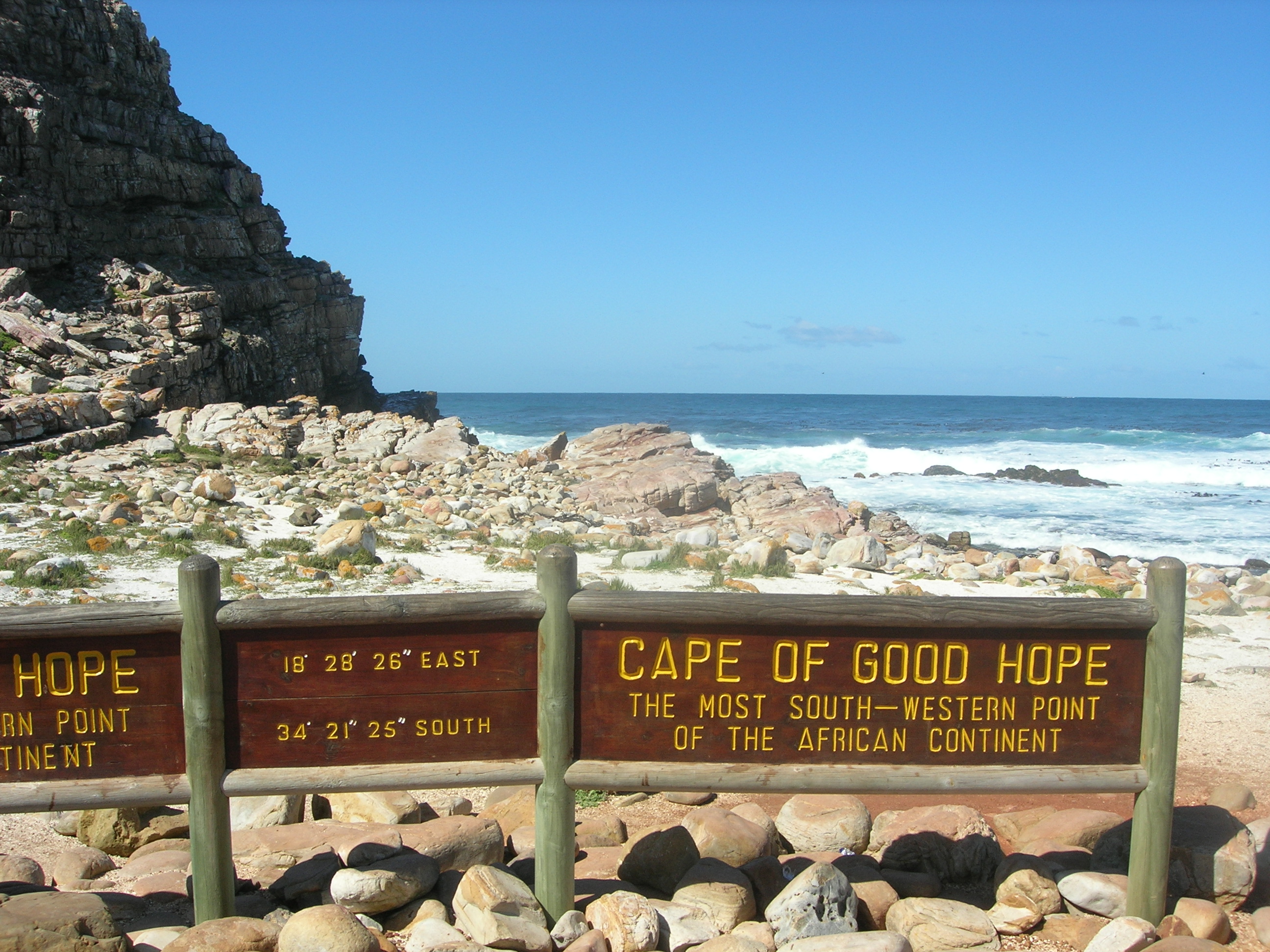
I have to say I learned something from this post (actually, from the Wikipedia photo). It’s been over 60 years since I took geography, but I couldn’t believe that the Cape of Good Hope, is only at 34+ degrees south latitude. I had to go to my world atlas to confirm it. Heck, compared to northern Indiana, that’s practically the tropics! Regarding the study itself, I notice the usual appeal for further study (and funds, of course). That is the standard approach when dealing with sponsoring agencies. Your sponsor wants the studies to continue because his prestige is enhanced as well, ultimately on someone elses dime of course.
Anyone?
Could the subtropical front provide a throttling affect on the Agulhas Current that would limit or cut off the flow if Antarctic waters were cold enough, and the front moved far enough north?
Just asking…
CAUTION! The reading of this study may cause side effects such as:
1. Blurry eyes
2. Skin rash
3. Bloody nose
4. Myocardial infarction
5. Head lice
6. A bad mortgage
7. Toenail fungus
8. A 75 IQ
9. Kidney stones
10. Aghulas Leakage!
With apologies to Jeff Foxworthy.