Here’s the view of La Niña today:

The Multivariate ENSO Index (MEI)
by Klaus Wolter, NOAA Earth Systems Research Laboratory

El Niño/Southern Oscillation (ENSO) is the most important coupled ocean-atmosphere phenomenon to cause global climate variability on interannual time scales. Here we attempt to monitor ENSO by basing the Multivariate ENSO Index (MEI) on the six main observed variables over the tropical Pacific. These six variables are: sea-level pressure (P), zonal (U) and meridional (V) components of the surface wind, sea surface temperature (S), surface air temperature (A), and total cloudiness fraction of the sky (C). These observations have been collected and published in COADS for many years.
The MEI is computed separately for each of twelve sliding bi-monthly seasons (Dec/Jan, Jan/Feb,…, Nov/Dec). After spatially filtering the individual fields into clusters (Wolter, 1987), the MEI is calculated as the first unrotated Principal Component (PC) of all six observed fields combined. This is accomplished by normalizing the total variance of each field first, and then performing the extraction of the first PC on the co-variance matrix of the combined fields (Wolter and Timlin, 1993). In order to keep the MEI comparable, all seasonal values are standardized with respect to each season and to the 1950-93 reference period. The MEI is extended during the first week of the following month based on near-real time marine ship and buoy observations (courtesy of Diane Stokes at NCEP) summarized into COADS-compatible 2-degree monthly statistics at NOAA-ESRL PSD. Caution should be exercised when interpreting the MEI on a month-to-month basis, since the input data for updates are not as reliable as COADS, and the MEI has been developed mainly for research purposes. Negative values of the MEI represent the cold ENSO phase, a.k.a.La Niña, while positive MEI values represent the warm ENSO phase (El Niño).
You can find the numerical values of the MEI timeseries under this link, and historic ranks under this related link. You are welcome to use any of the figures or data from the MEI websites, but proper acknowledgment would be appreciated. Please refer to the (Wolter and Timlin, 1993, 1998) papers (NOW available online as pdf files!), and/or this webpage.
If you have trouble getting the data, please contact me under (Klaus.Wolter@noaa.gov)

How does the 1998-2000 La Niña event compare against the seven previous biggest La Niña events since 1949? Only strong events (with a peak value of at least -1.2 sigma) are included in this figure. Note that some events last through the full three years shown here (for instance, 54-56), while others revert to “normal” or El Niño conditions by the second or third year (especially in 64-66). The 1998-2000 La Niña does not resemble any previous event in this comparison figure. It started late (about three months later than the previous latest case), and it featured a superimposed annual cycle (peaking around May and troughing around November) that does not match the other events displayed in this figure. However, the weak La Niña period after the 1982-83 El Niño had similar characteristics. Click on the “Discussion” button below to find the comparison of 2010 MEI conditions against several strong La Niña events.

How does the 2002-04 El Niño event compare against the seven previous biggest El Niño events since 1949? Aside from 2002-04, only strong events (with a peak value of at least +1.4 sigma) are included in this figure. The 2002-03 El Niño event peaked below that threshold, with just over +1.2 sigma in early 2003. Overall, I would rank it just barely in the top 10 El Niño events of the last half century. In its evolution, it bears some resemblance to the 1965-67 event (highest temporal correlation), but shared with 1991-93 its reluctance to drop below the zero line once it had run its course. The El Niño event of 2006-07 reached a similar peak as the 2002-03 event, but lacked ‘staying power’, and collapsed in early 2007. The most recent event (2009-10) will replace 2002-03 in this comparison figure by the middle of 2011. Click on the “Discussion” button below to find the comparison of 2010 MEI conditions against several strong La Niña events.

The six loading fields show the correlations between the local anomalies and the MEI time series. Land areas as well as the Atlantic are excluded and flagged in green, while typically noisy regions with no coherent structures and/or lack of data are shown in grey. Each field is denoted by a single capitalized letter and the explained variance for the same field in the Australian corner.
The sea level pressure (P) loadings show the familiar signature of the Southern Oscillation: low pressure anomalies in the west and high pressure anomalies in the east correspond to negative MEI values, or La Niña-like conditions. Consistent with P, U has positive loadings mostly west of the dateline, corresponding to easterly anomalies along the Equator. The meridional wind field (V) features its scattered negative loadings north of the Equator across the eastern Pacific basin, denoting the northward shift of the ITCZ so common during La Niña conditions, juxtaposed with large positive loadings northeast of Australia.
Both sea (S) and air (A) surface temperature fields exhibit the typical ENSO signature of a wedge of positive loadings stretching from the Central and South American coast to the dateline, or cold anomalies during a La Niña event. Negative loadings north and east of Australia contribute significantly to the overall temperature pattern. At the same time, total cloudiness (C) tends to be decreased from the central to the western equatorial Pacific, and decreased close to equatorial South America as well as over Indonesia.
The MEI now stands for 26.1% of the explained variance of all six fields in the tropical Pacific from 30N to 30S, having regained more than 8% since May/June. For comparison, this value is 1.5% lower than the one registered in 1997, attesting to an overall weakening of ENSO variability in the last decade, but not as much as last month or even last August-September, since the large size of the current event is starting to register in this metric. The loading patterns shown here resemble the seasonal composite anomaly fields of Year 0 in Rasmusson and Carpenter (1982).

Consistent with the continued strengthening of La Niña conditions, all of the key anomalies in the MEI component fields that exceed or equal one standard deviation, or one sigma (compare to loadings figure), flag typical La Niña features, while no comparable El Niño-like features reach the opposite one sigma threshold. Significant negative anomalies (coinciding with high positive loadings) denote strong easterly anomalies (U) along the Equator and west of the dateline (up to -2.5 standard deviations), anomalous northerly anomalies (V) north of Indonesia, while both sea surface (S) and air temperature (A) anomalies continue to show -1 to -1.5 standard deviations in the central and eastern tropical Pacific basin. Significant positive anomalies (coinciding with high negative loadings) denote strong positive sea level pressure (P) anomalies (up to +2.5 standard deviations) over the southeastern (sub-)tropical Pacific, very strong westerly (U; up to 3.2 standard deviations) and strong southerly wind anomalies (V; up to 2.2 sigma) over the northeastern tropical Pacific, warm sea surface (S) and air temperature (A) anomalies, the latter up to +2.9 sigma, and increased cloudiness (C) north of Java. Again, all of these cardinal anomalies flag La Niña conditions.
Go to the discussion below for more information on the current situation.
If you prefer to look at anomaly maps without the clustering filter, check out the climate products map room.
Discussion and comparison of recent conditions with historic La Niña events

In the context of recent plunge of the MEI into strong La Niña conditions, this section features a comparison figure with strong La Niña events that all reached at least minus one standard deviations by June-July, and a peak of at least -1.4 sigma over the course of an event. The most recent bigger La Niña events of 1998-2001 and 2007-09 did not qualify, since they either did not reach the required peak anomaly (the first one) or became strong too late in the calendar year (both).
The most recent (August-September) MEI value shows a continued drop from earlier this year, reaching -1.99, or 0.18 sigma below last month’s value, and 3.39 standard deviations below February-March, a record-fast six-month drop for any time of year, while slowing down a bit at the shorter time scales. The most recent MEI rank (lowest) is clearly below the 10%-tile threshold for strong La Niña MEI rankings for this season. One has to go back to July-August 1955 to find lower MEI values for any time of year.
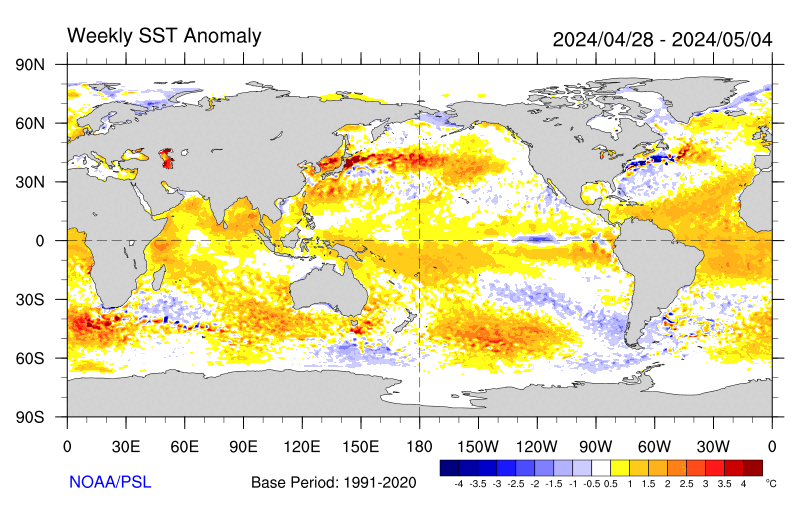
Negative SST anomalies are covering much of the eastern (sub-)tropical Pacific in the latest weekly SST map. Many of these anomalies are in excess of -1C.
For an alternate interpretation of the current situation, I highly recommend reading the latest NOAA ENSO Advisory which represents the official and most recent Climate Prediction Center opinion on this subject. In its latest update (7 October 2010), La Niña conditions are expected to last at least into the Northern Hemisphere spring of 2011.
There are several other ENSO indices that are kept up-to-date on the web. Several of these are tracked at the NCEP website that is usually updated around the same time as the MEI, in time for this go-around. Niño regions 3 and 3.4 showed persistent anomalies above +0.5C from June 2009 through April 2010, with a peak of +1.6C for Niño 3 and +1.8C for Niño 3.4 in December 2009, only to drop to about -0.5C or lower in both regions by early June 2010, reaching just shy of -1.0C for the month of July, and below -1.5C for September Niño 3.4 anomalies and below -1.2C for Niño 3. For extended Tahiti-Darwin SOI data back to 1876, and timely monthly updates, check the Australian Bureau of Meteorology website. This index has often been out of sync with other ENSO indices in the last few years, including a jump to +10 (+1 sigma) in April 2010 that was ahead of any other ENSO index in announcing La Niña conditions. After a drop to +2 in June, July rebounded to +20.5, August continued at an impressive +18.8, only to be followed by an even more impressive +25.0. The last time that this index showed higher values in September was back in 1917, which was also the only time on record that this happened for this month. An even longer Tahiti-Darwin SOI (back to 1866) is maintained at the Climate Research Unit of the University of East Anglia website, however with less frequent updates (currently through March 2010). Extended SST-based ENSO data can be found at the University of Washington-JISAO website, currently updated through May 2010 (which ended up just slightly below the long-term mean value).
Stay tuned for the next update (by November 5th) to see where the MEI will be heading next. After peaking seven months ago at +1.5, it has dropped just about as fast as it can, and continues to correlate highest with 1970, of the ‘analog’ cases shown here. Given the continued drop in the MEI into exceptionally strong territory, La Niña conditions are guaranteed well into 2011.
REFERENCES
- Rasmusson, E.G., and T.H. Carpenter, 1982: Variations in tropical sea surface temperature and surface wind fields associated with the Southern Oscillation/El Niño. Mon. Wea. Rev., 110, 354-384. Available from the AMS.
- Wolter, K., 1987: The Southern Oscillation in surface circulation and climate over the tropical Atlantic, Eastern Pacific, and Indian Oceans as captured by cluster analysis. J. Climate Appl. Meteor., 26, 540-558. Available from the AMS.
- Wolter, K., and M.S. Timlin, 1993: Monitoring ENSO in COADS with a seasonally adjusted principal component index. Proc. of the 17th Climate Diagnostics Workshop, Norman, OK, NOAA/NMC/CAC, NSSL, Oklahoma Clim. Survey, CIMMS and the School of Meteor., Univ. of Oklahoma, 52-57. Download PDF.
- Wolter, K., and M. S. Timlin, 1998: Measuring the strength of ENSO events – how does 1997/98 rank? Weather, 53, 315-324. Download PDF.
The views expressed are those of the author and do not necessarily represent those of NOAA.
It’s already happening here, when it’s drought and no rain, it’s Global Warming/Climate change. At the moment though Eastern Australia is getting plenty of rain. South East Queensland now has enough water in their dams to last until 2018 even if another drop of rain doesn’t fall!
Go back to 2007 and Australia’s biggest Alarmist said this:
Over the past 50 years southern Australia has lost about 20 per cent of its rainfall, and one cause is almost certainly global warming….Desalination plants can provide insurance against drought. In Adelaide, Sydney and Brisbane, water supplies are so low they need desalinated water urgently, possibly in as little as 18 months.
So what are they saying is the cause of this rain?? Global Warming? Climate Change? no of course not, it’s just La Niña
Just in time for Cancun.
That ocean is looking warm around on the aussie eastern coast, might need to do some more Cyclone preparation up here in Cairns.
Could someone confirm if La Nina events affect how much warmth are in the coastal waters of Fiji/PNG/Austrailia coast? As in with all the colder waters in massed out there in the center does it “push” the warmer waters to the continents? or am I just being daft? 😉
Also just want to take the opportunity to thank WUWT for being a great source of world Climate/Weather/Science/Politics, appreciate everyones efforts here especially Anthony.
Please, please, please can you include conclusions in your threads…please?
I know I should read the whole thing BUT I am only a mere mortal after all! 🙂
Regards
Mailman
Have you ever wondered why La Nina suddenly changes direction towards Peruvian cost?
http://weather.unisys.com/surface/sst_anom.gif
Well I think I may have an answer:
http://www.vukcevic.talktalk.net/LFC20.htm
a more direct indicator is that they’ve had to cancel the shoot for the new Mad Max movie as Max and his blue heeler standing in a desert covered in wild flowers isn’t exactly the look they are after 🙂
vukcevic says:
October 11, 2010 at 2:07 pm
This too worthwhile looking at:
http://www.atmos.washington.edu/~ovens/loops/wxloop.cgi?wv_east_enhanced+48+-update+3600
I remember the winters of 74-77……snow and more snow. (Montreal)
The child is suffering from Hypothermia and the so called experts still claim it is running a fever.
I do find it intriguing that these experts claim a symptom of the condition is the cause of the condition.
Vukcevic
It would seem that equator magnetic line it is today much more N-S inclined, as for the atmos.washington.edu animation. Is it that possible?
And for those interested, I’ve just posted the Monthly (Reynolds OI.v2) Sea Surface Temperature update for September:
http://bobtisdale.blogspot.com/2010/10/september-2010-sst-anomaly-update.html
Weekly Global SST anomalies dropped like a rock (dropping 0.13 deg C) over the past two weeks:
http://i53.tinypic.com/1ig7sl.jpg
Mike Davis says:
October 11, 2010 at 2:24 pm
#
I do find it intriguing that these experts claim a symptom of the condition is the cause of the condition.
Think the answer is the one Vukcevic give us:
http://www.vukcevic.talktalk.net/LFC20.htm
Fields are moving things. Those “experts” just label things, as our MD when they don’t know what is the cause of an illness: Either it’s a “virus” or a kind of “allergy”, what if you ask for a photo of that virus?
Enneagram says: October 11, 2010 at 2:27 pm
…………..
Yes it is. NOAA produces detailed geomagnetic maps every 5 years, my selection is from 2005, NOAA’s map for 2010 is not yet available.
http://www.ngdc.noaa.gov/geomag/data/mag_maps/pdf/Z_map_mf_2005.pdf
Could be an ice cold winter coming.
The weekly NINO3.4 SST anomalies based on the Reynolds OI.v2 SST data had been in record territories for September, but have recently fallen back in line with the earlier record setter for this dataset (1988):
http://i53.tinypic.com/sls9k8.jpg
“By the pricking of my thumbs,
Something wicked this way comes. ”
fr.Shakespeare’s Mac Beth
This is the 1950’s all over again…
Got Coal?
From the NOAA:
I’ll go with the Old Farmer’s Almanac myself…
I wonder if it will snow in Cancun. Anyone know if Al Gore will be attending? (LMAO).
vukcevic says:
October 11, 2010 at 2:07 pm
Then a weak sun instigating a weaker? magnetic field around Earth is going to play into this deepening La Nina.
Which way will it go? In the 1955-56 La Nina, we had a very strong Solar Cycle:
http://www.robertb.darkhorizons.org/TempGr/uSC18_19.GIF
Today we have:
http://www.robertb.darkhorizons.org/TempGr/uSC24vs13_14.GIF
an anttention-defecit disorder Solar Cycle.
Interesting stuff. Much more fun than watching the Arctic sea ice grow and shrink.
All we need is the AMO to transition cold and have a La Nina like this to hit again and then we can go back to talking about the upcoming glacial period. That will be a nice break to actually talk about the science again.
I wonder if really strong events like this are triggers for other changes coming in the climate. The warm signal in the paleo records would indicate that the current warm period will not last too much longer. I wish there were accurate records so we could better anticipate the climate indicators.
John Kehr
The Inconvenient Skeptic
We should have a pool on how far a negative deviation we get. I call a -3 standard deviation. That would be fun to watch.
Ok, I will go out on a limb here. We will have one hard month of March in the Northeastern US. That is as far out as I am willing to go. Early winter will lull people into a false sense of “no big deal” and March will howl like a banshee.
ROFLOL….
Re: janama [2:08]
“… Mad Max movie as Max and his blue heeler standing in a desert covered in wild flowers…”
Now that’s funny… I had to see what it would look like.
http://i54.tinypic.com/2pt6yz6.png
Eyeballing the “Multivariate ENSO Index” graph – it kinda jumps out at you… you know… that 50s and 60s cooling, and 80s and 90s warming.
So how does 340 to 380 ppm CO2 cool the ENSO for 2 decades, and then warm it for 2 decades? – that’s what I would like to know!
Looks flat in the 10s, with cooling ahead for another 20 years based on past cycles.