The Week That Was: 2026-07-25 (July 25, 2026)
Brought to You by SEPP (www.SEPP.org)
The Science and Environmental Policy Project
Quote of the Week: “An expert is a man who has made all the mistakes, which can be made, in a very narrow field.” — Niels Bohr
Number of the Week: Two per decade to Hundreds per decade?
THIS WEEK:
By Ken Haapala, President, Science and Environmental Policy Project (SEPP)
Scope: This TWTW discusses an editorial in the Wall Street Journal stating that the new report by National Academies of Sciences, Engineering, and Medicine “Attribution of Extreme Weather and Climate Events and Their Impacts 2026” is a biased opinion that may be used for litigation. TWTW continues with concurring views by Tilak Doshi. TWTW considers new papers that statistically demonstrate that Earth has been generally cooling for 6,500 years, interrupted by brief warming periods. TWTW discusses the firing of Henrik Svensmark and chapters in Canary In a Climate World written individually by Svensmark and Nir Shaviv. TWTW discusses new papers that assert that clearing up sulfur dioxide is contributing to the warming that is occurring in Europe. TWTW discusses a speech by Kathryn Porter who asserts that wind and solar are adding frailty to the grid and TWTW concludes with an example how this frailty is covered up by use of levelized costs of energy.
*********************
Non-Science: Last week TWTW identified major weaknesses in the report by the National Academies of Sciences, Engineering, and Medicine (NASEM) “Attribution of Extreme Weather and Climate Events and Their Impacts 2026.” On Monday, an editorial in the Wall Street Journal was more blunt. The editorial “A Climate Coup at the National Academies of Science: A report on CO2 and extreme weather is a trial-lawyer operation” began with: [Boldface added]
“Public confidence in scientific institutions has declined as they’ve become more political. A textbook case is the National Academies of Sciences, Engineering and Medicine, which on Thursday released a report that explicitly seeks to aid the tort and regulatory raid on fossil-fuel companies.
The 253-page report examines the purported scientific advances in quantifying the extent to which CO2 emissions contribute to natural disasters and extreme weather. A National Academies report in 2016 found that this area of research wasn’t well-developed. Yet this year’s report claims a sea change in the science.
Major advancements in climate methodology and modeling now ‘allow for more robust assessments,’ the report says. According to the report, scientists can now attribute particular extreme heat [events], and rainfall events with a high degree of confidence to man-caused climate change, and wildfires, droughts and tropical cyclones with moderate confidence.
Why is this important? The Academies claims its report is ‘relevant to policy and legal decisions pertaining to climate change and liability for losses sustained as a result of extreme weather and climate events.’ Translation: It could be useful in shaking down fossil-fuel producers.
Dozens of state and local governments have sued fossil-fuel companies for purported damage resulting from climate change and natural disasters. The report says its research can help such plaintiffs show they have legal standing to bring lawsuits, which requires a concrete injury that is ‘fairly traceable to the challenged action of the defendant.’
The report also says this research could help ‘inform’ policies like a law in Vermont, which empowers the government to assess the ‘financial impact on the state of fossil fuel related–greenhouse gas pollution’ and ‘demand payments from fossil fuel companies to fund adaptation projects.’ The point is to put a scientific gloss on a coercive exercise of government power.
Such research, the report tells us, ‘may also be relevant in challenges to permitting decisions or to the adequacy of environmental impact assessments’ of projects. Sierra Club, have at it. What the report glosses over is that CO2 emissions are global, and the contributions to climate change of any one company or project are minuscule.
That’s not the report’s only oversight. The Academies notes that Michael Burger, the executive director of Columbia Law School’s Sabin Center for Climate Change Law, assisted with the report and cites one of his papers. Yet the report omits that Mr. Burger is a counsel at the law firm Sher Edling, which has led the litigation raid on fossil-fuel producers.”
After noting that the climate change chapter was retracted by the Federal Judicial Center for using Mr. Burger’s work without proper attribution, the editorial concludes with:
“Mr. Burger’s fingerprints are all over last week’s report, which was partly funded by the U.S. government. Congress established the National Academies in 1863 to advise on science—e.g., fixing the weights and measures of currency and methods for protecting ship hulls from saltwater corrosion.
The Academies undermines its credibility when it makes itself a tool of legal advocacy and a political agenda.”
If these low standards of evidence continue any major user of fossil fuels could also be sued for contributing to “climate change.” The litigation can be extended to all utilities relying on fossil fuels, government agencies, airlines, automobile rentals, etc. See Article # 1.
*********************
Commentary on NASEM: In “Trump is Right to Take On the Climate Litigation Complex: President Trump has laid into a new report from the National Academy of Sciences that purports to support ‘extreme weather’ climate litigation. He’s right to do so” Tilak Doshi begins with claiming that Mr. Trump’s actions are justified. Then, in the section “The conflict-of-interest problem” Doshi writes, in part: [Boldface added]
“The most damning detail in the whole affair, and the one that ought to trouble even sympathetic observers of the Academies, concerns Michael Burger, the Executive Director of Columbia Law School’s Sabin Centre for Climate Change Law. Burger assisted with the new report and is cited approvingly within it. What the report does not mention is that Burger is also a counsel at Sher Edling LLP, the law firm that has led – and profited handsomely from – the wave of municipal and state lawsuits against ExxonMobil, Chevron, Shell and the rest of the industry. This is not a minor conflict of interest tucked away in a footnote. It is the central actor in the litigation campaign helping write the scientific document that the litigation campaign will then cite as independent authority.
This is not the first time the pattern has surfaced. The WSJ editorial board reminds readers that a climate chapter written for the Fourth Edition of the Reference Manual on Scientific Evidence – a joint publication of the Federal Judicial Centre and the National Academies, distributed to federal judges as guidance on how to weigh expert testimony – drew heavily on Burger’s prior work without proper attribution. That chapter, once the plagiarism and the conflicts came to light, was quietly retracted by the Federal Judicial Centre in February. Electronic copies had already gone out to hundreds of federal judges the previous December and, as one report on the affair noted dryly, could not be recalled. Judges across the country had already been handed a manual instructing them, in effect, on how to receive plaintiff-side attribution evidence – drafted substantially by a plaintiffs’ lawyer.
One retraction might be an embarrassment. A second report, released five months later featuring the same actor and pursuing substantially the same legal agenda, is something closer to an institutional pattern – what David Wojick, writing on Watts Up With That website some years back, described as the Academy’s evolution ‘from guardians of science to an alarmist fortress’. Institutions rarely announce their capture by groupthink. They simply keep producing the same kind of document, staffed by the same networks, funded by the same interests, until groupthink becomes the institution’s ordinary business.”
In the section “The attribution chain was never solid” Doshi writes: [Boldface added]
The scientific case underlying all of this – the claim that individual weather events, and the economic losses that follow from them, can be attributed with confidence to the historical emissions of a named company – rests on a flimsy chain of inference with at least three weak links. The first link runs from carbon dioxide emissions to global mean surface temperature, a relationship that depends on climate sensitivity estimates still disputed within the scientific literature itself, with published ranges running from roughly 1.5°C to 4.5°C of warming for a doubling of CO2.
The second link, ‘pattern scaling’, attempts to translate that global average into specific regional and local weather outcomes – a method that imposes a linear, orderly relationship onto a chaotic and non-linear climate system. The IPCC’s own reports as well as independent researchers such as Roger Pielke Jr. have shown how such pattern scaling does a poor job explaining actual trends in hurricanes, droughts and heatwaves once the data are normalized for population growth and economic development.
The third link, translating weather extremes into quantified economic losses, ignores the adaptive capacity of modern economies – air conditioning, flood defenses, crop resilience – that has driven a dramatic long-term decline in weather-related mortality, as Bjørn Lomborg has documented at length.
Each of these links is contestable on its own terms. Multiplied together across the ‘end-to-end’ framework that this style of research proposes, the uncertainty compounds rather than cancels. Tort law asks for ‘but-for’ causation: that the harm would not have occurred but for the defendant’s conduct. A model producing damage estimates for a single company spanning a range of several trillion dollars – as the Nature paper did for Chevron – is not evidence of precise causation but rather of spurious claims dressed up in the mock certainty of numbers and dollar amounts.
There is also a more fundamental omission running through the entire attribution literature, one that the National Academy of Sciences report shares with its predecessors: the studied silence on the benefits of the very gas being prosecuted. Carbon dioxide is not merely an externality to be priced and litigated against; it is, among other things, plant food, and NASA’s own satellite data have documented a substantial global greening effect over recent decades, with researchers finding that CO2 fertilization explains roughly 70% of the observed increase in global leaf area since 1982, an area equivalent to twice the size of the continental United States. A genuine cost-benefit accounting – of the kind William Nordhaus’s Nobel-winning integrated assessment models are meant to enable – would weigh these benefits against the harms before assigning liability. The attribution literature, by contrast, counts only one side of the ledger. It is advocacy dressed in the vocabulary of science, selectively blind to any finding that would complicate its verdict.
For Doshi’s full comments; and comments by Leslie Eastman and attorney Francis Menton see links under Problems in the Orthodoxy.
*********************
Global Cooling? In “No Tricks Zone”, Pierre Gosselin translates an article by Austrian Peter F. Mayer “3,000 Years of Climate History: What Solar Cycles Have to Do with Temperature Trends.” Drawing on the Temperature 12k database, published in Nature Scientific Data in 2020 and using five different statistical methods, Mayer asserts:
“that the Holocene climate optimum occurred about 6,500 years ago.
Since then, a long-term cooling trend with superimposed fluctuations has prevailed.
Mayer criticizes popular publications (such as the 2013 paper by Marcott et al.), alleging that statistical artifacts or improper blending of proxy data with modern measurements are misused to depict an extreme temperature rise.
Mayer finds a pattern that runs throughout the paleoclimatological literature: “The closer one gets to the present, the more blurred the line becomes between proxy data and instrumental measurements, between reconstruction and model assumptions.”
Historical solar activity and the solar cycle (Schwabe cycle) can be reconstructed using isotope analysis ([Be-10 and C-14] in tree rings). In addition to changes in total solar irradiance, the article points to the shielding of cosmic rays by the solar magnetic field. Weak solar activity allows more cosmic radiation to reach Earth, which can promote cloud formation and contribute to cooling.
Mayer concludes that the sun is the dominant external driver of Earth’s climate. He criticizes mainstream climate science (such as the IPCC) for focusing primarily on [CO2] as the main cause, arguing that natural solar cycles must be given greater weight in the climate debate.”
There appears to be regional differences when the Holocene climate optimum occurred (when the current interglacial period experienced its highest temperatures. Based on the geological record, the general finding is that Earth has been cooling since the Holocene climate optimum with intermittent warm periods. The International Commission on Stratigraphy (study of rock layers (strata)) estimates that Earth has been generally cooling for 8200 years.
Of course, the physical evidence that Earth is generally cooling with intermittent warm periods and that a changing Sun may be the major driver of climate change is ignored by the UN IPCC and the US National Academies of Science, Engineering and Medicine. For Gosselin’s translation see links under Challenging the Orthodoxy.
*********************
Svensmark Hypothesis: The above work supports the Svensmark hypothesis that cosmic rays influence Earth’s climate by promoting cloud formation, which can alter global temperatures. Svensmark may have applied his hypothesis too rigidly because it may be one of many reasons for our changing climate. The hypothesis has been verified by experiments at CERN, the European Organization for Nuclear Research, which has the world’s largest particle accelerator.
It is unfortunate that Svensmark has been fired. Karl Iver Dahl-Madsen writes for CLINTEL, that:
“Something unusual and encouraging has happened in Danish climate journalism. Berlingske, one of Denmark’s leading national daily newspapers, has published an excellent and genuinely inquisitive article about the dismissal of physicist Henrik Svensmark from the Technical University of Denmark (DTU), where he has been working since the late nineties. The headline leaves no room for doubt: ‘Controversial Danish climate and space researcher has received the pink slip from DTU: It is ‘a death blow’ to my research’.”
Both Svensmark and astrophysicist Nir Shaviv had chapters in the book Canary in a Climate World in the section “Climate Drivers Beyond CO2.” Shaviv wrote Chapter 4: “The Missing Driver: Solar Activity and Its Impact on Earth’s Temperature. Svensmark wrote Chapter 5: “Cosmic Rays, Clouds and Climate.” In commenting on these chapters John Robson wrote:
“The manner in which their research is mutually reinforcing is especially revealing because Shaviv and Svensmark came to the topic from opposite directions. Shaviv was interested in astronomical events over millions of years, Svensmark in the physics of cloud formation over days to weeks. But both were drawn to look at the role of cosmic rays, the constant shower of high energy particles bombarding our solar system from distant supernovae, because of a vital point about how fluctuations in solar activity affects climate.”
For Robson’s post see link under Commentary: Is the Sun Rising? and for Karl Iver Dahl-Madsen’s discussion of Svensmark’s dismissal see link under Suppressing Scientific Inquiry.
*********************
Sunlight Warming Europe? The Soviet bloc countries did not consider air pollution a problem. The implosion of the Soviet Union revealed the extent of air pollution created by burning coal which emitted sulfur dioxide. By the 1970s Western nations were addressing the problem with sulfur scrubbers, which became mandatory for new coal-fired power plants in the US in 1977. (Sulfur dioxide readily combines with vapor water to become sulfurous acid (HSO3), a weak unstable acid, which when oxidized becomes the powerful sulfuric acid (H2SO4). Sulfur dioxide is the third major gas produced by volcanoes, behind water vapor and carbon dioxide.)
John Robson links to two papers which assert that part of the summer warming occurring in the European Union is the result of a decline in sulfur dioxide. Robson writes:
“So, we have two recent studies acknowledging the EU is warming rapidly, and it can’t be explained in climate models by CO2 emissions. Instead, it is likely caused by air pollution reductions which remove aerosols, thus removing their cooling effect, and indirectly causing large-scale circulation changes that promote blocking events and summertime heatwaves. How then to cut warming? As noted, one way would be to relax the stringent EU sulfur pollution control rules. But those rules do have a legitimate purpose, to reduce some actual pollution, and they seem to have been fairly effective in ways that clearly enhance human well-being.”
It is not clear how removing air pollution causes large-scale circulation changes. Paul Homewood also notes one of the papers for which the plain language summery states:
“In particular, the reduction of sulfate emissions over Europe starting from 1980 is associated with changes in the atmospheric circulation and an additional warming over Europe. Climate models reproduce this behavior, but with a magnitude much smaller than that of observations. If the outputs of the models are corrected to compensate for this underestimation, the increase in European summer temperatures becomes largely predictable.”
Homewood adds:
“Three of the authors are from the Earth Sciences Department, Barcelona Supercomputing Center. But D M Smith works at the Met Office Hadley Centre in Exeter.
The paper was first published on 30th June and formally included in the GRL Issue 13 on 16th July. Yet weeks later, the Met Office still has not referred to it on its news website, blog or even its X Feed.
I find this astonishing, given their own role in the study and the significance of the paper’s findings.”
For Robson’s post see links under Challenging the Orthodoxy, for Homewood’s post see links under Questioning the Orthodoxy
*********************
Adding Frailty? Energy consultant Kathryn Porter gave a speech to the New South Wales Energy Forum (Australia). The speech begins with: [Boldface added]
Good afternoon and thank you for inviting me to speak today about the practical realities of the energy transition and what lessons we can draw from the experiences in Australia, Britain and elsewhere.
Electricity systems don’t respond to political ambition or financial models. They respond to the laws of physics. These are not laws that politicians can repeal!
Let me be clear at the outset: I do not believe the energy transition, as currently conceived, is sensible. I’m not against cleaner energy, technological progress or reducing genuine environmental harm. Nor do I believe that the electricity system should remain frozen in the form it took fifty years ago.
But replacing reliable, energy-dense generation with large volumes of intermittent wind and solar is a poor use of both capital and natural resources. It requires us to build far more generating capacity than we need, duplicate it with dispatchable capacity for periods when the weather does not co-operate, expand the network to connect increasingly remote and dispersed assets, and then procure additional equipment and services to replace the essential electrical characteristics lost when synchronous power stations close.
This isn’t an elegant transition from an old system to a better one. It’s the construction of several overlapping systems, at enormous cost, in an attempt to reproduce the reliability, we already had.
After going through the problems of adding expensive backup to wind and solar to create stability, Porter discusses the frailty that wind and solar add to the system:
“The Iberian blackout in April 2025 revealed the physical risks behind these economic distortions. The initial public reaction divided along familiar tribal lines. Renewable advocates insisted that wind and solar had nothing to do with the collapse, while critics described it as definitive proof that renewables could never be operated securely. The detailed reality is both more complicated and more important.
The disturbance involved voltage instability, inadequate dynamic voltage control, protection behavior and the failure of inverter-based generation to remain connected as required. More than eight gigawatts of inverter-based resources disconnected within seconds, including installations that should have ridden through the fault conditions.
With relatively little synchronous generation online, the system couldn’t arrest the cascade and the Iberian Peninsula went dark.
The lesson isn’t simply that the system lacked inertia. Inertia has become a convenient catch-all whenever a grid disturbance occurs, but synchronous machines also provide short-circuit current and voltage stiffness. These characteristics interact, particularly during faults, and they can’t safely be reduced to a single metric.
Iberia demonstrated the difference between compliance on paper and performance in the real world. An inverter may be certified against a grid-code model and still respond differently when exposed to a complex disturbance involving both voltage and frequency changes across a weak network.
Protection settings designed for a system dominated by large rotating machines may also behave unpredictably as fault currents become smaller and less familiar. Simulations and certificates are valuable, but neither is a substitute for demonstrated behavior under credible system conditions.
The blackout also illustrates the danger of normalization of deviance. As synchronous generation falls and inverter-based penetration rises, system operators may repeatedly operate closer to boundaries that would once have been considered uncomfortable. Most days nothing catastrophic happens, and each successful day is then treated as evidence that the reduced margin was safe.
But the absence of failure isn’t proof of resilience. It may simply mean the system hasn’t yet encountered the disturbance capable of exposing its weakness. It’s a bit like thinking running out in traffic is safe because you did it a few times and lived to tell the tale.
Electricity networks operate in milliseconds, not annual averages. They must survive the wrong fault in the wrong place on the wrong day. Iberia had abundant generation before the blackout, but it lacked the ability to keep that generation connected and the system stable when conditions deteriorated.”
For the entire speech which should be required memorization for all politicians who wish to tinker with the grid. See link under Energy Issues – General
*********************
Statistical Coverup: Porter recognizes that “Electricity networks operate in milliseconds, not annual averages. They must survive the wrong fault in the wrong place on the wrong day.” By contrast the Wall Street Journal had an article by a reporter, Jennifer Hiller, that fell for the statistical concept of Levelized Cost of Energy. Hiller wrote:
“Costs for large-scale solar projects increased to an average of $69 per megawatt hour, up from $58 last year, according to Lazard. Adding batteries to a solar project increased costs to about $109 per megawatt hour, up from $91.
Combined-cycle plants, which are a grid workhorse and the most efficient gas plant, capture waste heat from turbines to generate more electricity. Construction costs have climbed to their highest level in roughly 15 years, according to Lazard, to about $90 per megawatt hour, from $79 last year.”
Lazard is a multinational financial advisory and asset management firm headquartered in New York. If the reporter examined the appendix of its Levelized Cost of Energy report, she would have discovered that energy storage is calculated for 2- and 4-hour storage – totally insufficient for cold, still winter nights or for stagnant summer high-pressure domes. Further, the report does not go into frailties created by adding wind and solar onto a reliable system. See links under Article #2.
*********************
Number of the Week: Two per decade to Hundreds per decade? In “The Myth of an Energy Transition” energy analysist Mark Mills states:
“The power needed per single AI data center is truly staggering, as is the number and velocity of data centers under construction. Dozens are already underway, and hundreds have been announced, many with a power demand well over 200 megawatts (MW), enough to serve a city of 100,000 homes. The 1,000 MW scale—gigawatt scale—data centers under construction each match the power demands of a city of half a million people.
For context on the grid-engineering implications, over the past 60 years, the United States’s public grids have added only about a dozen industrial facilities with electricity demands exceeding 200 MWs. All were huge chemical factories, oil refineries, steel mills, aluminum smelters, or LNG export terminals.
But in the past half-dozen years, eight data centers, each well over 200 MW, have already been connected to public grids. And that’s just the warm-up act. Hundreds more at that scale, and bigger, are under construction or planned. Most of today’s publicly regulated electricity industry is incapable of meeting that kind of growth for both technical and regulatory reasons. Demand is mounting faster than most utilities can make decisions, much less build power plants and transmission lines.”
The public is right to be concerned. Data centers need ultra-reliable electricity at a time when politicians are tinkering with the grid by adding unreliable electricity sources such as wind and solar while promising “clean” industries. See link under Energy Issues – US.
NEWS YOU CAN USE:
Commentary: Is the Sun Rising?
#Canary in a Climate World: Cosmic rays and climate, or, sunny ways
By John Robson, Climate Discussion Nexus, July 22, 2026
Suppressing Scientific Inquiry
Henrik Svensmark fired by his university
By Karl Iver Dahl-Madsen, CLINTEL, July 21, 2026
Challenging the Orthodoxy — NIPCC
Climate Change Reconsidered II: Physical Science
Idso, Carter, and Singer, Lead Authors/Editors, Nongovernmental International Panel on Climate Change (NIPCC), 2013
Summary: https://www.heartland.org/_template-assets/documents/CCR/CCR-II/Summary-for-Policymakers.pdf
Climate Change Reconsidered II: Biological Impacts
Idso, Idso, Carter, and Singer, Lead Authors/Editors, Nongovernmental International Panel on Climate Change (NIPCC), 2014
http://climatechangereconsidered.org/climate-change-reconsidered-ii-biological-impacts/
Climate Change Reconsidered II: Fossil Fuels
By Multiple Authors, Bezdek, Idso, Legates, and Singer eds., Nongovernmental International Panel on Climate Change, April 2019
http://climatechangereconsidered.org/climate-change-reconsidered-ii-fossil-fuels/
Why Scientists Disagree About Global Warming
The NIPCC Report on the Scientific Consensus
By Craig D. Idso, Robert M. Carter, and S. Fred Singer, Nongovernmental International Panel on Climate Change (NIPCC), Nov 23, 2015
http://climatechangereconsidered.org/why-scientists-disagree-about-global-warming/
Nature, Not Human Activity, Rules the Climate
S. Fred Singer, Editor, NIPCC, 2008
http://www.sepp.org/publications/nipcc_final.pdf
Challenging the Orthodoxy – Radiation Transfer
The Role of Greenhouse Gases in Energy Transfer in the Earth’s Atmosphere
By W.A. van Wijngaarden and W. Happer, Preprint, Mar 3, 2023
Dependence of Earth’s Thermal Radiation on Five Most Abundant Greenhouse Gases
By W.A. van Wijngaarden and W. Happer, Preprint, December 22, 2020
Net Zero Averted Temperature Increase
By Richard Lindzen, William Happer, and William A. van Wijngaarden, CO2 Coalition, June 2024
Radiation Transport in Clouds
By W.A. van Wijngaarden and W. Happer, Klimarealistene, Science of Climate Change, January 2025
Challenging the Orthodoxy
Short Summary of Observations until June 2026
By Ole Humlum, Climate4you, July 2026
New Study: A 40-Fold Increase In Earth’s Main Greenhouse Gas Contributes To Cooling The Ocean
By Kenneth Richard, No Tricks Zone, July 18, 2026
Link to paper: The Effect of Water Vapor and Solar Zenith Angle on Oceanic Diurnal Warming
By Andrew Harris, Gary Wick, and Sandra Castro, Geophysical Research Letters, Accepted Apr 15, 2026
Of Climate Models And Black Boxes
By Willis Eschenbach, WUWT, July 23, 2026
My conclusion is that despite the many hundreds of thousands of lines of code in the GISS E2.1 model, in reality, nothing makes a difference in the outcome except for the claimed forcings.
Modulation of the North Atlantic Oscillation; changes in the frequency and strength of the La Nina Pump; variations in the Gulf Stream; alterations in cloud type, cover, and time of emergence (except those due to aerosols); differences in where the forcing is occurring on the planetary surface; increasing or decreasing water vapor; variations in cloud albedo; the oft-predicted weakening of the Atlantic Meridional Overturning Circulation … none of that makes any difference in the model.
We know that because if any of them did make a difference, we couldn’t reproduce the output so exactly using just the input forcings.
Global Temperature Trend Has Cooled Over The Past 6500 Years, Scientists Have Found
By P Gosselin, No Tricks Zone, July 22, 2026
Link to latest paper: Patterns in solar activity over the first millennium CE
Jian Wang, et al., Nature, Communications Earth & Environment, Jan 6, 2026
Link to earlier paper: Holocene global mean surface temperature, a multi-method reconstruction approach
By Darrell Kaufman, et al., Nature.com, June 30, 2020
Euroheat Part I: It’s hot and we caused it, but…
By John Robson, Climate Discussion Nexus, July 22, 2026
Link to one paper: Drivers and mechanisms contributing to excess warming in Europe during recent decades
By Buwen Dong & Rowan T. Sutton, Naure Climate and Atmospheric Science, Feb 5, 2025
Link to second paper: Accelerated European Summer Warming Driven by Atmospheric Circulation Changes in Response to Aerosol Forcing
By P. J. Roldán-Gómez, et al., Geophysical Research Letters, June 30, 2026
Defending the Orthodoxy
Claim: The USA has a Legal Obligation to Fund Climate Science – But Research Teams MUST Include Indigenous Knowledge
By Eric Worrall, WUWT, July 23, 2026
Link to article: International Courts Against the Defunding of Climate Science? Revisiting the ICJ’s Climate Change Advisory Opinion
By Anna Saunders, EJIL:Talk, Blog of the European Journal of International Law, July 21, 2026
[SEPP Comment: According to Saunders, the US must fund systematic ignorance of climate history and ignorance of the physical evidence of the greenhouse effect.]
Questioning the Orthodoxy
Met Office Remain Silent About Their Own Research That Undermines Their Agenda
By Paul Homewood, Not a Lot of People Know That, July 24, 2026
Link to paper: Accelerated European Summer Warming Driven by Atmospheric Circulation Changes in Response to Aerosol Forcing
By P. J. Roldán-Gómez, M. G. Donat, G. Marcet-Carbonell, and D. M. Smith, Geophysical Research Letters, June 30, 2026
Update: My Tom Nelson Podcast with Slides Download
By Ron Clutz, His Blog, July 22, 2026
One hour video with links to slides, no text
Apocalypse now? Climate doomsday goes up in smoke
By Anthony Sadar, Washington Examiner, July 21, 2026
As the U.S. endures the summer heat and temporary, transported unhealthy air, it is helpful to know that sensible precautions can be taken, such as staying indoors while enjoying modern-day air conditioning (including air purifiers). We can ride out the unpleasant days of summer being grateful for contemporary conveniences not available to our ancestors who suffered the same fate.
Climate Scientists Clearly Don’t Believe Their Own Tales of Doom
By Philip Leith, The Daily Sceptic, July 21, 2026
Because the rest of the world is evidently increasing their use of hydrocarbons, if British based climate scientists genuinely believe that we are heading for disaster they should be screaming from the rooftops about what we need to do to protect our country and our people.
There should be a plethora of scientists on TV and writing columns in newspapers calling for things like flood defences and reservoirs to divert and save the massive amounts of rainwater expected for when we need it. Desalination plants to cope with prolonged summer droughts and provide a means to put out wildfires.
Why Cutting Emissions Can’t Fix Europe’s Heat Waves
By Roger Pielke Jr., AEI, July 20, 2026
Climate Bob
By John Robson, Climate Discussion Nexus, July 22, 2026
…one of the fishy unexamined premises of climate alarmism is that all feedback mechanisms are positive. Especially in a system as complicated as climate, common sense rises up in opposition to such a dogma and says surely at least some must tend to diminish, rather than reinforce, any particular cause of warming. Otherwise, if there are only positive feedbacks, why didn’t the warming in the last interglacial, or the one before that, or the one before that, or the one before that, all warmer than this one, unleash such a process in ways that prevented the next glaciation? One of the great weaknesses of climate alarmism, curiously, is its doctrinal certainty that simply doesn’t admit there are contrary viewpoints or awkward facts, so they don’t manage to think about or address them. [Boldface added]
Heatwaves caused by fall in pollution
By Paul Homewood, Not a Lot of People Know That, July 23, 2026
The effect of air pollution on global temperatures has been well understood for a long time, as evidenced by the estimated 0.5C fall in the aftermath of the Pinatubo eruption in 1991.
Canadian Wildfire Smoke Just Crossed the Border—And It Blew Up the Fantasy of Carbon Emission Trading
By Stephen Heins, The Word Merchant, Via WUWT, July 19, 2026
Wildfires remind us that nature still dominates many carbon flows. A policy that treats every ton as a controllable human emission is built on sand;
Successful pollution markets have always started with what can actually be metered at reasonable cost—large point sources. Carbon trading tried to leap to the entire economy and the entire planet at once. The results speak for themselves;
Tidbits
By John Robson, Climate Discussion Nexus, July 22, 2026
Cats ate my bug. So says a piece in Scientific American, reprinted from The Conversation aka The Rant, about how many insects feral cats devour. Now in our view there is no bug shortage. But we do want to note the strange mix of sense and nonsense in the piece. First, we agree that cats should be kept indoors, for their own sake and that of birds in particular. We realize cats are animals, and predators (and prey). But nature is red in tooth and claw and man is red in tire and outdoor cats deplete already bleak urban ecosystems and get run over.
Florida wildlife raise more doubts about climate fearmongering
By Paul Driessen, WUWT, July 20, 2026
Wetlands denizens turn tables on apex predator, suggesting ability to adapt to climate change
Energy & Environmental Review: July 20, 2026
By John Droz, Jr., Master Resource, July 20, 2026
Problems in the Orthodoxy
Trump is Right to Take On the Climate Litigation Complex
President Trump has laid into a new report from the National Academy of Sciences that purports to support ‘extreme weather’ climate litigation. He’s right to do so.
By Tilak Doshi, Tilak’s Substack, July 24, 2026
Trump Demands Review of ‘Reference Manual on Scientific Evidence’ Used by Federal Judges
Meanwhile, the House Committee on Science, Space and Technology investigates the National Academies of Sciences, Engineering, and Medicine (NASEM) over its stewardship of this nation’s scientific efforts.
By Leslie Eastman, Legal Insurrection, July 22, 2026
Meanwhile, the House Committee on Science, Space and Technology has been investigating NASEM over its “administration of federally supported activities, including its stewardship of taxpayer resources, scientific advisory processes, and compliance with applicable federal requirements.” The committee recently accused NASEM of withholding information requested by the Committee as part of its ongoing oversight of the organization’s federally supported activities.
Apparently, NASEM officials are claiming that this information is “privileged”.
Yet Another Embarrassment From The National Academy Of Pseudoscience
By Francis Menton, Manhattan Contrarian, July 23, 2026
The very first line of the “Summary” reveals that they knew the conclusion before they started:
“Earth system changes driven by rising greenhouse gas concentrations from human activities are affecting characteristics of extreme weather and climate events, such as frequency and intensity.”
That’s nice. And how exactly do you know it? Here are the two fundamental questions that need to be addressed: (1) What are the alternative hypotheses that you have considered, and how have those been ruled out as the causes of the recent extreme weather events? And (2) what has been your consideration of the evidence, if any, that might contradict or undermine the hypothesis that “human activities” and increased greenhouse gas concentrations are the cause of these extreme weather events?
Get ready: In a Report of 175 pages, they don’t expend even one word to address either of those two questions.
Instead, it’s all about whatever confirming evidence they can find about correlation between extreme weather events and (slightly) increasing global temperatures. They claim to have a “foundational understanding” of the relationship between increasing greenhouse gases and extreme weather events. How they have achieved this “foundational understanding” without ever entertaining any alternative hypothesis is never mentioned. But the “foundational understanding” has supposedly been “strengthened” by the accumulation of evidence consistent with it (while deliberately ignoring all inconsistent evidence).
[SEPP Comment: A lengthy quote from the Summary on how the “foundational understanding” has been “strengthened” follows.]
After Paris!
Rewards for climate zealotry include $4 million worth of beachside golf holidays in Fiji
By Jo Nova, Her Blog, July 21, 2026
We couldn’t possibly save the Earth in a teleconference.
Want a Free $20,000 Luxury Holiday in Fiji or Turkey? You also Have to Show Your Face at a Climate Conference
By Eric Worrall, WUWT, July 22, 2026
Free Aussie money for all – so long as you can claim to be a representative of an “underrepresented group”.
Social Benefits of Carbon Dioxide
The effect of extra CO2 on woad
By John Robson, Climate Discussion Nexus, July 22, 2026
From the CO2Science archive.
Science, Policy, and Evidence
Reforming the alarmist National Climate Assessment has begun
By David Wojick, CFACT, July 19, 2026
For 25 years, the periodic National Climate Assessment (NCA) report has been the flagship of American alarmism. It looks like that is about to change with a realist at the helm.
The assessments are produced by a small federal office called the U.S. Global Change Research Program (GCRP) which ironically does no research. It merely produces an annual report of the climate related research of 13 major federal agencies. Its big job is doing the NCAs. The first came out in 2001 with the fifth in 2023.
Measurement Issues — Surface
Temperature Trends at Rothamsted
By Paul Homewood, Not a Lot of People Know That, July 21, 2026
After weeks of Met Office claims of record temperatures, extreme weather and red alerts, we need to refocus from the junk stations where nearly all of the Met Office claims are derived, and concentrate instead on the pitifully small number of pristine sites.
Rothamsted has one of the longest records and is in the middle of the regions most affected by this summer’s heatwaves.
I have marked on the chart the introduction of Platinum Resistor Thermometers, PRTs, which the Met Office confirm occurred in 2010.
PRTs can cause temperature spikes of as much as one degree, as they record temperatures second by second. The old conventional thermometers are incapable of observing such short-term spikes, which may account for the slightly higher temperatures recorded in recent years.
Changing Weather
Forests, Peat, and Carbon Markets: Canadian Wildfires and the Long View
By Jennifer Marohasy, He Blog, July 21, 2026
As the ice retreated at the end of the Pleistocene and the Holocene epoch began around 11,700 years ago, the tree line moved north, rapidly expanding. By the mid-Holocene, during warmer conditions, the biome had grown to something approaching or locally exceeding its modern area. The current global extent of roughly 17 million square kilometres is probably the largest the boreal forest has achieved since the previous interglacial; the Eemian, around 130,000–115,000 years ago. [Boldface added]
[SEPP Comment: Doubtful that the boreal forests are at their greatest extent since the Eemian. As H.H. Lamb showed and recent revelation of human artifacts from retreating ice show, the likely maximum extent of the boreal forests was during the Holocene Climate Optimum, peaking about 8,000 to 6,500 years ago (with regional variations).]
Heated rhetoric
By John Robson, Climate Discussion Nexus, July 22, 2026
He [Roger Pielkd Jr.] further observes that the Urban Heat Island effect is real and adds dramatically to the death toll from heat waves, and notes another complexity:
“Cities dominate the human toll of European heat waves, because that is where the people are: about three-quarters of Europeans live in urban areas.”
The Weather Pattern is Stuck: Temperate, Mild Weather Ahead
By Cliff Mass, Weather Blog, July 24, 2026
Sometimes the weather gets stuck in a totally benign pattern, with little threat of heatwaves, wildfire explosions, heavy rain, or anything else of note.
During the next week or so, we will be stuck in such a boring pattern, with great benefits for our region.
[SEPP Comment: And no one is screaming climate change?]
Burns Day Storm
By Paul Homewood, Not a Lot of People Know That, July 22, 2026
Changing Cryosphere – Land / Sea Ice
Greenland’s Ice Sheet Was Supposed To Be Rapidly Melting Away. It Hasn’t Been.
By Kenneth Richard, No tricks Zone, July 23, 2026
Link to: Surface Conditions
By Polar Portal, DMI, July 23, 2026
From Polar Portal: The map illustrates how the surface of the Greenland Ice Sheet gains and loses mass on a daily basis. This difference between snowfall and runoff is known as the surface mass balance It is always positive over the course of a year as not all fallen snow runs off the ice sheet again.
The surface mass balance is not identical to the total mass balance (i.e. overall gain or loss of the ice cap), which also includes the mass that is lost when glaciers calve off icebergs, the melting of glacier tongues as they come into contact with warm seawater and frictional and other effects at the bottom of the ice sheet. [Boldface added]
Changing Seas
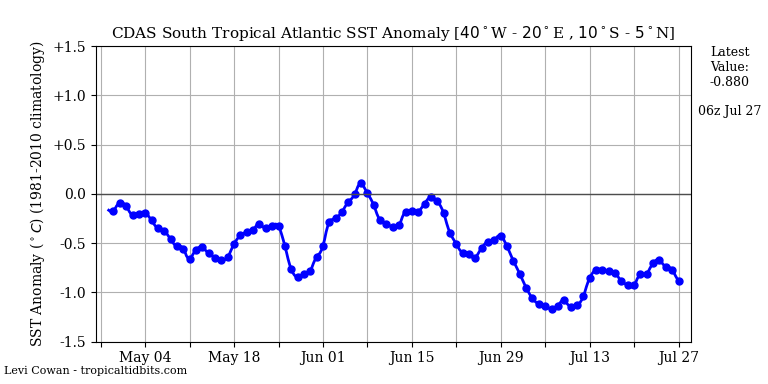
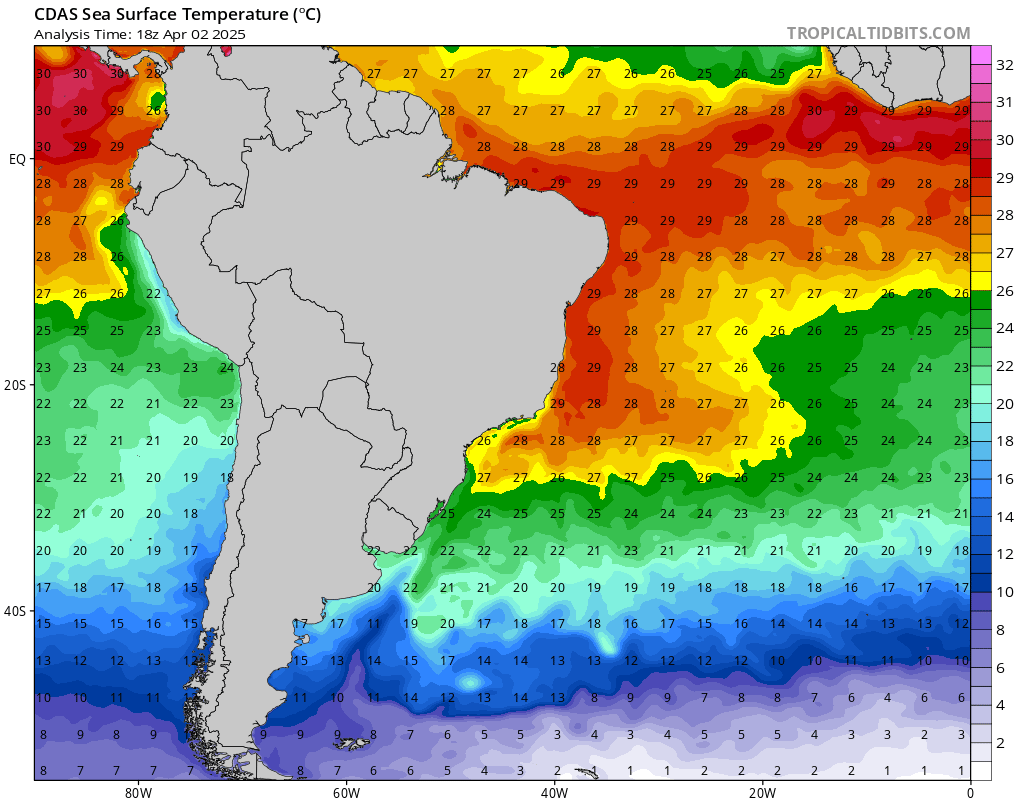
Outlook: Pacific El Niño and Atlantic Niña
By Ron Clutz, His Blog, July 18, 2026
Agriculture Issues & Fear of Famine
Cattle And The Climate
By Tony Heller, His Blog, July 17, 2026
Ten-minute video.
Lowering Standards
Met Office Heatwave “Records” Are Based on Junk Stations
By Paul Homewood, Not a Lot of People Know That, July 22, 2026
Was Storm Eowyn Worse than the Great Storm of 1987?
By Paul Homewood, Not a Lot of People Know That, July 17, 2026
Why on earth would they want to highlight the 1987 storm, if it was not to make people think Eowyn was much worse?
[SEPP Comment: The Met Office ignores other storms that were worse than both.]
Met Office & Weather Station on Top of Hills
By Paul Homewood, Not a Lot of People Know That, July 22, 2026
To sum up, the Met Office count of stations over 70Kt during Eowyn is not comparing like with like. The count is hugely inflated by the recent inclusion of ridiculously exposed weather stations. (And we won’t even mention The Needles!!!)
Communicating Better to the Public – Use Yellow (Green) Journalism?
No, WSJ: 9 Reasons Why “Green Energy” Makes Even LESS Sense Today
By Ron Clutz, His Blog, July 20, 2026
A Guardian Article Indicates the UK’s Climate Hype May Have Peaked
By Anthony Watts, Climate Realism, July 20, 2026
In The Guardian’s story “Most UK media reports on June heatwave failed to mention climate crisis,” the paper laments that nearly three-quarters of British media coverage of June’s heatwave failed to mention climate change, complaining that journalists missed an opportunity to educate the public about the “climate crisis.” It is a rare day when Climate Realism suggests a climate change article in The Guardian is worth reading but today is one of those days.
How wildfires and extreme heat are changing the way we travel (Or Not!!)
By Paul Homewood, Not a Lot of People Know That, July 21, 2026
Wrong, Wisconsin Examiner and Investigative Post, Canadian Wildfire Smoke Is Not Proof of Climate Change
By Anthony Watts, Climate Realism, July 24, 2026
In other words, today’s forests are not burning at historically unprecedented levels. Quite the opposite. Much of North America experienced more frequent fire activity centuries before increasing atmospheric carbon dioxide emissions became an issue.
That conclusion is consistent with the broader scientific literature.
Parmesan Cheese Is Not Endangered by Climate Change, Reuters
By Linnea Lueken, Climate Realism, July 17, 2026
Communicating Better to the Public – Do a Poll?
A country betrayed: less than 1 in 3 trust CSIRO and half the nation don’t want to pay a single dollar for Net Zero
By Jo Nova, Her Blog, July 22, 2026
[SEPP Comment: CSIRO, The Commonwealth Scientific and Industrial Research Organization, is Australia’s national science agency responsible for scientific research and its industrial and commercial applications.]
Communicating Better to the Public – Use Propaganda
Like wildfire
By John Robson, Climate Discussion Nexus, July 22, 2026
Forest fires have been a hot topic the last few years since there were some bad ones in the Amazon, LA, BC, eastern Canada and, once again, eastern Canada, and a lot of people have said some very ignorant things about their becoming more common and indeed the “new normal”. Global data say otherwise; they are not becoming more frequent, especially not by comparison with the early 20th century and certainly not with earlier centuries. Even though bad forest management practices have contributed to the severity of individual fires and satellite coverage was and is making it easier to detect them this is not the same as them becoming more common. It’s time to learn to see the forest for the burning trees.
West African Woes
The Guardian’s at it again
By Mark Hodgson, Climate Scepticism, July 21, 2026 [H/t Bernie Kepshire]
Questioning European Green
Britain’s National Security Must Not Be Sacrificed to Net Zero
By Richard Dearlove, The Daily Sceptic, July 22, 2026
A pillar of our national security is energy security. The supply of abundant, consistently reliable and inexpensive power, whatever the weather, is vital for the modern nation state. It guarantees that civil society does not fall apart. The idea of building an energy system designed to meet a set of ideological targets, which can at points be disrupted by a hostile government, is symptomatic of an extreme condition of political dystopia. It turns the concept of a secure energy policy on its head and destroys the logic of being focused on self-sufficiency.
Cool Comfort Denied: Europe’s War on Air Conditioning
By Tilak Doshi, Tilak’s Substack, July 20, 2026
In Camden, North London, a homeowner did something that would strike most of the people in the world as entirely unremarkable: he fitted two air conditioning units to the rear of his flat so that his family might sleep more comfortably through a spell of hot weather. Camden Council’s planning enforcement officers thought otherwise. They ordered the units “permanently removed”, ruling that the installation breached the borough’s “cooling hierarchy” policy, and advised the resident to rely instead on open windows and balcony doors.
Questioning Green Elsewhere
Beyond net zero: Toward a carbon symbiosis society
By Ronald Stein and Yoshihiro Muronaka, America Out Loud News, July 20, 2026
A New Measure of Progress
Perhaps the success of the twenty-first century should not be measured only by tons of carbon emissions reduced.
A more meaningful measure would ask different questions.
- Are fewer people living in poverty?
- Do more families have access to clean water, reliable electricity, modern healthcare, and quality education?
- Are ecosystems healthier because technology has become cleaner and more efficient?
- Has economic development become more sustainable?
These are the questions that ultimately matter.
Unreliables Made US Power Grid Fragile
Video by Kite & Key Media, Text by Ron Clutz, His Blog, July 24, 2026
When Cheap Energy Is Bad
In 2023, PJM issued a report estimating that it might lose about 40 gigawatts of electricity — more than 20 percent of its capacity — by the year 2030, thanks to power plant retirements.
Which isn’t the end of the world, right? You just bring on new power sources! Which is what they’re doing!
Here’s the problem: The high-end estimate of those new sources … is a little over 30 gigawatts.
In other words, they’re replacing 40 … with 30.
Also known as: “The math doesn’t work.”
And similar situations are happening all over the country.
When wind and solar can’t produce, we rely on sources like nuclear, natural gas, and even coal to keep the lights on. But if we cut out that part of the equation — if we don’t build to ensure resiliency — we’re placing our standard of living on a knife’s edge. And if we get that balance even slightly wrong, well…
Funding Issues
The dark green lobby that nobody talks about
By Marcel Crok, CLINTEL, July 23, 2026
[European Climate Foundation] This organization acts as a conduit for lobbying funds, mainly from American philanthropists. How much money? A great deal! According to its own tax return under its ANBI status, the ECF received no less than 275 million (!) euros in funds from other non-profit organizations in 2023.
The Political Games Continue
Charred sausages
By John Robson, Climate Discussion Nexus, July 22, 2026
It is shocking to find that politicians generally are as ignorant of economics, and as disdainful of it, as their shallow and manipulative campaign statements. And as cynical.
Litigation Issues
Endangerment Finding Litigation Update
By Francis Menton, Manhattan Contrarian, July 21, 2026
If you are a betting person, you will likely bet that the D.C. Circuit will rule against the Trump administration on the merits of this case. After all, the climate scam is a central tenet of Democratic Party orthodoxy, and 7 of the 11 active judges on the D.C. Circuit are reliable partisan Democrats. But the Supreme Court is likely to support the position of the Trump administration. The case needs to reach final resolution in the D.C. Circuit by, at the absolute latest, sometime in late 2027, in order for the case to reach resolution in the Supreme Court before President Trump leaves office in January 2029. (Some Supreme Court specialists may say that the drop-dead date for D.C. Circuit resolution is even earlier.). Will the D.C. Circuit game the scheduling to make this case take that long to resolve? Place your bets!
What Trump v. Slaughter Means for FERC
By Curtis Schube, Real Clear Energy, July 22, 2026
For nearly 90 years, Humphrey’s Executor v. United States allowed Congress to create “independent” agencies whose leaders could not be removed by the President except for limited reasons. The theory was that these commissions performed specialized, quasi-legislative and quasi-judicial functions that justified a degree of independence from the White House.
Trump v. Slaughter changed that. The Supreme Court concluded that today’s FTC exercises substantial executive authority. It writes binding regulations, investigates private parties, brings enforcement actions, and administers federal law. Because those are executive functions, the Court held that the President must have the authority to remove those who exercise them. In doing so, the Court overturned one of the foundational precedents supporting the modern administrative state.
Blue States Join Lawsuit Against Trump’s Wind Energy Freeze
By Paris Apodaca, Daily Caller, July 17, 2026
In 2025, Washington state generated the most hydroelectric power compared to any other state, accounting for 85% of its renewable power — with wind at 11%, according to the Energy Information Administration. Also in 2025, hydroelectric power made up 45% of Oregon’s total electricity net generation and wind contributed 14%.
“Oregonians are counting on these wind projects for good paying jobs and cleaner energy,” Oregon Attorney General Rayfield told local Oregon outlet KGW8. “
Subsidies and Mandates Forever
CfD Subsidies Cost £492 Million in Q2, Despite Iran War
By Paul Homewood, Not a Lot of People Know That, July 23, 2026
Despite high gas prices since the Iran conflict began in March, substantial subsidies are still being paid to renewables under the Contracts for Difference scheme.
In Q2, they amounted to £492 million, which included £373 million to out of control offshore wind farms.
Market prices rose from £74/MWh in Q4 to £90/MWh in Q2. However the average CfD strike price was £156/MWh.
[SEPP Comment: The UK Contract for Difference (CfD) price guarantying minimum payments is far too high, bilking the consumer and taxpayer.]
EPA and other Regulators on the March
Endangerment Species Act Reform: Ending the Weaponization of Regulation Against Energy, Economy, and Environment
By Stephen Heins, The Word Merchant, Via WUWT, July 20, 2026
Link to: Endangered Species Act Regulation Revisions
The U.S. Fish and Wildlife Service (Service) and the National Oceanic and Atmospheric Administration’s National Marine Fisheries Service (NOAA Fisheries) announce revisions to regulations that administer portions of the Endangered Species Act (ESA).
Final Rules, July 10, 2026
On July 10, 2026, the Service and NOAA Fisheries jointly announced a final rule removing the regulatory definition of “harm.”
On July 17, 2026, the Service announced two additional regulatory revisions. The Service is removing the future use of its “blanket rule” option under section 4(d) of the ESA. This change does not affect the protections for species currently listed as threatened species but ensures that species listed as threatened species in the future receive the protections tailored to the species’ individual conservation needs.
Additionally, the Service is revising regulations related to section 4(b)(2) of the ESA to provide criteria and clarify the processes by which the Service will implement the statutory requirements of designating critical habitat. These revisions describe when and how we determine whether the benefits of excluding an area outweigh the benefits of designating the area as critical habitat.
From Heins: These changes matter. The EPA has eliminated the burdensome “blanket rule” created in the final months of the prior administration. That rule wrongly treated every “threatened” species as if it were “endangered” by default, imposing the strictest protections unless a specific exception was carved out. In the future, a threatened species will be treated as such, with tailored 4(d) rules that reflect each species’ biology and circumstances.
Energy Issues – General
Affordable and reliable energy: where to from here?
By Kathryn Porter, Watt-Logic, July 19, 2026 [H/t Bernie Kepshire]
[SEPP Comment: Another outstanding presentation by Kathryn Porter. Should be required reading and memorization for all politicians who wish to tinker with the Grid.]
Global Air Conditioning: Adaptation in Action (warming alarmists getting their due)
By Robert Bradley Jr., Master Resource, July 21, 2026
Link to: Cooling a hotter world: El Niño meets strong growth in global electricity demand
By Anthony Vautrin, et al., IEA, July 10, 2026
From Bradley: The momentum is building for comfort over dogma.
Energy Issues – Europe
Global LNG vs the European Union
By Robert Bradley Jr., Master Resource, July 23, 2026
Link to Letter, An Open Letter to Leaders of the European Commission, European Council, and European Union (EU) Member States on the EU Methane Regulation
By heads of national energy organizations: Chris Wright (USA); Saad Sherida Al-Kaabi, (Qatar); Ekperikpe Ekpo (Nigeria); and Mohamed Arkab, (Algeria), Accessed July 24, 2026
Letter opens with: As your largest energy suppliers, we are committed to strengthening our economic and strategic partnerships and ensuring Europe’s energy security. We fully support your objectives of increasing EU economic competitiveness, prosperity, sustainability, and energy security through provision of reliable energy supplies for the European Union and its citizens.
It is with these shared goals in mind that we write to urge the EU to take swift, necessary actions to clarify and to adopt targeted amendments to the EU Methane Regulation (EUMR), some of which have already been requested by several EU Member States, industry, and members of European Parliament.
Grid Upgrade Costs Could Soar 500%
By Paul Homewood, Not a Lot of People Know That, July 18, 2026
The real scandal is that successive governments have turned a blind eye to the costs, and authorized these upgrades at any cost, in their blind zeal to get to Net Zero.
Grid capacity squeezed as net zero projects delayed
By Paul Homewood, Not a Lot of People Know That, July23, 2026
Heat Pump Use To Be Rationed
By Paul Homewood, Not a Lot of People Know That, July 19, 2026
Ignore the lie that you can opt in to this.
Yet now we find ourselves rushing headlong into a Stalinist rationing system.
It will not be long before it is mandatory. We already have legislation allowing the Government to restrict EV charging. It is inevitable that heat pump demand will soon overwhelm the power grid as soon as most households have them. There will be no alternative at all once that happens but to ration power.
Ironically, homeowners will simply resort to conventional electric heaters to warm their homes up instead. As these are less energy efficient than heat pumps, the load on the grid will increase, not reduce.
Energy Issues – Australia
Aussie Renewable Energy Retailer Collapse Blamed on President Trump
By Eric Worrall, WUWT, July 18, 2026
Quite how President Trump figures in adverse conditions in Australia’s renewable energy market, I’d love to hear that explanation in detail. Australia’s energy and climate minister Chris Bowen continuously assures us renewables are the cheapest option, so those renewables companies which haven’t collapsed recently should be giving Australia some kind of competitive advantage
Queensland Defies Aussie Data Center Green Energy Mandate
By Eric Worrall, WUWT, July 21, 2026
Aussie Green Energy Plans in Chaos, as the Majority of Capacity Investment Scheme Projects Fail to Progress
By Eric Worrall, WUWT, July 20, 2026
The AI companies aren’t interested in dumping money into Australia’s energy policy disaster, but at least one AI company is buying big in Australia’s premier coal district, where vast quantities of cheap coal are still waiting to be mined, even though they are not allowed to use that coal under current rules.
Major pivot: Academic says — get used to a few blackouts to keep costs down
By Jo Nova, Her Blog, July 23, 2026
A little piece of the third world has just arrived in Australia
What bad luck eh? Electricity prices are rising again in the Renewable Superpower known as South Australia. But it’s not the fault of renewable energy, it’s your fault see, for “demanding the highest standards of reliability.” — you unreasonable perfectionist, you.
[SEPP Comment: From newspaper article: “Daniel Rossetto is an expert in global environmental and energy commodity markets at Adelaide University.” Shouldn’t Adelaide University lead by example?]
Energy Issues — US
Power Operators Must Plan Now for Four Quantum Attacks
By Eddy Zervigon, Real Clear Energy, July 21, 2026
The Myth of an Energy Transition
Both the Hormuz crisis and AI boom reinforce the centrality of hydrocarbons.
By Mark Mills, City Journal, July 20, 2026
Rolling Blackouts Hit New York
By Francis Menton, Manhattan Contrarian, July 18, 2026
In other words, we have had temperatures over 100° F many times in the past, and undoubtedly we will have them again. But with temperatures on July 2 and 3 that were well short of the records, the grid operators had to resort to imposing rolling blackouts and/or voltage reductions in various areas of the City and Westchester County. One can only imagine how much more extensive the outages would have been if the temperature had gone up another 6° F to match the 1936 record.
Without any ability to add reliable generation to it grid, New York faces more of same every time the heat gets into this range. There is nothing inevitable about this. It is entirely a consequence of intentional decisions made by politicians.
New York’s Wind Permitting Scandal
By Roger Caiazza, WUWT, July 24, 2026
I am convinced that implementation of the Climate Leadership & Community Protection Act (Climate Act) net-zero mandates will do more harm than good if the future electric system relies only on wind, solar, and energy storage because of reliability challenges, affordability risks, and unacceptable environmental impacts.
Green Hypocrisy. The Case of Virginia Rejoining RGGI
By Geoffrey Pohanka, Real Clear Energy, July 22, 2026
Spanberger was committed to both reducing consumer’s skyrocketing energy bills and having Virginia rejoin RGGI, the Regional Greenhouse Gas Initiative. RGGI is a carbon cap-and-trade program that taxes CO2 emissions from fossil fuel power plants.
[SEPP Comment: RGGI is a cap and tax program driving up energy costs to consumers in every state that is a member.]
Hyperscalers Are the Grid’s School Choice Moment
By Marc Oestreich, Real Clear Energy, July 22, 2026
[SEPP Comment: Questionable analogy to Covid.]
Washington’s Control of Energy
E15 Misdirection (WSJ letter from farm-state US senators)
By Robert Bradley Jr., Master Resource, July 22, 2026
Link to letter, The Market Has Spoken: E15 Is a Net Positive
We know securing nationwide, year-round access will lower prices at the pump.
By Sens. Chuck Grassley (R., Iowa), Joni Ernst (R., Iowa), Deb Fischer (R., Neb.), Pete Ricketts (R., Neb.) and Roger Marshall (R., Kan.), WSJ, June 3, 2026
Oil and Natural Gas – the Future or the Past?
Open The Door – New Pipeline Capacity Unlocks Supply Potential for Permian Natural Gas
By Lindsay Schneider, RBN Energy, July 20, 2026
Return of King Coal?
America Is Leaving a Global Coal Opportunity on the Table
By Rich Nolan, Real Clear Energy, July 23, 2026
While U.S. coal exports flow to more than 70 nations, India has become exceptionally important, now taking roughly a third of U.S. export volumes.
Energy Security and Climate Realism Usher in Coal’s Rise
By Vijay Jayaraj, CO2 Coalition, July 12, 2026
Alternative, Green (“Clean”) Solar and Wind
Renewables ‘Can’t Keep Up’ With Data Center Pace. As Usual, the Left Wants Government to Step In.
By Gary Abernathy, WUWT, July 24, 2026
Wind Energy Means Going Back To The Middle Ages, Says German Professor Horst-Joachim Lüdecke
By P Gosselin, No Tricks Zone, July 19, 2026
Solar for the soul or for the senses
By Kelvin Kemm, CFACT, July 20, 2026
The large solar arrays that we are seeing are there because politics is telling you that they will ‘save the planet,’ but in fact, they are quite dangerous to an electricity grid. That is because they can create huge instability into a system, resulting in a crash. That is what happened in Spain recently. Huge solar arrays also create a significant system-management problem. For a system controller, it is obviously far more difficult to try to manage hugely varying amounts than it is to manage a far more continuous, reliable source of supply.
Alternative, Green (“Clean”) Vehicles
Honda Is Paying the Price for Falling for Biden-Era Climate Policies. Let’s Spare Others the Same Fate.
By Gary Abernathy, Real Clear Energy, July 17, 2026
Carbon Schemes
Carbon discredits
By John Robson, Climate Discussion Nexus, July 22, 2026
Especially since Heatmap just can’t give up on carbon removal, or government, so it pops corks on “The Carbon Removal Buyer the World Has Been Waiting For” and celebrates that “Proposed reforms to Europe’s Emissions Trading System could see the EU itself become a carbon credit customer.” Oh great. Having set targets it can’t meet, it steps in to rig the market including the metrics and you really think we’re going back to 1719 weather conditions, as if we should even want to.
California Dreaming
Newsom’s plastics bill increases prices, punishes the poor
By Donna Jackson, CFACT, July 21, 2026
California politicians claim corporations will absorb these costs. However, corporations do not absorb costs; consumers do. Because California is the nation’s largest market, companies cannot realistically create one packaging system for California and another for the rest of the country. They will end up spreading the costs nationwide.
Other Scientific News
America’s PFAS policy faces a scientific reckoning
By Dr. Edward J Calabrese, ACSH, Jul 15, 2026
Link to paper: Hormesis in biomedical and toxicological models: A generalizable phenomenon induced by per- and polyfluoroalkyl agents
By Edward J. Calabrese, et al., Chemico-Biological Interactions, Sep 1, 2026
BELOW THE BOTTOM LINE
Trump calls for review after climate manual for judges withdrawn
By Zach Schonfeld, The Hill, July 20, 2026
The president’s criticisms came after Sen. Susan Collins (R-Maine) asked liberal Supreme Court Justice Elena Kagan about the controversy on camera when she appeared last week on Capitol Hill to testify about the court’s security.
Kagan wrote the foreword to the updated manual and referenced the climate science update. Last week, she told Collins she hadn’t read the chapter, however, and insisted the judge who managed the project is working to avoid a repeat.
[SEPP Comment: Contrary to the article, the “climate manual” has not been withdrawn, only the climate chapter in the US Manual on Scientific Evidence. Justice Kagan wrote the foreword without reading what it referenced?]
ARTICLES
1. A Climate Coup at the National Academies of Science
A report on C02 and extreme weather is a trial-lawyer operation.
By The Editorial Board, WSJ, July 19, 2026
TWTW Summary: Substantially presented in the “This Week” section above.
*********
2. America’s Demand for Power Is Soaring—and So Are the Costs of Building Out the Grid
Equipment backlogs, permitting delays, tariffs and yearslong waits to connect to the grid are pushing up the expense
By Jennifer Hiller, WSJ, July 24, 2026
Link to: Levelized Cost of Energy
By Staff, Lazard, July 2026
TWTW Summary: Key points discussed in the “This Week” section above.
Trump’s offshore wind freeze leaves Mass. with idle terminals, soaring energy bills
https://www.masslive.com/news/2026/07/trumps-offshore-wind-freeze-leaves-mass-with-idle-terminals-soaring-energy-bills.html
I wasn’t promoting the idea- so no need to give me thumbs down. I was just showing the idiocy of energy policy in Wokeachusetts. Give me a break, guys. Or maybe the thumbs down are for the idiot state, not me. 🙂
” An expert, is a man who has made all the mistakes, which can be made, in a very narrow field”
Sounds very much like my golf !!!
In The Guardian’s story “Most UK media reports on June heatwave failed to mention climate crisis
In other words, most media outlets have reported very warm (and decent for a change) weather. Not as good as ’76, but nice just the same.
We still don’t really know which way ‘our Andy’ will jump.
PM urged to uphold climate pledges made as mayor and ban new North Sea oil drilling
Leading climate scientists who created Greater Manchester’s carbon neutral by 2038 commitment are urging Andy Burnham to unequivocally reject new drilling in the North Sea. Grauniad
Who are these leading scientists?
Prof Kevin Anderson and scientists from the Tyndall Centre at the School of Engineering at the University of Manchester…
The Tyndall Centre is a unique partnership between the universities of East Anglia UEA (Headquarters), The University of Manchester, Newcastle University, The Centre for Social Climate Change and Social Transformations and Fudan University in Shanghai. Tyndall Centre
In the words of Christine Keeler of [John] Profumo fame: Well, they would say that, wouldn’t they.
And as we all know only too well, they are entirely wrong.
The cool equatorial Atlantic.
In Search of El Niño in the South Pacific.
