The Week That Was: 2026-10-10 (October 10, 2026)
Brought to You by SEPP (www.SEPP.org)
The Science and Environmental Policy Project
Quote of the Week: “[W]e compare the result of [a theory’s] computation to nature, … compare it directly with observations, to see if it works. If it disagrees with experiment, it is wrong. In that simple statement is the key to science.”— Richard Feynman, The Character of Physical Law (1965), p. 150.
Number of the Week: 121 Years
THIS WEEK:
By Ken Haapala, President, Science and Environmental Policy Project (SEPP)
Scope: This TWTW begins with SEPP comments to the Corps of Engineers and the EPA on defining the Waters of the United States. TWTW discusses an article and paper by Steven Koonin et al. on what the authors call The Consensus Trap. Then, TWTW discusses comments by Roger Pielke Jr. on the revelations made by the House Judiciary Committee, about the new US Manual on Scientific Evidence. Then TWTW discusses comments made by former US Attorney General William Barr on the Suncor v. Boulder Climate Case. TWTW concludes with a discussion the Atlantic Meridional Overturning Circulation.
*********************
Waters of the United States: On Friday, SEPP filed comments to the Corps of Engineers and the EPA on the proposed new rule defining the “Waters of the United States.” The proposed new rule was prompted by a 2023 decision by the US Supreme Court limiting the powers of Federal government agencies over private property. The court held that the Clean Water Act covers only wetlands with a continuous surface connection to relatively permanent “Waters of the United States.” The proposed new rule continued many vague terms that are not necessary to define water. SEPP’s brief comments were:
“Formed in 1990, the Science and Environmental Policy Project (SEPP) evaluates government environmental and energy policies using the scientific method. That is, we ask: Are the policies consistent with all available physical evidence? Few Federal policies are as disconnected from physical evidence as the implementation of ‘Waters of the United States’ after the Clean Water Act.
As a private landowner, one of us has personally seen wet leaves without any surface water called Waters of the United States by the Corps of Engineers. Also, he saw perched water tables without any standing water called Waters of the United States. Such declarations are absurd.
Fortunately, in its 2023 decision in Sackett v. EPA the US Supreme Court ruled against the EPA and the Corps of Engineers. The case provides clear and specific guidance on how to define Water of the United States. On behalf of the Science and Environmental Policy Project we recommend government agencies follow the clear, specific guidance provided in the Court’s decision in defining Waters of the United States.
Further, we recommend that the agencies eliminate vague terms in their proposed clarification such as ‘at least during the wet season,’ ‘relatively permanent’ and ‘continuous surface connection’ and precisely define Waters of the United States based on physical evidence. For example, to be considered Waters of the United States rivers or streams must be continuously flowing all the time except in very rare situations and they must be surface waters crossing or their downstream connections crossing state boundaries.
Further, we recommend that agencies clearly establish that Waters of the United States are only physical surface water, not adjacent ‘wetlands’ which may not have any water at all. Tidal wetlands are washed daily by tides thus are Waters of the United States. One-hundred-year flood plains that are not inundated daily are not Waters of the United States.
Further, we recommend that the burden of responsibility be on Federal agencies to demonstrate that the Waters of the United States meet these criteria and are physical interstate waters.”
The comments were signed by the Chairman, President, and Secretary/Treasurer of SEPP.
*********************
The Consensus Trap: In the Wall Street Journal article “Covid, Climate and the ‘Consensus Trap’: Scientists are as prone as anyone else to groupthink, and stifling dissent often produces disaster” physicist Steven Koonin and physician-scientist Scott W. Atlas summarize their paper “The Consensus Trap: How Manufactured Agreement Corrupts Policy” co-authored with investment advisor Terrence Keeley. The authors assert that the three costliest policy failure in recent decades, the 2008 financial crisis, the Covid lockdowns and the campaign for rapid decarbonization, share a pathology they call the Consensus Trap. They write, in part:
“Problems began with the output of complex, unvalidated models presented as facts. Institutions and public figures under pressure to appear authoritative ignored uncertainties. Along with the press, these institutions and people became arbiters of truth, amplifying the declared consensus rather than critically assessing the evidence. Once ‘the science’ was declared, dissent was treated as misconduct. In all three cases, as we examine in a paper with Terrence Keeley, the consensus was wrong and the public suffered severe consequences, while the architects of failure avoided accountability. [Boldface added]
The 2008 crisis is the clearest example of a Consensus Trap in economic policy. Political incentives to expand homeownership, fee-driven enthusiasm on Wall Street, and Basel II capital rules built around rating-agency models combined to make a multitrillion-dollar subprime structure look safe when it was fragile. When economist Raghuram Rajan warned at Jackson Hole, Wyo., in 2005 that the system could crack, Lawrence Summers dismissed his premise as ‘slightly Luddite.’ Mr. Rajan was right. Millions of workers lost their jobs, and millions more lost their homes. Taxpayers paid for enormous bailouts, and no top executive of a major Wall Street bank went to prison.
Covid-19 had the same toxic mix, but in a public-health emergency. Beginning in 2020, policies allegedly following the science-imposed lockdowns, prolonged school closings, church and business shutdowns, and vaccine mandates even for low-risk populations. But data available by the spring of 2020 showed that lethality was concentrated overwhelmingly among the elderly. Simple common sense argued instead for targeted protection. Those who said so—including one of us, Dr. Atlas, from inside the White House—faced attacks in the media and university censure. The collateral damage was sweeping, even beyond extra deaths: historic learning loss, a surge in youth self-harm, delayed and missed medical care, and economic devastation. The full human cost may never be known, yet few institutions have done after-action reviews.
Climate policy shows the same dynamic on a longer fuse. While greenhouse gases do warm the planet, the claim of inevitable catastrophe absent an energy transition—which, conveniently, would be painless—rests on implausible scenarios and on institutional incentives that reward alarm. Scientists who drew attention to that disconnect, such as Judith Curry, were assailed rather than debated.
Germany’s environment minister stated that a consumer surcharge for renewable energy would cost households ‘as much as a scoop of ice cream’ each month; it rose more than tenfold before being scrapped altogether in 2022. The emissions reductions achieved so far have had no detectable effect on the climate. As with subprime and Covid, the architects have faced little reckoning, and because climate consequences unfold over decades, they probably never will.
Accountability failed in each case. Alan Greenspan confessed his ‘shocked disbelief’ and largely kept his standing. Anthony Fauci and Francis Collins collected awards and honorary degrees. The Intergovernmental Panel on Climate Change, whose summaries for policymakers are more alarming than the reports beneath them, retains the 2007 Nobel Peace Prize. None of them paid a price remotely commensurate with the failure.
Open debate that airs dissent can reduce the likelihood of a Consensus Trap. A moderated online forum could make challenges to contested papers part of the scientific record. Federal research funding could be conditioned on universities demonstrating real protection of academic freedom. Congress could again have its own independent science advisers. And public after-action reviews could test the accuracy of consensus-based projections, as the military does, so that overconfidence carries a reputational cost.
The Reference Manual on Scientific Evidence, which guides federal judges in weighing expert testimony, was recently revised by the Federal Judicial Center and the National Academies. Its new foundational chapter, ‘How Science Works,’ links ‘widespread acceptance’ to ‘the highest level of certainty science has to offer.’ Our examples show this to be untrue. Manufactured consensus too often guides the application of the law. An April letter to Chief Justice John Roberts co-authored by one of us, Mr. Koonin, explicitly asked that this chapter be withdrawn—yet it continues to guide thousands of federal judges.
Expert input is essential to policymaking—but avoiding policy debacles means understanding the experts’ proper role. We should neither be wholly distrustful of expertise nor subservient to it without critical challenge. We must institute safeguards that make expertise trustworthy: transparency about uncertainty, protection for those who test it, and real consequences when things go wrong. Sound conclusions come from testing claims and debating evidence. ‘The science is settled’ is often an attempt to foreclose vital debate.
We have paid dearly for ignoring that three times in the past two decades. Building those safeguards is how we avoid another Consensus Trap.”
For the paper and a separate article by John Ridgway see links under Challenging the Orthodoxy, for the article and other links see Article # 1.
*********************
National Academies Disgrace: Roger Pielke, Jr. posted further search on how Michael Burger became involved in drafting key chapters of the Reference Manual on Scientific Evidence, Fourth Edition, which the Federal Judicial Center (FJC) and the National Academies of Sciences, Engineering, and Medicine (NASEM) published on December 31, 2025. Burger directs Columbia’s Sabin Center for Climate Change Law and serves as Of Counsel at Sher Edling, the law firm representing most of the cities and counties suing fossil fuel companies. Pielke writes, in part:
“The contested climate chapter acknowledges in a footnote that it drew upon the law review paper led by Burger — so identifying and quantifying the ghost authorship was not exactly rocket science.
In their report released last week, House Judiciary Committee investigators revealed emails among the Sabin Center collaborators and the NASEM and FJC. The emails provide some truly remarkable details about the drafting of the chapter — details that are far worse than what I reported last March.
Specifically, the emails reveal that after NASEM invited Burger to author the chapter, the FJC removed Burger from the chapter over concern about a real or perceived conflict of interest with his litigation work.
The timeline indicates that NASEM approached Burger to be the original author of the chapter and suggested that he base it on his earlier law review paper.
Despite Burger’s agreement to the FJC request that he not co-author the chapter, he kept taking part in the drafting and editing — in his words, contributing “behind the scenes” (Exhibit 24).
The NASEM scandal is just the tip of the iceberg of a large, organized effort to repurpose institutions of expertise that are supposed to be independent and impartial to instead serve stealth advocacy in support of climate litigation.
Last week, the editorial board of the Wall Street Journal commented:
‘None dare call it conspiracy, but it sure looks like an organized, stealthy effort to influence how judges rule on cases.’”
Pielke also writers that:
“After the FJC withdrew the chapter on February 6, 2026, NASEM’s then-president [Marcia K.] McNutt defended the chapter in the Wall Street Journal and then told state attorneys general on February 26 that the chapter would remain on NASEM’s website.
After McNutt retired from the NASEM on June 30, 2026, on August 7, 2026, NASEM removed the chapter pending an independent review of ‘the processes used to develop the chapter.’ NASEM has yet to publish its findings.
At the start of September 2026, NASEM’s new president, Neil Shubin, said that the chapter ‘followed a very different process from the reports we do,’ and he stood by NASEM’s July report, Attribution of Extreme Weather and Climate Events and Their Impacts.
However, a National Review analysis compared the front matter of the NASEM/FJC chapter and that of the NASEM attribution report and demonstrated that NASEM put forward the same review standards for each — almost word for word.” [Boldface added]
Pielke points out that officials often choose “experts” who will deliver what the officials want. He gives specific examples in recent years over several administrations and in other countries as well. For more on this disgraceful episode involving the National Academies see link under Challenging the Orthodoxy.
*********************
Gaming the System: The above two topics illustrate how organizations and people try to game the legal system for their own benefit. These efforts regarding climate change are one-sided. Just like the UN IPCC and its followers, they ignore climate change history. We are in a brief warm period during Icehouse Earth. There are lengthy periods of glaciation where the breadbaskets of Earth are either covered in ice or are barren, cold, and dusty.
The physical evidence shows that carbon dioxide is a minor contributor to climate change and the amount of carbon dioxide that has been added since the beginning of the Industrial Revolution has a minor influence of Earth’s temperatures. Yet, government organizations try to blame producers of fossil fuels for extreme weather events which have been occurring throughout known history. These organizations ignore that increasing atmospheric carbon dioxide is causing vegetation to flourish, particularly in arid regions.
One example of self-serving is the City and County of Boulder Colorado suing oil companies, a case heard by the US Supreme Court on Monday October 5. Much has been written about the litigation, some of the most succinct comments that TWTW reviewed came in a transcript of a speech by former US Attorney General William Barr. In part, he said:
“In the case of these current emission lawsuits, it’s obvious that some of these energy companies were producing an emissions-causing product and selling it to those who ultimately emitted it. But they’re not being sued for selling it; they’re being sued because they contributed to interstate and international emissions. A state, however, like Colorado in Suncor, does not have the authority to unilaterally decide that it’s going to apply its own law to those emissions.
Extraterritoriality is another point that is obviously at stake in this case and reflects the same basic principle: a state generally cannot exercise its powers outside of its own territory. There is not very much wiggle room in that doctrine. I do think there’s foreign affairs preemption, but first, let’s be clear: we’re talking about preemption. The Constitution’s structure preempts it because no single state can regulate an interstate phenomenon that affects multiple states.
That’s the Clean Air Act’s whole basis: to provide for the regulation of air that’s constantly moving among states, because that movement is inherently an interstate phenomenon. The Clean Air Act was Congress’s effort to have federal supervision and rules regarding interstate emissions, while also preserving some room for the state to regulate sources in the state. The state’s regulatory authority, however, comes only from the statute.
The Clean Air Act only replaces what it replaces in federal common law. It doesn’t replace the basic precept inherent in the Constitution, that a state does not have the authority to make rules for other states. Under the Clean Air Act itself, it’s preempted as well.”
Barr then discusses the foreign affairs preemption for which TWTW asks: Can Boulder sue China for emitting more carbon dioxide than the rest of the world combined and collect? Barr concludes with [Boldface italics in original]:
“Homo sapiens have been walking the earth for 300,000 years, and for most of that time, our lives have been nasty, brutish, and short. That fate only changed 300 years ago, coincident with the beginning of the fossil-fuel-based Industrial Revolution. There is a chart in Alex Epstein’s Fossil Future (2022) that shows how humanity’s well-being, life expectancy, per capita income, and population growth all coincide with our increased use of fossil fuels. Until the Industrial Revolution, human beings relied on muscles, horses, a few windmills, and burning wood, dung, and charcoal for fuel. That’s what we relied on until coal, oil, and natural gas changed everything.
Canadian environmental scientist Vaclav Smil, whose books show how dependent the world is on fossil fuels, thinks this idea that we can quickly eliminate or start drastically reducing the use of fossil fuels is an illusion. It is caused by the disconnect between the life of urban elites and the truth of what supporting our society requires: runways and flights and the fertilizers half the world depends on, which are made from natural gas and the tremendous amount of heat that process generates.
Every price increase and curtailment of fossil fuels, without a good idea of economic and effective substitutes, comes at a huge cost. This is a decision we’re choosing to make.
The states are playing in the wrong ballpark. They’re looking at this issue as though it’s a tort [issue] and asking how much damage was done, and how much the companies paid….But tort damages is not the issue that the U.S. or the world faces. The real issue is how do we sensibly try to reduce emissions without destroying our economies the way Germany has. That’s the way everyone else in the world is looking at it now.
But the climate activists don’t want a national decision. They don’t want this question to go through the political process, where there will be a discussion of the pros and cons and benefits of fossil fuel and what it means to lose those benefits. Climate activists want the jury to decide how much companies have to pay out. We can’t go into the courtroom and point out that people will die if the energy prices rise because that’s not a defense in a tort case. But questions about consequences are questions we must raise, and that requires the political process. It also requires a locus of responsibility. We need people we can hold accountable for these decisions, rather than a bunch of municipal and state judges making individual decisions across the country that cumulatively destroy the American energy industry.
And what will that destruction do? The market won’t disappear because there is no suitable energy substitute. People will still use petroleum and natural gas that will come from far less environmentally sensitive foreign suppliers. And all we will have succeeded in doing is destroying our own industry with no environmental benefit. That’s exactly why any sensible person agrees that these policies must be pursued through international agreements. Otherwise, we’re going to end up holding the bag.
The Constitution is a sensible document; the structures it builds align with reasonable common sense. The idea that the Constitution would enable local courts to make independent judgments dealing with who pays for worldwide emissions is preposterous. That would require local juries making judgments on whether the Chinese and their thousands of coal plants, for example, bear more responsibility for emissions than ExxonMobil. This is not a question the courts are best suited to answer; it is a question of whether the democratic process works. If it doesn’t, people have a remedy. It’s certainly not a case for state courts. We need national rules and approaches.
Is this the logical place to make these decisions? No, but it’s where the environmental movement likes to make policy. Federal courts don’t seem hospitable to these suits and that’s why they’re happening at the state and municipal courts. The litigants know that if they [are] in the federal court system these cases will make their way to the Supreme Court, where all these conservatives are. So, they need to find someplace else to pursue this agenda.”
I hope the Court takes a stand on this because it isn’t just a run-of-the-mill decision. This issue has been percolating for years. These are public companies. They need investments. We need to know that we can fulfill our commitments to provide natural gas to the Europeans, for example. We can’t have this morass of litigation around the country hanging over us while we’re moving forward.
See link under Challenging the Orthodoxy and links under Litigation Issues for other comments.
*********************
Fear of Cold: Frequently articles appear stating that the Atlantic Meridional Overturning Circulation (AMOC) is collapsing from CO2 caused climate change. The circulation is vital for northwest Europe because it is part of the Gulf Stream that brings warm water from Gulf of America (Mexico) to northwest Europe. [Based on observations he made and information from sailors Benjamin Franklin drew a chart of the Gulf Stream in the 1760s.]
Paul Homewood discusses an article in the Telegraph claiming the AMOC is weakening. He mentions a 2007 paper by two noted oceanographers: “One hundred years in the Norwegian Sea.” The Norwegian Sea is between Norway, the Greenland Sea, and the Arctic Ocean. The abstract states, in part:
“During the past 100 years, six events in particular have made an impact on the physical environment of the Norwegian Sea on a timescale of decades, each seeming to involve a different mix of ocean-climate processes, and each therefore providing new insight into the varied nature of physical change and ecosystem response: 1) the Great Chill, 1900–1920; 2) the Warming in the North, 1920–1960; 3) the Great Salinity Anomaly, 1968–1982; 4) the Warming of the Abyss, 1970–present day; 5) the freshening of the subarctic seas; and 6) the warming of the Arctic.”
On September 1, NOAA had a post “Satellite data reveals Gulf Stream intensification” which discussed a paper by NOAA oceanographers “Rapid Surface Intensification of the Gulf Stream Since 2014.” The abstract of the paper states:
“The warm, swift Gulf Stream (GS) plays a key role in shaping weather and climate patterns across the North Atlantic. Using 31-year (1993–2023) of continuous satellite altimeter observations, we identify a pronounced intensification of the free-flowing GS after its separation from the coast beginning around 2014 and persisting thereafter, following a prolonged period (2005–2014) of weaker transport. This intensification coincides with a northward displacement and reduced meandering of the GS path, which appears to be linked to a spin-up of the North Atlantic subtropical gyre. This gyre acceleration is largely driven by an increase in the negative wind stress curl, partially modulated by the two leading modes of atmospheric variability in the region: the North Atlantic Oscillation and the East Atlantic Pattern. Our analysis also suggests that GS intensification may have a local air–sea feedback leading to anomalous wind stress curl.”
As Homewood stated.
“In short, there is nothing unusual, unnatural, or unprecedented about the changes in the AMOC being discussed here. They are all part of the Earth’s thermostat.
Cutting ‘planet-warming emissions’ will have no more effect on the AMOC than King Canute had on the tide!”
See links under Challenging the Orthodoxy and Changing Seas.
*********************
Number of the Week: 121 Years. Until the early morning of October 8, no hurricane was seen in the Atlantic Basin. Given modern satellite observations, this is quite remarkable. Named Hurricane Isaias, the storm made landfall as a class 2 hurricane near Destin Florida. According to Wikipedia the last time there was no hurricane spotted until October 8 was in 1905, 121 years ago. Will World Weather Attribution (WWA) announce that the delay in the hurricane date was due to climate change and give a probability to justify its assertion?
NEWS YOU CAN USE:
Challenging the Orthodoxy — NIPCC
Climate Change Reconsidered II: Physical Science
Idso, Carter, and Singer, Lead Authors/Editors, Nongovernmental International Panel on Climate Change (NIPCC), 2013
https://www.heartland.org/media-library/pdfs/CCR-II/CCR-II-Full.pdf
Summary: https://www.heartland.org/_template-assets/documents/CCR/CCR-II/Summary-for-Policymakers.pdf
Climate Change Reconsidered II: Biological Impacts
Idso, Idso, Carter, and Singer, Lead Authors/Editors, Nongovernmental International Panel on Climate Change (NIPCC), 2014
http://climatechangereconsidered.org/climate-change-reconsidered-ii-biological-impacts/
Climate Change Reconsidered II: Fossil Fuels
By Multiple Authors, Bezdek, Idso, Legates, and Singer eds., Nongovernmental International Panel on Climate Change, April 2019
http://climatechangereconsidered.org/climate-change-reconsidered-ii-fossil-fuels/
Why Scientists Disagree About Global Warming
The NIPCC Report on the Scientific Consensus
By Craig D. Idso, Robert M. Carter, and S. Fred Singer, Nongovernmental International Panel on Climate Change (NIPCC), Nov 23, 2015
http://climatechangereconsidered.org/why-scientists-disagree-about-global-warming/
Nature, Not Human Activity, Rules the Climate
S. Fred Singer, Editor, NIPCC, 2008
http://www.sepp.org/publications/nipcc_final.pdf
Challenging the Orthodoxy – Radiation Transfer
The Role of Greenhouse Gases in Energy Transfer in the Earth’s Atmosphere
By W.A. van Wijngaarden and W. Happer, Preprint, Mar 3, 2023
Dependence of Earth’s Thermal Radiation on Five Most Abundant Greenhouse Gases
By W.A. van Wijngaarden and W. Happer, Preprint, December 22, 2020
https://wvanwijngaarden.info.yorku.ca/files/2020/12/WThermal-Radiationf.pdf?x45936
Net Zero Averted Temperature Increase
By Richard Lindzen, William Happer, and William A. van Wijngaarden, CO2 Coalition, June 2024
Radiation Transport in Clouds
By W.A. van Wijngaarden and W. Happer, Klimarealistene, Science of Climate Change, January 2025
https://scienceofclimatechange.org/wp-content/uploads/SCC-2025-vWijngaarden-Happer.pdf
Challenging the Orthodoxy
The Consensus Trap: How Manufactured Agreement Corrupts Policy
By: Steven Koonin, Scott W. Atlas, Terrence Keeley, Hoover Institution, Sep 29, 2026
We describe a pattern common to three of the most consequential public policy failures of the past two decades—the 2008 financial crisis, the COVID-19 pandemic management, and the campaign for rapid decarbonization. While these involve very different sectors, they share a common pathology we call the consensus trap. Each of these failures derives from an alignment of powerful institutions and leaders in manufacturing a consensus not supported by the evidence.
Climate Model Software
Where good programming standards went to die
By John Ridgway, Climate Scepticism, Oct 7, 2026 [H/t Bernie Kepshire]
During the Covid pandemic, a great deal of government policy relied upon predictions made by epidemiological models. Specifically, the UK placed great store in a model known as CovidSim, developed by Neil Ferguson of the Imperial College London. However, when the source code for this model was finally made public on GitHub in mid-2020, the wider software engineering community found it to be wanting.
Actually, the technical term used by many of that community was ‘horrendous bag of crap’. Firstly, it was a monolithic file of over 15,000 lines of code, enjoying the structure of a plate of spaghetti Bolognese. Upon detailed examination, a total of over 1,200 ‘issues’ were documented, not the least of which was the lack of reproducibility.
[SEPP Comment: See paper immediately above.]
“Behind the Scenes” at the National Academies
New documents reveal stealth advocacy at the heart of America’s science academy
By Roger Pielke Jr, The Honest Broker, Oct 5, 2026
My Comments on the Suncor v. Boulder Climate Case
By William P. Barr, Real Clear Energy, Oct 9, 2026
Telegraph’s “Day after Tomorrow” Scare
By Paul Homewood, Not a Lot of People Know That, Oct 5, 2026
Link to contradicting paper: One hundred years in the Norwegian Sea
By Bob Dickson &Svein Østerhus, Norwegian Journal of Geography, Aug 21, 2007
Beijing’s Useful Idiots: Germany, California and the Green Road to Chinese Supremacy
By Tilak Doshi, Tilak’s Substack, Oct 10, 2026
Germany sits on shale gas that its federal geological institute puts at 320 to 2,030 billion cubic metres of technically recoverable resource, far exceeding its conventional reserves, yet a 2016 ban keeps the frackers out while Berlin imported some 684 terawatt-hours of gas in 2025. That import dependence is a policy choice, and a bad one. Germany’s answer to the 2022 gas shock, after it sanctioned Russian gas imports to itself, was to lean harder on lignite while its last nuclear plants closed on schedule and were demolished with fanfare. Dunkelflaute, the cold, still, dark spells northern Europe undergoes, cannot be bridged by batteries at any price an economy could bear. Brussels, whose energy policy takes its cues from Berlin, is no better. Norway, outside the EU, ignores Brussels: it brought the Johan Castberg field onstream last year and its gas already covers about 30% of EU consumption. The Norwegians are not saving the planet; they are selling Germans heat.
Dr. Thompson’s upside-down thermometer
By John Robson, Climate Discussion Nexus, Oct 7, 2026
Link to McIntyre post: Re-visiting Thompson’s Dunde
By Stephen McIntyre, Climate Audit, Oct 1, 2026
This post was written in 2018 but not published. I noticed it the other day (Sept 30, 2026) and am posting it up.
Dr. Judith Curry: ‘Michael Mann and the rest of that gang can go suck eggs’
By Anthony Watts, WUWT, Oct 9, 2026
Defending the Orthodoxy
Anthropogenic climate change leads to a pronounced reorganisation of wintertime North Atlantic atmospheric circulation regimes
By Susmit Subhransu Satpathy, et al., Nature Communications Earth & Environment, Jan 20, 2026 [H/t Bernie Kepshire]
Questioning the Orthodoxy
#Canary in a Climate World: Dr. Ken Green on 25 years in the trenches
By John Robson, Climate Discussion Nexus, Oct 7, 2026
New Study: 50 Years Of The Most Aggressive ‘Net Zero’ Policies Can Only Affect The Global Climate By 0.03°C
By Kenneth Richard, No Tricks Zone, Oct 8, 2026
Link to paper: Air quality improvement masks global cooling from CO2 reductions under China’s carbon neutrality policies for half a century.
By Bin Zhao, et al., Nature Communications, Jan 21, 2026
[SEPP Comment: Great argument for China not to reduce emissions – dirty air is cooler air.]
An outbreak of sanity
By John Robson, Climate Discussion Nexus, Oct 7, 2026
And as proof of this thesis they mentioned not only “a big variation in precipitation between coastal and inland areas of the country” but also that “inland areas of Turkey already have harsh climates with limited precipitation” and:
“According to Kayam and Cetin (2012), previously Turkey has experienced severe droughts in 1973, 1974, 1983, 1989, 1990, 1996, 2001 and 2007. Same as the current drought, the previous events were caused by the lack of precipitation for an extended period of time.”
Dawk. And if there were droughts in the 1970s that were as bad as this one, it’s nothing new so not proof of change but of lack of same. Or, if you’re in the climate cult:
“While in the short term, the country needs sustained rainfall immediately, in the long term, the government of Turkey, which is yet to ratify the 2015 Paris Agreement, should prioritize environmental concerns on both national and local levels.”
So the madness is not over. Just, like many a holiday Turkey, overdone.
Tidbits
By John Robson, Climate Discussion Nexus, Oct 7, 2026
One odd side-effect of the “climate crisis” is that news stories keep warning us how hot it is, including in Canada in fall, while our telephones bring us frost warnings
Problems in the Orthodoxy
Climate Change Weekly # 592—Major Nature Study Retracted After RCP8.5 Debunking
By Staff, The Heartland Institute, Oct 2, 20226
‘Hot mess’ paper questioning CO2 and climate change gets retracted
By Adam Marcus and Ivan Oransky, Retraction Watch, Oct 2, 2026 [H/t Bernie Kepshire]
Link to paper: RETRACTED: Comparison of Recently Proposed Causes of Climate Change
By Stuart A. Harris, Atmosphere, Aug 3, 2023, Retracted Sep 16, 2026
A paper that called into question many central data linking carbon dioxide to the rapidly warming climate has been retracted for “significant concerns,” including “unsupported conclusions” and “inaccuracies” in the interpretation of the data.
‘Natural Allies for a Clean Energy Future’ (trade group under fire)
By Robert Bradley Jr. Master Resource, Oct 5, 2026
After Paris!
A $20 million dollar Pre-COP Flop to entertain two leaders and hundreds of hanger-ons? Elitist holiday camp?
By Jo Nova, Her Blog, Oct 6, 2026
Fiji Pre COP31 Climate Conference Panic: “is anyone listening?”
By Eric Worrall, WUWT, Oct 7, 2026
What’s Going to Happen at COP31?
Not a lot, probably
By Mark Hodgson, Climate Scepticism, Oct 26, 2026
Guardian: The Coal Hypocrisy is Strong with COP31
By Eric Worrall, WUWT, Oct 5, 2026
Social Benefits of Carbon Dioxide
The effect of additional CO2 on Kielmeyera coriacea
By John Robson, Climate Discussion Nexus, Oct 7, 2026
From the CO2Science.org archive.
Seeking a Common Ground
EPA didn’t scrap clean-air rules: the real story behind the carbon mandate rollback
By Tom Golab, ACSH, Oct 8, 2026
The media recently pushed alarming headlines claiming the EPA gutted clean-air rules by rolling back power plant greenhouse gas regulations. But this narrative is misleading, at best. The EPA left longstanding protections on criteria pollutants completely intact, targeting only unproven and costly carbon-capture mandates. As extreme climate models face a long-overdue scientific reckoning, the agency’s decision corrects administrative overreach, aligning federal energy policy with the law, science and economic reality rather than perpetual environmental alarmism.
Why So Many Social Science Claims Are False
By Christopher J. Ferguson, WUWT, Oct 3, 2026
Can Bayesianism Quantify True Belief?
By William Briggs, Science Is Not The Answer, Oct 8, 2026
Bayesians, as they call themselves, have a different way of looking at it, and a bad habit. They say “Why don’t you announce, in numerical terms, what your prior probability of the proposition is, and then I’ll show you how to update that prior when new evidence arrives. Maybe think of this number as a bet, or how it makes you feel.” Suddenly the Bayes formula looms, and math happens. Which gives a satisfying scientific patina to the formula.
Yet if it were that easy, if all we had to do is assign priors to propositions, then update them with evidence, we’d be done with all the Big Questions by now, having had computer models (AI, if you like), solve the math for us.
You will have noticed I repeatedly emphasized if. Not all probability relations can be quantified. Not everything can be turned into a number. (We did this in Class recently.) Which is why Bayes is only of limited help. But even supposing every relation could be put to a number, would you be satisfied on hearing from some Expert. “The probability of God’s existence has been scientifically determined to be 93.8%”? [Boldface added]
[SEPP Comment: With World Weather Attribution the problems are that they quantify relations without any bases and they do not consider all the possibilities.]
Science, Policy, and Evidence
Climate change not the only blame for bushfire crisis
By Eric Worrall, WUWT, Oct 8, 2026
Heartland Institute Experts Applaud Trump’s New, Realistic Automobile Efficiency Standards
Press Release By Heartland Institute, Oct 2, 2026
Measurement Issues — Atmosphere
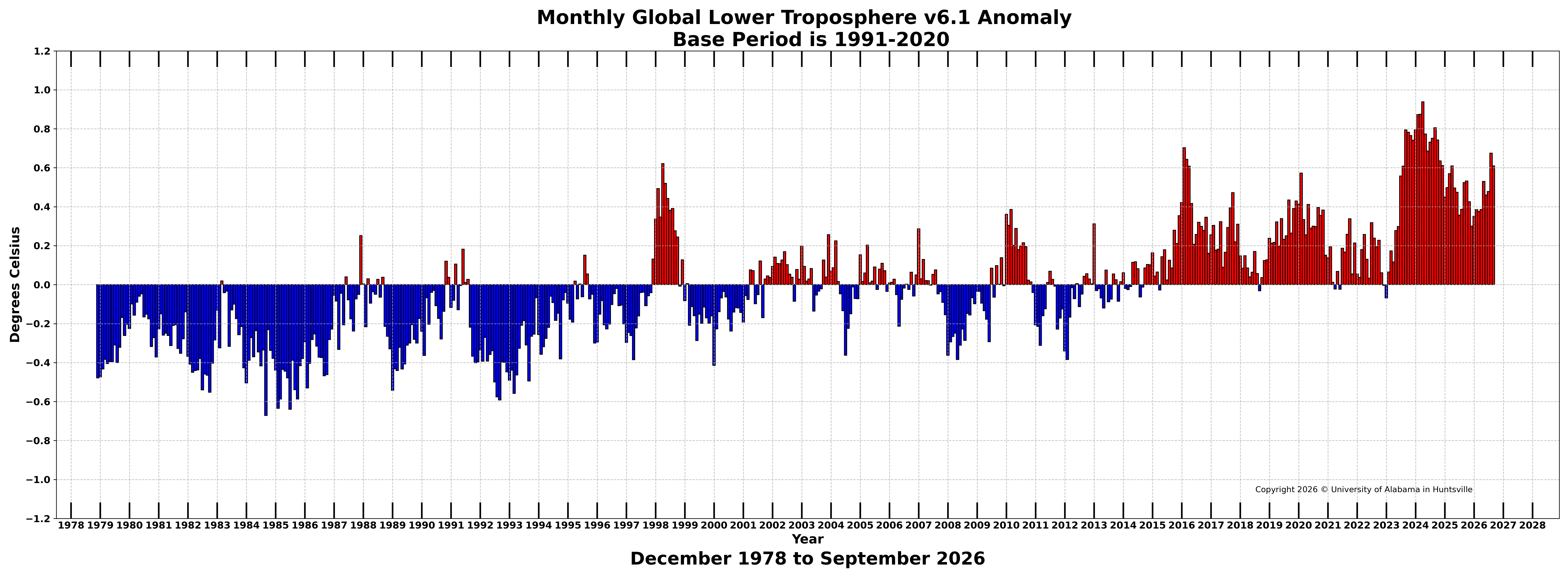
Global Temperature Report: September 2026
By Staff, The Earth System Science Center at The University of Alabama in Huntsville Oct 2, 2026
Text: https://www.nsstc.uah.edu/data/aosc/Global_Temperature_Report/2026_Reports/GTR_202609.pdf
Map: https://www.uah.edu/images/research/aosc/september_gtr_tlt_26.png
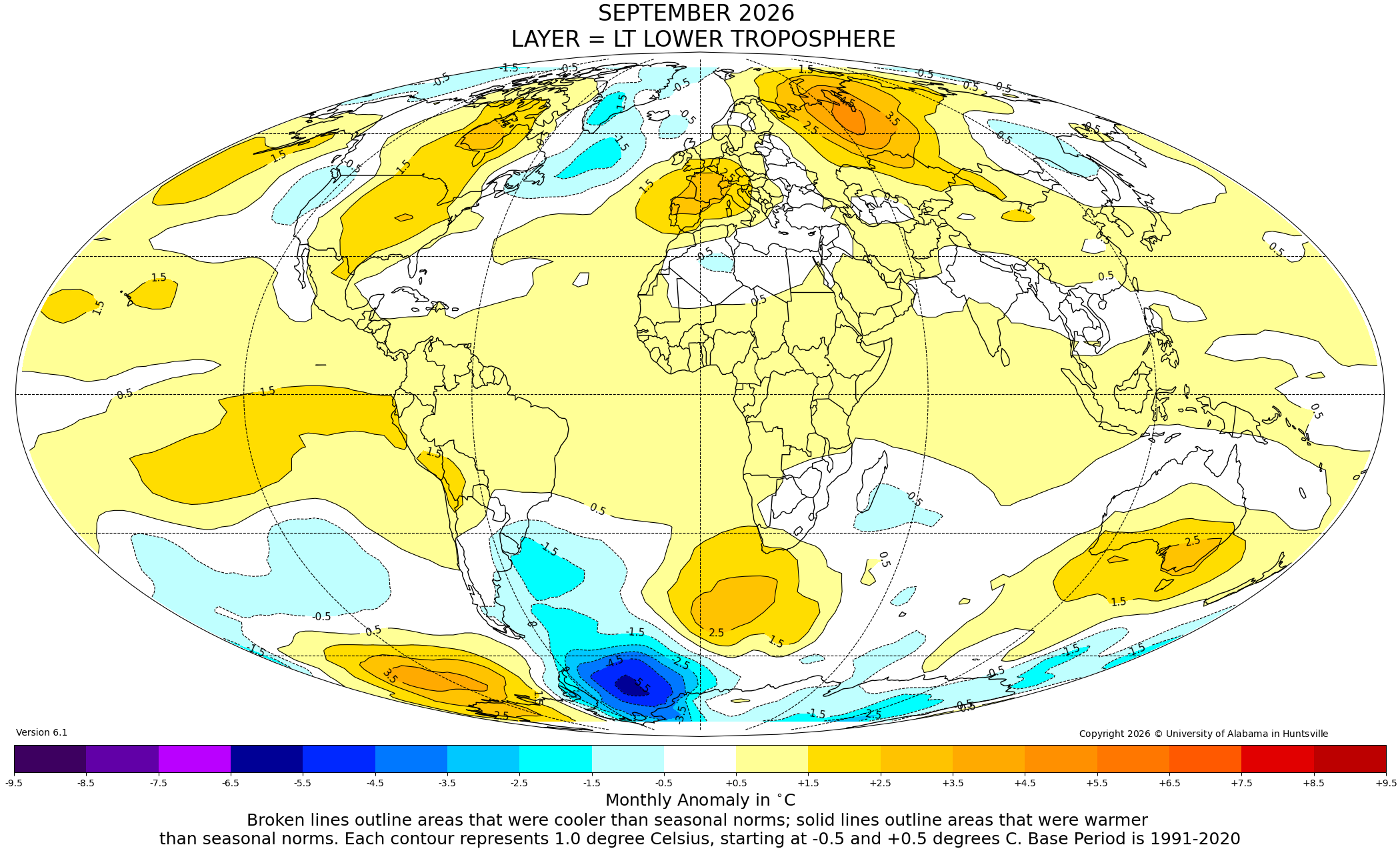
Chart: https://www.uah.edu/images/research/aosc/september_gtr_bar_26.png
Changing Weather
India Monsoon 2026
By Paul Homewood, Not a Lot of People Know That, Oct 3, 2026
As expected, India’s monsoon season has ended with rainfall below average. This is the norm during an El Nino year, which of course we have this year:
On The Criteria For Falsifying A Scientific Hypothesis
By Francis Menton, Manhattan Contrarian, Oct 4, 2026
This just in: weather variable
By John Robson, Climate Discussion Nexus, Oct 7, 2026
It certainly beats prattle (from an allegedly right-wing newspaper, the Toronto Sun) like:
“‘El Nino is being supersized before our eyes,’ UN Secretary-General Antonio Guterres said in a statement Sept. 3, warning of the potential for floods, drought and extreme heat around the globe. ‘The science leaves no room for doubt: the planet is in uncharted waters, and those waters are heating up. Sea surface temperatures are rising, temperatures keep climbing, and the world is in the danger zone of extreme weather.’”
[SEPP Comment: See link immediately above.]
US September “Heat” Was No Record…Many Records Set Decades Ago
By P Gosselin, No Tricks Zone, Oct 7, 2026
Many [records] were set in the 1880s, 1930s, 1950s and 1980s.
Changing Cryosphere – Land / Sea Ice
Chinstrap Penguins in Decline–BBC Blame Global Warming!
By Paul Homewood, Not a Lot of People Know That, Oct 9, 2026
Antarctic krill cannot be “abundant” on one hand, but in short supply at the same time in the same area.
One possibility is that, while total biomass might be abundant, in certain areas such as Area 48 it is being overfished.
Alternatively, of course, the BAS [British Antarctic Survey] might quite probably be totally wrong and krill are still plentiful.
Either way, climate change is not to blame for the decline in chinstrap populations, which have been steadily falling since the 1970s.
Greenland Ice Update
By Tony Heller, Real Climate Science, Oct 4, 2026
The press is reporting that a “decades-old” “Manhattan-sized” ice island has broken off of Greenland’s Petermann Glacier and that “researchers are watching closely.”
What they forgot to mention is that the ice which broke off is only about one-third of the ice which has grown since 2012.
Greenland Meltdown Scam
By Tony Heller, Real Climate Science, Oct 5, 2026
A short video explaining how climate alarmists describe an expanding glacier as a shrinking glacier.
Changing Seas
Satellite data reveals Gulf Stream intensification
By Staff, Atlantic Oceanographic & Meteorological Laboratory, NOAA, Sep 1, 2026
Link to paper: Rapid Surface Intensification of the Gulf Stream Since 2014
By Shenfu Dong, et al., Geophysical Research Letters, Aug 14, 2026
Acidic Waters
Ocean acidification reshapes phytoplankton phosphorus metabolism under phosphate-limited conditions
By Bingkun Wang, et al., Nature Geoscience, Oct 5, 2026 [H/t Bernie Kepshire]
Here we present multi-omics analyses of >1,000 generations of experimental diatom evolution to disentangle evolutionary and acclimation-driven responses to ocean acidification under different phosphate regimes. Long-term selection under elevated CO2 produced heritable increases in growth and carbon fixation that persisted irrespective of phosphate availability.
[SEPP Comment: With more CO2, oceans thrive with life. The term ocean acidification is intentionally deceitful. The term should be reduction in ocean alkalinity.]
Agriculture Issues & Fear of Famine
The “historic low” UK harvest, 2026
It was actually not symptomatic of a “climate doom loop”
By JIT, Climate Scepticism, Oct 8, 2026 [H/t Bernie Kepshire]
Communicating Better to the Public – Use Yellow (Green) Journalism?
As clichés rage
By John Robson, Climate Discussion Nexus, Oct 7, 2026
Boo online conspiracies; yay censorship. As in “Governments can no longer treat disinformation as an unavoidable feature of the internet, and must do more to address it through safer design of online platforms.” Safer, you see. A favorite word of benign rulers from Beijing to North Korea. And while one shudders to imagine an online platform designed by government (which in the spirit of the usurper Miraz in C.S. Lewis’s Prince Caspian) would be at once wildly inaccurate and mind-bogglingly dull, one also shudders to contemplate a state-subsidized media that insists that wildfires are blazing in unprecedented out-of-control ways when they’re um not.
Seattle Times Story on Skagit Flooding and Global Warming is Clearly Wrong
By Cliff Mass, Weather Blog, Oct 7, 2026
This article claims that global warming will cause serious flooding of the Skagit River. This is clearly wrong.
Specifically:
- The article is based on a report by an advocacy group. A report that has serious technical flaws.
- The Seattle Times provides no analysis of the claims’ viability, nor does it examine historical data to determine whether such an ominous trend is occurring.
- The report claims that “today’s 100-year flood events, or those considered to have a 1% chance of happening in any given year, will happen about four to five times as often by the 2040s.
Wrong, Los Angeles Times, Climate Change Is Not Turning Nature into a Horror Movie
By Anthony Watts, Climate Realism, Oct 7, 2026
The Los Angeles Times (LAT) claims in “Killer mosquitoes, rabid bats and bear attacks: Climate change is making eco-horror feel real” that climate change is the common denominator behind a spate of rabid bats attacks, mosquito-borne illnesses, dangerous wildlife encounters, rattlesnake bites, hiker deaths, and flooding in California in 2026. These claims are pure hyperbole and demonstrably false.
Euronews Is Wrong, Climate Change Is NOT The Biggest Threat to Tourism
By Linnea Lueken, Climate Realism, Oct 8, 2026
Impossible, Asia Nikkei, Climate Change Can’t Be Harming Indonesian Coffee Production, It Is Setting Records
By H. Sterling Burnett, Climate Realism, Oct 1, 2026
Communicating Better to the Public – Use Propaganda
Babies will die! Heat and pregnancy is this week’s new scare to add money and power for the UN
By Jo Nova, Her Blog, Oct 7, 2026
Shameless: The UN is using pregnancy and babies to boost their own job opportunities
Costa Blame Financial Woes On Climate Change!
By Paul Homewood, Not a Lot of People Know That, Oct 8, 2026
Costa [coffee shop] charges about £5 a cup for its coffee, but how much of this is accounted for by the coffee itself?
A 200g bag of Costa coffee beans costs £4 at Amazon. My good Mrs. tells me you would get 13 cups out of this, equating to 30p each. That’s retail, so Costa probably pay no more than 10p a cup. Much of that includes the cost of shipping, distribution and processing, not the cost of the green beans.
The other £4.90 per cup covers all other costs, most of which, I suspect, are staff costs.
If Costa’s costs are going through the roof, it will be because of Rachel Reeves’ tax and minimum wage hikes, not global warming!
Winning: New York Times tosses out “climate change” and tries to rebrand it “energy security”
By Jo Nova, Her Blog, Oct 3, 2026
Communicating Better to the Public – Use Propaganda on Children
How classrooms become “Impact” zones on climate
By Tony Thomas, Climate Scepticism, Oct 4, 2026 [H/t Bernie Kepshire]
Communicating Better to the Public – Protest
Why China Cares About Data Centers in Arkansas
By Greg Kiley, WUWT, Oct 7, 2026
Today, China is trying to slow the pace of data center development across the country, including in states across the nation like Georgia, Virginia and Arkansas. This is because the U.S. is locked in an AI arms race with China and the winner of this high-stakes AI competition may well dominate the global economy and enjoy military supremacy.
Raising awareness of this threat to our national security, Arkansas Senator Tom Cotton recently urged the Department of Justice to investigate Beijing’s efforts to block data centers in America by working through U.S. nonprofits.
Anti ULEZ Low Emission Zone Campaigner Jailed for 15 Years for Terrorism
By Eric Worrall, WUWT, Oct 4, 2026
Questioning Green Elsewhere
We’re not paranoid but…
By John Robson, Climate Discussion Nexus, Oct 7, 2026
Link to: China’s Net Zero Advantage
Beijing is pursuing a climate strategy that weakens the West while strengthening its own competitive position,
By Michael Doran and Brenda Shaffer, Tablet, Sep 16, 2026
From Doran and Shaffer: In its competition with China, the United States holds a natural advantage: abundant oil and cheap natural gas. Reliable energy powers factories, data centers, transportation networks, and military operations. It lets the United States combine technological innovation with industrial scale, an advantage that China, dependent on imported oil and gas, cannot easily reproduce.
But China has found a partial answer: the Net Zero movement. For years, a large, influential, and well-funded Western network has campaigned to restrict the production and use of fossil fuels. Many of the same campaigning organizations also oppose nuclear power, the largest source of emissions-free electricity in the United States. Climate advocates seek to persuade the American government to surrender its energy advantage voluntarily. Beijing agrees.
The Political Games Continue
Democratic Socialists want a Green New Deal … and more
By Craig Rucker, CFACT, Oct 3, 2026
How Can Democrats Possibly Run On “Affordability”?
By Francis Menton, Manhattan Contrarian, Oct 7, 2026
With an Energy Executive Order, Trump Could Solve ‘Affordability’ Once and for All
By Gary Abernathy, Real Clear Energy, Oct 2, 2026
Litigation Issues
PRESS RELEASE: Heartland Institute Experts Comment on Big Climate Case at Supreme Court Today
By H. Sterling Burnett, Linnea Lueken, Anthony Watts, The Heartland Institute, Oct 5, 2026
The U.S. Supreme Court today heard oral arguments in Suncor Energy v. County Commissioners of Boulder County
People’s Republic of Boulder Wants To Run Your Energy Policy
By Larry Behrens, WUWT, Oct 6, 2026
Republican Attorneys General Are Fighting to Lower Energy Costs
By J.B. McCuskey, Real Clear Energy, Oct 5, 2026
JB McCuskey is the attorney general of West Virginia.
Climate Lawfare Cannot Rewrite Energy History
By Vijay Jayaraj, CO2 Coalition, Oct 7, 2026
Michigan Attorney General Dana Nessel took aim at BP, Chevron, ExxonMobil, Shell and the American Petroleum Institute, hauling them into federal court on antitrust charges. The theory was breathtaking in scope.
She accused them of stealing the future. Nessel’s complaint claimed that the companies had colluded, in violation of federal antitrust law, to hold back wind, solar, and electric vehicles and that Michigan families had paid inflated energy bills as a result.
Judge Jane M. Beckering of the U.S. Western District Court in Michigan dismissed the complaint, holding that the state lacked standing to pursue the claim at all. That was only the beginning of the court’s skepticism.
Methylene chloride decision: A win for common sense
By Susan Goldhaber MPH, ACSH, Oct 1, 2026
How safe is safe enough? For a decade, EPA has struggled with that deceptively simple question under the Toxic Substances Control Act. A landmark Fifth Circuit decision on methylene chloride now draws a clearer line: Congress required EPA to regulate “unreasonable risk,” not eliminate risk.
The Court not only vacated EPA’s entire methylene chloride rule, but in a stunning rebuke of the Biden EPA’s approach to chemical regulations, stated that “Congress did not enact TSCA as a zero -risk statute” and that “Unreasonable risk is not a factual finding but a prudential baseline set by the statute.” This means that EPA must set standards for chemicals under the amended TSCA that permit some residual risk.
This decision is significant because it’s the first time the court has provided substantial guidance on what constitutes an “unreasonable risk.”
CFACT joins allies in urging Supreme Court to hear challenge to EPA’s fine particle rule.
Press Release, CFACT, Oct 3, 2026
Link to full brief: https://www.cfact.org/wp-content/uploads/2026/10/KentucyCEI_Amicus-Document-FINAL-Oct-02.pdf
EPA and other Regulators on the March
Secretary Brooke Rollins Shepherds Another Anti-ESG Reform for USDA
By Samantha Fillmore, WUWT, Oct 9, 2026
Link to memorandum: To: Chief Executive Officers, Chairs, and Members, Research and Promotion Boards
RE: Terminating Mandatory ESG-Related Checkoff Funding; Terminating Checkoff Support for ESG Commitment Solicitation of Food Processors; and Alignment of Research and Promotion Activities with the Administration’s Priorities
By Dudley Hoskins, United States Under Secretary for Agriculture for Marketing and Regulatory Programs, Sep 17, 2026
https://www.usda.gov/sites/default/files/documents/usda-final-esg-memorandum-9-17-26.pdf
From purpose: Mandatory producer, handler, and importer assessments must support promotion, research, and nutrition education that expand markets and demand for agricultural commodities. Assessments should not underwrite environmental, social, and governance (ESG) frameworks, net-zero, or climate-neutrality initiatives that impose non-statutory costs, restrictions, or commitments on domestic producers or processors.
Energy Issues – General
How to Prepare for a Blackout
By Kathryn Porter, The Daily Sceptic, Oct 5, 2026
None of this requires panic buying or turning the spare bedroom into a warehouse of survival equipment. Much of it is inexpensive, useful in ordinary life and can be accumulated gradually. Resilience is largely about thinking about these things before you need them.
[SEPP Comment: What Porter calls torches are flashlights in the US.]
Build power stations to protect the environment.
By Kelvin Kemm, CFACT, Oct 7, 2026
Right now, there are 600 million people in Africa who do not have access to electricity. But these people still cook meals for the family and need to keep warm in winter. How do they complete these very human tasks? They light fires. What do they use for fuel? They collect fuel from the immediate surroundings. That fuel consists of materials such as wood and dung. The dung they collect from their cattle, or maybe they get some from wild animals in the neighbourhood. The wood they get from the natural environment. They go out into the surrounding bush and collect dead trees and branches. They also chop trees down.
The refinery war and the vulnerability of modern society
By Ronald Stein, Energy Literacy, Accessed Oct 7, 2026
The lesson is remarkably simple: natural resources have latent value, and refining makes that value active by converting them into usable forms and delivering them where they are needed.
In other words, refining does not simply “consume” crude oil. It converts it into forms that society can use.
The current conflict is making this otherwise invisible process visible.
Natural Gas Turbine Boom (better late than never)
By Robert Bradley Jr., Master Resource, Oct 8, 2026
[SEPP Comment: Hi Tech companies are finding that Wind and Solar plus batteries are not able to provide ultra-reliable electricity that data centers need at a reasonable cost.]
Energy Issues – Europe
Early winter ENM rings alarm bells
By Katheryn Porter, Watt-Logic, Oct 9, 2026
On Tuesday, 6 days into the Winter 26-27 season, NESO [UK’s National Energy System Operator] issued an Electricity Margin Notice (“EMN”). Despite NESO repeatedly telling the market that EMNs are “routine tools” that do not signify a blackout, the following facts are notable.
Kathryn Porter Teaches [Prime Minister] Burnham A Lesson
By Paul Homewood, Not a Lot of People Know That, Oct 6, 2026
Ed Miliband’s “Connect & Manage” Costs Us A Fortune
By Paul Homewood, Not a Lot of People Know That, Oct 5, 2026
University of Reading Professor Explains How Britons will Have to Do Without when Renewable Energy is Unavailable – Unless you are Rich
By Eric Worrall, WUWT, Oct 3, 2026
Energy Issues – Australia
Submission on Snowy 2.0 Project Management – September 2026
By Richard Willoughby, WUWT, Oct 7, 2026
Summary
The National Electricity Market is in transition. It is increasingly moving toward distributed solar being collected on rooftops and then stored in local batteries to power houses and facilities. The gates to heavy industry are gradually being closed for the last time as owners move to countries offering base load electricity at base load electricity prices last seen in Australia in 2003 at $23/MWh.
The usable storage capacity of Snowy 2.0 able to generate a daily return will work out to be in the vicinity of 6,000MWh. The probable annual revenue in 2026 terms is $99.7M. This revenue to likely to be lower than the ongoing operating and maintenance cost of the Snowy 2.0 pumped storage scheme.
Any prudential review of any project, irrespective of terms of reference, should start with the obvious question – is there value?
Final Notes
It is acknowledged that the storage capacity of Snowy 2 is much greater than 6,000MWh however the extra capacity has limited ability to earn income or offer value to the electricity market. Even a fully “renewables” grid with the current mix of grid scale wind and solar has a cost optimized storage requirement of 16 hours duration on the highest demand day. At 16-hour duration, Snowy 2.0 offers 32,000MWh capacity. This capacity would only be useful on a few days a year if there were no other firm sources like gas turbines or other hydro.
Energy Issues – Elsewhere non-US
Mark Carney Discovers The Real World
By Paul Homewood, Not a Lot of People Know That, Oct 9, 2026
Trump’s fault?
Or maybe just the fact that Mark Carney now has a country to run, instead of sitting in an ivory tower in the Bank of England.
Maybe he has realized how dependent Canada is on the fossil fuel industry!
The Great Trump-driven Pre-Referendum Pipeline/Infrastructure Build Out: great to see but tread wisely.
By Terry Etam, BOE Report, Oct 7, 2026
In a 2017 town hall meeting in Ontario, sitting Prime Minister Justin Trudeau said this about the largest sector of oil patch: “We can’t shut down the oilsands tomorrow. We need to phase them out. We need to manage the transition off of fossil fuels.”
Trudeau was recently replaced by global banker Mark Carney, who had this to say in 2020: The financial sector is “not moving fast enough” to divest from fossil fuels and had not woken up to the looming crisis that half the world’s oil and gas assets could become “stranded and worthless”. Canada’s oil sands were at the top of that asset list, being flagged as expensive ‘dirty’ oil by the people most hoping for hydrocarbons’ demise.
The references above to Carney and Trudeau’s thoughts and comments of 6-8 years ago are not thrown into the discussion for purely derogatory purposes. Just partially. But they are mainly brought up to illustrate something clearly: political motivations are often unstable and flighty, and yet are sometimes required to cut through the fog that private industry cannot (such as accelerating regulatory approval processes).
We are at a very crucial stage now, seemingly open to unleashing the full power of our national economic assets. Political whims cannot be the sole driver. There are many other great reasons to do these things. We need to think them all through.
India Rejects UN Climate Politics in Favor of Industrialization
By Vijay Jayaraj, CO2 Coalition, Oct 5, 2026
India’s External Affairs Minister, Dr. Subrahmanyam Jaishankar, used the U.N. General Assembly gathering to say something that climate scaremongers like Al Gore and John Kerry have spent three decades excluding from the conversation: “Energy security is at the heart of development. Availability and prices should not be manipulated for political ends.”
Energy Issues — US
Bringing Home the Beacon
The Project Beacon natural gas pipeline will save Massachusetts $367 million per winter
By Isaac Orr, Mitch Rolling, and Gabriel Collins, Energy Bad Boys, Oct 3, 2026
Our modeling found that Project Beacon could reduce average fuel oil consumption by 8.4 million gallons by cutting oil-fired electricity generation by around 35 percent.
Burning less oil would generate meaningful savings for consumers. During the average winter, Massachusetts could save $6.7 million from burning less oil. During a mild winter, displacing fuel oil could lower costs by $1.2 million, and by as much as $13.1 million during an extreme winter.
[SEPP Comment: It will be interesting to see how the greens react if politicians they supported change their positions and promote pipelines they previously opposed; for example, the Massachusetts governor. Will it be all show and no go?]
Washington’s Control of Energy
Trump exempts oil exploration in Arctic petroleum reserve from environmental reviews
By Rachel Frazin, The Hill, Oct 8, 2026
The exemption will apply to seismic surveys to assess where oil is located, construction of temporary roads and drilling of exploration wells. These activities are often pursued in preparation for broader-scale oil production.
Oil and Natural Gas – the Future or the Past?
Movin’ On – The Infrastructure That Keeps Permian NGLs Flowing
By Lisa Shidler and Adam Baker, RBN Energy, Oct 5, 2026
Nuclear Energy and Fears
Google Deal Backs 890 MW of Constellation Nuclear Uprates at 11 PJM Reactors
By Sonal C. Patel, Power Mag, Oct 7, 2026
On Tuesday, the companies notably framed the agreement as “a direct response to PJM’s ‘Bring Your Own Power’ proposal, providing a practical model for how major power consumers can expand new supply alongside growing operational requirements, without state or federal mandates.” They said the approach aligns with the White House Ratepayer Protection Pledge, which Google and six other technology companies signed March 4, and allows Google to support its growth “without passing on costs to residential customers.”
Alternative, Green (“Clean”) Solar and Wind
Latest European Green Energy Debacle; Portugal’s Largest Flagship Solar Park Insolvent!
By P Gosselin, No Tricks Zone, Oct 4, 2026
Germany’s online Report24 discusses the insolvency of Solara4 (at Alcoutim in the Algarve), which was once celebrated as Portugal’s largest flagship solar park (~219 MW) built without traditional state-backed feed-in tariffs.
[SEPP Comment: Wind and solar with no subsidies means no electricity?]
Pentagon Backs Ambitious Plan to Beam Solar Power From Space
By Haley Zaremba, Oil Price.com, Oct 4, 2026 [H/t Bernie Kepshire]
Overview Energy received a military contract to design, build, and test a homing beacon that would allow its satellites to accurately direct near-infrared energy toward solar arrays on Earth.
The company plans a low-Earth-orbit demonstration in 2028 and is targeting initial geosynchronous-orbit commercial deployment in 2030.
Meta separately signed an agreement giving it early access to as much as 1 GW of capacity from Overview’s proposed space-solar system.
However, both of these contracts are based on a nascent technology and the complete space-to-ground system has yet to be demonstrated from orbit.
Wind Waste: Environmental Backlash Ahead?
By Robert Bradley Jr. Master Resource, Oct 6, 2026
Alternative, Green (“Clean”) Vehicles
Brown economics
By John Robson, Climate Discussion Nexus, Oct 7, 2026
As in not emitting them? So, you pay more and fly less? Um yeah:
“Air travel represents a growing share of global emissions and decarbonizing the sector is one of the most difficult challenges facing the energy transition. Airplanes are hard to electrify and lower-carbon alternatives to jet fuel, made from crops or waste, are expensive and insufficient to meet global demand. That makes adding more flights and more emissions irreconcilable with climate goals, unless the industry is forced to invest heavily in engineered removals and lower-carbon fuels, driving up its costs and the cost of flying.”
“Airplanes are hard to electricify” stands as one of the funniest examples of British understatement we have heard in a long time. Back in the day when skeptics said the green climate agenda amounted to freezing in a cave and living on moss scraped from its walls, advocates laughed heartily at our failure to see that we’d all move from the dank dark cave of fossil fuels to the bright sunlit uplands of the sparkly new clean economy. We shall let the alarmists show the way in their electric jets. [Boldface added]
Volvo’s EV Plan in Tatters
By Paul Homewood, Not a Lot of People Know That, Oct 4, 2026
Following their catastrophic miscalculation in 2021, Volvo have now backtracked and have instead targeted 90% to 100% electrified sales (BEVs + PHEVs), with a limited role for mild hybrids.
Even this is wishful thinking.
Taking the XC60 model, the mid-range SUV, a new mild hybrid costs £42860. PHEVs and EVs cost £56765 and £56860 respectively.
Who is going to pay an extra £14k for exactly the same car with an electric engine?
California Dreaming
Observations as a New Water Year Begins
By Edward Ring, What’s Current, Accessed Oct 7, 2026
Conservation has been a success. Enough already. Our cities and farmers use the same amount of water today as they did in the 1980s when the population was 40 percent lower and farm productivity was half what it is today. We did that. Now it is time to deregulate the approval processes which will dramatically lower the cost for water supply infrastructure, firmly rebuke the opportunists for whom environmentalist obstruction is a business model, and go to work.
Health, Energy, and Climate
Redoing Daubert: Are judges letting bad science back into the courtroom?
By Barbara Pfeffer Billauer JD MA (Occ. Health) PhD, ACSH, Oct 07, 2026
The epidemiological standard of proof differs. The epidemiological hypothesis is couched in the negative, called the null hypothesis. In the case of Tylenol, the epidemiologic hypothesis is framed as trying to disprove that the drug causes ASD and ADHD. If you can’t disprove, or are not fully certain, that Tylenol causes the diseases, as an epidemiologist you infer that the drug is associated with the diseases, and this can be interpreted in a way that supports a conclusion of causation.
[SEPP Comment: The standards used in epidemiology do not meet the standards of the scientific method used in physical sciences. The new US Reference Manual on Scientific Evidence failed to recognize this disparity and used the lower standards.]
Things that Apparently Cause Cancer
What does this methodology measure anyway?
By Deric Tilson and Adam Stein, The EcoModernist, Oct 2, 2026
Let’s recap: In December 2025, researchers led by Yazan Alwadi at Harvard’s T.H. Chan School of Public Health published a paper in Environmental Health that claimed to find that cancer incidence increased for people living closer to nuclear power plants in Massachusetts. In March, the same researchers published an expanded nationwide study claiming a similar result—this time looking at cancer mortality rates, rather than incidence—in Nature Communications. This was followed by a paper in the Journal of Exposure Science & Environmental Epidemiology that looked at associations of lung, breast, and colon cancers. Most recently, a study of total mortality, not just cancer, was published in the European journal Environmental Epidemiology.
To use the authors’ words, since they have claimed their papers don’t prove causality, we can create an association between any physical landmark and cancer and, from that association, figure out how much cancer is attributable to that thing. Which is totally not the same as saying “that thing causes cancer.”
For instance, living near a private four-year university is associated with a 15-fold increase in cancer mortality when compared to living near a nuclear power plant. [Boldface added]
Other News that May Be of Interest
RIP Margaret Hamilton: The Software Engineer who Saved the First Moon Landing by Implementing Error Handling
By Eric Worrall, WUWT, Oct 9, 2026
Top 10 Reasons AI Will Never Become Superintelligence
It Won’t Destroy Nor Save Us
By William M Briggs, Science Is Not the Answer, Oct 05, 2026
BELOW THE BOTTOM LINE
Climate Crazy Articles (please add your own)
By Robert Bradley Jr., Master Resource, Oct 7, 2026
The historical record is unkind to the climate alarmists and the apologists of industrial wind and solar forcing (via government activism). A periodic look back at the litany of emotional, rash judgements is merited. A small sampling follows.
Digger Digs Its Own Grave: Hollywood Finally Produces Something Truly Shovel-Ready
By Anthony Watts, WUWT, Oct 5, 2026
The High Court says we have to ask our miners if they can stop people in China or Japan burning our coal or gas
By Jo Nova, Her Blog, Oct 8, 2026
The newest High Court decision looks more like a minor win on a technicality, but it does make us look silly, like a stupid place to invest, and leaves our industries open to sabotage through years in pointless red tape and lawfare.
It’s a bit like telling a committee that assesses satellite launches that they will have to consider whether each satellite will change the orbit of Jupiter — and, just to be safe, consider whether they could impose conditions on Jupiter. We all know the answer, but for the red tape monster to be satisfied, we must ask the question.
[SEPP Comment: Perhaps each lump of coal needs to carry a California style warning – WARNING: Burning this product is known by the government of Australia to cause dangerous global warming.]
ARTICLES
1. Covid, Climate and the ‘Consensus Trap’
Scientists are as prone as anyone else to groupthink, and stifling dissent often produces disaster.
By Steven E. Koonin and Scott W. Atlas, WSJ, Oct. 5, 2026
Link to: The Consensus Trap: How Manufactured Agreement Corrupts Policy
By: Steven Koonin, Scott W. Atlas, Terrence Keeley, Hoover Institution, Sep 29, 2026
Link to: Open Letter to Federal Judicial Center Chair, Chief Justice John Roberts
By Richard Lindzen, William Happer, and Steven Koonin, CO2 Coalition, April 10, 2026
TWTW Summary: The key points are discussed in This Week section above.
***************
2. Permitting Reform at Last, Really?
A draft Senate deal could pass in the lame duck Congress.
By The Editorial Board, WSJ, Oct. 5, 2026
TWTW Summary: The editorial begins with:
“Maybe the one issue on which there is consensus in Washington is that federal permitting is dysfunctional, but lawmakers have struggled to agree on how to fix it. Miracle of miracles, a draft bipartisan permitting bill emerged in the Senate last week that—dare to hope—could pass in the lame duck session.
Permitting headaches may be America’s biggest economic Achilles’ heel. Under the National Environmental Policy Act, projects that receive federal funds or take place on federal land typically require lengthy environmental reviews, often with sign-offs from multiple agencies.
The feds take an average of four years to issue environmental impact statements that are hundreds of pages long and require developers to make special accommodations for species that might be disturbed by construction. Opponents then pore over the reviews and sue anyway, adding more years of delay, if courts don’t block projects entirely.”
The editors state that permitting takes years, and a new administration may stop the permitting allowed by a previous administration. The editorial concludes with:
“Republicans have sought permitting reform for years, and Senate Democrats have finally come around as they realize their green-energy projects are also blocked. The deal isn’t perfect, but it’s probably the best that’s possible without a GOP filibuster-proof majority.
The bill imposes strict deadlines for agencies to complete environmental reviews—two years for bigger projects and one for smaller ones—and lets developers sue if their reviews are delayed. A federal judge would have the power to order an agency to take action on a permit application, and in some cases pay economic damages caused by the delay.
It would also curb litigation by requiring plaintiffs to challenge permits within 150 days of their publication—they now have six years—and to have suffered direct harm or face imminent injury.
A 150-day statute of limitations would apply to challenging so-called biological opinions, which review project impact on species and habitats. The bill would let federal agencies outsource some permitting work under the Endangered Species Act to states, which could expedite reviews.
If a judge faults an environmental review, agencies could correct the purported lapse rather than restart the permitting process. The bill also instructs courts to afford ‘substantial deference’ to an agency on the ‘scope and contents’ of an environmental review, which is intended to prevent judges from second-guessing agencies.
Importantly, repair and replacements of critical infrastructure, including transportation, water, grid and energy projects, would be exempt from NEPA reviews. So an environmental review wouldn’t be required to fix an aging bridge or to harden transmission lines. Projects that receive federal loans or minimal grants would also be exempt from NEPA.
The bill would generally prohibit federal agencies from rescinding or suspending permits and allow permit holders to sue for damages if they do. This might not stop willful regulators who want to stop a project approved by their predecessors, but at least developers would be compensated for losses.
***
These reforms would help all industries, but fossil fuels stand to benefit most because permitting has been weaponized against them. In return, Senate Democrats demanded easier construction of interstate transmission lines to connect renewable energy to the grid. State utility commissions have often blocked lines.
The Federal Energy Regulatory Commission could override states and approve transmission lines in the ‘public interest,’ as well as delegate eminent-domain power to developers. FERC can already do this for natural-gas pipelines, but extending the authority to transmission lines is more controversial.
A transmission line that transports, say, wind power to Mississippi from Iowa would help wind farms in Iowa. But Mississippians might get stuck paying for some of the cost even if they don’t need the power. So could pass-through states. The bill says customers receiving trivial benefits from new transmission lines shouldn’t be forced to bear the cost. That’s some protection for power customers, though the bill also gives FERC expansive authority to apportion transmission costs.
This is the price Democrats demanded for conceding to GOP priorities. Republicans may lose control of Congress in November, which will reduce their leverage. The country urgently needs permitting relief, and if this deal sticks, it’s worth passing.”