On Thursday, May 14, the NOAA Climate Prediction Center issued its monthly ENSO Diagnostic Discussion. Within hours, CNN ran a piece under the headline:
A Super El Niño is coming. Here’s how a hotter ocean could change the weather near you.
The piece opens by telling readers that El Niño is “emerging even faster than expected in the Pacific Ocean and odds are increasing that it could become historically strong, a rare ‘Super’ El Niño, by fall or winter.”
That framing is worth examining, because it does not appear in the NOAA discussion the article is built on.
What the forecast actually says
The May 8 ENSO Diagnostic Discussion is direct about current conditions:
ENSO-neutral conditions are present. Equatorial sea surface temperatures (SSTs) are near-to-above-average across the central and eastern Pacific Ocean. El Niño is likely to emerge soon (82% chance in May-July 2026) and continue through Northern Hemisphere winter 2026-27 (96% chance in December 2026 – February 2027).
The El Niño Watch is real. The probability of an El Niño appearing this summer is high. The probability of one persisting into winter is very high. None of that is in dispute.
What gets less attention is what comes next. The CPC’s probabilistic strength forecast assigns roughly a 2-in-3 chance that the November–January 2026-27 peak will be classified as “strong or very strong.” It assigns roughly a 1-in-3 chance that the event peaks as a Super El Niño, defined as a Niño-3.4 relative SST anomaly exceeding 2.0°C.
A 1-in-3 chance, as a matter of statistics, is what one would more commonly describe as “unlikely.” Coin-flip outcomes do not normally get headlines reading “Heads is coming.” The increment from last month’s 1-in-4 probability, a single CPC update earlier, has nonetheless been packaged as a developing trend toward something “historically strong.”
The forecaster running the desk is more measured. Michelle L’Heureux, who leads El Niño and La Niña forecasting at the Climate Prediction Center, told ABC News:
There is substantial uncertainty in the ultimate strength of El Niño. While there is a 2-in-3 chance of a strong or very strong El Niño for the November-January 2026-27 season, there is still a 1-in-3 chance of an event weaker than that.
The CPC’s own update is similarly careful:
Stronger El Niño events do not ensure strong impacts; they can only make certain impacts more likely.
The conditions that have to line up
For a Super El Niño to develop, two systems have to remain in phase. The tropical Pacific upper-ocean heat content has to stay elevated, and the atmospheric circulation has to respond in a way that reinforces the oceanic anomaly rather than damping it.
The current subsurface signal is favorable. Per the CPC’s evolution status document, “negative subsurface temperature anomalies emerged in mid-July 2025 and persisted through mid-December 2025. From mid-December 2025 through late April 2026, positive anomalies developed and gradually increased.” The upper-ocean heat content anomaly is now above average and the thermocline slope index is below average, both consistent with the early stages of a warm event.
The atmospheric piece is the open question. L’Heureux explained the requirement to ABC News:
El Niño depends on the tropical Pacific ocean and atmosphere interacting in a way that reinforces the event. For example, we need to see weaker than average trade winds along the equatorial Pacific Ocean because that will help keep the ocean surface temperatures above average.
That coupling is what separates the strong events from the merely warm ones. The strongest El Niños in the historical record are characterized by sustained ocean-atmosphere coupling through the summer, and whether that coupling materializes this year is what the spring forecast cannot yet resolve.
The spring predictability barrier
ENSO forecasters have a name for the uncertainty L’Heureux is describing. It is called the spring predictability barrier, and it refers to the well-documented tendency for ENSO forecasts issued in boreal spring to perform worse than forecasts issued at other times of year. The tropical Pacific in late spring and early summer sits at a transition point where the coupled ocean-atmosphere system is most sensitive to initial conditions, and forecast skill collapses accordingly.
This is not a quibble from skeptics. The World Meteorological Organization, in its most recent Global Seasonal Climate Update, states the issue plainly:
Models indicate that this may be a strong event, but the so-called spring predictability barrier is a challenge for the certainty of forecasts at this time of year.
The WMO is even more cautious about the upper bound:
While some model forecasts indicate the possibility of stronger conditions later in the year, there is currently no consensus or sufficient confidence to confirm or exclude a high-intensity event.
That is the operating expert community describing a forecast that the press is presenting as a near-certainty.
The buried admission
Among the more striking numbers in the current forecast cycle is one that has not received much coverage. The same NOAA office that issued the El Niño Watch, NOAA’s National Centers for Environmental Information, has also issued its outlook for 2026 global temperature rankings.
According to that outlook, there is a 96% probability that 2026 ranks among the five warmest years in the instrumental record.
There is a less than 1% probability that 2026 sets a new record.
That admission deserves a moment. After three years in which “warmest year on record” headlines have followed every January with metronomic regularity, the agency that produces those rankings has now publicly assessed that even with a developing El Niño, even with a 2-in-3 chance of a strong or very strong event, 2026 has effectively no chance of beating the recent peak.
The implication is straightforward. The 2023–2024 spike, the one attributed at the time to everything from anthropogenic forcing to the Hunga Tonga eruption to the IMO 2020 reduction in marine sulfate emissions, has subsided. NCEI now puts the probability of clearing it this year at less than 1%, and the probability of clearing it next year depends entirely on whether the developing El Niño manages to peak in the upper portion of its forecast distribution.
This is the kind of quiet methodological update that ought to inform public framing of climate trends. Instead, it sits under a 96% top-five-warmest headline that obscures the more interesting structural detail.
The 2015-16 precedent
Comparison to the last Super El Niño is worth doing carefully. The 2015–16 event was, in NOAA’s records dating to 1950, the strongest El Niño ever observed. It cleared the 2.0°C Niño-3.4 threshold and remained there for an extended period. By every standard objective metric it was, in fact, super.
The CNN article concedes that even a super event’s predicted impacts do not necessarily materialize:
The 2015-2016 Super El Niño delivered on its reputation of causing serious drought in the Caribbean, but also failed to produce the wetter than average winter it’s known for in Southern California.
Southern California’s expected El Niño response, wetter winters, replenished reservoirs, drought relief, is the canonical impact in the popular imagination. The 2015–16 event was the largest El Niño on record. It failed to produce that response.
The CPC’s standard caveat, that strong events make certain impacts “more likely” but do not ensure them, is doing a lot of work here. In the most extreme observed case, in the region with the most widely publicized expected impact, the relationship did not hold. That is the kind of empirical result that should temper confident projections about what a possibly-Super-and-probably-not El Niño will do to weather patterns nine to twelve months out.
One technical change is worth flagging because it affects how this event will be compared to its predecessors. In February 2026, NOAA moved to a relative ONI methodology, in which the Niño-3.4 SST anomaly is computed as the departure from the tropical-mean SST rather than from a fixed climatological base period. The relative index is then rescaled to match the variance of the traditional index.
The motivation is reasonable: with the entire tropics warming, the older absolute-anomaly approach was producing El Niño classifications during periods when the equatorial Pacific was not, in fact, anomalously warm relative to the surrounding ocean. The relative index isolates the actual ENSO signal more cleanly.
The practical effect is that direct comparisons between the 2015–16 event under the old methodology and a possible 2026–27 event under the new methodology require some care. A “Super” classification today is not measuring exactly the same quantity it measured a decade ago. This is a defensible scientific update, but it is worth noting whenever the “strongest on record” framing is invoked.
None of this is to suggest that there is no El Niño developing, or that NOAA’s forecasters are wrong about the probabilities they are publishing. The CPC’s discussions are careful, the probability ranges are reasonable, and the model agreement on emergence by mid-year is broad and consistent.
The issue is the translation layer.
The forecast says: 82% chance of El Niño emerging by July, 96% chance of persistence into winter, 2-in-3 chance of peaking strong or very strong, 1-in-3 chance of clearing the Super threshold, substantial uncertainty in ultimate strength, spring predictability barrier limiting confidence, no expert consensus on high-intensity scenarios, and a less than 1% chance that 2026 sets a new annual temperature record.
The coverage says: “A Super El Niño is coming.”
These are not the same statement. One is a probability distribution with explicit uncertainty bounds drawn by the forecaster running the desk. The other is a declarative claim about a specific outcome at the upper tail of that distribution.
The CPC has done the responsible thing by publishing the underlying probabilities, by quoting its own scientist’s uncertainty caveats, and by including the standard reminder that impacts do not follow mechanically from category. The next ENSO Diagnostic Discussion is scheduled for June 11. By then the spring predictability barrier will have started to dissolve, and the probability ranges will tighten. Whether they tighten upward toward a Super event or downward toward a routine moderate one is, at this point, genuinely unknown.
In the meantime, “could become historically strong” is what the forecast actually allows. “Is coming” is what the headline says.
There’s been a lot of hype and false attributions to “climate change” but all of it is unsubstantiated until it happens. By the end of July forecasts improve but nobody can predict the future.
“There is a less than 1% probability that 2026 sets a new record.”
Good article Charles. It needed to be said, the Super-hype has been all over the place.
I was looking at this a few days ago and concluded similarly that 2026 would likely not beat 2024, as the growth in OHC and SST has slowed considerably after the big early year jump.
The 2026 Pacific Equatorial upper-ocean heat content anomaly (Eq OHCa) does not look as impressive as it did in 2015.
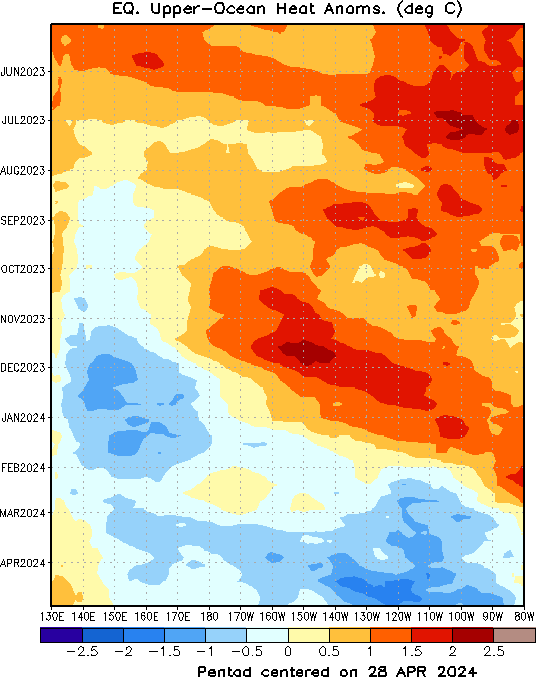

The entire climate pivots on what happens with the Eq OHCa, as I showed in my 2024 AGU poster correllogram, indicating a regular order in climatic responses to equatorial warming at depth.
James Hansen also used this fact this year, independently (?), to predict the upcoming El Niño.
He also thinks the temperature could set new records in 2026/27. I think he’ll definitely be wrong if the equatorial Pacific doesn’t produce a second strong Kelvin wave this year.
“Within hours, CNN ran a piece under the headline:”
When I looked just now, the headline said:
“El Niño is coming faster than expected and chances are rising that it will be historically strong”
which seems vary reasonable. I checked on wayback, which had that same headline on 14 May – the first one they recorded. The capture was at 4.30pm 14 May, the article appeared 9.05am 14 May, so they could have changed it during that day.
El Ninos are NOT caused by human anything.
The only atmospheric warming in the UAH data comes at El Nino events.
Between those El Nino events there is basically no warming..
… so no sign of any human caused atmospheric warming in 47 years.
All this hype about El Nino next years PROVES that they know, deep down, that the warming is NOT human caused.
I downloaded the RONI data (the three month running average of the relative Niño 3.4 index) from the link above. The chart below compares RONI/Nino3.4 and the equivalent UAH 3-mth average anomalies (starting Dec 1978-Feb 1979 and ending Feb-Mar-Apr 2026). As the trendlines show, the strong warming trend in UAH is not matched by a warming trend in RONI/Nino3.4, which is in fact negative over that period.
Thanks for showing you have no clue about El Nino events
And also for showing us the Nino34 region IS NOT WARMING..
I guess there is no CO2 in that region.. right ! 😉
It would be weird if it was, as ENSO is an index showing an oscillation. It neither warms nor cools by ‘magic’; it just moves heat around in the system. It doesn’t ’cause’ the heat.
The energy for EL Nino events comes from the ocean..
It doesn’t just “magically” appear from unicorn farts. !
There is no warming in the oceans in the Nino region, because as soon as it gets warm, it expels the extra energy to the atmosphere as an El Nino WARMING EVENT, and spreads the warmer water to adjacent basins.
Energy comes from absorbed solar radiation, trade winds etc…
Human released CO2 has absolutely nothing to do with it.
“Thanks for showing you have no clue about El Nino events”
In fact, the R in RONI is relative. It is the difference between the ENSO temperature and the tropical SST mean. All it says is that the ENSO region is warming slightly less fast than tropical overall.
Just another thing the farcical climate models get wrong…
I’m not sure why people are marking down Nick on his comment. Checking the headline on the wayback machine and concluding the headline may have been changed is a perfectly reasonable thing to do.
For Nick’s information the article states:
Incidentally, Nick, if you hover over the tab, the headline reads “El Nino’s coming, chances rising it will be historically strong“.
Nullius in verba
Thanks, Redge
The hover version is simlsr to the currently displayed headline. It is not similar to the headline Charles is writing about, which was
“A Super El Niño is coming. Here’s how a hotter ocean could change the weather near you.“
Yes the article with that headline was published in April.
https://www.cnn.com/2026/04/07/weather/super-el-nino-extreme-weather-climate-disaster
Nick has a reputation that he deserves based on past posts.
That aside, Nick has also made some intelligent contributions to the conversations over the years.
Far fewer as time progresses.
Yes Nick, Rotter got the headline wrong, the article which had the headline he quoted was published in April!
https://www.cnn.com/2026/04/07/weather/super-el-nino-extreme-weather-climate-disaster
So the piece CNN ran “within hours” of the NOAA Climate Prediction Center issuing its latest monthly discussion actually had the headline:
And not:
That second headline came after the previous month’s update, not this latest one.
I’m sure we’ll get a correction …
It is great that everyone is now getting behind El Nino events as the cause of atmospheric warming..
Finally realising that it is NOT CO2.
I’m sure you will correct all your past erroneous comments re CO2.
Erm, that would be you, alone, in the entire world, not “everyone”.
You have yet to show any other atmospheric warming apart from El Nino spike+ step events.
Batting ZERO.
No correction ,as yet …
Picking nits aside, a plethora of headlines from numerous sources hype the “Super El Niño” theme with varying degrees of mitigation. Since most headline skimmers likely lack a sense of discrimination or depth seeking, the “Super” designation is what is most likely to be absorbed. I tend to suspect that is the intent overall.
By “nits” do you mean erroneously claiming that CNN published last month’s article in response to this month’s ENSO update, when in fact it published an entirely new one?
That’s a fairly big “nit“, when you consider it’s the basis for this entre article.
Don’t worry, I’m sure Rotter will see his error and make a correction. It’s just a matter of time …
I doubt Charles ever bothers reading any of your posts.
Correct. I generally only read the moderator users in order to clear them. Although in tricky cases I will read the surrounding context.
So no intent to correct your mistake in the original post?
Charles made a mistake, but CNN did publish that headline when the uncertainty was even greater. We have been inundated with similar hype for weeks, and I suspect that trend will continue. The bulk of Charles’ article was correct and substantial, unlike the endless stream of fiction you seem to prefer.
Charles’ mistake was worth pointing out, but Nick is famous for picking at a small piece while ignoring the main substance of an article, usually in defense of the alarmist cadre. I call it picking a “nit” to distract from said substance.
“even faster than expected“
Why are all these track records falling? Must be global warming.
Wait for the “Mega Super El Nino” headline.
Alarmists run hard on hyperbole it is the only way to get attention anymore as their track record for predictions is horrid.
Do any of these so-called journalists ever ask themselves if it would be better if it were the coldest on record?
I think these journalists get paid to hype the heat.
Of course.
Reporters are always vying for a “scoop”.
Same as climate “scientists” stretching passing minor anomaly observations into “if”, “may”, “could”, “possibly”, “unlnown” eventuate into some sort of ho-hum weather event or other
Ad clicks generated by hype.
This graphic shows more and more cool blue starting to appear. There’s still plenty of red but unless more red shows up, this could be a lot weaker than they are saying.
If trade winds weaken around the eastern Pacific, then those warm anomalies will begin growing in volume and intensity.
Yes and if the Sun stopped shining tomorrow we would soon be freezing to death.
IF provides a whole lot of wiggle room.
I was replying to the post which itself mentions “unless” and “could be”. But thanks for clearing that up…
Here’s what NOAA’s weekly ENSO status report says (5/18/2026 edition):
Source:
http://www.cpc.ncep.noaa.gov/products/analysis_monitoring/lanina/enso_evolution-status-fcsts-web.pdf
Gotta look at other natural indicators as well. Fish aren’t reading the headlines or thermometers. In the Monterey Bay, Halibut moved into the shallows 3 months early. Salmon are being caught 300 feet down in the mud where its cooler. Bonita are being caught on top and are rarely seen this far north as they prefer warmer southern California waters.
I bet lots of people/businesses in the Western US are hoping for a El Nino that brings more rain & snow in 2026-27 after a rather dry year. Its just weather, not climate.
ENSO forecasters have a name for the uncertainty L’Heureux is describing. It is called the spring predictability barrier, and it refers to the well-documented tendency for ENSO forecasts issued in boreal spring to perform worse than forecasts issued at other times of year.
As of right now, the SOI is running consistently negative, and there are warm SSTs and subsurface in the eastern Pacific that we haven’t seen in a while. Fingers crossed. These multi-year Las Niñas are hurting the Western US badly.
“Real” climate scientists always use weasel words when predicting chaotic events. Their sycophants have no such reservations. I think it has more to do with academic reputation management than desire to be accurate.
Thanks, Charles, well said. I’ve been watching the indices for a while, and I don’t see a Mega-Super-Really-Dangerous El Nino that they’ve been raving about … but hey, that’s just me.
w.
Excellent article, Charles.
ah yeah about that..WHERE? has our beloved ENSO meter got to ? enquiring minds n all that ;-)))
Look on the banner at the top of the page. Then Mouse over:
Reference > Climatic Phenomena > ENSO Page.
ENSO Page – Watts Up With That?
Another question for the ultra hypers is what is the probability of two super el nino events occurring in half the average separation between them.
Is CNN predicting a break in the mega drought for the southwest? That would be news in itself. Better prepare the “devastating floods” news team for action and find open ditches to report from.
What are the odds of CNN hyping super el nino early guesses and not checking past accuracy of such guesses? What are the odds of multiple hype news outlets following on to each other for near constant drumming for six months of super hyper news feeds?
Some days I suspect there is a competition to see who can be most creative with hyperbolic headlines.
I have lived a bit in the southern part of California (47 out of 68 years). I saw weather some of it strange or out of the observable norm. Some summers were hot others not so much. Some winters cool others not so much (see what I did there?).
I didn’t panic if it rained. I mostly stayed inside as not to not get wet. I knew the auto body shops were rubbing their hands together in anticipation of a up tic of biz due to people’s inability to drive on wet roads.
In short, the weather will change. The “Climate” will change. So slowly that no one will notice. And the really hilarious thing is the people who get their nickers in a wad over a perception that the sky is falling. For all of their running around with their hair on fire doing the pee-pee dance, their total influence is ZREO PERCENT.
As with all things, your milage may vary.
I like the word ZREO. May I use it?
Reminds me of an oreo, which often is what a lot of this nonsense reminds me of.
Help your self!
Declaritive statements make sense within the Climate Alarmist narrative: “the science is settled and the outcome, certain”. Disaster IS coming. Maybe not today, but maybe today. Could be today, so be alarmed!
Let’s have a contest to see who can create the most hyperbolic headline!
Easy to spot CNN viewers, they see a catastrophe around every corner!
Do they manage to read the articles published in response to the NOAA ENSO updates for the right month?
Charles apparently can’t.
So it’s a guarantee that this super El Nino is coming now, but if not, everyone will quickly forget about yet another alarmist forecast that didn’t materialize.
Have a look
https://www.facebook.com/share/1bd6AGi5z1/?mibextid=wwXIfr
Further proof that they KNOW it is El Nino events causing the warming….. not CO2.
I don’t see a problem with NOAA’s work here. The problem as usual is with CNN and most all other mainstream media outfits. NOAA has released its work using its language but what is really needed is a version the mainstream media can’t screw up. NOAA and all other reporting agencies must consider two messages, one for professional users and one for the rest of us especially the mainstream media. This whole thing could have been reported like this. There is a better than even chance of a strong El Niño this year but it is too early to tell with any confidence. There fixed it for you.
We have been suitably warmed…err… warned-
BOM winter forecast predicts unusually warm season as El Niño increasingly likely
I guess that gobbelydegook makes them feel useful
In my dictionary, the word “could” means an event that that is not considered impossible, but is very low probability. It is in the same category as the probability that our sun will become a supernova overnight, and it will not rise as expected the next morning. The alternative to that is to define its probability for a discussion taking place, such as “Defined as 0 to 5%.”