By James Taylor, H. Sterling Burnett, Anthony Watts
‘Earth Day today feels increasingly detached from the kind of environmental problems that gave rise to it in 1970’
SCHAUMBURG, IL (April 22, 2026) — On Earth Day 2026, environmental activists and politicians will once again exploit a day founded with an ecological focus to peddle climate alarmism and government action that puts restrictions on affordable energy.
The Heartland Institute, known as the leading global think tank pushing back on climate alarmism, offers a more hopeful view. Heartland, founded in 1984, has organized 16 International Conferences on Climate Change, the latest on April 8-9, 2026 in Washington, DC.
It is also the publisher of the Climate Change Reconsidered series of scientific volumes, Why Scientists Disagree About Global Warming, Climate at a Glance, ClimateRealism.com, Energy at a Glance, and streams The Climate Realism Show every Friday at 1 p.m. ET.
The following statements from climate and energy experts at The Heartland Institute may be used for attribution. For more information, or to interview a Heartland expert, please contact Executive Vice President and Director of Communications Jim Lakely at jlakely@heartland.org or call/text 312-731-9364.
“Today is a day to celebrate the improving environmental condition of our planet and the rapidly improving environmental condition of the United States. Recovering temperatures from our recent 10,000-year lows are benefiting ecosystems around the world. Restoring CO2 to the atmosphere is dramatically increasing the amount of global plant life which is currently starved of CO2. Rolling back wind and solar power mandates is preserving open spaces that had previously been slated for destruction to serve the so-called renewable power industry. We need more affordable, reliable energy and less pandering to totalitarian leftist restrictions on freedom.
James Taylor
President
The Heartland Institute
“This Earth Day we have many things to celebrate. Science is increasingly showing that there is no climate crisis, necessitating a wholesale government takeover of the economy.
“In addition, even though energy use is at an all-time high and growing, our air and water are cleaner now than at any time in the last 150 years. That’s due to efficiency and technology, proving once again that we can have both economic growth and environmental quality.”
H. Sterling Burnett, Ph.D.
Director, Arthur B. Robinson Center on Climate and Environmental Policy
The Heartland Institute
“Earth Day today feels increasingly detached from the kind of environmental problems that gave rise to it in 1970. Back then, the issues were obvious and immediate — urban smog, polluted rivers, toxic industrial discharge — and they were addressed with equally direct solutions. The legislative and technological push in that first decade produced measurable gains: cleaner air in major cities, the end of routine river fires, and a sharp reduction in the most visible forms of industrial pollution. Those were real achievements grounded in observation and engineering, not speculative modeling.
“What we have now is something quite different. The focus has shifted toward global climate projections and sweeping energy transformations built on models that continue to evolve and, at times, diverge from observed trends. Meanwhile, the realities of energy demand, reliability, and cost have reasserted themselves in ways that can’t be glossed over by annual messaging campaigns. Earth Day, in its current form, often leans more on narrative than on the kind of tangible, verifiable progress that defined its early years — and that raises the question of what purpose it actually serves today.”
Anthony Watts
Senior Fellow
The Heartland Institute
The EPA put itself out of business by cleaning up the most egregious pollution, so it was necessary to plump for an alternative -CO2 and climate. That alternative mission has made the environmental cleanup look like $peanuts. To date, over 16 $trillion has been spent in the intermittent renewable energy system with nothing essential to show for the money. Meanwhile, the second, equally expensive scam, also of ZERO value: CCUS, carbon capture utilization and sequestration, has continued apace. Our only hope apparently is that together, these scams bankrupt the world and allow us to return to science, not nonsense.
The Nato had the same problem after the collapse of the USSR .
Some high official(Powell?) then said something like:
They are running out of demons to justify their existence, but I’m sure they’d be successful in finding new ones.
And they were so successful that the Nato, instead of disbanding, started growing and growing faster than ever before after its lost its purpose and the promis that NATO won’t move one inch eastwards.
NATO grew because nations once part of the Soviet Union and its empire were/are terrified of Russia. NATO didn’t conquer those nations. Any supposed promise wasn’t a treaty so they are utterly irrelevant. What national leaders with half a brain would believe anything said by any other national leaders? Was that promise in writing? If so, let’s see it.
That supposed promise was a passing comment by one person that was never discussed nor codified.
Amen. EPA was given the regulatory authority that allowed it to reduce the most significant amounts of pollution. But this is being used to chase ever more tiny amounts of emissions due to the zero threshold philosophy. If you have the tools, why not use them, even if they are not suited for the job? Use your sledge to drive a tack.
Yes that’s the problem – their “Linear No Threshold” assumption that presumes “some harm” (even where none is demonstrated as a practical matter) all the way to “zero” of whatever they want to “regulate.”
Earth Day happens to be Lenin’s birthday. Pretty well sums up the motives of the people behind it.
As the Spanish inquisition found, if you pay people to find heresy they will find heresy.
And they will keep on finding heresy even if they have to expand the definition of heresy.
Only when the money stops will heresy diminish.
And reality may return, but not guaranteed given the general vileness of politicians and priests.
But nobody expects the Spanish Inquisition.
Here’s a few things that ‘Earth Day’ could focus on profitably in the 2020s/2030s:
8. Reverting to the primitive, brutal lives that humans had to survive before our brains developed, reason and rationality.
Thanks, but I like to think we have a long way to yet with developing our ingenuity before we all start wearing hemp and not bathing regularly.
“Creating genuine energy-independence in millions of households through efficient insulation and solar-based energy production allied to battery storage technologies.”
The above is technologically possible right now, and will become more affordable in the near future with concerns about safety issues also being addressed as technology progresses.
Roof top solar is very popular in Australia because the country is mostly sunny, but the percentage of the roof areas that are covered with PV panels is quite small, usually ranging from about 1/10th of the area to a maximum of 1/4th.
Imagine the benefits, when building a new house, if the design included a sloping flat roof, which was entirely covered with solar roof tiles with a 30 year warranty.
An Australia company, Tractile, is already providing solar tiles with impressive qualities, such as a 30 year warranty, a resistance to hail stones as large as 65mm, and a 5-7 year payback period for domestic consumption, excluding any benefits from feedback to the grid.
For those who have an electric car to charge, the payback period is only 3-4 years, again excluding feedback to the grid. In other words, such a system should provide at least 26 years of zero electricity bills, and zero fuel costs for the BEV.
Of course the BEV naysayers will argue that the huge purchase price of a BEV will negate the zero fuels costs. However, this would only be true for those who buy an expensive, long range BEV, and who frequently travel long distances and frequently re-charge their BEV away from home.
For those who live in the suburbs of a city in Australia and rarely travel long distances in their car, a short-range electric car will suit their needs. The price of such a BEV is currently almost the same as an equivalent sized ICE vehicle.
I’ll repeat that, in case anyone glossed over it. The cheapest BEV in Australia is now almost as cheap as the cheapest ICE vehicle, according to my internet search.
Here are the results:
BYD Atto 1 Essential (BEV)
Estimated Drive-Away price ranges from $25,200 to $27,023 depending on the dealer.
Kia Picanto (ICE)
Estimated drive away price for a new Kia Picanto in Australia typically ranges from approximately $21,697 to $26,023.
Interestingly, whilst the average price of the BYD Atto 1 is slightly higher than the Kia Picanto, its size (length, height and width) and boot space are also slightly larger, and of course, because of its all-electric architecture, the Atto 1 provides several modern technological and structural advantages over the Kia Picanto. These advantages would more than justify any slight increase in the purchase price of the Atto 1 Essential.
What I would recommend to the Australian government is that it should stop all construction of new solar farms, which are ugly, take up valuable land, and often require additional, long transmission lines, and instead encourage the expansion roof top solar to cover the whole area of all new roofs with solar tiles, so that the owners of the homes will not only have free electricity and free fuel for their BEV for at least 26 years, but also an income from feed-in tarrifs which would be more than sufficient to pay for the house insurance costs, water bills, general house maintenance costs, and BEV maintenance costs.
What could be better!
For those interested in the options, features, and benefits of the new solar tiles in Australia, the following site is interesting.
https://tractile.com.au/features/
What could be better? A reliable, affordable grid. Which would still be available if they didn’t force-feed the “renewable” stupidity.
This list reads like it was copied from an ignorant higher education sustainability office — busybodies who don’t know how the world actually works.
“Heartland, founded in 1984, has organized 16 International Conferences on Climate Change, the latest on April 8-9, 2026 in Washington, DC.”
Never mentioned in the MSM, of course.
They are mentioned in other media
https://www.theguardian.com/environment/2012/feb/15/leak-exposes-heartland-institute-climate
https://ncse.ngo/files/nipcc.pdf
https://www.nytimes.com/2012/02/16/science/earth/in-heartland-institute-leak-a-plan-to-discredit-climate-teaching.html
https://www.theguardian.com/environment/2019/oct/10/vested-interests-public-against-climate-science-fossil-fuel-lobby
https://energyandpolicy.org/heartland-institute/
https://insideclimatenews.org/news/22122017/big-oil-heartland-climate-science-misinformation-campaign-koch-api-trump-infographic/
https://subscriber.politicopro.com/article/eenews/1059962332
https://www.desmog.com/heartland-institute/
I guess just not the way you want them to…
all lies and propaganda, but you are not capable of understanding that
Yes, that’s what Heartland is about.
Ah, poof you are incapable of understanding anything.
I doubt the environmental religiosity of Earth Day should be given credit for cleaning up obvious problems of air and water in 1970. I tend to give credit to necessity and technology. But, to be fair, the religion does seek to impede both industry and technological progress. See, for example, mining and nuclear power generation.
I recall seeing a graph of atmospheric pollution levels since the 1800’s. When the Clean Air Act was passed, pollution levels were already reducing at a pretty good pace. That pace did not change after the passing of the Act. When humans can do stuff cleanly, they tend to do so, regardless of government influence.
I’m willing to give the environmental movement of the 60s-70s, including Nixion’s creation of the EPA, credit for substantial improvements in air and water quality. One major improvement was the substantial elimination of sulfur dioxide emissions. Of course, that reduction allowed for reduced reflection of short-wave solar energy and may have reversed what had been a climate cooling trend. But you can’t vilify industry for causing warming by eliminating a clearly harmful pollutant can you?
Celebrate Earth Day! Hug a tree and breathe on it.
FREE THE CARBON!
” Back then, the issues were obvious and immediate — urban smog, polluted rivers, toxic industrial discharge ” {H. Sterling Burnett, Ph.D.}
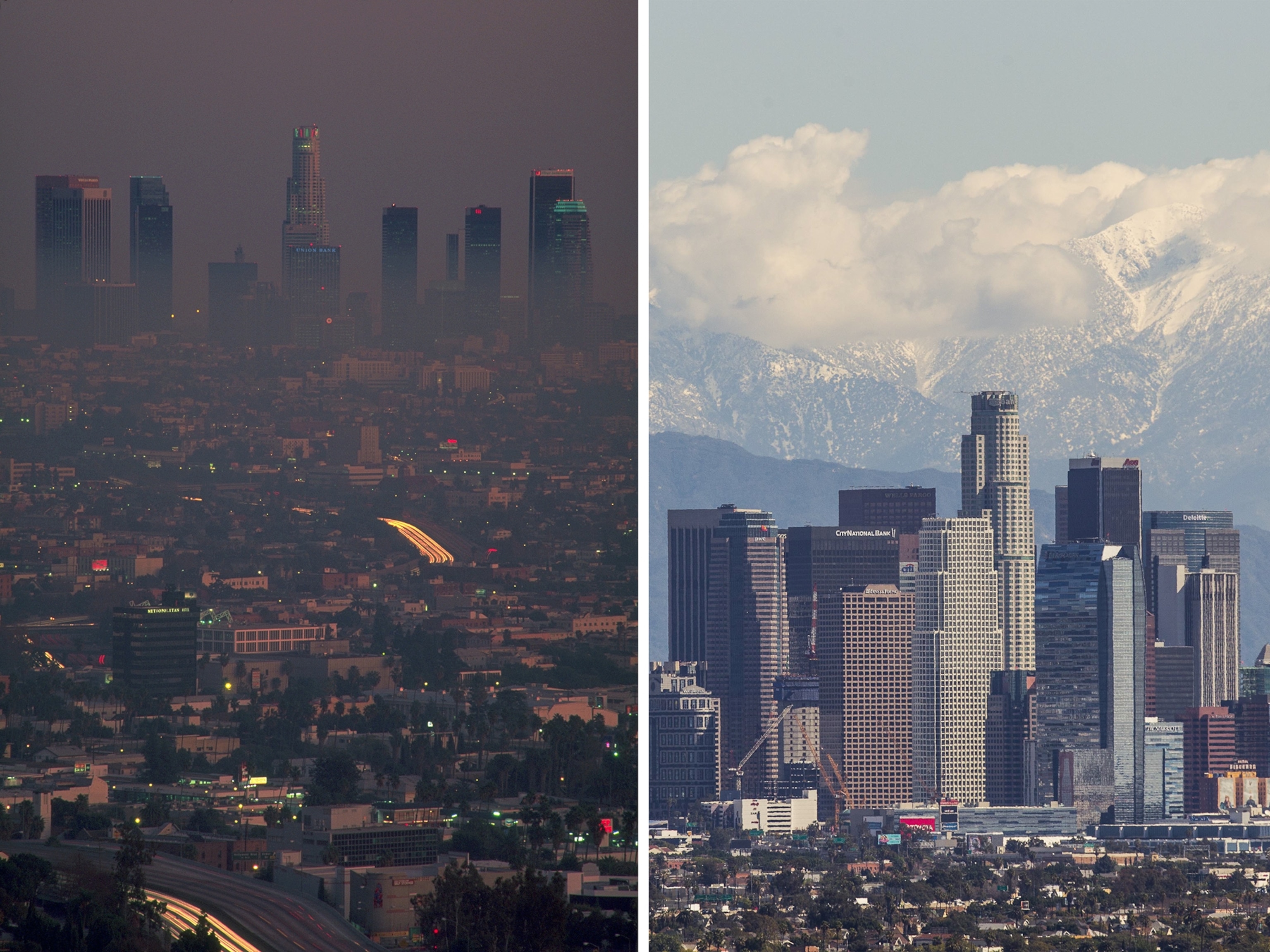
Some of us are actually old enough to remember:
– Great Smog of London 1952; New York City 1966;
– Cuyahoga River fire 1969;
– Hudson River PCBs 1947-1977,
Also see: Phosphorus: https://www.usgs.gov/water-science-school/science/phosphorus-and-water
Los Angeles smog:
I have been an environmental professional for over 50 years and I’ve never acknowledged nor celebrated Earth Day. Earth day is about as useful as Pride month.