A few weeks ago, an article by Professor Ulf Büntgen titled The Importance of Distinguishing Climate Science from Climate Activism created a significant stir when it was published in Nature’snpj Climate Action. Büntgen’s commentary was lauded in climate-skeptic circles for calling out the growing trend of scientists blurring the lines between objective research and ideological activism. His argument was clear: scholars should not have a priori interests in their study outcomes, and activists should not masquerade as scientists.
Büntgen’s call for a clear separation between climate science and activism was welcomed as a refreshing deviation from the usual climate alarmism. As Judith Curry tweeted,
Kudos to Nature for publishing this
“I am concerned by climate scientists becoming climate activists, because scholars shouldn’t have a priori interests in the outcome of their studies. Likewise, I am worried about activists who pretend to be scientists”
Büntgen’s stance was a significant departure from the ideologically motivated narratives that often dominate climate science discourse.
This was lauded in the climate skeptosphere, climate realist circles, or whatever we are calling ourselves these days, as a welcome change from the constant barrage of ideologically motivated journal publishing on climate topics.
As with Patrick Brown, people appreciated that sane and ethical people were willing to put their heads up in opposition to the long march of climate alarmism.
However, barely ten days after Büntgen’s commentary, Nature rushed out an article titled 2023 Summer Warmth Unparalleled Over the Past 2,000 Years, co-authored by Jan Esper, Max Torbenson, and ironically, I happened to notice, Ulf Büntgen himself. This paper claimed that the summer of 2023 was the warmest in the Northern Hemisphere in over two millennia, exceeding the 95% confidence range of natural climate variability by more than half a degree Celsius. The article emphasized the urgency of implementing international agreements to reduce carbon emissions, framing recent temperature extremes as clear evidence of anthropogenic climate change exacerbated by an El Niño event.
This Nature piece is part of a long tradition in paleoclimatology that uses tree rings as pre-instrumental temperature proxies and then grafts instrumental records onto these proxies to establish a narrative of unprecedented modern warming. This approach, popularized by Michael Mann’s infamous “hockey stick” graph, has been criticized for its methodological flaws and for downplaying natural climate variability, such as the Roman Warm Period and the Medieval Warm Period.
The Hypocrisy Unveiled
Büntgen’s involvement in the Nature article raises glaring questions about his commitment to the principles he espoused in his earlier commentary. How can one reconcile his call for separating science and activism with his participation in a study that clearly advocates for immediate policy action based on its findings?
In his Nature commentary, Büntgen warned against the dangers of scientists becoming activists, stating, “I am concerned by climate scientists becoming climate activists, because scholars should not have a priori interests in the outcome of their studies. Likewise, I am worried about activists who pretend to be scientists, as this can be a misleading form of instrumentalization”. Yet, the abstract of the Nature article he co-authored concludes with a call to action for rapid reductions in greenhouse gas emissions, aligning more with advocacy than with the dispassionate pursuit of scientific knowledge.
Although 2023 is consistent with a greenhouse gases-induced warming trend7 that is amplified by an unfolding El Niño event8, this extreme emphasizes the urgency to implement international agreements for carbon emission reduction.
Tree Rings and Temperature Proxies: A Dubious Foundation
The reliance on tree rings as temperature proxies is fraught with uncertainty. Tree ring data, which may at times be useful for understanding certain climatic trends, are influenced by multiple factors, including precipitation, CO2 levels, and soil conditions. As Anthony Watts pointed out in his detailed critique in Human Events, these proxies are often used selectively to support predetermined conclusions about climate trends. The Roman Warm Period (1–250 AD) and the Medieval Warm Period (950–1250 AD) are well-documented in historical and archaeological records, yet they are conspicuously absent in the reconstructions presented in such studies.
The study, Esper, J. et al. Nature, 2023, is using an old statistical trick pioneered by Michael Mann, PhD. in his hockey stick graph controversy, where estimated temperatures from tree rings and other proxies (used because no thermometer readings exist prior to about 1850) far into the past are grafted onto more reliable temperatures measured in the present and presented as one unified dataset, when in fact they are different. … For example, an article about the study in the BBC showed this graph, which is highly reminiscent of Mann’s original “hockey stick” graph.
…
…
That graph is highly misleading, if not flat-out fabrication. It suffers from the same sort of issues in Mann’s original “hockey stick” graph such as suppressed climate variability over the past 2000 years. We know from other studies that the Roman Warm Period (from 1–250 AD) and the Medieval Warm Period (950 to c. 1250) existed, but they have been erased from the graph presented to the public.
The value of tree rings in paleoclimatology is highly debatable. While they can provide some insights into past climate conditions, their interpretation is complex and often contentious. The methodological issues associated with tree rings, including their susceptibility to various environmental factors, make them less reliable as standalone indicators of historical climate variability.
Anthony also notes:
The lead author, Jan Esper, confirms by quotes given to the BBC, that he is in fact using this study as a vehicle to elicit change.
The authors say the key conclusion from their work is the need for rapid reductions in emissions of planet-warming gases. “The longer we wait, the more expensive it will be and the more difficult it will be to mitigate or even stop that process and reverse it,” said lead author, Prof Jan Esper from Johannes Gutenberg University, in Germany.
“That is just so obvious,” he said. “We should do as much as possible, as soon as possible.”
This admission makes the study more about climate advocacy than science, and the media fell for it
Büntgen’s dual role as a critic of activism in science and a co-author of an advocacy-driven study highlights a troubling trend in climate research. This blending of science and advocacy undermines public trust in scientific institutions. When scientists take on activist roles, they risk compromising the perceived objectivity of their work. This is particularly problematic in climate science, where policy decisions with far-reaching economic and social consequences are often based on ideologically captured academic scientific recommendations.
Questioning Büntgen’s Motives
Büntgen’s contradictory actions suggest a deeper issue. Is his sudden pivot to advocacy a genuine shift in understanding, or is it driven by other motivations? The timing of his involvement in the Nature article, so soon after his call for separating science from activism, is suspicious. It raises the possibility that Büntgen might be playing both sides of the fence—garnering credibility among skeptics with his initial commentary, while aligning with the mainstream climate narrative to maintain academic standing and funding.
Such duplicity is not uncommon in academia, where the pressure to secure grants and publish in high-impact journals can lead researchers to align their findings with prevailing narratives. Büntgen’s case is a stark reminder of the complexities and potential conflicts of interest in climate science.
The Ideological Capture of Academia
The current state of climate science reflects a broader societal issue where the predetermined narrative of an urgent need to address climate change has led to the ideological capture of academia. Research is often driven by political and ideological motivations rather than an unbiased pursuit of knowledge. This ideological capture can lead to the selective use of data and the promotion of specific narratives that support policy goals, rather than providing a balanced view of the available evidence.
This ideological capture of academia has fueled the narrative of an urgent need to address climate change. This urgency is more about political agendas than scientific necessity. The Intergovernmental Panel on Climate Change (IPCC), for instance, has been criticized for overstating the certainty of anthropogenic warming relative to natural climate variability. The IPCC’s summaries for policymakers often present a simplified and sometimes alarmist view of climate science, which can distort public perception and policy debates. This tendency to “sell” climate science as a crisis requiring immediate and drastic action can lead to the implementation of policies that are not justified by the underlying science.
A Call for Intellectual Independence
To address these issues, it is crucial to foster a culture of critical scrutiny and intellectual independence within the scientific community. Scientists should be encouraged to question dominant paradigms and explore alternative hypotheses without fear of professional ostracization. The peer review process must be transparent and robust enough to withstand political and ideological pressures.
Additionally, the media, policymakers, and the public need to be educated about the complexities of climate science. Understanding that scientific knowledge evolves and that uncertainty is a natural part of scientific inquiry can help temper the often sensationalist portrayal of climate issues in the media.
Conclusion
Büntgen’s initial call for distinguishing between climate science and activism was both timely and necessary. However, his involvement in the Nature article underscores the difficulty of maintaining such a distinction in practice. The challenge lies not only in separating science from activism but also in ensuring that “climate science” as it’s come to be known, remains a rigorous, objective discipline that can inform effective and rational policymaking. Only through a recommitment to the principles of scientific inquiry and a vigilant defense against ideological influences can climate science ever hope to provide the guidance needed for any type of policy decisions.
In summary, the current state of climate science is a reflection of broader societal trends where the predetermined narrative of an urgent need to address climate change has led to the conflation of science and activism. While activism plays a crucial role in raising awareness and driving action, it is essential that scientific research remains an unbiased and objective pursuit. Only then can we hope to develop policies that are both effective and based on a comprehensive understanding of the complexities of our climate system.
The Final Irony
Perhaps the greatest irony of all is that Büntgen himself exemplifies the very issue he critiques. By participating in an advocacy-driven study, he undermines his own argument for the separation of science and activism. This hypocrisy not only tarnishes his credibility but also highlights the broader problem of ideological influence in climate science. If we are to trust science, we must first ensure that it remains free from the taint of activism. Only then can we have confidence in the policies derived from it.
Climate change, as presented by mainstream narratives, is fraught with uncertainties and driven by ideological motivations rather than urgent, unbiased scientific inquiry. Policies derived from such skewed science are more likely to cause harm than benefit. By exposing the hypocrisy of figures like Büntgen, we can begin to reclaim a more balanced and objective approach to understanding and addressing actual environmental issues.
“The methodological issues associated with tree rings, including their susceptibility to various environmental factors, make them less reliable as standalone indicators of historical climate variability.”
In my opinion, tree rings have ZERO value as “standalone indicators of historical climate variability”. When I first heard about this theory several years ago – I contacted several forestry professors and even PhDs in dendrochronology. I asked how tree rings can have such value. Nobody responded- other than one who recommended a textbook. I ordered it on Amazon- and it said NOTHING about tree rings as a climate tool. There are many things that effect tree ring sizes.
I was cutting firewood from one of my jobs (road for subdivision) and I stopped to sharpen the chain. Started again and was not cutting well at all. Sharpened again, thinking I didn’t do a good enuf job the first time, and happened to look at the stump. Only 8.5 ” Madrone at 110 +/- years. 500 feet away and 60′ higher in elevation was another similar age Madrone that was just over 24″ (my saw went thru that one ok).
Anybody that spends time cutting can verify how dis-similar the growth can be.
However, it would be wise to bear in mind a number of issues that amount to caveats when considering or using the temperature reconstruction data we provide. It is worth stressing that the specific climate history we present here relates only to the region from which the tree-ring data are drawn. There is no definitive prescription for how small or large such a region should be. Incorporating many (ideally homogeneous) data from a small region will allow more rigorous application of the RCS approach and enable more reliable inferences about past climate variability.
…..
Hence we add a cautionary note stressing the seasonality and local scale of the inferred climate history we present here: it represents summer temperature for Yamalia.
…..
Persistent warming might also lead to other growth-promoting changes in the environment (e.g. increased soil mineralisation, nutrient recycling, or promotion of mycorrhizal activity) that could also conceivably promote tree growth beyond the degree expected as a linear response to the degree of warming.
And most likely the reward was paid out of funds that were NOT voluntarily removed from our pockets.
Giving_Cat
May 29, 2024 10:49 am
Two related questions.
Is anyone currently running tests growing trees controlling for CO2, light (cloud cover!), water and of course temperature to establish baseline component responses?
Is anyone recreating ancient climate specifically excluding dendroastrology?
There have been ice core, bore hole, and sediment isotope studies. They are better than tree rings, hands down. Even so, they are limited, but the limitations are much clearer.
There are elements in geology, geography, and archeology that also provide valuable clues.
The trick is when things do not line up or disagree to highlight those discrepancies.
Sparta,
Borehole temperature reconstructions should never be used for past climate temperature calculations.
There is a large lack of heat flow studies that include the experience and observations of scientists who actually drill holes. This lack cannot be overcome by smart mathematics, especially when many mathematicians have claimed the concept to be ill-posed. You cannot solve this problem by ignoring major objections. But that is what is being done by ignorant activists.
Geoff S
However, I am going to start a new scientific endeavor called “dendrophrenology”.
If the Biden administration approves my $50 million grant application, I will read the bumps on the bark of ancient trees and determine the exact temperatures and CO2 levels across the globe over the last 2,000 years.
Further, I am going to hire all of my buddies for “pal review” so there will be no doubts about the reproducibility of my work!
Argue against advocacy, then immediately advocate.
Reuse ‘Mike’s Nature trick.’
Post a reconstruction with a straight shaft, thereby wiping out the MWP and LIA.
One might hope a Cambridge professor would have higher standards. Nope. Not when it comes to ‘climate science’.
bobpjones
May 29, 2024 11:03 am
The other day, I received a link to an article about CO2.
Orbital changes in temperature from models (red & orange), treeline (green), and glaciers (blue) all show a multimillennial cooling trend that trees (grey) are unable to capture.
This is logical if we think that trees manage to grow under very variable temperatures, so they are not good at recording long-term changes.
So there are two problems:
tree-ring records tend to cool past summers as they don’t record the multi-millennial cooling trend.
Their papers make no effort to correct for the positive effect that the increase in CO₂ has on tree growth, which is very well known.
So the result is that they are not analyzing temperature but tree happiness. We can conclude that 2023 was the happiest year for trees in at least 2000 years.
Space heating consumed the most energy of any end use in homes, according to latest data.
Space heating continued to be the top energy-consuming end use in U.S. homes in 2020 according to the Residential Energy Consumption Survey (RECS).
Heating homes accounted for 42% of energy consumption in the residential sector.
Air conditioning accounted for 9% of total site energy across all U.S. households.
Somehow I do not believe the assertion that heating is the biggest household energy cost compared to air conditoning once you get south of Virginia on the east or Nebraska in the middle or San Francisco on the left coast.
They must be leaving out something or surveyed the wrong folks. If only electricity, I would give the south #1 for a/c bill for at least 6 or 7 months outta the year. The heat pump folks down here in the deep south pay a lot more during winter than we gas furnace folks. Summer is about the same for cooling, although it seems the old systems are pretty good.
Oh well, if heating is that expensive, then we are in a heap o’ trouble with the approaching glaciation.
WUWT should ask Buntgen if he wants to respond to this article.
AlanJ
May 29, 2024 12:13 pm
Büntgen’s letter is a bit internally contradictory, and I disagree on principle that scientists shouldn’t care deeply, passionately, and openly about the issues they study (how on earth could there be conservationists, or cancer researchers?). But in his letter he does call for more careful reporting of certainties and uncertainties, and this Nature paper seems to be exactly an attempt to robustly quantify the scale of recent extreme warming against natural variability of the past 2kyr, so it doesn’t seem to be at odds with his overall position, as the author of this WUWT piece suggests. In fact, I don’t think the contrarians lauding his letter as a vindication of their beliefs have actually read it.
The value of tree rings in paleoclimatology is highly debatable.
Only by people who don’t know what they’re talking about.
Indeed, for us slow thinking folk, do explain, in simple terms obvs, what information, useful or otherwise, is derived from tree rings and why two known warm periods are not apparent in either Mann or Buntgen’s charts. After all, there’s no debate about it is there?
Tree rings grow wider when climate conditions are favorable to growth, and they are tinner when conditions are unfavorable. Thus, tree rings archive changes in the local, regional, and global climate, and by combining tree ring records from around the world (or with other climate proxy records), scientists can reconstruct past regional and global climate changes. Because the rings exhibit annual growth pattern, they can be precisely dated. That these reconstructions hold value is beyond dispute.
Global reconstructions do not show a pronounced MWP or RWP because these events were primarily constrained to the North Atlantic and parts of Europe, and they were not globally synchronous climate events. Thus there is no coherent global signal in proxy records.
And Alan along with the rest of his loony envirowacko pals like nyolci, Warren Beetoff, loydo as well as the rest of the indulgent bums can’t stand it.
Yeah, they don’t have much to say about tree stumps.
What can they say? They can’t refute that they exist, which means it was warmer when the stumps were alive than it is now, and that means we are not experiencing unprecedented warming today as the climate alarmists claim. It was warmer in the not-too-distant past, and it is demonstrable as evidenced by the tree stumps (and tree lines around the world).
So dedicated climate alarmists don’t have much to say about tree stumps.
Mr. J: Congrats on another epic performance as the mole. Can’t speak for Mr. Kamarkis, but the tree stump tells any rational observer that the tree line farther north back then is indisputable proof that it was warmer then than now. Naturally so. Locally, regionally, and globally, as you say. all you need to do is open your eyes to that fact, and you’ll come out of the AGW stupor you struggle through.
That particular region was warmer than present day, sure. At least for parts of the year. The picture of the Mid-Holocene Warm Period we currently have is that Northern Hemisphere summers were warmer than today (and winters in some areas). So your tree stumps align well with this understanding.
But, of course, the period covered in Buntgen’s paper is the past 2kyr, not the Mid-Holocene Warm Period. The claim your peers are making is that the reconstruction shown in Buntgen’s paper erases some warm periods of the past 2kyr, not that the reconstruction erases a warm period > 3kyr before the reconstruction even starts.
Mr. J: You were talking about the efficacy of tree rings vs. the tree stump, not Buntgen’s paper, because you digressed. “That particular region” also limits your 2000 year-old studies based on tree rings, because the trees didn’t move around the globe. Only the mole in whack-a-mole could pop back up with a “that’s regional” answer, there is no paleo data (whether 2k or 5k or a millionk years ago) that isn’t regional.
A forced digression, but not one of particular interest. Nobody is denying that the Mid-Holocene Warm Period existed, or at times and places saw temperatures comparable to today’s. The people trying to lead us down a rabbit trail are arguing with phantoms.
Paleo records are not limited to regional analysis when combined, that is why they are often combined. Except by the contrarians, who operate by the “the less we know, the better” principle.
And up pops the head once more. The “combination” you speak of has been taken down at Climate Audit for many years, the method of combining things “local” that are not alike, into something “global” is just a trick that has you utterly fooled. The closer you look, the less scientific method there is in these so-called “combinations”. Then again, you so badly want to be fooled.
Climate Audit has done exactly nothing to take down the concept of global climate reconstructions, but I’m sure McIntyre’s loyal acolytes fervently believe that he has. The scientific community at large continues to ignore his ramblings, however.
Certainly will never be able to counter the facts on Climate Audit which show just how much malfeaces the climate scammers go to in their mal-fabrications.
CA has an article up , top of the list, laying waste once again to this “method” and Buntgen. Both this site and CA have removed all doubt about this notion that tree rings from one location can be “combined” with sediment over there……..but why bother, MR. J has made his choice, he prefers to be fooled.
What made it hotter more than 2000 years ago? SUV’s and coal power plants? Must have been something to do with more CO2 in the atmosphere since we can’t think of anything else that is the climate control knob.
Denis
May 29, 2024 12:37 pm
There must be lots of tree rings datable to the 1930’s to compare with tree rings from 2023. What were the results?
“The reliance on tree rings as temperature proxies is fraught with uncertainty.”
This uncertainty is the honey that attracts the demagogue ‘clime syndicate’ (Mark Steyn term) to this proxy. There is a low uncertainty
real dendrochronology that the clime syndicate studiously avoids pecisely because it has a very low uncertainty. I’ve mentioned the ‘Tuk’ tree on the far NW Canadian Arctic coast many times, but have learned non-conventional data needs a lot of promotion (we tend to let the fraudsters proscribe the terms of the debate).
Here is the tree (there are tens of thousands others across the tundra of the northern hemisphere!):
?w=600&ssl=1
From this 5000 year old, still rooted stump located~ 100km N of the present day treeline, and a further 100+ km south to living white spruce (same species) of this girth, puts average temperature anomaly at the the arctic coast at 6 to 8°C. Factoring in Arctic Amplification of 2x the global anomaly, puts the global anomaly 5000ya at the very least at +3°C warmer than today’s global.
This could be refined by a stat analysis of location of today’s spruce of this girth and their N-S variance in location. A highschool class could go up and do the fieldwork and stat analysis!
Yes many have been posted, but this one is 5000ya, more than double the age of your oldest Roman WP. Also, it is the same species as the living forest 200-300km south of the Tuktuyaktuk thick-trunked old spruce.
We know with uncommon accuraccy from a setup like this what the average ambient temperature was AND what the global anomaly was!!
Perhaps I should be more expansive in my explanation for some readers. Do you see now my points and why I fault the avoidance by the paleo tree folk?
Factoring in Arctic Amplification of 2x the global anomaly, puts the global anomaly 5000ya at the very least at +3°C warmer than today’s global.
You’re mistaken.
During the peak of the Holocene, solar insolation in July was very high at higher latitudes in the Northern Hemisphere, though winters may not have been as warm in this region as they are today.
And this doesn’t imply that it was warmer everywhere. Other regions could have experienced colder temperatures than today’s.
You’ve got it backwards. Scandinavia and the Russian tundra have a large number of these stumps from early Holocene that are well north of the present treeline and younger big stumps from the MWP in stunted modern forests. I’ll let you hone your own research skills. Also checkout a beach on today’s ice-locked north coast of Geeenland with driftwood dating to 8000ybp. Geological hint: to form a beech like this, you need a considerable stretch of open water to the north to permit wave action (and where do you think the driftwood originated). No. It was definitely much warmer then than today by inspection! The dendrocrimatoligists know this, but daren’t have 3-4°C warmer then with their “tipping points” not have happened.
Sparta Nova 4
May 29, 2024 1:47 pm
Advocates and activists seem to be conflated in this article.
Advocates play a crucial role in raising awareness and, as part of the process listen and discuss and often reach a new level of understanding of the complexities of an issue.
Activists drive action and, as part of the process, silence critics and opponents and never deviate from their ideology.
Bob
May 29, 2024 2:14 pm
Very nice.
I never hitch my wagon to individuals, I hitch my wagon to ideas. Individuals will disappoint you, ideas rarely will. I pretty much have one standard, who best represents my ideals? The one who does gets my support but if I disagree with them I feel free to let them know they are wrong. I look up to Ronald Reagan, Milton Freidman, William F. Buckley, Walter Williams, Thomas Sowell and many more including contributors and commenters here at WUWT. I don’t always agree with those I look up to, that is not necessary.
The real problem we are seeing in the science community is that the government people that the summaries are written for are the ones financing the studies. Number one no policy decision should be made on the basis of a summary. The IPCC summary for policy makers does not represent what the studies say. They represent what the writers of the summary want the policy makers to take away from the study. It is disgraceful.
The reliance on tree rings as temperature proxies is fraught with uncertainty.
You might call it a tree-ring circus…
Laws of Nature
May 29, 2024 3:19 pm
>> The reliance on tree rings as temperature proxies is fraught with uncertainty.
That might be true, but proxy-based temperature reconstructions have FAR worse problems!
One of the main issues is what Wyner called p-hacking in his hockeystick testimony in the Mann Vs Steyn process.
(In my words):
The questions is not if temperatures from reconstructions like those (this is just one time slice of Mann’s hockeystick reconstruction as presented by S. McIntyre (see https://climateaudit.org/2008/03/10/mannian-pca-revisited-1/):
have the right uncertainty attached to them, but how representative are they at all?
As long as the selection bias is not discussed mathematically as part of the reconstruction method, the reconstruction is just worthless.
Even if all these data points would have the correct uncertainty attached to them, they simply do not represent the world or the Northern hemisphere in a valid manner.
Richard Greene
May 29, 2024 3:31 pm
This article is nonsense
2023 was most likely the warmest year in the past 5000 years, based on averages of local proxies. So what? People like warm periods.
In 1990 before the climate lying took off, the warmer and colder periods in the past 5000 years were estimates at +0.5 degrees warmer and -0.5 degrees colder than in 1990.
While 1990 may have been -0.5 degrees cooler than 1990, the 2023 average temperature has increased +0.7 degrees C. since 1990.
That suggests 2023 was slightly warmer than any warm period in the past 5000 years.
It’s not science fraud to make that claim.
But without real time temperature measurements from thousands of years ago, we can never be sure.
We can be sure from anecdotes that people strongly preferred the warmer periods in the past, and hated colder periods..
I did not like Büntgen’s first article where he wanted the Climate Realists to work together with the Climate Howlers and sing Kumbaya around a campfire. Leftists do not compromise. The climate hoax is used by leftists to get political power and control people. Nut Zero is not really about the climate.
average temperature has increased +0.7 degrees C. since 1990
You actually believe that the 24×7 temperature readings taken 365 days a year in hundreds of different climates and seasons all around the world’s continents and oceans over a period of 33 years can be accurately and precisely constructed to a single average value of 0.7 degrees C variation?
When at the same time and using the same instrumentation, meteorologists say that even a local weather forecast more than 4 days (a period of just 96 hours) out, can only claim to be relied upon for accuracy 50% of the time.
One of these 2 disciplines – meteorologists and climate modelists – is full of crap.
The only way to estimate prior global average temperatures in the past 5000 years is to average many local proxies. That is what my original comment was based on. Too complicated for you?
If we averaged all the unmodified, regional land surface temperature data it would show that the Early Twentieth Century was just as warm as it is today.
Here’s an example of that temperature profile, the U.S. regional chart (Hansen 1999). Temperature charts from around the world have a similar temperature profile.
I doubt that you have missed this, so I assume you ignore it because it doesn’t fit your CO2 meme.
“The US — most states — was hot in the 1930s
So what?
The US is 1.5% of Earth’s global surface area/”
Here are 600 more unmodified, regional charts from around the world that have the same temperature profile as the U.S., that being that it was just as warm in the Early Twentieth Century as it is today.
You going to say “so what” to all those, too? How long will you remain in denial of history?
The criticism in this article was a character attack and was not justified. Conservatives want to deny that 2023 was an unusually warm year. They can’t handle the truth.
This website tries to hide the fact that USCRN has been rising at a +0.34 degrees per decade “catastrophic” rate since 2005.
Here’s what this website claims:
“The US Climate Reference Network record from 2005 shows no obvious warming during this period.
I have asked for this false statement on the home page of this website to be changed three times in past comments, but this is a myth conservatives want kept alive.
Mr. Greene: Perhaps the site would take your comment seriously if your comments indicated that you had any capability, education or experience-wise, on the subjects you choose for comment. Or if there was any sign that you learn from other comments. There is barely a signal of reason from your comments. You could do something about it, but you choose to keep track of downvotes.
You rely on certain “records” to draw your conclusion that it’s warmer now than 5,000 years ago. So how did trees grow 120 miles north of where they grow now, if it was colder then? You don’t grasp that the tree stump photos compel you to sit down and wonder where the records you rely on went wrong. I’ve never seen the slightest indication that you can think critically or absorb a fact that contradicts your opinion. I know i’m wasting keystrokews on you, but others here should look at your comment record, and come to their own conclusion that you are the nutter.
You wasted your time with a long-winded generic put down comment that makes almost no attempt to refute anything I have previously typed.
I did not say it was warmer now than 5000 years ago. I said it was most likely warmer in 2023 than any period in the past 5000 years.
Between 5000 and 10000 years ago, there were two long periods, most likely warmer than 2023, during the Holocene Climate Optimum.
A few local tree remnants indicate ONLY local conditions and do NOT lead to anything close to a global average based on real time measurements.
One must average as many local proxies as possible to get a fake global average.
You prefer to cherry pick a few extreme photo examples that lead to the conclusion you prefer.
That’s the Michael Mann technique of cherry picking proxies to support a desired conclusion … that he used for his Hockey Stink Tree Ring Circus Chart.
Most of the “ancient’ tree stumps were from 5000 to 10,000 years ago during the warm Holocene Climate Optimum. One exception I know of was found under glaciers in Southeast Iceland and confirmed to be roughly 3,000 years old.
So what?
One local area being warm 3000 years ago is not proof that the average temperature was warmer than 2023.
Many of the local proxies in the past 5000 years had more than +0.5 degrees C. warmer than 1990 AT LEAST FOR A SHORT PERIOD, but they were not all warmer at exactly the same time. Thats why averaging local proxies reduces variations,
It is my opinion that claims of +/- 0.5 degrees C. variations in the past 5000 years may be true but I believe the margin of error of the local proxies is at least +/- 1.0 degrees C., so +/- 0.5 degrees C. is statistically insignificant.
YOU WROTE: “There is barely a signal of reason from your comments.”
I will now type a reasonable statement to prove you wrong: You are an angry old man who needs to be sedated,
Mr. Greene: You didn’t say it’s warmer now than 5000 years ago, you said it’s warmer than any period in the last 5000 years. ?!
There’s not enough sedative in the world to hide that one. Still no sign of reason, but you really tried.
“I said it was most likely warmer in 2023 than any period in the past 5000 years.”
“Most likely”. So you are just guessing. Not very scientific.
The truth is you have no clue if that statement you made is true or not.
Based on the written, historical temperature record, that statement is not true. It was just as warm in the recent past as it is today, and it wasn’t just regional. When all regions are warmer at the same time, that makes it global.
My family built a large clear span barn 50 some years ago. The lumber/trusses was trucked in from Oregon and was marketed as “West Coast Fir” and the number of growth rings was something like
8or10 per.inch and was clear. The growth ring count were very much a part of this deal. The trusses were engineered/stamped and a bit over built IIRC. I recall being told by a forest professional years later on this subject while in OR and was told they manage the regen after harvest that pushes the trees to grow with tight rings by not thinning early to force the growth up not out and only later the thinning happens.. The weather on the coast is what makes this happen from what I remember. The timber was a lot more expensive than anything grown locally.
kwinterkorn
May 29, 2024 5:33 pm
Perhaps Büntgen is looking to position himself as the Anthony Fauci of climate sciencs…
sherro01
May 29, 2024 6:08 pm
Charles,
As I wrote to you, you write well. You have identified some problems in science without expressing any personal beliefs that you might have. Your logic is crisp and hard to fault. Thank you for showing science objectivity.
Geoff S
It is quite puzzling. Esper and Buntgen also recently published this 2024 article with the following conclusions.
“It is premature, and possibly incorrect, to conclude that the first millennium was free of centennial-scale temperature trends and that the decadal variations were systematically smaller than during subsequent centuries.”
”The IPCC’s focus on a single reconstruction is an insufficient summary of temperature variability over the Common Era.”


“exceeding the 95% confidence range of natural climate variability by more than half a degree Celsius”
Horrifying! It must be the “end times”. /s
Another ignorant question from me. Does this “95%” mean that 1 out of 20 summers do normally exceed the range of the other 19?
“The reliance on tree rings as temperature proxies is fraught with uncertainty.”
As a forester with 50 years experience, I suggest that trick/lie should be a felony.
“The methodological issues associated with tree rings, including their susceptibility to various environmental factors, make them less reliable as standalone indicators of historical climate variability.”
In my opinion, tree rings have ZERO value as “standalone indicators of historical climate variability”. When I first heard about this theory several years ago – I contacted several forestry professors and even PhDs in dendrochronology. I asked how tree rings can have such value. Nobody responded- other than one who recommended a textbook. I ordered it on Amazon- and it said NOTHING about tree rings as a climate tool. There are many things that effect tree ring sizes.
Tree rings, as I have read elsewhere, only have value if calibrated against other sources of data.
The local environmental conditions greatly affect tree ring width and often the width varies from one side of the tree to another.
The species of tree also is significant. Some types of trees just should never be used at all, such as the pine trees used by A.Gore.
I was cutting firewood from one of my jobs (road for subdivision) and I stopped to sharpen the chain. Started again and was not cutting well at all. Sharpened again, thinking I didn’t do a good enuf job the first time, and happened to look at the stump. Only 8.5 ” Madrone at 110 +/- years. 500 feet away and 60′ higher in elevation was another similar age Madrone that was just over 24″ (my saw went thru that one ok).
Anybody that spends time cutting can verify how dis-similar the growth can be.
Briffa et al
“it represents summer temperature for Yamalia”
It doesn’t even do that. It may be weakly correlated with temperature- at best.
Büntgen must have been “rewarded” to sing the party line.
And most likely the reward was paid out of funds that were NOT voluntarily removed from our pockets.
Two related questions.
Is anyone currently running tests growing trees controlling for CO2, light (cloud cover!), water and of course temperature to establish baseline component responses?
Is anyone recreating ancient climate specifically excluding dendroastrology?
There have been ice core, bore hole, and sediment isotope studies. They are better than tree rings, hands down. Even so, they are limited, but the limitations are much clearer.
There are elements in geology, geography, and archeology that also provide valuable clues.
The trick is when things do not line up or disagree to highlight those discrepancies.
Sparta,
Borehole temperature reconstructions should never be used for past climate temperature calculations.
There is a large lack of heat flow studies that include the experience and observations of scientists who actually drill holes. This lack cannot be overcome by smart mathematics, especially when many mathematicians have claimed the concept to be ill-posed. You cannot solve this problem by ignoring major objections. But that is what is being done by ignorant activists.
Geoff S
For your first question, a good source would be a greenhouse gardener.
Excellent point!
However, I am going to start a new scientific endeavor called “dendrophrenology”.
If the Biden administration approves my $50 million grant application, I will read the bumps on the bark of ancient trees and determine the exact temperatures and CO2 levels across the globe over the last 2,000 years.
Further, I am going to hire all of my buddies for “pal review” so there will be no doubts about the reproducibility of my work!
That would provide “data” which would offend the narrative.
so no.
A high level of hypocrisy indeed.
Argue against advocacy, then immediately advocate.
Reuse ‘Mike’s Nature trick.’
Post a reconstruction with a straight shaft, thereby wiping out the MWP and LIA.
One might hope a Cambridge professor would have higher standards. Nope. Not when it comes to ‘climate science’.
The other day, I received a link to an article about CO2.
http://www.popularmechanics.com/science/environment/a60819842/50000-year-old-block-of-ice/
When I got to the bit where it said “the dwindling number of climate deniers”, I stopped reading and decided it was probably more of an article about political science.
Meanwhile, I think this guy, might have a plausible explanation.
https://youtube.com/shorts/dBUNpzpZgzI?si=33-r6ca9X25IK6-w
Warming in the 2+ million-year ice age the Earth is still in is a good thing.
Outside of the Tropics, almost everyone has to have warm clothes, live and work in heated buildings, and use heated transportation most of the year.
Most of North America and Europe is too cold to live outdoors without protection from the cold most of the year.
It is worse than that. Jan Esper and Ulf Büntgen are also co-authors in a 2012 article published in Nature Climate Change where they demonstrate that trees do not capture millennial temperature trends.
https://www.blogs.uni-mainz.de/fb09climatology/files/2012/03/Esper_2012_NatureCC6.pdf
Look at figure S1.
https://www.researchgate.net/profile/Rob-Wilson-10/publication/235003732/figure/fig4/AS:667045821693964@1536047525572/Figure-S1-Temperature-trends-recorded-over-the-past-4000-7000-years-in-high-latitude.ppm
Orbital changes in temperature from models (red & orange), treeline (green), and glaciers (blue) all show a multimillennial cooling trend that trees (grey) are unable to capture.
This is logical if we think that trees manage to grow under very variable temperatures, so they are not good at recording long-term changes.
So there are two problems:
So the result is that they are not analyzing temperature but tree happiness. We can conclude that 2023 was the happiest year for trees in at least 2000 years.
Well in fairness they’re not using the tree ring proxies all the way to 2023; after all *that wouldn’t ‘hide the decline’.*
Briffa’s tree ring data since 1900 is quite interesting.
1940’s peak well captured, as is the late 1970’s cold period.
Going back further, the CO2 constraint to growth means a basically level graph
That chart has a similar profile to the U.S. regional chart (Hansen 1999):
Büntgen got the call that everybody – I mean everybody – understands –
“Nice career you’ve got there. Pity if something happened to it.”
Space heating consumed the most energy of any end use in homes, according to latest data.
Space heating continued to be the top energy-consuming end use in U.S. homes in 2020 according to the Residential Energy Consumption Survey (RECS).
Heating homes accounted for 42% of energy consumption in the residential sector.
Air conditioning accounted for 9% of total site energy across all U.S. households.
https://www.eia.gov/pressroom/releases/press535.php
story tip
Salute!
Somehow I do not believe the assertion that heating is the biggest household energy cost compared to air conditoning once you get south of Virginia on the east or Nebraska in the middle or San Francisco on the left coast.
They must be leaving out something or surveyed the wrong folks. If only electricity, I would give the south #1 for a/c bill for at least 6 or 7 months outta the year. The heat pump folks down here in the deep south pay a lot more during winter than we gas furnace folks. Summer is about the same for cooling, although it seems the old systems are pretty good.
Oh well, if heating is that expensive, then we are in a heap o’ trouble with the approaching glaciation.
Gums wonders…
WUWT should ask Buntgen if he wants to respond to this article.
Büntgen’s letter is a bit internally contradictory, and I disagree on principle that scientists shouldn’t care deeply, passionately, and openly about the issues they study (how on earth could there be conservationists, or cancer researchers?). But in his letter he does call for more careful reporting of certainties and uncertainties, and this Nature paper seems to be exactly an attempt to robustly quantify the scale of recent extreme warming against natural variability of the past 2kyr, so it doesn’t seem to be at odds with his overall position, as the author of this WUWT piece suggests. In fact, I don’t think the contrarians lauding his letter as a vindication of their beliefs have actually read it.
Only by people who don’t know what they’re talking about.
Which is what you see every time you glance at a mirror?
Indeed, for us slow thinking folk, do explain, in simple terms obvs, what information, useful or otherwise, is derived from tree rings and why two known warm periods are not apparent in either Mann or Buntgen’s charts. After all, there’s no debate about it is there?
Tree rings grow wider when climate conditions are favorable to growth, and they are tinner when conditions are unfavorable. Thus, tree rings archive changes in the local, regional, and global climate, and by combining tree ring records from around the world (or with other climate proxy records), scientists can reconstruct past regional and global climate changes. Because the rings exhibit annual growth pattern, they can be precisely dated. That these reconstructions hold value is beyond dispute.
Global reconstructions do not show a pronounced MWP or RWP because these events were primarily constrained to the North Atlantic and parts of Europe, and they were not globally synchronous climate events. Thus there is no coherent global signal in proxy records.
Temperature is just one of many.
The main issue before about 1900, was the constraint of CO2 for growth.
The RWP and MWP have been proven conclusively by many studies in many parts of the world… Get over it. !!
“ Because the rings exhibit annual growth pattern, they can be precisely dated.”
The clueless AJ strikes again.
Many things affect the width of tree rings. Climate has many aspects apart from temperature.
Tree rings are a very UNRELIABLE temperature proxy.
Yes.
Geologists present much more reliable examples of periodic paleo climate conditions in all parts of the continents.
Their evidence is literally carved in stone.
Nice wide growth rings in this guy, bub. What does it tell you?
Tree Stump Evidence! 🙂
And Alan along with the rest of his loony envirowacko pals like nyolci, Warren Beetoff, loydo as well as the rest of the indulgent bums can’t stand it.
Yeah, they don’t have much to say about tree stumps.
What can they say? They can’t refute that they exist, which means it was warmer when the stumps were alive than it is now, and that means we are not experiencing unprecedented warming today as the climate alarmists claim. It was warmer in the not-too-distant past, and it is demonstrable as evidenced by the tree stumps (and tree lines around the world).
So dedicated climate alarmists don’t have much to say about tree stumps.
It suggests that the Arctic tree line in this area had advanced northward during the Mid-Holocene Warm Period. What does it tell you?
Mr. J: Congrats on another epic performance as the mole. Can’t speak for Mr. Kamarkis, but the tree stump tells any rational observer that the tree line farther north back then is indisputable proof that it was warmer then than now. Naturally so. Locally, regionally, and globally, as you say. all you need to do is open your eyes to that fact, and you’ll come out of the AGW stupor you struggle through.
That particular region was warmer than present day, sure. At least for parts of the year. The picture of the Mid-Holocene Warm Period we currently have is that Northern Hemisphere summers were warmer than today (and winters in some areas). So your tree stumps align well with this understanding.
But, of course, the period covered in Buntgen’s paper is the past 2kyr, not the Mid-Holocene Warm Period. The claim your peers are making is that the reconstruction shown in Buntgen’s paper erases some warm periods of the past 2kyr, not that the reconstruction erases a warm period > 3kyr before the reconstruction even starts.
Mr. J: You were talking about the efficacy of tree rings vs. the tree stump, not Buntgen’s paper, because you digressed. “That particular region” also limits your 2000 year-old studies based on tree rings, because the trees didn’t move around the globe. Only the mole in whack-a-mole could pop back up with a “that’s regional” answer, there is no paleo data (whether 2k or 5k or a millionk years ago) that isn’t regional.
A forced digression, but not one of particular interest. Nobody is denying that the Mid-Holocene Warm Period existed, or at times and places saw temperatures comparable to today’s. The people trying to lead us down a rabbit trail are arguing with phantoms.
Paleo records are not limited to regional analysis when combined, that is why they are often combined. Except by the contrarians, who operate by the “the less we know, the better” principle.
And up pops the head once more. The “combination” you speak of has been taken down at Climate Audit for many years, the method of combining things “local” that are not alike, into something “global” is just a trick that has you utterly fooled. The closer you look, the less scientific method there is in these so-called “combinations”. Then again, you so badly want to be fooled.
Climate Audit has done exactly nothing to take down the concept of global climate reconstructions, but I’m sure McIntyre’s loyal acolytes fervently believe that he has. The scientific community at large continues to ignore his ramblings, however.
AlanJ does ABSOLUTELY NOTHING.. period.
Certainly will never be able to counter the facts on Climate Audit which show just how much malfeaces the climate scammers go to in their mal-fabrications.
CA has an article up , top of the list, laying waste once again to this “method” and Buntgen. Both this site and CA have removed all doubt about this notion that tree rings from one location can be “combined” with sediment over there……..but why bother, MR. J has made his choice, he prefers to be fooled.
“people who don’t know what they’re talking about.”
In every post I have seen from AJ.. that would be him. !
There has not been any recent extreme warming… you are building lies upon lies.
Mr. 2000: And Mr. J does this in the context of his explanation tree rings indicate “climate conditions”, so that fudge got smeared all over him.
Hottest in 2,000 years huh? So I guess the dust bowl of the 1930’s never happened.
Wasn’t on TikTok, so clearly didn’t happen, Denis.
What made it hotter more than 2000 years ago? SUV’s and coal power plants? Must have been something to do with more CO2 in the atmosphere since we can’t think of anything else that is the climate control knob.
There must be lots of tree rings datable to the 1930’s to compare with tree rings from 2023. What were the results?
He appears to be the prototype for the two-faced mayor in Tim Burton’s ‘The Nightmare Before Christmas. ‘
“The reliance on tree rings as temperature proxies is fraught with uncertainty.”
This uncertainty is the honey that attracts the demagogue ‘clime syndicate’ (Mark Steyn term) to this proxy. There is a low uncertainty
real dendrochronology that the clime syndicate studiously avoids pecisely because it has a very low uncertainty. I’ve mentioned the ‘Tuk’ tree on the far NW Canadian Arctic coast many times, but have learned non-conventional data needs a lot of promotion (we tend to let the fraudsters proscribe the terms of the debate).
Here is the tree (there are tens of thousands others across the tundra of the northern hemisphere!):
From this 5000 year old, still rooted stump located~ 100km N of the present day treeline, and a further 100+ km south to living white spruce (same species) of this girth, puts average temperature anomaly at the the arctic coast at 6 to 8°C. Factoring in Arctic Amplification of 2x the global anomaly, puts the global anomaly 5000ya at the very least at +3°C warmer than today’s global.
This could be refined by a stat analysis of location of today’s spruce of this girth and their N-S variance in location. A highschool class could go up and do the fieldwork and stat analysis!
There are also many other similar biological remnants and artefacts that show the MWP was warmer, and the RWP was warmer than the MWP.
Many of these have been posted multiple times.
But who ya gonna trust?
The models or your lyin’ eyes?
Yes many have been posted, but this one is 5000ya, more than double the age of your oldest Roman WP. Also, it is the same species as the living forest 200-300km south of the Tuktuyaktuk thick-trunked old spruce.
We know with uncommon accuraccy from a setup like this what the average ambient temperature was AND what the global anomaly was!!
Perhaps I should be more expansive in my explanation for some readers. Do you see now my points and why I fault the avoidance by the paleo tree folk?
Also, retreating glaciers in the Swiss Alps have revealed artefacts, some dating back several thousand years to a period that was warmer than now.
You’re mistaken.
During the peak of the Holocene, solar insolation in July was very high at higher latitudes in the Northern Hemisphere, though winters may not have been as warm in this region as they are today.
And this doesn’t imply that it was warmer everywhere. Other regions could have experienced colder temperatures than today’s.
You’ve got it backwards. Scandinavia and the Russian tundra have a large number of these stumps from early Holocene that are well north of the present treeline and younger big stumps from the MWP in stunted modern forests. I’ll let you hone your own research skills. Also checkout a beach on today’s ice-locked north coast of Geeenland with driftwood dating to 8000ybp. Geological hint: to form a beech like this, you need a considerable stretch of open water to the north to permit wave action (and where do you think the driftwood originated). No. It was definitely much warmer then than today by inspection! The dendrocrimatoligists know this, but daren’t have 3-4°C warmer then with their “tipping points” not have happened.
Advocates and activists seem to be conflated in this article.
Advocates play a crucial role in raising awareness and, as part of the process listen and discuss and often reach a new level of understanding of the complexities of an issue.
Activists drive action and, as part of the process, silence critics and opponents and never deviate from their ideology.
Very nice.
I never hitch my wagon to individuals, I hitch my wagon to ideas. Individuals will disappoint you, ideas rarely will. I pretty much have one standard, who best represents my ideals? The one who does gets my support but if I disagree with them I feel free to let them know they are wrong. I look up to Ronald Reagan, Milton Freidman, William F. Buckley, Walter Williams, Thomas Sowell and many more including contributors and commenters here at WUWT. I don’t always agree with those I look up to, that is not necessary.
The real problem we are seeing in the science community is that the government people that the summaries are written for are the ones financing the studies. Number one no policy decision should be made on the basis of a summary. The IPCC summary for policy makers does not represent what the studies say. They represent what the writers of the summary want the policy makers to take away from the study. It is disgraceful.
The government is the problem.
You might call it a tree-ring circus…
>> The reliance on tree rings as temperature proxies is fraught with uncertainty.
That might be true, but proxy-based temperature reconstructions have FAR worse problems!
One of the main issues is what Wyner called p-hacking in his hockeystick testimony in the Mann Vs Steyn process.
(In my words):
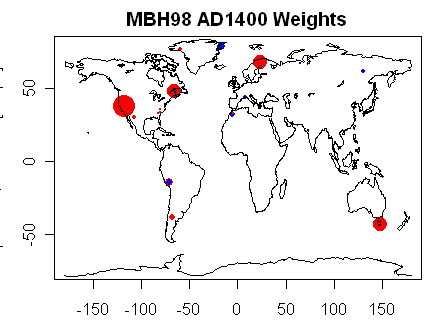
The questions is not if temperatures from reconstructions like those (this is just one time slice of Mann’s hockeystick reconstruction as presented by S. McIntyre (see https://climateaudit.org/2008/03/10/mannian-pca-revisited-1/):
have the right uncertainty attached to them, but how representative are they at all?
As long as the selection bias is not discussed mathematically as part of the reconstruction method, the reconstruction is just worthless.
Even if all these data points would have the correct uncertainty attached to them, they simply do not represent the world or the Northern hemisphere in a valid manner.
This article is nonsense
2023 was most likely the warmest year in the past 5000 years, based on averages of local proxies. So what? People like warm periods.
In 1990 before the climate lying took off, the warmer and colder periods in the past 5000 years were estimates at +0.5 degrees warmer and -0.5 degrees colder than in 1990.
While 1990 may have been -0.5 degrees cooler than 1990, the 2023 average temperature has increased +0.7 degrees C. since 1990.
That suggests 2023 was slightly warmer than any warm period in the past 5000 years.
It’s not science fraud to make that claim.
But without real time temperature measurements from thousands of years ago, we can never be sure.
We can be sure from anecdotes that people strongly preferred the warmer periods in the past, and hated colder periods..
I did not like Büntgen’s first article where he wanted the Climate Realists to work together with the Climate Howlers and sing Kumbaya around a campfire. Leftists do not compromise. The climate hoax is used by leftists to get political power and control people. Nut Zero is not really about the climate.
You actually believe that the 24×7 temperature readings taken 365 days a year in hundreds of different climates and seasons all around the world’s continents and oceans over a period of 33 years can be accurately and precisely constructed to a single average value of 0.7 degrees C variation?
When at the same time and using the same instrumentation, meteorologists say that even a local weather forecast more than 4 days (a period of just 96 hours) out, can only claim to be relied upon for accuracy 50% of the time.
One of these 2 disciplines – meteorologists and climate modelists – is full of crap.
And I know which group I regard as realists.
You are comparing a weather forecast with a measurement based on data. There are both surface and satellite data to choose from.
That is a meaningless comparison.
“2023 was most likely the warmest year in the past 5000 years”
Absolute nonsense….. describes too much of the content of your posts. !
Still in total DENIAL of MWP, RWP and the massive amounts of evidence that back them up.
Tree lines much further north, and much higher altitudes.
Peat bed, now in permafrost
Animals remains where they now can’t inhabit.
Instead, you rely on massively averaged, agenda-driven “fabrications” based mainly on tree rings.. D’Oh !.
You really are a manic and deluded AGW-asspostle, aren’t you.
The dingbat speaks
The only way to estimate prior global average temperatures in the past 5000 years is to average many local proxies. That is what my original comment was based on. Too complicated for you?
If we averaged all the unmodified, regional land surface temperature data it would show that the Early Twentieth Century was just as warm as it is today.
Here’s an example of that temperature profile, the U.S. regional chart (Hansen 1999). Temperature charts from around the world have a similar temperature profile.
I doubt that you have missed this, so I assume you ignore it because it doesn’t fit your CO2 meme.
The US — most states — was hot in the 1930s
So what?
The US is 1.5% of Earth’s global surface area/
I know NOAA “fixed” the mid-1930s US temperatures so 1998 was the warmest US year, so I no longer trust them.
I do not have a CO2 meme
But I have advocated for a doubling of atmospheric CO2 since 1997 to improve plant growth. The opposite of the Climate Howlers.
I love more CO2 and so do my plants.
Love warming too.
CO2 is not carbon pollution
Leftists are carbon pollution.
“I do not have a CO2 meme”
So you now say it doesn’t cause warming… Well done.
Maybe you are capable of basic learning
Basically all of the NH was warmer in the 1930/40s, and significantly warmer in the MWp and RWP…
SH was also warmer in the MWP and RWP.
We are very much still in a COOL period of the Holocene.
“The US — most states — was hot in the 1930s
So what?
The US is 1.5% of Earth’s global surface area/”
Here are 600 more unmodified, regional charts from around the world that have the same temperature profile as the U.S., that being that it was just as warm in the Early Twentieth Century as it is today.
You going to say “so what” to all those, too? How long will you remain in denial of history?
https://notrickszone.com/600-non-warming-graphs-1/
“The dingbat speaks“
No.. you yap. !! ..
…. with your characteristic lack of any comprehension or factual counter of anything.
Tree lines much further north, and much higher altitudes.
Peat bed, now in permafrost
Animals remains where they now can’t inhabit.
Crops grown in areas that can now no longer grow them.
Arctic marine life only just returning after the LIA and late 1979 extremes, last in evidence in the tail end of the MWP.
DENIAL of history is a strong AGW-CULTIST trait… because they have to.
Richard Greene, it would be much simpler for you to just comment about the articles that are not nonsense.
The criticism in this article was a character attack and was not justified. Conservatives want to deny that 2023 was an unusually warm year. They can’t handle the truth.
This website tries to hide the fact that USCRN has been rising at a +0.34 degrees per decade “catastrophic” rate since 2005.
Here’s what this website claims:
“The US Climate Reference Network record from 2005 shows no obvious warming during this period.
I have asked for this false statement on the home page of this website to be changed three times in past comments, but this is a myth conservatives want kept alive.
Mr. Greene: Perhaps the site would take your comment seriously if your comments indicated that you had any capability, education or experience-wise, on the subjects you choose for comment. Or if there was any sign that you learn from other comments. There is barely a signal of reason from your comments. You could do something about it, but you choose to keep track of downvotes.
You rely on certain “records” to draw your conclusion that it’s warmer now than 5,000 years ago. So how did trees grow 120 miles north of where they grow now, if it was colder then? You don’t grasp that the tree stump photos compel you to sit down and wonder where the records you rely on went wrong. I’ve never seen the slightest indication that you can think critically or absorb a fact that contradicts your opinion. I know i’m wasting keystrokews on you, but others here should look at your comment record, and come to their own conclusion that you are the nutter.
You wasted your time with a long-winded generic put down comment that makes almost no attempt to refute anything I have previously typed.
I did not say it was warmer now than 5000 years ago. I said it was most likely warmer in 2023 than any period in the past 5000 years.
Between 5000 and 10000 years ago, there were two long periods, most likely warmer than 2023, during the Holocene Climate Optimum.
A few local tree remnants indicate ONLY local conditions and do NOT lead to anything close to a global average based on real time measurements.
One must average as many local proxies as possible to get a fake global average.
You prefer to cherry pick a few extreme photo examples that lead to the conclusion you prefer.
That’s the Michael Mann technique of cherry picking proxies to support a desired conclusion … that he used for his Hockey Stink Tree Ring Circus Chart.
Most of the “ancient’ tree stumps were from 5000 to 10,000 years ago during the warm Holocene Climate Optimum. One exception I know of was found under glaciers in Southeast Iceland and confirmed to be roughly 3,000 years old.
So what?
One local area being warm 3000 years ago is not proof that the average temperature was warmer than 2023.
Many of the local proxies in the past 5000 years had more than +0.5 degrees C. warmer than 1990 AT LEAST FOR A SHORT PERIOD, but they were not all warmer at exactly the same time. Thats why averaging local proxies reduces variations,
It is my opinion that claims of +/- 0.5 degrees C. variations in the past 5000 years may be true but I believe the margin of error of the local proxies is at least +/- 1.0 degrees C., so +/- 0.5 degrees C. is statistically insignificant.
YOU WROTE:
“There is barely a signal of reason from your comments.”
I will now type a reasonable statement to prove you wrong: You are an angry old man who needs to be sedated,
Happy now?
Mr. Greene: You didn’t say it’s warmer now than 5000 years ago, you said it’s warmer than any period in the last 5000 years. ?!
There’s not enough sedative in the world to hide that one. Still no sign of reason, but you really tried.
“There is barely a signal of reason from your comments.”
A very apt description of nearly all RG comment.
Small snippets of sanity, overlaid with manic tantrums and scientific denial and idiocy.
“I said it was most likely warmer in 2023 than any period in the past 5000 years.”
“Most likely”. So you are just guessing. Not very scientific.
The truth is you have no clue if that statement you made is true or not.
Based on the written, historical temperature record, that statement is not true. It was just as warm in the recent past as it is today, and it wasn’t just regional. When all regions are warmer at the same time, that makes it global.
Who to take any notice of… A manic AGW CO2-warming stall-wart like RG.
Or actual science…
New Study: China’s Loess Plateau 7-8°C Warmer Than Today For Much Of The Last 4000 Years (notrickszone.com)
A wild guess about a Chinese plateau is NOT an accurate global average temperature statistic based on real time data.
You really believe there is such a construct as “an accurate global average temperature”?
Just contemplate for a bit how that’s supposed to be arrived at.
Satellite data should be able to generate a decent average temperature statistic. Not that less than 1 degree C. of warming or cooling means much.
Satellite data shows absolutely no human caused atmospheric warming at all. A fact you have yet to prove wrong.
Poor RG. still in denial of anything that counters his limited concept of science.
China peat moss, RWP, MWP both warmer than now.
Get over it. !
My family built a large clear span barn 50 some years ago. The lumber/trusses was trucked in from Oregon and was marketed as “West Coast Fir” and the number of growth rings was something like
8or10 per.inch and was clear. The growth ring count were very much a part of this deal. The trusses were engineered/stamped and a bit over built IIRC. I recall being told by a forest professional years later on this subject while in OR and was told they manage the regen after harvest that pushes the trees to grow with tight rings by not thinning early to force the growth up not out and only later the thinning happens.. The weather on the coast is what makes this happen from what I remember. The timber was a lot more expensive than anything grown locally.
Perhaps Büntgen is looking to position himself as the Anthony Fauci of climate sciencs…
Charles,
As I wrote to you, you write well. You have identified some problems in science without expressing any personal beliefs that you might have. Your logic is crisp and hard to fault. Thank you for showing science objectivity.
Geoff S
It is quite puzzling. Esper and Buntgen also recently published this 2024 article with the following conclusions.
“It is premature, and possibly incorrect, to conclude that the first millennium was free of centennial-scale temperature trends and that the decadal variations were systematically smaller than during subsequent centuries.”
”The IPCC’s focus on a single reconstruction is an insufficient summary of temperature variability over the Common Era.”
https://www.nature.com/articles/s43247-024-01371-1