Guest Post by Willis Eschenbach
This is a follow-on from my previous post entitled Greenhouse Equilibrium. If you haven’t read it, you might want to, as it introduces many of the concepts I’ll discuss in this post.
I got to thinking about the oft-repeated claim that a doubling of CO2 increases top-of-atmosphere (TOA) radiative forcing by 3.7 watts per square meter (W/m2) … and that in turn, the additional 3.7 W/m2 of TOA forcing causes a ~3° warming of the temperature. In other words, they say that ~ 1.2 W/m2 of additional radiative forcing causes one degree of warming.
What set me to thinking was the Stefan-Boltzmann equation. It relates temperature to the amount of thermal radiation emitted. It turns out that the radiation varies as the fourth power of the temperature, T4. What this means is that the warmer an object is, the more energy needs to be added to the object to raise the object’s temperature by each additional degree.
So how much extra energy does it take to raise the temperature of the earth (which is at about 15°C) by one degree C?
Per the S-B equation, it requires an additional ~ 5.2 W/m2 to raise the temperature of the earth by one degree C. But as discussed in my previous post, only ~ 80% of the surface absorbed energy is expressed as temperature. This means that to warm the earth by 1°C requires 5.2 / .8 = 6.5 W/m2 absorbed energy at the surface per 1° warming.
Now, recall that their claim is that 1.2 W/m2 of TOA forcing causes one degree of warming … which in turn requires 6.5 W/m2 at the surface.
Presumably, their claim is that various feedbacks amplify the change in radiative forcing. But turning 1.2 W/m2 at the TOA into 6.5 W/m2 at the surface? That’s a neat trick. I’m not seeing that happening at all.
Now, let me back up to a graphic from my previous post, along with the caption.

Figure 1. Greenhouse multiplier. The multiplier is calculated as upwelling longwave surface radiation divided by incoming solar radiation (after albedo reflections). A multiplier of 2 would mean that the surface would be radiating two W/m2 of energy for each one W/m2 of solar energy actually entering the system. This shows that the greenhouse has increased the incoming solar radiation by about two-thirds, as measured at the surface.
Now, over the period of the CERES record, greenhouse gas forcing increased by about 0.7 W/m2.
Theoretically, this would be increased by feedback in the ratio 6.5/1.2 to the value at the surface. in this case, it converts the 0.7 TOA W/m2 to 3.8 W/m2 at the surface.
This allows us to see what the change in the greenhouse efficiency shown in Figure 1 should look like if the absorbed surface radiation increased by 3.8 W/m2. Figure 2 is the same as Figure 1, but including the expected change from the additional 3.8 W/m2 absorbed.

Figure 2. As in Figure 1, but including the trend in the multiplier that would be expected from the increase in TOA greenhouse gas forcing.
Hmmm … several points.
First, I simply don’t believe their numbers. Their claim is that a doubling of CO2 gives an additional 3.7 W/m2 at the TOA, and it results in 3°C of surface warming. That’s about 1.2 W/m2 per degree of warming.
But we know that it takes 6.5 W/m2 to raise the earth’s temperature by one degree …
I’m not seeing any physical processes by which the 1.2 W/m2 could somehow be increased to 6.5 W/m2.
Second, even if the warming were only 1°C per doubling of CO2, we still would be able to see it in the graphic. Figure 3 shows that result.

Figure 3. As in Figure 2, but with the CO2 forcing figured at one degree of warming per doubling of CO2, which is one degree per 3.7 W/m2.
But we don’t see that lesser trend in the multiplier either. Instead, the multiplier has a slight but not significant decrease, and it’s nothing like what we’d see if increasing GHGs actually were increasing the surface temperature.
However, at least that lesser trend is a bit believable since the increase from the TOA to the surface is from 3.7 W/m2 to 6.5 W/m2. Still a big reach, though … it would require strong positive feedback, and I haven’t seen that anywhere.
Now, the important thing to remember about this measurement of the efficiency of the system is that it is end-to-end. By that I mean we start with the energy entering the system (solar minus reflections) and we end up with surface temperature.
In between the sun and the surface, we have a range of emergent climate phenomen. Inter alia they include variable cloud shortwave and longwave radiation effects, changes in surface albedo and TOA albedo, massive variable advection of energy from the tropics to the poles, changes in aerosols, the La Nina/El Nino pump, variations in timing and strength of thunderstorms, variations in sensible/latent heat loss from the surface … and changes in greenhouse gases.
And what appears to be happening is that, as I’ve said for years, the changes in greenhouse gases are being counteracted by some combination of the other emergent climate variables included above.
What a marvelously complex world we inhabit!
w.
PS—As with the previous post, please stick to the topic. Claims that the greenhouse effect isn’t real or that downwelling radiation doesn’t exist have no place in the comments on this post, and they will be frowned upon from a great height. You are welcome to discuss those issues … just not on this particular post.
My Usual—I can defend my own words. I cannot defend your (mis)interpretation of my words. Please QUOTE THE EXACT WORDS you are discussing in your comments, so we can all understand who and what you are replying to.
If there was no moisture in the atmosphere CO2 would function as a GHG. Because there is percent concentration of moisture in the atmosphere CO2 is not a GHG. Same for CH4 and all the other “GHGs” the climate pseudo-scientists are on about.
The only reason why the fraud is still alive is too many billionaires are making money off subsidy farming.
CO2 is a greenhouse gas in competition with water vapor.
A weak greenhouse gas after 400ppm.
Weak after 200ppm (400 is generous)
Lets settle with weak because of 400 ppm
A fair argument James Hansen’s “runaway feedback” scenario is unfounded.
Runaway positive feedback is coming in the FUTURE
and always will be coming in the FUTURE.
It’s over the rainbow.
Or got lost in New Jersey,
I’m not sure which.
My first flight into Newark Airport, long before GPS, I got lost trying to get to Holmdel, NJ. Somehow wound up at some port along the harbor at 1am in the morning. It was 3am before I finally figured out, using a folding map, how to get to my hotel near Holmdel.
So you *can* get lost in NJ!
Not to mention the NJ concept of left turn lanes.
Invented in Connecticut
jug handles?
Is this the locals term?
I don’t know. That’s what they look like from inside an airplane, at least to me.
“…at 1am in the morning.”
You were lucky it wasn’t in the afternoon!
If you are in NJ you are lost
I have been lost in New Jersey several times
I used to live in New York.
Don’t get off the main highways
Obvious for a quarter Century.
But he still seems to have a few bucks to jingle in his pocket. Even The Mann still seems to be doing OK.
Always a good market for liars and charlatans.
I agree with you, Willis.
The 3.7 W/m^2 figure (still used by the IPCC) is from Myhre (1998), who estimated 3.7 ±0.4 W/m² per doubling of CO2. However, van Wijingaarden & Happer have recalculated it using an updated and expanded HITRAN database, and they found that the correct figure is only 3.0 W/m² per doubling of CO2.
https://sealevel.info/Radiative_Forcing_synopsis.html
Measurements by Feldman (2015) and by Kramer (2021) give results similar to van Wijingaarden & Happer’s figures, though with such wide error bars that they cannot rule out Myhre’s.
The question is, how much change at the surface could result from a 3.something W/m² forcing at TOA?
Positive feedbacks might increase the TOA forcing from a doubling of CO2, but not by a huge multiple. What’s more, Kramer’s results, which include effects of all but the slowest feedbacks, are still not much higher than van Wijingaarden & Happer’s calculated figure:
https://sealevel.info/Radiative_Forcing.html#kramer
Let’s do a little arithmetic.
The “average” temperature of the surface of the Earth is variously claimed to be 13.9 to 15 °C:
https://www.google.com/search?q=average+temperature+of+the+surface+of+the+earth
Add 273.15 to convert to temperature in K: 287.05 to 288.15 K.
For a temperature of 287.05K, a 3K increase would result in a ((287.05+3)/287.05)^4 – 1 = 4.24645% increase in radiative emissions at the surface.
https://www.google.com/search?q=%28%28%28287.05%2B3%29%2F287.05%29%5E4%29+-+1%3D
For a temperature of 288.15K, a 3K increase would result in a ((288.15+3)/288.15)^4 – 1 = 4.23000% increase in radiative emissions at the surface.
https://www.google.com/search?q=%28%28%28288.15%2B3%29%2F288.15%29%5E4%29+-+1%3D
If the surface emits 398.2 W/m², then a 4.24% increase would be +16.88 W/m².
That certainly does seem inconsistent with a TOA forcing of only 3.something W/m².
There’s a lot of variation in the figures for various components of Earth’s radiation budget, though you’d never guess it from the precision with which those figures are often given; e.g.:
https://science-edu.larc.nasa.gov/wp-content/uploads/sites/141/2020/07/ERB-poster-combined-update-8.2019v4.pdf
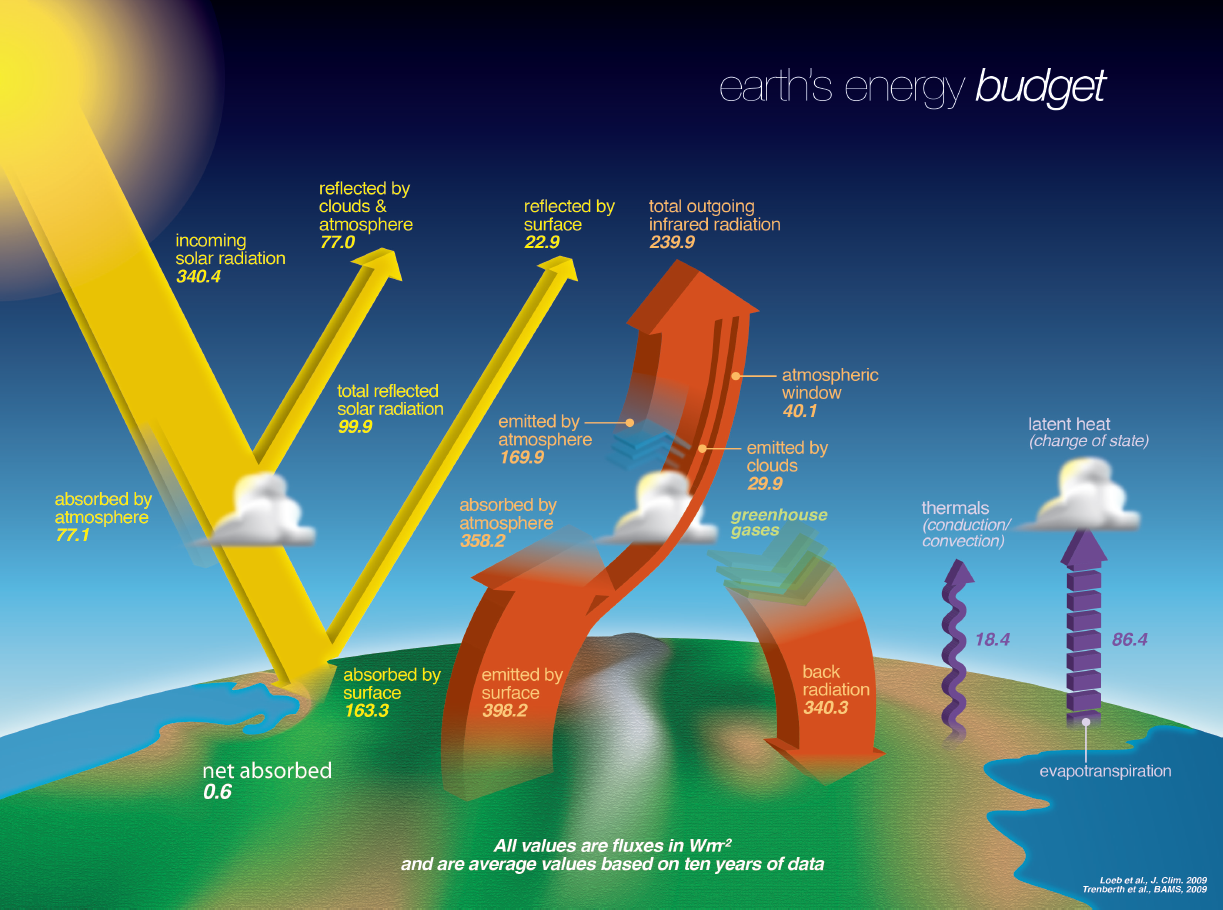
Many of the numbers in that diagram are “best guesses” and are actually quite rough. Here’s the equivalent diagram from AR4:
Note that in this diagram the surface emits only 390 W/m² (rather than 398.2), and it absorbs only 324 W/m² (rather than 340.3).
Here’s the equivalent diagram from Trenberth (2009):
Source: http://www.cgd.ucar.edu/cas/Trenberth/website-archive/trenberth.papers-moved/BAMSmarTrenberth.pdf#page=4
Note that in Trenberth’s diagram the surface emits 396 W/m², and absorbs 333 W/m².
Those large variations might be why NASA’s latest version rounds to integers:
https://science-edu.larc.nasa.gov/wp-content/uploads/sites/141/2021/08/ERB-Litho-Edits-2020.pdf
In this version, the surface emits 398 (rather than 398.2, or 396, or 390) and it absorbs 345 W/m² (rather than 340.3, or 333, or 324).
The Stefan-Boltzman relation is: E = ε σ T⁴, where:
epsilon ε is emissivity (estimates vary, perhaps (.29 * .85 land) + (.71 * .95 ocean) = about 0.92 average for the whole Earth. But some sources say as high as 0.96. It is actually a function of frequency, except for a perfect grey-body, but emissions from seawater and land are pretty grey.)
sigma σ is the Stefan-Boltzman constant = 5.670374419E−8 W/m²K⁴
temperature T is in Kelvin
E = radiative emission
Plugging in the high-end values T=288.15 and ε=0.96, we get:
E = 0.96 × 5.670374419E−8 × 288.15⁴ = only 375 W/m²
https://www.google.com/search?q=0.96+%C3%97+%285.670374419+%C3%97+10%5E%E2%88%928%29+%C3%97+%28288.15%5E4%29+%3D
To get 398.2 W/m² emission from the surface would require an impossible emissivity of 1.0186:
https://www.google.com/search?q=1.0186266+%C3%97+%285.670374419+%C3%97+10%5E%E2%88%928%29+%C3%97+%28288.15%5E4%29+%3D
Part of the problem is that “average” temperature is not the same thing as the temperature at which a body of uniform temperature would emit that much. This was discussed by ferdberple and bdgwx, here:
https://wattsupwiththat.com/2022/08/23/numbers-tricky-tricky-numbers-part-3/#comment-3584728
Hmmm… that “NASA’s latest version” ERB diagram link has gone stale. It worked about a month ago, but they’ve apparently moved their site from:
https://science-edu.larc.nasa.gov
to:
https://science.larc.nasa.gov
The ERB diagram moved to:
https://science.larc.nasa.gov/edu/wp-content/uploads/sites/141/2021/08/ERB-Litho-Edits-2020.pdf
Also, archive.org has a copy:
https://web.archive.org/web/20220716090536/https://science-edu.larc.nasa.gov/wp-content/uploads/sites/141/2021/08/ERB-Litho-Edits-2020.pdf
IIRC, Wijingaarden and Happer came up with a 2.0C rise with a doubling of CO2. HOWEVER, that was only taking radiative heat transfer into account and ignoring all the feedbacks due to phase changes in water.
I think Willis and Richard Linzden are on the right track in stating that tropical thunderstorms are a major negative feedback mechanism. One thing about the million year temperature record shows that there is a factor that limits maximum temperature. My assumption it is the saturation vapor pressure of water approximately doubling for every 10C rise in temperature. Note that the NWS reports on hurricanes assume that a SST of 26C is the minimum to sustain a hurricane.
Not right.
“Upon doubling the concentration of carbon dioxide to 800 parts per million, the radiated intensity decreases from 277 to 274 W/m2 (area below the red line). This causes an increase of the global temperature of 3*(60—16)/(394—274)F = 1.1 F = 0.6°C. The reason for this ultralow increase of temperature is the saturated nature of the absorption of carbon dioxide: when its concentration is increased, the same radiation will be absorbed in an increasingly smaller atmospheric layer. The only reason of there being any excess absorption at all, is in the non-saturated sidebands of carbon dioxide.”
SOURCE: 2021 presentation
Prof. Happer (Princeton ) explains CO2 – ingenuousness
Thank you for that link. Bookmarked separately.
The diagram you referenced is only related to surface radiation absorption. It doesn’t deal with the rate of flow of energy through the atmosphere.
If you double CO2 you now have twice as many CO2 molecules emitting energy.
At the same time the average emission-reabsorption distance (it’s upward) decreases.
The overall average of all the changes (including the wing absorption you referenced) appears to come out to zero.
No net change in the rate of energy emission to space.
Pretty cool design. Mother Nature is one smart cookie.
Is my memory faulty, but were Wijngaarden and Happer’s calculations based on clear-sky conditions?
Measuring the earth for over 2 years has never been 288K or 390w-m2. July 5th was the peak of 350.87w-m2. 1403.5w-m. Solar heating in the stratosphere makes up (105.825 w-m2 x 4) 423.3 leaving 980w-m2 (245*4). Summed excess energy was 849wm2 plus 640w-m2 going out. 209 is compression heating. 1.4*1.28*333 squared (110891) / 946.5.
So no empirical evidence, then?
Willis is diligently showing in his recent posts based on actual physical principals and measurements that the IPCC’s alarmist figures just don’t tie out. Here’s a back of the envelope calculation that pretty much shows how far they’re off:
IPCC fans throw out a lot of formulas / numbers, so it’s hard to ‘pin’ them down, i.e., check their work. But generally, they’ll agree that a doubling of CO2 by itself will increase green house forcing by 3.7 W/m^2 via the IPCC approved rule of thumb:
delta_F_2XCO2 = 5.35*ln(2).
Since this is the ‘instantaneous’ impact, they add another 3.7 W/m^2 for water vapor feedback, plus a smidge for other feedbacks, so the total equilibrium impact of CO2 doubling is about 9.8 W/m^2, which is how they get to a ‘consensus’ 3C impact for CO2 doubling via another IPCC approved rule of thumb:
delta_T = 0.31*delta_F
However, the Stephan-Boltzman equation, which is applicable to Earth’s surface (but not its atmosphere, h/t Howard Hayden) says that a 3 C increase in surface temperature will increase surface long-wave emission by about 16.5 W/m^2. This means the alarmists are ‘short’ forcing by about 6.7 W/m^2, meaning they would need either additional forcings and/or a reduction in albedo to tie out. Obviously neither of these are supportable, which is another clue why their models are running hot.
There are other things supporting your conclusion that the IPCC ‘standard rules’ do not square or tie out.
If the models were meant to reflect physical reality they would have been discarded when that tropical troposphere hotspot, that appeared on the front cover of AR3, didn’t appear in the real world.
The models are meant to reflect political reality. And they are working very well, thank you.
They are props to support pre-existing beliefs about CO2.
Science like computer games.
Big computers
Ph.D. scientists
How could they possibly be wrong?
No publicity on how wrong the predictions have been.
Except for the Russian INM model, which appears accurate, but gets no publicity for that either. Probably a lucky guess.
It would be interesting to see a plot of the implied ECS of the CMIP5 models versus the factor by which their hindcasts have overestimated temperature rise.
John Christy has supplied such plots of both hindcast and forecast, for example in his 2016 congressional testimony.
Your ECS inference, however, is not valid. To summarize my previous posts here on this topic, All climate models have to be parameterized because of computational intractability on relevant scales thanks to the CFL constraint on numerical solutions to PDEs. The parameters are ‘tuned’ (via two different methods) tobest hindcast 30 years per a written CMIP model submission requirement. So in general they don’t get the past ‘wrong’ independent of their future whatever ECS.
Perhaps I was unclear. The attached image shows CMIP6 models baselined to 1979 with projections through 2030 compared to Observations. It might be interesting to compare the implied ECS of each model to the degree which they have overestimated temperature rise to date. The question is not how they hindcast the past, but rather how they failed to project the present. Have I misinterpreted this and similar charts?
There must be a +3 degree or higher ECS to scare people.
And it must gradually increase to “worse than we thought”
That’s how climate scaremongering works.
No attempt at accurate predictions since 1988.
The scaremongering will continue because it does work.
It used to generally work. Then two things happened, which mean the whole thing is now falling apart.
We know that. But how many other people know that?
Leftists claim their models are accurate, believe it or not.
But Nut Zero fans in Europe are still blaming Putin. And the grid reliability problems are not yet at the tipping point convincing people that Nut Zero is not working. They see the high energy prices, but they don’t have the warning shot of blackouts … yet. Most people are still far from believing Nut Zero is not needed. Remember that they see Niut Zero as saving the planet — that’s their religion — which excludes engineering and science
It always makes me laugh when I read that “it’s worse than we thought!” then later [sometimes even the same article] we are told “the science is settled!”.
Don’t people recognize that these two phrases are incompatible?
Then I sigh, because it makes me sad to see the manipulation by the MSM with the tacit approval of the climate scientists. Confluence of interests indeed!
btw We are having another beautiful (if hot) summer day here in central Arizona – completely consistent with “climate change” [ie CC is not always “bad”]
But it’s my understanding that you will be getting a significant cut in water supply from the Colorado river?
And possibly electricity from the Glen Canyon Dam. Within the next year Lake Powell may drop below the level necessary to support generation. On our canyon vacation this summer we stopped to see how low the water is, and it is low. Back in the 1990’s on vacation with our then young kids, there was a rock jutting out of the water that was an easy swim from the nearby boat ramp, with all the kids taking turns jumping or diving from it. Now the water level is around 120 feet lower and the tall rock is a relatively easy walk from the extended shore line. The boat ramp is gone.
Climate Realists often say Climate Howlers claim the science of climate is settled. That overlooks all the new “it’s worse than we thought” studies, new predictions of doom, and the current attempt to define bad weather as a climate emergency.
The key to climate propaganda is to produce so many new studies predicting doom that Climate Realists can’t keep up with them. Refute one, and there are two more. Scaremongering is a steady job. “It’s worse than we thought” is a strategy for a new study to get attention in the media. They would never publish “it’s not as bad as we thought” studies !
“History doesn’t repeat itself, but it does rhyme.” – attributed to Mark Twain
Typo Willis- Phenomen
Best,
RD
P.S.
It would be great if you could give us a post where you link to all the different ways you have shown that ECS is well below 3. You’re amazing! Even more mystifying is how certain … interlocutors (not to say raving loons)…miss the significance of your contributions because they’re foaming at the mouth about “LUKEWARMISTS!!!”, back-radiation, and precious bodily fluids.
I’m more in tune with Dr. Strangelove’s fixation on the race to caverns stocked with shapely, nubile young women for the elites’ use of their precious bodily fluids.
just to say I am no one, and an old granny at that, but I love your posts ; they give me hope for the future of my grandchildren and their grandchildren.
Un Abrazo
¡Ay, mi jovencita, abrazos pa’tigo tambien! Mil gracias.
w.
The greenhouse effect is solar heated radiative active gases coupled with compression heating.
202,300 joules (1.75 × 340 x 340) / 1000. (Watt/joules)
Added together makes up the over 300 watts of downwelling infrared radiation. Gasse that make up the 1% of the atmosphere can’t have all this energy.
Let me tap the sign since Willis seems to be busy.
The post is not about arguing whether the conventional theory of greenhouse gases is right, wrong, or indifferent. This is not the place for the discussion.
The post is about suspending your disbelief, accepting the warmist premises — for the sake of argument — and showing that the numbers don’t add up to support their claims.
“Claims that the greenhouse effect isn’t real or that downwelling radiation doesn’t exist have no place in the comments on this post”. The greenhouse effect is conflicting as I have it as 100% composition 1.28kg, while Willis assumes < 5g (includes water vapor) and heated by the earth. Willis rejects anyone dismissing gases increasing in temperature when compressed by pressure and radiative active gases heated by the sun. This makes up the 314 watts of downwelling radiation.
209 watts compression heating.
105 watts solar heating.
*Sigh*
The cranks will always be with us. That should be written in scripture.
Where is the offset at sunrise?
Stephen Lindsay-Yule wrote, “The greenhouse effect is solar heated radiative active gases coupled with compression heating.“
That is incorrect, Stephen. The radiatively active gases (a/k/a “greenhouse gases”) which help warm the Earth are not “solar heated.” They are transparent to most solar radiation.
Instead, they are heated by LW IR radiation from the surface of the Earth. They prevent some of that radiation from escaping to outer space. By absorbing some of that radiation they cause it to warm the atmosphere.
You can learn about it from the first ten resources here, especially #7-10:
https://sealevel.info/learnmore.html
Sorry you are incorrect. Why at 10hpa does the temperature over Antarctic gets as high as -6C in December while in June it is -90C. Solar heating. What is absolute zero? answer -273°.How long does it take for molecules velocity at 800,000km/hour slow to 0km/hour. Current earth rotation barely slows at all. Have you heard of the atmospheric window. This is infrared radiation that is transparent to space. Infrared radiations are in wavelengths. The transparent window is 8 micrometers to 14 micrometers. This all of earth. Else earth would heat up pretty quickly if heat was blocked. None of the greenhouse gases absorb between 8 micrometers and 14 micrometers. They absorb below 8 micrometers. This is solar heating. As the highest 5cm dry hot land emitted radiation wavelength is 8.52 micrometers. So not earth.
Greenhouse gases are solar heated and non-water vapor greenhouse gases heat to -40C and near the tropics water vapor cools to -65C. I have 2 years of observing 250hpa, 70hpa and 10hpa.
Correction. Greenhouse gases are solar heated and non-water vapor greenhouse gases heat to -40C and near the tropics water droplets in clouds causes cooling the air to -75C. I have 2 years of observing 250hpa, 70hpa and 10hpa.
The greenhouse gases absorb around 14 microns near the peak of the surface IR emission, 8 microns is way beyond the tail of the solar spectrum.

solar radiance-07.svg
IR emissions is around 105 watts solar heating and a separate mechanism compression heating that makes up the peak surface temperature curve.
After 50 years of weather watching here in England am convinced that the cause of the warming during the Spring and Summer here in England, has little to do with CO2 and all to do with shifts in the weather patterning.
Because a percentage change in the cause of fine weather been the Azores high rather then a North Atlantic high during these seasons then that would account for the warming we have seen over the last 50 years. With more air coming up from the Mid Atlantic rather then the northern Atlantic.
Denying the fact that when a gas is compressed it heats up (increases in temperature) and this process happens in our atmosphere is unscientific. Carbon dioxide velocity is 400,000 metres per hour slower than air molecules at 1 bar pressure. It is a cold gas not a hot gas the media portray it as.
Stop embarrassing yourself.
To the extent that any parcel of air is compressing and heating, another parcel of air must be decompressing and cooling.
Do you imagine that the average atmospheric pressure is rising over time?
The average atmospheric pressure must be increasing over time. As we exchange an oxygen molecule for a CO2 molecule the mass of the atmosphere increases.
It may not be a lot but is going up.
Many things are true but not significant.
In order to warm the atmosphere as a whole in a significant way comparable to the warming attributed to the greenhouse effect, there would need to be a sustained, steady increase in pressure.
Damn plants keep stealing that carbon though. A little extra pressure probably helps them out.
Compressive heating appears to be real. This is why a key term in the lapse rates is gravitational acceleration, not radiation.
One can prove gravitational acceleration is still happening by throwing a ball in the air: this acceleration is constantly working.
Maybe we tend to mistake the reality of buoyancy within a pressurized medium for ‘it’s not happening.’
Don,
Compressive heating is of course real and is neither denied nor mistaken for something else.
In certain topologies, such as winds coming down into a valley, it can be very relevant. But any time some of the atmosphere is heating from being compressed, somewhere else it is expanding and cooling. The net effect is…zero.
You can’t look at only one side of the balance sheet. That’s like saying that somebody who made an average salary of $100k/yr over the past 20 years must have $2 million in the bank today.
Your talking about convection. What is the weight of air at 70hpa (around 110g) and and surface 1280 grams. What difference of weight does that have. Compression. You said any parcel of air compressing and heating. What is missing that the other parcel decompressing and already heated has that caused the parcel to rise. Surface heat. Both are coupled until equilibrium. I think your making a fool of yourself.
Surface heat via conduction adds more heat as the parcel before it reaches the ground is cooler than the parcel both heated via compression and conducting heat it touched rises up.
Surface heat via conduction adds more heat as the parcel before it reaches the ground is cooler than the parcel both heated via compression and conducting heat it touched rises up.
The temperature at 70hpa with 110g is -59C. During this slow compression pressure and temperature rise as weight and molecule collisions increase. At 9000 metres over middle east the temperature was -33C higher than -59C due to compression heating. The temperature did not change from sun rise to 4pm. As thermometer can’t measure infrared radiation. This shows no absorption of heat from the surface or the sun. Absorption of solar heat happens at higher altitude. Again debunks your argument.
No more wasting time on you. Your invincible ignorance is apparent.
Feeling is mutual You suffer cognitive dissonance. Because you think trace gases obsorbs most of the energy of the earth. When it is well known that to heat up a cold gas by more than100C is via high compression.
I do not think that trace gases absorb most of the energy of the earth. As with most of what you say, you have a mistaken understanding of reality that extends to what other people think.
Almost all the heat on earth (other than geothermal heat from radioactive decay) is from sunlight absorbed at the surface and to some depth into the oceans.
So-called “greenhouse gases” (GHGs) merely delay cooling of the surface that would otherwise occur more quickly if the GHGs did not interfere. The relatively hot surface cools by radiation to deep space that is almost 300 degrees C colder.
Some trace gases like carbon dioxide play a minor role but nearly all of it is caused by water vapor.
You correctly observe that when work is done on air to compress it, it warms. What you miss is that when air does work expanding into a lower pressure region, it cools. All compression in the atmosphere is offset by expansion somewhere else. Overall the average atmospheric pressure stays constant. There cannot therefore be any net increase in temperature caused by compression.
I don’t expect you will listen or understand but I write for those who have been confused by your errors.
Dismissing compression heating in our atmosphere but used in so many ways. Desiel engine, jet engine and now heat pumps. Even our heart requires pressure of 10hpa(1000 pascals) to produce a watt per heart beat.
Correction: the pressure required is 10hpa (10,000 pascal’s not 1000 pascal’s) to produce a watt.
“I simply don’t believe their numbers.”
Their numbers are phony. Physicists who have done the line by line calculations of CO2’s radiative flux show that it doesn’t have a strong enough forcing to cause the strong positive feedback’s assumed in climate models. That’s why they have never been observed in the real world.
False attribution underlies the whole house of cards.
Willis,
As expected from you, another excellent article! Thank you.
Just one comment: many readers may not appreciate the implications of your comment:
“Second, even if the warming were only 1°C per doubling of CO2, we still would be able to see it in the graphic. Figure 3 shows that result.”
This basically reflects on the fact that many physical processes reach what is called an “asymptotic limit” on cause-vs-effect. Many people just do not appreciate the presence of an asymptotic limit on the ability of CO2 to affect global temperatures.
As per the attached graph, and as well-argued by Happer and Wijngaarden (https://wattsupwiththat.com/2020/10/26/study-suggests-no-more-co2-warming/ ), we are currently at the asymptotic limit of increases in atmospheric CO2 concentration causing additional greenhouse gas warming.
This asymptotic limit at around 400 ppm is the obvious explanation for why Earth did not experience “runaway global warming” at paleoclimatology-data-based past atmospheric CO2 levels as high as 7000 ppm during the Cambian period.
Your post is correct but your graphic isn’t. It assumes a sensitivity per Lindzen and. How 2009. That paper was just wrong. They redid it in 2011. Still wrong, but not by as much. A more realistic curve would by Callendar’s from 1935.
Rud,
I do appreciate your clarification, but would that be known as a “distinction without a difference”?
In a sense, yes. Asymptotic limits.
In another sense (best info for others), no. Repeating an easily disprovable graphic can discredit our side. Nobody can discredit Callendar’s 1935 logarithmic concentration curve, which has withstood the test of time.
“What a marvelously complex world we inhabit!”
Heresy or misinformation? 😉
While the feedbacks you mentioned are real, they are NOT the reason for the result we are seeing in the CERES data. What we are seeing is primarily the result of atmospheric boundary layer feedback (BLF). That is, sub-second changes in conduction, radiation and evaporation as a result of thermal equilibrium processes in said boundary layer.
The equilibrium found between the boundary layer and surface is the result of these processes. Any change that warms/cools either side is corrected almost immediately. Otherwise, there would be no equilibrium. Hence, when we get a change in DWR from increased CO2, it is met with an equal and opposite energy transfer from the surface.
There are experiments that have been done (Seim/Olsen 2020) that also show no warming from increasing CO2 content. BLF would explain their results.
That equal and opposite energy transfer from the surface is from surface to space and prompted by the creation of kinetic energy within descending air as it is compressed during the descent.
Don’t think so.
This is really very simple when you think about it. The atmosphere and the surface are touching. They conduct energy back and forth. Lots of energy. It just doesn’t create a significant flux in either direction. However, if either side of that boundary warms or cools a little it is easily nullified by small changes in conduction.
Over oceans the low energy photons are absorbed right at the surface and will also enhance evaporation.
Over both the land and oceans you will also see small increases in surface radiation which is quickly absorbed back into the boundary layer.
Since over 99% the DWR that reaches the surface is produced in the boundary layer, the net effect of BLF is to return the energy back into the boundary layer. This nullifies any warming effect.
The same radiatively active gases are also radiating energy upward through the atmosphere. This is how the temperature of the atmosphere is maintained as well as the lapse rate.
There is no need for any compressional warming.
Convection.
All your emergent phenomena are just the visible manifestation of convective adjustments within an atmosphere.
Convection causes the surface temperature enhancement known as the greenhouse effect and adjustments in convection maintain it.
All potentially disruptive elements including from greenhouse gases are neutralised by convective adjustments.
Back in the 1990’s physicist and mathematicians were saying you can’t model the climate. It’s too complicated and chaotic. This post reinforces that conclusion.
AR3 said that explicitly. Because climate is a nonlinear dynamic system, therefore chaotic. But there is LOTS of money for those trying anyway.
You certainly can model nonlinear dynamic systems successfully, I wrote my thesis on doing so and comparing the results with experiment. Did so well before the 90s, they weren’t called ‘chaotic’ then.
Just because people think that they have some sort of influence on climate change does not mean that the natural climate change stops…floodings around the equator and droughts on the higher latitude.
It is the Gleissberg, not so?
https://breadonthewater.co.za/2019/09/22/revisiting-the-87-year-gleissberg-solar-cycle/
Willis says, “And what appears to be happening is that, as I’ve said for years, the changes in greenhouse gases are being counteracted by some combination of the other emergent climate variables included above.”
Yes, all the way to the TOA where we can “watch” from space. It all appears as a huge array of highly variable emitter/reflector elements. There is a NOAA visualization depicting the end result of what you are describing, in a band of infrared wavelengths from which a good portion of the static warming effect of CO2 arises.
This link is to an animation of the most recent 8 hours of high-resolution images from GOES EAST band 16 (the “CO2 band.”) For reference, on the brightness temperature color scale used for the visualization, the radiance at 30C (yellow) is 10 times the radiance at -90C (white.)
https://www.star.nesdis.noaa.gov/GOES/fulldisk_band.php?sat=G16&band=16&length=48&dim=1
The other bands in the visible spectrum, and the composite imaging, help show the variable reflector performance.
I just wanted to put this here for readers to quickly see the end result of the operation of the atmosphere as the compressible working fluid of its own heat engine motion, which is largely why the emergent phenomena are so powerful as a governing mechanism.
The highly self-regulating transport of mass and energy from the equator to the poles, and from the surface to high altitude, are plain to see.
Willis: “Their claim is that a doubling of CO2 gives an additional 3.7 W/m2 at the TOA, and it results in 3°C of surface warming. That’s about 1.2 W/m2 per degree of warming.”
and
“I’m not seeing any physical processes by which the 1.2 W/m2 could somehow be increased to 6.5 W/m2.”
WR: Neither do I. But I do see some obstacles for TOA LW radiation wanting to reach the surface to warm it: 60% cloud coverage and lots of absorbing CO2 and H2O molecules whose densities are firmly rising nearing the surface. And there is another problem: net LW radiative transport is upward, not downward.
Exactly. Net radiation flow is upward due to changing density. As CO2 molecules decrease the radiation from below has nowhere to go and eventually radiates to space. Going downward the CO2 density increases and quickly absorbs any photons that might warm the surface.
The crazy notion that adding more CO2 molecules proportionally at all altitudes will reduce this upward flow is nonsense. The same logic applies.
Not only true, but doubly true because of the lapse rate. As temperature declines with altitude, so does the major GHG water vapor. (Higher, colder, is dryer, as any weather ballon radiosonde proves.) So the only aggregate direction LWR can eventually go is up and out. Thank goodness.
I doubt that GHG concentration has much effect on the cooling of the troposphere from the surface.
If we look at weather balloon data as a balloon moves from relatively dry air to moist air (e.g.,through a cloud) there’s no increase of heating except perhaps a blip from the heat of condensation; then the cooling continues following the same moist lapse rate trajectory, as we see on skew-T diagrams of balloon soundings. No perturbation of heating/cooling is happening.
In the higher troposphere there’s less water vapor and the dry and moist lapse rates become parallel on skew-T diagrams. There’s no signature of radiative effects from CO2 higher in the troposphere.
There are no terms in the lapse rate equations for radiative effects. The lapse rates describe how the atmosphere cools.
The radiative sensitivity of CO2 at the top of the atmosphere is 3.7W/m^2, and close to the ground it is 6W/m^2.
The reason is that the effective temperature for radiation at the top of the atmosphere is 255K and close to the Ground is 288K.
Moritz, I don’t understand this. It sounds like you are saying that a downwelling flux of 3.7 W/m2 at the TOA is somehow transformed to 6 W/m2 at the ground … could you please detail the physics of that?
w.
The CO2 has the same temperature as the surrounding atmosphere, therefore it radiates according to that temperature.
The CO2 in the tropopause radiates a certain amount according to 255K temperature (use the plank equations here) , and a doubling of CO2 leads to a change of 3.7W/m^2.
It is appropiate to use 255K, because the tropopause is rather thick with almost constant temperature. Therefore, the mean distance of radiation lies within the tropopause for most of the absorption spectrum of CO2
The CO2 close to the ground has a temperature of 288K and radiates accordingly. Doubling the concentration leads to same proportional change in flux.
The temperature changes quickly with altitude but the mean length of the radiation path at low altitudes is quite short within the dense atmosphere for the absorption bands of CO2, so it is a reasonable approximation to use 288K.
I use the stefan bolzmann equation as an approximation and get a ratio of 1.6.
I also checked the plank equation, but only for a single wavelenghth: 15micrometer. The result is a rato of 1.56.
Therefore, the forcing on ground changes by roughly 6W/m^2 per doubling of CO2.
This is not about amplifying 3.7W/m^2, but just checking the inward flux components (not the net flux) at two locations within layered radiation insulation: once near the inner side and once near the outer side.
I read your explanation, but it wouldn’t it be simpler to say that to produce a change in temperature of 1K at 255K of a black body radiating according to S-B requires a delta emitted power of while to do the same thing at 288K requires
Thanks, Moritz. It seems you misunderstand the 3.7 W/m2 figure.
What that figure means is that if CO2 is instantaneously doubled, the amount of longwave radiation emitted to space will drop by 3.7 W/m2.
Note that this is NOT, as you say, just a change in the upper atmosphere or a change at 255K. It is the total change due to all CO2 at every elevation and at every temperature.
As a result, you can’t say that what it is at 255K and at 288 K are different. The 3.7 W/m2 is the total absorption of longwave, not the absorption at either 255K or 288K.
w.
“the warmer an object is, the more energy needs to be added to the object to raise the object’s temperature by each additional degree.”
False. The energy needed to raise the temperature by one degree is called a thermal capacity. Nothing to do with the Stefan-Boltzmann law.
Specific heat is for objects insulated from their surroundings, so they’re not losing heat.
w.
No, not so much, You should go back to engineering school. What an absurd statement….
Willis is talking about energy flux in stationary sytems. You are talking about energy in a non stationary system. Hence the confusion.
Thanks, Moritz. You are correct. I am indeed talking about energy flux at what is basically a steady-state energy flow system.
w.
Earth is not a steady-state energy flow system
Greg Bacon September 4, 2022 12:36 pm
Actually on average it is very close to being one. Otherwise the temperature would constantly be either rising or falling a significant amount.
w.
What an arrogant comment, Moon.
Just a moment of reflecting on it with an open mind and you’d be embarrassed.
420J/kg-degC is the heat capacity of steel. At a rate of 420J/hr how long will it take to raise the temperature of a 1 kg block of steel initially at 20C up to 100C if it is placed on top of a glacier in Antarctica during August with ambient air temperature of -75C?
The irony is that you probably did go the engineering school and Willis did not. Which only shows that education can improve a dullard to the point where they can repeat a pattern by rote but formal education is not necessary for a genius.
For you trolls, the answer is infinite hours. The steel will never heat to 100C. It will cool to something a bit above -75C and stay there at steady state.
The Stefan-Boltzmann law must be satisfied at all times. If the steel is able to radiate heat away to colder surroundings, then the amount of heat needed to raise a kg of steel one degree is 420 joules plus the amount of heat that will be lost to the surroundings. (Not only radiative heat loss, but also heat lost to conduction into the thin film of air at the surface, which leads to convection).
That is what Willis is talking about. While the heat capacity is relatively constant, the amount of radiative heat loss will increase in proportion to the fourth power of absolute temperature. The heat necessary to raise the temperature of a surface depends fundamentally on balancing the heat lost and then adding to that. The warmer the surface, that heat loss rises exponentially even as the heat capacity stays roughly constant.
It’s not rocket science. But those who don’t want to understand won’t.
Curious George,
Dimwits just make silly statements because they believe their fantasies.
Even the delightful Wikipedia states –
“The large calorie, food calorie, or kilogram calorie was originally defined as the amount of heat needed to raise the temperature of one kilogram of water by one degree Celsius (or one kelvin).”
No mention of changing with increasing temperature. For those who complain, there are measurements which show that in fact, that the amount of energy for a 20 C calorie is slightly less than for a 4 C calorie, so that whoever wrote the quote you refer to could not even be bothered looking up Wikipedia!
Obviously, many people prefer fantasy to fact – GHE believers, and idiots who claim that the average of weather (climate) dictates future weather outcomes!
What a pack of fools, eh?
The IPCC do not use physics to estimate climate sensitivity to CO2, they use their models.
“The mean and standard deviation of climate sensitivity estimates derived from current GCMs are larger (3.2°C ± 0.7°C) essentially because the GCMs all predict a positive cloud feedback (Figure 8.14) but strongly disagree on its magnitude.” https://archive.ipcc.ch/publications_and_data/ar4/wg1/en/ch8s8-6-2-3.html
The IPCC’s climate sensitivity is simply a model prediction.
And a thin and emaciated model at that. Kate Moss comes to mind.
It’s a whole lot uglier than Kate.
“And what appears to be happening is that, as I’ve said for years, the changes in greenhouse gases are being counteracted by some combination of the other emergent climate variables included above.”
THERE ARE too many climate change variables to know exactly what any one of them is doing. Greenhouse gases are one of many variables. There are also unknown feedbacks and unknown interactions among variables. The effect of more CO2 can be offset by other variables. Such as in the 1940 to 1075 period with global warming. And in the past seven years with a flat UAH trend.
The problem is the IPCC calls all natural causes of climate change “noise” since 1995. So all climate change becomes “manmade”. Juk science. And to make AGW scare people, the estimated effect of CO2, already high, is tripled by the imagined water vapor positive feedback, which so far appears to be small. The bottom line is there is no science to support CAGW, there never has been CAGW, but the predictions of CAGW never stop.
This article effectively points out that CO2 is one of many variables, although I don’t agree that CO2 has had no effect in the past 20 years, it certainly has greened the planet, and harmed no one. And that is no climate emergency. The world needs far fewer climate Ph.D. and far more Willie E.’s questioning the obviously wrong CAGW consensus.
Due Diligence:
I favor more CO2 in the atmosphere and love global warming.
There can’t be an accurate climate model until every variable’s effect is known. We are a long way from that knowledge:
The following variables are likely to influence Earth’s climate:
1) Earth’s orbital and
orientation variations
2) Changes in ocean circulation
Including ENSO and others
3) Solar activity and irradiance,
including clouds, volcanic and manmade aerosols, plus possible effects of cosmic rays and extraterrestrial dust
4) Greenhouse gas emissions
5) Land use changes
(cities growing, logging, crop irrigation, etc.)
6) Unknown causes of variations of a
complex, non-linear system
7) Unpredictable natural and
manmade catastrophes
8) Climate measurement errors
(unintentional or deliberate)
9) Interactions and feedbacks,
involving two or more variables.
I thought Judith Curry’s blog post on this was very good.
https://judithcurry.com/2010/12/11/co2-no-feedback-sensitivity/
Thank you for resurrecting her post on no feedback uncertainties. She had previously posted a guest contribution using SB to guesstimating about 1.1C no feedbacks. If one uses the AR4 data, one also gets 1.1. Lindzen in 2011 used 1.2. Monckton’s equation with his inputs gives 1.16. So we know the no feedbacks ECS zone pretty well.
I use 1.2, because it might be high so all else derived from it might also be ‘high’.
I have long been puzzled by these calculation because not even the stratosphere, much less the TOA, has enough molecules to be a significant energy source. So the 3 or so watts per SqM seems to come out of thin air, as it were. What am I missing?
Exactly right. It’s not the TOA where DWIR is sourced. It all comes from very near the surface. My own guess is over 99% of that energy comes from the boundary layer (lowest 1 km). I keep trying to point this out to almost no avail. Any downwelling photons from higher in the atmosphere are easily absorbed by the higher density atmosphere below it.
It is precisely this change in density as altitude increases that creates the outward flux of LWIR. It’s a cooling mechanism.
You are absolutely correct about the origin of the LWIR that arrives back at the surface. I live at 2200m above sea level. When the sun goes down, even on a day with air temperature near 90F, the place cools down dramatically and immediately. The issue is entirely about the absolute humidity of the air.
It’s just a terminology problem. “At TOA” should be translated “from above.”
I.e.,
“forcing of +x.y W/m² at TOA”
means:
“a forcing equivalent in effect to a change in average solar insolation (TSI/4) of +x.y W/m²“
(where the ” ➗ 4″ is because the surface area of a sphere is 4× the surface area of a circle of same radius)
Climatology is full terminology problems. This one isn’t as bad as many others:
● “BP” standing for “Before Present” but actually meaning “Before 1950.” That’s just stupid.
● “1.5° of warming” actually meaning 0.3°C or 0.4°C warmer than present, because they reference it to the late Little Ice Age, to make it sound less laughably insignificant. That’s just dishonest.
Terminology problems may sound trivial, but are the source of endless confusion and argument.
You are missing the wonders of climate phiisics. Climate scientists have written these new laws of phiisics and incorporated them into climate models to make predictions for political purposes. The better question you should ask is how did climate scientist hijack physics.
Climate phiisics has radiant energy bouncing around in all directions in thorough oblivion to field theory and Maxwell’s equations that define the electro-magnetic transport of energy through space and time. They misapply S-B equation in situations where there is zero radiant heat transport and come up with this utter nonsense of :back-radiation”.
I tried to ask what Willis meant by forcing at TOA, but my questions seem to go into the void of space and cannot be heard. What is being meant I suppose is that the accumulation of downward welling LWIR starting from the TOA and terminating at the surface amounts to . It can’t mean anything else.
The real shame here is that the stefan-boltzman law is being used by any number of folks inappropriately as a radiation transfer equation. Putting it to this use is only possible in very limited circumstances, and radiation through a grey atmosphere is not one of those circumstances.
For downwelling radiation, “TOA” is generally defined by the IPCC as being at the tropopause. You’re welcome.
w.
Thank you for your reply, but maybe you should have skipped the “you’re welcome.
Kevin kilty September 5, 2022 9:39 am
I was pissed off that you claimed your question “went into the void of space and cannot be heard”, with the clear implication that I was ignoring you.
So sue me.
w.
Somehow, somewhere, the solar component to Earth’s climate and modern climate change has very much lowballed the solar component and grossly exaggerated the role of GHG levels in the atmosphere. The connection to solar activity or total solar insolation at higher latitudes is clear. Looking at ice core data, to the best of our ability we can deduce that the temperature changes precede changes in CO2 (and probably everything else). We’ve seen the strong correlation between more recent temperature swings and solar activity (why was the Maunder Minimum so cold, take a guess). If the GHG feedback were even remotely strong/positive, Earth’s climate would be total chaos. Every little temperature change would cause CO2 and water vapor especially to fly off into the nether reaches, and take temperature along with it…
That is what happens where climate phiisics is involved. It is junk science.
You can believe there is such a thing as “greenhouse effect” but bringing it up in any topic related to Earth’s energy balance is a diversion.
This whole post, despite its lack of connection to observable physics makes the point that the “greenhouse effect” has done nothing over 20 years.
Any location on Earth that has cooled steadily over the past 40 years is all the proof needed to know CO2 does nothing to the energy balance. The Southern Ocean is that proof. Likewise the Nino34 region being stuck around 27C for the whole satellite era is further proof.
Orbital changes, dominated by the precession cycle, are constantly altering the solar intensity across the globe. The changes vary over months and latitude.
The changes in the Northern hemisphere mid latitudes is dominated by increasing spring solar EMR that increase summer temperature due to thermal lag while autumn solar EMR is reducing causing cooler winters.
You can get an appreciation of the monthly changes in solar intensity over the years using the IMCCE web model:
http://vo.imcce.fr/insola/earth/online/earth/online/index.php
This is the change at 40N for April from 1,000 years before J2,000 to 1,000 years after J2000. So present time close to 377.4W/m^2. Anyone living in the Northern Hemisphere should expect to observe summers getting warmer. That means higher maximum temperature. And reducing CO2 is not going to alter that because it is not going to alter Earth’s orbit.
-1.000 373.489453
-0.900 373.872773
-0.800 374.258234
-0.700 374.645437
-0.600 375.034002
-0.500 375.423566
-0.400 375.813785
-0.300 376.204330
-0.200 376.594883
-0.100 376.985132
0.000 377.374769
0.100 377.765110
0.200 378.154160
0.300 378.541432
0.400 378.926421
0.500 379.308615
0.600 379.687501
0.700 380.062572
0.800 380.433341
0.900 380.799342
1.000 381.160145