From Dr. Roy Spencer’s Global Warming Blog
August 24th, 2022 by Roy W. Spencer, Ph. D.
UPDATED: Fixed Bureau of Reclamation study link, added Colorado River basin snowpack graph and discussion.
In today’s news is yet another article claiming the record-low water levels in Lake Mead (a manmade water reservoir) are due to human-caused climate change. In fact, to make the problem even more sinister, the Mafia is also part of the story:
Climate change is uncovering gruesome mafia secrets in this Las Vegas lake
While it is true that recent years have seen somewhat less water available from the Colorado River basin watershed (which supplies 97% of Lake Mead’s water), this is after years of above-average water inflow from mountain snowpack. Those decadal time-scale changes are mostly the result of stronger El Nino years (more mountain snows) giving way to stronger La Nina years (less snow).
The result is record-low water levels:

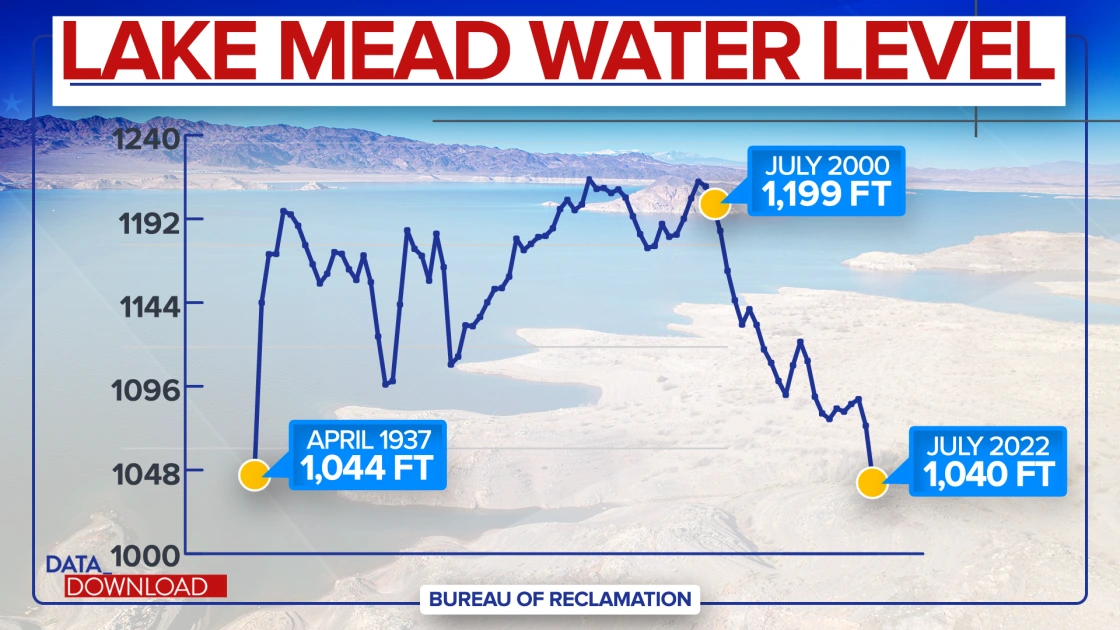
Lake Mead water levels since the construction of Hoover Dam (source: NBC News)
But the real problem isn’t natural water availability. It’s water use.
The following graph shows the fundamental problem (click for full resolution). Since approximately 2000, water use by 25 million people (who like to live in a semi-desert area where the sun shines almost every day) has increased to the point that more water is now being taken out of the Lake Mead reservoir than nature can re-supply it.

This figure is from a detailed study by the U.S. Bureau of Reclamation. As long as that blue line (water supply) stayed above the red line (water use), there was more than enough water to please everyone.
But now, excessive demand for water means Lake Mead water levels will probably continue to decline unless water use is restricted in some way. The study’s projection for the future in the above figure, which includes climate model projections, shows little future change in water supply compared to natural variability over the last century.
The real problem is that too much water is being taken out of the reservoir.
As long as the red line stays above the blue line, Lake Mead water levels will continue to fall.
But to blame this on climate change, whether natural or anthropogenic, ignores the thirsty elephant in the room.
UPDATE: Since it was pointed out in comments (below) that the latest Bureau of Reclamation study is rather dated (2012), and supposedly the drought has worsened since then, here’s a plot of the Colorado River basin April (peak month) snowpack, which provides about 50% of the water to Lake Mead. The rest is provided in the non-mountainous areas of the river basin, which should be highly correlated with the mountainous regions. I see no evidence for reduced snowpack due to “climate change”… maybe the recent drought conditions are where the demand by 25 million water consumers originates from, causing higher demand?

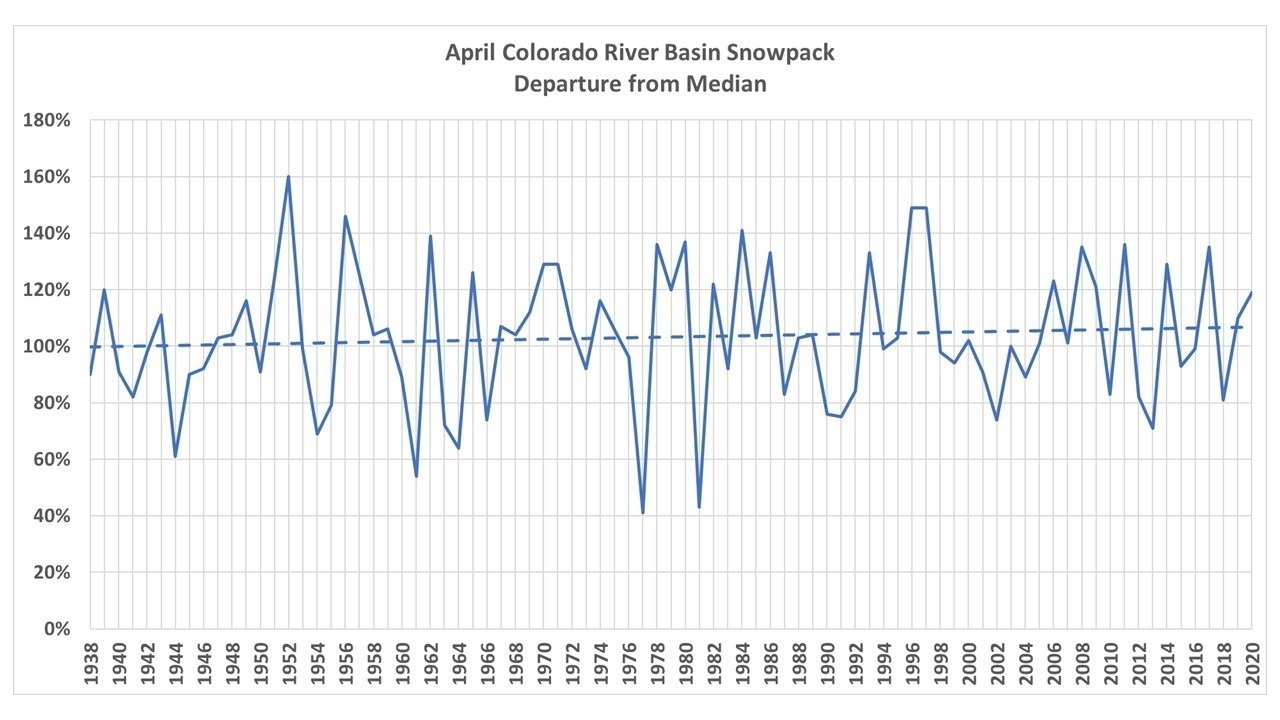
April snowpack in the Colorado River basin, the greatest source of water input to Lake Mead (data from https://www.nrcs.usda.gov/Internet/WCIS/AWS_PLOTS/basinCharts/POR/WTEQ/assocHUCco_8/colorado_headwaters.html
How much water does California take to supply desert areas? (Like LA?)
It’s being drained on purpose. No new dams , let the water flow to the sea….instant climate change.
No sweat! When climate change kicks in there will we severe rain fall and there will be more water than the lake can handle. Be patient that may be a while.
When we bought a house about 10 miles from Lake Mead, the irrigation systems was broken and the grass was dead. A few loads of rock later the landsacaping was done. There are still a few houses left with grass but they look aswful in both summer and winter because it is a bad place to grow grass.
For readers from other places, most of Nevada is in the Great Basin where water does not drain to the ocean. Except for locations with mountain runoff, not a nice place to live.
California stopped shipping water from the north to the south back when Schwarzenegger was governor. Every attempt to get fresh water to farms and cities where it is needed has been thwarted by environmentalists, most recently a proposed desalination plant in Huntington Beach – with tacit support from our betters in Sacramento who will settle for nothing less than Toilet-to-Tap.
The lower Colorado River Basin is experiencing an unusually wet Summer monsoon season here in 2022.
A few locations are near records. The included map that show this is rainfall over the past 90 days.
On average these locations receive 50% of their annual precipitation during the June-September monsoon but that varies by region.
This Summer, the wettest areas in AZ/NM(pinks on the map) have seen more than their annual average precipitation in just 2 months and have been the wettest places in the country compared to average(average isn’t a heck of a lot in the desert).
That is very temporarily helping to ease the pain a bit in the state of Arizona. None of the state is in severe drought any longer and drought has improved across the entire state since early June.
Many more details on that and Lake Mead in the discussion below.
Extremely robust Summer Monsoon/Lake Mead
https://www.marketforum.com/forum/topic/88409/
+++++++++++++++++++++++
What does the future weather have in store?
This is the 3rd year of a very long lived La Nina, which is the biggest short term factor in the severity of the current drought.
I’d be willing to bet my house that when we have the next El Nino, we will see greatly increased precipitation amounts in the West that will help to ease/shrink the drought in many areas and Lake Mead will likely see some recovery.
A long lived El Nino that affects 2 consecutive Winters could help significantly to increase the level of Lake Mead, especially if water use cuts are maintained.
However, as Dr. Spencer states, there’s just too many people living in this desert (that became a desert from centuries of weather similar to this) to provide all of them with unlimited water every year.
The current strong -PDO configuration in the Pacific (that strongly favors La Nina and is helping to sustain the current long lived La Nina-that won’t die) makes having 2 consecutive Winters with El Nino’s much less likely.
That’s the solution that we have no control over……..weather/climate.
Related to the rains mentioned above:
Mother Nature lends a ‘foot;’ lake’s level rises
https://bouldercityreview.com/news/mother-nature-lends-a-foot-lakes-level-rises-70896/
The wettest Las Vegas Valley monsoon season in a decade likely isn’t the only reason behind it, but Lake Mead has risen just over 18 inches during recent area rainfall.
As of 10:30 a.m. Wednesday, the lake was at 1,042.44 feet in elevation.
On July 27, about the time rainfall became a nearly daily event in the area, the lake elevation was 1,040.71 feet — which is also the low point for the lake so far this year. Some downpours exceeded a half inch in 10 minutes.
Harry Reid International Airport has received 1.08 inches so far this monsoon season with several areas of the valley receiving considerably more. Between July 27 through Aug. 12, Boulder City received .87 inches of rain.
Rainfall that doesn’t soak into the ground usually finds its way through the Las Vegas Wash to the lake, Southern Nevada Water Authority spokesman Bronson Mack said after the first summer storm in late July.
The rise of 1.73 feet is also the only rise during the summer in at least three years. During summer months the lake level typically declines a foot or two. Winter snowpack on the western slope of the Rocky Mountains is, of course, the biggest factor in the amount of water that flows into Lake Powell and Lake Mead.
Same problem with Northern Nevada. The dry pan evaporation rate has dropped over the last century and snowpack runoff has increased over the same period. Many of the dry lakes would come back if water diversion ended.
We decided, en masse, to move by the millions to the freakin’ desert and then we wondered where the water went. At the same time, we decided to grow most of our food in the freakin’ desert, too.
Now, we could’ve grown it in the Midwest where there’s plenty of water, but all the land there is already devoted to growing fake gasoline.