In the contest to be the most virtuous of all the states on the “carbon-free” electricity metric, the race is on between California and New York. In 2018 California enacted a bill going by the name “SB100,” which set a mandatory target of 60% of electricity from “renewables” by 2030 (and 100% by 2045). Not to be outdone, New York responded by enacting its “Climate Leadership and Community Protection Act” in 2019, setting its own statutory targets of 70% of electricity from renewables by 2030 (and 100% by 2040).
So is any of this real? Or is it just so much posturing to show conformity with current fashions, all of which will be forgotten by the time the now-seemingly-distant deadlines approach? As to New York, I have had multiple posts (for example here and here) explaining how the supposedly mandatory goals are completely unrealistic as to both feasibility and cost, and how the people charged with achieving the goals have no idea what they are doing.
Is California any less clueless?
The short answer is “no.” However, a gaggle of “think tanks” is just out with a big Report trying to convince us otherwise. Indeed, the Report advocates that California can achieve not just its current statutory goal of 60% carbon-free electricity by 2030, but rather an even more ambitious 85% — as indicated by the headline of the press release announcing the Report, which is “Achieving 85 Percent Clean Electricity By 2030 In California.” The Report itself has the title “Reliably Reaching California’s Clean Energy Targets.” The think tanks putting their names on the Report are Energy Innovation, Telos Energy, and GridLab. The authors of the Report are identified as Derek Stenclik and Michael Welch of Telos and Priya Sreedharan of GridLab.
Also identified is a big “Technical Review Committee” of some 13 members. Do you think these people may be the experts who are going to be sure that this project gives honest technical and engineering answers as to how to achieve the ambitious goals? Don’t kid yourself. Five of the 13 are California energy bureaucrats (three from the California Energy Commission and two from the California Community Choice Association); and the rest are environmental and “green energy” advocates of various sorts, including from the Environmental Defense Fund, Vote Solar, Jas Energies, Sharply Focused and so forth. Even the few listed as “independent consultants” have backgrounds in advocacy for wind and solar energy.
And then there is this bizarre combination of “Disclaimer” and funding disclosure:
The views contained in this report do not represent the views of any of the technical review committee organizations and cannot be attributed to any single technical review committee members. This work was supported by funds from Climate Imperative.
In other words, “you can’t blame me when none of this works.” And, have you heard of the funding organization, Climate Imperative? Neither had I. But a few moments with a search engine will give you the answer. Two of the six members of the Board of Directors are Laurene Powell Jobs and John Doerr. Yes, that is the Laurene Jobs who inherited the Apple money, and the John Doerr of Kleiner Perkins who just dropped a billion on Stanford University to create a new school of “Sustainability.”
The Report is some 89 pages long, much of it couched in seemingly highly technical jargon. The goal is to persuade you that the target of 85% carbon-free electricity by 2030 can be easily achieved with full reliability. We have “models” that include all the relevant variables. We have run “stress tests” on every sort of possible extreme scenario. The following is from the blurb promoting the Report found on the Energy Innovation site:
Modeling from GridLab and Telos Energy finds California can achieve 85 percent clean energy by 2030 without compromising reliability, even under stressful conditions. . . . The technical study developed three 85 percent clean electricity by 2030 portfolios, reflecting different resource buildouts and accelerated electrification. These portfolios were tested against stressors including retiring in-state natural gas units, replacing West-wide coal with renewables and energy storage, and mimicking the August 2020 heat waves that caused rolling power outages. The study evaluated all stressors together, including stricter-than-normal import restrictions, finding the future clean grid is capable of serving load under these extreme conditions.
So the message to Californians is, invest some hundreds of billions of dollars of taxpayer and ratepayer money over the next eight years in complete blind faith that our models have considered everything that can go wrong. And by the way, don’t expect any kind of cost projection from us — that is beyond the scope of this project.
As readers here know, I have a simple answer to these kinds of fantasies, which is, show me the working demonstration project, even for a small town of 5000 or 10,000 people, from which we can evaluate the feasibility and cost of doing this for a large state of 40 million. Needless to say, no such thing exists.
To consider whether there is any seriousness at all behind this effort, let’s look at how the scenarios in the Report deal with two questions: (1) overbuilding of capacity, and (2) energy storage.
To its modest credit, the Report recognizes that reaching the 85% carbon-free electricity target will mean retaining a residuum of about 15% generation from natural gas. But how much wind and solar capacity will be needed to supply the remainder?
And the Report also gives at least some recognition that large amounts of storage will be required. But how much storage and at what cost?
The heart of the information addressing these questions appears in this chart from page 24:

For perspective, California’s peak electricity usage of all time hit 50.27 GW on July 24, 2006. In most recent years, the peak has been in the range of 46 – 47 GW. Current generation capacity from all sources is about 82 GW, already representing substantial overbuilding to deal with intermittency of large amounts of wind and solar. These scenarios from the Report for 2030 propose building capacity up to the range of 140 – 160 GW, or approximately three times peak usage. Natural gas capacity of about 30 GW would be almost enough to supply all of average usage, and about two-thirds of peak usage, but apparently the proposal is to keep it fully maintained and ready, but turned off about 85% of the time.
As to how much storage will be needed for these scenarios, the chart shows a range from about 20 GW in the “diverse clean resources” scenario, to about 25 GW in the “high electrification” scenario. OK, but how many gigawatt hours will you need, and how much will that cost? Even though that is far and away the most important question that must be addressed in any effort to build a primarily wind/solar/storage electricity system, you will not find that question addressed in this Report. Like the Scoping Plan of New York’s Climate Action Council, this Report is just that incompetent. (Or maybe the authors are aware of the problem and avoid addressing it because they know that addressing it would demonstrate the impossibility of the project and displease the paymasters. It’s hard to know which.). The only discussion in the Report of energy storage in gigawatt hours appears all the way on page 79, where from the context it is clear that the storage being discussed is only intended for intra-day balancing, and cannot even begin to address the seasonality of wind and solar generation.
So, what will be the cost of all of this? Building capacity to a level that is triple peak usage; keeping an entire back-up natural gas system fully-maintained but idle at least 85% of the time; and adding sufficient storage to deal with the seasonality of wind and solar? Three times the cost of the current system would seem conservative. Five times is more likely. And of course, this Report does not address the cost issue.
Sure. Just get rid of their industry, cars, and keep electrical use to a minimum. Maybe ban aircraft, ships, and fertilizer, as well. Start using horses, and require any ships that DO come into their harbors to be sailing vessels only.
Even then … no.
Add cull the population and they may be ok
The kicker is that 100% electric AND 100% renewable is achievable…
Simply eliminate 90% of the population
And 90% of the tax base – you cant get there from here
Aren’t the serfs supposed to pay for it all? If they are eliminated, there goes the tax and rate payer revenue.
If they are eliminated, there goes the tax and rate payer revenue.
I think that the end goal is intentional, but I also think they haven’t really considered the reality of it.
Which is probably their plan… first, by killing off all those who oppose their glorious Great Leap Forward.
You might be onto something. Giordano. as California had the second largest population drop in the last census (edged out by New York). Maybe this trend solves a lot of problems, like energy consumption. Kaifornia: going faster and faster down a dead-end street.
How does a city house and feed those horses? /sarc
Well, “by the turn of the century the city will be piled 10 feet deep in horse manure…” to paraphrase a report from the ’80s (1880’s that is._
Quoted by Prof Wilf Beckermann in his critique of Limits to Growth (In Defence of Economic Growth) in a way that clearly implied he thought LtG was horse manure.
“Can California Really Achieve 85% Carbon-Free Electricity By 2030?”
I say the answer is YES. For most of the earth’s history, and indeed for most of humanity’s history, California has had no electricity at all – which will look very much like 85% carbon-free electricity. So this condition is not unprecedented.
What did carbon-crusaders use for light before candles? Light bulbs. Are candles carbon-neutral?
They used electricity for light before they used candles! 😮
The joke is:
1800’s people used candles (and whale oil)
1900’s and early 2000s – people used light bulbs, CFLs and LEDs.
Post 2030ish net-zero – people will use candles…
Whales are getting nervous.
I hear they’re chanting in whale-sounds –
“My body. My oil”
You know there’s going to be trouble when the whales start hiring lawyers.
Omg….thank you for the laugh.
The whales are fighting back – there have been several cases of tourist boats coming too close and whales capsizing or flipping them over completely. In a recent case, a whale called ‘Pichoco’ breached and landed on a boat, injuring a couple of tourists and turning the boat over! Moral of the story – don’t go too near whales, they don’t like it and they have a damn good way of showing their displeasure!
Whale oil, its renewable…. sort of.
If biomass is renewable than whale oil certainly is, and about as smart.
You forgot whale oil. Not your bad, so did the planners.
How many candles are made from petroleum?
Without adequate storage, wind and solar cannot work.
The battery storage situation is quite worthless. Since they don’t have nuclear & AFAIK, don’t have
biomass electricity production, the only longer-term reliable production & storage is through pumped
water & the much hated hydroelectric. They can always “fake it” by importing electricity from
neighboring states. One other thing most of us forget is that PV electricity loses efficiency when it
gets too hot so production probably peaks in fall & spring.
Nuclear- forgot Diablo Canyon @ur momisugly 2.25GW. Annual CA power usage 250kGWh = ~ 29GW
continuous generation daily.
daily s/b hourly
Too many brain f@rts- Great news- no evil toxic CH4 was released!
I think it was just yesterday that I read about California closing down the Diablo Canyon reactor! So much for THAT source of energy, huh?
“ Without adequate storage, wind and solar cannot work.”
They will if you have 100% fossil spinning reserve. But you will have built (and paid for) twice the capacity you need. Not to mention that to keep it spinning you are using fuel.
“Natural gas capacity of about 30 GW would be almost enough to supply all of average usage, and about two-thirds of peak usage, but apparently the proposal is to keep it fully maintained and ready, but turned off about 85% of the time.”
I found their “ace up their sleeve” loophole- probably from the 3% non-consensus. The
logical thing would be to scrap all that useless, duplicative renewable junk, but the 97%
consensus is “all in” on stupid virtue signalling!
turned off about 85% of the time.
How long does it take to come online from “turned off”?
Absolutely, all the electricity used in California can come from wind and solar. 100%
Of course, there will only be electricity available when the wind blows and the sun shines.
The collapse of the economy, a mere $3.4 trillion.
The virtue signalling, priceless.
In the brave new world of the future only the lucky few will have energy on demand
From Yale University Press:
“In a world of scarce resources, particularly if you were struggling to find food and water to survive, it could actually be rational to kill other people before they killed you. In Hobbes’ memorable description, life outside society would be ‘solitary, poor, nasty, brutish, and short’.’
Aldous Huxley may have got there first with ‘Brave New World’.
I have a couple questions:
This Article answers your question 1: https://www.npr.org/2022/05/07/1097376890/for-a-brief-moment-calif-fully-powered-itself-with-renewable-energy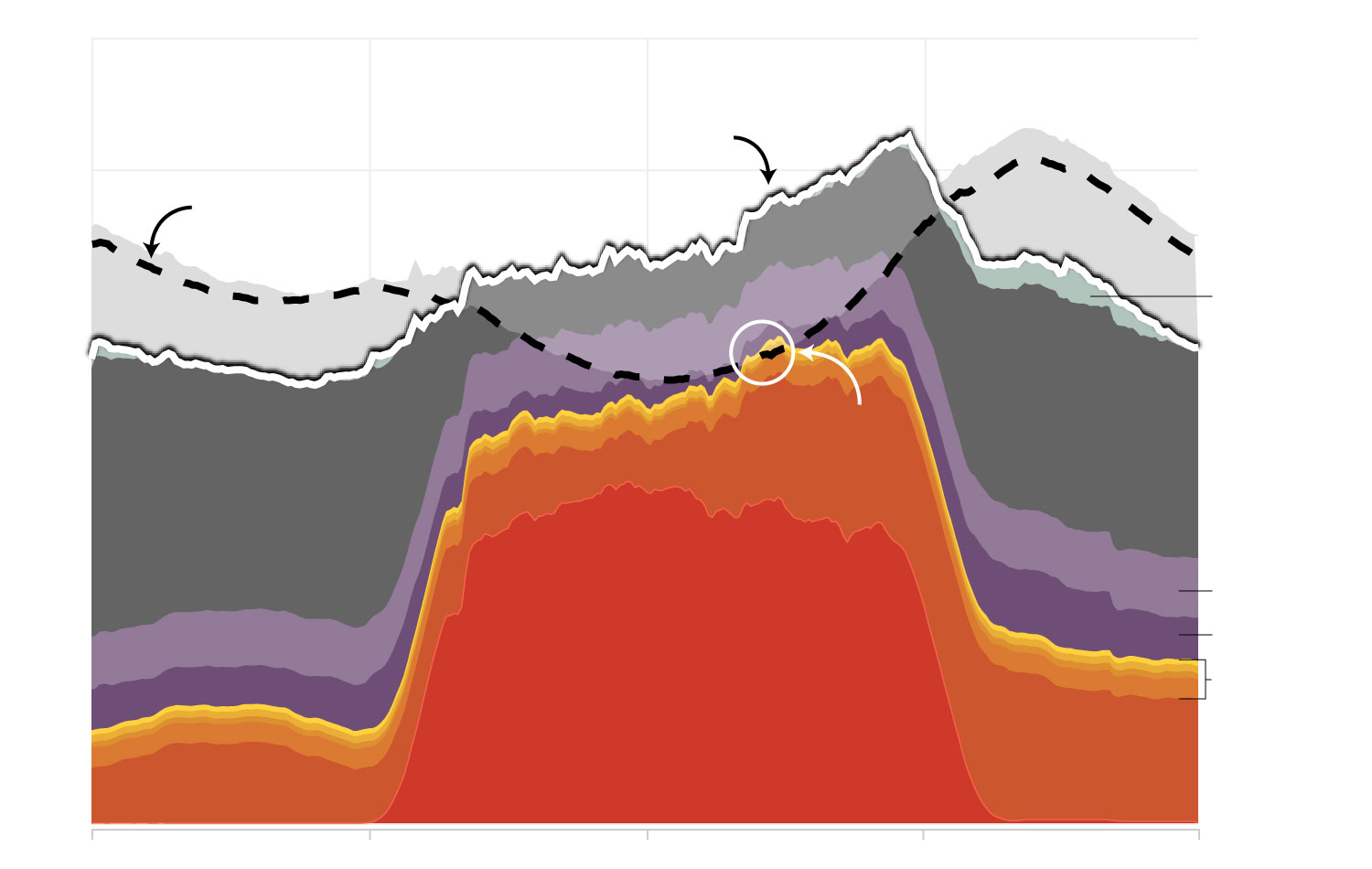
One hour for one day!?
And its graph shows how CA fared the res if the day on that very good Spring day:
Note the gray areas of the graph. Do they even think?
“for a brief minute California was powered by renewables…” -NPR
And for a brief minute Titanic survivors tread water.
Do they even think?
It’s all about feelings. Rational thought is anathema.
First, CA uses 250kGWh per year- ~29GW continuous generation I don’t have a breakdown as to its
sources used in generation/importation from other states.
Second, when battery storage amount is listed, that is usually only for ~1.5 hrs. As such, it’s <<
pumped water & hydroelectric. Regardless of how much they build. it’s essentially worthless versus
what they need. If there’s also a drought, then they’re S.O.L!
CA only has Diablo Canyon @ur momisugly 2.25GW for reliable nuclear. AFAIK, they have no biomass power.
So, the reliable sources for when the wind doesn’t blow & the sun doesn’t shine is pumped water &
hydroelectric.
Here’s a wind potential chart for the US. I’ll have the solar potential map below it.
OOPS- fat finger, Make that two posts below, too.
The map I wanted to use was too big- I’ll use two others.
offshore wind
US PV solar- solar loses generation efficiency when it gets hot.
And Diablo Canyon is going away in the next couple years because of the once-through cooling.
That’s assuming they can find the raw materials with which to build the solar cells, wind mills and batteries.
They don’t know it yet, but batteries
I do have some US data: 4kTWh/yr use- 1.25TW nameplate generation- 8% nuclear, 10% wind, 4%
PV & thermal solar, 1.5% stored & hydro, 1.5% other, 75% 24/7 solar. Current battery 1GW. Adding
10GW in 21-23, total =11GW @ur momisugly 1.6hr storage= 17.6GWh. 4kTWh/8760 hrs = 457GWh actually
used per hr. 17.6/457 = 0.04 hrs of power. Get out the candles, Martha!
They don’t need to answer your stupid questions this is an existential crisis.
No such required storage exists. There is not enough lithium and cobalt in the world for EV’s, let alone the California grid. There aren’t enough permitable sites for pumped hydro. And the other storage ideas like flow batteries or high speed fly wheels all have failed when tried on grid demonstration scale. Covered those in essay California Dreaming in ebook Blowing Smoke.
That essay title also aptly covers this new ‘report’.
I’ve been following ammonia as a fuel for a while. If you’re really desperate, it actually works, because there are historical examples. There is a steady drumbeat of research and test projects. example The shipping industry seems to be betting on ammonia as a bunker fuel.
Ammonia has some significant drawbacks but, I’m guessing that hydrogen storage will eventually take a form something like that. So, no batteries required, just chemistry.
As always, there’s the EROEI cliff. Any eventual energy storage will have to be darn cheap otherwise it’s back to the stone age for us.
“…back to the stone age for us.”
This is not a bug in their plans, it is a feature.
Having lived close to major ammonia leaks I don’t want it anywhere me. At least gasoline does not jell your lungs.
Yep. I seem to remember that the use of ammonia as bunker fuel would require either changes to marine law or to insurance regulations.
I’m a technology geek, so I find ammonia fuel technology interesting. That doesn’t mean I think it’s a good thing.
Time after time we see that the ‘environmentalists’ are willing to push things that are very bad for the environment, not to mention human health.
When the ‘environmentalsts’ think ammonia, they’re thinking a smelly household cleaner. Really, they’re clueless about how today’s world works, i.e., the technology, the engineering, the energy that allows them to be so stupid and live the way they do.
I went for that peak oil thing at first, so I’m not buying the peak lithium or cobalt just yet. Both elements are relatively abundant in the earth’s crust. Got data?
It’s got to be mined and refined. 1000% increase just for EVs. Government red tape bureaucracy added to greenies and nimby’s says to me no chance.
Yep. America has plenty of lithium. Environmentalists and Indian tribes oppose lithium mining and are blocking it with lawsuits. link
The International Energy Agency foresees potential world wide shortages of lithium and cobalt as early as 2025.
Unless California manages to have a sunrise in one side and a sunset at the same time in the other, that is, sun at all times, this wishfull thinking initiative is doomed. Which is the weighted average renewable capacity factor for California? Give any number, say 30%? Well, that is the maximum renewable generation fraction that California will ever achieve. but that is only with respect to the thermal source that will be used both, as baseload generation and non-baseload to back up these unreliables, meaning that the final renewable share, taking into account all sources of generation, would be negligible. But there is more: with no CO2 abatement except for the amount that would be buried, and electricity costs skyrocketing. By June an entire artiicle on this subject and other beauties will be available. California needs desperately Trump.
We just have to look at Germany, they already have massively overbuilt wind, something like 160% of average grid load, and yet it only produces a little over 40% of their electricity.
Because the wind doesn’t blow all the time.
Their wind assets are situated all over the country already, widespread penetration, so doubling or tripling the installed based doesn’t help as they already have too much. Putting more wind turbines beside ones already not turning does not produce more power.
They have not been creating more Germany since the 1940s, without expanded areas to install them in different weather zones its pointless.
Tripling it just destablizes the grid as you’d have far too much power when the wind blows, there is already too much, none when it doesn’t.
It can only work with massive amounts of storage and there is nothing in development that can provide that.
There ARE massive amounts of energy storage.
It’s called COAL.
& the other 24/7 solar- natty gas & oil!
and gas and oil, but of course that is not what this discussion is about.
The only way wind and solar have a chance to function is with massive, affordable, efficient storage of electricity. Which does not exist even theoretically.
Notice i said “function” not succeed, as a functional renewables system requires despoiling the earth in a way never seen before.
We just need automated, self replicating, nano constructors that build coal or some other useful hydrocarbon?
You have to go a long way for different weather zones. This heat matrix of cross correlations
shows that most of NWE is highly correlated. You have to go to the Med to reduce the correlations, but winds there are much slower on average so it’s not going to produce a convenient export surplus.
https://datawrapper.dwcdn.net/6yqhP/2/
Any carbon-free energy generation plan that doesn’t include large amounts of nuclear is doomed to failure.
California currently imports 30% of its electricity from other states. Other states do not necessarily sell “clean” energy and there is no way to tell which electrons are clean and which aren’t. Electric demand is rising and will continue to rise as policy demands it. So at some point, California will have to raise it’s ceiling of use above 100% in order to meet its legislative demand of 85%. Math doesn’t lie, but politicians do.
I think you can get a good idea of power sources over interties. The one that links to Four Corners will be mostly coal. Links from Lake Mead will be hydro when it runs, etc.
IIRC the last coal plant in Arizona’s Four Corners shut down in 2021 [was the largest employer on the Navaho reservation], and California owns ~25% of the Palo Verde Nuclear plant just west of Phoenix.
This is what happens when you are in a cult (and don’t know it), and the high priests of your cult are in charge and indoctrinate you and your fellow member of the faithl High priests in a cult are always considered infallible and unquestionable by the believers, hence the blind faith in wind a solar. The vitriol that skeptics of climate alarmism and renewable energy regularly receive earn them the labels of religious heretics and thought criminals.
No feasibility studies needed here — they have no value in a cult.
I wonder how much traction Schellenberger is going to get running for governor, at least he is on record as being not-as-insane as so many.
“The Report is some 89 pages long, much of it couched in seemingly highly technical jargon.”
I am retired from the power industry and there is nothing technical here.
For example, yes you can model offshore wind. But no you cannot build off shoe wind. Or even close to the shore. The simple reason is the people of Califonia will fight the permitting process.
Is power produced in other states attributed to Califonia goals?
https://transmission.bpa.gov/business/operations/wind/baltwg.aspx
This link shows how wind can be balanced in the PNW and sent to Califonia.
Making electricity is hard work. Califonia is depending on the hard work of other states.
“Califonia is depending on the hard work of other states.”
Exactly right.
A key element of US Nut Zero is that EVERY state cam buy 20% of it’s electricity
from neighboring states. This is based on new math, that you old fogey power
industry retirees have not kept up with. You are old school, where 2+2 – 4.
That’s ancient history. In today’s world, you just have green dreams and
then someone, somewhere, will solve all the feasibility problems.
With new technology, not yet invented, made with unobtanium
and run by vaporware.
And if that doesn’t work, you cut down trees and burn them — claim
doing that is “green”, like they do in England.
CA has plenty of trees, and plenty of wildfires.
Might as well cut down the trees, and burn them for electricity,
before they burn down in a non-productive wildfire.
Other high technology solutions:
Portable nuclear powered fans to spin the windmills when there’s no wind.
Portable nuclear powered spotlights for the solar panels at night.
Low technology solutions:
— Long extension cords to Chinese coal power plants.
– Candles and flashlights Fridays
This is modern engineering,
Most important is developing good excuses for when
Nut Zero electricity in CA has failed. My three proposals:
(1)
The CA Nut Zero project has revealed an alarming
increase in the number of subjects we knew nothing about.
(2)
By doing a little every year, we were able to let
the CA Nut Zero Project completely overwhelm us.
(3)
The Nut Zero Project is not going according to plan,
because there was no plan.
“CA has plenty of trees, and plenty of wildfires.”
Burning wood waste to make electricity is an example of a good environmental choice that is reliable. Most of these plants were built in the 70s to improve local air quality.
Forest health is a serious issue in the semi-arid US west. I was working on these projects in the 90s. The Sierra Club lawyers put a stop to such projects in Califonia over the objections of local members.
I think it is acceptable to grind excess biomass and export it. The coal trains no longer supply local plants. Now it goes to China.
” tests on every sort of possible extreme scenario.”
One thing on the positive side is wildfires won’t be as troubling because they can retire the army of arsonists used light a lot of them.
https://www.nbcnews.com/news/us-news/california-man-accused-arson-setting-spree-charged-starting-fire-dixie-n1276523
I was reading extracts from the today’s Pentagon report to Congress on UAEs (UFOs to you and I).
If these ‘objects’ are of extraterrestrial origins then my granny was supernova and my younger sibling is a neutron star.
On topic: Just as big a fantasy as renewable energy.
OK Vuk, you are on. What are the UFOs???
Or maybe your granny was supernova, after all.
Exactly as it says on the tin, those unidentified are, those identified are not.
Is this a photo of your granny, an SS396 “Super Nova”. What a looker! 😮
The UFOs are OBVIOUSLY from other planets.
Any logical person would come to that conclusion.
I would not waste my time reading Pentagon reports on UFOs
They have obscured the truth since the 1940s
I know people like to make fun of UFOs
Like you just did.
You may be very intelligent on some subjects.
But you are a poor comedian
And an absolute fool on the subject of UFOs.
They are obviously time travelling tourist humans from the future having some temporary technical glitches with their Alcubierre bubble drive system….at least until the backup kicks in and gets them out of Dodge…and back in compliance with their non-interference directive.
Don’t think he was making fun of UFO’s, just healthy scepticism. As far as I’m concerned there is no ‘obviously’ about it: they are unidentified therefore you cannot make the assertion that they are extra terrestrial in origin, they could be absolutely anything.
Hasn’t there been an objection from Abu Dhabi yet? Perhaps they went out hawking or something…
No.
To make the numbers appear close, California will cheat, too.
It’s all for show. Ignore that man behind the curtain.
Well, it’s like climate computer modeling – you can make your model say anything your heart desires.
But, where is all this wind and solar capacity actually coming from? How much developable land will be required to produce that much power, essentially three times current power generation? How many acres? Who owns the land, and will they sell it? What are the environmental impacts of creating vast areas of solar collectors and wind farms?
I am not against renewable energy supplies, as so many WUWTers are here in sort of knee jerk fashion, but they only make sense as a supplemental source of energy because of all the resource requirements necessary.
Look, I’ve spent quite a bit of time in West Texas which is the nation’s wind energy capital. You can fly over thousands of square miles of West Texas countryside fully occupied by tens of thousands of windmills, and marvel at the scale of what they’ve done there.
But that’s West Texas – there’s literally nothing there but ugly dirt, grass, and mesquite in most of it, nearly all of it is privately owned, and is of little scenic or practical value other than oil and gas production and grazing cows … and there are very few people there (most Texans live in the big cities in East and South Texas, megacities that don’t exist in West Texas).
But that kind of vast private land resource reallocation is simply not feasible or available in California, where the population density is much higher than West Texas, and where much of the land is publicly owned, and is considered to be environmentally sensitive and valuable, and where most of the privately owned rural lands are devoted to some of the most productive farmland in the world. You can’t just remove that farmland from production. Or put up vast wind farms in the Sierras or national parks, monuments, and forests.
That is why these pie in the sky plans are so ridiculous.
Back in the ’80s when I flew over Midland, they had areas that looked like a square grid of dots that
were reliable 24/7 oil wells, which they probably have even more of now with the fracking boom. I
enjoyed W Texas, as it was always “fair to Midland”! 😮
Thought you might enjoy this:
West Texas in My Eye
To be fair, there is easily 100,000 square kilometers of valueless wasteland on the border with Nevada and Arizona, But doesn’t change the fact the plan is untenable.
So, California enacted SB100 with its mandatory target (is that an oxymoron, or what?) of 100% of electricity from ‘renewables” by 2045
(Ref: second sentence of above article).
Well, let’s look to Dr. Roger Pielke, Jr.’s relevant, science-based analysis and related conclusion:
“. . . to achieve net-zero carbon dioxide emissions by 2050, the world would need to deploy 3 Turkey Point nuclear plants worth of carbon-free energy every two days, starting tomorrow and continuing to 2050. At the same time, a Turkey Point nuclear plant worth of fossil fuels would need to be decommissioned every day, starting tomorrow and continuing to 2050.”
— source: https://www.forbes.com/sites/rogerpielke/2019/09/30/net-zero-carbon-dioxide-emissions-by-2050-requires-a-new-nuclear-power-plant-every-day/?sh=3e5d774d35f7 , my underlining emphasis added.
True, California is not “the world” (even if Californians think it is, hah!), but it is obligated to do its fair share toward the end of eliminating fossil fuels as a means of generating electricity, isn’t it?
Based on just the population ratio CA-versus-world at end of 2021 (39.2 million/7.9 billion), the State of California should plan on building about 72 Turkey Point-size nuclear power plants between now and beginning of 2050. That’s a build rate of about 2.7 nuclear power plants a year for the next 26.5 years, just in California!
What about the contribution from future hydro, wind, solar and biomass? . . . pfftphttttp!
Let’s do a stress test and shut down one nuke plant now, one large refinery, and one large NG plant.
Okay but what do the metrics do in surrounding states in the process?
Shut down Palo Verde nuclear plant for a year and let’s see.
Only if they CA buys a lot of electricity from neighboring states and runs long extension cords to cola power plants in China. Also, the CA Nut Zero plan includes the assumption that the CA electric grid will become so unreliable that 50% of the CA residents will move to other states, or back to Mexico, thereby reducing the demand for electricity.
They must have modeled in a large amount or unicorn flagellants to get the number they wanted.
California doesn’t need to generate any electricity in state… as long as it can import enough from Arizona, Nevada, Oregon, Washington, and Utah. Then they can say that they are truly carbon free.
No. Next stupid question, please.