Guest Post by Willis Eschenbach
Let me start with the standard explanation of why the earth warms when greenhouse gases (“GHGs”, e.g. water vapor, CO2, methane, etc.) increase. This is from NASA:
When averaged over the course of a year, the amount of incoming solar radiation received from the sun has balanced the amount of outgoing energy emitted from Earth. This equilibrium is called Earth’s energy or radiation balance. Relatively small changes in the amounts of greenhouse gases in Earth’s atmosphere can greatly alter that balance between incoming and outgoing radiation. Earth then warms or cools in order to restore the radiative balance at the top of the atmosphere.
SOURCE
That explanation is clean and clear. When greenhouse gases reduce the amount of outgoing radiation, the earth’s surface has to warm up and radiate more, until the balance is restored.
According to NASA it’s quite clear and obvious—when CO2 increases, simple physics requires that the surface temperature increases to keep the radiation balance at the top of the atmosphere.
So, what’s not to like?
To explain what’s not to like, let me provide the simplest possible energy balance model of the earth. The values are all approximate.

Figure 1. Approximate energy budget of the planet. All values are in watts per meter squared (W/m2).
There are three layers in the model—the lowest part of the stratosphere; the troposphere; and the surface. Note that all three layers are balanced, in that the amount that is lost by each layer is equal to the amount that is absorbed. In addition, the system as a whole is balanced—237 W/m2 is absorbed by the system, and 237 W/m2 is radiated back out to space.
Now, recall the NASA claim that if GHGs increase and absorb more upwelling radiation, that the “Earth then warms or cools in order to restore the radiative balance at the top of the atmosphere.”
How large a change in the radiation balance are we talking about? Well, if we use the figures of the Intergovernmental Panel on Climate Change (IPCC), since the year 1958 when we started measuring CO2, the reduction in outgoing longwave radiation due to increased CO2 is about 1.5 W/m2. This is a change of a bit more than half of one percent of total outgoing radiation. Or to look at it another way, it’s an imbalance that is increasing at the rate of about two-hundredths of one watt per square meter per year … very, very small, in other words.
So let me ask you. Looking at Figure 1 above, is the warming of the surface the only way that the outgoing radiation at the top of the atmosphere (TOA) can be increased by about half a percent per half century to restore the overall balance?
Obviously, and totally contrary to NASA’s claim, surface warming is NOT the only way to restore the top-of-atmosphere radiation balance. Some of the other ways are:
• Decrease the incoming radiation. This happens by means of changes in the amount, composition, albedo, thickness, time of emergence, and/or nature of the clouds. It also happens over the ocean, from the ocean albedo changing due to winds causing breaking waves, spume, and foam. These are all white and reflect much more sunlight than does a calm ocean surface.
• Increase the amount of solar radiation absorbed by the atmosphere. This happens by means of changes in the amount of atmospheric water vapor, or by changes in the clouds.
• Increase the amount of latent heat removed from the surface via evaporation of water. This happens by changes in the wind, since evaporation is inter alia a linear function of the wind speed. It also happens by changes in the number of thunderstorms, which increase local evaporation due to storm-generated winds. It also happens due to increasing ocean water surface area due to spray, as well as due to the increased surface area of waves compared to smooth water.
• Increase the amount of sensible heat removed from the surface. This is also a function of the wind, since the sensible heat transfer increases as a linear function of wind speed.
• Increase the amount of surface energy moved high into the troposphere inside thunderstorm towers. These towers circumvent greenhouse gases in two ways. First, heat from the surface is moved into the bases of the thunderstorms as latent heat of water vapor, which doesn’t interact with the greenhouse gases. Then when the water vapor condenses, the heat is released. But it travels vertically inside the cloud tower, where it is not free to interact with the surrounding greenhouse gases. At the end of the vertical movement, the energy is released far above the surface, where there are far fewer greenhouse gases to absorb it.
• Increase the amount of surface upwelling radiation that makes it directly to space. This happens in the areas around and between the thunderstorms. These areas are composed of dry descending air which has been emitted at the top of the thunderstorms after having most of the water condensed out. Because water vapor is the major greenhouse gas, this lets much more surface energy go straight to space.
• Increase the amount of energy moved from the tropics to the poles. This is a huge amount of energy, about 10% of the total solar energy entering the system. Because the poles are much drier and colder than the tropics, much more of the outgoing radiation from the surface goes straight to space. When more energy is moved polewards, more radiation escapes to space.
Any one of these phenomena is certainly capable of changing outgoing TOA radiation by half a percent in half a century.
Let me summarize:
- There really is a very poorly-named “greenhouse effect”, which has nothing to do with greenhouses. It’s the main reason why the earth is not as cold as the moon.
- When greenhouse gases increase, the amount of outgoing top-of-atmosphere radiation does decrease.
- The theoretical imbalance over the last sixty years due to increasing CO2 is about 1.5 W/m2, or about half a percent of the outgoing radiation. Per year, it’s an annual imbalance increase of 0.02 W/m2, an amount far too small to measure.
- Unlike what NASA and other mainstream scientists endlessly claim, there are many more ways other than surface warming for this imbalance to be restored.
- In general, we do NOT have measurements of the various other ways of restoring the balance that are anywhere near accurate enough to tell us how much of each of these phenomena contribute to the 0.02 W/m2 change which is annually necessary to restore the balance.
The important takeaway from all of this is that there is no physics-based requirement that surface temperatures perforce must change when the level of CO2 and other greenhouse gases increases or decreases. The surface temperature may indeed change to restore the TOA radiation balance, but contrary to the endless claims of the alarmists, there is no physics that requires that it does so.
There is a further problem, which is that the amount we don’t know about the climate far exceeds the amount we do know. For example, here are 2,000 years of Northern Hemisphere temperatures.

Figure 2. The temperature history of the extra-tropical northern hemisphere from 30°N to 90°N. These have about an 80% correlation with global temperatures.
Here are questions that we don’t know the answers to about the thermal history shown in Figure 2:
- Why did the “Roman Warm Period” end around 150 AD and the world start cooling? Why did it not just stay warm?
- Why did the warmth end in 150 AD and not 50 AD or 300 AD?
- Why did the world keep cooling, in fits and starts, until about 550 AD?
- Why did the cooling stop in 550 AD, and not 350 AD or 750 AD?
- Why did the world warm from there, in fits and starts, until the peak of the Medieval Warm Period in the year 1000 AD?
- Why was the peak not in 800 AD or 1200 AD?
- What started the cooling from there to the depth of the Little Ice Age in 1700 AD?
- Why did the cooling end in 1700 AD, not in 1500 AD or 1900 AD?
- Why didn’t the cooling continue until we went into a true Ice Age, as the Milankovich cycles would suggest?
- What made it start warming again in 1700 AD, instead of just staying at the same cooler temperature?
- Why has the warming continued, again in fits and starts, for three centuries since 1700 AD to the present? (Protip—we know that the first two centuries of warming were NOT caused by CO2 increases.)
Given all of that, the idea that we understand the climate well enough to claim that we can predict the future climate a century from now based solely on projected CO2 levels is … well … let me call it insanely optimistic and let it go at that. As shown above, the system is far from as simple as it is claimed. The computer models are far too crude to capture all the complexities. And most of all, we simply do not understand enough about what natural processes made the past temperatures go up and down to stand a chance of predicting the future temperatures.
Sadly, despite all of that, a horde of obsessed folks, both scientists and laypeople, are insisting that based on nothing more than their inchoate fears of some imaginary future Thermageddon, we totally throw out a very successful energy source that has freed humans for the first time in history from lives of endless want and hunger, and replace that proven energy source with untested, unreliable, intermittent energy sources …
And they are still doing this despite the fact that we’ve been warned every year for half a century that the horrible Thermageddon is only a decade or two away. How many failed, cratered predictions will it take for people to notice that the underlying theory isn’t working?
This is madness. What we need to do is to continue to do what we’ve done so successfully in the past—use our proven, reliable energy sources to work to insulate and protect people from the endless, inevitable vagaries of the weather.
That is the no-regrets option. That way, whether or not CO2 turns out to be the secret knob controlling the temperature, we’ll be far less at risk from storms, floods, droughts, and all of the weather phenomena that have been killing people for millennia.
My very best to everyone,
w.
Keeping Things On Track: I am asking that you stick to the topic of the thread, which is the question of what can change the TOA radiation balance. In particular, if you think that there is no downwards radiation from the atmosphere to the earth, or if you claim that radiation from the atmosphere cannot leave the earth warmer than it would be if there were no radiation from the atmosphere, TAKE THAT ARGUMENT SOMEWHERE ELSE. I am NOT interested in getting side-tractored into debating that question on this thread, and I will assuredly snip it if you try. So save yourself the heartache of watching your genius argument disappear into the ether. There are lots of places on the web where you can debate that question to your heart’s content. This is not one of them. And don’t whine if you try it and get snipped. You’ve been warned, it’s on your head, not mine.
My Usual Request: I can defend my own words and I’m happy to do so. I cannot defend your interpretation of my words. So please, to avoid misunderstandings, quote the exact words that you are discussing.
Willis,
You wrote –
“Not quite true. Monatomic gases neither absorb nor emit thermal radiation (infrared).”
Yes they do. All matter above absolute zero does. Monatomic gases can be heated, and allowed to cool. Otherwise, they would remain at absolute zero, neither absorbing nor emitting IR.
Climate crackpots refuse to believe that oxygen and nitrogen behave like all matter, and that their absorption of IR is insignificant! From memory, Tyndall’s measurements showed that CO2 absorbs about 1750 times as much IR as dry air, free of CO2.
However, normal air contains about 2500 times as much oxygen and nitrogen as CO2, and as a consequence, intercepts more IR than CO2 does.
Still no GHE.
This goes along with a paper I read (don’t have it at hand) that attempted to show that you can’t ignore N2 and O2 in the temperature profile resulting from IR. IIRC, they didn’t come up with 2500/1750 = 140% but something that was still significant.
I’m pretty sure it is not this paper
https://www.omicsonline.org/open-access/a-novel-investigation-about-the-thermal-behaviour-of-gases-under-theinfluence-of-irradiation-a-further-argument-against-the-greenh-2157-7617-1000393.pdf
or is it?
There is much one could criticize about this paper but what I really would like to see is a real lab setting – in the best possible way imaginable – and prove that this paper is wrong.
Cause if that is not the case GHG theory is in serious trouble.
Willis, i know you read the comments… Would you please be kind enough to look through the volunteer articles heap and find my ur submission about a human contribution to CC not considered in the usual balance cartoons.
Ruf and Evans have found a way of detecting smooths from space and it is now possible to quantify the reduction in salt aerosols, albedo change and nutrient and CO2 mixing from wave suppression. This explains some anomalies.
If you want something done, ask a busy man. TIA
JF
Hey, Julian, always good to hear from you.
Unfortunately, I have no access to the submitted articles. I’m just a guest author, not a member of the volunteers that run WUWT.
So in lieu of that, I’ll send you an email so you can send your submission to me, and I’ll have a look. Can’t guarantee it will get published, but I’ll see what I can do.
My best to you and yours as always,
w.
[UPDATE] Can’t find your email, how about you send me a direct message containing your email to my twitter account, @ur momisugly weschenbach.
Thanks,
w.
Has this site been hacked? I have never seen so many downvotes for so many comments.
You are right. I wasn’t paying attention in the first pass through. An extension of the cancel culture tactic.
I call them “slacktivists”. They have insufficient cranial capacity to present a cogent counterargument, but they know how to click the little minus-sign symbol. They are mere shells, to be ignored.
I suspect it’s a combination of the warmunists and sky dragons.
Thank you for a concise explanation. I’ll send links to people I know.
Personally I have always been weak when it comes to math. I have others help me with my taxes. However, just because I’m weak it doesn’t mean I can’t run a small business, and couldn’t raise five strong and healthy children. If all goes well, I will soon be the grandfather of 10 strong and healthy grandchildren. I find I can make up for my weakness in math. One nice thing about a small business is that you can determine profit and loss by looking in your wallet.
In like manner, I’ve always been able to see weakness in the arguments of alarmists. I know about tree rings because I cut down trees. I know about salt blowing around on sea-ice because I lived on the coast of Maine during some very cold winters. I know about people blowing smoke because I have nearly 70 years of experience with my fellow man.
I do understand some scientific concepts such as latent heat being released when steam condenses. I know the difference between being burned by boiling water and being burned by steam. Therefore I am able to watch cumulus clouds tower in the sky and have an inkling of what is going on within them. But I don’t understand the math!
One wonderful thing about your posts is that they make sense to a person like me. Even though I may not understand the math, they agree with my actual experience. It seems different from the feeling I get from climate scientists, who say things that rub my practical fur the wrong way.
Thanks again for your work.
Caleb, thanks for your kind words. To write successfully, you need to know who is in your target audience. In addition to scientists, my target audience includes an imaginary person I call the “educated interested layperson”. This is a man or woman who probably doesn’t have a solid grasp of the math, but they are educated and/or have enough practical experience that they can follow a chain of logic to its end … sound familiar?
So I appreciate you reporting that in your case at least, my writing is accessible and understandable.
My best to you,
w.
Willis; in your article you cite several ways in which Earth’s energy balance can be affected. While I agree with these let me give you one other way which has a FAR FAR FAR FAR larger impact – one might even say with a high degree of justification, a dominant impact.
Wind is a form of mechanical energy, so is lifting water to fall as rain or snow at high altitudes. So the atmosphere does mechanical work but where does the energy for this come from? Fairly clearly it comes from the absorbed solar radiation ie: heat from the sun. That means the atmosphere is the working fluid of a classical heat engine as described by Carnot in the 18th century and must obey the laws governing such heat engines. These state that 100% efficiency is impossible – infact the maximum efficiency possible is Thot-Tcold/Thot. Thot is the temperature of the hot junction where heat energy is injected into the working fluid and Tcold is the cold junction where heat energy is extracted from the working fluid. The hot junction is obvious, the surface of the Earth and in particular the surface n the tropics. Where is the cold junction? It cannot be the poles because the Earth is a rotating sphere. As air moves to higher latitudes surface velocity is reducing and that means the poleward moving air mass ends up moving faster than the static air. This means it is thrown outwards in the pole of rotation which can be resolved into an upwards force and a force pushing it back towards the equator and inhibiting further poleward expansion. Its why we have 3 coupled circulations (Hadley, Ferrel and Polar) rather than one. Even if it could get to the poles it could not descend to transfer its energy to the surface.
The only way the atmosphere can lose energy (to space) is by radiation and that can only occur through the presence of GHG’s. In fact the cold junction is the tropopause or lower stratosphere. SO GHG’s do not just impede energy loss to space, they also allow an atmospheric heat engine. Without GHG’s the rising gas column could not cool so it could not descend again ie: circulation would stop. The atmosphere would become vertically isothermal and saturated wrt water vapour. Since conduction is very slow a temperature inversion would develop and the atmosphere would rise to close to the maximum temperature of the surface. Water vapour could not condense since that requires it to lose energy and it could not do so (lose energy to where?). That also means no clouds, no surface cooling from evaporation or convection, no rain, no wind no atmospheric dust ie: no weather. Without clouds the albedo of earth would be far lower so energy absorption would be closer to 340 watts/sqM not 240 watts/sqM. That would give an “average” temperature of around +5C but that is quite irrelevant because at noon the incident energy at the surface (in the tropics) would be more like 1340 watts/sqM which would translate to a temperature of around 116C. This would of course be ameliorated by the thermal time constant of the surface but without evaporative cooling the surface time constant can be quite short. Think about how fast beach sand or a concrete footpath or even bare soil heats up in summer – often in minutes. The peak temperature would peak at close to 100C!!! In fact the entire surface would be like the interior of a closed car and for the same reason. Where I am at latitude 37 that kills children during summer in a matter of minutes. Then again at night the temperature would be far far below zero.
So GHG’s ameliorate temperatures increasing minima and decreasing maxima. I would consider this very much a first order effect!!!! Given that, either an increase in GHG’s will further ameliorate temperatures making the climate even more benign or there must be a point of inflection where the incremental action of GHG’s reverses. If the latter, why, at what point does this reversal occur, which side of it are we currently at?
You are missing one concept. Adiabatic means no energy entering or leaving a volume of “air” as it rises or falls. However, it does allow that the temperature can change, that is, isothermal is not a requirement of an adiabatic process and thus enters the lapse rate. Therefore, as a parcel of air rises, it can cool without an energy change. This is an ideal process, so doesn’t exactly apply to the atmosphere and thus a different lapse rate for dry versus wet air.
No Jim I am not missing that concept. However adiabatic means that the total energy content of the parcel of air is not changing so if the air tries to fall again its temperature rises again. What drives convection is an increase in the total energy content of the air near the surface causing it to rise and a reduction of the total energy content of the air at the tropopause allowing it to descend again. If the air cannot radiate it cannot reduce the toal energy content so it cant fall hence convection stops. Sure initially the air temp will be falling with increasing altitude but in the absence of convection conduction will eventually bring all the air to the same temperature. That of course means the total energy content is rising with altitude, ie a major temperature inversion ensuring a static atmosphere.
Michael Hammer July 27, 2021 1:55 am
True. This is covered very well by Adrian Bejan in relation to the Constructal Law. See here for a discussion you may find quite interesting.
You continue:
Sorry, but that’s not true. See here, where they say:
As a result of you being incorrect about that, I fear that although you are correct to treat the climate as a giant heat engine, the remainder of your conclusions don’t hold water.
My best to you,
w.
In addition to the points made by Willis, further increases in atmospheric CO2 give diminished additional warming due to the logarithmic relationship.
It is interesting that all of the factors that can change outgoing TOA radiation are “local” in some way, such as clouds, wind and water vapour concentration. That does not reduce their collective potency but it does make it more difficult to quantify the effect and almost impossible to model due to resolution constraints. It is convenient for the climate scientists to ignore such factors.
Perhaps the most powerful aspect of this post is that by pulling these disparate factors together, Willis provides a strong argument to counter the idea that the earth has to warm up in order to increase outgoing radiation. The big challenge is how best to use this argument to inject some sanity into the climate emergency fantasy.
I have never seen so many red negatives in the comments of a post here on WUWT.
?????
Yo, dawg, great to hear from you. Until this post I’ve never paid the slightest attention to the up/down votes, barely even knew they existed. Seems like a stupid system to me, anonymous opinions like that are meaningless.
Me, I’ve got a whole ecosystem of websites out there dedicated to hating on me … and I pay them the same amount of attention I’ve paid to the up/down votes.
Please give my very best to the family,
w.
Willis, can you identify those doing the downvotes? It was my understanding that moderators can see the names. I don’t know it fhat applies to authors like you or not, but it’s your article so maybe you can see what’s going on.
I’m not asking for specific names, but maybe a pattern can be discerned by looking at them.
I believe some comment software allows anyone reading the article to see who is doing those up and down votes. That might discourage some of the downvoters who are just tryjng to cause trouble.
Willis articles draw right to the bone ,I’m not saying he’s right or wrong, I’m saying the battle field of warmests ,lukewarmests ,and coolests gets played out on the field of WIllis’s article on heat transfer through the atmosphere, you can read the passion in some of the arguments for and against. Whereas most members agree on most topics here we see differences on this topic ,the very essence I suspect why most of us are here.
With regard to cartoon numerology, 22+76 > 392-321. At the surface, convection is the dominant mechanism for energy removal and its dissipation is responsible for storms, etc. Dissipation is defined by the 2nd Law as the loss of free energy. Current models presume convection and thermal gradients invariant to greenhouse gas changes. While the adiabatic lapse rate asserts total energy density is constant, it does not imply transfers at finite rates are free of dissipation. (Theoretically, this lapse rate defines a necessary threshold for convection, J=0.) A basic theorem for nonlinear steady states says that nature seeks to minimize the work required to transfer energy from T1 to T2. Thermodynamically, if increasing greenhouse gases reduce a flux, it will be restored by changes in thermal gradients affecting both radiation and convection. Qualitatively, nature is going to try to keep the surface as cool as possible using all tools at her disposal, clouds included.
It seems to be a given that nitrogen and oxygen conduct heat in ways described by traditional heat flow equations. Where I get confused is the fate of “hot” nitrogen and/or oxygen at the top of the troposphere or thereabouts. Here, we are told, GH gases cool the atmosphere by radiation of photons to the coldness of space. (Cold space is close to the tropopause region, so photons can escape to it, the theory goes.)
What happens there, to nitrogen and oxygen? Do they meet a barrier to conduction, from decreased density, so that conduction can no longer proceed? If so, does this thwart heat flow in a vertical column (in theory) of nitrogen and oxygen, leaving only GH gases to save the globe from overheating? Geoff S
Interesting question. My speculative answer is that nitrogen and oxygen are not active in the infra red at characteristc IR frequencies because they do not possess a dipole and are not GHG. But they are matter and they will have kinetic energy and a temperature and like every other body they will emit black body radiation in accordance with their temperature.
“When greenhouse gases increase, the amount of outgoing top-of-atmosphere radiation does decrease”
–
Really?
–
Or to put it more succinctly define it better or think about it.
–
Let us leave out all of the other mechanisms for the moment and focus on just 4 levels.
–
Now here is the thought process with no other changes clouds, waves etc.
The earth has received its 1360 W/M2 minus albedo effect.
The albedo effect and the absorption in the atmosphere that never reaches the earths surface is noted.
We have the input at the earths surface which must send it back to space per meter of earth surface absorbed.
169W/M 2 in your diagram.
But we have what goes back into space 169W/M 2 at the top of atmosphere.
Only here of course it is diluted by the fact that the surface area of emission at TOA is much larger than that of the earth’s surface.
–
In fact to get it up to 169/M2 at TOA it needs extra energy from the other 2 factors
i.e 10 absorbed by lower stratosphere [going out]
58 absorbed by troposphere [going out]
hmm, added together that is 237 going out,
exactly what is coming in ,
And what does that 237/M2 equate to ?
What got to the earth’s surface area or would have gotten to the earth’s surface area.
–
The presence or absence of GHG has virtually nothing to do with the amount of outgoing radiation.
I cannot say this strongly enough.
Whether the atmosphere is 100% CO2 or water vapour or GHG free the amount of outgoing top-of-atmosphere radiation will be the same.
–
When there is a change in GHG, say an increase, there is a warming of the surface layer of the earth.
Temporarily there will be a slight retention of some energy in the system because it takes a little longer to get it back out to space.
You state” the amount of outgoing top-of-atmosphere radiation does decrease”
Only while it is changing.
Not the actual amount of increase or decrease.
–
Note that over the course of a day and night the TOA changes drastically locally.
It builds up energy with the sun’s arrival. Positive TOA.
It loses energy dramatically as the sun moves away. Negative TOA.
Much greater in the course of the day than any CO2 shift could possibly cause.
–
The temporary decrease is simply an accommodation of warming up locally as the sun rises.
The warming air is slowing down heat loss to space while it warms.
While it cools it lets more heat escape to space.
–
Again wherever you wish to define a TOA ,which moves out with more CO2 or in with more clouds, the amount of energy going out does not decrease because the amount of energy coming in did not decrease.-
–
“When greenhouse gases increase” I take as meaning to increase to a new stable level.
“This is madness. What we need to do is to continue to do what we’ve done so successfully in the past—use our proven, reliable energy sources to work to insulate and protect people from the endless, inevitable vagaries of the weather.”
–
Thank you for putting the message out.
–
Human reliance on making short sighted decisions on insufficient knowledge usually changes when catastrophes hit.
We need either 3 La Nina’s or enough people getting bored with being scared.
Convection is considered to be an adiabatic process. That is, no energy in or out, yet temperature can change. In other words, as a parcel of air rises, it can cool via the lapse rate. As it cools it becomes more dense and begins to sink as the buoyancy force pushing it up is insufficient to hold it up.
Lots of ramifications in this. Does convected and cooled air fall all the way to the earth during the day? It could reach a point where it’s temperature rises and density decreases sufficiently for the parcel to rise again. At night, when the temperature of the surface air falls, can convected air fall all the way to the surface? Don’t know that one?
Dry air falling will compress & warm, but cold rain/snow doesn’t compress or heat moving down, so decending, relatively cold rain/snow filled air is actually a cooling effect, transporting “cold” from upper to lower elevations.
Thank you. I always appreciate the sanity of your posts in an increasingly dishonest & insane world.
https://principia-scientific.com/co2-is-an-insulation-blanket-right-wrong/
Obviously, and totally contrary to NASA’s claim, surface warming is NOT the only way to restore the top-of-atmosphere radiation balance. Some of the other ways are:
Another couple of items for possible addition to the list:
The number of independent ways by which a dynamic system can move, without violating any constraint imposed on it, is called number of degrees of freedom. Wikipedia
The number of ways by which a researcher can fiddle with a model of the world, with the basic data going into their model, or even with the scientific method itself is called: “researcher degrees of freedom“. Many students and critics of fake science argue that increased researcher degrees of freedom is the principle reason why 50%, or more of scientific papers published today may be junk science.
Game, set, match , , ,

But – isn’t the optical depth going up and up and up?
Because of all that CO2 that we’re belching / spewing / vomiting / choose your perjorative verb-ing – into the at-muss-fear??
The failure of rhe GHG model to explain past warming/cooling suggests strongly that it is an elegant piece of mathematical garbage.
The most obvious problem is that IR only travels a few feet before being absorbed near the surface. As such it acts similar to conduction in a ghg rich atmosphere.
In contrast it is convection that does the heavy lifting of energy in the lower atmosphere.
Ferdberple July 27, 2021 9:13 am
Ferd, I’m sorry but that’s not true. Here are the actual measurements. The mean free path at the surface is about 30 meters, which is far larger than your claimed value of “a few feet”. And from there upwards, the mean free path grows progressively longer.
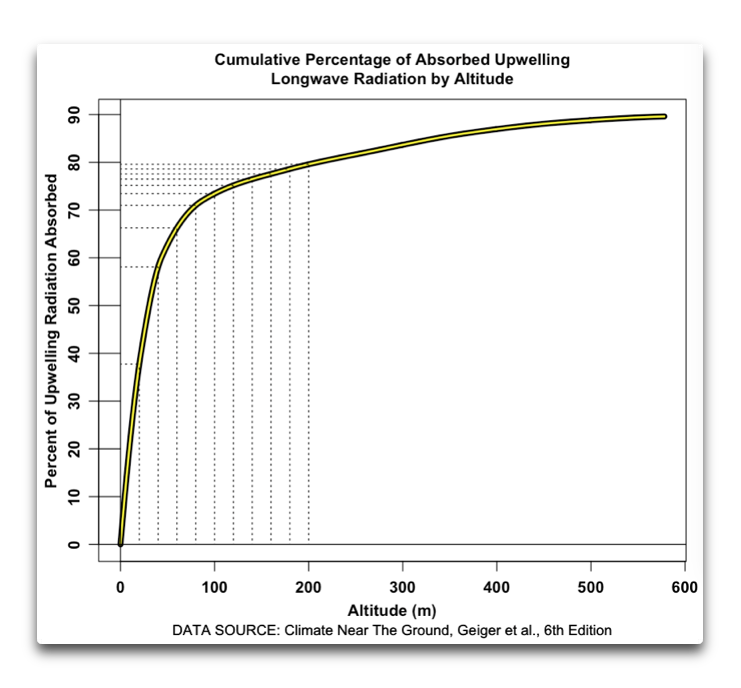
Best regards,
w.
What is the effect of a doubling of co2 on this chart?
Don’t know. Clearly, it would move the curve downwards, but how much is unknown.
w.
Willis – that graph appears to be averaged over the spectrum emitted at ground level, yet the absorption will be variable and very wavelength-dependent. For wavelengths around the 10-micron “window”, most will pass through, and this is the peak power of the ground-emitted IR radiation. For wavelengths of around 4.3 and 14.7 microns,the absorption length will be of the order of 20m or so anyway (I haven’t found exact distances yet) and so already pretty-well at saturation, so won’t change much with more CO2. For wavelengths around 5-8 microns and above around 20 microns, water-vapour will absorb them (also saturated for most locations).
Thus it looks to me that an increase in CO2 won’t make a lot of difference to the curve in your graph here. The bands where the CO2 absorbs are already very close to saturation, so not a lot changes.
Fun thing is that by using a metamaterial that radiates strongly around that 10-micron “window” you can cool a surface by up to around 10°C relative to a white-painted surface also in the same sunny place. Since such a metamaterial also doesn’t receive well outside that 10-micron band, it doesn’t “see” the downwelling LWIR, so it’s also a nice physical demonstration that the downwelling LWIR does indeed keep the ground warmer than if it wasn’t there. The metamaterial is manufactured using something like 8-micron glass balls in a plastic film.
“Ferd, I’m sorry but that’s not true. Here are the actual measurements. The mean free path at the surface is about 30 meters, which is far larger than your claimed value of “a few feet”. And from there upwards, the mean free path grows progressively longer.”
But only the earth surface and bottom of atmosphere matter to climate right?
That’s what we’re constantly reminded.
After all, above the emission height, CO2 cools the atmosphere, as well as increasing the IR component of albedo.
Ferd is quite correct that (a) convection owns IR, convection is the completely dominant way that heat moves in the troposphere, radiation only is dominant in the stratosphere and above. Where CO2 cools.
(b) The 25m mean free path is short enough for the effect to be like conduction. Head and shoulders might treat dandruff but it won’t get you out of this fundamental IR problem for the alarmists.
This diagram relates to CO2 not water vapor. Which is weird because climate people keep telling me water (vapor & clouds) are responsible for between 95% and 72% of OLR absorption. Alarmists say 72%. Skeptics say 95%. Why the fuss over CO2?!
This is what Miscolczi predicted, right?
Please up/down load your brain to the internet.
Alls Is gots to say about this subject … I’s totally agrees wit ya Willis!! …. I have a tree by my swimming pool. When the tree was small, the pool used to heat up to bath water temperatures. Now that the tree is big, and blocks the SWR from the sun, the pool stays really cool. Given that the ocean is 70% of the surface and thus 70% of the surface temperature estimate … I’d have to say CO2 and greenhouse gases don’t have squat to do with the earths temp. No matter how hot it is outside, and no matter how much warmer the “night time lows” have gotten, without ol SOL warming that pool, it stays really cool. IMO .. it is all about the clouds and oceans.
“This is from NASA:
When averaged over the course of a year, the amount of incoming solar radiation received from the sun has balanced the amount of outgoing energy emitted from Earth. This equilibrium is called Earth’s energy or radiation balance”.
–
This is true for 1 year?
It is also true for 1 second.
Or 1 million years .
–
It is one of the principles of thermodynamics.-
–
If one has a constant heat source affecting a non heat object until they are in equilibrium [very important]
then they will always balance thereafter.
The only way for the balance to be upset is to alter the incoming source [non constant]in which case the balance will shift as a result of the new input only.
–
The make up of the non heat object is immaterial.
I do not see why people cannot see this.
It does not matter whether the earth is plastic, metal glass air, water or any GHG or combination of all of them.
Once in balance the energy in is the energy out.
Regardless of the mix or composition.
–
There is a difference between temperature and energy that eludes people.
The various surfaces and substances will be at different temperatures because they have absorbed different amounts of energy.
Not because they are producing energy.
They all emit the amount of energy they have absorbed.
Some of that energy is absorbed and re emitted millions of times before it can make its way back out. Some goes straight out.
How many water molecules and CO2 in a straight line out one wonders.
Whatever change occurred in the past once in balance the energy absorbed and emitted must be in balance.
There is no TOA imbalance by definition.
The TOA is where input and output balance.
–
The amount of energy in a system may increase or decrease.
The height of the TOA may vary.
But they are different things.
–
Whether the energy in the system goes up or down the TOA emission remains the same by definition.
The height of the TOA can vary but not the amount of the TOA emission as the TOA has a constant emission.
It is a constant.
Defined in terms of input balancing output.
–
Hence
NASA
“Relatively small changes in the amounts of greenhouse gases in Earth’s atmosphere can greatly alter that balance between incoming and outgoing radiation. Earth then warms or cools in order to restore the radiative balance at the top of the atmosphere.”
–
is totally incorrect.
The sun did not change its incoming radiation because of a green house gas increase.
The TOA did not alter because of a GHG increase.
–
Earths atmosphere at surface level warms because the energy is taking a more indirect path out [in balance].
I would like some feedback from anyone interested in this concept as if a few people can see that there is logic in this it can gradually gain some traction.
Negative comments, if scientific are also appreciated.
I am pretty intense at times and do miss occasional sensible points.
I am not saying I would change but I would appreciate any sensible corrections.
Sorry to be negative angech but I disagree with you concept. True if an entity is in thermal equilibrium then energy in = energy out. The problem is that as soon as input or output energy change the entity is no longer in thermal equilibrium. Either energy in > energy out or vice versa. The imbalance is absorbed by the entity and causes it to change its temperature (warming up or cooling down). As its temperature changes the input and output get closer together until when a new equilibrium is reached they will again balance. The claim of the CAGW proponents is that increasing GHG is reducing outgoing longwave radiation (OLR) at TOA which creates an energy imbalance. That will cause Earth to warm which in turn would raise OLR until it again matches incoming solar energy at which point the Earth will again be in thermal equilibrium.
Michael Hammer
“I disagree with your concept. True if an entity is in thermal equilibrium then energy in = energy out.
The problem is that as soon as input or output energy change the entity is no longer in thermal equilibrium.”
–
Consider this.
–
The claim is that adding a GHG increase will cause a TOA reduction in outgoing LW.
Add the amount of GHG.
Check the TOA the amount in equals the amount out.
“True if an entity is in thermal equilibrium then energy in = energy out.”
–
Then the new level of GHG, GHG plus X GHG
is exactly the same TOA as previously.
–
If it is the same before as it was after the increase why should there be any change during the increase?
–
The answer is the energy going in and out does not change.
This is the difficult part.
–
The TOA stays the same in principle and fact albeit it emits from a higher level.
The TOA and the energy going out to space are different from how the energy travels to space and what temperatures are needed in the levels emitting it.
–
The TOA emission always stays the same [as what is coming in]
–
The temperatures of the different components of the surface and atmosphere change to reflect the nature of the change in components.
–
You say there is no physics that demand the temperature has to increase, and then cite reasons such as thunderstorms and evaporation of water. But surely the temperature has to go up to increase the evaporation of water and to increase the frequency of thunderstorms?
True in some cases, not in others. An increase in clouds will increase TOA radiation, as will an increase in advection. An increase in the wind will increase evaporation.
And with thunderstorms, they have a unique ability in that they are able to cool the surface to below the initiation temperature. So overall, it’s like your air conditioner thermostat—it takes warming to turn it on, but the net result is overall cooling.
w.
Willis, in this context please look at my comment from 1:55 am on the 27th. I would be interested in your views.
“And with thunderstorms, they have a unique ability in that they are able to cool the surface to below the initiation temperature. So overall, it’s like your air conditioner thermostat—it takes warming to turn it on, but the net result is overall cooling.”
That’s what I’m talking about! 🙂
Yes, the room warms up a little and this change in the room temperature causes the airconditioner to kick in and cools things back down.
The airconditioner process keeps things within certain bounds and prevents the room from overheating.
What’s wrong with the Principle of Least Action?
What’s wrong with Noether’s theorem?
A system – especially a complex system – forced to change from state A to B will do so with the least expenditure of energy.
Heating the entire hydrosphere and atmosphere – when other options are available – hardly qualifies. It’s the most absurdly improbable option of all.
The TOA stays the same in principle and fact albeit it emits from a higher level.
The TOA and the energy going out to space are different from how the energy travels to space and what temperatures are needed in the levels emitting it.
–
The TOA emission always stays the same [as what is coming in]
–
The temperatures of the different components of the surface and atmosphere change to reflect the nature of the change in components.
–
I guess the hard part is accepting that there is no extra heat retained when we can all see that the temperature of the earth surface has gone up.
–
How to explain?
–
Take the case of an airless planet [earth], thin dark metal surface say steel 1cm thick with non absorbent asbestos underneath.
What temperature would the metal get up to at midday?
Extremely hot.for the whole cm.
Would it glow red or white hot ?No.
What radiation would it put out? Infra red at 342
What would the average earth temp be ? 33C less than our current
287 ie 255C. SB
Yet
–
“It is an undisputed fact that the atmosphere can appreciably heat a planet’s surface above the temperature of an airless environment receiving the same stellar irradiance. Known as a natural Greenhouse Effect (GE)”
–
The temperature of the surface, or the atmosphere, is not the same thing as the temperature of the planet.
–
The effective energy radiating from the planet is the same as the energy radiating into it.-
The energy radiating from the planet is the sum of of all the energies that reach the planet.
The components of the planet have to irradiate at the right amount to send the energy back to space.
This can lead to a hot surface or a hot atmosphere that is hotter than without the atmosphere but there is no extra heat [energy] in the system with no GHG some GHG or all GHG.
GHG does not make energy.
The total amount of energy in the system is the same as the total energy in the stainless steel of the airless world.
How do we know?
Because they both put back into space from the TOA exactly the same amount of energy as what comes in.
The whole argument of inbalance of OLR vs incoming solar radiation is wrong. The so called greenhouse gases do act as an insulation between the ground, the atmosphere, and radiation to space, and does cause some heating of the ground compared to the case of no greenhouse gas effect. However, the atmosphere responds rapidly (on average hours to days) to the slow changes in composition over longer periods, so that the atmosphere is close to equilibrium (on average) at short times. Thus the average incoming solar radiation is always almost the same as outgoing LWR except for storage effects (net melting ice or ocean temperature increases). The storage effects have nothing to do with the greenhouse effect, so are a different issue. Thus the so called inbalance of OLR is not a greenhouse gas effect, it is a storage effect. The magnitude of the greenhouse gas effect can be estimated by the absorption and back radiation effect, but the level of outgoing radiation vs incoming solar radiation will not give additional information due to the quasi equilibrium.
An example to make clear what I am saying is given when you assume the rise in greenhouse gases stops and is the composition of the atmosphere is constant at this level for a long period. Now the input of solar energy (on average) has to exactly balance the outgoing LWR except for any continuing storage. If storage is assumed to be zero (on average), there still is a hotter surface due to the greenhouse gases present, but incoming solar radiation exactly equals outgoing LWR or the surface would continue to get hotter continually, which is a contradiction.
There is no TOA imbalnce.
The warming of the atmosphere is just simople redistribution of the energy between the various emitting substances.
That is only true if no continuing storage, but is actually what I said.
Basic explanation of why the GHGE simulation cannot work:
The GHGE model begins with an averaged radiative balance (see Willis’ diagram). But the real proportions (of energy flows) found in the atmosphere differ depending on: latitude, season, day/night, type of surface, etc. There’s probably not a single place on earth were the average is valid, at any one time! So, we cannot calculate effects from averaged numbers. We must use real numbers found in nature instead. Our model must be dynamic, and must account where/when of earth.
Example (A), whether the ground is ocean, desert, tundra, or luscious vegetation, etc. affects latent heat and convection which depends on water evaporation. Little water evaporates from deserts, which is why they get so damned hot. It follows that evaporative cooling must be less there. Likewise, it follows that evaporative cooling must be greater in the middle of summer on a hot day over the tropical oceans.
Example (B), the albido of water, ice and snow vary significantly depending on incident angle of solar insolation; which depends of the season, the angle of incidence of spin, day/night.
There are many more examples where the real world is not the model. There are practically no examples where the real world is GHGE model-like.
Willis (and others here) treat the averaging greenhouse gas model too seriously by arguing with its logic. It’s nit-picking. The averaging model has already been shown to be invalid in scientific terms. The model makes invalid assumptions, and it fails several validations where reality contradicts test predictions.
Invalid model assumptions:
1. “CO2 makes the atmosphere more opaque at infrared wavelengths“.
This has never been observationally validated. It is just an assumption; and there are lots of reasons it could be wrong.
2. “added opacity causes the planet’s heat radiation to space to arise from higher, colder levels in the atmosphere”
Where is the empirical evidence for this
3. “thus reducing emission of heat energy to space“.
In practice, this 3rd assumption has never been shown either.
[quotes from Hansen et al, 2011, doi:10.5194/acp-11-13421-2011]
Invalid model effects:
4. Modelers attribute most climate warming due to more water vapor in the atmosphere, which is supposedly a positive feedback due to more CO2. Reality (weather balloons) contradict this claim.
5. The actual model used is supposed to be a simulation of the atmosphere, Model calculations show a clear hotspot in the mid to upper troposphere, over the tropics, in theory caused by extra moisture. Contradicted by reality again.
When any part of a simulation model is contradicted the entire model is invalid because the final predictions of the simulation depend on how the model ‘works‘. But the missing extra atmospheric humidity, and hotspot show the model does not work.
Reading another GHGE defense is like listening of Medieval monks debate how many angels can dance on the end of a pin. You cannot repair the GHGE by tinkering with it because it is nonsense.
Willis, you ask:
“Decrease the incoming radiation. This happens by means of changes in the amount, composition, albedo, thickness, time of emergence, and/or nature of the clouds.”
20% of the ocean surface is covered with stratocumulus cloud. This forms when CCNs are lofted by turbulence to the condensation level, a few thousand feet up. If CCN production is reduced – fewer breaking waves so less bubble bursting, fewer salt aerosols, DMS-producing plankton starved by less nutrient mixing– then a reduction in stratocumulus cover is the result. Plankton driven deeper looking for nutrient and using carbon-concentration mechanisms (which utilise C13 as well as C12 isotopes) send a light CO2 signal into the atmosphere.
“It also happens over the ocean, from the ocean albedo changing due to winds causing breaking waves, spume, and foam. These are all white and reflect much more sunlight than does a calm ocean surface.”
When the ocean surface is polluted by oil and/or surfactant it smooths. Wave breaking is suppressed. Fewer salt aerosols are produced. From personal observation a smooth can suppress wave breaking up to Force 4 on the Beaufort scale.
“Increase the amount of latent heat removed from the surface via evaporation of water. This happens by changes in the wind, since evaporation is inter alia a linear function of the wind speed. It also happens by changes in the number of thunderstorms, which increase local evaporation due to storm-generated winds. It also happens due to increasing ocean water surface area due to spray, as well as due to the increased surface area of waves compared to smooth water.”
Lakes are particularly vulnerable to the smooth effect if they have major populations on their shores. Lake Michegan is warming at two to three times the expected rate. It should be easy to check pollution levels. Lake effect snow may be affected depending on other factors – e.g. prevailing winds.
“Why has the warming continued, again in fits and starts, for three centuries since 1700 AD to the present? (Protip—we know that the first two centuries of warming were NOT caused by CO2 increases.)”
Current warming is from 1920 (ish, with caveats). Plot this against oil production (and dissolved silica run-off which also interferes with plankton growth*. There’s a blip during WWII. Compare this with the amount of oil spilled in the oceans by ship sinking. That’s “why the blip.”
Ocean smoothing is not a small phenomenon. I have seen one between 10,000 and 20,000 square miles.
Ruf and Evans have found a way to look for smooths using some clever trickery with GPS satellites which they use to track microplastic concentrations. This means they can quantify the smooth effect. Measurement, numbers, that’s science. At last we can do it wrt warming.
I have a post at a minor UK blog about this. I will add a link later.
JF
(Who wishes someone would at least look.)
*Increase in diatom populations at the expense of calcareous phytoplankton. Diatoms export less C to the deep ocean and that reduced amount contains more heavy C as diatoms use a C4-like carbon fixation pathway.
https://independencedaily.co.uk/first-we-guess-then-we-do-science/
I’m going to extricate myself from the bellowing of the gored oxen below and recap.
Not only do the K-T diagram and all of its clones CALCULATE the 396 W/m^2 upwelling ASSUMING black body that result includes a second helping of the 63 W/m^2 which literally has NO place to go.
Dodge that!
The best part about threads like this is that it reminds me who I can safely ignore.
w.
Willis gives us 7 reasons why NASA are wrong about more CO2 necessarily increasing surface downwelling LWIR, which then, hypothetically, warms the surface. There may be more reasons.
Yet (1) which of these mechanisms is validated by empirical science? My main complaint here is (2) Willis gives us no citations. I think Willis should try to cite both the first claim for the effect, and any evidence (even indirect evidence) for or against the 7 claims. I look forward to another article (with citations to 1st claimants & evidence) which I can quote from. Otherwise this gets dismissed as ‘yet another blog‘.
Nevertheless: thanks Willis.
Thanks, Mark. The ways that the atmosphere gains and disperses energy are well understood—sensible heat, latent heat, advection, absorption of solar energy, and the rest. As a result, for this particular post I saw no need to detail them—my point was different.
My point was that the claim is wrong that “if the upwelling TOA longwave decreases, the surface has to warm up to re-balance the situation”. It’s wrong because it leaves out the other known ways that the TOA longwave can be increased.
I was not attempting to prove anything new, so I didn’t need examples. I was simply pointing to well-understood phenomena which are being ignored by far too many mainstream scientists.
My best to you,
w.
I’m going to dispute your claim that that energy budget diagram you posted is the simplest possible one, Willis. For example, here is a simpler one. You will note that all of the absorption and emission numbers in each layer still balance, yet there are fewer numbers overall. What do you think?
Your dispute fails, Steve, since your diagram does not follow Kirchhoff’s law. It doesn’t follow Planck’s law either. Simple is good, but no simpler – famous physicist.
I don’t know where you got those ideas from, Trick. Power in equals power out at each node, just like in Willis’s original, so Kirchhoff’s law is not violated. Planck’s law isn’t violated either. Remember, this is a thermal energy transfer diagram. It does not show equilibrium photon gas temperature, pressure, or volume, because it doesn’t need to, and that would be a different diagram.
“so Kirchhoff’s law is not violated.”
Steve shows surface absorption not equal to surface emission for radiation in equilibrium with matter over more than 4 annual periods violating Kirchhoff’s law which established the opposite of what Steve shows in the diagram.
“Planck’s law isn’t violated either.”
Steve shows ~288K surface radiating at 71 when it is measured radiating at 396 so Steve violates Planck’s law containing no less than 3 constants of nature. In addition, Steve shows Planck’s law could be identically zero for earthen atm. when that can’t happen at any temperature or any frequency.
Remember, Steve, this is a thermal energy transfer diagram with radiation in equilibrium with matter. Your diagram is far from radiation in equilibrium with matter.
Trenberth is way ahead of Steve in understanding atm. radiation principles.
Steve Keppel-Jones
July 30, 2021 8:43 am
Say what? That IS the energy budget I posted.
w.
It’s not, Willis. Look closer. Yours has a bunch of extra numbers in it that aren’t necessary. Mine is simpler.
Oh. I see what you’ve done. You’ve taken my diagram, removed actual individual physically verifiable energy flows, and replaced them with net flows. Bad idea.
As an accountant, I can assure you that such actions are frowned upon if you want to understand the actual flows in any system. If you tried that with your taxes, you’d go to jail.
“Everything should be made as simple as possible, but no simpler.” — Albert Einstein
w.
What he’s successfully done is remove the number in the big fat arrow of “backradiation” from “greenhouse gases” in the ATMOSPHERE, which is supposed to be belting down from the ATMOSPHERE 24/7. …..something in the vicinity of 320 watts/sq.m. according to Trenberth’s looney diagram. I think he reckons that the idea of having those 320 watts/sq.m. of thermal “backradiation” rat droppings from the ATMOSPHERE, which, according to the looney diagrams, is nearly twice the amount of solar radiation arriving at the surface from the SUN , is too looney for even his imagination to cope with. He’s noticed that if he leaves his bacon and eggs out on the porch over-night they are not cooked for him in the morning by the “backradiation”, Willis.
The amount of ignorance in this comment is stunning.
Downwelling radiation from the atmosphere has been MEASURED, not estimated but MEASURED, literally thousands of times by scientists all over the planet. In the US there is a series of observation stations operated by NOAA called SURFRAD that do nothing but measure such radiation at the surface. From their website, emphasis mine:
Downwelling longwave radiation is also measured automatically every ten minutes by instruments on each buoy in the TAO moored buoy array.
So I’m sorry to say that the unsupported word of someone like you, a man (I assume) who doesn’t even have the albondigas to sign his own words, means nothing against those thousands of actual measurements.
You desperately need to read a thermodynamics textbook. See, for example, section 2-32 et seq. of the thermo textbook here. It discusses the fact that almost all matter radiates according to the Stefan-Boltzmann law, including gases. Read up on it, you are embarrassing yourself with your foolish claims.
Oh, wait, I forgot. You can’t be embarrassed because you hide behind an alias, so none of your friends can know how foolish your claims are …
w.
“(The text linked) discusses the fact that almost all matter radiates according to the Stefan-Boltzmann”
Relative texts discuss all matter radiates according to Planck’s eqn. and S-B, there is no hedging therein. All means all. No exceptions. Your linked text author ref.s it:
“Above 1234.93 K the temperature is defined using Planck’s equation for blackbody radiation and measurements of the intensity of visible-spectrum radiation.”
Trick, the monatomic gases neither absorb nor radiate in the thermal longwave region. And no, I don’t care if you believe that. It’s true.
And yes, everything else does radiate in the thermal longwave region.
w.
Willis writes incorrectly: “Trick, the monatomic gases neither absorb nor radiate in the thermal longwave region.”
It’s not a belief, Willis. Experiments show monoatomic gas particle spin is quantized, Willis, among their other absorption/emission physics, so all monoatomic gases radiate nonzero intensity at all frequencies & all temperatures. All means the thermal radiation longwave IR bands contrary to Willis’ statements.
I don’t care either if Willis doesn’t care about his radiative physics credibility or even want to learn the 1st course basic text book radiative physics correctly according to Planck’s law/S-B.
Trick August 2, 2021 7:07 am
I know of nothing that radiates “at all frequencies & all temperatures”. Setting that aside, your claim is only true at very high temperatures, so it is NOT in the frequency band of thermal longwave radiation.
This temperature is so high that in most textbooks it’s not even considered, viz (emphasis mine):
Regards,
w.
Great, Willis cites a source that simply assumes the atoms are zero dimensional:
“In separating out translational, rotational and vibrational modes of motion, we assume the atoms comprising the molecules are zero dimensional; they are points.”
It’s true, Willis, unphysical points don’t have rotational inertia, but real physical monoatomic gas (e.g. Ar) atoms do rotate, have a nonzero radius, and thus do possess quantized rotational inertia as learned from long ago experiments.
Willis writes: “I know of nothing that radiates “at all frequencies & all temperatures””
All matter radiates with nonzero intensity Willis, actually look up the Planck eqn. you cited and substitute in any frequency and any temperature; the radiant intensity result is never identically zero. You need to take the lab course and/or read up on the experiments in the 1930s proving Ar gas et.al. radiates from quantized rotational inertia and other modes supporting the Planck eqn.
Regards, Willis, & get thee to a relevant gas physics laboratory report in your nearest college library stacks to learn more about quantized atom rotations that in reality are not “points”.
Well, you didn’t provide any refutation of, or even reference to, the numbers that Steve K-J or myself presented to you. You just blathered on about SURFRAD. who, of course, measure atmospheric radiation.. they provide numbers at various sites… but these numbers are not interpreted correctly or collated together in any way to resemble, the numbers in those most important, peer reviewed, and followed by every science institute on the planet, loony Trenberth EEB diagrams. Why not , Willis?
What we’re wondering…Willis.. is why you and the guys at SURFRAD are not shouting from the rooftops, a Eureka moment, where the measurements at SURFRAD tally up with Trenberth’s looney diagrams.
You come across as very smug and defensive, Willis.
Mack, what you and Steve K-J did was to claim that there is NO downwelling longwave radiation.
I was simply pointing out that that is absurd. We know that because downwelling longwave is measured all the time by both scientists and automated instruments all over the planet.
I did not say the SURFRAD numbers match the numbers in the Trenberth diagrams, nor should they. The SURFRAD numbers are for a particular spot on the planet, while the Trenberth numbers are global averages. Anybody who thinks a global average should equal measurements in a single spot is unclear on the concepts.
w.
So, is this the most informative view?
Once again I will mention that your diagram claims that zero energy is transferred to the surface from the atmosphere via molecular collisions despite trillions of these events occurring every second.
Why treat kinetic energy transfers different than IR energy transfers? You have essentially done the exact same simplification for kinetic transfers that Steve has done for radiation.
Richard, there is no “simplification”. With radiation, there are two distinct and separately measurable energy flows, one from object A to object B, and the other in the other direction. The net flow, of course, is from the warmer object to the colder as required by the LOT.
With sensible heat, there’s only one measurable energy flow, from the warmer object to the colder object.
w.
Richard, the Trenberth diagram doesn’t separate the relevant thermal KE returned to the surface from downdrafts and rain (water cycle) as that is not his chart’s purpose – there is no need. This circumstance has indeed confused a great many ill informed commenters as well as you.
Stephens et.al. do include the water cycle as separate down energy flux item if you want to start reading/learning how to do the separation from the total downward radiation cycle.
Willis says “replaced them with net flows. Bad idea.” Well, it’s only a bad idea if you’re trying to push bad physics with incorrect numbers. Some of us prefer to push good physics with correct numbers. The numbers I took out are unmeasurable. They were put there by converting the characteristics of equilibrium photon gases (temperature, pressure, and volume) into power. That is an invalid operation. There is no measurable energy transfer (power) from cooler objects to warmer ones, and SURFRAD will tell you that, if you pay attention. (Ignore the fabricated numbers that they add to their measurements, and just watch the actual measurements.) Those measurements agree with my diagram. The net (macroscopic, measurable) flows are what everyone is supposed to be interested in, aren’t they? Why complicate them by fabricating unmeasurable numbers to add in both directions in equal quantities? I can only assume that Trenberth et al. did this for purposes of pushing CAGW, which we all know is a load of hooey.
To bring this back to your tax analogy, you are including line items from your balance sheet in your income statement. That’s not going to go over well with the auditors.