Mojtaba Sadegh, Boise State University; Amir AghaKouchak, University of California, Irvine, and John Abatzoglou, University of California, Merced
Just about every indicator of drought is flashing red across the western U.S. after a dry winter and warm early spring. The snowpack is at less than half of normal in much of the region. Reservoirs are being drawn down, river levels are dropping and soils are drying out.
It’s only May, and states are already considering water use restrictions to make the supply last longer. California’s governor declared a drought emergency in 41 of 58 counties. In Utah, irrigation water providers are increasing fines for overuse. Some Idaho ranchers are talking about selling off livestock because rivers and reservoirs they rely on are dangerously low and irrigation demand for farms is only just beginning.
Scientists are also closely watching the impact that the rapid warming and drying is having on trees, worried that water stress could lead to widespread tree deaths. Dead and drying vegetation means more fuel for what is already expected to be another dangerous fire season.
U.S. Interior Secretary Deb Haaland and Agriculture Secretary Tom Vilsack told reporters on May 13, 2021, that federal fire officials had warned them to prepare for an extremely active fire year. “We used to call it fire season, but wildland fires now extend throughout the entire year, burning hotter and growing more catastrophic in drier conditions due to climate change,” Vilsack said.
As climate scientists, we track these changes. Right now, about 84% of the western U.S. is under some level of drought, and there is no sign of relief.

The many faces of drought
Several types of drought are converging in the West this year, and all are at or near record levels.
When too little rain and snow falls, it’s known as meteorological drought. In April, precipitation across large parts of the West was less than 10% of normal, and the lack of rain continued into May.
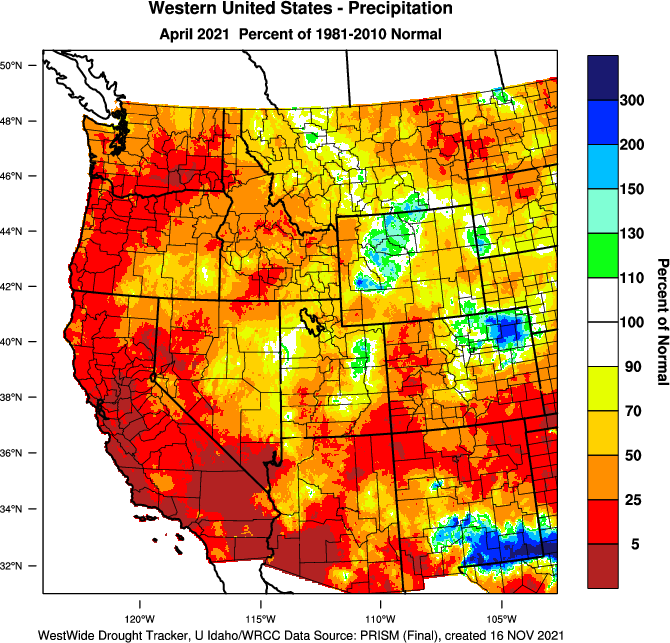
Rivers, lakes, streams and groundwater can get into what’s known as hydrological drought when their water levels fall. Many states are now warning about low streamflow after a winter with less-than-normal snowfall and warm spring temperatures speeding up melting. The U.S. Bureau of Reclamation announced it would cut off water to a canal serving farms in the Klamath Project on the Oregon-California border because of low water supplies. It also warned that Lake Mead, a giant Colorado River reservoir that provides water for millions of people, is on pace to fall to levels in June that could trigger the first federal water shortage declaration, with water use restrictions across the region.
Dwindling soil moisture leads to another problem, known as agricultural drought. The average soil moisture levels in the western U.S. in April were at or near their lowest levels in over 120 years of observations.

These factors can all drive ecosystems beyond their thresholds – into a condition called ecological drought – and the results can be dangerous and costly. Fish hatcheries in Northern California have started trucking their salmon to the Pacific Ocean, rather than releasing them into rivers, because the river water is expected to be at historic low levels and too warm for young salmon to tolerate.
Snow drought
One of the West’s biggest water problems this year is the low snowpack.
The western U.S. is critically dependent on winter snow slowly melting in the mountains and providing a steady supply of water during the dry summer months. But the amount of water in snowpack is on the decline here and across much of the world as global temperatures rise.
Several states are already seeing how that can play out. Federal scientists in Utah warned in early May that more water from the snowpack is sinking into the dry ground where it fell this year, rather than running off to supply streams and rivers. With the state’s snowpack at 52% of normal, streamflows are expected to be well below normal through the summer, with some places at less than 20%.

Anthropogenic drought
It’s important to understand that drought today isn’t only about nature.
More people are moving into the U.S. West, increasing demand for water and irrigated farmland. And global warming – driven by human activities like the burning of fossil fuels – is now fueling more widespread and intense droughts in the region. These two factors act as additional straws pulling water from an already scarce resource.
As demand for water has increased, the West is pumping out more groundwater for irrigation and other needs. Centuries-old groundwater reserves in aquifers can provide resilience against droughts if they are used sustainably. But groundwater reserves recharge slowly, and the West is seeing a decline in those resources, mostly because water use for agriculture outpaces their recharge. Water levels in some wells have dropped at a rate of 6.5 feet (2 meters) per year.
The result is that these regions are less able to manage droughts when nature does bring hot, dry conditions.
Rising global temperatures also play several roles in drought. They influence whether precipitation falls as snow or rain, how quickly snow melts and, importantly, how quickly the land, trees and vegetation dry out.
Extreme heat and droughts can intensify one another. Solar radiation causes water to evaporate, drying the soil and air. With less moisture, the soil and air then heat up, which dries the soil even more. The result is extremely dry trees and grasses that can quickly burn when fires break out, and also thirstier soils that demand more irrigation.
Alarmingly, the trigger for the drying and warming cycle has been changing. In the 1930s, lack of precipitation used to trigger this cycle, but excess heat has initiated the process in recent decades. As global warming increases temperatures, soil moisture evaporates earlier and at larger rates, drying out soils and triggering the warming and drying cycle.
Fire warnings ahead
Hot, dry conditions in the West last year fueled a record-breaking wildfire season that included the largest fires on record in Colorado and California.
As drought persists, the chance of large, disastrous fires increases. The seasonal outlook of warmer and drier-than-normal conditions for summer and fire season outlooks by federal agencies suggest another tough, long fire year is ahead.
[Get the best of The Conversation, every weekend. Sign up for our weekly newsletter.]
This article was updated with a statement from Secretaries Deb Haaland and Tom Vilsack.
Mojtaba Sadegh, Assistant Professor of Civil Engineering, Boise State University; Amir AghaKouchak, Associate Professor of Civil & Environmental Engineering, University of California, Irvine, and John Abatzoglou, Associate Professor of Engineering, University of California, Merced
This article is republished from The Conversation under a Creative Commons license. Read the original article.
“Rising global temperatures also play several roles in drought”
But… but… the climate change cluckers have been telling us global warming wll cause more rain and more floods,,,which is it? I’m sooooooo confused.
It’s going to rain so much that it dries everything out…
The Climate Liars really need to get their story straight. Is it “Global Warming” or is it “Climate Change”, or is it the “Climate Crisis”? They can’t seem to decide, and so bounce from one to the other. It sends a confusing mixed-message to the Believers, which creates cognitive dissonance. Now it’s true that the True Believers have developed finely-honed coping strategies, but still, that creates stress. The Climate Liars need to give the Believers a break! I’m not suggesting that they actually tell the truth (God forbid), just that they make the messaging more succinct. Think of the Believers!
This article is focused on the wrong issue.
Instead of worrying about CA, people should be worried that the Dakotas, Nebraska, Kansas, Iowa, MI are in drought, and it is spreading to Minnesota, Illinois, and Indiana. A drought in all of this agricultural area already in May doesn’t look promising for grain, etc.
Drought in “fly over country” is far more important than wild fires in the neighborhood of Hollywood & Silicon Valley billionaires.
Here in NC I’m hearing talk of a drought – this coming after a year so wet literally everything I tried to grow died from the flooding, at a time when all the local ponds are the highest I’ve ever seen them. And we’re still getting rain on a regular basis.
I’m beginning to question what they mean by “drought”.
The West Coast is in drought because the Hadley cells in the Pacific kept directing the storms north into Alaska/Canada all through the fall and into the winter. This picture is from 10/29/2020, and is a good example of how the process worked.
That drought stricken region which is shown as dark red? Isn’t that desert?
Ah! The Conversation, is it? Droughty conditions often turn moderate or even to wet in the west in short order. When I started graduate school in Utah in the mid-1970s we were in the midst of a drought so severe we were told that it would take a decade to refill reservoirs. Six months later they were spilling water from those reservoirs.
But those were the old days, and these days we have climate change. Nothing it doesn’t do.
This map is WAY out of date. Central Texas is getting 3 or more inches a day.
That’s the climate in the Southwestern US: Periods of drought separated by years of high precipitation. Some of the droughts are worse than others. Been like that for millennia.
Vapor pressure deficit? That’s a new one.
These are more manipulated data. Texas has been getting loads of rain, even in the high western plains.
Meanwhile in Arizona, the snow falls today, ignoring the drought…. https://www.instagram.com/p/CPIueYEHrVT/?utm_medium=copy_link