Guest Post by Willis Eschenbach
A couple months ago I wrote a post called “Bright Green Impossibilities“. In it, I showed the impossibility of converting all global energy to zero-CO2-emission fuels by 2050. But what about a simpler task? A number of US states have committed to converting, not total energy but just electricity, to zero-emission fuels by 2040. How tough can that be?
Let me start by looking at the history of US electrical generation. Figure 1 shows US electrical generation from 1985 to 2019 by fuel source.

Figure 1. US electrical generation by fuel source.
From that, it doesn’t look too hard. After all, you can see that renewables (orange) are increasing.
But when we look at it by percentage of generation by fossil versus zero-emission fuel sources, we find a curious thing:

Figure 2. US Generation by type of fuel, zero-emission and fossil fuels. Zero-emission generation is by wind, solar, geothermal, hydroelectric, and nuclear.
Doesn’t look so easy now. In fact, if we continue at the rate of change since 2010, it will take 75 years to get to zero-emissions …
But wait, as they say on TV, there’s more. As of 2019, the US was using 4,400 terawatt-hours of electricity per year.
There is also a big push to go to electric vehicles … and that will require more electricity. The current US generating capacity is about 1,000 gigawatts (GW), of which about 675 gigawatts (GW) is fossil-fueled. By 2040, the US Energy Information Agency (EIA) estimates we’ll need about 1500 GW of generating capacity. This means we’ll need another 500 GW of new generating capacity to get to 1,500 GW, plus 675 GW more to replace existing fossil capacity. That’s 1,175 GW of new generating capacity needed by 2040.
As Texas has just proven beyond doubt, no matter if we supply part of this with wind or solar, we’ll need 100% backup. Nuclear is not ideal for this, but the new generation of reactors are said to be able to respond quickly enough to balance out the load when wind and solar fail. So either way we’ll need about 1,175 GW of new nuclear power by 2040 … and there are about 975 weeks until 2040.
Now, typically it takes about ten years to find a site, get the permits and licenses, overcome the objections, construct, test, connect to the grid, and commission a new nuclear power plant. Figure 3 shows an overview of that whole process.

Figure 3. Typical nuclear plant timeline, from initial study to final startup. SOURCE.
But we don’t have ten years per nuclear plant. With only 975 weeks until 2040, and the need for 1,175 GW of new CO2-free generating capacity by 2040, we’ll need to create a feasibility study, find and survey a site, obtain the licenses, design, purchase, construct, excavate, install, test, and commission a 1.2-gigawatt nuclear power plant every single week for 975 weeks in a row until 2040.
Anyone who believes that that lovely green fantasy can actually be completed out here in the real world, well, I want some of whatever green stuff they’re smoking.
And bear in mind, that’s just electricity. It doesn’t include the huge amount of fossil fuel used directly by industry, and for transportation, and for space heating …
TL;DR version? 100% CO2-free electricity by 2040? Can’t. Be. Done. Fuggeddaboutit. Not. Possible.
My very best to all,
w.
The Customary: If you are commenting please quote the exact words you are discussing, so we can all be clear on exactly what you are referring to.
An Expected Objection: I suspect some folks will say, “We need another 500 gigawatts of generating capacity even if we don’t go CO2-free … how is that going to be possible?”
It will be possible, albeit difficult, because it is infinitely easier to add another gas-fired generator to an existing generating station than it is to add a new nuclear plant. First, the permitting process is far simpler. Second, the site requirements have obviously already been met because there’s a power plant there already. Third, the infrastructure in the way of power lines, switching stations and the like is already in place, and only needs expansion rather than creation de novo.
This is not to say it will be easy, particularly with the foolishness of the proposed bans on fossil-fueled cars and fossil-heated homes and offices. Those unrealistic goals will make even fossil-fueled expansion of electric generation a huge challenge.
But it will be doable.
But, but, but fweelz trumps facts….
As I usually say, the Green thinker have to learn first, what a pocket calculator is, what it is good for and how to use it.
But I doubt, that after these three instances they find down to reality.
Remember, math is white supremacy.
And there was me thinking that al-jebr was an Arabic word.
Wasn’t al-Khowarazmi an Arabic mathematician?
NBA player, I think, though I might have that wrong.
“As I usually say, the Green thinker have to learn first, what a pocket calculator is”
They have a calculator on their phone. They ought to learn to use it.
If they open up the calculator app on their iPhone and turn the screen to portrait mode, they will have themselves a scientific calculator.
Learn how to use it, and then realize that the claims of the Greens/alarmists are science fiction.
Thanks again for another superb analysis. One quick question – do you have the breakdown of non-zero Co2 contributions by type – e.g., wind, solar, hydro, geothermal, etc? A sad reality is that no matter how simple and clear you make it, few of the brainwashed masses will be convinced.
Barnes, all of that information is in the BP Excel spreadsheet linked to in the head post.
Regards,
w.
Thanks Willis.
The quick answer is to look at the steady graph with hydro and note typically how our ancestors grabbed the low hanging fruit with dams. Good luck getting any more marginal fresh water dams up now. Doubly so wanting to flood any dryland existing high valleys with seawater for pumped hydro storage for the unreliables. It’s all fantasy with electrochemical storage.
One aditional factor is that none of the existing windmills & very few of the solar panels in existence will still be working by then.
Yes, you have to figure in the time and costs of replacing all the worn-out windmills and solar panels, too.
And then you have to replace all that windmill/solar panel infrastructure again about every 20 to 30 years into the future, and on and on.
Building Solar Power Satellites in space would make more sense, and probably cost a lot less.
Yes, and beam it, tightly focused, down to California.
Can you imagine the damage that would be caused by a micrometeor hitting the transmitter and moving the beam a tenth of a degree. The nice transmission to the California desert suddenly fries downtown LA.
I’ll have to dig out my old Space Studies Institute Solar Power Satellite Studies (maybe SPS will become a viable alternative, considering the absurd alternatives being proposed by alarmists), but if I recall correctly, the claim was the microwave beam was estimated to be safe enough for birds to fly through it. It’s not like a focused laser beam.
1) The rectennas cover many, many acres per MW, low energy density. (one idea was to suspend them over cropland or grazing range, they’re like a chain link fence.
2) Fail-safe interlocks. You have a low power guide beam, that if it goes off target, the transmitter shuts down.
3) “Phased array emitters” great beam steering mean that physical orientation is not strong coupled to beam orientation (the large virtual aperture also limits beam divergence)
4) SPSS will have a mass in the *tons* and lengths in the 100’s of meters a micro meteorite *might* induce a ripple (the structure won’t be all that rigid) but enough momentum to reorient some that size would likely simply *break* it.
Now, just add the land area required for the 1.2 GW of renewable power sourced by wind/solar and illustrate the raw area required. With a 1 GW nuclear plant being the equivalent of about 1000 2MW wind turbines (assumes 50% nameplate capacity) or ~10 million 295W solar panels, that is a lot of land. Figure 1.5 acres per 2MW turbine (How Much Land Is Needed for Wind Turbines? (sciencing.com)) 975 weeks * 1200 turbines / week * 1.5 acres/turbine = 1,755,000 acres (7100 km^2). Now, assume that even a 50% capacity factor is way to high and you can increase the area by a factor of 2-5? That is a lot of land being impacted for a variable power generation source that must still be 100% backed up by something else.
Off shore wind turbines don’t need any “land.”
They still require a great deal of space on the water that then can’t be used for other things like shipping lanes, anchorages, etc. In addition, sea based turbines require more maintenance and have shorter lifespans due to corrosion. Not a panacea
Make freshwater lakes in the Ocean.
Those off-shore windmill farms might interfere with Kerry’s windsurfing. I think he has complained about this in the past.
Being such a hypocrit, he probably wouldn’t care if off-shore windmills interfered with the windsurfing that others do. As long as it’s not him.
They still occupy the same amount of space on Land or Water.
I doubt the continental shelf is large enough.
The analysis of the UK land area – surrounded by seas – was that there was nowhere near enough continental shelf to power the UK with renewables, and power the backup systems we would also need.
See my post on ‘Without Hot Air’ above.
Ralph
Try and build 1 of those off Martha’s Vineyard.
https://boston.cbslocal.com/2021/03/08/offshore-wind-project-marthas-vineyard-nears-approval/
…nears approval…. Don’t count your chickens… In in the green utopia of Germany, communities have turned against wind farms and are not letting existing ones be repowered when the turbines wear out. Might be better if they are promoted as artificial reefs – then the turbines will really help the environment.
Many problems; hard and expensive to build, expensive to maintain, expensive to replace (unless you don’t plan to replace them at all).
What’s your plan Roger? Can you draft one up, with numbers, locations, $?
Taguchi
To be practical, power sources need to be close to the consumers. Without any ocean on the US northern and south-west borders, your idea won’t work there! Once again, you have demonstrated that you don’t have a good grasp of the nature of the problem and what solutions might be feasible. Also, many of those on the coasts will object to having wind mills within viewing range and ruining their scenery when looking out from their coastal homes.
The southern beach of Long Island is very near New York City.
So, your are saying that there is one place in the entire country where your suggestion might work?
Actually, you are probably onto something, although you don’t realize it. There is probably no “one size fits all” solution. We will have to be flexible and objective, and not driven buy ideological blinders, to find the best solutions for the future.
Roger, they are still far and away the most expensive source of power that is in use … you ready for your electric bill to quadruple? And that doesn’t count the difficulties of maintenance and the short lifespan.
And you STILL need nuclear for a zero-emissions backup, so double the expense …
w.
https://www.utilitydive.com/news/texas-wind-power-is-so-cheap-electricity-providers-are-giving-it-away/408902/#:~:text=Wind%20power%20is%20so%20cheap%20in%20Texas%2C%20and,customer%20loads%20shifted%20away%20from%20peak%2C%20expensive%20hours.
Visited the site, read the article. Noted “Recommended” at the end of the article – to something in the New York Times. Told me all I needed to know.
Exactly. Fake-news specialists.
Roger, from your link:
No, Roger, the utilities are not “giving it away” as the headline claims. That is what in the trade is called a “lie”.
All they’re doing is shifting the cost to other customers … including the poor bastards running factories, and the sweaty folks at home and at the offices running air conditioners, which now they are less able to do.
Pass …
w.
“No, Roger, the utilities are not “giving it away” as the headline claims. That is what in the trade is called a “lie”.”
I love it! Tell it like it is, Willis! 🙂
There’s too much generated when no one needs it but they still have to pay the wind farm owners for every KW at inflated prices. Please don’t be gullible about ‘cheap wind power’ – one has to look at the full effect it has on the system because of all the disruption it causes. Research which states have the cheapest rates to consumers and which have the most expensive, and then look at their main sources of power.
And of course when the wind/sun don’t blow/shine enough the spot rates go through the roof and that cost gets shifted into your electric bills… and to avoid that problem, which will become more of a problem as more and more other states buy into the BS, you must then over-build NG driven generation and keep it standby to “come to the rescue” when needed but that cost also gets shifted into your electric bills
and this of course makes the idea of “zero emissions” a pipe dream (at least until / unless small nukes become reality and prevalent)
“Off shore wind turbines don’t need any “land.”
That is a frivolous point in the debate.
All wind and solar energy generation still needs to ensure that it has adequate conventional generation back-up to meet peak demand.
These are intermittent, unreliable sources of energy that will not be up to the task of running an all electric world of the future, that’s the reality whether you like it or not.
Example: Saturday morning 7:00am UK
Gross demand 27.5 GW and rising.
17.5 GW
FOSSIL FUELS – 62.3 %
3.9 GW
RENEWABLES – 13.8 %
Of the total installed windfarm capacity in the UK of 25 GW, this morning it is only capable of producing 1.5 GW.
Why?….. BECAUSE THERE ISN’T ANY WIND!!
“BECAUSE THERE ISN’T ANY WIND!! “
gees, don’t let griff hear you say that.. poor muppet will go into some sort of delusional trance again.
Yes, I was watching the service for Prince Philip on television just now, and every flag I saw was hanging limp for lack of wind.
Windmills don’t work very good when the winds stop blowing. Planning to supply society’s electricity needs with windmills is a fool’s errand. Hear that, Griff?
Our Western leadership needs to snap out of this delusion. Society cannot be powered with windmills. There are too many obstacles standing in the way.
Continuing down this road will reveal all those obstacles. Some are becoming apparent now, like the unreliability of windmills, and the large additional costs they add for consumers when the windmills are part of the power generation mix.
Western Society is heading for a trainwreck if the leaders insist on using windmills and industrial solar. And then they want to electrify all transportation and add that additonal requirement to the electrical grid. It’s just one ridiculous idea after another from the alarmists.
And all these ridiculous ideas are based on distortions of reality which hark back to distortions of the temperature record, carried out by political activists posing as climate scientists.
We are living in a Big Lie, created by the radical left and corrupt climate scientists. Some of us can see it. Some of us cannot. Unfortunately, most of our leaders cannot. We need to wake them up somehow before they do something rash and destroy our societies.
+100% agree.
But they do require more money than reliable power, a suitable coastline, consistent wind, and people who will allow it. The project off of Martha’s Vineyard was delayed for years by the rich, green citizens of that island. Oh, and having lived through the collapse in Texas, you have to promise me consistent power regardless of the weather.
Quite right! I can’t believe that end users were given massive bills because of that fiasco – and it’s doubly maddening knowing that it’s the fault of the so-called experts who designed and run the grid. Some blame too to the pipeline companies giving in to green-bullying by re-powering the pipelines with line power (which is supposedly green because it is partly wind and solar) instead of the natural gas that’s in the pipeline itself.
Those offshore turbines are anchored to the ground and have massive cables further anchoring them in multiple directions.
They’re just as much a waste of space bird killers as if they were built on land.
To date, end of life windmills fail to provide substantive benefit to match their costs and definitely fail to address the burden when they’re decommissioned and dumped into landfills.
Tell us about the vast quantities of concrete needed for the bases of offshore turbines, and the energy required to make it.
You misread the article you linked to. The 1.5 acres/turbine is for the immediate area around the turbine for the pad, access roads, etc. The recommended design inter-turbine spacing is at least 7 rotor diameters, although total efficiency can be increased with a larger spacing. The average area used by current wind farms is about 0.5 sq. km. / 2MW turbine. This is roughly 10 MW / sq. mile.
Keeping the current spacing, it would require 500 * 0.5 = 250 sq. km to site 1 GW of nameplate wind turbine capacity, or 500 sq. km to site 1 GW of actual wind turbine output, assuming a 50% capacity factor (which you won’t get anywhere except West Texas). This is 193 sq. miles for 1 GW of output.
Contrast this with Plant Vogtle in Georgia. Total site size is 3,100 acres (12.5 sq. kilometers, or 4.8 sq. miles). There are two 1.2 GW reactors operating currently, with two more marginally smaller units under construction and scheduled to come one line in 2021 and 2022. With all reactors operational total plant output will be 4,664 MW, or 373 MW / sq. km. A wind farm by contrast produces just 2 MW / sq. km, assuming a 50% capacity factor, 1.2 MW / sq. km. assuming a more realistic 30% capacity factor.
How much land does Plant Vogtle in Georgia require for mining, processing and enrichment of it’s uranium fuel?
And by comparison, how much land is required for mining materials required to build wind turbines, solar panels, electric motors, batteries, grid expansions? I suppose you have all the answers.
Very little.
LOL, the land used to transmit power doesn’t care what the source about the source.
The land doesn’t “care” about anything. 12.71 acres/MW and 70.64 acres/MW are the numbers. You might want to Google the word “number”.
Then once you are comfortable with numbers, Google “algebra.” Wind had a capacity factor ranging from 25-40%, nuclear has an average capacity factor of ~93%. Assuming your brain functions, it should be fairly easy for you to calculate MWh/acre.
Taguchi
How much land does a wind farm need for mining, processing, smelting, and fabrication of the materials to build the turbines and transmission towers? Once again, you are demonstrating that you are viewing the ‘solution’ with blinders!
Same land used to procure all of the materials to make automobiles…..which already is in production.
You really shouldn’t have eaten so many lead paint chips when you were a child.
WRONG as always rogtag.
(are you deliberately trying to imitate griff in ignorance and stupidity?)
Massive areas need to be mined and are polluted for production and refining of the huge neodymium magnets used in wind turbines.
Also, HUGE amounts of limestone are needed to make the MASSIVE concrete foundations.
The building of wind turbines requires far more mining and is FAR MORE POLLUTING than any ICE automobile.
Maybe it IS griff in disguise.
You are demonstrating that you don’t understand the different materials, like REEs and more copper. You brought up the issue of a unique component, uranium, to provide power. Since you don’t seem to be able to read between the lines, I’ll be more specific. Alternatives to fossil fuels, ALL require unique components that aren’t in extant automobiles. That is, vastly increased quantities of copper, REEs, cobalt, and new sources of lithium such as through mining in Maine and South Dakota. Also, every wind turbine will require massive concrete pads, which increases the production of CO2 in the calcining process.
You can’t just wave your hands around and declare one approach is superior. It requires a detailed analysis of the competing approaches from mining to ultimate disposal.
The coal plant I worked at was rated 340 MW (2 units) and area, including coal-storage pile & transmission yard, was about 30 acres. It was beside a river and a main railroad line. Admittedly it had a once-thru cooling system, so didn’t need cooling towers.
Neal
The problem is more complicated than just total area required. Not all land is suitable for installation of turbines and solar. As an example, placing solar panels within the Rocky Mountains will reduce the number of hours the panels will receive illumination because of the shadow cast by the mountains as the sun gets low in the western sky. Also, the rugged terrain and adverse weather will increase the cost of installation and maintenance. Not all places are windy enough. Not all places are close enough to the population centers that actually need power to warrant long transmission lines, with inherent resistive losses, to be practicable. So, you have to eliminate from consideration all the areas, which for various reasons are unsuitable, and you will probably end up competing with demands for agriculture and urban infrastructure.
It is not unlike the unreasonable demands of uneducated ‘greenies’ that we do away with mines or place them where the land isn’t useful for anything else. They don’t understand that the location of a mine is dictated, first and foremost, by where the particular ore can be found, and secondarily by accessibility and proximity to water and power.
You can’t pack wind turbines in close arrays. Optimum spacing on average is easily at least 25 acres per megawatt of installed capacity (50 acres for 2 MW units). So the area is closer to 240,000 km^2, assuming your other inputs are close to correct. I have seen estimates much higher than that. 240,000 km^2 is >1/3 the area of Texas. Of course, once you have built out the prime wind locations, subprime sites would require much more land to produce the same amount of electricity.
America needs to become Energy Wise. We need to use all of our sources of energy so that we will be able to provide all that electricity for when we need it.
America has an abundance of coal. Clean Coal Is Possible. Coal can be combusted and emit into the atmosphere less CO2 than what the natural gas power plants are emitting.
Lets use our natural gas for building space heating and by industry to produce and process all those items er consume daily.
Our oil is to be used for transportation and by those industries that require oil in their base products.
Lets use our solar and wind created electricity to power our growing EV market.
If this is done we will power everything for a long -long time.
Lets use our solar and wind created electricity to power our growing EV market.
Yeaaah, less circulation in the streets 😀
Lets use our solar and wind created electricity to power our growing EV market.
We’ll keep the EV cars parked when the wind does not blow and the sun don’t shine, it’s that simple
less traffic in winter perfect
I was in my French as I wrote “circulation” meaning “traffic” 😀
Krishna, Just for interest,
What is your native language?
… and how many languages can you communicate in?
My native language is German, the target of the school I was after 4 years grade school / basic school was to teach French as second native language, with success, later Latin, still later English.
Some basics in Spanish after school. I’m used to communicate in 3 languages, in French I miss some practice now, but I know, some hours French radio or TV, I’m in again 😀
You do a good job with your English. 🙂
WUWT teaches well, thx 😀
Yep, doing well with the English… well done 🙂
No need to park the EV when the wind isn’t blowing. Just put a wind turbine on the roof and go for a drive.
True story: I once met a Green activist who suggested this idea perfectly seriously.
And also shine a light on the solar panel at nite….
No can do. We have to charge the cars at night. We are going to have to solve sun set problem.
“Coal can be combusted and emit into the atmosphere less CO2 than what the natural gas power plants are emitting.” Once we develop that technology. So far, CCS has not been a resounding success. Damn that Second Law of Thermodynamics!
Maybe Nancy Pelosi could simply outlaw it?
Why not? She seems to be doing her best (worst?) to outlaw ever other law!
Solar would only work to power EVs only if there is a charging station at a high fraction of the parking spots where cars park during the day (when solar is producing power). The streets would have to be lined with chargers -businesses, factories, shopping malls, parks, and hospitals too.. Many cars don’t spend the day at home. You could charge some EVs at home at night with wind IF the wind is blowing, but what do you do if it isn’t? You still need backup power.
“Clean Coal Is Possible. Coal can be combusted and emit into the atmosphere less CO2 than what the natural gas power plants are emitting.”
Not efficiently it can’t. The CO2 generated has to go somewhere. If you add on processes to capture CO2 on Coal, you can do the same for Gas. The real issue is why reduce CO2 at all. Coal produces a lot more real pollution then gas does, and this is why coal is less desirable for many.
“Lets use our solar and wind created electricity to power our growing EV market.”
Um, how do we separate the electrons that come from nuclear, gas, or coal from those that come from wind and solar? They all go over the same wire. Most EV charging is down at night when the sun is not shining. Wind comes and goes, but going to work still matters. I suppose your answer is going to be large scale battery farms which is an entirely new can of worms.
We simply do not need wind or solar energy for most uses – just niche. To power something not easily connected to the grid, or as an emergency source of part-time power for California homes that are under constant threats of fire and earthquake. Those sort of uses, not main grid uses.
Robert
And carbon capture requires the expenditure of energy. Therefore, the net power is reduced, reducing the efficiency of converting fossil fuels to electricity.
Ahhh, here comes Sid, still trying to sell carbon capture to the masses. He never understands that this venue is waaaay to smart for that. He might as well try to extol the virtues of Hell to the Vatican.
The Greenie Weenies are pros when it comes to the impossible. Why, they sometimes have believed six impossible things before breakfast.
“A number of US states have committed to converting, not total energy but just electricity, to zero-emission fuels by 2040.”
Massachusetts aims to have the state at net zero by 2050 and that means all energy. see https://www.spglobal.com/platts/en/market-insights/latest-news/electric-power/032621-massachusetts-governor-signs-climate-change-legislation-calling-for-net-zero-emissions
“The legislation signed by Baker updates the greenhouse gas emissions limits related to the 2008 Global Warming Solutions Act, commits Massachusetts to achieve net-zero emissions in 2050, and authorizes the Secretary of Energy and Environmental Affairs to establish an emissions limit of no less than 50% for 2030 and no less than 75% for 2040. It also authorizes EEA to establish emissions limits every five years and sublimits for at least six sectors of the Massachusetts economy – electric power; transportation; commercial and industrial heating and cooling; residential heating and cooling; industrial processes; and natural gas distribution and service.”
5 year plans. Where have I seen that before?
Yes, and it ALWAYS worked so well, right?
Massachusetts is headed down the primrose path which leads to perdition.
Tim
One of my favorite aphorisms is, “The road to Hell is paved with good intentions.”
Do any of these states understand the carbon footprint of building the devices and constructing them and disposing of worn out components. I doubt it. Considering the carbon life cycle of these “green” devices will show they are never net zero.
In Mass., hundreds of thousands of acres of mostly forest will have to be converted to solar “farms”. They are NOT counting the loss of ecosystem services nor the loss of productive forest land which was once an economic resource with thousands of jobs.
And in Scotland it is estimated that almost 14million trees have been cut down to make way for windfarms.
That’s a travesty!
Essentially they do not need to understand as the carbon does not affect the temperature so nobody will notice it and they think they are achieving their objective at whatever cost.
Well, CA is well on its way. Already about 30% of its electricity comes from outside the state so any CO2 generated in producing it doesn’t count. That plus its internal wind and solar probably make it already 35% (a wild guess on my part) of the way there.
Off topic, sorry- but:
“Greta Thunberg to testify in Congress on Earth Day”
https://www.politico.com/news/2021/04/16/greta-thunberg-congress-testimony-482410
Chuck up !
Up chuck?
Earth day? You mean Lenin’s birthday.
turn off all the lights and the PA-system. they consume electricity
That reminds me of that one county in Germany, which published how they managed to increase their electricity production to 50% zero-emission over the last 30years and with just a bit more effort they can got to 100% and lead the way..
lol they had built a hydro-dam in that period (but cant just build a 2nd one).
“Germany shuts too much coal, lasted 8 days without them, now admits they can’t close them”
https://joannenova.com.au/2021/04/germany-shuts-too-much-coal-lasted-8-days-without-them-now-admits-they-cant-close-them/
Willis, shirley you don’t mean to not start a journey of a thousand miles without taking the first step? Why not start designing, permitting, and constructing nuclear power plants right now, and then whatever other energy sources can be added to the mix as things advance is additive and gap-filling? Did you ever set sail without knowing where you were going? Don’t goof on me because all of the WATTS readers already know the answer.
Ron, I’ve been a fan of nuclear for decades. Build ’em!
w.
1) As of 2019, the US was using 4,400 terawatt-hours of electricity per year.
.
2) he current US generating capacity is about 1,000 gigawatts (GW),
..
3) There are 8760 hours per year
..
Your calculation do not reflect the fact that we are currently running our existing capacity at 50% utilization.
..
If we ran at 75% utilization, you only need to add 675 gigawatts of capacity.
..
Also note that you can build nuclear plants larger than 1.2 Gwatt
Getting electric power system load factor from 50% to 75% is a lot easier said than done. “Smart” charging for EV’s might help, especially if EV2G becomes common.
US NRC regulations put a limit of 3800MWth on individual power reactors (dates back to the AEC days), which comes out to 1300MWe. At one time the US had the ability to build 30 nuclear units per year, but I suspect capability is now lower than that. One lost opportunity was decision to not build out the Palo Verde plant in AZ to 6 units.
palo verde had a desert water problem
Roger, I can’t do any better than the comment by an alert reader on my last post — where I’d originally made the same error you’re making
This is exactly why, as you’ve noted, our average power consumption is about half of our generating capacity. It has to be, to cover the peak usage and not just the average usage.
w.
You don’t run a nuke at 50%, you don’t run a hydro dam at 50%, you don’t run a CCGT at 50% and you don’t run a coal burner at 50%. The problem with your analysis is that you are proposing using nukes which don’t run at 50%. Your analysis is crap.
You don’t add 50% utilized generation capacity with base load 95% nukes.
That is NOT what Willis said
Deliberate misinterpretation.. of are you just plain DUMB
Which was it, Rogtag?
Roger, you’re dealing w/a topic here that you obviously have no real knowledge of. Just another troll……
Poor Rog-dumb, obviously didn’t read Willis’s comment
of is totally lacking comprehensions skills…. on purpose. !
Your comment was CRAP.. with big capital letters, RogTag
Just like all your other comments.
Roger, as someone pointed out upthread, the US has ~ 1,000 GW of generation capacity, and uses on average about 500 GW of that … oh, wait, it was YOU who pointed that out.
Since you claim that nothing can be run at 50%, perhaps you can explain to us all how that is happening.
And as to whether you can “run a coal burner at 50%”, perhaps you can also explain how they’re actually running at about that capacity factor.
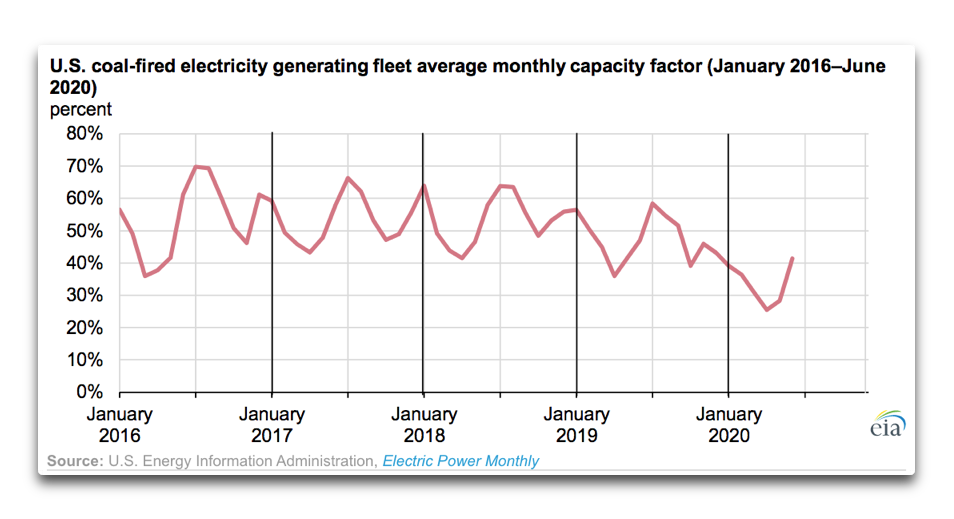
Also from the EIA, regarding your claim that “you don’t run a CCGT at 50%” …
I await your explanation. And please dial back at the accusation that my analysis is “crap” … it makes you look vindictive on top of already looking unaware of the facts about electric generation.
w.
Roger doesn’t understand facts, so he’s getting rude instead
The facts are that you can also run a coal or gas, or nuclear plant at close to 100% of nameplate WHEN NEEDED and often for protracted periods.
It is exceedingly rare for wind or solar to run anywhere close to its nameplate rating, and certainly only for very brief periods of time, and certainly not AS REQUIRED.
Ask a Texan what happens when you design too close to the margin and something goes wrong. Plants have to be able to suspend operations for maintenance and upgrades, for repairs after storms, and unplanned equipment failures. One again, you demonstrate your naivete.
75% is a long way away form “close to the margin.”
When wind and solar regularly operate at VERY LOW capacity factors, and occupy a large fraction of the grid..
…. 75% is “close to margin” …. because large percentages can go missing at any time.
Then what is the optimum safety factor, and on what do you base the assertion?
If the “1,000 GW generating capacity” includes wind & solar at nameplate capacities, that’s a bullsh1t number right there.
Divide those by at least 3 to arrive at a real-world useful number.
And as most people are interested in “GUARANTEED SUPPLY”…
You need to ask the question something like…..
“What percentage of nameplate can the supply source GUARANTEE TO SUPPLY, say, 95% of the time?” (assume 5% for maintenance time)
For wind, that might be some 3-4% of nameplate
For solar it is ZERO
In Australia, before it was close, Hazelwood’s 3 operating coal fired turbines had been sitting on over 95% of nameplate for several months straight. !
Nuclear can also supply near nameplate for long periods of time if required.
There really is no comparison on a GUARANTEE TO SUPPLY basis..
wind and solar are utterly USELESS.
The EXISTING mix is running at 50%….including all the gas, coal, nuke, and hydro.
“Guarantee to supply” of wind is about 3-4%….. GET OVER IT !
You HAVE TO RELY ON NEARLY 100% of real supply to be available as back-up.
Come on RogTag…. you are the shill with wind and hot air.
What is the “95% of time, Guarantee to supply, as percentage of nameplate” for wind in Texas.
(let’s call it the RELIABILITY FACTOR)
Do you want “reliable” electricity?
Here’s some data from Germany for 2015 and 2016 clearly showing it was less than 5% of nameplate.
Fred, Texas has shown all of us that coal, gas, nukes, and hydro are utterly USELESS when you run a system on the cheap.
Yes rogtag (the unreliable energy shill), we KNOW that Texas WASTED too much money on wind and solar, and didn’t look after the RELIABILITY of the dispatchable supply system
You build in UNRELIABLES……..
You get an UNRELIABLE system.
….period
Wake the **** UP to REALITY, mindless twerp.
And THANK GOODNESS they still had a whole heap of GAS to cover most of the needs,, being able to ramp up to 450% of is pre-emergency supply as wind supply COLLAPSED.
What would have happened if they didn’t have SO MUCH AVAILABLE GAS supply !! (even though not enough)
No, Texas shows us what happens to reliable gas and nuclear when wind turbine failure causes you to load shed compressor stations and nuclear cooling pumps.
Power usage varies by day and by the weather. You have to have enough power to cover the peak load, hence the operating factor of about 50% for parts of the year. Don’t forget, solar and wind never run at 50% of nameplate because the wind doesn’t blow at the right speed very often, and the sun doesn’t shine at night. they drag down our average utilization rate.
Good one. But I’d like to request that we stop talking about zero emissions sources of energy as if it was true. As you wrote “It doesn’t include the huge amount of fossil fuel used directly by industry, and for transportation, and for space heating …” which sort of hints at the idea that no power generator can be built without combustion of fossil fuels. To get to “zero emission” power generation, we would have to multiply emissions output by several times, razing the villiage in order to save it.
And all wind turbines, solar panels, and electric cars will have to be made from wood and stone, hand cut with stone tools, because all other options will require fossil fuels to make.
Intermittent/renewable energy, shared/shifted responsibility, and a Green Blight because the environment does not matter.
“As Texas has just proven beyond doubt, no matter if we supply part of this with wind or solar, we’ll need 100% backup. Nuclear is not ideal for this,”
You use nuclear power to provide constant base load and gas to provide for the peaks. You use wind for blowing soap bubbles, and solar for getting skin tans. This isn’t rocket science! 😀
Point taken, you can’t build nuclear fast enough under the current political and environmental culture or using current technology – that is why it is essential to invest in new nuclear technology now.
If safe to operate small nuclear power plants can be standardized, they can form a more distributed network of power infrastructure that is more stable, harder to sabotage, and easier to build out and maintain. Even large nuclear power plants are far better then wind.
Small nuclear plants will be uneconomic particularly if you try to swing their generation. The security and infrastructure for each plant are still needed. Installing A lot of small reactors on the same site may help a little but not much.
I’m no build more 4-5 GW plants but the risk averse American public won’t allow it. They still think Three Mile Island killed millions when the real answer is 0.
He was referring to the new trend in small module reactors, that will make up a plant of how many GW you require. The modules will be say 100-300W and be made in a plant and trucked to their location. This goes a long way to improving quality and reducing cost. Costs for all megaprojects, not just nuclear even old-fashioned hydro, have ballooned over the decades for various reasons and it is hoped that standardization and mass production in a factory setting will drop the costs.
“Nuclear is not ideal for this, but the new generation of reactors are said to be able to respond quickly enough to balance out the load when wind and solar fail.”
Nuclear is highly uneconomic if operated in this mode. Nuclear fuel is a very small percentage of the cost of running a nuclear plant so it doesn’t save much on fuel by only running it when wind and solar fail but the other costs remain with less revenue coming in because less electricity is being sold. Most of the cost of nuclear is the capital cost related to high construction costs and the long period of construction so if you run it intermittently with less revenue you just increase the amount of time needed to pay off the loan thus INCREASING the total cost.. If you bulid nuclear you’re going to run it flat out for 3 years until you need to refuel but then what do you need wind and solar for?
Most people don’t know that the miniature modular reactors being developed will cost significantly more than a full-scale nuke per kw-hr.
This is the fundamental question that needs to be addressed.
If these technologies will always require reliable sources of back-up for at least the 30% of time they are being relied upon to produce & supply electricity, why not just cut to the chase and let the reliable power sources supply the whole 100% of electricity required at any given time?
Yes Mr you’re right, it’s that bleeding obvious. If we concentrated all our effort and money into nuclear we could pretty much wrap this problem up by 2050.
They are being developed specifically because they hope it will cost less – they will be built in a factory setting, based on a standard plan, trucked and setup at the desired location in much less time than past designs. They will have many reactors feeding the steam generators and the whole plant will be in the GWs – though nothing stopping a utility from starting small and adding as needed. The modular design also helps decrease the loss from having a unit down for maintenance or refueling.
Prof David McKay, the former UK government science advisor, said exactly the same about Britain. McKay was a confirmed Greeney, but even he concluded that the UK could never go fully renewable. All his options involved a generous dollop of nuclear power.
See his free pdf booklet. It is very good, but he should have used the same energy-unit all the way through it.
Renewable Energy Without Hot Air.
https://withouthotair.com/
And McKay never did solve the problem of the 5,000 gwh of backup supplies that the UK would need to go fully renewable. He suggested flooding Scottish glens with pumped water systems, but I don’t think the Scots will be too impressed with that scheme.
Without Hot Air is a few years old now, but the analysis is still valid.
Ralph
Read it when first came out. The butter pat energy analysis was brilliant.
McKay was basing his calculation on the technology of 25 years and more ago.
And indeed there is a plan to flood a scottish glen for pumped storage still at the planning stage -though meanwhile there are several small pumped storage projects building, e.g at Loch Ness, but more importantly there are grid scale batteries for peak demand and frequency response and tens of GW of HVDC connections to european countries McKay never dreamed of.
ROFLMAO….
grid scale batteries, that last 5 minutes and PRODUCE NO ELECTRICITY
Are you on one of your DELUSIONAL fantasy hallucinogenic-based trips again griff
…and connections to European countries that have NUCLEAR and COAL as RELIABLE supply.. so funny !
Wind is a massive LOSER over the last week in the UK
THANK GOODNESS FOR GAS, NUCLEAR and woodchips from the USA, hey griff!!
That’s all that is holding the UK grid together.
MacKay’s book was published in 2009 not 25 years ago.
Griff doesn’t do numbers.
Griff lies in the name of his agenda every day,
And still thinks he is the virtuous one.
Ralph
Cult members never think they’re in a cult.
Willis,
On December 20, 2020, Charles Rotter had an interesting post on WUWT (Biden’s Energy Plans Are Expensive—and Dangerous).
From this post it can be inferred that converting fossil fuel electricity generation to green energy would involve a capital cost about $15 Million / MW of fossil fuel electricity that is replaced. For your 1175 GW, this would represent almost $ 18 trillion.
In addition, one could expect that on-going maintenance and replacement costs for ‘Green Energy’ of approximately 10% of the capital cost (i.e. almost $ 2 trillion/yr, $ 5000 per capita per year). This is equivalent to almost 2/3 of U.S. combined GDP for manufacturing, mining and construction.
So in addition to the time constraint, there are simply not the financial nor physical resources available to carry out the task of converting to ‘Green Energy’.
The real point is that the word renewable or sustainable is a fraud.
Could you build with “renewable energy” sufficient to replace the units that need replacing and repair.
The Chinese build solar panels with coal power priced at @8c/Kwh. what would the panels cost if they used solar power?
Because the availability is ~25% at best, if you are replacing the fossil fuels then you need 4x, so 72 trillion
Then you need batteries for when it craps out completely, tens of trillions more
Then to be able to recharge the battery while running the grid after a no wind event, make that 6x generation instead of 4
So call it nice round 100 trillion just for the generation
It is amazing that people believe CO2 is a problem. In my world, the earth is CO2 starved. 400 ppm isn’t enough. We should be subsidizing power generation that releases CO2.
There is exactly zero data that points to increasing CO2 concentrations from fossil fuel use will ever be a problem. It would be nice if concentration levels could rise to 800 ppm, but there isn’t enough fossil fuels to get us there.
The new generation of SMR’s like Nuscale’s, which is fully developed and licensed, will be on line in a decade. My guess is that they will quickly catch on as base load power. Nat gas can pick up intermediate and peaker needs.
My best guess is that a huge backlash is coming for “green” energy. When people find out they have been lied to about CO2 it will get ugly. The huge costs and no benefits from wind and solar make for political poison.
My guess is that in 2-3 years the UAH temperature will show no warming for the 21st century. What then?
When you repeat a lie often enough people will believe anything. just watch CNN. Look at the expose by veritas. Their next big lie is climate until Trump runs again.
1) Global Warming2) Climate Change3) Climate EMERGENCY
“Climate Emergency!”
The new meme for the Climate Alarmists.
One big problem for the Climate Alarmists using “Emergency” is they can’t find an emergency that is being caused by temperatures rising because temperatures are *not* rising, evidenced by looking at any regional surface temperature chart from around the world.
The Alarmists are “crying Wolf!” when there is no wolf.
And yet repeating the lie that CO2 from human activity is NOT warming the planet doesn’t make the news headlines.
Its NOT a lie.
Let’s see you produce the scientific evidence to prove warming by human released atmospheric CO2.
Why are you so COWARDLY and DISHONEST, griff-leftard?
Do you really want to be an ABJECT FAILURE and LOSER all your pitiful life ?
What skeptics repeat is that Alarmists don’t have any evidence that CO2 is causing the Earth’s climate to change. That’s not a lie.
You could turn it into a lie, or at least an untruth, by providing some evidence that CO2 is doing what Alarmists claim it does, but you won’t do that because you can’t do that because you don’t have any evidence of such.
Prove me wrong.
For all those “undecided readers” out there, Griff will not provide any evidence, as you will see. He probably won’t even address this comment.
That should tell you all you need to know about who has the evidence and who does not.
Anytime any alarmist is challenged to provide evidence of Human-caused Climate Change, they go silent. They all go silent for the same reason: They have no reply because they have no evidence.
Bogus Hockey Sticks don’t count as evidence here. And that’s all they have. A made-up computer-generated global temperature lie, not supported by actual temperature readings on the ground.
Don’t expect many replies to this comment from alarmists. They have nothing to offer.
See what I mean?
The alarmists have nothing. It’s all smoke and mirrors.
OH NO! The planet is wa-wa-wa-WARMING! OMG! What will we do? Who ever shall we call? We’re doomed. DOOOOOOMMMMEEDDD!!!
Biologists are beginning to see that the next major extinction event (other than say an asteroid collision), perhaps of almost all life, will be CO2 starvation.
“As Texas has just proven beyond doubt, no matter if we supply part of this with wind or solar, we’ll need 100% backup. “
Unless I’m misunderstanding something, the Texas normal for unreliables had been established as around 25 to 27 % of total generation during February. That dropped to about 3% for a week or more. Gas generation increased considerably more that the loss of wind and solar but it was still far from enough. That says 100% backup is only adequate for simple situations. Worse times, which obviously come, require far more than 100% backup.
Texas was a failure of fossil fuel plant and failure to spend money on winter proofing all generation equipment. It would have still failed with 100% fossil fuel, wouldn’t it?
Imagine how robust the real generation system would have been if the $80billion spent on renewables had been spent on the part that needs to be there?
As you and others made clear, in your own words, renewables are not responsible because no one expects them to be there
No. The problem was load shedding compressor stations and the cooling water pumps at a nuke plant. The load shedding occurred when the wind turbines failed.
LIAR-griff yaps again
Wind failed, and because the clowns in charge had mandated that grid energy be used for Gas pumps, rather than the reliability of gas driven pumps, the GAS, which had carried the WHOLE LOAD, increasing by 450% in a short period of time to compensate for a near TOTAL LOSS OF WIND, that also eventually failed to deliver
If they still had their old COAL fired base load, and had maintained it rather than WASTE copious amounts of money on UESLESS,UNRELIABLE wind energy, this would NOT have happened.
California has actually set a zero emissions electricity goal for 2040. Good luck getting them to build nuclear or hydro. Instead, they have volunteered as a renewables crash test dummy.
Fun watching from afar here in South Florida where we just tore down two large old resid fired steam generating plants, and on the same sites switched to bigger capacity (more than needed, for the reason below), but much less costly, CCGT. Even enlarged the states pipeline capacity to support them. Was also able to shut down some inefficient old gas peakers because CCGT loses only 1% efficiency running at 80% and can be flexed to 100% in just about a minute. Result is significantly lower electricity bills for the entire east coast of South Florida. Each new plant only cost about $1.2 billion, not about $10 for equivalent nuclear capacity. Each conversion (demolition plus new plant) took about 2 years, not 10. Produces about half the emissions of the old resid steam because about twice as thermally efficient.
There you go, using that “math” and “logic” thingie to destroy a perfectly good unicorn …
Always good to hear from you, bro’,
w.
If Cal can further push off their electrical generation needs to other surrounding states and just import more electricity, they might could actually get there. Just as we’ve off-shored much of our manufacturing related emissions to China, along with the jobs and economic wealth. It’s all a fake smoke and mirrors game at this point.
The hilarious irony is that your Florida is The Sunshine State, but because of clouds and hurricanes, no one is foolish enough there to go big on solar or wind turbines.
Yup. We got sunshine. And all the weather stuff that it creates. We got clobbered by Wilma. Took two years to recover. We got sideswiped by Irma—center roughly 120 miles away—and it still took a year to recover. But the beach I am on and the reefs just offshore are worth than annual winter decent of Snowbirds.
Problem is Florida is ripe for invasion by the marxists-greenies.
Not to worry Smithers, we’ll just have the peasants ride bicycles to generate electricity.
I worry about the under utilisation of the nation’s hamster and gerbil resource…
And the lack of griff-type unicorn farts over the last week in the UK.
Bet that griff has this picture over his bed.
Exxxxxxcelent.
This is an interest in article, and, I am sure, accurate. But it missed out one HUGE weapon in the Green armoury.
Demand Management. Otherwise known as power cuts. All the technology is being put in place to enable central control of the amount of power provided to people. You may say that we NEED 1500 GW – but if we only have 750 GW by 2050, then that is what we will have to make do with.
This is the Green plan. They see cutting energy as a major step in de-industrialising and becoming more ‘natural’….
Demand response is indeed a growing industry… but what you miss is the reduction is by consent and paid for… there are many electricity using systems which require power at some point in a given hour, but not for all of it and coordinating and managing where that happens reduces demand. Air con and freezers are the systems most involved. Look it up!
It has to be a growing industry…
….. to help cope with the TOTAL UNRELIABILITY of wind energy.
So glad you want to live in a “developed” country where the government has control over your fridge and air-conditioning.
The Griff-Tard way of life.
We have been able to delay the eventual electrical energy shortfalls so far with big efficiency gains. For example a 1970’s era 100 watt lightbulb has been replaced by a 15 watt LED bulb. Now if a next generation LED has a 67% energy use reduction we are only going to save ten watts. I think we are looking at some serious energy shortages even with the continued use of fossil fuels.
Uh, no, not really.. Lighting is only 2% of total electricity consumption in the US. There has been significant efficiency improvements in some kinds of lighting but overall it has made little difference to the total electricity demand. Efficiency improvements aren’t why electricity use has fallen short of many projections – transferring much of the production base to China and other foreign countries is. That’s why China’s electricity demand is skyrocketing and why China is building huge numbers of coal plants.
I used the LED lightbulb as an example of efficiencies gained in the last several decades in all areas of electrical use and generation. Air conditioners, electric motors, appliances and so on. We will be hard pressed to match these gains going forward.
Think of all the aluminum smelted in the 1940s to ’80s. Most of the Columbia River dams’ generation went itno making aluminum.
You beat me to it, that’s what I was going to point out.
Going Green with Uyghur slave labor:
https://apple.news/Al11qYxB3T9y8s1xwE9w2Vg
In woke New York State they are now demolishing Indian Point nuclear power plant. Most of my neighbors in my area already have natural gas operating backup power supplies and I am leaning in that direction also. We are not too far from blackouts with governor Cuomo at the helm. Maybe diesel may be better as it wouldn’t need weekly exercise. Every Saturday morning the two houses across the street exercise their systems.