Guest Post by Willis Eschenbach
Today, as the result of a series of wrong turns and bad choices, I ended up at the Wikipedia entry for Watts Up With That. It says:
Watts Up With That? (WUWT) is a blog promoting climate change denial that was created by Anthony Watts in 2006.
The blog predominantly discusses climate issues with a focus on anthropogenic climate change, generally accommodating beliefs that are in opposition to the scientific consensus on climate change.
Appalled by the misrepresentations in that, I thought I might comment on them.
First, the blog doesn’t “promote climate change denial”. I always laugh when I read about “denial” because none of the authors of such nonsense ever get around to telling us exactly what we’re supposed to be “denying”. Me, I deny nothing. I disagree with some of the revealed wisdom of those who believe in “consensus science” but that’s a very different thing. And for those who would like a full explanation of why “consensus” has nothing to do with science, let me recommend a wonderful paper entitled Aliens Cause Global Warming.
The real misunderstanding, however, is that WUWT doesn’t “promote” anything. Instead, it serves a very different purpose. Let me explain what WUWT really is, which will require a bit of a digression. But then if you know me, you’ll know that I’m susceptible to being sidetractored …

Many, perhaps most people don’t understand what science is. Some say they rely on “the science”, as if such a thing existed. Others think that science is a subject. Some believe that a scientific “consensus” establishes truth.
In fact, science is a process, not a subject. And it is a most curious process, one that has brought infinite good to the world. The process works as follows:
- Someone comes up up with an idea about how the world works.
- They publish their results in some public forum, along with all of the facts, logic, references, mathematics, and/or computer code that they think will support their idea.
- Then other people try to poke holes in their facts, logic, references, etc.
- If they are successful in that process, then the idea goes down in flames.
- If nobody can find any errors in what they’ve done, then their idea is provisionally accepted as being valid.
- The reason the acceptance is “provisional” is that at some time in the future, someone may find something wrong with the idea.
Now, there are several import things to note about this process we call “science”
- It doesn’t matter who came up with the idea. Either it is valid or it is demonstrably incorrect.
- The education level of the person who came up with the idea is also immaterial. The only valid question is whether they are right or wrong.
- Similarly, it doesn’t matter who poked holes in the idea.
- The education level of the person who poked holes in the idea is also immaterial. The only valid question is whether they can show the exact problem(s) with the idea.
- It doesn’t matter where it is published. E=MC2 is not untrue just because you find it written on a bathroom wall.
- The system only works when there is transparency and access to the facts, logic, etc. If other people can’t see what the person has done, how can they possibly determine if it’s valid?
- The system is totally adversarial. If I can show that the central idea in someone’s entire lifetime of work is incorrect, they will not be happy with me … my saying about this is, “Science is a blood sport”. So we should not be surprised if passions run high.
- The more people who try to poke holes in the claims, and the better they understand the subject, the better the system works.
Now, historically there were no “scientific journals”. New scientific ideas were circulated hand-to-hand or mailed between people who knew each other. But the process described above was how they judged the ideas. If someone could show the idea was wrong, it would be discarded.
Then along came the scientific journals. Historically, they started earlier, but they only became prevalent in the 20th century. Same idea. But they use “peer reviewers” to secretly judge the validity of the ideas.
And as you might imagine … this system is highly slanted towards whatever is currently believed. People whose continued employment depends on some idea being correct will only very rarely be honest enough to say that a new idea is worth publishing if that new idea will cost them their job …
Finally, in modern times, in some cases, we’ve gone back to the original, pre-peer-review method. And THAT is what WUWT is. It’s not a place that only publishes things that are 100% validated. There’s little point in that.
Instead, it is a place to expose new scientific ideas to the harsh glare of widespread publicity in the crowded public marketplace of new ideas.
People say “But WUWT publishes some things that are obviously false”, as though that were a bad thing.
That’s true, and it’s not a bad thing. It is a good and necessary thing. The more that incorrect ideas get exposed to critical review, the sooner they will be shown to be incorrect.
And inter alia, this is why I love writing for WUWT. If my work contains errors, they rarely last more than a couple of hours before someone points them out. This is infinitely valuable to me, as it keeps me from wasting months haring down a blind alley.
It is also a place where I can publicly defend my ideas against people trying to poke holes in them. As mentioned above, science is adversarial, and to make that work, the person who came up with the idea needs to be able to defend it, rather than have it censored by what I call “pal review”. There’s a description of one of my interactions with the peer-review system in my post called “Michael Mann, Smooth Operator“.
Next, compared with WUWT, the peer-review process is infinitely slow. On WUWT I can think of a new idea in the morning and see it published by the afternoon, and then totally demolished the next day, not six months later. And this is good because I’m not interested in being famous or garnering citations. I’m interested in having an effect on the ongoing discussion of climate science, and for that my ideas need to be current.
Next, unlike my ideas being shot down by a few peer-reviewers with a large investment in defending the consensus ideas, there are literally thousands of people out there who would like very much to prove me wrong. Heck, there are whole websites that do little else but tell people what a jerk I am. Having this many adversaries provides a far more rigorous, skeptical, public, and fair peer-review than having say three people with fixed ideas on the subject censor my ideas in secret.
(In passing, I am happy that there are websites that spend much of their time dissing my ideas, or me personally. They’ve obviously never heard the old Hollywood axiom that “All publicity is good publicity.” In my case, what looks like bad publicity is actually good because when people read that my ideas are wrong, wrong, wrong … well, a certain percentage of them will wonder why the folks on that site are so opposed to me, and they’ll come here and read what I actually wrote. So they’re just driving traffic to WUWT in general and to my work in particular. What’s not to like?)
To summarize, WUWT is not a blog for “promoting” anything, as Wiki falsely claims. And it is assuredly not a blog that only publishes just what is “correct” or just what skeptics say.
Instead, it is a place where scientific ideas of all kinds can be most critically examined and publicly peer-reviewed in a modern, efficient manner. And curiously, it is one of the few places in the world where this is true.

Finally, in that regard let me say that without Anthony Watts, Charles The Moderator, and the various moderators around the world, none of this would be possible. My thanks to the whole crew—WUWT is a huge contribution to the testing of new scientific ideas.
And now? … now I’m going for a walk in the sunshine with my gorgeous ex-fiancee, my delightful wife of forty years.
My best to everyone, and wishes for the finest of new years.
w.
That last part; “demonstrably…” is a favorite misdirection from the warmist camp. Rarely will you see a claim that can be disproven. Their alarmism is laced with “may,” “could,” and any number of escape hatches.
Use of nebulous waffle words is a critical failing of many, especially alarmists.
Usage of nebulous waffle words/wording prevents postulations and speculations from being scientific claims, at all.
Instead it is an attempt to any measurement of success or to avoid verification, validation or replication.
Waffle words are a CYA statement that provides an escape clause.
Which is why so many people have been upset that multiple government agencies steadfastly refuse to authenticate, verify or audit monies they’ve handed over to pseudo scientists.
It is not the job of science or scientists to disprove speculations. It is the job of the speculators to prove that their speculations are, in fact, serious claims.
A giveaway of this failure by speculators is how many readers/commenters/reviewers expect to see those magic words or implications in so many published research conclusions; “Give us more money/grants” or similar “More research is needed”.
Speculators are very interested in establishing their careers as grifters parasitizing public funds.
Which is why so many readers/commenters/reviewers remark about how such nonsense would never be allowed in private companies and corporations.
It is sad but true that WUWT is one of the few forums for the free exchange of ideas. I can’t thank Anthony, Charles, and the posters and commenters enough.
Same here. My heartfelt thanks to all.
I third that. 🙂
I don’t want to seem like a cheerleader but WUWT is better than a University education!
I have always noted the similarity between the scientific method and legal trials.
Legal profession has developed its own problems, but is supposed to be similar, they rely on opinions, scientists conclusions, now too much hypotheticals. It is a good education, need to have more subjected to real, but not pejorative, cross-examination. I know of a few embarrassing examples where testifying “experts” were so biased that they “forgot” (omitted) their own research on the subject. Happens also too often in “peer-reviewed” papers often on other’s research. Maybe the Wiki guys need more cross-examination, everybody does.
I too have noted the similarity.
It is a new idea or concept that is on trial; opposing attorneys represent the support and deny side of the new idea, and many different attorneys may take part; the jury represents the scientifically knowledgeable about the new idea, but who presumably do not have a vested interest in it. The judge represents the scientific method, and both have the duty of seeing that the process follows the “Rules”. The courtroom audience represents teh broader public who have an interest in the proceeding and the outcome.
And just as with jury trials, sometimes the process gets it wrong.
And experimental data and modeling in support of a new scientific claim (and sometimes against) represent witnesses and evidence presented at a trail, also in support or against.
“the similarity between the scientific method and legal trials”
True in a fashion.
Except that these days “evidence” in a legal trial is expected to be rigorously tested / contested.
“Reasonable doubt” is an accepted basis for rejection of evidence.
In THE climate “science” method however, “evidence” is accepted based upon who presented it, and whether or not it has been republished verbatim from a press release.
Sad times for science in this discipline.
Another basis, not accepted, is “you filed too late”, as in Georgia. No discovery, no investigation, no trial.
The similarity lies in the observation that both use methodologies to REDUCE an or more uncertainties.
There are two methods for verifying truth claims. The first, described by Willis here, is the scientific method- although I will note that he left out of the process the creation of a model, usually mathematical, which allows one to predict future events or states. This is, after all, the purpose of science: to allow us to predict how some part of the universe works well enough to anticipate future events.
The second method is the historical/legal method. Like the scientific method, the goal is to be able to predict unknown data, to describe not what will but what did happen. However, since you can not recreate a murder completely in a court and you cannot interview, say, Julius Caesar to find out what happened, historians and lawyers have developed a set of techniques for verifying documents and eyewitness accounts and reconciling various accounts, which may have discrepancies.
Both systems have their place, both have their strengths and limitations. The scientific method relies heavily on statistical analysis and certain assumptions about the universe, especially that if you do the same thing twice you will get the same result. The legal/historical method, of course, must work with the historical evidence and cannot experiment. On the other hand, they do compliment each other and you will seldom find a field which is purely one or the other.
Will Wikipedia give you permission to correct their entry? They seem to block non-progressives from correcting blatant errors made by progressives.
It is because of these actions that I now decline to donate to Wiki. If they go under, it will be no big loss I am afraid.
No they won’t, in effect. I speak from experience. You can add, correct, delete to your hearts content but your amendments will not pass the self-appointed moderators. It’s not restricted to WUWT but generally any subject where the politically correct information must be ruthlessly enforced. Wikipedia has been completely Borged, taken over by the woke. I supported the project ar first, until I wisened up.
You have to pick your battles on Wikipedia. It is a waste of time to try to change some, because their defenders are so numerous.
On the other hand, some things slip through the cracks. The Wikipedia article on Mt. Kilimanjaro does tell us that there is snow on that mountain. It doesn’t mention Al Gore and others’ claims that it would be gone years ago, but this refutation of that prediction hasn’t gone down the “memory hole” as of today.
But that should change soon. Surfacing that weak spot here will get that Wikipedia page onto some group’s protected list.
They won’t ever. If you correct anything in a way they don’t like, they will remove or change it again. A never ending battle. I know it because If have battled uphill over a year on an completely over another but evenly controversial subject. Even complaining to the administration at the top of Wikipedia didn’t help.
It should perhaps be referred to as Wokipedia.
Thank you Anthony, Willis and all who contribute and comment here.
Thank you very much for voluntarily spending a lot of time here being an author and commenter for this marvelous place!
I agree 100%
Always interesting, often eye-opening, sometimes mind-bending and frequently amusing, Willis’ contributions to the knowledge, and fun, on this site are superb!
To Anthony, all contributors, moderators & other denizens of WUWT, thanks for everything! I continue to learn from you all. Thanks for helping to keep science alive!
I second that; to me WUWT is a place of learning and reflection.
Willis, With your skillful graphing of data I was able to assemble much more balanced reports than most were privy to from mass media regarding the Covid epidemic over the spring and summer months, even to alerting a hospital director in Africa what he might expect and when, as fortunately his tropical region’s experience proved much moderated in a setting of widely dispensed antimalarial medications. Good on you, man.
Your descriptions and thoughts are so true re: WUWT. It is what annoys those who do not recognize or seldom are forced to recognize they live within a blood sport.
Today, as the result of a series of wrong turns and bad choices, I ended up at the Wikipedia entry for Watts Up With That. It says:
Did you consider editing or rewriting the entry?
Oh! Thanks for the link to the Wikipedia article on WattsUpWithThat. I did read it, but after my post above I plead unworthyness on that point. But the Wikipedia article wasn’t as toxic as I thought it would be, and covered a few points I hadn’t known before.
I have often heard from people whose work is posted on Wikipedia correct misleading information, only to discover that their corrections are removed, sometimes within a half-hour.
I once corrected misinformation on Wikipedia about the biological chemistry of vanadium in tunicates (sea squirts), on which I had long done research.
One might think such scientific arcana would be immune. My corrections were deleted out within a day. That was it for me.
The rule is that you have to cite a published reference. Since you’re editing anonymously, you can even cite your own web site. That said, it’s more convincing to cite peer reviewed work published somewhere other than your own web site.
There is such a thing as an edit war. Wikipedia has policies to deal with the problem which are listed in the link.
I’ve never had an edit totally trashed. Articles change over time but I happily note that the bones of my contributions still remain visible.
Wikipedia encourages drive-by editing, which is what I do. The lack of red tape (other than insisting on proper citations) results in more contributions.
I must say that I have felt a lot better about Wikipedia since they forbade William Connolley from making climate related edits. As far as I can tell, he’s still banned.
Wikipedia hasn’t forbidden Connolley from making climate-related edits. He is still there, and he and his cabal of activist allies ruthlessly enforce their point of view in all climate-related Wikipedia articles, to the enthusiastic applause of Wikipedia czar Jimbo Wales.
Wikipedia is not a trustworthy source for information about any controversial topic. Inevitably, partisans for one side of the argument take over the articles, and turn them into propaganda. Gender issues and climate change are particularly notorious examples, but you really cannot trust Wikipedia for information about anything controversial.
https://thelibertarianrepublic.com/harvard-students-edit-wikipedia-to-dismantle-the-patriarchy/
Since Jimbo Wales is a leftist, his thumb on the scale ensures that that side of the argument generally “wins” on Wikipedia.
Wikipedia is not completely useless. Sometimes you want to find out what the Left’s position is on an issue, and Wikipedia works for that. It is also fine for looking up data cable pinouts, and the like.
https://en.wikipedia.org/wiki/IEEE_1284#IEEE_1284_typical_color_codes
I agree.
Wikipedia could have been a much more valuable resource, if Jimmie Wales had been more concerned with facts rather the the left’s obsession with feelings. As you stated, cBob, Wikipedia is valuable for non-controversial topics, or for the left’s perspective on an issue. The problem that I see with Wikipedia is that leftists have been invading so many academic areas that Wikipedia is becoming more feeling based, rather than fact based every day.
The good news is that there are many other resources on the web, like WUWT, which encourage a free flow of ideas. Willis’ article explains the value of having WUWT and similar forums where ideas are discussed and tested.
It’s become Wokipedia.
My work on tunicate vanadium is peer-reviewed, cBob.
Yeah, but what about the endocronic properties of resublimated Thiotimoline?
Obviously, the micropsychiatric applications of Thiotimoline should be therapeutically applied to the neuronal health of vanadium-challenged sea squirts.
Thanks, Steve. I’ve tried editing Wiki a couple times on climate-related topics, only to see my entry changed back very quickly. It’s not worth doing with anything controversial … and climate is definitely that …
w.
Wiki is contributor-funded. Need I say more?
And Thank You All for your great work. I learned so much on this website.
And I do read many of the replies.
Signed: Daily Lurker
“Wiki is contributor-funded.”
I’ve read that it gets $30 million annually from some leftist foundation, and that its pleas for contributions from its readers are camouflage.
There is one simple question which never fails to reduce proponents of CAGW to silence: “What tangible, empirical evidence do you have to show that CO2 concentration controls global temperatures and not vice-versa? Output of computer models is not evidence.”
I have never had a coherent answer to this question yet.
I posed this question to a new friend (who happens to be a retired EPA administrator). More specifically, I asked him if he knew that CO2 concentrations in the atmosphere were a trailing indicator of temperature, rather than a leading indicator.
He did not believe me- he had never heard of the Greenland ice core sampling.
They are both thick and ignorant.
Geeez Lluizzzzz!!!!! You’d think someone working in a science-based Fed office would at least have enough scientific education to understand what was being talked about!!!! That idea goes all the way down to the secretaries and the entry level lab techs, and LAWYERS
The EPA is not a science based fed office. Years of appointments of leftists and hiring of those of similar thought to the bureaucracy have created the perfect deep state leftist federal political department. Think of the first TRUMP! appointed administrator hounded from office after being spied on by his subordinates, Scott Pruitt. If I remember correctly he even tried to soundproof his office to stop the eavesdropping by the cabal of leftists surrounding him.
The major problem the conservatives have had is the never ending forward motion of every leftist democrat president in appointing leftists and padding the bureaucracy with leftists and the 8 years of W where his appointees did nothing to counteract the appointments of Clinton. Think of all the FBI higher ups who started their climb under Clinton and what they did to TRUMP! in 2016 to 2018. If W had been competent, he would have cleared out much of that political trash in the FBI, CIA, NSA, and the Pentagon.
Apparently TRUMP! may have removed many of the leftist generals in the Pentagon. His appointing of so many generals, thinking they were Americans first, actually cleared many of them from positions of power in the military. He later discovered his generals were just leftist politicians, and dumped them all.
In 4 years, if a true conservative Republican is elected, if not TRUMP!, he/she could appoint TRUMP! as the bureaucracy reduction Tsar to cut through the whole of the DC swamp and with his 4 years of experience, he could clean house. Also a continuation of relocating federal bureaucracies from DC to the middle of nowhere would be beneficial.
Ultimately I would like to see a substantial drop in residential housing values in DC and the surrounding suburbs due to the reduction in the number of federal swamp creatures. If enough are dumped, Virginia could go back to being purple, especially if retired fed employees were prohibited from being consultants, giving them no reason to stay in the DC area.
Wishful thinking, I know, but I can dream, can’t I?
During the 8+ years that I lived in the DC area, I was active in the AIChE chapter. I met many engineers who worked for the EPA. One newly hired EPA engineer was complaining that the EPA employed more lawyers than engineers. I explained to him that he was discovering the true nature of Washington, DC.
Since everything is caused by CAGW, everything proves CAGW must be true. /sarc
I once had a PhD atmospheric “sciencist” state that proving the negative is all it would take to disprove CAGW.
Graemethecat wrote, “…one simple question… “What tangible, empirical evidence do you have to show that CO2 concentration controls global temperatures and not vice-versa?” … I have never had a coherent answer to this question yet.”
There are several problems with that argument.
1. You’re arguing about the wrong thing. The fact that CO2 concentrations have an effect on temperatures is not legitimately disputable. We know it from spectrographic data, like this; note the big, green notch, which represents energy that did not leave the Earth as radiation, because of CO2 in the atmosphere:
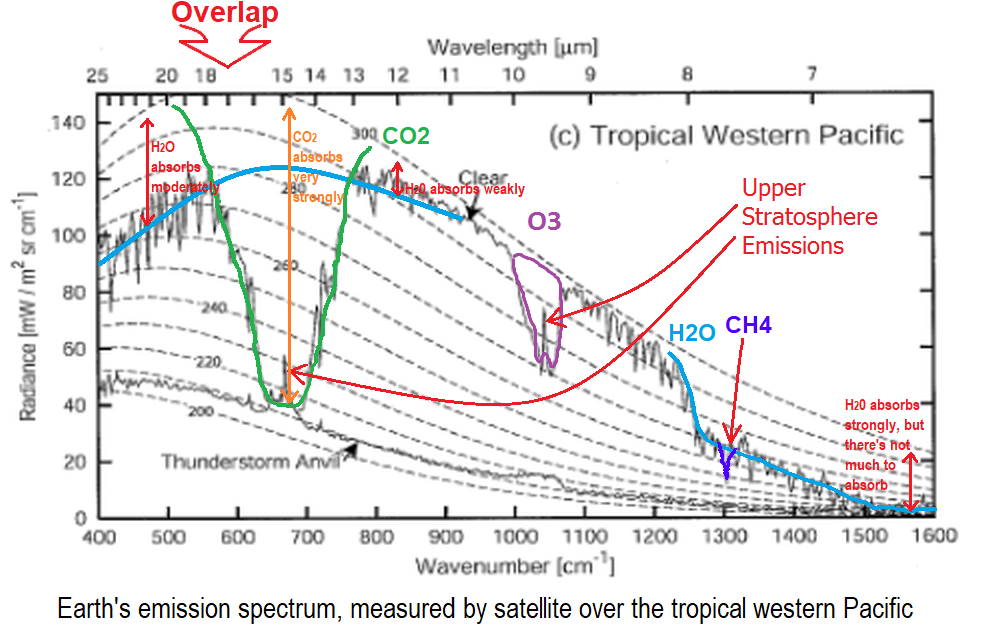
That’s not where the climate crackpots go off the rails.
Where they go off the rails is with their claim the effects are harmful, or even catastrophic. The overwhelming evidence is that the the effects of rising CO2 levels are net-beneficial, and the modest warming is benign. After all, real scientists call warm periods “climate optimums.”
2. That’s a bit of a red herring, because you’ve posed it as an either-or proposition. The reality is that neither is correct. CO2 concentration affects temperatures, but it is not the only thing that does. Temperatures affect CO2 concentration, but they aren’t the only thing that does (and these days they are a very minor factor). Neither controls the other.
From the ice cores we know that temperatures have an effect on atmospheric CO2 concentrations, and we can roughly quantify it.
The decline in temperature from MWP peak to the bottom of the LIA reduced atmospheric CO2 level in Antarctic ice cores by only about 9 ppmv, in 450 years, which is a rate of change averaging only about 2 ppmv per century. Likewise, the difference between interglacial peak CO2 levels and glacial maxima CO2 levels is only about 90 ppmv, from the combined result of ocean temperature changes, ice sheet burial and probably other mechanisms. Here’s a paper:
https://www.atmos.umd.edu/~zeng/papers/Zeng03_glacialC.pdf
Here are Law Dome (Antarctic) ice core data, back to year 1010. Scroll down to “CO2, 75 Year Smoothed”, then keep scrolling. Watch CO2 levels climb to their peak of 284.1 ppmv circa 1170 (MWP), and fall to their lowest level of 275.3 ppmv circa 1615 (LIA):
https://www1.ncdc.noaa.gov/pub/data/paleo/icecore/antarctica/law/law_co2.txt
284.1 – 275.3 = 8.8 ppmv, from a prolonged temperature change which probably in the neighborhood of 1°C (global average).
Over the much more longer time periods of the glaciation cycles, global temperature changes which are generally thought to have averaged less than 10°C, and perhaps as little as 6°C, caused CO2 level changes of about 90 ppmv.
From those data we can conclude that 1°C of globally averaged temperature change can be expected to cause somewhere in the range of 9 to 15 ppmv atmospheric CO2 level change.
3. Temperature increases have not caused the increase in atmospheric CO2 concentration. CO2 emissions did that.
Average atmospheric CO2 concentration has increased by about 99 ppmv since precise measurements began in 1958. From the ice core data we know that it would take between 6 and 11 °C of global warming to change atmospheric CO2 concentration that much, and to do it in just 62 years would require even more. I hope it is obvious that we’ve not seen that much warming since 1958.
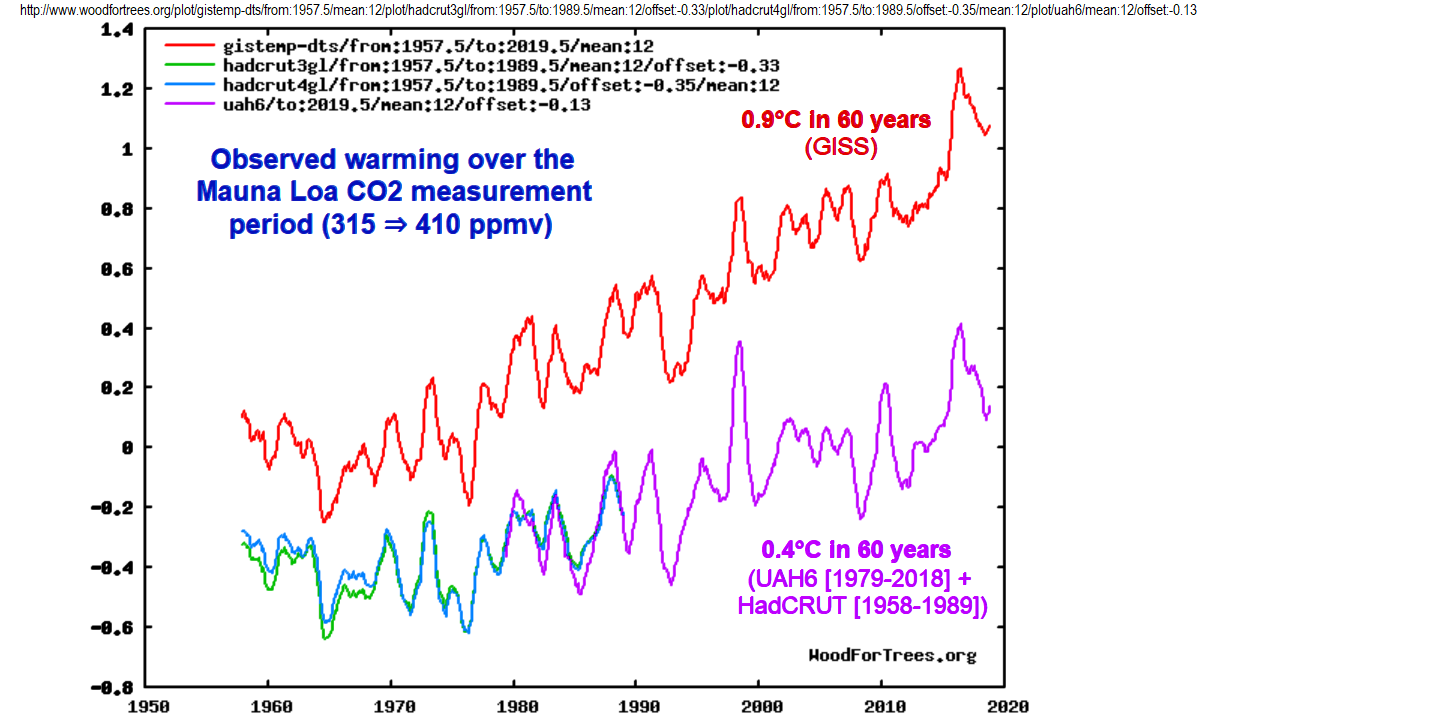
4. Graemethecat, less than three months ago you wrote that, “I have challenged several proponents of CAGW to provide me with tangible, empirical evidence that CO2 affects global temperature… I have yet to receive an answer.”
I’m definitely not a “proponent of CAGW,” but I gave you an answer to that question.
1. It is a mistake to argue about whether CO2 has a warming effect. It does. That’s proven physics. If you argue otherwise, you will lose the argument.
Argue, instead, about the things that the climate catastrophists get wrong.
Talk about the stubborn refusal of things to get worse; things like sea-level rise, storms, droughts, fires, polar bear numbers, etc.
Ask them if they know what a “climate optimum” is, and why it’s called that?
Talk about the compelling evidence that higher CO2 levels are dramatically beneficial for both human agriculture and natural ecosystems.
Show them graphs like these:
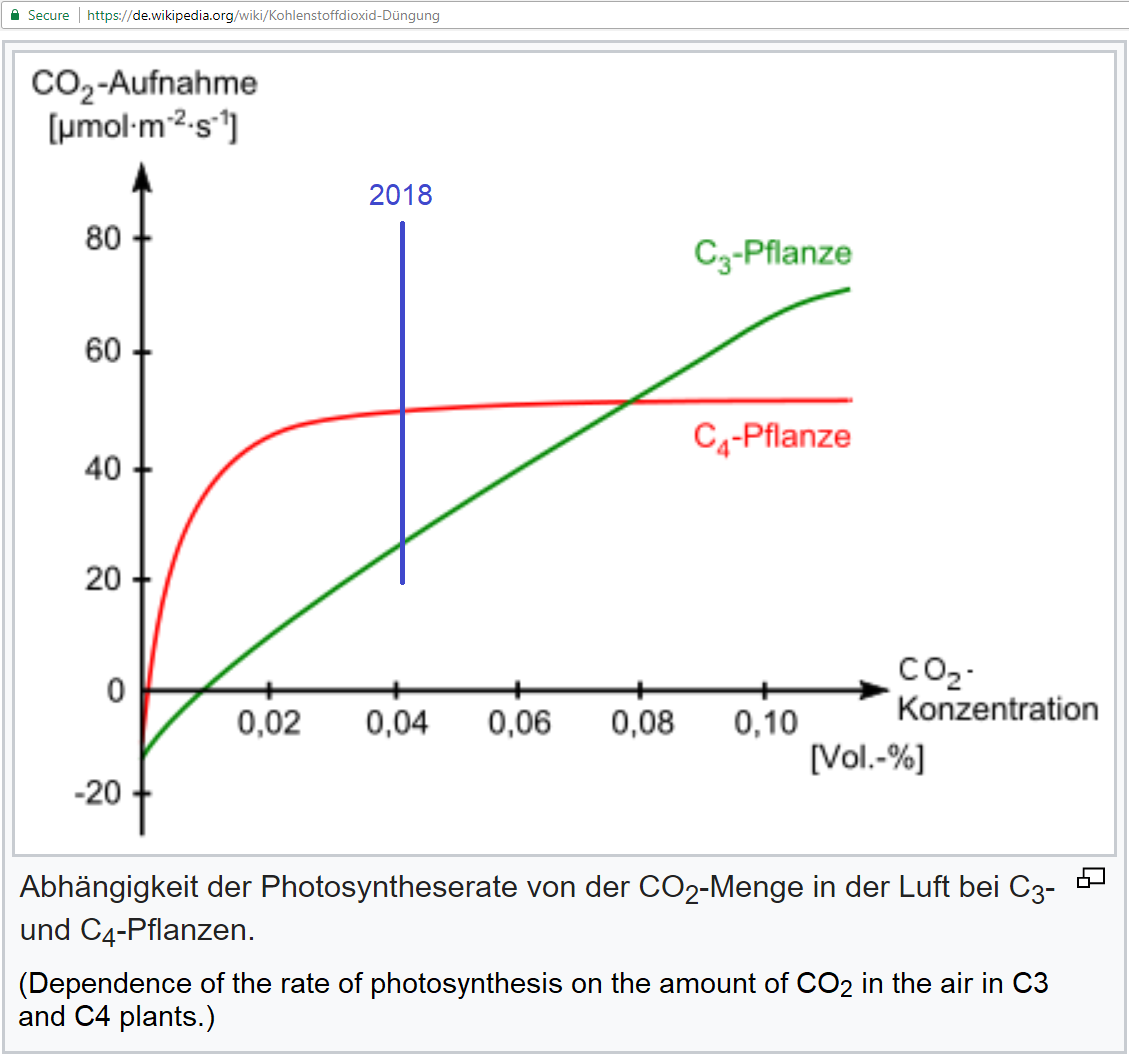
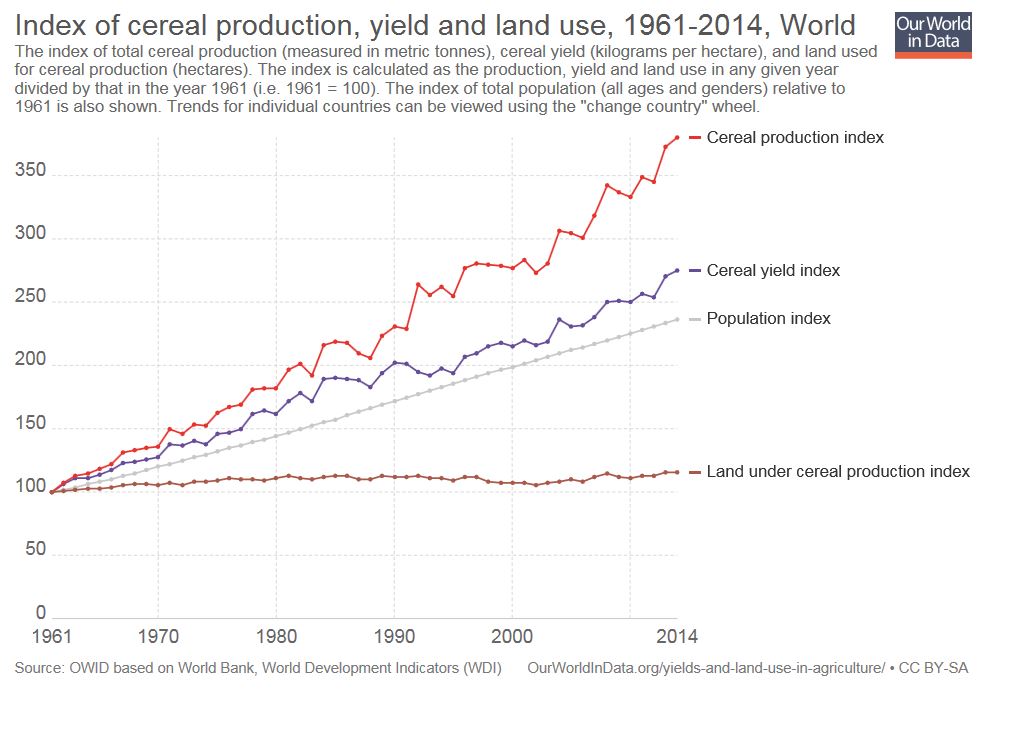
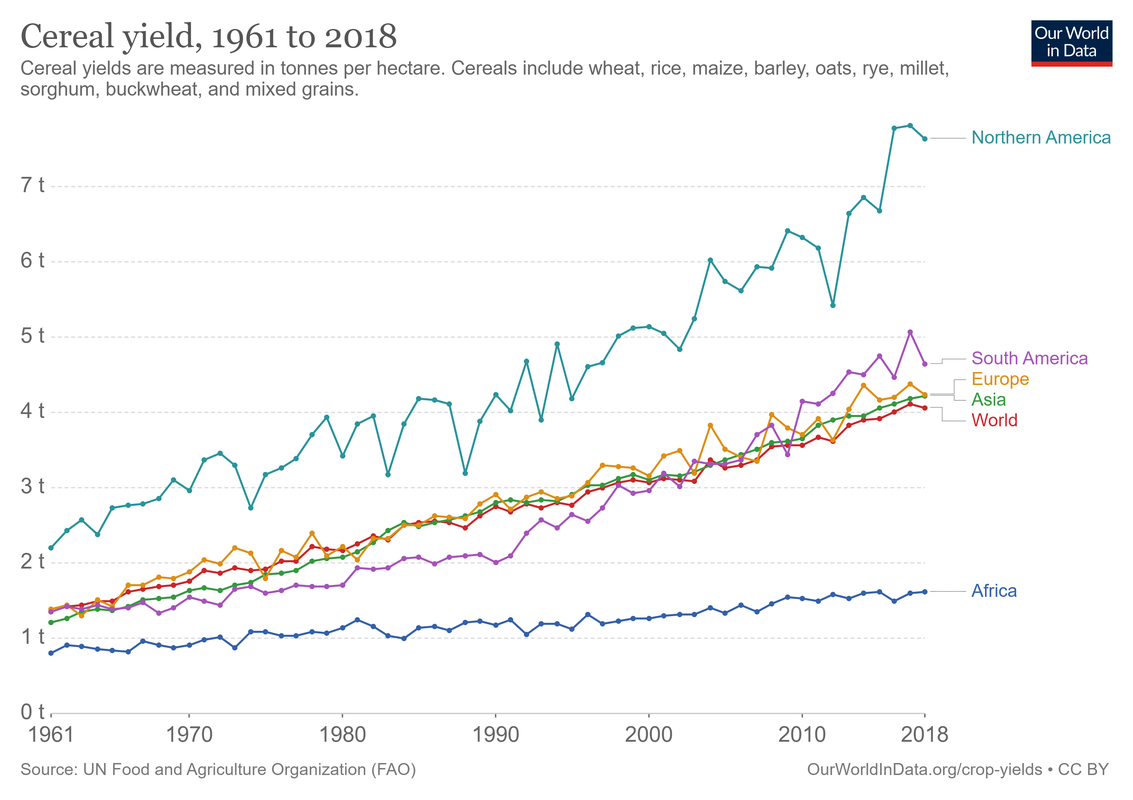
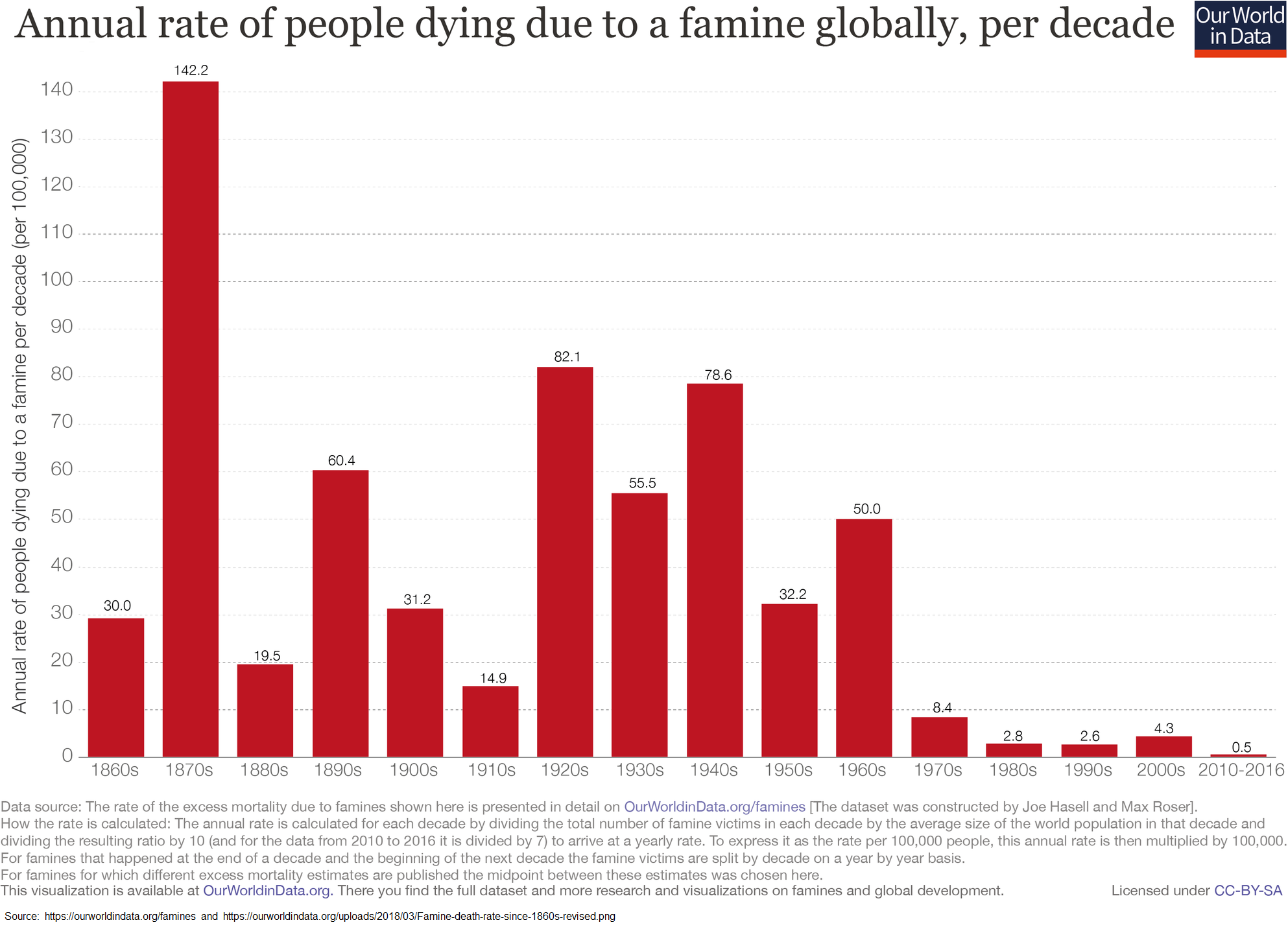
Show them maps like this:
https://www.sealevel.info/greening_earth_spatial_patterns_Myneni.html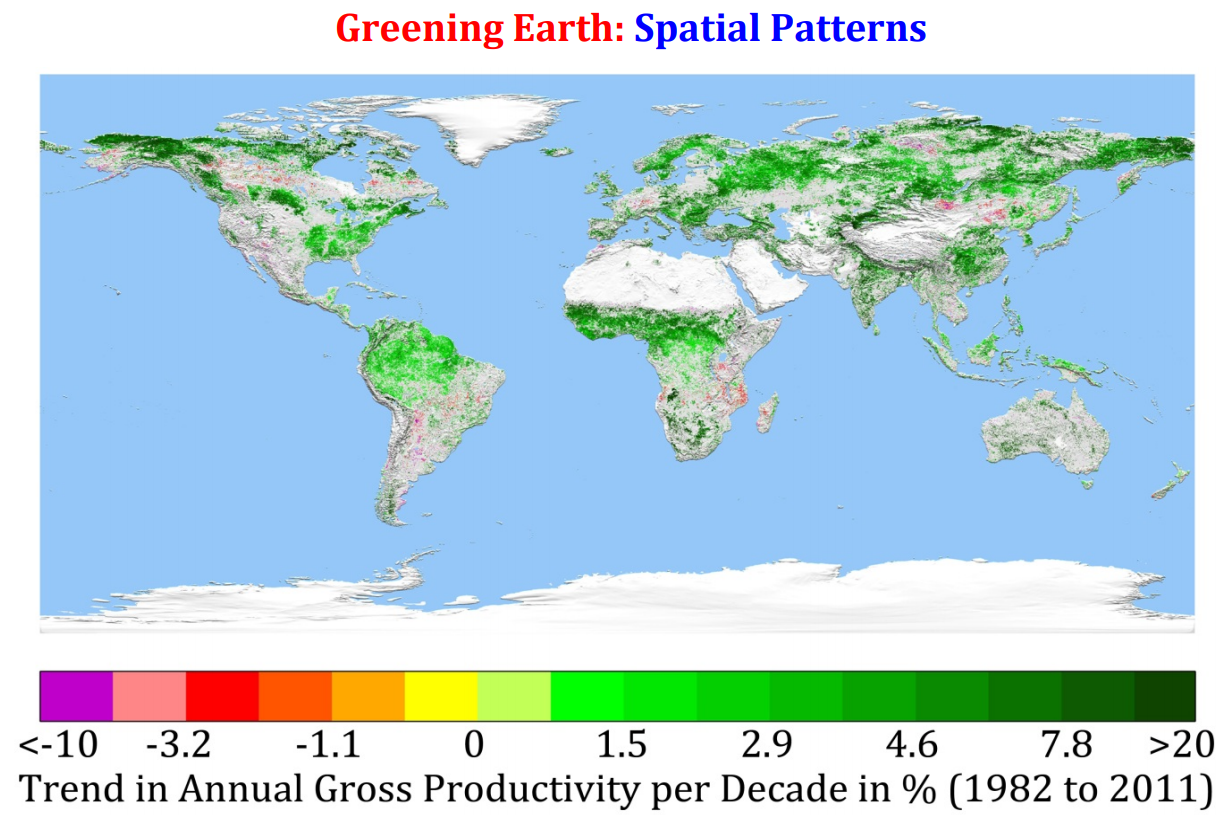
Well said. Roy Spencer also has a good blog post on weak skeptic arguments.
http://www.drroyspencer.com/2014/04/skeptical-arguments-that-dont-hold-water/
I would only slightly disagree with one point. I think the temperature increase and/or land-use changes since 1600 caused much of the CO2 rise before the mid-20th century. However, I agree that almost all, or all, of the CO2 rise since 1950-1960 is due to anthropogenic emissions.
While it’s impossible to determine the exact percentages, we know from the Law Dome DE08 ice core that atmospheric CO2 stopped rising for 10-20 years in the mid-20th century, despite increasing emissions. This was most likely due to the mid-20th century cooling.
One thing to keep in mind about the Antarctic ice cores, is that only the Law Dome DE08 core can resolve relatively short-term changes in atmospheric CO2. Over the past 2,000 years, it has a resolution of 10-30 years. Most other Antarctic ice cores have difficulty resolving century-scale changes.
Thanks, Dave. I’ve provided a much simplified version of some of your arguments in a post entitled “Gavin’s Falsifiable Science“. I’d recommend it to anyone interested in the underlying issues.
w.
Isn’t the real problem with the warmist’s theory the “amplification” or “feedback” effect? CO2 does some minor warming, the warmists agree. But they go on and multiply up that small amount of warming by suggesting the additional water vapour amplifies the GHG capacity to slow escaping energy.
Yes, and water vapor feedback is only one of many climate feedback mechanisms, which complicate the Earth’s climate system. Some of those feedbacks are positive (amplifying), and some are negative (attenuating/stabilizing).
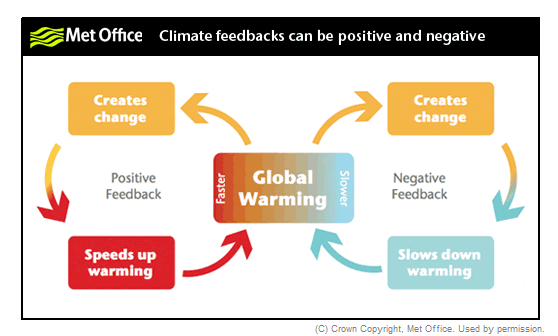
It is generally expected that warmer temperatures should increase the amount of water vapor in the atmosphere, because warmer air holds more moisture (roughly 7% more for each 1°C of warming). This effect is usually crudely approximated in climate calculations by assuming stable relative humidity as temperatures change. Under that assumption, warmer temperatures cause greater amounts of water vapor in the atmosphere, and since water vapor is a greenhouse gas, increased water vapor in the atmosphere should increase greenhouse warming: a positive feedback.
This is generally believed to be the most important positive climate feedback mechanism. Quantifying it is difficult, though.
The 2015 version of the U. of Chicago’s online MODTRAN interface calculated that for a Tropical Atmosphere water vapor feedback should increase the warming effect of CO2 in the tropics by only about 8% to 9%. That’s probably incorrect: most other sources give much higher estimates, generally between 60% and 100% (i.e., up to doubling).
AR4 section 8.6.3.1.1 cites Forster and Collins (2004)‘s estimate that water vapor feedback adds 0.9 to 2.5 W/m² of radiative forcing per 1°C of warming (best estimate 1.6 W/m²). For comparison, a doubling of CO2 is estimated to cause a radiative forcing increase of about about +3.7 W/m² (generally estimated to add a little over 1°C to average temperatures), before feedbacks (though Prof. Will Happer has found evidence that CO2’s forcing is commonly overestimated by about 40%):
http://www.ipcc.ch/publications_and_data/ar4/wg1/en/ch8s8-6-3-1.html
Such a wide range of values tells us little about the magnitude of the amplification from water vapor feedback. E.g., if Forster & Collins’ best estimate of +1.6 W/m² per °C of warming is assumed, and if it is also assumed that 2.8 W/m² causes 1°C of warming, and if other feedbacks are ignored, that would imply ƒ = 1.6/2.8 = 0.571, i.e., a very strong 57% positive feedback, which, with “compounding,” would result in a net amplification of 1/(1-ƒ) = 1/(1-(1.6/2.8)) = 2.33×, adding 133% to the original warming. But if 1°C of warming increases radiative forcing from water vapor by only 0.9 W/m², and it takes a +3.4 W/m² forcing to increase temperature by 1°C, then ƒ = 0.9/3.4 = 0.265 (26.5%), and, with compounding, the net amplification would be only 1/(1-ƒ) = 1/(1-(0.9/3.4)) = 1.36×, adding just 36% to the original warming.
Much more usefully, AR5 drops the Foster & Collins (2004) reference, and instead considers Water Vapor and Lapse Rate feedbacks together, with a much narrower estimated range (section 7.2.5, p.587) of +0.96 to +1.22 W/m² per 1°C, for the net effect of the two feedbacks, combined. If we also assume that 2.8 to 3.4 W/m² forcing causes 1°C of warming, that would imply a 0.96/3.4=28% to 1.22/2.8=43% positive net combined feedback from water vapor & lapse rate feedbacks, which, with “compounding,” would result in a net amplification of 1/(1-ƒ) = 1/(1-(0.96/3.4)) to 1/(1-(1.22/2.8)) = 1.39× to 1.77×, adding 39% to 77% (best estimate 54%) to the original warming.
The highest estimate (by far!) that I’ve ever seen was in a 2013 paper by Lacis & Hansen, et al, which claims (without support) that the “feedback contribution to the greenhouse effect by water vapour and clouds” effectively quadruples (adds 3× to) the warming effect of CO2 and other GHGs.
Steve Carson’s “Science Of Doom” blog has fairly in-depth discussions, here:
● http://scienceofdoom.com/2015/04/30/clouds-water-vapor-part-eight-clear-sky-comparison-of-models-with-erbe-and-ceres/
● https://scienceofdoom.com/2011/09/02/radiative-forcing-and-the-surface-energy-balance/
A complicating factor is that atmospheric water vapor levels do not appear to be increasing as expected:
● http://wattsupwiththat.com/2012/07/18/new-paper-on-global-water-vapor-puts-climate-modelers-in-a-bind/
● http://wattsupwiththat.com/2012/12/14/another-ipcc-ar5-reviewer-speaks-out-no-trend-in-global-water-vapor/
● http://wattsupwiththat.com/2013/03/06/nasa-satellite-data-shows-a-decline-in-water-vapor/
● http://wattsupwiththat.com/2014/07/28/new-study-claims-to-confirms-water-vapor-as-global-warming-amplifier-but-other-data-says-no/
A further complication is that, although water vapor feedback certainly amplifies temperature increases, it probably amplifies temperature increases due to rising CO2 by less than it amplifies temperature increases due to most other forcings, because of the overlap between the absorption bands of H2O vapor and CO2, on the long (>15 µm) side of CO2’s LWIR absorption band.
Note that some scientists use the term “water vapor feedback” in a broader sense than I’m using it, to encompass not only the direct greenhouse warming effect of atmospheric water vapor, but also water cycle (evaporative) cooling, lapse rate cooling, and/or perhaps clouds. For example:
● http://www.drroyspencer.com/2014/09/water-vapor-feedback-and-the-global-warming-pause/
● http://www.drroyspencer.com/2015/05/new-satellite-upper-troposphere-product-still-no-tropical-hotspot/
● http://www.drroyspencer.com/2015/08/new-evidence-regarding-tropical-water-vapor-feedback-lindzens-iris-effect-and-the-missing-hotspot/
Thanks, Dave. However, I fear you’re missing some important parts of the situation.
• The lifetime of water vapor in the atmosphere is days, unlike that of CO2 which is in years.
• It takes lots of energy for water to evaporate, which cools the surface.
• What goes up must come down … all the water evaporated comes down as rain or dew.
• When the water leaves the atmosphere it generally comes down as rain. Cold rain, falling from high in the atmosphere. This cools the surface, a lot.
• The rain entrains air, making a vertical cold wind that when it hits the surface spreads out in all directions. So areas far from the rain get cooled.
• The rain evaporates as it falls, sometimes evaporating entirely (called “virga”). So it can cool the air without even making it to the ground.
• In the tropics, thunderstorms evaporate lots of water underneath them. This water goes straight up into a cloud, condenses within the cloud, and cold rain falls out … so the vapor has little opportunity to act as a GHG.
Finally, all of this depends on the amount of water vapor in the air. Typically this is called “total precipitable water (TPW). The measure of TPW is kg of water per square metre of surface.
So how does the amount of precipitable water vary with surface temperature? This is one of the most misunderstood of variables. Here is the relation of annual average TPW and the annual average temperature:
This is a complex relationship, where in the warmest areas near 30°C the TPW is going almost straight up.
And it seems like this is related to the fact that almost nowhere in the open ocean, and few places on land, does the annual average temperature go above 30°C.
As a result of all of these complications, calculating the change in “water vapor feedback” is a most perplexing problem.
As Shakespeare might have said, “There are more climate phenomena, Horatio, than are dreamt of in your philosophy”.
w.
“Much simplified,” eh? 😉
You make lots of great points there, Willis. E.g.,
Well, yeah. It is clear that the GCMs are not fit for purpose. The GCMs listed in AR5 (Table 9.5) make wildly different assumptions about basic properties of the system which they’re trying to model. For example, properties like ECS and TCR both vary between models by more than a factor of two! If the physical processes that they’re trying to model were actually understood, that could not happen.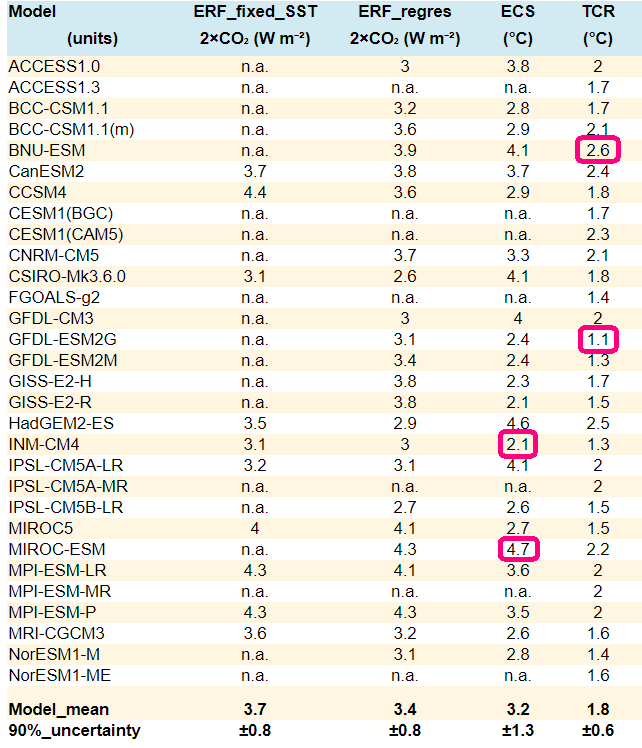
Could you perhaps help me with this point that I hear a lot? “But we’re changing the CO2 levels faster than can ever occur naturally, therefore the system will spiral out of control.” (Or something similar.)
See the recent W. Happer paper on the ineffectiveness of additional CO2 on raising the temperature. The GWPF, in its recent weekly threads here, has highlighted that paper three times, and reprinted much of it.
It has been rejected by three leading climate journals, which adds to the disgracefulness of the warmist side. The only way to bring them to book is to make them an offer they can’t refuse: a no-cost, week-long series of debates at the Oxford Union.
Thanks, Dave Burton. Great post.
And Extra goodie special thanks, to Willis, for the fog clearing article.
Keep holding their feet to the fire.
Does this answer your question? https://www.youtube.com/watch?v=zQ3PzYU1N7A
Spot on as usual Willis. That’s why they will ignore it or hide it or do whatever they do to prove you are an evil “Denier”. Keep it up.
The future Dystopia — when everything that is not approved is censored and cancelled. It is starting now with Google, YouTube, Facebook, and more.
One thing about it, noone is forcing anyone to use Google, Youtube, Facebook, Twitter, and other leftwing social media sites.
I would say the leftwing social media needs some competition from the rightwing social media. Why play on the left’s home field? They can’t censor you if you are not taking part in their games.
I would also think conservative media platforms would attract the lefties, too. Why not? They won’t get censored if they behave themselves properly. They won’t get censored for their ideas. Their ideas will just be refuted with good arguments.
One of these days conservative social media will reach critical mass and then the internet social tide may turn.
Their ideas will just be refuted with good arguments.
That’s probably why they will avoid such platforms. Easier to stay in the echo chamber and not deal with any intellectual challenges.
There are already many competitors to the leftist big tech cabal.
DuckDuckGo is search engine that actually searches without the misdirection of Google.
BitChute, Rumble, Parler and others compete with YouTube.
There are many browsers which do not track everything you do. Brave, Vivaldi and Firefox are better than Google.
Wimkin, Gab, Minds and others compete with Facebook.
The problem in competing against Big Tech is the insidious nature of the left. Once a competitor shows up, Sleeping Giants and their ilk go to work to destroy the competitor. First they go after their advertisers, then the work to deplatform their sites, then they get PayPal, Visa and MC to cancel their accounts to cut their funding.
It’s worse, as the Twitter handling on the Post story on Biden’s laptop proved. Evidence is not permitted but unfounded conjecture is.
“the old Hollywood axiom that ‘All publicity is good publicity.'”
I’d always heard it as Madison Avenue, but I’m not sure there’s ever been much difference, and it probably goes back centuries. Martin Luther and his Popes probably understood it.
With Cancel Culture, I think that axiom has been proven false.
To my mind the concept of peer review is not part of the scientific process, it is a political process devised by so called “policy makers” to subvert the action of scientific enquiry and to skew the answer to support a partisan political objective.
Peer review assumes two fundamental things: 1) that reviewers are knowledgeable and 2) that they are honest. My experience (with over 40 publications to my name) is that both assumptions are false. The review system is inherently vulnerable to subversion, caused by either ignorance or by malicious obstruction or both. It is an outdated concept and ought to be abolished.
Ed, your comment reminds me of James Lindsay’s Grievance Studies hoax. While plumbing the depths of the academic peer review in soft sciences, he and his colleagues were able to publish absolute garbage quality academic papers. Here’s a short video of it: https://www.youtube.com/watch?v=kVk9a5Jcd1k
Exactly right!
Everyone: if you haven’t yet seen that “grievance studies” video which leowaj linked, do yourself a favor, and watch it now!
It would be hilarious if it weren’t so tragic.
Unfortunately, the Left has subverted many fields, substituting politics and special interest propaganda for sound science. Climate science is one of those fields, but it certainly isn’t the only one. In fact, many fields are now dominated by complete crackpottery.
BTW, if you want to know why the video “in-lined” for me, but not for leowaj, I think it is because I put the video’s URL on a line by itself, and leowaj put it at the end of a line of text.
It worked for me even though I used the longer version of the URL, which includes the “&lc=UgyqbK1IDJFBj1mrRC54AaABAg” part to highlight a particularly astute comment (by Prof. Mark Frost):
Whoops, I expected that one to post as a link, but it didn’t. It had text on the same line as the YouTube URL, before the URL, but no text after the URL.
I’m going to try again, using the same URL, but this time with text on the same line both before and after the URL:
This text is before the URL, on the same line. https://www.youtube.com/watch?v=kVk9a5Jcd1k&lc=UgyqbK1IDJFBj1mrRC54AaABAg This text is after the URL, on the same line.
There is peer review and peer critique. Publishing scientific journals is very profitable and key to keeping the expensive academic library subscriptions being renewed is to maintain a reputation of being authoritative and trustworthy. Thus, there is a built-in bias for being very conservative (thus weeding out the ‘perpetual motion machines’) and not rocking the boat with research that challenges the current paradigms. To that end, so-called peer review is actually a function of ‘gate keeping’ that weeds out anything really controversial or that goes against the paradigm consensus.
On the other hand, the real purpose of journals was originally to allow the peers of researchers to critique the published research and conclusions as part of the process of the Scientific Method.
Unfortunately, because of the overwhelming profit motive, the ‘out of the box’ ideas and paradigm-upsetting research finds it very difficult to get published in the old line journals. And, the peers usually don’t get a chance to critique really novel ideas. Therefore, advances in science are slowed to make sure that the journals stay in business. It is a tradeoff that favors profit more than advancement. That, and the tendency to award grants to Big Science that supports the status quo.
Weeding out anything ‘controversial’ is purely subjective. The reviewer ‘advises against publication’ because he or she does not like your conclusions, not by showing that your methods or logic are flawed.
I love being called a denier as I think it means I won the argument.
The part that saddens me is that when I post a comment on LinkedIn or elsewhere there are many that I know agree with me but are too afraid to signal that directly
The reality that people feel they cannot express their opinion is something the climate scientologists will have to answer for someday
What a great phrase…climate scientology! Can I use that?
Alastair, I cant claim to have invented the phrase but I think it fits best with the quasi religious nature of the arguments on here from some of the alarmists.
How else to describe Griff where he blathers endlessly about reduced arctic ice but never will acknowledge that regardless of ice cover the bears are increasing, because his religion states less ice MUST be bad for bears
So it must.
People like him are why I couldn’t stay in the Catholic Church 40 years ago, for which my mom never forgave me
I keep my views on climate change and many other controversial topics away from LinkedIn as I don’t want to lose business.
Gotta eat
Sure Redge, but if the direction of thought and policy is going to destroy my business, I have to step out?
Canada leads the world in virtue signaling, all in for the Paris accord, but I simply ask why we need to reduce CO2 production when the amount we are supposed to decrease by 2030 is equivalent to 1/30 of what China is allow to INCREASE over the same period?
How can I possible take this seriously and not crap publicly all over it.
I have been attacked by a couple guys who I recognize from commenting here, I point out that they alway leave here with their heads being handed to them
Such a great site
I get it, Pat.
I have spoken out on occasions when ill-informed, supposedly intelligent people have made ridiculous statements such as “millions are dying now because of climate change!”.
I’ve pointed out the lack of evidence for this and the true killer in poor countries – lack of sanitation and education – and I’ve noticed a drop in enquiries for my services.
This is not just climate change.
On the black lives matter movement, one of my (white) contacts posted a rant about US cops killing an unarmed black man.
My response was measured. I agreed with him it shouldn’t have happened and the police should be held accountable. The moment I mentioned the number of black people killed by black people on a daily basis, I was all of a sudden a privileged white racist man.
It’s the same with slavery. What happened was wrong, but try pointing out black Africans sold their countrymen into slavery and you’re a racist.
I avoided a discussion of the racist aspects of 60s/70s British comedies, although I wanted to point out that the white racist was an unlikeable man. This man always lost out to the better looking, better educated, more eloquent black man who was often lusted after by the ignorant white man’s object of affection.
British comedies were not racist, they were anti-racist.
Personally, I think these discussions shouldn’t be on LinkedIn, but, from a business point of view, sometimes it’s best to not get involved.
In my business circle, I’m known for my honesty and integrity. I won’t overcharge even when it’s an open cheque and if I say something will be done to meet a clients deadline, it will be done.
I have a good reputation and a successful business.
I’m not going to lose that over something I have no real control over.
Extremely important to take the Great Reset seriously.
Credit for “successful business” will be first digital, thus easily vetted for green compliance, and be-damned if you do not measure up.
Green reputation is going to be key.
Shareholders will experience extreme pressure, from the like of BlackRock to do due green diligence, reputations will be smashed.
Linked-in is only the start.
So says Prince Charles, soon to be King of the USA.
Willis, you write:
Somewhere between flames and provisionally there needs to be discussion of the new idea (model, conjecture, viewpoint) allowing a prediction about things as yet unseen. “If we raise prices, demand will fall.” “If the speed of light varies with the motion of the earth we will detect interferometer patterns.” “If the tree rings represent GLOBAL weather patterns then new samples from Norway will match previously collected samples from Siberia and Canada.”
By chance, just before arriving at WUWT I was looking at this:
https://www.geeksaresexy.net/2020/12/30/a-theory-about-the-evolution-of-dwarven-beards/
Which is a closely crafted model of scientific reasoning. Progressing from intuition to notion to conjecture to hypothesis — to consensus. But there is no way to EXPERIMENT with the idea. No prediction, no measurement, no way to refute.
Fun, for sure. “Scientific” in the fashion of thought and being consistent with other observations of actual phenomena. But — not predictive.
SO, I suggest you add a line in your discussion / definition to account for the processes of testing predictive values of any scientifically generated hypothesis.
Thanks,
Thanks, pouncer. There are hundreds of ways to falsify a scientific claim. The code might have bugs. The observations might be biased or inadequate. The logic may contain unjustified assumptions. And, as you point out, the theory may make predictions that don’t come true.
My goal was to give a broad overview of the scientific process, rather than to delve into the details.
All the best,
w.
Spot on, Willis. Thanks WUWT.
Happy New Year, Everybody!
Thanks so much, Zoe. You and I are proof that people can disagree passionately about the science, and yet respect each other.
My very best of the new
year to you,
w.
Thank you, Willis. I have always admired your writing skills. I just wish you wouldn’t neglect what’s beneath your feet, so to speak.
Have a happy new year. Best regards, -Zoe
What the AGW true believers hate most about WUWT is having their leaders and pundits regularly exposed for their bad science and ludicrous claims.
In fact, this site has become possibly the only platform in which people from both sides and even those riding the fence can cross swords on neutral ground. As Willis indicated, WUWT is one of the few places where real “peer review” takes place.
Those who attack the skeptics that are critically analyzing the AGW alarmist narrative (and finding it wanting) are the ones attacking science, not the other way around. The idea that the skeptics are attacking and denying the “science” of the AGW theory comes from those who do not understand how science and scientific discourse work.
The failure to understand how scientific discourse works is one of the things that permits the AGW narrative to survive and prosper in politics, in the mass media, on the Internet and elsewhere. Keeping the masses ignorant of this is vital to the AGW narrative’s continuing survival. The dominoes of climate alarmism could start falling when there is a concerted effort to do something about that.
Biden won’t be the one to change the status quo.
Happy new year Willis and to all on wuwt!
I totally agree, that science should be kept in the scientific trail and that all political and religious debates should be kept where they belong. Science IS not about consensus.
I do hope that all you bright guys out there will be able to shoot a big hole in the simple black body model which is the “scientific” basis for the greenhouse effect. It seems to me, that there is a hugh problem, when CO2 should be accountable for a 33 C temperature rise, and I can’t find data that suggest that. As I see it this model is false due to the fact, that black body Earth model don’t consider a complex atmosphere, a rotating Earth, with a gravity that creates a pressure (=warming) and that Earth contains 2 complex water and water vapor based fluid systems.
Lets get to the root of the problem! and once and for all get this theory falsified!
Happy new year!
Kind regards
SteenR
Thanks, Steen. The very poorly named “greenhouse effect” is quite real. See here for details.
The real problem lies elsewhere. See here for a full discussion of the unresolved question.
Best regards,
w.
What if steel greenhouse is heated only by sunlight at 1 AU from the Sun?
And between shell and surface is vacuum.
And/or varying amount atmosphere- which amounts to varying amount internal pressure upon the shell. Say near zero to 10 psi.
One could also have shell spin and/or planet {or it could be planet, Earth}.
For vacuum the “planet” could be the Moon.
In terms of real world, structurally, it seems difficult. And economically, crazy.
And miles above the surface, even worse.
Since economically crazy, let’s base it on political decisions, so all transportation system must be 100 meter {or higher] above the natural lunar surface.
So, got tracks, encircling world, and after thousand years bureaucratic hell, you tracks going everywhere- will spaces between tracks filled in. And this shell
is not spinning- it’s fixed to lunar surface.
Does it affect temperature of “natural surface” temperature.
And there is a political question to answer, if painted it with reflective paint or black paint, does make much difference to the “natural surface” temperature?
Earth, since have atmosphere, perhaps one can use atmosphere to hold up the sphere. And since it’s dumb idea, we will assume it’s also political decision.
Let’s say the desire is to have uniform average temperature of 15 C as measured 5 feet above the surface.
A basic problem is the sunlight would not uniformly warm the sphere.
If we had the magical technology of Ideal thermally conductive blackbody, one could make the sphere have uniform temperature {which would be about 5 C}.
If lapse rate is 6.5 C per 1000 meter: 10 C / 6.5 = 1538.46 meters above sea level.
And the weight shell could not exceed the weight of Earth atmosphere above
1538.46 meters above sea level. Or something like say 7 tons per square meter
of shell. Or removing amount atmosphere above shell to equal it’s mass.
“I do hope that all you bright guys out there will be able to shoot a big hole in the simple black body model which is the “scientific” basis for the greenhouse effect. “
It seems you talking about Ideal thermally conductive, blackbody.
Which at earth distance from Sun would have uniform temperature of about 5 C.
The unscientific bit is part where it’s reflective.
Quite simply, ideal blackbody is not reflective.
But if accept the nonsense of Ideal thermally conductive, blackbody which also reflective
one would it is said to have uniform temperature of about -18 C or maybe it’s an average temperature of -18 C.
The ideal thermally conductive blackbody at 1 AU distance from the Sun having a uniform temperature of about 5 C seems like a somewhat useful model.
And I believe there are some fast spinning small space rocks at around 1 AU which conform to this model.
Earth does have anything approaching a uniform temperature, but one can say Earth has a more uniform temperature as compared to Moon, as the Moon much further away from having a uniform temperature. Due to slow rotation and it’s surface is no where near being ideally thermally conductive. Though if the Moon had enough atmosphere it would be more towards that of being thermally conductive.
Ideal thermally conductive could bring to mind material which highly conductive of heat- silver, copper, diamond, and metals in general.
But broadly the idea of it, is being able to absorb energy.
And Earth’s atmosphere and oceans can absorb a lot energy.
“It seems to me, that there is a huge problem, when CO2 should be accountable for a 33 C temperature rise,..”
The Greenhouse Effect theory seems to allow the idea that CO2 and CO2 alone can cause 33 C temperature rise, but that mainly because “Greenhouse Effect theory” is utter garbage that is written by committee of idiots.
gbaikie
Reply to
Steen Rasmussen
December 31, 2020 1:48 am
I’ve never read anyone saying that the black body model represents the earth, or that it is the scientific basis for the “greenhouse effect”. And in fact, your calculations of the average temperature of a blackbody at 1AU from the sun assumes that the blackbody is superconductive of heat … and nobody makes that assumption.
Let me recommend to you the excellent explanation of the problem by Dr. Robert Brown entitled “Earth’s baseline black-body model – “a damn hard problem“. It is not a simple question in any sense.
My best to you,
w.
“I’ve never read anyone saying that the black body model represents the earth, or that it is the scientific basis for the “greenhouse effect”. And in fact, your calculations of the average temperature of a blackbody at 1AU from the sun assumes that the blackbody is superconductive of heat … and nobody makes that assumption.”
Wiki:
“An ideal thermally conductive blackbody at the same distance from the Sun as Earth would have a temperature of about 5.3 °C (41.5 °F). However, because Earth reflects about 30% of the incoming sunlight, this idealized planet’s effective temperature (the temperature of a blackbody that would emit the same amount of radiation) would be about −18 °C (0 °F)”
https://en.wikipedia.org/wiki/Greenhouse_effect
Yes, an ideal thermal conductive assumes superconductive transfer of
heat.
And Wiki “a temperature of about 5.3” when it’s actually uniform temperature of 5.3 C.
Typical Wiki BS, obviously they’ve never read Dr. Brown’s post about why it is insanely difficult.
Now my statement was ““I’ve never read anyone saying that the black body model represents the earth, or that it is the scientific basis for the “greenhouse effect”.”
And true to my statement, they don’t say the blackbody model represents the earth. They say it is an “idealized planet”. And they don’t claim that that idealized planet is the “scientific basis for the greenhouse effect”. They just ramble on about a superconducting blackbody … and???
And of course, the real earth is not superconducting … so all I can say about this Wiki nonsense is, unsurprisingly, it’s garbage.
w.
Let me recommend to you the excellent explanation of the problem by Dr. Robert Brown entitled “Earth’s baseline black-body model – “a damn hard problem“. It is not a simple question in any sense.
Well that interesting.
I will add stuff.
With Moon it’s first few inches in highly insulated and the geothermal heat of moon can seen in it’s dark crater which have measured at cool at 30 K.
And of course lunar poles are sunlit and have a lot shadows. Due to low angle of sunlight level areas not heated by much but stuff like mountain side can be heated.
And regarding earth, when considering longer time scales, one has included geothermal heat of the ocean which also being cooled the falling waters of polar regions.
Very complicated.
But in terms of simple, the entire ocean temperature which is about 3.5 C
determines global average air temperature.
Or cooling or warming by 1 C, makes large difference upon global average surface air temperature.
And regard the number 3.5 as not related ideal thermal conductive blackbody
of about 5 C- mostly a coincidence. Other than planets roughly could be around 5 C at about 1 AU from Sun.
Thanks, Gordon. There’s a longer discussion of these issues in my post “The Moon Is A Cold Mistress“.
w.
“It seems to me, that there is a hugh problem”
What did Hugh ever do to you?
https://youtu.be/MYNNaMDNlYI
Nicely stated, Mr. Eschenbach.
The wikipedia “cancel culturists” and bullies (this means you, William M. Connolley) are the antithesis of scientists.
Thanks, John. William Connoley is behind many of the climate “edit wars” on Wiki, and since he’s an editor or whatever they call them on Wiki … guess who always wins?
w.
William is an editor, which is the term applied to any of the millions of people who have made an edit. He was an administrator at one time, but that was stripped. He’s not the antithesis of a scientist, he’s an actual scientist, which makes him rare among Wikipedia editors.
Stephen, I’ve had more than a few interactions with William. I fear that I would say that he is not a “scientist” at all, he is the antithesis of a scientist. He ran the climate section of Wikipedia and was absolutely ruthless in censoring anything his fantasies disagreed with.
Here’s what he said about me:
Yeah, that’s a real scientist making a real scientific objection to my work … which consisted in toto of waving his hands and making accusations.
Here’s Pointman on Connolley:
Here’s Anthony on the subject:
He has censored or rewritten over 5000 articles … science in action, I guess.
So for you or anyone claiming that Connolley is a scientist, all I can say is what they said on the cattle ranch where I grew up …
w.
John, I’m so glad that you mentioned William M. Connolley. Just look at how Wikipedia itself (https://en.wikipedia.org/wiki/William_Connolley ) currently portrays his past outrageous, personally-biased editing of many, many articles/additions/corrections submitted to Wikipedia by other qualified contributors on the subjects of climate and climate change:
“Connolley received national press attention over several years for his involvement in editing Wikipedia articles relating to climate change.”
A world of sins are hidden under that phrase “national press attention”.
Here is a significant fact that you will not find in the current Wikipedia article on Connolley:
After a finding of his malfeasance in editing climate articles on Wikipedia, Wikipedia management “punished” Mr. Connolley in late 2010 by banning him from making any edits for 6 months. It is disgraceful that Wikipedia did not ban him from ever again editing even a single Wikipedia article, no matter the topic.
(source: https://wattsupwiththat.com/2010/10/14/willia-connolley-now-climate-topic-banned-at-wikipedia/ )
The above link to the Oct 14, 2010, WUWT is still active (thanks 10^6, Anthony!) and provides additional details on the Connolley “slap on the wrist” from Wikipedia, as well as reference to other publications that carried the same story at the time. Of course, Wikipedia itself finds no reason to mention this significant event in their “purified” story over the greatness of having Connolley as one of their “renowned” editors. Not too surprising, there!
The founder of Wikipedia, Jimmy Wales, is reported to be a big Greenie and strong advocate of AGW, so you can see why Wikipedia’s censoring and outright falsifications related to climate change subjects could have become policy at that once-honorable, comprehensive Web resource.
The above scandal was the reason that a decade ago I ceased donating to Wikipedia. I see no reason to revisit that decision.
“It is disgraceful that Wikipedia did not ban him from ever again editing even a single Wikipedia article, no matter the topic.”
Yes, it is! It’s an outrage! One of many in climate science.
6 months is a fairly significant ban, and especially for someone who at one time was an administrator. Can you point out examples of problems after he returned from his ban that are problematic?
No. Why should I bother?
You should bother because I will take action if you point out a clear example.
Well, others have fulfilled your request, per posts below with clear examples.
Now, what specific “action” do you promise to perform?
Yeah … try here.
Next, you’d think that after being kicked out on his ass from Wikipedia, which tolerates all kinds of ugly creatures, he’d hide his head in shame. But nooo … he’s got a blog called “Stoat”, which is a kind of weasel … no comment. And of course, he uses it to attack people, not to further science.
Next, I gave you a bunch of links to other people talking about W. Connolley and what a vicious jerk he is.
So I’ve gone to the trouble of doing a hunk of research and laying out a host of objections to Connolley. So what’s with you defending a scumball like him? He censored articles by Dr. Richard Lindzen, whose shoes he is not fit to polish.
I ask because in doing so, you’ve totally canceled your vote on my planet. Why should I believe someone who thinks Connolley is a good guy, won’t listen to evidence to the contrary, and when you are told that even Wikipedia couldn’t stand him, your response is you want “examples of problems after he returned” …
What, his banning of over 5,000 climate articles and doing so in such a way that Wikipedia canned him isn’t enough for you?
What is your name? Stephen Philbrick? Ah, well, just another Connolley apologist. He’s got lots of sycophants, and I’ve just added your name to the list. Me, I’ll never believe another word you say, or answer any further questions.
Why should I answer them, when you’ll just say something along the lines of “Well, after John Wayne Gacy killed all those kids and buried them under his house, what kind of problems did he cause after that?”
w.
PS—I say all of this in sorrow, not in anger. I hate to see someone like you who is so enthralled by a “scientist” that they refuse to hear a bad word about him.
Groupie is the word you were looking for.
You misjudge me.
I think Connolley’s contributions to Wikipedia are mixed, some positive, many negative, and on balance have been negative, but being a net negative is not license to say anything you want about them. I have defended Connolley when I think the aspersions are inaccurate. I trust you would do the same. If you examine the history of my interactions with him. you will see I am usually not in support of his edits.
Thanks, Stephen. Me, I don’t throw good money after bad. Given his actions at Wiki, and various claims on his website (“Stoat”), along with my link in the post above, I’m done with him.
I still don’t understand your objection, though. For me, it’s like if a dog bit me last year, and not just me but five dozen other people.
After that, I truly don’t care what anyone says about the dog. Nor would I believe anyone who claimed the dog was “reformed” or had changed his ways. I would NEVER trust that dog again … same with Conolley.
And no, I will not defend Connolley on any grounds. He’s gone far beyond that with his vile actions on Wikipedia, has slandered the names of a lot of good men, and has used his authority to do huge damage to climate skepticism with his lying edits.
Now, I won’t cast false aspersions on him. I don’t lie to help or hurt any man.
But I truly couldn’t care less if someone else does. Not my pony, not my rodeo. He can defend himself, but I certainly won’t. He’s canceled his vote with me forever.
Best of the new year to you,
w.
Here’s Connolley’s recent edit history:
https://en.wikipedia.org/wiki/Special:Contributions/William_M._Connolley
Here’s an example of him editing on climate change:
https://en.wikipedia.org/w/index.php?title=Global_cooling&diff=prev&oldid=994152428
As you can see, Connolley’s “revert” reinserted the following statement into an article entitled “Global Cooling”:
Obviously that is untrue. There’s a broad consensus that the Earth cooled (rather than warmed) from the early 1940s through the mid-1970s, though the amount of cooling has been reduce by numerous revisions to the data:
https://woodfortrees.org/plot/hadcrut4gl/from:1940/to:1975/mean:12/plot/hadcrut4gl/from:1940/to:1975/trend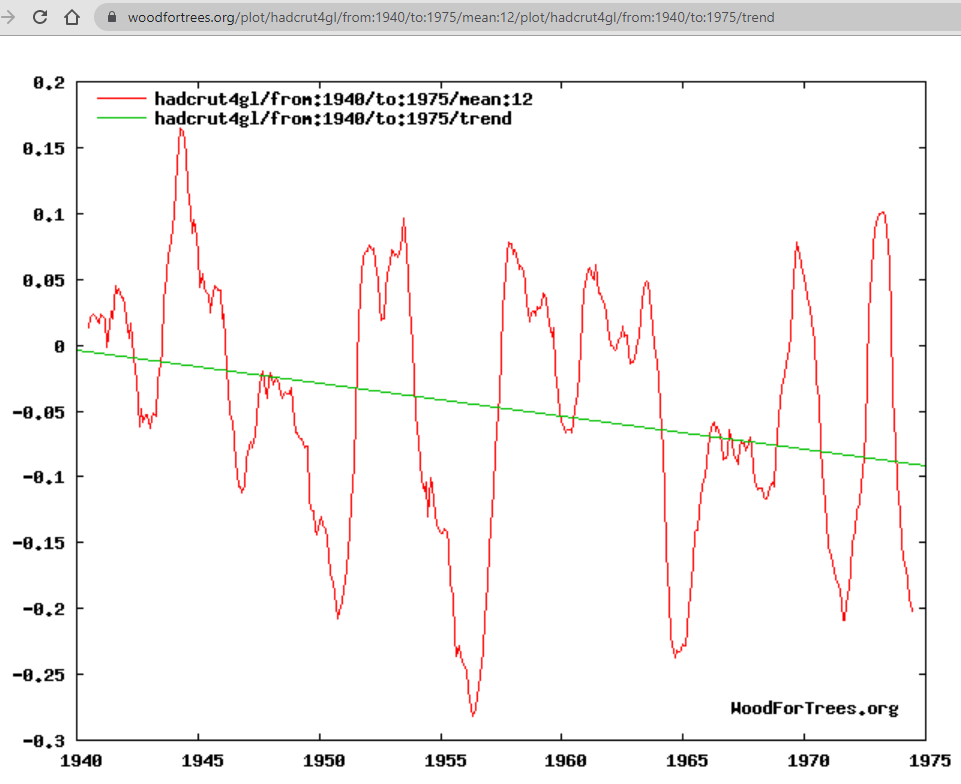
Here’s another example of Connolley editing on climate change::
https://en.wikipedia.org/w/index.php?title=United_States_withdrawal_from_the_Paris_Agreement&diff=prev&oldid=988896123
As you can see, Connolley deleted the following from the description of the Paris Climate Treaty:
Apart from the spelling error, the statement which he deleted was true.
Notice, too, that the “handle” of the writer of those 15 words is in red, which means that his account has been deleted. I don’t know whether Connolley had a part in that, but it wouldn’t surprise me.
That person had also committed the heretical act of deleting a false accusation against Dinesh D’Souza, which was also quickly reverted, but that sin didn’t get his account deleted. His last edit before his account was deleted was the attempt to write something true about the Paris Climate Treaty (which Connolley reverted 36 minutes later).
I removed that sentence from the article. I don’t expect to prevail, but let’s see what happens. .Anyone who wants to weigh in to the discussion is welcome to.
Dave
I want to thank you for responding with actual facts. Let’s see how this turns out.
Well written, Willis.
Happy New Year to you and yours.
“thousands of people out their”
====
there?
Regards, Ferd, fixed. Couldn’t be a better example of the short lifespan of my errors on WUWT.
w.
Wikipedia has a bot that moderators control. I forget the name. The bot is script driven so you can automatically monitor and revert pages without human intervention. Change a page and within a few seconds a bot will take action.
WUWT could of course set up a dueling bot but then higher powers would get tnvolved.
Wikipedia has thousands of bots (2469 in the English Wikipedia at last count). Each of them is controlled by their body operator which may or may not be an administrator. There is no such thing as a moderator in the world of Wikipedia. Each bot has to be approved by a committee so no it is not of course that WUWT could set up a dueling bot. I can’t be absolutely sure which one you are referring to but Cluebot has millions of edits, and is one of the more common ones. It reverts edits according to certain rules. It works pretty well, in my opinion. Some of the reversion seem obvious but others seem more subtle. It rarely (a fraction of a percent) makes an error but there is a reporting mechanism in those rare cases so that it can learn.
bot operator not body operator (is there no longer an edit option?)
Yes there is. If you mouseover your comment, a small gear symbol should appear in the lower right corner of the comment area, click that. It might be timed so as not to allow edits days later, not sure.
Thanks for responding. I haven’t found it, but will keep looking
Found it, but I guess it times out.
Unjustified and not-clearly-revealed censorship to impart a personal or organizational point-of-view bias is nonetheless abhorrent censorship, no matter what pretty wrapping and bow you want to put on it.
Software robots carrying out the editing mandates of humans (“a committee”, to use your words) is no excuse for such behavior.
Of course, you are fully entitled to your expressed opinion that “it works pretty well.”
Can you identify an example of a Cluebot reversion that is in error? I’m sure there are some, but I’ve looked at hundreds of its reversions and don’t recall one that was wrong. Wikipedia has issues with organizational point of view bias, but I haven’t seen it in Cluebot.
“Philosophical Transactions of the Royal Society” first published in 1665. A French journal was also founded that year, but wasn’t limited to scientific papers.
The scientific method requires that your guess, ie hypothesis, make testable predictions capable of being shown false.
An hypothesis which doesn’t yield testable, falsifiable predictions isn’t scientific, but mere baseless conjecture.
A commenter here, for instance, believes that the so-called “Cambrian Explosion” resulted from horizontal gene transfer, but can cite no evidence to support this idle speculation. So his guess isn’t science.
Such an hypothesis may not be scientific. It may, or may not, be baseless. Even a wild conjecture may cause somebody to think, and work out said falsifiability. Continental drift when first proposed, was ridiculed. Later, it was subsumed into the theories of plate tectonics. But – if somebody had said, back in 1912, “That means they’re probably still moving,” that would not be falsifiable. How in the world would you even measure that?
If you can’t test it in the world, it turns out, getting off the world with GPS satellites can do the job. Today we know how to do the measurement. But was it still science when nobody knew what was going on or how to measure it? Perhaps not – but hardly baseless.
There would have been ways to measure drift back then. Wouldn’t necessarily have been easy or cheap, but it could have been done.
“An hypothesis which doesn’t yield testable, falsifiable predictions isn’t scientific, but mere baseless conjecture.”
That sounds like a description of Alarmist climate science.
One might view the incorporation of the pre-mitochondrial or pre-chloroplast bacterium into primordial eukaryotes a sort of horizontal gene transfer.
True, John, but as I said, it didn’t come into general use until the 20th century.
Warm regards,
w.
Annalen der Physik dates from 1799, and important journals like Lancet, Nature, Science and the sadly corrupted SciAm from the early to late 19th century.
NEJM 1812. US was among 19th century leaders in science and medicine journals.
True … but they haven’t been peer-reviewed until recently. Nature started peer-reviewing submissions in 1967. Here’s from an interview with the author of “The Rise of Peer Review”.
Best regards,
w.
Peer-review was introduced to scholarly publication in 1731 by the Royal Society of Edinburgh, which published a collection of peer-reviewed medical articles. But the practice didn’t become common until the 20th century. Einstein objected to it early in the century.
After the war and into the ’50s and ’60s, specialization of articles increased, and so did the competition for journal space. Journals proliferated.
In this century, the practice has been corrupted into pal review, largely thanks to bogus “climate science”. But blogs are filling the yawning void.
However, even without peer review, scientific journals have been important conduits of research since the 17th century.
Memoires of the Royal Academy of Sciences of Paris, 1699 to 1793.
Its important contributor Lavoisier was beheaded in 1794.
For destroying state property : he burned diamond, which are not forever.
Now Dr. Schellnhuber the be-knighted great de-carbonizer would behead humanity. Makes Robespierre look amateur.
Some forget what actually happened to Danton, Marat, Robespierre…..
Annalen der Physik, in which Einstein published his four famous papers in 1905, did not subject those papers to the process known today as “peer review”.
True, but in 1936 he had a paper rejected upon peer review:
https://mindmatters.ai/2020/05/einsteins-only-rejected-paper/#:~:text=Albert%20Einstein%20only%20had%20one,This%20happened%20in%201936.&text=%5BAll%20of%20Einstein's%201905%5D%20papers,papers%20were%20sent%20to%20referees.
Regardless of peer review, my point is that scientific journals have existed, some continuously, for hundreds of years. In the 16th and early 17th centuries, letters and publications, ie pamphlets and books, got the scientific word out.
Even in the late 18th century. Jenner described his vaccination activities in three booklets published at his expense by a London printer, 1798-99. I don’t know if he tried on the RS first or not. He was advised that his initial write-up wasn’t ready for prime time.
John, I’m totally unclear on your point. I had what I thought was an important point, that peer-review is a new development.
So I’m unclear on why it’s important whether the Annalen Der Physik started in 1897 or 1807.
I also don’t understand why if one and only one publication was using peer-review in 1897 or 1807, what difference does it make when the second one chimed in. What I said was true—peer review is new, mid 20th century. I said nothing about when journal X started printing.
The important issue for my discussion above is, when did peer-review become common? The age of the periodical is meaningless. Nature magazine started in 1869 … but it didn’t start using peer review on selected articles until 1967, and didn’t peer-review all articles until 1974.
So for the purposes of this discussion … why is the Journal’s starting date important?
w.
Because you said that historically there weren’t journals, which isn’t true from the middle of the 17th century.
You:
“Now, historically there were no “scientific journals”. New scientific ideas were circulated hand-to-hand or mailed between people who knew each other. But the process described above was how they judged the ideas. If someone could show the idea was wrong, it would be discarded.”
In the next paragraph, you mention peer review. But even in the 17th century, editors decided which communications would get published.
But in fact, peer review did exist for over 200 years before Einstein objected to it in 1936.
That Nature adopted the practice later than other journals is really neither here nor there.
Still not clear what your point is. One scientific journal obviously didn’t contain anything like the amount of ideas exchanged by the scientists of the time.
And for the editor to decide what to print? If he got a letter from some important person, he’d probably publish it.
Finally, scientific discussions existed before there were scientific journals. Note that, being a careful man, I said “historically”, not “prior to year X”.
Here was my point:
So yes, there were isolated examples. But I wasn’t talking about 2 or 3 journals that covered two whole countries … I was speaking of the world.
My regards to you, and my point holds: Until the mid-20 century, most journals were NOT peer-reviewed, including Nature magazine. And since I was discussing peer-review, that was the important point, and not whether or not some Anglophone journal was ahead of its time by having some pre-peer-review system in 1763 …
Best regards,
w.
So your statement that, “Now, historically there were no “scientific journals”. New scientific ideas were circulated hand-to-hand or mailed between people who knew each other” means nothing?
I’d have thought the point obvious. Scientiric journals existed for 300 years before 1965.
But, if by “historically”, you meant 1543 to 1665, ie the first 122 years of the Scientific Revolution, you’re right.
Question to Willis Eschenbach:
Two decades ago you published a graph http://www.john-daly.com/stations/vardo2.gif about “Vardo Temperature Discontinuity” http://www.john-daly.com/press/press-03b.htm (see excerpt below; but you never asked why it happened. It marked the start to an intense sudden Arctic warming, effecting the entire Northern Hemisphere for two decades until winter 1939/40 (in the United States until about 1933). Actually between 1914 and the end of 1918 there was war in Europe and severe naval activities around Great Britain. All water masses from there ended up in the North. If interested see: http://www.arctic-heats-up.com/ ,
Willis Eschenbach < willis@taunovobay.com > did a closer examination of Vardø and also found the same discontinuity around 1920, amounting to 0.73°C. When that artificial discontinuity is discounted, the temperature rise is only +0.12°C per century, a tiny result for a region that according to the models should have undergone rampant warming in the last century.
Man, we’re delving into deep history now, back when I was living in Fiji. John Daly was an early giant. I have very little info from that time …
I just took a look at the GISS data from both Vardo and Vardoe, and it is quite different from my graph. So I’m not sure whether it was my error or that of the “homogenization”.
…
…
Hmmm. Further research indicates I may have used Nordklim data. I’ll have to get back to you on this.
Regards,
w.
Thanks W.
I would be happy and very interested to get your view, as a man from the sea,
Happy New Year and good health
ArndB
Willis – not sure if you noticed but there is an email address for you in the post you responded to. If that email is still valid you might want to fix that.
Thanks, Tony. That address is three addresses ago.
w.
So, it’s been addressed.
A similar 0.4°C discontinuity seems to have happened before and after the 1998 El Nino and a smaller 0.2° one after the 2016 El Nino (using Dr. Roy Spencer’s data) This in spite of the huge increases in CO2 emissions from China, India, rest of the world after 1998 that should have led to a very distinct rising temp graph, not the 15 or so years of flatlining around the new discontinuity level. Thank you for bringing to light another discontinuity.
The point why I mentioned the Vardo incident is that the observation by W. Eschenbachin 2003 was a great observation and, as mentioned, occurred at the end of WWI, and as many other indication related to WWI, show strong links to the Early Arctic Warming, a matter still poorly understood after 100 years.