UNIVERSITY OF BERN

A marine heatwave (ocean heatwave) is an extended period of time in which the water temperature in a particular ocean region is abnormally high. In recent years, heatwaves of this kind have caused considerable changes to the ecosystems in the open seas and at the coast. Their list of negative effects is long: Marine heatwaves can lead to increased mortality among birds, fish and marine mammals, they can trigger harmful algal blooms, and greatly reduce the supply of nutrients in the ocean. Heatwaves also lead to coral bleaching, trigger movements of fish communities to colder waters, and may contribute to the sharp decline of the polar icecaps.
Researchers led by Bern-based marine scientist Charlotte Laufkötter have been investigating the question of how anthropogenic climate change has been affecting major marine heatwaves in recent decades. In a study recently published in the well-known scientific journal Science, Charlotte Laufkötter, Jakob Zscheischler and Thomas Frölicher concluded that the probability of such events has increased massively as a result of global warming. The analysis has shown that in the past 40 years, marine heatwaves have become considerably longer and more pronounced in all of the world’s oceans. “The recent heatwaves have had a serious impact on marine ecosystems, which need a long time to recover afterwards – if they ever fully recover,” explains Charlotte Laufkötter.A huge increase since the 1980s
In its investigations, the Bern team studied satellite measurements of the sea surface temperature between 1981 and 2017. It was found that in the first decade of the study period, 27 major heatwaves occurred which lasted 32 days on average. They reached maximum temperatures of 4.8 degrees Celsius above the long-term average temperature. In the most recent decade to be analyzed, however, 172 major events occurred, lasting an average of 48 days and reaching peaks of 5.5 degrees above the long-term average temperature. The temperatures in the sea usually fluctuate only slightly. Week-long deviations of 5.5 degrees over an area of 1.5 million square kilometers – an area 35 times the size of Switzerland – present an extraordinary change to the living conditions of marine organisms.Statistical analyses demonstrate human influence
For the seven marine heatwaves with the greatest impact, researchers at the University of Bern carried out what is referred to as attribution studies. Statistical analyses and climate simulations are used to assess the extent to which anthropogenic climate change is responsible for the occurrence of individual extremes in the weather conditions or the climate. Attribution studies typically demonstrate how the frequency of the extremes has changed through human influence.Without ambitious climate goals, marine ecosystems might disappear
According to the findings of the attribution studies, major marine heatwaves have become more than 20 times more frequent due to human influence. While they occurred every hundred or thousand years in the pre-industrial age, depending on the progress of global warming, in the future they are set to become the norm. If we are able to limit global warming to 1.5 degrees, heatwaves will occur once every decade or century. If temperatures rise by 3 degrees, however, extreme situations can be expected to occur in the world’s oceans once per year or decade. “Ambitious climate goals are an absolute necessity for reducing the risk of unprecedented marine heatwaves,” emphasizes Charlotte Laufkötter. “They are the only way to prevent the irreversible loss of some of the most valuable marine ecosystems.”
###
Amazing to see how well the oceans recovered from the significantly warmer temperatures of the Holocene some 6,000 years ago. I wonder how they managed to do it.
“A marine heatwave (ocean heatwave) is an extended period of time in which the water temperature in a particular ocean region is abnormally high. In recent years, heatwaves of this kind have caused considerable changes to the ecosystems in the open seas and at the coast… STATISTICAL ANALYSES DEMONSTRATE HUMAN INFLUENCE.”
– Laufkötter et al (2020)
So humanity is responsible? OK… but now Nino34 area SST’s are getting much colder and a La Nina is forming. Nino34 SST’s are a good predictor of future global temperature.
Is man also responsible for cooling? I know, I know, I predicted global cooling starting circa 2020, way back in year 2002, but must I claim personal responsibility? Does that mean I will be at fault for the increase in Excess Winter Deaths and all the other terrible losses that occur in global cold periods? Saying I am sorry hardly seems adequate. Je suis désolé! I am desolated! It sounds so much better in French. (Tabarnac!)
(sarc/off)
Data:
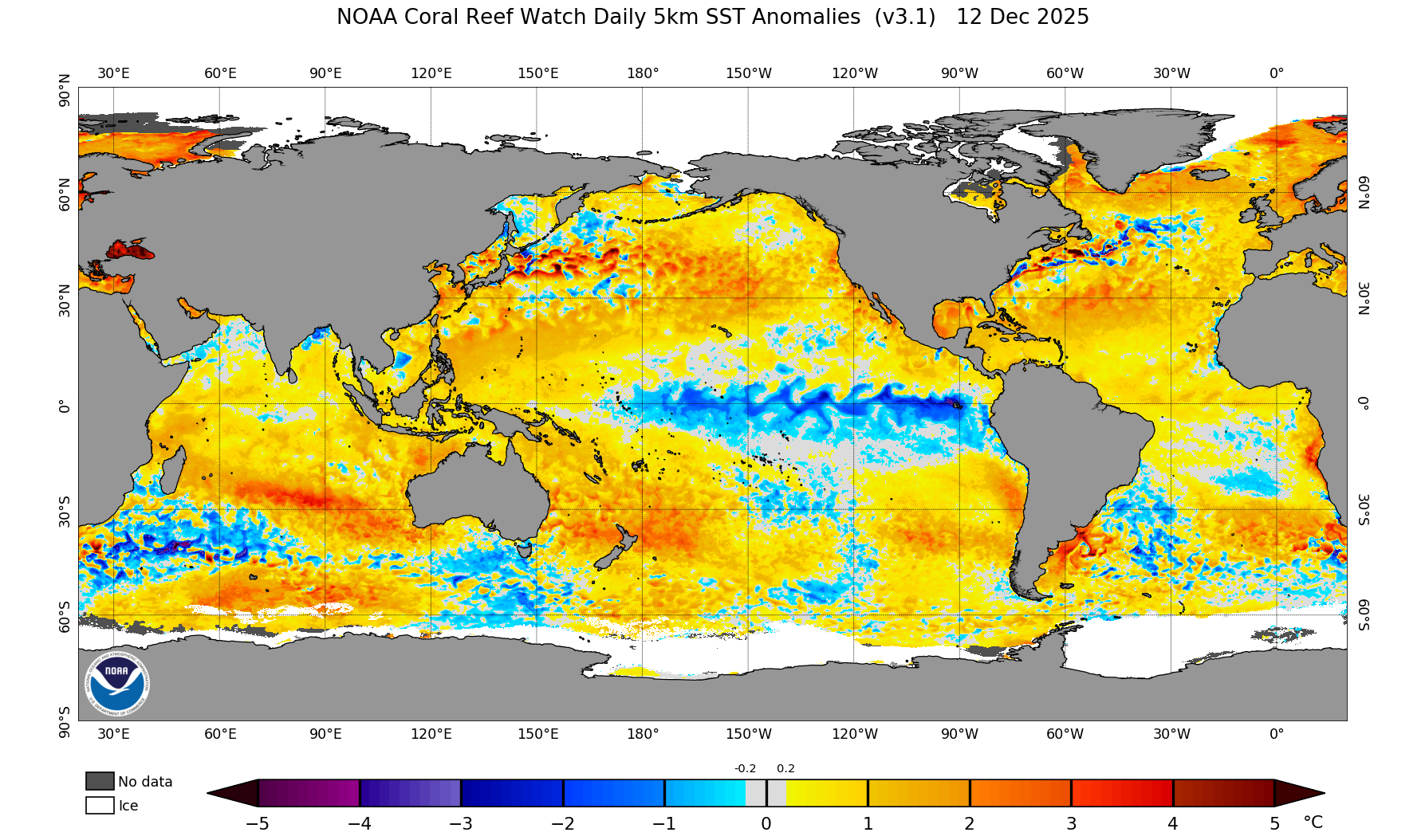
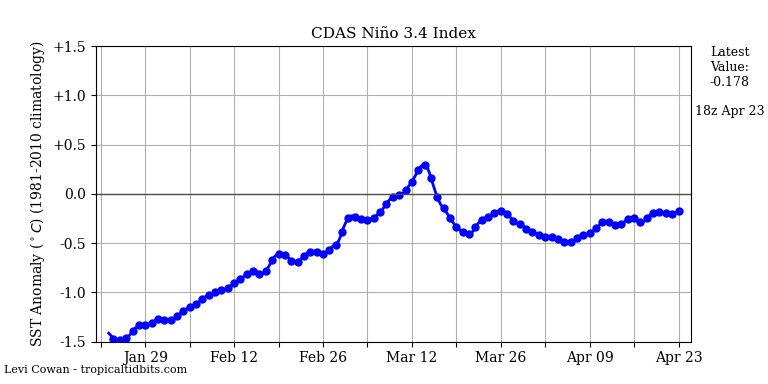
Bob Tisdale showed that this kind of warming is formed by eastern Pacific cold upwelling pushing El Niño hot water out the western end, thence to the temperate zones. He made a movie of this circulation. Do oceanographers and climate wroughters not know this? Another eminently retractable study. Is it to complicated to imagine the bulk of heating is in the ITCZ and the theory of “When you push the hot water out with cold, this water has to go somewhere”?
I like Bob’s work – link please?
Climate change is caused by butterflies flapping their wings in Brazil.
Lepidopterogenic Climate Change?
As a prof once told me….”If you have to rely on statistics, you did the wrong experiment”
You are right. Climatology is an art, not science.
The way gloabl warming alarmists practice it, climatology is a dark art – the very antithesis of science – a pack of insidious lies that have done enormous harm to humanity AND the environment.
Posted before, simplistic but relevant to this.
At my lake in south Saskatchewan we had a cool and wet year right up to end of July, rarely above 20c, nevertheless the lake warmed from freezing to ~23c.
Then we had the most beautiful August in memory, lots of 30c and higher, sunny, no rain
And yet by end August the lake fell to 16c when we took out docs
Ie, atmosphere doesn’t warm water, sun height and length of day is all, water cools even with hot air above it
Duh
Key statements in the above article:
— “The analysis has shown that in the past 40 years, marine heatwaves have become considerably longer and more pronounced in all of the world’s oceans . . .
— “In its investigations, the Bern team studied satellite measurements of the sea surface temperature between 1981 and 2017 . . .
— “The temperatures in the sea usually fluctuate only slightly . . .
— “Statistical analyses demonstrate human influence . . . Statistical analyses and climate simulations are used to assess the extent to which anthropogenic climate change is responsible for the occurrence of individual extremes in the weather conditions or the climate . . .
— “According to the findings of the attribution studies, major marine heatwaves have become more than 20 times more frequent due to human influence. While they occurred every hundred or thousand years in the pre-industrial age, depending on the progress of global warming, in the future they are set to become the norm.”
So, the “researchers” admit they only looked at satellite data for the period of 1981 to 2017. In fact, there were NO satellites capable of measuring/inferring sea surface temperatures prior to 1967 (ref: https://en.wikipedia.org/wiki/Satellite_temperature_measurements ).
So how did they compare that very limited span of direct scientific measurements of SSTs to equivalent data from the pre-industrial age, or even going back thousands of years prior to that, to support their claim that “major marine heatwaves . . . occurred every hundred or thousand years in the pre-industrial age?
Well, of course, no such DATA exists, so instead they used “statistical analyses and climate simulations”. What could possible go wrong there . . . GIGO perhaps . . . hidden agenda perhaps?
Since they obviously have no data to determine what the distribution of global sea surface temperatures was, say, 200 or more years ago, these “researchers” have no credibility in assessing “the extent to which anthropogenic climate change is responsible for the occurrence of individual extremes in the weather conditions or the climate”, let alone in making the idiotic statement “major marine heatwaves have become more than 20 times more frequent due to human influence.”
Like shooting fish in a barrel.
The mostly-red image in the header is a fake perspective. Try to reproduce it in Google Earth or Google Maps. It heavily exaggerates the size of the warm blob. Long live data manipulation.
Curious G, my thoughts exactly! At first, I had difficulty recognizing the coastline as being anywhere on Earth. Then I recognized the perspective had the Baja California Peninsula at the bottom right and the Aleutian Islands at the top left, with huge perspective distortion of the relative size of Vancouver Island in the middle.
I have never before seen such a perspective of Earth presented. It was obviously chosen for the exactly the reason you stated . . . to raise alarm over the magnitude and to what areal extent Earth’s oceans have warmed in the satellite era, especially the NE Pacific “Blob”.
Distorted imagery to accompany distorted “science” . . . it figures.
How deep was the ”deviation of 5.5 degrees” measured?
Are they saying there was that much deviation at anymore than 10 meters or so?
What evidence is there that marine life is adversely affected?
What evidence is there that marine life ”needs a long time” to recover?
How long is a ”long time”?
”Researchers led by Bern-based marine scientist Charlotte Laufkötter have been investigating the question of how anthropogenic climate change has been affecting major marine heatwaves in recent decades.”
First they need to prove that anthropogenic climate change exists, then they need to quantify it by separating it from natural variation, THEN they might be able to tell us how humans are affecting the temps, THEN they might be able to start to figure out how we are affecting oceanic life…
Garbage from start to finish.
Loydo, I asked you to explain why the increase in CO2 has had no effect on the “rate” of sea level rise……the rate was exactly the same before global warming and before CO2 ever increased…and after CO2 has increased….it has had no effect on the “rate”….it is exactly the same
Imagine if we didn’t have the likes of Lloydo and his shadow personality Griff come here and entertain us with their ignorance. To be sure, I have an old friend, who I once respected and thought was reasonably intelligent, “guarantee” me that CO2 was warming the Earth and that it had to be cut back and controlled … his son living in California told him so. I find it curios that the bleating that I hear from these types is so consistent, from one to another, like they were all tuned to the same propaganda organ.
Hot seawater associated with marine heatwaves are better explained by submarine volcanism. Recent examples
of hot blobs supported by records of ARGO data buoys include the 2013-2016 North Pacific Blob, the 2018-2019 Southwest Indian Ocean Blob and the 2019-2020 South Pacific Blob.
Negative AO/NAO drives warm blobs, that’s normal for a centennial solar minimum. There’s a great analogue of the 2013-2014 NE Pacific warm blob in 1876-77 winter, a cold northeast US, and a mild stormy and wet UK.
https://craigm350.wordpress.com/2014/03/18/the-great-global-weirding-of-18767/