Guest essay by Eric Worrall
Decorated former firefighter Greg Mullins thinks fire chiefs are being prevented from talking about climate change.
‘Some things were out of bounds’: Fire chiefs ‘gagged’ on climate change warnings to government, inquiry told
Decorated former firefighter and climate action advocate Greg Mullins says current fire chiefs have been effectively gagged from raising the bushfire risks created by global warming with politicians.
Mr Mullins said he had “deep concerns over climate change”, which was fuelling “unprecedented” bushfires in evidence to a Senate inquiry into the 2019-20 bushfire season on Wednesday.
Asked by Victorian Liberal senator James Paterson if he thought “the current serving fire chiefs are gagged in some way”, Mr Mullins replied: “yes”.
Mr Mullins, a former Fire and Rescue NSW commissioner, said when he was in the role “some things were out of bounds and often climate change was one of those issues, even to the point of having to work around it when preparing documents, and I think that is a tragedy”.
…
Read more: https://www.smh.com.au/politics/federal/some-things-were-out-of-bounds-fire-chiefs-gagged-on-climate-change-warnings-to-government-commission-told-20200527-p54wxv.html
This issue is more complex than it might seem.
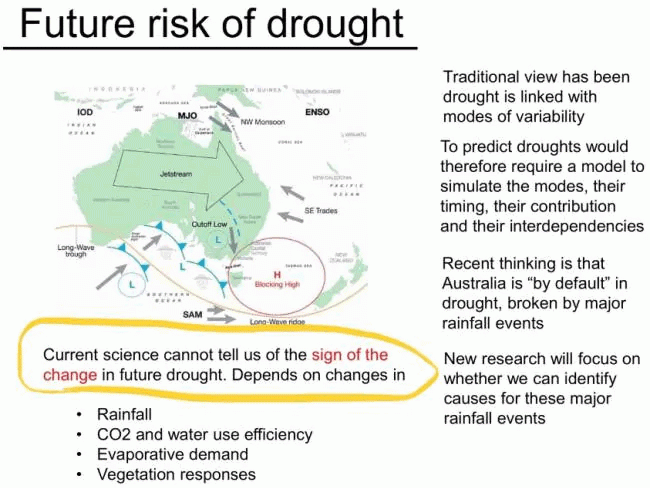
There is a 20 year drying trend in Australia, which fire chiefs operating in those areas would have noticed, so I understand fire chiefs being concerned about climate change. But some parts of Australia are getting wetter. And on a 100 year timescale, there is no trend.
There is also very little correlation between temperature and bushfires. From Roy Spencer’s post;
…
First, if we correlate the yearly temperatures in Fig. 2 with the bushfire land area burned in Fig. 1, there is essentially no correlation (-0.11), primarily because of the huge 1974-75 event. If that year is removed from the data, there is a weak positive correlation (+0.19, barely significant at the 2-sigma level). But having statistics depend so much on single events (in this case, their removal from the dataset) is precisely one of the reasons why we should not use the current (2019-2020) wildfire events as an indicator of long-term climate change.
Secondly, while it is well known that the CMIP5 models are producing too much warming in the tropics compared to observations, in Australia just the opposite is happening: the BOM temperatures are showing more rapid warming than the average of the climate models produces. This could be a spurious result of changes in Australian thermometer measurement technology and data processing as has been claimed by Jennifer Marohasy.
Or, maybe the discrepancy is from natural climate variability. Who knows?
…
Read more: https://wattsupwiththat.com/2020/01/09/are-australia-bushfires-worsening-from-human-caused-climate-change/
But what if Roy Spencer is wrong? (just kidding Roy!) If the risk is getting worse, even on a 20 year timescale, what should be done about it? An obviously solution is to remove tracts of forest which pose a danger to people, and cut bigger firebreaks. But in Australia, there appears to be a strong relationship between land clearance and reduced rainfall, so removing too many trees might actually increase the risk of the rest of the woodlands burning.
But lets assume for a moment, despite the lack of evidence, that anthropogenic climate change is causing a problem. What should be done about it?
Embracing renewables is not a solution. How much forest would have to be cleared to power all of Australia from wind and solar energy? What impact would all this land clearance have on rainfall and fire risk? How much overcapacity would be required to eliminate the risk of blackouts, assuming this is even possible? How much water would be needed to clean the solar panels – in dry, dusty country, solar panels have to be washed regularly to stop the dust blocking the sunlight, just like house windows have to be cleaned to let the light in. The thousands of square miles of solar panels (see calculation below) which would be required to have any chance of powering Australia from renewable energy would consume a lot of water.
Nuclear power is the only zero carbon energy source which has a hope of replacing fossil fuel. But I doubt you will see Climate Council contributor Greg Mullins and his friends advocating for more nuclear power plants anytime soon. Like many green groups, the climate council is dead against zero carbon nuclear energy.
Calculation: how many solar panels would be required to power Australia?
Australia consumed 6,172 petajoules of energy in 2017-18. or 6,172 x 10^15 / (1000 * 3600) = 1714 billion kw/h. Using land art generator’s generous 400kwh / year / square metre, Australia would need 4.3 billion square metres of panels, or 4286 square kilometres (1654 square miles), an area equivalent to a square 66km (40 miles) on each side. Of course the real amount of land required would be far higher; my calculation assumes unlimited capacity 100% efficient energy storage and transmission, and no gaps between panels for access and maintenance.
Even if we stick with the idealised calculation, building the required solar system would still be impractical. A 4m^2 outdoor clothes hangar I recently installed in sandy clay required a recommended 40kg of concrete to stabilise the pole. Since solar panels can’t be furled in high winds like a clothes line, they would require a lot more concrete and structural support.
Assuming an optimistic weight of 50kg / square metre (concrete foundations, metal supports, panels, wiring, step up transformers, cleaning system, maintenance roads), building the array would require 4.3 billion square metres x 50kg = 215 billion million tons of concrete, refined silicon solar panels, wiring and metal supports. Australia currently produces 10 million tons of concrete, and 1.5 million tons of alumina per year, somewhat short of the required amount. A 20-100x increase in mining and heavy industry to produce the required concrete, metal and silicon panels would require a substantial upward revision to Australia’s 6,172 petajoule annual energy consumption number, which in turn would increase the area of solar panels which would have to be built.
Correction (EW): the calculation is 215 million tons of material, not 215 billion tons. The rest of the calculation is correct AFAIK, 215 million tons is 20-100x Australia’s current heavy industrial production of relevant material like concrete and alumina.
Climate change campaigning led to “carbon farming” where people got tax breaks for growing wood on their land. In a drought, this could be known as “tinder farming”. The Australian government legislation website provides the legislation. They publish reports/data explaining how much carbon they have taken out the air. Not surprisingly, when this burns all the carbon is released back into the atmosphere and it is all for naught.
Legislation encouraging “Carbon Farming”- ie building up carbon stocks on the land:
https://www.legislation.gov.au/Details/F2018C00127
https://www.legislation.gov.au/Search/carbon%20farming
Reports into carbon inventories
https://www.environment.gov.au/system/files/resources/a97b89a6-d103-4355-8044-3b1123e8bab6/files/state-territory-inventories-2016.pdf
Check out the table on the bottom. The land use/forestry (in green) goes from 95 000 000 tonnes of CO2 emissions in 2005 to negative 23 000 000 tonnes of CO2 equivalent per year on the most recent numbers. That is a lot of wood being grown.
https://ageis.climatechange.gov.au/NGGITrend.aspx
Negative carbon growth indicates increase in forest revegetation equivalent to 104 000 tonnes of CO2 in NSW since early 2000s. This doesn’t seen enough given the table above:
https://ageis.climatechange.gov.au/Chart_KP.aspx?OD_ID=90418346444&TypeID=2
Land use shows increase in carbon inventories. Table 16 shows significant reduction in burning after 2009 in Queensland and a corresponding increase in wildfires. I wonder if they had many fires recently.
https://ageis.climatechange.gov.au/Reports/ActivityTable%20_1990_2017_LULUCF.xlsx
The government website is really helpful. I haven’t tried it, but they seem to have a nice new carbon accountancy tool:
http://www.environment.gov.au/climate-change/government/emissions-reduction-fund/consultation/erf-fullcam-update
I haven’t got the time to do a detailed analysis but I really think that someone should.
Australia has one of the highest rates of uptake of renewables in the world and has been sabotaging its very reliable coal fired plants by blowing them up. Yet we are ( according to our alarmists ) having increased fire seasons. Wouldn’t that suggest that it makes no difference .In fact it could be argued that the more renewables we put in , the worse the fires get ,a clear pattern that has developed in the last 10-15 years.
Or Maybe the warmists just tell porkies to support their narrative.
Hoo, that’s an easy one! He means “I do not know!”.
Political appointees shouldn’t talk about things outside their area of expertise.
And people have a problem with this?
Isn’t one of the biggest problems faced by the Australian fire service the fact that they are mostly – if not all – reservists. This has meant that the number of suitable days for tree clearing is greatly reduced due to the non-availability of staff. Isn’t THAT one of the issues that fire chiefs should be raising?
A transition away from fossil fuels is a decades-long endeavor, even under the most optimistic assumptions. The effects of reduced CO2 on climate-aggravated brushfires would take decades longer to manifest, again according to official IPCC science. And has been pointed out innumerable times, whatever Australia does will make bugger-all difference to the global climate unless the rest of the industrialized and developing nations do likewise — also official IPCC science.
Meanwhile, brushfires are a this fire season problem which needs to be addressed on a corresponding timeframe. And there are ample effective strategies: fuel load reduction, increased arson pursuit and prosecution among others. All these can be done by Australia without needing any other nation to go along, and will make a difference almost immediately.
For a fire chief to claim the only way he can discharge his duties is to pursue remedies that can’t have any impact for decades is at least nonfeasance and probably misfeasance. This would be like a military officer in WWII claiming the only way to beat the Germans was establish the UN and get the Germans to join. Time to install new fire chiefs.
The history of fire in Australia during the Quaternary is a story of VEGETATION not climate. The same climate trend has produced increases in fires in some areas of Australia and at the same time produced decreases in others, the greatest differences usually being between the northeastern Tropics and the mid-southern cooler regions. Anyone who claims otherwise is cherry-picking their sites (and some of the most cited papers do exactly that).
In California, native Americans used to burn the floor of Yosemite Valley regularly, to provide grass for deer (their favorite protein). Now, under a loving care of the National Park service, meadows are being displaced by forests.
Sorry Greg
A number of leading Australia Bush Fire researchers do not agree with you. Both Phil Chenney and David Packham have stated publicly it is about fuel management and access.