By University of California Davis May 6, 2020
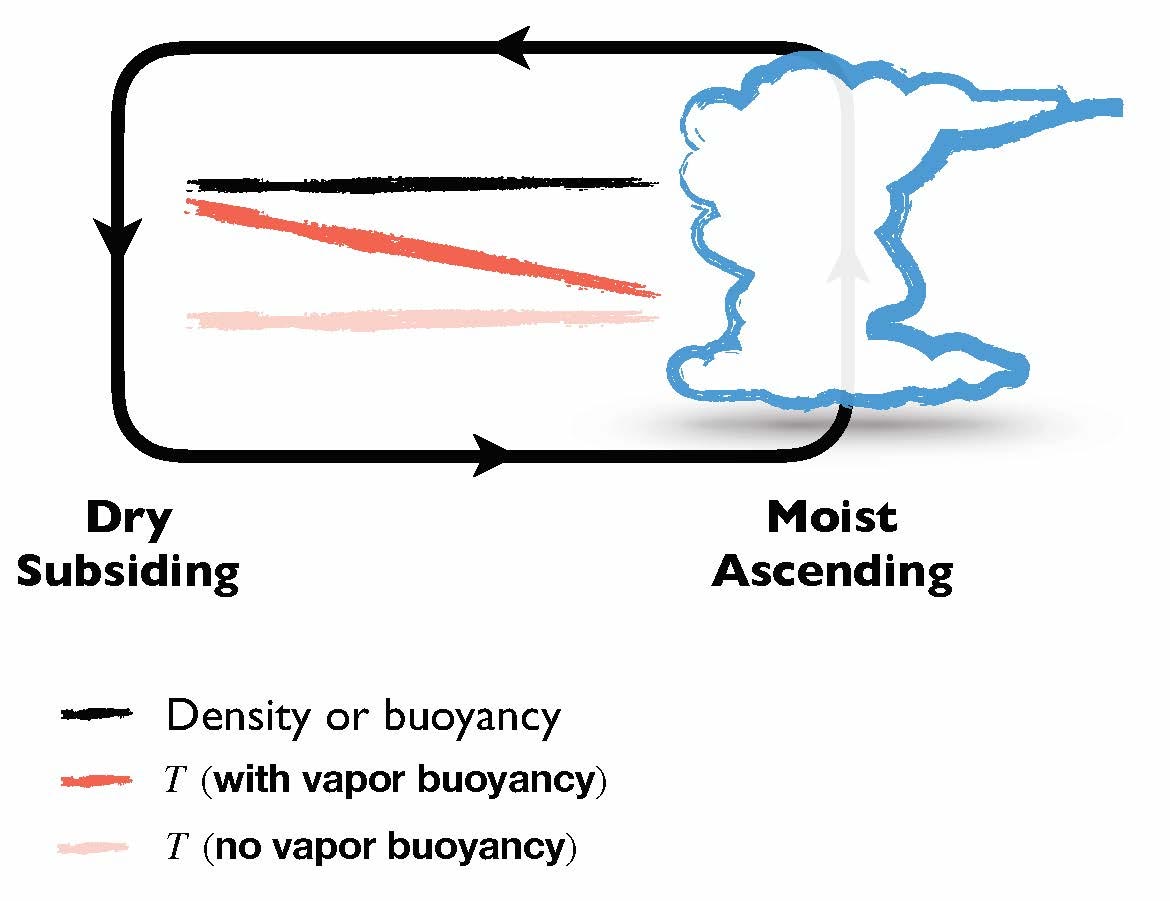
The lightness of water vapor buffers climate warming in the tropics.
Conventional knowledge has it that warm air rises while cold air sinks. But a study from the University of California, Davis, found that in the tropical atmosphere, cold air rises due to an overlooked effect — the lightness of water vapor. This effect helps to stabilize tropical climates and buffer some of the impacts of a warming climate.
The study, published today (May 6, 2020) in the journal Science Advances, is among the first to show the profound implications water vapor buoyancy has on Earth’s climate and energy balance.
The study found that the lightness of water vapor increases Earth’s thermal emission by about 1-3 watts per square meter over the tropics. That value compares with the amount of energy captured by doubling carbon dioxide in the atmosphere.
“It’s well-known that water vapor is an important greenhouse gas that warms the planet,” said senior author Da Yang, an assistant professor of atmospheric sciences at UC Davis and a joint faculty scientist with Lawrence Berkeley National Laboratory. “But on the other hand, water vapor has a buoyancy effect which helps release the heat of the atmosphere to space and reduce the degree of warming. Without this lightness of water vapor, the climate warming would be even worse.”
Humid air is lighter than dry air under the same temperature and pressure conditions. This is called the vapor buoyancy effect. This study discovered this effect allows cold, humid air to rise, forming clouds and thunderstorms in Earth’s tropics. Meanwhile, warm, dry air sinks in clear skies. Earth’s atmosphere then emits more energy to space than it otherwise would without vapor buoyancy.
Here is the abstract from the paper which can be found here.
Abstract
Moist air is lighter than dry air at the same temperature, pressure, and volume because the molecular weight of water is less than that of dry air. We call this the vapor buoyancy effect. Although this effect is well documented, its impact on Earth’s climate has been overlooked. Here, we show that the lightness of water vapor helps to stabilize tropical climate by increasing the outgoing longwave radiation (OLR). In the tropical atmosphere, buoyancy is horizontally uniform. Then, the vapor buoyancy in the moist regions must be balanced by warmer temperatures in the dry regions of the tropical atmosphere. These higher temperatures increase tropical OLR. This radiative effect increases with warming, leading to a negative climate feedback. At a near present-day surface temperature, vapor buoyancy is responsible for a radiative effect of 1 W/m2 and a negative climate feedback of about 0.15 W/m2 per kelvin.
HT/Clyde Spencer
They JUST discovered “Moist air is lighter than dry air at the same temperature, pressure, and volume because the molecular weight of water is less than that of dry air.” ???
Strange, I learned that fifty years ago in my graduate thermodynamics class. Also learned that the molecules in liquid water are held together by relatively strong hydrogen bonds, and its enthalpy of vaporization, 40.65 kJ/mol, is more than five times the energy required to heat the same quantity of water from 0 °C to 100 °C. That provides an massive source of energy transfer from the evaporation of water in the Oceans, cooling them, and transporting that heat, enthalpy, to the upper atmosphere. The Sun causes the water to evaporate, however the evaporation takes some of the enthalpy of evaporation from the water. And that “some of the enthalpy” is MASSIVE. More enthalpy is taken than the Sun adds to the water.
Because of this lack of knowledge, then these “Scientists” do not understand where the heat is going.
And we wonder if the Climate models are accurate.
Pointed that out years ago.
“Conclusions [were] reached that [did] not take into account other factors!”
Epitaph on the tombstone of the great climate crisis narrative, as well as the COVID-19 response.
cool but warm water saturated air at ground level emits photons at CO2 and H20 wavelengths at an ambient temperature
This cool humid air rises and cools. Thus forming clouds as dewpoint reached. Some will continue up cooling and radiating to space at a much lower temperature than at ground level. Thus less energy transferred to space.
Clouds will radiate as a near black body as they always do but they will be at a temperature of the level in the atmosphere as they always are.
I do not see how rising h2o saturated cold air is much different to rising warm h2o saturated warm air. At the time the mean free path to space is long enough and dry enough to allow the radiation to escape the air temperature will be substantially the same.
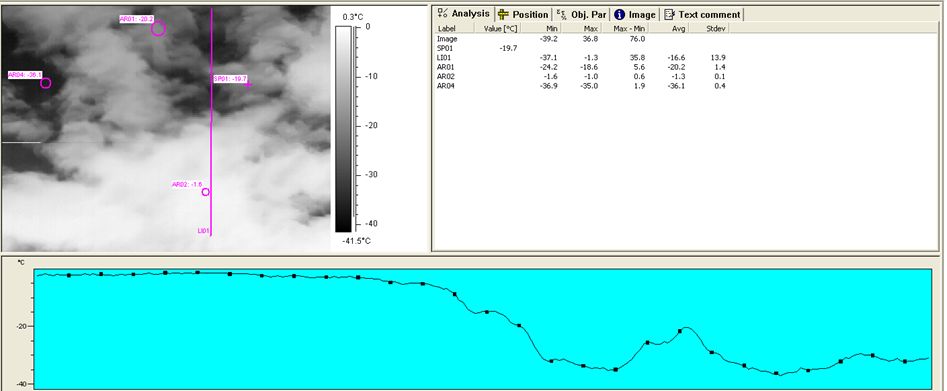
cloud and no cloud shows difference in thermography – clouds are near black body so show a valid temperature sky + co2 +water vapour do not radiate in the bandwidth of thermal cameras so the shown temperature is at minimum of the camera (uncooled in this case). CO2 and H2O will radiate in only “fixed” wavelengths
Catch here is not in outgoing radiation, I think that clouds are not substantial source of heat emitted to space, in spite of many opinion here.
Earth is more less homogeneous source of IR heat.
Catch is in incoming radiation, where clouds are effectively reflecting most of it. 1300W/m2 in space, but around 50W/m2 on the ground under clouds.
And it is zero sum game, homogeneous IR heat of Earth is same energy as spotty clear sky vs. clouds incoming energy aka. albedo.
So yes clouds are main driver of Earth temperature and energy equilibrium.
Phoiled by Physics. Again.
Loving this “settled science” thingy.
‘Although this effect (buoyancy) is well documented, its impact on Earth’s climate has been overlooked.’
Wow! The most important heat transport mechanism in the earth’s atmosphere has been missing from the Climate Models. No wonder the models are so wonderfully (in-)accurate!
What can one say about these models
– Garbage In – Garbage Out.
– Automated Ignorance.
– Settled Science
On November 17, 2018, I posted the following comment on WUWT, which presents an overview of the multiple mechanisms by which water, and not CO2) governs the earth’s climate.
Dear Willis:
The answer to your question “Why does the global temperature change so little?” is really quite simple.
Water!!
Water has truly remarkable properties that enable the earth’s temperature to be governed in a very narrow temperature range. These are:
– High heat capacity (4 times that of air)
– High heat of vaporization
– Vapor pressure which increases exponentially with temperature
– As a gas, low density relative to air
– As a liquid, transparent to solar radiation at high frequencies
– As a gas, broad absorption and emission frequencies in the infra-red range
– As a solid, very low emissivity
These properties, combined with water’s abundance on the earth’s surface, enable water to affect, and govern, the earth’s temperature through the following processes:
1. As a green-house gas, water vapor prevents the earth from excessive cooling:
From Monkton (https://wattsupwiththat.com/2018/08/15/climatologys-startling-error-of-physics-answers-to-comments/) water vapor was responsible for approx. 75% of the green-house gas effect (in 1850). Because the vapor pressure of water increases exponentially with temperature this is a self reinforcing effect.
2. As an energy accumulator, the oceans buffer the earth from rapid changes to the earth’s energy balance:
The heat capacity of the oceans is 3 orders of magnitude greater than the atmosphere. Due to the transparency of water, much of the sun’s energy goes directly into the deep oceans without being absorbed as heat in the atmosphere. And the time constant for temperature mixing in the oceans is of the order of decades.
Is it any wonder why people, using simple regressions and not taking into account the effects of this buffer, cannot correlate the temperature record to the most active sun in a 1000 years (from the 1950s to the 1990s)?
3. By mass transfer cooling:
The principle mechanism of heat transfer from the earth’s surface is not by radiation, but rather by mass transfer. The very large heat of evaporation of water (2250 kJ/kg) is the principle method of heat transfer from the oceans and terrestrial vegetation to the atmosphere. This water vapor is then transported to the upper atmosphere where it condenses, with much of the heat of condensation being directly radiated into space, bypassing the green-house gases.
If the earth’s temperature increases, the rate of mass transfer cooling increases as a power function of temperature. Not only does the driving force for mass transfer increase exponentially with temperature, in proportion to the exponential increase in the vapor pressure of water, but the mass transfer coefficient also increases, driven by the density difference between water vapor and the rest of the air.
Thus if the earth’s temperature increases, mass transfer cooling increases exponentially, transferring the surface heat, not only from the earth’s surface to the upper atmosphere, but also from the tropics to the higher latitudes.
4. As an insulator:
Snow is a near perfect insulator, and not only that, it has a very low emissivity. Thus there is little heat loss to space from both the arctic and the ant-arctic When the earth cools, the snow cover increases, reducing the earth’s radiative heat transfer to space.
In conclusion, water, due to both its abundance and its unique properties, is responsible for governing the earth’s temperature.
If the heat balance becomes energy deficient, water reduces outgoing radiation by the green-house gas effect and the insulating effect of snow.
If heat balance has excess energy, water increases outgoing radiation by mass transfer cooling, which increases exponentially with temperature.
And finally, both of these variants are buffered by the energy storage capacity of the oceans with a time constant of the order of decades.
How could a simple linear constant called “climate sensitivity” possibly describe the multi-mechanism, time-lagged, highly non-linear climate phenomena driven by water?
You omitted one of the most important water features: the inversion in the density curve: maximum density occurs at 4°C, freezing at 0°C. Ice floats!
Yes. Contributing to the insulating effect.
Not only does ice float, the density inversion trick keeps all the lakes and ponds from freezing solid in winter.
Some thoughts. I feel that somehow the energy, enthalpy, in the water vapor has something to do with the fact that the Temperature increases as you gain altitude in the stratosphere and the thermosphere.
Also, I feel that the use of the term “Temperature” of the molecules of water, CO2, O2, N etc. means nothing. They will still release their energy [enthalpy] to their surroundings. Surely you have noticed that in a room heated to 72F/20C, with no breeze or air currents, as you walk by a large window your bare arm will feel cold when it is cold outside. I feel this effect even with triple pane windows from three feet away.
Well done. 🙂
So many people are saying “heat transfer” when they should be saying “energy transfer”
They forget that latent heat, does not represent as heat/temperature.
ie, just because the water vapour measures as having a lesser temperature, does not mean it holds less energy.
And there are rivers of water in the atmosphere, carrying more water than the Amazon River. Where are the rivers in the atmosphere taking this water and what happens to the enthalpy when it turns to snow, ice, rain or back to WV from either of these? Me thinks the “Lost heat from the Ocean” was taken away from the Ocean by evaporation lifted into the sky as WV and warmed the atmosphere by releasing the stored enthalpy.
Notice that this process is self controlling. If to much water is evaporated then the higher moisture content and “warmer” atmosphere will make more clouds and thus less water is evaporated.
dh-mtl, you post is nice overall, but there is one glaring mistake in it. You posted: “Water has truly remarkable properties that enable the earth’s temperature to be governed in a very narrow temperature range. These are: . . . – As a solid, very low emissivity.”
For your reference:
— emissivity of ice = 0.97 (source: https://www.thermoworks.com/emissivity-table )
— “investigation of the thermal infrared (8-14μm) emissivity at normal incidence of the type of fresh snowfall typical of the Arctic during winter . . . show that the emissivity varies between 0.70 and 0.92, in marked contrast to Arctic summer snow which has a constant emissivity of approximately 0.99.” (source: https://www.tandfonline.com/doi/abs/10.1080/01431169308904420?journalCode=tres20 )
Also, see discussion of snow and ice spectral albedos at http://www.cesm.ucar.edu/models/atm-cam/docs/description/node35.html
Perhaps I made a mistake.
I assumed that because snow covered ice has a high reflectivity to sunlight (https://nsidc.org/cryosphere/seaice/processes/albedo.html), that it also has, as its complement, a low emissivity. This may not be correct at long wavelengths.
In any event, radiation from snow covered surfaces is minimal, snow and ice do act insulate the land and sea that they cover.
As ever, they and people on here fall into the big strawman trap of discussing the atmospheric physics of CO2 and water vapor as if we’re starting at zero of each. If we want to discuss man-made global warming then we need to start at 280ppm of magic gas and 40,000ppm of water vapor, where the additional effect of magic gas at 416ppm on a background of 40,000ppm of water vapor is the square root of f*ck all. Why does everyone fall into this trap?
You know what is fascinating and please dont accuse me of being a biased against women in the field, but ever notice that the people that comment here are mostly male ( at least their names seem that way) It would be interesting to see a study on skeptics, as to the male, female ratio of commentary here. Now why would I bring this up? Well when I was on Weather Geeks with Dr Marshall Shepherd asked me if there were any women working at weatherbell.com I said well if you want to work like Joe D and I do ( and now Tom Downs and our IT folks who are always on call) which has been producing product every day and going going going( Joe and I both believe you can not take time off from the weather) than you are weathbell material, Basically, this is all I ever wanted to do and I have no problem not taking any days off, I was recently in Texas for a week, but while there, did what I normally do every day Have produced product every day since joined and was on the same streak at Accuweather when I left from when they elevated me in 2003. And I was happy as a clam doing it believe me. ( clams are very happy creatures, like me they like being down in the mud) . , The fact is the weather never stops,) it is a relentless unyielding challenge that will take what you dont know and dont see and drive you to your back with it, Quite Frankly at accuweather, everytime there was overtime available, Dave Bowers and I, ( both mad dogs in the gym) would suck it up. Zevon had a song : I’ll sleep when I’m dead, and it became my theme song, twice i was floored by exhaustion once in college ( I was wrestling, going to school my last term, and had my own radio network) and the night of the blizzard of 1978 was laying in bed not being able to move with a 103 fever. ( But I did not miss class, practice, or any time on my job.. I feel if you give in , then the sickness beats you) In 2014, I was heavily invested in a major snowstorm after Ground Hogs day and for 7 days I did not sleep more than 3 hours, constantly waking up when model runs came in as my body clock would adjust to it. ( I am not a well person, I know that) NYC had an 8 inch snow on Tuesday ( right after the warm super bowl) and the Thursday-Friday storm was a double shot of arctic love The fact that we were way out on a limb from so far out obsessed me even more, Went thru out Nittanly Lion Wrestling club circuit Thursday am, went to the waffle shoppe after with the coaches, came home and collapsed. when I came too Garrett was on top of me, slapping me and asking me to stay with him. I was like where are we going? I had a hit with Cavuto at 2:20 on the storm, and Hannity all afternoon on radio and I had to cancel, When I collapsed again at 5:20 the ambulance came. It got stuck in the driveway cause we had a foot of unplowed snow. Anyway I get to the hospital, they slip a pill under my toungue, boom nausea gone! I was severely dehydrated and had been hit by that flu going around, but until it hit me, I was so obsessd with the weather, I had no idea I had better back off, Anyway as soon as that IV went in I starter posting again ( weatherbell.com subscribers may have seen the posts I cut from my hsopital bed, I wonder if its still in our archives) But check this out, After the second bag I was fine, left the hsopital, and was lifting the next morning, ( I was bummed when we left the hsopital cause the snow had tapered to flurries) So I realize I am not normal, but guess what, there are alot of weather/climate people just as obsessed and to show you how much love they have, many dont even work in the field. You know everyone is created equal, but not all people are the same. I know people that can spend much less time on the weather and come up with the same or better conclusions than I. But it is interesting that question was posed to me, and somehow whenI get on WUWT and look at comments, it seems like the people most into this are male. Yet when we come to voting, many people are now in what I think is a climate change voting bloc and since that may be roughly 50-50 male female, the disconnect spells big trouble. While our merry little band of skeptics may see things one way, if you are not into it and listen to the constant drumbeat of man mad climate change, and your vote is towad a so called “green” policy how would you know, Now there is a chance that many that identify themselves with a nickname are women. But of those that use a name, it seems like its predominately a name that traditionally ( its amazing how you have to adjust wordking today since some woke person is going to say this is code about something. Frankly I never was good at languaages, I have enough problems with English) has been associated with males, that dominates outside of nicknames. One more “exhaustion ” story Sandy: So I was competing in the New England BBchampionships the Saturday before sandy. Garrett and I drove to NYC to do hits on Fox for Thur and Fri, then left late Fri for RI. I competed and came right back so I was doing hits Monday into Tuesday. It was crazy, I was up on the 17th floor of the FOX building and could feel it swaying, Bascially all Garrett and I ate was green room food ( they had these cream cheese brownies that were unreal) So I go from being contest eating to the exact opposite, Anyway when they finally got us back to my brothers, where I left my car in Jersey, while drivng down 206, they had to pull over. Once again Garrett was there to see his dad in a less than ideal state as I was at a strip mall in Hillsborough NJ throwing up into a trash can. All the stress had come off , the exhaustion took over and down goes Frazier, I am quite sure some of you have had similar weather exhaustion stories. I will close with a line from Tom Petty which I think sums it up for us: “Some of us are different, its just something in our blood, there’s no need for explanation we’re just dogs on the run. ” I look at that as a compliment
” . . . a major snowstorm after Ground Hogs day . . .”
Do people eat hamburgers made from real ham on Ground Hog day?
Joe
Getting back to your opening line, feminists usually attribute differences in the male/female ratio in professions to some sort of discrimination. Yet, those differences continue in voluntary activities. To whit, I co-founded the Bay Area Atari Users Group, back in the days when computers were novelties. We would sometimes have over 100 attendees at our monthly meetings. Less than 10% were female, and they appeared to be there are the behest of their husbands or boyfriends. It was rare to see an unaccompanied female. When I go to a shooting range, again, what few women I see, generally appear to be there with their significant other. I’m active collecting minerals in Ohio. When Friends of Mineralogy goes on field trips, there might be about 20% women. I could go on. The point being is that the interests of American men and women are different and that is reflected in the professions and hobbies they choose.
As to ‘climastrology’ skeptics, among my social groups, what few skeptics I know, are all male. The few females that even hold an opinion, tend towards being the stereotypical defensive supporters of “We are going to Hell in a man-made handbasket.”
Neither masculinist nor feminist, and transgender (i.e. divergent physical and mental sex-corellated attributes) spectrum is not trendy. That said, men and women are equal in rights and complementary in Nature.
No mention of thunderstorms? The Hadley circulation cell? Relationships between, temperature, pressure, air density, and H2O saturation limit? Effect of latent energy? etc. etc. etc.
Any calculation of convection effects require the calculation of density of the air parcel. This would NOT be done on a dry air basis by anyone but the least competent climate scientist. So assuming these guys aren’t in that group, they must be as politely as possible saying something has been missed in the models, maybe ?
When air parcel buoyancy is calculated, as in convective processes, the “Virtual Temperature” is used. This takes into account water vapor in the parcel. This is very basic meteorology. But I have worked with some climatologists who actually did not know parcel theory and very basic meteorology.
And, I suspect a lot of the computer geeks writing the code for GCM’s have no idea at all.
I get the feeling many, many of these people have little background in thermodynamics and probably little in physics. I keep reading about how the GCM’s are “physics'” based, yet I never, ever see thermodynamics based.
Hi DMacKenzie !
Please have a look at my comments on this link.
Juergen Michele
Meteorologists use a kind of argot! – potential temperatures
Is the implication of the journal Science Advances article referenced above that most/all of those extremely complex general circulation models of Earth’s climate—that have been in development for decades and to the tune of many millions of dollars invested and requiring supercomputers to run—simply neglected to consider how atmospheric density varies with humidity (absolute and/or relative), the so-called “water vapor buoyancy”?
Hard to believe, but models are not immune from containing bonehead mistakes.
Gordon
You asked, “… simply neglected to consider how atmospheric density varies with humidity …?”
That was my take on it when I first read it and alerted Charles.
“It’s well-known that water vapor is an important greenhouse gas that warms the planet,” said senior author Da Yang, an assistant professor of atmospheric sciences at UC Davis and a joint faculty scientist with Lawrence Berkeley National Laboratory.
Excuse me if I’m wrong, but is not WV the most important greenhouse gas by a considerable factor?
Yes, but WV both warms Earth surface (predominately during nighttimes) and cools Earth surface (predominately during daytimes). NB, the “warming” at night is actually the reduction in heat loss.
Climate science 101, but universally disregarded by AGW alarmists, such as Da Yang.
And doesn’t water vapor cool during the day when it blocks the Sun?
Sure seems like it does today.
Is the effect positive, negative equal? Where is this study.
Water vapor, per se, “blocks” a relatively small percentage of incoming solar radiation, in SWIR, due to absorption in it’s six major spectral bands between 0.7 and 2.0 microns.
However, when water vapor condenses to tiny liquid water droplets, thereby forming visible clouds, it can block/reflect a much, much larger percentage of incoming solar radiation across the full spectrum, depending on percent cloud cover over a given surface area.
I believe the best scientific research shows water micro-droplet clouds are net negative feedback in Earth’s energy balance during daylight hours, thus acting to stabilize Earth’s surface temperatures at these times.
For sure, clouds stabilize Earth surface temperatures during nighttime by (partially or fully) blocking surface views to deep space through the otherwise “transparent” atmosphere.
Mother Nature knew what she was doing when she “invented” water vapor and condensed water clouds!
An engineer’s note to the community of meteorologists April 15th, 2013 Supplemented: August 17th, 2017
Back to the roots
It is somewhat irritating if an engineer looks into the advanced literature in the field of meteorology. Being used to look for driving forces in chemical engineering one would not even find in some books the word density in the index. So it is possible for the advanced student to read about vertical stability ten pages without hitting the word density.
Instead he will be confronted with all kinds of temperatures. There is the temperature measured with a thermometer. He will be made aware that radiation from the bulb may give different results. Then there is of course the “wet bulb temperature”. Interesting are then all kinds of “potential temperatures”.
In a standard text on atmospheric convection the index lists 9 different temperatures and in addition 9 virtual and potential temperatures. Some of these are well known to engineers but the question has to be asked whether all this is necessary. The introduction and discussion obviously brings not more clarity.
So meteorologists arrived at some kind of argot. To me this seems not to be very helpful when discussing atmospheric convection and especially stability in tornado and hurricane generation situations.
So back to the roots …
When Archimedes raised from his bath tub and would run naked through Syracuse shouting his famous “eureka” he did not find a potential temperature but he was aware what density and density differences would mean.
Density differences are the driving forces in fluid mechanics and meteorology is pure application of fluid mechanics concepts.
Also the term “wind shear” is not clear to engineers. Usually they deal in pipe flow also in turbulent flow with the concept of velocity gradient or shear rate (with the unit of 1/s). Also mixing processes are fairly well understood by engineers. So the mixing in a free jet is well-investigated more than 50 years ago. The colliding of cold and warm humid air is a mixing process.
So I believe it would be very helpful not only to engineers if the meteorological community would change back to a discussion of atmospheric science in terms of density and density differences.
To me potential temperatures do not make life easier.
Juergen Michele
Wilhelmshaven, Germany
PS: Meteorologists have not accomplished that even well educated people know that humid air has a lower density compared to dry air (at the same pressure and temperature). This fact is especially driving atmospheric convection.
Let you tell from a cliamte”scientist”, that you don’t understand the difference between weather and climate.
Let you tell from a sceptic layman, that climate is at least weather over 30 years. Without understanding weather, you don’t understand climate.
In so far, Jürgen, you are on the right path, you got it very well 😀
Back in the day (many, many moons ago!) I’d graduated with a BS in Chemical Engineering, and found myself in the Air Force, being trained at NC State to become a meteorologist. The nomenclature used drove me nuts for a while, but once I figured out it was the same conservation of energy, momentum, and mass going on, but using a different language, it got a lot easier.
The folks who had it rough were the ones with no background in engineering or physical chemistry. They had to learn it all from scratch.
The Connolly talk about atmospheric molecular density a lot.
As you say, it is the over-riding controlling influence in the atmosphere.
https://youtu.be/XfRBr7PEawY?t=1431
Dry air has a density of about 1.29 g/L (gram per liter) at standard conditions for temperature and pressure (STP) and an average molecular mass of 28.97 g/mol.
The gaseous state of water is lighter than air (density 0.804 g/L at STP, average molecular mass 18.015 g/mol) due to water’s low molar mass when compared with typical atmospheric gases such as nitrogen gas (N2).
https://en.wikipedia.org/wiki/Lifting_gas
The effect that these researchers demonstrate is fairly small. For example, using the ideal gas law at 25°C and 1 atmosphere (298.15 K and 1010325 Pa for the rest of the world), dry air has a density of 1184 g/cubic meter. Air saturated with water (100% relative humidity) at the same temperature and pressure contains 3.4 mol% water, and has a density of 1169 g/cubic meter. Air at 100% relative humidity at 21.9°C has the same density as dry air at 25°C. Over the ocean, you aren’t going to find any air near the surface that is dry. Therefore, the effect is less than the maximum stated here. So slightly cooler air containing more water can rise relative to a surrounding atmosphere that is slightly warmer and drier.
I don’t see how this situation is common over the ocean since warmer air is close to the surface and will evaporate more water from the surface if the air is not still. This may happen as moist air blows onshore and meets slightly warmer air that has been heated over the land but not humidified due to the lack of available surface water. I don’t think this is a major factor in cloud development since these are usually formed by warmer, wet air rising through a cooler atmosphere around it. Even after the cloud forms, the air continues to rise because the heat released by the condensing water keeps the inside of the cloud warmer than the air external to the cloud at the same elevation.
Loren
You said, “The effect that these researchers demonstrate is fairly small.” Did you read the full article that was linked at the top?
No, I stopped at the statement that in the tropical atmosphere, buoyancy is horizontally uniform. I then asked myself how a thunderstorm rises if the buoyancy is really horizontally uniform. How do sail-planes fly if there are no areas of updraft? I showed through first principles (ideal gas law) that the difference in buoyancy is quite small. Now if their point is that the moist air radiates long-wave radiation and this cools the earth, that again is not really news. How does that effect compare to the cooling effect of a squall line (both radiative and reflective), which Willis E. has shown to be much more significant.
Loren
I think that you misunderstood. They were not saying that the troposphere was horizontally uniform. They were contrasting the continuously changing density in a vertical column with a uniform horizontal density in a rising column. For it to be anything other than uniform horizontally one would be dealing with a chaotic, turbulent system with no organized parcels of rising or descending air columns.
So, as I understand it, you misread something, decided it wasn’t worth your time to try to get the big picture, and then moved on to demonstrate that you knew more than the authors and thereby debunk the claims that you hadn’t read. That is definitely how science is advanced!
These people call themselves “Climate Scientists”???? And they have just now discovered Meteorology 101???
No wonder that so many of the Climate Models are so very wrong!!
And doesn’t water vapor cool during the day when it blocks the Sun?
Sure seems like it does today.
Is the effect positive, negative equal? Where is this study.
There is an important property of water vapor that has been conveniently overlooked here. It absorbs solar radiation in the near infra-red. The bands are around 0.95, 1.1 1.4 and 1.8 micron. In round numbers this adds about 100 W m^-2 directly into the convection – before the solar flux reaches the surface. Take a look at the reference solar spectrum for solar panel evaluation – ASTM G173-3, http://rredc.nrel.gov/solar/spectra/am1.5/ This is the ‘trigger’ that starts the tropical convection/thunderstorm cycle. The temperature difference between the ocean surface and the air layer above is too small to produce much convection. Sensible heat is about 10 W m^2.
As the water vapor concentration increases, so does the absorption and the solar heating.
I thought these were scientists talking here: “Without this lightness of water vapor….” It’s DENSITY’ young man!
The first sentence in the abstract is correct, mentioning temperature, pressure, volume and molecular weights He still uses “lightness” instead of density, but the poor guy went through school not too long ago when precision in speaking went out of style.
“vapor buoyancy effect. Although this effect is well documented, its impact on Earth’s climate has been overlooked.” It is really hard to believe that thousands of scientists in a many countries “overlooked” the main driver of the weather and climate! It certainly is hard to see how one would write a model of climate or weather without it.
I hope poor Willis can take the shock.
philo,
Maybe it is a reflection of the knowledge of his peers that he needs to simplify communications to a elementary grade level to try and make them understand.
Philo
English may not be Da Yang’s first language. You might give him the benefit of the doubt.
Wouldn’t we all love to spend time chatting with this gentleman ?
Worth watching till the end even if your lifespan is not related to thunderstorms and their effects.
https://youtu.be/ZrtfUZRk5h4
Flight Level
Fascinating discussion. The moral of the story is, don’t fly an aircraft into a thunderhead unless you are flying an aircraft with the strength and agility of a fighter, and you are personally indestructible.
Clyde yes, in that sense. I would say, don’t even get close as those beasts throw parties in a matter of minutes.
And also something else worth noting: After all that many years of AV weather science, no one has come to fly in a phenomena where cold air rises. Except maybe very, very close to ground where all can happen.
All our days at the office are directed the other way round, hot goes up. And it kind of works.
So my point is that, happens, no crew that I know of has been ever weather-briefed on the dangers of upgoing cold air.
While hot air can easily reach vertical speeds in excess of 90 knots.
Flight Level
I don’t know how to respond to the lack of empirical data. I suspect the the use of the word “cold” may the the result of the article being edited by someone for whom English is a second language. I think a key is the statement, “Moist air is lighter than dry air at the same temperature, pressure, and volume because the molecular weight of water is less than that of dry air.” So, if air over water is the temperature of the water (relatively cool), and moist, it may be more buoyant than warmer air over dry land, thus creating a thermal cell. I know that glider pilots look for ascending ‘thermals.’ Would you know if water over a reservoir, or on the edge of the ocean would provide potential lift for a glider?
Dear Clyde,
I’m not glider certified. However common core knowledge is that thermal ascendants are mostly due to hot air going up, often very violently.
Reason why the infamous Swiss solar flyer can only land past sundown when hot air from the runway will not keep it floating.
Water is a beast. It will boil at 70C at 30’000 feet while at that altitude, the standard air temperature is about negative 34 Celsius.
Past 10’000 feet, there is really not that much of gaseous water in the air. Higher, water condensates, freezes in various shapes and sizes and can be even super-cooled yet liquid. But not gaseous.
Clouds are not water vapor. They are both solid, liquid and gas depends on how close one looks at them. Water vapor in actually transparent, invisible. Condensation and tiny ice crystals make clouds what they are.
Which why it’s a beast. It can “gently” wash your plane, hammer it into a new creative shape when hail or, bring it down altogether by freezing on it plus anything in between.
So having water in gaseous instead of liquid/solid form would be a welcome present. However, no such free meal.
Cold, humid air rises in the tropics, dry, hot air rises over the Sahara desert — like it’s been doing forever — put it in a model and voilà, science discovers weather.
150 years ago it was well understood that cool damp air was slightly lighter than warm and dry air, large and small buildings were built in england using that principal to maintain a suitable internal enviroment.
Why has it taken 150 years for the knowledge to reach the University of California ?
Many a basement of many a public building including a nice 6,000 sq m grade 2 listed building I have the fun of looking after uses that exact principle to remove the moisture from the underfloor voids. I have seen the underside of slates in roof voids 3 floors updripping with water in the morning, delivered via the wall cavity.
The moisture exiting from tunnels, at a point higher than ground level, where no natural ventilation exists has always occured and is nothing to write home about, certainly nothing I would want to express my new found amazement about.
Clever Vistorian engineers !
I took a look at the paper, and then I did a simple word-search (ctrl-f) for the words “condense” “condensation” “evaporate” and “evaporation” and did not find a single occurrence of any of them.
I would have thought that an analysis of the role of water vapour in tropical weather/climate would have discussed phase changes and how the latent heat of evaporation and condensation moves heat from one place to another, specifically from the surface to the upper troposphere (or is it the lower stratosphere?). They have rising columns of moist air, and descending columns of dry air, but where’s the rain? And where are the clouds (and their effect on albedo)?
This paper is important because it points out the failure of GCMs to incorporate changes in density due to humidity into the modeling process. And, to be fair, it attempts to rectify that. But without a discussion of the role of phase changes, it presents only part of the overall picture.
Smart Rock
My take on this is that the physics in the GCMs takes into account the phase changes and heat exchanges. They are pointing out that an important parameter, the increased outgoing long-wave radiation in the subsiding column of air, is NOT incorporated in extant models. They are not trying to present a comprehensive model. Instead, they are addressing what they think is a missing, and important part of models.
Here comes another example of where the science is not ‘settled’!