Guest Post by Willis Eschenbach
[UPDATE—
Well, I got up today and fired up the weed wacker and went out to sweat a bit in the sun. You can see the mowed part at the bottom and the much larger unmowed part behind … I limit my fun to one tank of gas per day, makes my hands shake afterward.

And while turning tall grass into short grass, I thought …
Rats! I asked the wrong question!
The question is not “Do Lockdowns Work”? The answer to that is obviously yes. All different types of those restrictions, from the mildest to the most draconian, will have some effect on the speed of transmission. So “Do lockdowns work?” is meaningless.
The real question is, “Is Extending Lockdowns Worth The Cost?”
That is to say, will any further extension of the lockdowns make any difference? From what people say below, we don’t see the effects of the lockdowns for three weeks or so after the imposition of the sanctions. Now, thanks to a most interesting site provided by my generally aggravating friend Steve Mosher, the future of the US looks like this (the site also has individual states):

If the peak is in two weeks, and the effects of what we do today won’t be visible for two weeks, and at this point the possible changes are small, is that worth the huge damage this lockdown is doing?
The problem that I see is the cost. One week of lockdown has cost us two trillion dollars, along with thousands of failed businesses, people unable to retire because their 401Ks are in the toilet, hundreds of thousands unemployed, a big uptick in domestic violence, and lots of jobs lost.
Now, I estimate that something on the order of 80,000 people will die in the US from this virus. (Curious me, I also looked up the estimate from the model above … 93,000.) Suppose the “flattening the curve” saves 10% of them. By all indications, it won’t, but let’s use that number.
That means that we have spent two trillion dollars to save maybe 8,000 people.
And that, in turn, means that we’ve spent a QUARTER BILLION DOLLARS PER PERSON, most of them over 70 like me but unlike me with other diseases, and put our economy in the crapper in the bargain. I may be wrong, but somehow I don’t think my life is worth a quarter billion dollars.
Now, think about the alternative—voluntary self-isolation, particularly of geezers like me, along with putting two billion into field hospitals, quarantine hospitals, accelerated doctor and nurse training in quarantine procedures, ventilators, masks, quarantine ambulances, drug production of antibiotics, chloroquine, and whatever drugs we need, instructional videos on social distancing, and the like.
I’d say there’s a good chance that we could save more than the 8,000 people by that method, and no matter how many we saved, we’d end up with a) a medical system second to none, b) a humming economy that just had two trillion poured into increased production, c) on-shoring our drug-production industry, d) no business losses, unemployment, or job losses, and e) no uptick in domestic violence.
Call me crazy, but I do NOT want to spend another two trillion dollars to prop up a mostly “feel-good” lockdown ..
Given the general ineffectiveness of these various lockdown-type interventions in the Western countries, and given that a couple weeks of lockdown have already cost us a trillion dollars and hundreds of thousands of vanished jobs and failed businesses and unemployed workers …
… given all of that, I have to ask … is yesterday too soon to end the lockdowns?
Don’t give up. Just end the stay-at-home shelter-in-place regulations. Leave a strong VOLUNTARY self-isolation on geezers like myself, retired folks. Test incoming visitors to the US. Keep washing hands. START WEARING MASKS!.
Let’s get the country back to work before any more people go bankrupt or are unable to pay their rent.
Anyhow, that was my morning. How was yours? I’ve changed the title of the post, and left the original title as well, for searching purposes. And now, here’s my original post.
Best wishes to all for good health,
w.]
Before this $%^&* lockdown started, I said “SPEND THE $1 TRILLION ON OUR HEALTH SYSTEM AND DON’T LOCK THE UNITED STATES DOWN”!!!
(See, back then they were only talking one trillion. But it’s politicians spending OPM, so of course now it’s two trillion.)
And from everything I’ve seen up to now, I was right. Near as I can tell, the lockdowns in various countries have done little & our health system is still inadequate. However, that’s just anecdotal. So here is some harder data on the question.
First, almost every country has implemented some forms of health interventions, ranging from the mild to the Chinese-style totalitarian clampdowns.
And as the Koreans have shown, this can work … but only if people are willing to have quarantines enforced with GPS locations and a surveillance state and GPS contact tracing that shows everywhere you’ve been in the last two weeks. As far as I can see, you have to be Korea or China to pull that one off, and no western country has even tried it.
And as a result, there is very little difference between the spread of disease and the concomitant rate of death in any of the western countries. Figure 1 shows the tragic trajectory of death in the 14 countries with the highest death rates.
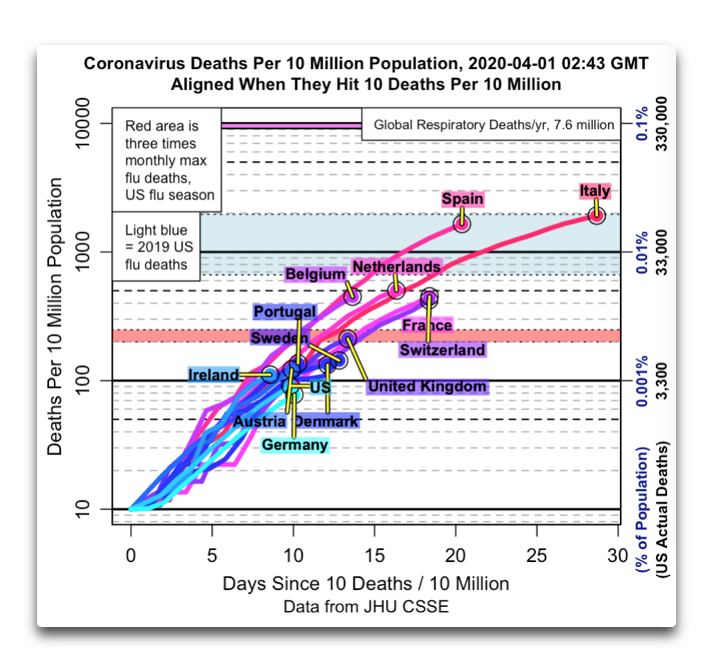
Figure 1. Coronavirus deaths versus the number of days since the country went over 10 deaths per million people.
As you can see, there is very little difference in the death rates between the various countries, despite the fact that they all have differing levels of health interventions to try to prevent the spread. They’re all following the same trajectory.
Now, other than lockdowns, what kind of health interventions am I referring to? Glad you asked. Over at ACAP you can download a dataset of the different kinds of measures used by different countries. They list no less than 33 different types of health interventions being used to fight the coronavirus, viz:
- Additional health/documents requirements upon arrival
- Amendments to funeral and burial regulations
- Awareness campaigns
- Border checks
- Border closure
- Changes in prison-related policies
- Checkpoints within the country
- Complete border closure
- Curfews
- Domestic travel restrictions
- Economic measures
- Emergency administrative structures activated or established
- Full lockdown
- General recommendations
- Health screenings in airports and border crossings
- Humanitarian exemptions
- International flights suspension
- Introduction of quarantine policies
- Limit product imports/exports
- Limit public gatherings
- Lockdown of refugee/idp camps or other minorities
- Mass population Testing
- Military deployment
- Obligatory medical tests not related to COVID-19
- Partial lockdown
- Psychological assistance and medical social work
- Public services closure
- Schools closure
- State of emergency declared
- Strengthening the public health system
- Surveillance and monitoring
- Testing policy
- Visa restrictions
So I used that to see if countries with more of those restrictions fared better. Here, for example, are the restrictions imposed by South Korea over time. Some are listed twice because they were expanded or made more rigorous over time:
- Health screenings in airports and border crossings
- Limit public gatherings
- Visa restrictions
- Visa restrictions
- Introduction of quarantine policies
- Schools closure
- Introduction of quarantine policies
- Additional health/documents requirements upon arrival
- Surveillance and monitoring
- General recommendations
- Additional health/documents requirements upon arrival
- General recommendations
- Partial lockdown
- General recommendations
- Introduction of quarantine policies
- Psychological assistance and medical social work
- Introduction of quarantine policies
- Surveillance and monitoring
Quarantine, then surveillance, then more rigorous quarantine, then even more rigorous surveillance and quarantine. I don’t believe that Americans would put up with that.
However, being a graphically minded sort of person, I then made a scatterplot of the number of distinct kinds of restrictions a country has imposed versus the number of deaths per ten million in that country. Figure 2 shows the result:
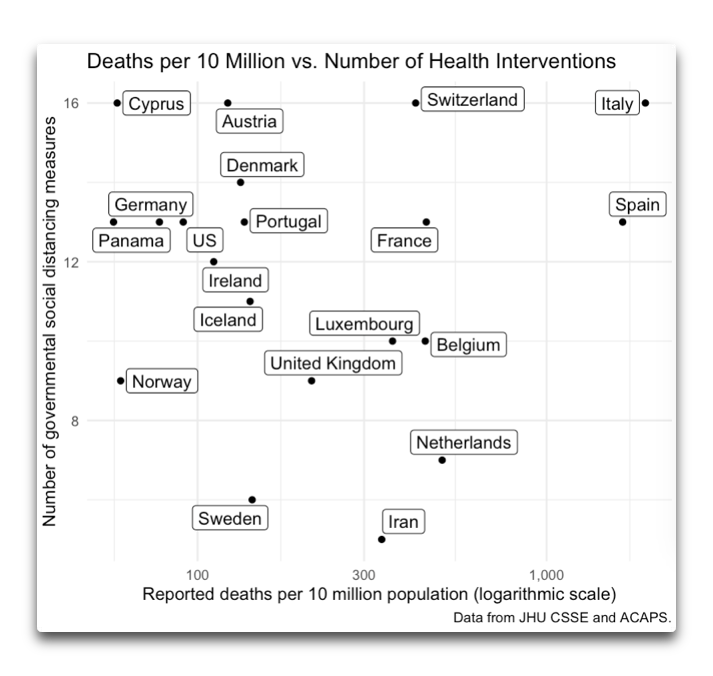
Figure 2. Scatterplot, number of kinds of restrictions to try to prevent viral spread versus coronavirus deaths per ten thousand.
As you can see, the number of restrictions seems to have little to do with the number of deaths. For example, here’s what Switzerland has done. These are the different restrictions they’ve applied.
- Limit public gatherings
- Border checks
- Visa restrictions
- State of emergency declared
- Schools closure
- State of emergency declared
- Border checks
- Visa restrictions
- General recommendations
- Strengthening the public health system
- Awareness campaigns
- Testing policy
- Limit public gatherings
- Border closure
- Limit public gatherings
- Economic measures
- Limit public gatherings
- Partial lockdown
- Full lockdown
- Partial lockdown
- Economic measures
- Economic measures
- Limit product imports/exports
- Military deployment
- Limit public gatherings
- International flights suspension
- Limit public gatherings
- Strengthening the public health system
- Visa restrictions
- Economic measures
So the lack of visible effect is not from a lack of restrictions. Nor is the lack of visible effect because the restrictions haven’t been in place long enough. Switzerland imposed the first restrictions forty days ago, on the 21st of February. They closed the schools. On the 24th of February, the government declared an “extraordinary situation,” and banned all private and public events and ordered restaurants and bars to close. At that point, they had no coronavirus deaths. [UPDATE: A couple of people said that Switzerland’s restrictions had not been in place that long. Upon rechecking my sources, I find they were right and I was 100% wrong. However, my point remains—the different restrictions haven’t made any detectable difference to date, and the crunch is coming in one or two weeks for most countries. So any effect will be minimal, if not detectable, and meanwhile the economic and human cost is horrendous.]
They currently have 433 deaths from coronavirus. Forty days of sanctions with no effect.
Meanwhile, the Swiss have about the same number of deaths per ten million population as say Netherlands, and here’s all that the Dutch have done:
- Introduction of quarantine policies
- Limit public gatherings
- Schools closure
- Public services closure
- General recommendations
- Economic measures
- Emergency administrative structures activated or established
No lockdown, neither partial nor full. No limitations on import/export. No suspension of flights. No visa restrictions. No state of emergency. No border checks.
And despite that … they are on a par with the Swiss, despite all of the Swiss containment measures.
Or you could look at it another way. Germany, the US, Portugal, France, and Spain have all instituted the same number of restrictions … but their deaths go from low to high.
So it seems that my intuition was correct. Unless you are willing to impose a full-blown police and surveillance state, these measures do very little. The problem is that this bugger is so insidious. It has a long incubation period when it is infectious but asymptomatic. And it can live on surfaces for days. As a result, in terms of government restrictions, nothing but a major Korean-style full-court press, with surveillance and strict quarantine and a populace willing to follow restrictions to the letter, will cut down the number of cases.
And Americans simply won’t do that. In fact, it’s impossible to get Americans to just shelter in place. If you go out into the streets of the US, there are lots of people working, lots of people going from place to place, grocery stores full of people … control the virus?
I don’t think so.
But regarding controlling the virus, here’s another graph. It’s exactly the same as Figure 2, but it contains Japan as well.
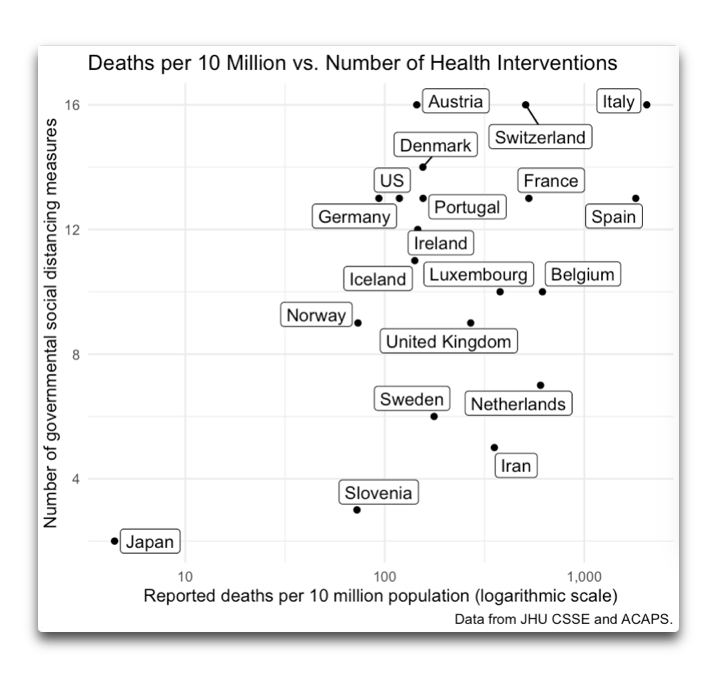
Hmm … they’re in the danger zone, near to Korea and China, so what extreme health measures are they practicing? Here you go …
- Health screenings in airports and border crossings
- Visa restrictions
Whaaaa? That’s all the restrictions? … my only conclusion from that is simple.
WEAR A MASK.
The one virus health practice that distinguishes Japan from most of the world is that they all wear masks in public. Even the liberal US news media is noticing the effectiveness of masks—a CNN story is headlined “Face masks and coronavirus: Asia may have been right and the rest of the world is coming around” … seems the US specialists were wrong again. Go figure.
A mask cuts transmission down in two ways. First, it keeps you from touching your mouth or nose. This both protects you until you can wash your hands, and if you are infected it keeps you from spreading the virus onto hard surfaces to infect others.
Next, it keeps you from sneezing or coughing a billion virus particles into the air. It’s less effective at preventing you from inhaling such particles, although it helps with that as well. And it is that sneezing and coughing that is the major way that the virus is spread.
And overall, as Japan is showing us, wearing a mask cuts the transmission rate way down.
We’re starting to get there, but it may be too little too late. I see that the genius medical experts who recommended the ineffective drastic lockdown are now thinking about recommending that Americans wear masks. The headline in Politico says “Fauci: Mask-wearing recommendation under ‘very serious consideration’” … under consideration?? They’ve destroyed the American economy without looking back, but a simple recommendation to wear a mask in public requires “very serious consideration”?
Sigh …
We can see above that there’s very little upside to the American lockdown … so let’s look at the downside. First, the economic damage from the current insane “shelter-in-place” regulations designed to thwart the coronavirus is already huge—lost jobs, shuttered businesses, economic downturn, stock market losses. This doesn’t count the personal cost in things like increased suicides and domestic and other violence. The people who made the decision obviously were led by doctors, which was good, but they did not listen to economists or social scientists, which was lethal.
To partially compensate the populace for those stupendous economic losses, we’ve just thrown two TRILLION dollars in the general direction of the problem. That’s trillion with a “T”. Most people have no idea how much a trillion dollars is. Consider it this way.
Suppose you were an immortal who made so much money that you were able to spend a million dollars a day forever. In the first week, you buy 350 ventilators at $20,000 each and give them to the various states. The next day you buy 200,000 face masks at $5 a pop, epidemic prices. Then you decide to take a year and buy a field hospital every day, 365 of them at a million dollars each. That feels so good that you decide to set up full hospitals. They’re something like 1.5 million dollars per bed. So you can buy a 250-bed hospital per year. You spend the next two hundred years doing that, two hundred new hospitals, 50,000 new beds.
Now that’s only about a hundred years of spending a million bucks a day. Suppose further that you started spending one megabuck per day, that’s a full million dollars each and every day including weekends, back on January First way back in the Year One. And imagine that you spent a million dollars a day every day right up to the present, buying medical equipment, expanding medical schools, purchasing test kits, a million dollars a day from the year 1 right up to the year 2020.
Guess what …
…
… you still would have spent far less than a trillion dollars, only about three-quarters of a trillion. And to spend two trillion, you’d have to spend a million dollars a day for 5,500 years.
Can you imagine what our medical system would be like if we spent a million dollars a day on it for fifty-five-hundred years?
Instead, we’ve pissed the two trillion away on repairing the damage caused by the lockdown without getting the economy started again, plus wasting it on all the pork that got loaded onto the bill.

Consummate financial idiocy that only politicians could ever think was reasonable, logical, or practical. Mark Twain was right when he said “Suppose that you were a Member of Congress. And suppose further that you were an idiot. But I repeat myself.”
So … how about we all put on masks, keep washing our hands, give up our steamy midnight rendezvous (rendezvous?) with pangolins, increase testing particularly of our medical personnel, start testing for antibodies, and end this stupid lockdown? The pluted bloatocrats in Congress are already dreaming up a new appropriations bill to waste another trillion dollars or so that we cannot afford. Me, I say, let’s quit while we’re behind and get back to work.
Here on my forest hillside where the redwood trees scratch the sky, it’s my great fortune that my daughter, her husband, and my infant granddaughter have come to spend the lockdown in the woods … and both I and my gorgeous ex-fiancée are overjoyed that they are here. They’re working from home, and we’re retired, so all is well chez nous.

So stay well in these parlous times, dear friends. I see that Chloroquine has been approved in India for Covid-19 treatment. I had malaria four times, so I know that drug up close and personal. Plus I took it once a week for a year as malaria prophylaxis. And I used to take three weekly doses per day for three days in a row if I felt malaria coming on, and that would stop it in its tracks. So I’d take it again in a minute.
And I also saw that the advisor to the Italian Health Minister has said that only 12% of the Italian deaths were actually deaths FROM Covid-19, and the rest were deaths WITH Covid-19. So things may be looking up.
Regards to everyone,
w.
The Usual: When you comment please quote the exact words you are discussing, so we can all be clear who and what you are referring to.
Hi Willis,
It is true that Japanese do often wear masks, but mainly when they are sick or think they might be, not all the time. The annual average number of deaths per million population from influenza is about 200 in Japan, while in the USA it is about 160. So for influenza at least, the mask wearing does not seem to have much of an impact. Of course, it could be that with the new corona virus threat, all Japanese are now wearing masks in public. Maybe there is some way to verify if this is the case.
I would suggest that the Japanese population concentrations are much greater than found here so that comparison is not really valid.
rah,
Sure, the population density is higher, but why would that not also apply to Coronavirus 19? The Japanese also do a lot less public hand shaking, hugging, and kissing than the Italians do…. and for that matter, than Americans do. There is a lot less international travel to Japan than there is to many other countries. There are plenty of factors which can impact transmission rates. I would not hang my hat on *just* the use of masks without careful consideration of other potential factors.
Keep an eye on the Swedes.
Jo Nova posted on. Sweden’s gamble with very limited restrictions on social interaction.
The situation is compounded the relative shortage of ICU beds vis-a-vis other developed countries.
A science experiment in the making. Unless they reverse course, they are courting disaster.
http://joannenova.com.au/2020/04/sweden-going-for-herd-immunity-and-using-the-1918-flu-plan/
Japanese population is also older on average.
Willis,
The Washington state Department of Health is having problems with their Wuhan virus tracking data base.
“We are experiencing technical difficulties with our COVID-19 data repository. We are working diligently to resolve these issues. For more information, please view our statement on the delay in data posting, 3/31/20 (PDF).” https://www.doh.wa.gov/Portals/1/Documents/1600/coronavirus/DelayDataPosting.pdf
As best I can ascertain, they have not updated the state provided public access data since 3/29. The WA Covid-19 Case dashboard displays individual county data up to 3/29 only.
https://www.arcgis.com/apps/opsdashboard/index.html#/3614241b1c2b4e519ae1cf52e2c3d560
While the state ‘dashboard’ shows only 195 deaths in WA, other sources pin the number at 225, as of 3/31.
https://komonews.com/news/coronavirus/virus-deaths-hit-223-in-wash-as-glitches-plague-statewide-reporting-system
Yesterday and today, this has been in the news.
Thus, it is no longer news. They are working on it.
The State of Washington has been pre-occupied with solving climate change and banning “single use” (sic) plastic bags.
State officials cannot be expected to be doing 3 things at once!
– – winking smiley face – – Poe’s Law
John, good info.
a lockdown of the at risk seniors in America (about 5 million) would have worked to keep them from catching and then dying from it …
locking down everyone else just keeps people at no risk of dying from it from possibly catching it (unless like in Italy you as an at-risk senior get locked down with infected family members) …
If the goal is less dead you only needed to lock down the at risk seniors … yes locking down everyone might accomplish the same thing … but so would have locking down just the at risk folks …
Agree. And most of the high-risk have already retired, so it would have little impact on the economy. It’s a shame that Donald Trump (and his advisers) couldn’t push the US in that direction after having talked about not making the cure worse than the disease. I think a great opportunity has been missed.
“Agree. And most of the high-risk have already retired, so it would have little impact on the economy.”
Age might not be as much of a factor with regard to the Wuhan virus. A doctor on tv just now who is actively treating patients with hydroxychloroquine says his experience, which is in line with the Washington State experience, is the most at risk people are diabetics, pre-diabetics and people who are overweight to the point of being obese, a bmi of 30 or more. And this applies to all ages. He said he had a slim 75-year old that did just fine. He said none of his patients who recieved five days of treatment had to be intubated.
He said it is a game-changer.
Mike,
1) there are a sizable number of seniors (65+) still in the workforce/not fully retired. And a good percentage of them work in public facing jobs in the service industries – meaning they come in contact with lots of people on a daily basis.
2) It’s not just the elderly that have high-risk, it’s those with underlying conditions which can affect any age group. (just look around you at the number of under 40 Americans who are overweight and/or smoke – just for starters. Diabetes, High blood pressure, heart conditions, Lung conditions – these things don’t just magically appear when you turn 65)
Bingo!
This is a fast moving target. In the UK:
yesterday’s death/10M was 275 people
today’s death/10M was 361 people
an increase of 31%
Today’s update here
Agree
Some people are denying this is the real deal. It’s real.
My daughter in-law is an ICU nurse in Indianapolis. Talked to my son today and he said she had a crying jag last night. She is doing COVID-19 only and has been working extremely long hours of course. Says that she has 4 patients to deal with, all on respirators. Working in an adhoc ICU. Being the caring individual she is this is really hard on her. She says that from her perspective in the ICU the patient ages are scatter shot. The youngest 31 the oldest 80 y/o. Peak surge has not hit Indianapolis yet. They are doing OK with the N-95 masks though they are sanitizing them for reuse. Their worst shortage in PPE are the disposable gowns.
Here is a preprint article from the US CDC on the policy decisions which Taiwan used.
Willis, generally speaking, where does Taiwan fit on your scatter plot?
https://wwwnc.cdc.gov/eid/article/26/7/20-0574_article?deliveryName=USCDC_333-DM24542
OK, so Taiwan reports 5 deaths with a population of 23.57M, the deaths per 10M is around 2.
Down near the Japan level.
From the above article after SARS, they do have a mask wearing culture.
Another thing they did was develop a 4 hour PCR test and did extensive testing.
It certainly seems that having a knowledgeable public health care system in place as well as high population densities enables early control without too much draconian measures.
I think Taiwan instituted a travel ban early, too.
Yes, the travel ban was mentioned in the CDC link above.
As far as Taiwan, I don’t know where that level of government intervention fits into Willis’s scale.
In Asian countries, people commonly wear masks in public when suffering from some ailment (cold, flu), a practice quite rare in the West. So masks are readily available. The shortage of masks in western countries is the likely reason they were not recommended for use by the general public. An official recommendation to wear masks would have created a buying stampede and, hence, severe shortages for medical staff. Catch 22.
Masks probably do work to reduce infection rates, contrary to what some of our health professionals – and politicians – have stated.
I don’t think surgical masks really do much, even in Japan. The fact of the matter is that the Japanese are probably the biggest germaphobes in the world. The are incessant hand washers and wipe down/disinfect surfaces often. This is almost certainly the biggest reason they don’t have as many infections of either CoViD 19 or Influenza.
Do lockdowns work>:
https://www.ft.com/coronavirus-latest
(12 noon BST 01/04/20) from which a summary:
‘The US is now the global centre of the pandemic, with the number of new cases increasing every day, and total infections in the last week alone passing 100,000.’
The US has a much smaller death total and deaths per population than most countries. The reason we have so many positives is that we have many more tests made and they are more accurate. The most likely death to positives when all people are tested is almost surely far below 1%. Any country with a higher percent and higher number than US is likely due to tracking deaths well, but not positives.
Well, I guess we’re all going to find out just which policy is best, if one appears, in about a year’s time . . .
I see no evidence of an optimal strategy from any of the graphs.
I read on WUWT the other day that the virus doesn’t like high temps and high humidity, and spreads further in cold and dry conditions.
Perhaps a face-mask will raise temperature and humidity around the mouth and nose of the wearer, and offer a bit more protection ?
The Coronavirus Hug-fest: Israeli Hippies Brazenly Flout the Rules
The two dozen people at a refuge in the north say group cuddling and a communal bed are among the best ways to bolster the immune system against COVID-19
https://www.google.com/amp/s/www.haaretz.com/amp/israel-news/.premium-the-coronavirus-hug-fest-israeli-hippies-brazenly-flout-the-rules-1.8731032
They should go and repeat the exercise in Gaza and see how that goes. Looking forward to that.
I’m not sure this sort of analysis means much at this stage.
Firstly, it takes at least 2 weeks before any effect will be observed. In Wuhan the lockdown was introduced on Jan 23rd. The decline in confirmed (tested) cases began on Feb 4th. There are good reasons for this, i.e. incubation period and development of symptoms.
Secondly, intervention measures have not been applied uniformly across countries. Italy’s began in specific provinces in Lombardy and has been gradually extended across the country ever since.
Thirdly, countries are at different stages of the pandemic. The Fig 2 graph reflects the fact countries are responding to the seriousness of the problem, i.e. the measures have increased because the cases have increased,
John,
You said “Firstly, it takes at least 2 weeks before any effect will be observed.” Because the doubling period is less than the incubation period, one can expect to start seeing an effect within a few days, with maximum effect after about 2 weeks of isolation.
The problem with masks is that they are currently disposable. It is not possible to produce the number of disposable masks required in the U.S. If you give each person in the US one disposable mask, you needs over 300 million masks. What is reasonable use? One mask per day for 30 days? Make that 9 billion masks. It would not be a bad idea to have a non-disposable full-face respirator that can be decontaminated regularly with hydrogen peroxide or bleach. Hopefully we are learning things from this pandemic. I hope the impracticality of disposable personal protective equipment in a pandemic is one of them.
There is only one way out of this. Vaccine, testing, and drug therapy. The testing seems to be solved, finally, with a 15 minute turnaround time test of sufficient reliability. Unfortunately that will not identify the symptomless carrier of the virus. We would have to be prepared to give 300 million tests on a periodic basis to catch the mild cases. An 18 month clinical trial for a vaccine is not going to be acceptable. There has to be an emergency fast track to put it out now after minimal safety and efficacy testing and an informed consent letter. Give it only to those at high risk. That should prevent excessive hospitalizations, the real crisis. To bring length of hospital stay down a drug therapy is needed. Emergency fast track approval required, given only to those hospitalized with informed consent. There are two now well known candidates and dozens of candidates on the back burners. All must be tried now. The solution acceptable to the existing FDA system is simple. Everyone who is hospitalized is enrolled in a clinical trial. No controls. Everyone gets one med or another, the outcomes of the various meds are compared. to each other, not to placebos
We have to realize that people with lung disease, cardiac disease or metabolic disorders are probably going to die. So protect them. Lock down the nursing homes and retirement communities.
I just want to add a pet peeve. Cubicles in offices are terrible for infection control. Not only are they hated universally by employees, they pack people together in high density in the same air space. No one should be allowed to go back to work in a cubicle until the pandemic is over. It is the employers’ problem to work out.
Ordinary cloth works, you can iron it or wash it. Reusable.
Describe the procedure, step-by-step, that you would go through to produce and use/reuse an “ordinary cloth” mask.
How do you insure that it is virus free, upon its first application? Spray with alcohol, maybe? Then how long would you wear it at a time? Are your hands completely sanitized when you touch it the first time? How exactly do you place it on your face? How exactly do you take it off your face? Where do you place it, after you take it off your face, so as not to contaminate a surface? Do you answer all these questions in such a way that the chain of contamination is completely sanitized, each and every step of the process, … each and every time you place the mask and remove the mask?
If it were dust we were talking about, then sure, I see the value of a mask — I use one, when I mulch leaves, to keep out the leaf dust, and I spray it with alcohol, when I’m done breathing on it.
But we are talking about a virus. Is it really possible to effectively control the locations of these with a barrier like this? Again, I have doubts. I’m not convinced that it is practically possible for such masks to actually make any difference.
Masks make people feel better. They signal an intent and a consciousness of a contaminant. Intent and general consciousness does not magically cause the chain of contamination to stop where you want it.
I wear a mask when I leave the property , I dont ware it to protect others I ware it to help protect me, the virus is airborne in water droplets when someone coughs or sneezes, the mask will help prevent me breathing in the snot of some one else=virus , it’s not fail safe but it gives me time to ditch the mask (in a plastic bag) and burn it when I get home. Unless you have a full face mask with air filter cans stuck on the end ,its the best people can do when they have to out.
Robert, in my country, Slovakia, masks are mandatory now. We had same problems with availability as all countries. Then after few days many women, locked down volunteered and started sewing masks. Manual was viral on Youtube, Facebook.
https://m.youtube.com/watch?v=Md-jy2YEERE
After another few days small sewing companies started to produce masks in hundreds batch. Now everybody who wants mask can get one.
Those masks are created from cotton, so you can iron them on high temperature. After ironing with 120C/270F iron it is sterile. This is point of ironing for hundreds of years.
Mask have rubber strings, which you put behind your ears. Whole manipulation is done by strings, to not touch front area. It is simple.
Another way how to sterilise mask is to put it into oven at 120C/270F for 10 minutes.
And of course washing it. Detergent plus high temperature water kills viruses.
Robert, someone with a mask sneezes in your location, you and anyone near them may well get the virus. It can go from one person to a dozen in that instant.
But if they are wearing a mask, you and they likely won’t get the virus.
Please explain to us whether this will speed up or slow down the spread of the virus, regardless of the considerations you list …
w.
Yes Willis, my guess is that ordinary cloth face masks protects you for around 10%, but protects other for 70% getting virus from you. So mutual protection is (1-0.1)x(1-0.7)=0.27. That means that chance to get virus when all wear face masks is reduced to 27%.
This alone can reduce R0 of Covid from 3.5 to around 1.
https://www.youtube.com/watch?v=Md-jy2YEERE
Here is manual how to produce face mask.
Sterilization? Iron it, bake for 10 minutes on 120C/250F, let it sit for hour or more on direct sunlight, wash it in machine.
Manipulation? Get it on or off only by strings behind your ears.
Honestly, I’m one of the lucky ones in my state. I still get to go to work – turns out I’m an essential service (Yeah, I know – who knew – I’ve always felt very redundant) – we service truckers, farmers, the city and county, and utilities – so we’re actually doing tons of volume.
But that can only last as long as our customers continue in business themselves.
The biggest issue as far as the economy is that there is no ‘end’ – this holding pattern simply can’t last – there is no point of ‘zero-risk’ – LIFE is risk.
I think, to a large extent, we’ve been spoiled by the illusion of absolute safety – to the point where it seems to be taken for granted.
I work part time for landscape company (so plowing in winter) and we are essential also. sort of makes sense since we do commercial lots like parts stores and apartment buildings. luckily these are all under contract with money set aside so we get paid but yeah…our customers suffering bugs us too. we also plow lot of residential and we gave them breaks the last week from storm plowings.
the forced quarantines are pretty much common sense being forced onto people at the point of a gun.
by that I mean due to the exclusions most of it is useless, people with common sense were already practicing good hygiene and distancing, and was a very small subset of people acting like idiots.
those idiots still gonna act that way only difference is now local/state governments get to see (1) how easy it is to strip away (in the US) constitutional rights, (2) how easy it is to jail any member of the populace for any reason with the stroke of a pen, and (3) how easy it is to gain yet another income stream from the fines.
And once a government has seen how easy it is to gain power of=ver a populace lets see how hard it is to get them te reduce that power back to the pre-edict days. Hint…it never happens. Any rollbacks always are much less than the pre-edict days.
This disabled vet (peacetime in germany when all we had to deal with were red army pukes and baader-meinhof pukes…yeah they were not violent at all) is disgusted about how easily the populace is giving up a huge % of their freedoms for a facade of safety due to their feelings. I got hurt basically for no damned reason.
color me fking disgusted!!
dmacleo,
You are not alone. I too believe that these sweeping lock-downs are unlawful and unconstitutional. It’s only a matter of time before someone who is asymptomatic is arrested and charged under one of these orders and challenges the legality of it. Then we will see if we are still a nation ruled by laws, or by men.
And your sacrifice was not for nothing – I for one am grateful. Thank you for your service.
I live in Colorado. I keep asking officials what the government’s estimate is for keeping the current rules in place (stay at home, social distancing, businesses shutdown, etc). So far I haven’t received an answer. And “forever” and “as long as necessary” aren’t answers to my question. (The answer may be classified).
So far I haven’t received an answer
Yes you have: “as long as necessary” is an answer, it’s just not an answer you like. The fact is no one knows a definitive answer to your question because the answer is “it all depends” (which effectively means “as long as necessary” in regards to the rules) as in it all depends on how things go, how quickly the virus dies down (as it will at some point, but nobody know when that point it and if anyone claims to know, they’re lying). You looking for a timeline, and no one can give you a timeline because no one knows what the timeline will end up being (and again, it anyone claims to know the timeline, they’re lying)
The only spending that makes sense for ‘refugee’ resettlement is for transportation returning them to their country of origin. Economic refugees don’t qualify for asylum and it’s these kinds of illegal immigrant refugees that the Democrats want to resettle. I would have no problem spending money on this if a condition for resettlement was that the recipient must have entered the country legally and has a valid asylum claim.
If being poor and/or having a corrupt and incompetent government was a criteria for asylum, we would be overrun with the billions of people around the world who would qualify. America has always been a generous country, but there are practical limits to our generosity. To get around these limits, the Democrats have become racists who break the law by extending this exceptionally generous privilege to only ‘people of color’ from Central America and Mexico who ILLEGALLY crossed the border to get here. To add insult to injury, they call anyone who opposes their agenda a racist. It’s just another example of the projection they frequently use as a deflection tactic.
Merit based immigration is what most of the world does and we should do the same. Anyone who crosses the border illegally should be sent back with no exceptions. A policy like this was enacted due to Covid-19 and should stay in place permanently. If someone has a legitimate asylum claim, they must go through the proper channels. The Democrats don’t want this because those immigrants who respect US law will probably not vote for a Democrat (or a Socialist) if they were to become a citizen.
For me, by far the more important metric is confirmed cases. Of course, there are differences in the way cases are reported, as between Italy on the one hand and Germany on the other. But given a consistent reporting scheme, confirmed cases (if it’s all the one virus – and that’s an assumption) will translate to deaths in a way that should be fairly consistent across countries with similar medical systems. At 2 to 3 weeks out. Though it does look as if new cases are starting to decline in many European countries.
And in reply to your question “Do lockdowns work??” my answer is an unequivocal Yes. For those that want to suppress human rights and freedoms.
Neil Lock April 1, 2020 at 12:25 pm
I’m sorry, Neil, but “confirmed cases” is a function of testing. Suppose a country does no testing. How many confirmed cases will it have?
w.
To me the most important metric is level of hospital load or overload. Seasonal flu does not overload the hospitals. If they could handle the load with no lockdowns, then the lockdowns probably should ease. But right now in more and more locations they are becoming overloaded even with deferring all non-elective procedures. Death rate per million is not useful to determine the measures taken. Neither is # tests or # cases. It is the impact on the health system itself. So something along the lines of % of critical resources consumed in a given area. Problem is, it is too late once overloaded, so as flawed as models are if the trends or models are pointing towards overloading 2-4 weeks in the future, the time for action has arrived because of the length of the incubation period. Once hospitals have more equipment and the # serious admissions levels or starts to decline, then it is a different story.
The fact that measures were put in place across entire states overshoots basing it on overloading of particular service areas, but it is far easier to implement and communicate than drawing maps around service areas (which do not tend to correspond to any particular governmental boundaries.)
If you look at the number of confirmed cases in any one country, you can take the variability in the testing regime out of the equation – well, almost.
In the Swiss example, confirmed new cases continued to increase at over 20% per day until 21st March.
Then followed 4 days with between 10 and 20 per cent.
The last week’s daily increases have averaged 7 per cent.
On this basis, I would suggest that the draconian Swiss lockdown measures have started to work, implying that there was a built-in 2 to 3 week increase in the pipeline already, before their effect kicked in.
Similarly, I can imagine that the rate of increase in daily deaths will start to decline a couple of weeks or so after the start of the decline in new cases. In other words, somebody who catches the disease today is only likely to become a death statistic in 2 or 3 weeks’ time.
Sweden has taken the opposite approach, with many public amenities still open as normal.
It will be interesting to see how these 2 countries compare over the next month
If a country does no testing beyond those who report symptoms (as looks to be the case in the UK, and very probably in some of the other countries too), then you will – obviously – get less confirmed cases than if you test random samples of the general population. And less still than if you aim to test everyone (which is probably out of bounds on cost grounds). Nevertheless, you will still get a, more or less useful, count of confirmed cases. It’s better than nothing.
Bravo Neil! Your inalienable right to be an egocentric, short-sighted imbecile must in no way be infringed! That would probably be Comnism or sumfink. Celebrate your freedom and individuality by buying more guns!
Naturally, I’m perfectly happy for you and your hideous moronic tribe to infringe my right to have my wife, with Stage 3 emphysema/COPD live long enough to celebrate our 25th wedding anniversary in 2 months time. She might be dead by then, drowned by fluids filling her lungs, but at least she’d be free and her rights would not have been infringed. You’ll be alive and free so spread your ghastly, ignorant TRUTH, I’ll replace the flowers when I can. Twat.
Adrian, I’m sorry your wife is so ill, and I’m sure you are over the edge with worry. But, your wife does not have a “right” to survive, nor do you, nor do any of us. Pretending we are immortal is an illusion. You and your wife do have every right to lock yourselves down and not emerge until this is over. Locking everyone else indoors and impoverishing them to boot might make you think something is being done for your wife, but it is a fantasy. Her best bet is personal isolation and assuming everyone she contacts, including you, is an asymptomatic carrier. Good luck to you both.
Unfortunately Uk statistics regarding Covid 19 will, quite shortly if not already, further reinforce prejudices against ‘experts’. That is a pity, because some of them really seem to know what they are talking about:
‘Now look at what has happened since the emergence of Covid-19. The list of notifiable diseases has been updated. This list — as well as containing smallpox (which has been extinct for many years) and conditions such as anthrax, brucellosis, plague and rabies (which most UK doctors will never see in their entire careers) — has now been amended to include Covid-19. But not flu. That means every positive test for Covid-19 must be notified, in a way that it just would not be for flu or most other infections.
In the current climate, anyone with a positive test for Covid-19 will certainly be known to clinical staff looking after them: if any of these patients dies, staff will have to record the Covid-19 designation on the death certificate — contrary to usual practice for most infections of this kind. There is a big difference between Covid-19 causing death, and Covid-19 being found in someone who died of other causes. Making Covid-19 notifiable might give the appearance of it causing increasing numbers of deaths, whether this is true or not. It might appear far more of a killer than flu, simply because of the way deaths are recorded.’
Dr John Lee, recently-retired Professor of Pathology and NHS consultant pathologist
https://www.spectator.co.uk/article/The-evidence-on-Covid-19-is-not-as-clear-as-we-think
I agree.
Mask can be recommended, but try to find the appropriate one in the USA at the beginning of this year.
As for the surgical mask, one would be needed at least once a day. Try to find a box of them. Not available.
Could you cook the mask and reuse it? Would that work? Just asking.
You can heat the mask so that you can reuse the mask. One study said if you heated the mask to:
132F it would take 90 minutes to sterilize
152F it would take 60 minutes
167F it would take 30 minutes
Or you could leave it in a plastic bag for 9 days and then reuse
How about microwaving it. Wouldn’t this excite any water molecules in the viral particles and cause them to explode from within in a much shorter time then heating them from the outside?
I’ve seen one study that says uwaves do kill the virus, but tends to melt the masks. This tells me that they were using too high of a power setting or cooking it for too long. If it was heated enough to melt, then it got to a much higher temperature than required to kill any viral particles.
Dampen the mask. Place in a bowl covered with a saucer. Microwave until steamed thoroughly (15 – 30 seconds, depending on your microwave). Remove and let dry.
Well I’m not sure if what seems to be happening these days. What we’re told and what appears to be happening are different. For example in South Dakota restaurants and bars are open as are all manner of stores. Virus growth rate is same or less than states with everyone fully locked in place. If problem is related to lockdown then the rates ought to reflect this, then by all rights SD ought to be ballooning. It’s not. This says that infectiousness isn’t as claimed. It’s not about totals or testing but about rates. In minn most of the ICU beds and deaths are related to the virus being in long term elderly care facilities. This despite the confirmed cases being fairly evenly represented across age groups 20-80. Growth rate in minn is fairly flat ie 50 cases per day rather than 50-70-90 over 3 days as we’ve been told is what to expect.
It is possible that this virus simply converts a death that would soon have occurred anyway in a quiet hospital bed into one that, before it occurs, requires assistance with breathing via oxygen or a ventilator.
In that case one would see that particular speciality overwhelmed whilst it becomes quieter than average in the rest of the healthcare system.
Of course it would add some additional deaths because it is added on top of the average disease burden but such deaths occur from respiratory problems all the time. My wife lost a good friend many years ago, in her 20s, to pneumonia so such deaths are hardly unprecedented.
The key is to observe how much of an increase in deaths occurs over and above the normal national death rate so that is the parameter to keep an eye on.
At this moment the average death rate in the UK is running a bit less than normal due to a mild winter. It is likely to rise from Corvid 19 infections but by how much ?
The issue, then, is whether any such rise is enough to justify closing down economic activity because that can also increase death rates from mental distress and problems in the supply of food and medicines worldwide.
Is this really a problem for the UK NHS as a whole or just a burden on a specific specialised facility within the NHS ?
Are we fighting a phantom and causing the cure to be worse than the disease?
There is a reason why pneumonia was often referred to as ‘the old man’s friend’. It may have carried him off a bit sooner but saved him a load of suffering in the process.
Something that alarms me is the idea of sick people in the process of dying quite naturally within a year or two being kept alive and aware artificially by means of painful, distressing, damaging ventilation when they might have preferred to pass away quietly under sedation.
In most of Europe the mild winter has resulted in a low influenza season which has created a pool of senior citizens who would normally have died already with flu imposed on top of underlying illnesses exposed to the depredations of Corvid 19 but in the end will the total death rate be much higher than normal ?
Questions, questions.
Yes much of the death count attributed to COVID ( or the normal flu ) is done to make it sound dramatic. It is often a life shortened by a year at most. When you are at the end of your force, it only takes a little problem to push you over the edge.
They play the same game with PM2.5 etc. claiming it costs xxxx million lives per year, when this is just a snip from a statistical result saying that it shortened those lives 2.54 days on average !!
Willis,I believe you really should have waited at least one month, better a year. Nobody really expected a notable effect this soon, just getting away from the logarithmic growth and we know so little. Probably Sweden is acting the most rational, persons over 70 to be quarantined, public life taking mostly its normal course. The success of Japan and the mask wearing however are really convincing. In the Netherlands there is a plea for letting children go to school again and since they are not at risk I strongly support the idea.
Alexander Vissers April 1, 2020 at 12:45 pm
Alexander, there is no noticeable effect in Switzerland after 40 days. Now, you can say that nobody “really expected a notable effect this soon”, but if so, then why the hell are we doing this? Remember, the point was supposed to be to lower the peak cases in the crunch time. The crunch time for the US is later than most, it will be in the next couple of weeks, and if there is no effect by then as you claim, then it has all been trillions of dollars in damages for absolutely no gain.
w.
Switzerland does not have a lockdown for 40 days. I don’t know where this false information is coming from. Switzerland was even later than Germany to put up restrictions.
Exactly. That was a bit of fake news in the article.
The Swiss lockdown started in earnest on 17th March. They only closed their ski resorts on 14th March.
The average daily increase in infections for the following 9 days was 18.9%
The average daily increase for the next 9 days (26th March to 3rd April) was 6.8%
Something is working.
Yes, I clarified that I was wrong about that a couple of days ago. Check the head post.
However, your claim that “something is working” isn’t borne out by the data.
If the growth rate truly had dropped by half in the days after the 17th we’d see a clear “kink” in the trajectory … but we see no such thing. There is no change in the curve.
Stay well,
w.
People living in rural remote communities where the risk levels are extremely low are being impacted financially by this lockdown. This makes no sense at all.
Rural communities are “essential services” and should be reanimated ASAP.
Sadly, too many of those making these decisions are city dwellers, born and bread and their whole mindset is totally blinkered to that context.
French rules now only allow ONE ‘health’ outing per day limited to a 1km distance from place of residence. I live in a rural context and I does not matter a damn whether I go 1km of 5km up the track. The designed these rules for Paris. Les Parigots think nothing exists ( or at least matters ) outside their little universe.
Yes, Greg, there’s a serious disconnect between rural and urban communities.
Rural remote communities will be impacted financially.
Is this intentional or is it being done out of sheer ignorance?
Lubos Motl recently wrote a similar article, coming at the lockdown question from a viral load angle.
See:
https://motls.blogspot.com/2020/03/lockdowns-may-increase-viral-doses.html?m=1
Makes sense and argues for use of masks.