Guest Post by Willis Eschenbach [see update at the end]
How much is a “Whole Little”? Well, it’s like a whole lot, only much, much smaller.
There’s a new paper out. As usual, it has a whole bunch of authors, fourteen to be precise. My rule of thumb is that “The quality of research varies inversely with the square of the number of authors” … but I digress.
In this case, they’re mostly Chinese, plus some familiar western hemisphere names like Kevin Trenberth and Michael Mann. Not sure why they’re along for the ride, but it’s all good. The paper is “Record-Setting Ocean Warmth Continued in 2019“. Here’s their money graph:

Now, that would be fairly informative … except that it’s in zettajoules. I renew my protest against the use of zettajoules for displaying or communicating this kind of ocean analysis. It’s not that they are not accurate, they are. It’s that nobody has any idea what that actually means.
So I went to get the data. In the paper, they say:
The data are available at http://159.226.119.60/cheng/ and www.mecp.org.cn/
The second link is in Chinese, and despite translating it, I couldn’t find the data. At the first link, Dr. Cheng’s web page, as far as I could see the data is not there either, but it says:
When I went to that link, it says “Get Data (external)” … which leads to another page, which in turn has a link … back to Dr. Cheng’s web page where I started.
Ouroborous wept.
At that point, I tossed up my hands and decided to just digitize Figure 1 above. The data may certainly be available somewhere between those three sites, but digitizing is incredibly accurate. Figure 2 below is my emulation of their Figure 1. However, I’ve converted it to degrees of temperature change, rather than zettajoules, because it’s a unit we’re all familiar with.

So here’s the hot news. According to these folks, over the last sixty years, the ocean has warmed a little over a tenth of one measly degree … now you can understand why they put it in zettajoules—it’s far more alarming that way.
Next, I’m sorry, but the idea that we can measure the temperature of the top two kilometers of the ocean with an uncertainty of ±0.003°C (three-thousandths of one degree) is simply not believable. For a discussion of their uncertainty calculations, they refer us to an earlier paper here, which says:
When the global ocean is divided into a monthly 1°-by-1° grid, the monthly data coverage is <10% before 1960, <20% from 1960 to 2003, and <30% from 2004 to 2015 (see Materials and Methods for data information and Fig. 1). Coverage is still <30% during the Argo period for a 1°-by-1° grid because the original design specification of the Argo network was to achieve 3°-by-3° near-global coverage (42).
The “Argo” floating buoy system for measuring ocean temperatures was put into operation in 2005. It’s the most widespread and accurate source of ocean temperature data. The floats sleep for nine days down at 1,000 metres, and then wake up, sink down to 2,000 metres, float to the surface measuring temperature and salinity along the way, call home to report the data, and sink back down to 1,000 metres again. The cycle is shown below.

It’s a marvelous system, and there are currently just under 4,000 Argo floats actively measuring the ocean … but the ocean is huge beyond imagining, so despite the Argo floats, more than two-thirds of their global ocean gridded monthly data contains exactly zero observations.
And based on that scanty amount of data, which is missing two-thirds of the monthly temperature data from the surface down, we’re supposed to believe that they can measure the top 651,000,000,000,000,000 cubic metres of the ocean to within ±0.003°C … yeah, that’s totally legit.
Here’s one way to look at it. In general, if we increase the number of measurements we reduce the uncertainty of their average. But the reduction only goes by the square root of the number of measurements. This means that if we want to reduce our uncertainty by one decimal point, say from ±0.03°C to ±0.003°C, we need a hundred times the number of measurements.
And this works in reverse as well. If we have an uncertainty of ±0.003°C and we only want an uncertainty of ±0.03°C, we can use one-hundredth of the number of measurements.
This means that IF we can measure the ocean temperature with an uncertainty of ±0.003°C with 4,000 Argo floats, we could measure it to one decimal less uncertainty, ±0.03°C, with a hundredth of that number, forty floats.
Does anyone think that’s possible? Just forty Argo floats, that’s about one for each area the size of the United States … measuring the ocean temperature of that area down 2,000 metres to within plus or minus three-hundredths of one degree C? Really?
Heck, even with 4,000 floats, that’s one for each area the size of Portugal and two kilometers deep. And call me crazy, but I’m not seeing one thermometer in Portugal telling us a whole lot about the temperature of the entire country … and this is much more complex than just measuring the surface temperature, because the temperature varies vertically in an unpredictable manner as you go down into the ocean.
Perhaps there are some process engineers out there who’ve been tasked with keeping a large water bath at some given temperature, and how many thermometers it would take to measure the average bath temperature to ±0.03°C.
Let me close by saying that with a warming of a bit more than a tenth of a degree Celsius over sixty years it will take about five centuries to warm the upper ocean by one degree C …
Now to be conservative, we could note that the warming seems to have sped up since 1985. But even using that higher recent rate of warming, it will still take three centuries to warm the ocean by one degree Celsius.
So despite the alarmist study title about “RECORD-SETTING OCEAN WARMTH”, we can relax. Thermageddon isn’t around the corner.
Finally, to return to the theme of a “whole little”, I’ve written before about how to me, the amazing thing about the climate is not how much it changes. What has always impressed me is the amazing stability of the climate despite the huge annual energy flows. In this case, the ocean absorbs about 2,015 zettajoules (10^21 joules) of energy per year. That’s an almost unimaginably immense amount of energy—by comparison, the entire human energy usage from all sources, fossil and nuclear and hydro and all the rest, is about 0.6 zettajoules per year …
And of course, the ocean loses almost exactly that much energy as well—if it didn’t, soon we’d either boil or freeze.
So how large is the imbalance between the energy entering and leaving the ocean? Well, over the period of record, the average annual change in ocean heat content per Cheng et al. is 5.5 zettajoules per year … which is about one-third of one percent (0.3%) of the energy entering and leaving the ocean. As I said … amazing stability.
And as a result, the curiously hubristic claim that such a trivial imbalance somehow perforce has to be due to human activities, rather than being a tenth of a percent change due to variations in cloud numbers or timing, or in El Nino frequency, or in the number of thunderstorms, or a tiny change in anything else in the immensely complex climate system, simply cannot be sustained.
Regards to everyone,
w.
h/t to Steve Milloy for giving me a preprint embargoed copy of the paper.
PS: As is my habit, I politely ask that when you comment you quote the exact words you are discussing. Misunderstanding is easy on the intarwebs, but by being specific we can avoid much of it.
[UPDATE] An alert reader in the comments pointed out that the Cheng annual data is here, and the monthly data is here. This, inter alia, is why I do love writing for the web.
This has given me the opportunity to demonstrate how accurate hand digitization actually is. Here’s a scatterplot of the Cheng actual data versus my hand digitized version.

The RMS error of the hand digitized version is 1.13 ZJ, and the mean error is 0.1 ZJ.
I smell fraud/tampering. The line is way to lineair.
The fraud is in the extra data they created using models.
“Model simulations were used to guide the gap-filling method from point measurements to the grid, while sampling error was estimated by sub-sampling the Argo data at the locations of the earlier observations (a full description of the method can be found in Cheng et al., 2017). ”
https://link.springer.com/content/pdf/10.1007/s00376-020-9283-7.pdf
Figure 3 of the paper shows trends amongst the Indian, Atlantic, Southern, and Pacific Oceans to a depth of 2,000 meters. Except for the Southern Ocean, the graphic appears to show significant areas that are cooling. And, there are large areas of the Pacific showing no change at all. So what explains these anomalies? And, is a maximum depth of 2,000 meters valid inasmuch as the ocean is much deeper than that in certain locations?
The paper claims to have data measurements below 2000 m after 1991.
” The deep OHC change below 2000 m was extended to 1960 by assuming a zero heating rate before 1991, consistent with Rhein et al., (2013) and Cheng et al., (2017). The new results indicate a total full-depth
ocean warming of 370 ± 81 ZJ (equal to a net heating of 0.38 ± 0.08 W m−2 over the global surface) from 1960 to 2019, with contributions of 41.0%, 21.5%, 28.6% and 8.9% from the 0–300-m, 300–700-m, 700–2000-m, and below-2000-m layers, respectively. “
iirc, HadSST3 has ±0.03°C uncertainty, so these guys claim 10X better….
However, the rates and magnitudes of ocean warming and the associated risks will be smaller with lower GHG emissions
Climatologists just don’t know positive MEI, not CO2 or GHGs, drives SST growth:
The ‘pros’ just don’t seem to realize CO2 follows Nino34, MEI, OLR:
Human GHGs don’t change the weather or climate. ML CO2 naturally follows the climate.
The Argo buoys may well take measurements of the top 2,000 metres of the Earth’s oceans, but these oceans average some 5,000 metres in depth, so we basically know diddlysquat about 60% of the overall oceanic volume.
Not to worry. They made up data to cover that area and show it in their charts starting in 1991 even before Argo.
We must all assume
the depths filled with missing heat
boil bottom feeders
How can this be published? The ‘data’ for the most part is made up, and uncertainties are huge. I would doubt the temperature ‘data’ prior to 1978 knowable to + or – 1C. They show 50 times more precise?
For the technically obsessed of us, how did you digitize the graph, on screen or with an actual digitizer?
Love your posts. You are a gifted creative writer and a supurb technical writer. Rare combination. We are grateful indeed.
Thanks for the kind words, Tom. I not only write the posts, I do the scientific research for them as well. Regarding digitization, I’m running a Mac, and I use “Graphclick” for digitizing.
w.
“supurb technical writer”
Indeboobably.
OT, but Australia has reduced its per capita CO2 emissions by some 40% since 1990
http://joannenova.com.au/2020/01/global-patsy-since-1990-each-australian-have-already-cut-co2-emissions-by-40/
Yes, the Australians only breathe out 60 times for every 100 times they breathe in.
That’s coffee all over my keyboard.
Recent bush fires have erased that and then some. Not that the CO2 matters.
But the rains to Australia will return surely as the the next La Nina will be a monster. Just as California’s and Texas Perma-drought claims of 7 years ago were erased. If the climate change socialists weren’t lyin’, they wouldn’t be tryin’.
Estimates of CO2 from fires – 400 megatonnes, likely a high estimate. That would require a fuel load of 44 tonnes/hectare, which is right at the top of the possible fuel load per table 9.2 here.
Aussie emissions 2018 – 560 megatonnes.
So … big, but not bigger than the Australian emissions.
w.
Willis,
You did not plot ocean temperature in degrees C, but variation in temperature from the average level in degrees C. I know that is what you meant, but it can be confusing to some.
We had the same news flash about a year ago. Also where there was a conversion to joules to make the number bigger
“we’re supposed to believe that they can measure the top 651,000,000,000,000,000 cubic metres of the ocean to within ±0.003°C”
Sounds easy, Australia BOM thinks it can “correct” daily temperatures at a weather station in 1941 using the daily data from 4 “surrounding stations” located 220, 445, 621 and 775km away with totally different geography (coast versus 4 inland) that only have daily temperature records from the late 1950s to the early 70s.
Now that’s a neat trick.
Thanks for preparing this post, Willis. When I saw a news headline for the paper, I thought, Oh, no. Not again.
The last post I prepared on the same topic was about a year ago:
https://wattsupwiththat.com/2019/01/23/deep-ocean-warming-in-degrees-c/
For anyone interested, the cross post at my blog is here, too:
https://bobtisdale.wordpress.com/2019/01/23/deep-ocean-warming-in-degrees-c/
Regards,
Bob
And they spend how many resources (human and material) to get these results?
According to local press, the EU commissioner for «whatever» has just announced 100.000.000.000 euros «to stop CO2 and protect natural resources».
This is getting insane…
Getting?
Sorry, English is not my «first language»…
That’s a joke implying that, in this case, it has been crazy for a long time.
Considering only short wave radiation can warm the ocean, any ocean heating is caused by the sun.
Thus placing a heavy burden on those saying surface heating is due to anything other than the sun as they must now take their Zeta joules off any warming calculations they attribute to greenhouse gasses
Scott, longwave does indeed warm the oceans. See my post “Radiating The Ocean” for reasons why.
w.
Scott:
Be sure to read the many comments on Willis’ 2011 post, challenging his claim that “longwave does indeed warm the oceans.” This ex cathedra pronouncement is made by one who believes that there’s no difference between the LW response of solid earth surfaces and that of water–which evaporates.
The “sky dragon slayers” claim that a warmer ocean can’t be warmed by longwave infrared radiation from CO2 in a cooler atmosphere because they confusedly imagine that the 2nd Law of Thermodynamics prohibits it. They are wrong.
Alternately, it is occasionally claimed that longwave infrared (LWIR) radiation doesn’t warm the ocean because it is absorbed at the surface and just causes evaporation. That claim is also false, but less obviously so. That appears to be the fallacy which has misled you, 1sky1, so I’ll address that one.
A single photon of 15 µm LWIR radiation contains only 1.33E-29 J of energy.†
To evaporate a single water molecule, from a starting temperature of 25°C, requires 7.69E-20 J of energy.‡
That means that to evaporate a single molecule of liquid water at 25°C would require the amount of energy provided by absorption of nearly 5.8 billion 15 µm LWIR photons.
In fact, it would require the absorption of about 9.4 million 15 µm photons to merely raise the temperature of one molecule of water by 1°C.
So water can obviously absorb “downwelling” LWIR radiation without evaporating.
– – – – – – – – – – – – – – – – – – – – – – – – – – – – – – – – – – – – – – – – –
† The energy in Joules of one photon of light of wavelength λ is hc/λ, where at 15 µm:
h = Planck’s constant, 6.626×10E-34 = 6.626E-34
c = velocity of light in a vacuum, 3.00E+8
hc = 6.626E-34 × 3.00E+8
λ = 15 µm = 15E-6
hc/λ = 6.626E-34 × 3.00E+8 / 15E-6 = 1.33E-29 J
So, one 15 µm photon contains 1.33E-29 J of energy.
‡ Water has molecular weight 1 + 1 + 16 = 18.
So one mole of water weighs 18 grams = Avogadro’s number of molecules, 6.0221409E+23.
So, one gram of water is 6.0221409E+23 / 18 molecules.
540 calories are required to evaporate one gram of 100°C water, plus one calorie per degree to raise it to 100°C from its starting temperature.
So if it starts at 25°C, 540+75 = 615 calories are needed.
So one molecule requires 615 / (6.0221409E+23 / 18) = 1.83822E-20 calories to evaporate it.
1 Joule = 0.239006 calories, so
one molecule requires 1.83822E-20 calories / (0.239006 calories/joule) = 7.69109E-20 J to evaporate it.
Your theoretical calculations do not alter geophysical realities. Indeed, water need not entirely evaporate upon being irradiated by LWIR. Nevertheless, since practically all such radiation is absorbed within a dozen microns of the surface, it’s only the skin that is warmed directly and profoundly, thereby decreasing its density strongly and producing an adjacent Knudsen layer in the air. That development makes it very difficult to mix heat into any subsurface layer, let alone the top 2000 m of the ocean. It’s the warming of that layer that is at issue here.
BTW, the observation-based maps of actual surface fluxes of Q, linked in my comment below, are found on pp. 42-43.
The point is that since it takes a measurable amount of time for a single molecule of water to absorb enough photons to increase it’s chances of evaporating, that is enough time for that water molecule to transfer some or all of the energy absorbed to other molecules of water.
1sky1, neither you nor anyone else has been able to refute the four arguments I put forward in Radiating The Ocean.
Your current claim is that the LW is all absorbed in the top dozen microns of the ocean and it cannot mix with the rest of the ocean, viz:
Average downwelling LW in the ocean is on the order of 360 W/m2, which is 360 joules/second/m2. A micron is a thousandth of a mm. One mm over an area of one square meter is one kg. One micron over one square meter is one gram. 12 microns is 12 grams.
It takes 4 joules to raise one gram by 1°C. We’re warming 12 grams, so it takes 48 joules to warm the surface layer by 1°C.
The water is getting 360 joules per second. That would heat your 12 microns of water by 7.5°C/second. If the 12-micron layer of surface ocean starts at say 25°C, it would start boiling in ten seconds …
Nice try, though. Vanna, what kind of wonderful prizes do we have for our unsuccessful contestants?
w.
Willis.. isn’t “boiling” also called evaporation taking the heat with it? I think the issue is LW photons don’t penetrate as much as SW ones. So the LW reaction with the ocean occurs mostly in the surface layers while the SW ones penetrate deeper before interacting.
Also the 360 w/m2 only occurs when the Sun is directly overhead and falls off as the spot rotates away (or you move north or south in latitude). And as the incidence angle increases so does the reflection to where it hits the critical angle.
What you are outlining is the “worst case” and from a real world perspective only occurs at a small spot on Earth at any given time. Maybe we can say LW radiation does impact the ocean temperatures, but not nearly what SW does.
neither you nor anyone else has been able to refute the four arguments I put forward in
Haven’t you made graphs before that depict the morning SST as cooler before daytime SW heating? There’s your answer.
Is the ocean surface warmer at dawn or at dusk? If it’s warmer at dawn (and not from upwelling) then the LW warmed it in the absence of solar SW. If it’s not warmer, as is the reality afaik, then LW doesn’t warm the ocean overnight.
Arguing photon exchanges misses what’s important: there’s no net LW warming, illustrating that colder air doesn’t warm a warmer ocean.
This plot indicates the atmosphere keys off the ocean:
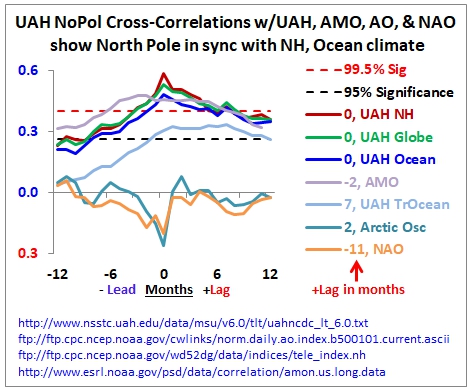
The atmospheric LW isn’t warming the ocean, and the residence time for heat flow from the ocean hasn’t changed over time, being very linear with SST. The atmosphere consistently holds a 4% higher temperature than the ocean over a month than it receives, a short residence time:
The atmosphere consistently holds a 4% higher temperature than the ocean over a month than it receives, a short residence time:
Hotter land surfaces provide additional heating effects on top of ongoing ocean-air heat exchange.
The linear UAH-SST 4% factor would be non-linear with increasing LW if LW drove SST, and would be a perpetual energy machine, as the LW would raise the SST, increasing LW eventually, leading to runaway positive feedback loop ocean warming, which is not observed.
The water is getting 360 joules per second.
The equatorial ocean gets full TSI minus albedo at the sub-solar point. Evaporation occurs after morning insolation rises from peaking insolation, not at the daily average.
It’s remarkable how many naive rationalizations are invoked here in avoiding the actual thermodynamic behavior of water. Being a relatively poor heat conductor, molecular transfer is quite limited; local convective currents due to density gradients keep the warmest water strongly confined near the surface. Nor is heat flux in water exempt from following the NEGATIVE gradient of temperature specified by Fourier’s Law.
But the gong-show winner is the notion that the flux density of absorbed DLWIR need only be normalized by the thickness of water-layer to obtain its rate of temperature change. Not only does this inept calculation ignore that such rates are critically dependent upon temperature differences, but it fails to account for LWIR emissions from the surface as well as the strong COOLING produced by evaporation. We only have coupled LWIR exchange within the atmosphere, NOT any bona fide external forcing.
The real-world consequence is that on an annual-average basis LATENT heat transfer from the ocean to the atmosphere exceeds that of all SENSIBLE heat transfers by nearly an order of magnitude. That is what is shown unequivocally in the WHOI-derived maps I referenced. Self-styled dragon-slayers remain unequipped to deal with that reality.
Wind is responsible for much if not most of the energy that goes into creating water vapor. Where exactly is the frictional heating of the atmosphere onto the surface referenced in the back radiation pseudoscience? http://www.cgd.ucar.edu/staff/trenbert/trenberth.papers/BAMSmarTrenberth.pdf
We’ve had a lot of fog hear recently as warm air has moved over the cold damp surface, something else that apparently never happens.
Your sciency answer sounds so clever
But since when did water have to get to 100C to evaporate?
Does the sweat on your skin get to 100C to evaporate?
How do you think the surface “dries” when there is no sunshine
AC, if you are claiming that the LW simply goes into evaporating the skin layer, then we have a very big problem.
Globally, evaporation is estimated via a couple of ways as being on the order of 80 W/m2. This evaporates about a meter of water, which is the global average rainfall.
But if all 360W/m2 were to evaporate water, then we’d be seeing about 4 metres (~13 feet) of rain on average. So we know that the LW is not simply going into evaporation.
w.
Mr Eschenbach, I did not mention anything to do with LW, I was merely pointing out that water does not need to get hot to evaporate.
So all the calculations to show “100C” were very nice but totally immaterial to evaporation.
The other day when this thread first appeared, I went and reviewed what occurs in the situation where water evaporates off of a cool surface, because no one can deny that a wet shirt or a mass of water will indeed create water vapor without ever getting anywhere close to 100° C.
A shirt will dry out.
A puddle on the floor will evaporate, unless the R.H. is 100%
There are tables for the amount of energy required to evaporate water at various temperatures.
It takes more energy to evaporate cool water than to evaporate hot water.
Water can evaporate, as I understand it, without being hot, because molecules are not all moving at the same velocity in a liquid.
Some have enough energy to escape from the surface.
When relative humidity is at 100%, the same number of molecules of water are leaving the surface of the water as are entering it from the air (ignoring supersaturation).
Comparison of the oceanic surface fluxes of latent and sensible heat Q is available in global maps shown on pp. 41-42 of:
ftp://ftp.iap.ac.cn/ftp/ds134_OAFLUX-v3-radiation_1_1month_netcdf/OAFlux_TechReport_3rd_release.pdf
Please, Scott, stay away from the Principia crackpot disinformation website, and their sky dragon book. They kill brain cells.
I came up with a thought experiment a while back which when presented to even ardent believers in this idea of thermodynamic impossibilities, convinced them they were mistaken.
Here it is:
Consider two stars in space, each in isolation.
Both have the same diameter.
One star is at 4000°K, and the other is at 5000°K.
Each is in stable thermal equilibrium between heat produced in the core, transferred via radiation and convection to the surface, and radiation of this energy into space.
Now, bring these two stars into orbit with each other, such that they are as close as possible without transferring any mass.*
Now describe what happens to the temperature of each star?
Each now has one side facing another star in close proximity, where before they were each surrounded by empty space.
What happens to the temperature of each of the stars?
Can anyone seriously think that the cooler star does not cause the warmer star to increase in temperature and reach a new equilibrium, at a now higher temperature?
If so, what becomes of the photons from the cooler star that impinge upon the hotter star?
In truth, the interaction would be complex, but the scenario described is a common one which has long ago been observed and described by astrophysicists.
The details are homework for anyone still thinking that the laws of thermodynamics operate as believed by dragonistas.
*Alternative scenario: Postulate further that they are white swarf stars, cooling so slowly that they stay the same temp for the interval of the experiment.
Too much like LM
Serving ping pong balls from a vat pressure driven with 300 balls added each minute.
Now have someone hit 1 in 3 back into the vat.
Result pressure driven vat serves out at a rate of over 400 balls a minute in equilibrium.
Mods,
I believe I have a comment in moderation bin posted here a day or so ago.
Thanks.
Nicholas, I just looked in both the Pending and the Spam lists, no posts from you. Might have posted it in some other location or thread by mistake …
Sorry,
w.
Ok, thanks.
Sometimes I change my mind after writing something.
Angech,
What is LM?
The question is clearly presented, and has nothing to do with vats full of ping pong balls and pressurized air.
Photons are not little balls of solid matter being propelled by a jet of air.
I will accept your expertise on the subject of vats full of ping pong balls, and assert that it has nothing to do with what happens to stars in space and the photons of electromagnetic radiation they emit and absorb.
The warmer star will cool less quickly, it will not get warmer.
If the energy being generated by the first star stays the same, adding new energy from a second star, regardless of the second star’s temperature will cause the first star to warm.
“The warmer star will cool less quickly, it will not get warmer.”
Do you care to support this assertion with any rationale for believing how and why it may be so?
For one thing, stars are highly stable with regard to their temperature at the radiating surface, over vast stretches of time.
What do you mean when you assert a star is cooling?
Is the Sun cooling over time?
Not according to currently accepted astrophysics.
For one thing, the energy radiated away at the surface takes tens of thousand of years to get from the core to the surface…first through the radiative zone and then through the convective zone.
There are parameters which can vary in my thought experiment which are not delineated:
– Are the stars rotating, and if so how fast?
– How massive are the stars? Stars smaller than 0.3 solar masses are thought to be entirely convective, and those larger than about 1.2 solar masses are thought to be entirely radiative. Those in between are like the Sun, with an inner radiative zone and an outer convective zone.
But regardless of these factors, when the stars were in isolation, surrounded by empty space, they were in equilibrium between energy generated in the core and energy emitted at the surface.
Bring another star into close proximity changes the amount of energy in the outer layer of the star…it increases.
So the star is no longer in equilibrium.
Instead of cold space and no influx, one side of the entire star now has a huge influx of energy from the second star.
Consider some other cases: What if the two stars are initially identical in temperature?
Then what happens to each?
Now consider the case where one is only slightly cooler than the other.
How is what happens in the case when they are identical changed to any significant degree?
I am curious to know how well you are considering the actual situation described.
Paper titled “Reflection effect in close binaries: effects of reflection on spectral lines”:
“The contour maps show that the radiative interaction makes the outer surface of the primary star warm when its companion illuminates the radiation. The effect of reflection on spectral lines is studied and noticed that the flux in the lines increases at all frequency points and the cores of the lines received more flux than the wings and equivalent width changes accordingly.”
https://link.springer.com/article/10.1007/s10509-013-1660-6
True. I discuss this question at length in my post “Can A Cold Object Warm A Hot Object“. The answer, of course, is “compared to what”?
w.
Hi Willis,
Not sure if this response in directed to me, but if so…
I devised my thought experiment after participating, but mostly just reading the back and forth of others who frequent WUWT, many of the discussions on your threads on this topic and those of some other contributors.
At first I did not know what to make of the ongoing disagreements among people who are apparently very knowledgeable on the subject of radiative physics.
I thought…how can it be that there is this basic disagreement about something that should be able to be settled by easily devised experiments or observations?
After a while, I decided to think of a dramatic case of two objects at different temps, in close proximity, and how they would be different than if each was in isolation.
At one point I even found out decades old astrophysics papers on this exact situation, although not any that were written with the goal of answering this question.
I will see if I can find that material.
Hi Dave,
A few comments below, Willis posted a link to one of his articles from 2017.
I had participated in that discussion (I used to use the handle “Menicholas”) but had apparently not stuck around until the thread was no longer accepting new comments.
Anywho…I missed your reply to the example I gave to respond to one of the people who assert that CO2 is in too small of a concentration to have much effect on…I am not sure what, radiation, optical properties, etc.
I am not anywhere close to having enough expertise to jump in on one side or another of many of the issues of radiative physics, but whenever possible I try to add something, or ask a question, in those instances when I am not following a line of logic or if I have info that someone else may not have considered.
Here is the comment, about using lake dyes like Blue Lagoon to dye an entire pond or lake in order to inhibit growth of aquatic plants and/or algae.
I just wanted to say, I agree with your assessment that the dye molecules are obviously absorbing the photons and so are almost certainty warming the pond.
Beyond that…I am not sure what it says about any of the basic disagreements about physics that are ongoing.
I am only hoping one day to be around when everyone finds some way to agree on such questions.
https://wattsupwiththat.com/2017/11/24/can-a-cold-object-warm-a-hot-object/#comment-2219952
You replied:
“What an interesting comment, menicholas! I had never heard of Blue Lagoon and products like it. Thank you for teaching me something.
Let’s do the arithmetic. Four acre-feet = 5,213,616 gallons. So 1 qt / 4 acre-feet = 0.1918 ppmv, blocks enough light from passing through 4 feet of water to prevent algae growth on the bottom. Impressive!
A column of the Earth’s atmosphere has about the same mass as a 30 foot column of water. So blocking the light through just four feet of water should require an even darker tint than blocking the absorbed shades of light through the Earth’s atmosphere.”
And most of the quart of Blue Lagoon (and there are plenty of other such dyes) is water and possibly other solvents…so the concentration is very small indeed.
You should see what happens when a tech spills some on his clothing or skin!
When will they start using the Jeff Severinghaus proxy I wonder.
https://tambonthongchai.com/2019/09/08/severinghaus/
And when will they other sources of heat into account?
https://tambonthongchai.com/2018/10/06/ohc/
I think the error bars back near 1960 should be a lot larger.
“Perhaps there are some process engineers out there who’ve been tasked with keeping a large water bath at some given temperature, and how many thermometers it would take to measure the average bath temperature to ±0.03°C.”
Willis:
I spent my 40 year career in laboratories where tight temperature control and precise measurement were often key requirements. Not many cases where control better than +/- 0.1 C was necessary or possible. Liquid baths are easier to control than air due to thermal mass/inertia, but precision requires good continuous mixing. Without mixing, it would take an array of sensors distributed both vertically and horizontally to obtain an accurate average. Sensors with resolution in the hundredths to thousandths of a degree range are quite expensive. Much cheaper to stir the bath to assure a uniform temperature. A good example is a combustion calorimeter which uses a small propeller type stirrer and, in the old days, a single high resolution mercury in glass thermometer (read with a microscope) or, these days, an RTD. Of course in a calorimeter we just want to measure temperature change and not control it. Control of temperature to thousandths of a degree is incredibly difficult and only attempted were large budgets are available in my experience. Small commercial lab temperature baths are typically accurate to about 0.1 C and cost several thousand dollars.
Thanks, Rick. I figured that was the case, but you have the experience to support it.
w.
I neglected to add that often when you dig into calibration certificates you find that the Measurement Uncertainty of your high resolution instruments is much bigger than the you might expect. 0.1 C resolution may come with +/-1.0 C MU.
This rubbish has been running on Sky News UK all day and it was in the Guardian yesterday. I noticed John Abraham is in the list of authors, he of the Guardian now defunct “Climate Consensus – the 97%” that he ran with Dana Nuccitelli.
Abraham did something similar in the Guardian in January 2018 concerning 2017.
https://www.theguardian.com/environment/climate-consensus-97-per-cent/2018/jan/26/in-2017-the-oceans-were-by-far-the-hottest-ever-recorded
Old propaganda beefed up.
Yes, there is a historical sequence of implausible papers. Good that Willis exposed the flaws in this one. In 2018 it was Resplandy et al. which Nic Lewis critiqued and a year later it was retracted. In the meantime Cheng et al 2019 made the same claims of ocean warming drawing upon Resplandy despite its flaws. Benny Peiser of GWPF protested to the IPCC for relying on Cheng (2019) for their ocean alarm special report last year. Nic Lewis also did an analysis of that paper and found it wanting. The main difference with Cheng et al. (2020) is adding a bunch of high-profile names and dropping the reference to Resplandy.
https://rclutz.wordpress.com/2020/01/14/recycling-climate-trash-papers/
Thanks Ron.
” “The quality of research varies inversely with the square of the number of authors” … but I digress.”
Ha ha ha ha ha ha ha ha ha ha ha ha ha!
This looks like yet another ‘study’ in which the likely errors are significantly greater than the tiny result obtained heralded as catastrophic. The ambitious claim that such a totally trivial temperature alteration is (mostly) due to human activities, rather than being caused by variations in cloud cover, or some El Nino/La Nina cycle, or in the activity of tropical thunderstorms is pure nonsense.
So Willis (my hat’s off to you) says the oceans absorb 6360 units, while the total created by man is .6 units (please correct me if I’m wrong), meaning that the anthropogenic contribution potential is .0094% of the total.
That seems reasonable given the .003deg accuracy coming from the 3858 Argo bouys wandering about.
Finally, the missing heat Trenberth was moaning about…
So how exactly does this differ from the
IPCC’s AR4 Report Chapter Five Executive Summary Page 387
where it says:
The oceans are warming. Over the period 1961 to 2003, global ocean temperature has risen by 0.10°C from the surface to a depth of 700 m.
Really? 0.10° not 0.11 or 0.09 but 0.10° degrees of warming in 42 years. That’s real precision, that’s for sure.
The mistake Eschenbach makes here is to confuse 0.1 degree of warming in the first 2000m of the ocean as UNIFORM warming across those 2000m.
Unfortunately for us land dwelling creatures, the temperature of the ocean at 5m is a lot more important than at 1675m. And we’re all perfectly aware that surface ocean temperatures have already warmed by 1 degree. This is basic knowledge that Eschenbach stealthily avoids by pretending that first the ocean must warm by 1 degree at a depth of 2000m before we are allowed to say
So here’s a question for Eschenbach. Yes, lets say it’ll take five centuries for the ocean down to 2000m to warm 1 degree. By what amount do you believe that the ocean surface will have warmed in order for the average warming through 2000m to be 1 degree? Right now we’re at surface: 1 degree, 2000m: 0.1 degree. So my naive guess is 10 degrees.
When considering a depth of two kilometres, an average warming of 0.1 degree is truly remarkable.
Butts January 14, 2020 at 2:03 pm
Grrrr. This is why I ask people to QUOTE MY DANG WORDS!! I made no such claim and I have no such confusion.
“Warmed by 1 degree” since when? Our data older than about forty years is very uncertain. The Reynolds OI SST data says that since 1981 (the start of their dataset) the ocean has warmed by 0.4°C.
However, if you can accept greater uncertainty, the HadCRUT SST dataset says that the SST has warmed 0.7°C since 1870 …
So no, Butts, we’re not “perfectly aware” of any one-degree rise in SST for a simple reason … it hasn’t happened. It’s just more alarmism.
w.
Willis wrote: ” HadCRUT SST dataset says that the SST has warmed 0.7°C since 1870 …”
What about the data back to the Medieval warm period? That is what we need in order to tell if it is anything unusual.
Jim, the whole question of paleo SSTs is fraught with complexitudes … there’s a good paper called “Past sea surface temperatures as measured by different proxies—A cautionary tale from the late Pliocene.”
The abstract says:
Hmmm …
w.
Willis wrote:” whole question of paleo SSTs is fraught with complexitudes …”
Which, as far as I can tell, means we have no way of knowing if the current ocean temperature is unusual. If it is not, then it cannot be used as evidence of CO2 causing unusual warming.
“Which, as far as I can tell, means we have no way of knowing if the current ocean temperature is unusual.”
Oh yes, we have. It is not unusual. The proxies do have large margins of error (on the order of 1-2 degrees at two sigmas), but not so large that it isn’t easy to show that ocean temperatures were much lower during glacials and significantly warmer during peak interglacials, including the warmest part of this interglacial 8-10.000 years ago.
And there are qualitative “climate proxies” that are pretty definitive, like fossil coral reefs, or glacial dropstones or iceberg ploughmarks.
Oh, snap!
Someone get a bucket of water to revive Butts with!
I’d suggest a bucket used to measure SST…
As Willis correctly asserts, the notion of measuring the top two kilometers of the whole ocean volume to such precision is ludicrous.
For the study authors to assert any sort of confidence in the accuracy of the result is even worse, IMO.
And several reasons for these doubts exist, some of which are not even debatable:
-The ARGO floats are not evenly distributed; each one covers a stupendously huge volume of water.
-There are large area where there are zero floats, including the entire Arctic Ocean, all of the coastal regions, any areas of the sea that are shallow banks and continental slopes.
-The floats do not go all the way to the bottom, where there are large variations in water temp over the global ocean, and so the import of the results, even if they are as asserted, are dubious at best…even if it were not such a tiny change in actual temp.
– The floats are not checked or recalibrated in any sort of systematic or ongoing basis.
– And perhaps the worst indictment of the methodology and results is, that when the results of the ARGO floats were first analyzed after deployment had reached what was considered a sufficient number of floats to be meaningful, what they showed was that the ocean was actually COOLING! Since that was not what was desired…or as they phrased it, what was “expected”, it was assumed the result was erroneous and the raw data was adjusted upwards until it showed warming!
So ever since, all the data has been adjusted upwards, guaranteeing that warming would be what was shown, no matter what was actually measured, let alone what the reality in the ocean was.
It matters not at all that they were able to come up with a justification for making the adjustment.
Everyone knows that the results would not have been adjusted downwards for any reason, even a legitimate and obvious one.
What they did was look at other data sets to find out they could use for calibration…and they found it in a TOA measured energy imbalance…which was incredibly tiny in terms of total flux, but had the correct sign.
For anyone who doubts this, I used to have a link saved on my computer that was to the article detailing the original finding and how it was subsequently “adjusted” to comport with preconceived expectations…but a recent reset of my computer erased all of my saved links.
However, the reason I am aware of all of these factoids is because it was all discussed in quite a bit of detail in a previous post by Willis on this same topic…discussed in the headline article and even more extensively in the lengthy and information comments thread on the article.
Here below is a link to that article, and I urge anyone interested in this topic to read the article and all the comments. I have read the whole thing several times over the intervening years.
Here it is (I think this is the one, but I’ll double check and locate that specific link to the adjustments made after cooling was initially found):
https://wattsupwiththat.com/2019/01/11/a-small-margin-of-error/
The upshot is…nearly everything published or asserted by the warmistas climate mafia is either wrong, incredibly dubious, or a deliberate lie, and that is my opinion but I think it is a virtual fact.
Here below is a link to the article describing how the original finding of cooling was “corrected” (translation: fudged) by the person responsible for doing it…the warmista True Believer named Josh Willis.
It is not an overstatement to describe this person as an extreme climate alarmist.
Article titled “Correcting Ocean Cooling”, by Josh Willis
https://earthobservatory.nasa.gov/Features/OceanCooling/
And here is another link to the comment thread and the specific comment where I personally originally came upon this inconvenient tidbit of information:
https://wattsupwiththat.com/2019/01/11/a-small-margin-of-error/#comment-2585471
“CECTERAM CENSEO CARTHAGENUM ESSE DELENDAM” Cato, the elder.
(It is also my opinion that Carthage must be destroyed.)
Thank you for the quote, and causing me to look up the reference.
Interestingly (or not), I have recently watched several entire series’ of TV shows about this period of the Roman Empire, around the time of Julius Caesar crossing the Rubicon and all of that.
Binge watch mode it was.
But I missed this quote, although I am pretty sure this individual was one of the characters portrayed.
Now I have to check on that.
Now if I can only deduce what exactly you mean to say…
Hmmm… *walks away scratching head*
PS…just checked…in my favorite series, the one called “Rome”, Cato the Elder was already dead, but Cato the Younger had a prominent role…he was referred to as Porcius Cato in the series.
The series is free for anyone with Amazon Prime…it was a great watch.
https://www.imdb.com/title/tt0384766/?ref_=ttfc_fc_tt
In the presence of a vertical temperature gradient, the ability to accurately measure temperature at a particular depth requires *both* a very accurate thermometer *and* a very accurate depth gauge.
The Argo floats accuracy is described as: “The temperatures in the Argo profiles are accurate to ± 0.002°C and pressures are accurate to ± 2.4dbar. ” 2.4dbar is about 2.5 meters. So in areas where the temperature gradient is more than 0.002°C/2.5m, or 0.8°C/1000m, the errors in depth swamp the errors in temperature. The tropical ocean has a difference between surface water and 1000m water of about 20°C or more, which makes the temperature error due to depth error 25 times greater than the temperature error itself, or +/- 0.05°C.
Refs:
1) http://www.argo.ucsd.edu/Data_FAQ.html#accurate
2) http://upload.wikimedia.org/wikipedia/commons/e/e7/Temperaturunterschiede_Ozeane.png
(Rescued from spam bin) SUNMOD
Since the temperature changes with depth and the ARGO probe is travelling upwards through the water while taking measurements, does the ARGO probe travel slowly enough to allow the temperature probe to stabilize before measurements are taken?
On the ARGO website, they mention that the results obtained (raw data) are “processed” in various ways and for several reasons…one of which is when the buoys are travelling through regions of rapidly changing temperatures.
Of course this makes the results obtained a modelled result, not a measured result.
But hey, we know they get everything exactly right when they “correct” data, no?
Their guesses at how to properly correct the measured numbers are so exact and perfect it has no effect on the uncertainties they report!
So much so that their calculated ocean heat content numbers for the entire planet are very close to the theoretical laboratory calibrated measurement resolution of the sensors on the probes.
They so smart!
Let’s not make it sound worse than it is. A thermometer that moves up from a cold layer to a warmer one will take time to equilibrate, but the surrounding temperature can be derived from the current reading *plus* the *rate* at which the current reading is changing in a well-defined way, since the thermal mass of the device is known. Of course, none of this is within +/- 0.002ºC when depth measurement error is taken into account. The bigger the temperature gradient, the bigger the error.
Due to the thermosteric expansion of sea water, it is easier to detect a rise in sea level than it is to detect a 0.003C/year rise in temperature. If the rise of the oceans since 1900 at a fairly steady 2mm/year were 100% thermal expansion, with no melting glaciers, etc., then given the average ocean depth of about 4000m, 0.002m/4000m = 0.5ppm/year. That translates to a temperature change of 0.5ppm/(150-300ppm/°C) = 0.0033 to 0.0067°C/year. If you multiply that by the ocean volume of 1.37×10^9 cubic km at 1cal/degree/cc, and divide by the surface area of the Earth, you get (1.37×10^24 cc)(1cal/degree/cc)(4.184watts/(cal/sec))(0.0033 degrees/year)/(31,536,000 seconds/year)(5.1×10^14m2) = 1.18 – 2.36 W/m2.
The total net anthropogenic radiative forcing is estimated by the IPCC to amount to 1.6W/m2. So, if all that heat going into the ocean, it accounts for just about all of the sea level rise, with no room for ice to melt.
It is even easier to precisely and accurately measure the rotational rate and the changes in that rotation, of the whole planet, and thus reveal if there is indeed even possibly such changes occurring.
Careful studies of this parameter reveal that it is impossible that was is being asserted by the alarmists is taking place in reality.
I will look for that link, but maybe someone else has the info handy.
And then there are also influences from salinity and the dynamic influences on ocean heights from surface gyres.