
Component/Shutterstock
The fossil fuel industry, political lobbyists, media moguls and individuals have spent the past 30 years sowing doubt about the reality of climate change – where none exists. The latest estimate is that the world’s five largest publicly-owned oil and gas companies spend about US$200 million a year on lobbying to control, delay or block binding climate policy.
Their hold on the public seems to be waning. Two recent polls suggested over 75% of Americans think humans are causing climate change. School climate strikes, Extinction Rebellion protests, national governments declaring a climate emergency, improved media coverage of climate change and an increasing number of extreme weather events have all contributed to this shift. There also seems to be a renewed optimism that we can deal with the crisis.
But this means lobbying has changed, now employing more subtle and more vicious approaches – what has been termed as “climate sadism”. It is used to mock young people going on climate protests and to ridicule Greta Thunberg, a 16-year-old young woman with Asperger’s, who is simply telling the scientific truth.

Statista, CC BY-SA
At such a crossroads, it is important to be able to identify the different types of denial. The below taxonomy will help you spot the different ways that are being used to convince you to delay action on climate change.
1. Science denial
This is the type of denial we are all familiar with: that the science of climate change is not settled. Deniers suggest climate change is just part of the natural cycle. Or that climate models are unreliable and too sensitive to carbon dioxide.
Some even suggest that CO₂ is such a small part of the atmosphere it cannot have a large heating affect. Or that climate scientists are fixing the data to show the climate is changing (a global conspiracy that would take thousands of scientists in more than a 100 countries to pull off).
All these arguments are false and there is a clear consensus among scientists about the causes of climate change. The climate models that predict global temperature rises have remained very similar over the last 30 years despite the huge increase in complexity, showing it is a robust outcome of the science.
Read more:
Five climate change science misconceptions – debunked

Carbon Brief, CC BY
The shift in public opinion means that undermining the science will increasingly have little or no effect. So climate change deniers are switching to new tactics. One of Britain’s leading deniers, Nigel Lawson, the former UK chancellor, now agrees that humans are causing climate change, despite having founded the sceptic Global Warming Policy Foundation in 2009.
It says it is “open-minded on the contested science of global warming, [but] is deeply concerned about the costs and other implications of many of the policies currently being advocated”. In other words, climate change is now about the cost not the science.
2. Economic denial
The idea that climate change is too expensive to fix is a more subtle form of climate denial. Economists, however, suggest we could fix climate change now by spending 1% of world GDP. Perhaps even less if the cost savings from improved human health and expansion of the global green economy are taken into account. But if we don’t act now, by 2050 it could cost over 20% of world GDP.
We should also remember that in 2018 the world generated US$86,000,000,000,000 and every year this World GDP grows by 3.5%. So setting aside just 1% to deal with climate change would make little overall difference and would save the world a huge amount of money. What the climate change deniers also forget to tell you is that they are protecting a fossil fuel industry that receives US$5.2 trillion in annual subsidies – which includes subsidised supply costs, tax breaks and environmental costs. This amounts to 6% of world GDP.
The International Monetary Fund estimates that efficient fossil fuel pricing would lower global carbon emissions by 28%, fossil fuel air pollution deaths by 46%, and increase government revenue by 3.8% of the country’s GDP.
3. Humanitarian denial
Climate change deniers also argue that climate change is good for us. They suggest longer, warmer summers in the temperate zone will make farming more productive. These gains, however, are often offset by the drier summers and increased frequency of heatwaves in those same areas. For example, the 2010 “Moscow” heatwave killed 11,000 people, devastated the Russian wheat harvest and increased global food prices.

Maulucioni/Wikipedia, CC BY-SA
More than 40% of the world’s population also lives in the Tropics – where from both a human health prospective and an increase in desertification no one wants summer temperatures to rise.
Deniers also point out that plants need atmospheric carbon dioxide to grow so having more of it acts like a fertiliser. This is indeed true and the land biosphere has been absorbing about a quarter of our carbon dioxide pollution every year. Another quarter of our emissions is absorbed by the oceans. But losing massive areas of natural vegetation through deforestation and changes in land use completely nullifies this minor fertilisation effect.
Climate change deniers will tell you that more people die of the cold than heat, so warmer winters will be a good thing. This is deeply misleading. Vulnerable people die of the cold because of poor housing and not being able to afford to heat their homes. Society, not climate, kills them.
This argument is also factually incorrect. In the US, for example, heat-related deaths are four times higher than cold-related ones. This may even be an underestimate as many heat-related deaths are recorded by cause of death such as heart failure, stroke, or respiratory failure, all of which are exacerbated by excessive heat.

National Weather Service, CC BY
4. Political denial
Climate change deniers argue we cannot take action because other countries are not taking action. But not all countries are equally guilty of causing current climate change. For example, 25% of the human-produced CO₂ in the atmosphere is generated by the US, another 22% is produced by the EU. Africa produces just under 5%.
Given the historic legacy of greenhouse gas pollution, developed countries have an ethical responsibility to lead the way in cutting emissions. But ultimately, all countries need to act because if we want to minimise the effects of climate change then the world must go carbon zero by 2050.

Nature. Data from the Global Carbon Project
Deniers will also tell you that there are problems to fix closer to home without bothering with global issues. But many of the solutions to climate change are win-win and will improve the lives of normal people. Switching to renewable energy and electric vehicles, for example, reduces air pollution, which improves people’s overall health.
Developing a green economy provides economic benefits and creates jobs. Improving the environment and reforestation provides protection from extreme weather events and can in turn improve food and water security.
5. Crisis denial
The final piece of climate change denial is the argument that we should not rush into changing things, especially given the uncertainty raised by the other four areas of denial above. Deniers argue that climate change is not as bad as scientists make out. We will be much richer in the future and better able to fix climate change. They also play on our emotions as many of us don’t like change and can feel we are living in the best of times – especially if we are richer or in power.
But similarly hollow arguments were used in the past to delay ending slavery, granting the vote to women, ending colonial rule, ending segregation, decriminalising homosexuality, bolstering worker’s rights and environmental regulations, allowing same sex marriages and banning smoking.
The fundamental question is why are we allowing the people with the most privilege and power to convince us to delay saving our planet from climate change?


Mark Maslin, Professor of Earth System Science, UCL
This article is republished from The Conversation under a Creative Commons license. Read the original article.
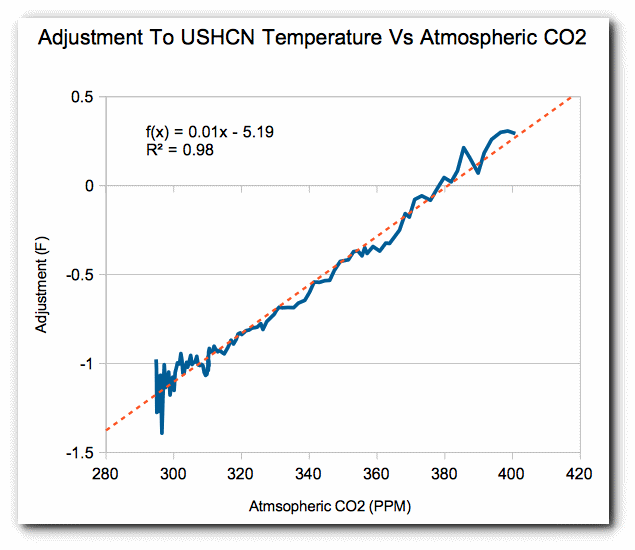
Of course NOAA Models match NOAA temperature graphs. They use their model outputs to “adjust” their temperature graphs. Am completely unconvinced they have a credible record of actual temperatures.
”From The (one way) Conversation”
He then shows a graph indicating that, based on the 10 and 30 year averages, cold-related deaths are increasing while heat related deaths are decreasing. Kind of inconvenient in a warming world, huh?
Probably without realizing it, he also makes the case that people are dying due to lack of air conditioning, not due to lack of heating.
The greatest affront, however, is not really his: The self-titled website “The Conversation” is not, and never has been, a conversation. It is merely “The Boring Sermon”.
I feel that scepticism is slowly growing but the alarmism is getting louder. It’s gonna end in tears. They will need a bucket of icy cold reality water dumped over them to wash all the tears away..
I still think all this will end with a decade. It will go something like this…. Governments will begin to make noises about the need to ”adapt to the changing climate rather than destroying economies” (which will lead to rioting and misery). The alarmists will get even louder but governments will start to look for, and present, evidence showing it’s not as bad as we thought. The argument will continue but will be more two-sided. the realists will start to win the argument because they have reality on their side. The alarmists will begin to dissipate as they realise their fight is futile. The climate will immediately start doing nothing. Life will go on…
There is a possibility that CO2 adds NO net heat to the Earth’s atmosphere. As Moller pointed out, a two-percent increase in cloud cover could offset a doubling of CO2 in Earth’s atmosphere. Increasing warmth in the atmosphere would create more water vapor, which would create more clouds.
Someone ought to ask Mark Maslin if he can rule out the possibility that CO2 adds no net heat to the atmosphere. If he says yes, he is a liar, or extremely uninformed, and if he says no, then all his predictions about the effects of CAGW are just so much speculation.
What do you say, MarK? Can you rule that possibility out for us?
If you can’t rule that out, then I guess the science isn’t really settled, now is it.
You really can’t fix stupid.Do to the warmists what they want to do to us. Cut them off from all fossil fuels, modern technology, confiscate all their assets and possessions, force them to live in caves and produce all their needs themselves. This is what they want to do to us so it’s fair and reasonable they show us the way.
I am unsure why a normally sane site such as WUWT would deign to re-publish such a load of garbage in such detail. Surely just a precis might have sufficed along with some comment to provide a sanity break from the content?
Giving such public advertising to the unsane is doing them a far greater favour than any of them have earned.
Can you imagine the Conversation posting an entire WUWT post in full? They simply cherry pick anything they can take exception to so as to ridicule the site to the mouth-breathers who read their tripe.
MarkMcD
Let me respond to your question because I sent Charles the link to The Conversation article. Sun Tsu (The Art of War) advised that one should know their enemy. I think it is important to see what alarmists are saying to understand what they are trying to accomplish. Further, if an alarmist asks any of us about Maslin’s article, we are not taken by surprise and have had an opportunity to think about its failings.
Secondly, The Conversation is unlikely to allow any cogent, factual response on their site. So, we make an end run around the hypocrites’ ban by allowing knowledgeable people to respond here. Actually, because The Conversation tends to be an echo chamber with those in agreement with the progressive goals being the faithful readers, WUWT probably is a more effective outlet for criticism, even if we were allowed to respond on the original venue.
Thirdly, WUWT might be accused of cherry picking if the entire article wasn’t presented. I think that Maslin and The Conversation editors are their own worst enemies. Anyone familiar with the topic can clearly see how weak Maslin’s arguments are.
I have not been reading this site for long and am intensely grateful for this article and the subsequent commentary. Just for one example, I knew the original article was wrong on Chinese vs US emissions but hadn’t figured out why before the answer was given.
Here in the normally mild south West of Ireland it has been a cool November to say the least. Daily maxima in the single degrees Celsius generally and lots of night frost – down as low as – 4 Celsius.
Tonight I had a drink with a friend of mine who is an intelligent well educated guy who told me that everyone including himself were remarking on how freakishly mild November had been. It seems that narrative now trumps lived experience.
Maslin makes the claim “The climate models that predict global temperature rises have remained very similar over the last 30 years despite the huge increase in complexity, showing it is a robust outcome of the science.”
Well, they have “remained very similar” if one’s definition of “very similar” is having a positive slope. However, if the definition is that the value of the slopes are all within some small range such as 5%, then the claim is suspect. Even so, if the slopes of the temperature rises are not realistic, i.e. agreeing with the historical record, then it is just proof that they all show poor skill in predicting.
The greatest sin in science is being right for the wrong reason. The only reason that any of Hansen’s1988 forecasts (i.e. Draconian Emission Cuts, which haven’t taken place!) even come close to the actual temperature record is that he assumed a theoretical volcanic eruption about 2014, which also did not take place! A simple linear extrapolation of the temperatures from 1964 through 1988 provides a forecast that is superior to Hansen’s computer model, without the necessity of any hypothetical events that didn’t occur.
https://wattsupwiththat.com/2018/06/30/analysis-of-james-hansens-1988-prediction-of-global-temperatures-for-the-last-30-years/
Another thing. In his “red” figure he has annual CO2 emissions per capita on the left (OK the numbers may be correct). On the right is a little figure labelled “cumulative emissions” by country. Cumulative since when? He must have gone back a long way in time to get the US and EU cumulative emissions so much greater than those of China and India. Totally misleading, and I’m quite sure it’s deliberately misleading.
Hayhoe used cumulative numbers of US forest fires in one of her presentations. Of course, being cumulative, the line always goes up, even though the annual numbers were decreasing.
Sneaky little tricks. The facts aren’t enough; they have to play around to make things look bad. That’s what makes them alarmists.
Smart Rock
Maslin must have bought the book “How to Lie with Charts.”
https://www.amazon.com/How-Charts-Gerald-Everett-Jones/dp/0996543864/ref=sr_1_1?crid=3HIP62ZX2A82V&keywords=how+to+lie+with+charts&qid=1575084854&s=books&sprefix=how+to+lie+%2Caps%2C176&sr=1-1
It is really unfortunate that those of us who foster genuine and healthy scientific debate by questioning climate orthodoxy have calmly accepted the term “Denier” without protest. To me, any one who uses the term is a low-life of sorts, unworthy of respect and serious discussion. The term is an ad hominem insult, and anti-semitic to boot. Wherever it appears, it should be roundly condemned.
Here, I fixed it for you:
If x happens, it’s climate change.
If !x happens, it’s also climate change.
And it’s all caused by Man emitting the Magic Molecule CO2!
Yes, that shows that the God hypothesis and the AGW hypothesis are equally empty. In other words, AGW is another religion.
Economists, however, suggest we could fix climate change now by spending 1% of world GDP. Perhaps even less if the cost savings from improved human health and expansion of the global green economy are taken into account.
Improved Human Health? What? Reducing the amount of Co2 in the atmosphere is going to improve human health? OMG. The Warmists are like marijuana pushers … TRUE Believers who are convinced their “product” will cure all ills in the human condition. Yep, about as FAR from science as one can get.
Some (a few?) of us have the knowledge necessary to calculate the probability that global warming is not occurring. What are the odds of choosing the 4 highest numbers from a bag of 145 numbers in 4 draws? So we have the 4 hottest years out of 145 years of climate observations occurring in the last 4 years. Selection without replacement. Basic probability. Trivial to calculate. Worse than Lotto odds.
NorEastern,
Even if your assertion that the last 4 years were the warmest in the last 145 years, that by itself is meaningless. There are many characteristics of a data set that must be understood before you can begin making any conclusions. For example, natural systems often exhibit clustering of data values, but these clusters are not necessarily indicative of anything special; they can be random or the result of a serially correlated process. Just being able to calculate probabilities or odds ratios (they are not the same) is not equivalent to understanding the data.
Simple probability states that you are wrong. The probability of choosing a specific set of n numbers from a bag of m numbers has been understood for centuries. I pose a simple question devoid of all other variables. Please tell me the probability of choosing 4 specific tiles from a bag of 145.. The CO2 content in our atmosphere is at the highest level in 3.2 million years. That should tell you something.
Sorry NorEastern but we have had many contradictors before you and I must say that your argumentation is very naive. Unless the level increases a little bit this will probably be my last comment to you because it will likely be a waste of time for everybody (you, me, and the poor other readers).
What you are doing is a very naive version of empiricism or inductivism, ie. trying to derive some physical law from simple observations while being unable to provide any explanation at all… To paraphrase a little bit your initial question (with some humour), the probability that, in an upward time series, the last 4 values are the highest is … one. But this is not science, not even *simple* science, this is not science at all. Same thing is you think to see any proof with the “3.2 million years” CO2…
What you should do, instead, is not to answer to your own questions (which are irrelevant) but to address scientific questions and start providing good explanations for :
– if CO2 is the main driver to climate, what are the other ones ?
– how do you quantify them ? What are the uncertainties ?
– What are the underlying physical principles at work with CO2 driving climate, and the same for other forcings ?
– Knowing this, is it possible to refute natural variability? How ?
– What is the real predictive power of models, given uncertainties in the data and systematic errors?
– How these previous answers can explain as well *opposite* observations ? (for instance, MWP or even recent 1940-1970? but also declining relative humidity ? no hot spot ? …)
etc. etc.
These are the main questions coming to my mind.
Our skepticism is not linked to our naivety, but the fact of being told so high claims based on so fragile and inconsistent explanations to questions above…
NorEastern, I play (at) golf. When I pay 18 holes I typically hit the ball 90 times and each time I hit the ball it comes to rest somewhere on the golf course (ignoring out-of-bound shots). 18 of those shots end up in the bottom of a hole–so a priori I know to within an inch or two where 18 of my shots will come to rest. This means that I routinely hit 72 shots that land at locations somewhere on the golf course. If prior to my first golf swing I designate an area two-inches by two-inches on the golf course and ask: “What is the probability that after hitting the ball with my first swing the ball will come to rest within the designated square two inches on a side?” The answer is: “I don’t know, but the probability is very small.” For each of the remaining 71 shots, I designate a similar (but possibly different) two-inch by two-inch area of the golf course. Before I start my round of golf, I ask “What is the probability that each of my shots will come to rest within its designated two-inch area?” Because that probability is vanishingly small, I conclude I can’t possibly have played the round of golf I did play. Somehow with a thorough understanding (i.e., with a non-deni@r understanding) of AGW principles, I can reconcile the two (the a priori probability estimate that my round of golf will happen with the actual probability (one, 1) that it did happen. So much for the voodoo mixing of actual results with a priori probabilities of those events occurring.
This probability lesson was brought to you by the good peer-review folk in the AGW community.
So what ? Temperatures are not distributed randomly from one year to another. There are physical processes, trends and correlations. What you (think to) prove is just that we observe (*) a somewhat upward trend which nobody really refutes here… Your argument is so superficial that it tells nothing on the climate, but a lot on you.
(*) putting aside the many problems with measurements and adjustments, of course
NorEastern
Are you proposing selection with or without replacement? However, it isn’t really a good analogy because what you are dealing with is not unique items, but measurements that have autocorrelation. That is, one can expect a given temperature measurement to be correlated with the other measurements in a time series. So, the probability increases significantly! You really are a charlatan!
You’re laboring under the misapprehension that there is such a thing as a “global average temperature”, and that because we can calculate an average, that all those individual temperature readings go in the same direction. You’re no scientist.
Given the fact that your arguments attempting to support your CAGW ideology are laughably illogical handwaving, I’d say the odds you being a moron are fairly high.
Denial is a Nazi-era concept as in denial of life deemed unworthy of life (e.g. selective-Jew). They also originated or progressed concepts of diversity (i.e. color judgment) and exclusion, Jew privilege, political congruence, social justice, and redistributive change along the communist-socialist-fascist axis.
This is war, in the semantic theater. Choose your rhetoric, but be careful from where you draw your inspiration.
@NorEastern
“Please tell me the probability of choosing 4 specific tiles from a bag of 145?”
Did someone predict the last 4 years would be the warmest ever? Otherwise, if they were ranked 4th, 9th, 7th, and 2nd, you could ask, “what are the odds the last 4 years would be the 4th, 9th, 7th and 2nd?”
Sorry for the typo. Should be Snape, not Smape.
I’m interested in the claim that the models closely match the observed temperature changes.
We have had articles on WUWT showing that the “average” prediction is about twice the actual change.
How are these two claims to be reconciled?
Well the climate models have remained very similar over the last 30 years – they have consistently been unable to predict decadal level fits and starts and consistently overestimate the magnitude of everything and consistently fail to agree with each other and spectacularly fail to predict the future no matter how much curve fitting they do.
This article is a joke.
For something called “The Conversation,” they are remarkable by their determination to avoid anything resembling a conversation or even readers’ comments.
https://theconversation.com/the-five-corrupt-pillars-of-climate-change-denial-122893
Also notice the slight-of-hand where they put the US CO2 emissions as “per head” at the top of the chart so the largest emitter in the world, China, can appear lower. If it was in percentage terms, China would soar above every other country.
Norway alone spends about 40.000 million NOK (around 4.000 million USD) in 2019 alone on activities related to stopping “climate change”. That is about 20 times more than the combined spending by the 5 oil majors.
saving our planet from climate change?
It’s hard to imagine a more profoundly ignorant and confused statement. Climate is always changing. Humans have lived for 200,000 years. Multicellular life for 630 million years. During none of that time has climate ever been static.
Yes there have been mass extinctions. They have mostly been cooling events, such as the end-Permian
https://www.nature.com/articles/srep43630
and also the dinosaur extinction.
The more minor extinction of megafauna at the last glacial maximum was also from cold.
Maskin is a scientist who has published good research in geosciences. For instance in the subject of the mid-Pleistocene transition (“revolution”). But here his political and social prejudices are getting the better of him and he is disgracing himself, his university UCL and his profession. He should seek help if he is experiencing personal issues that are driving him to this flail of ignorant prejudice and class hate.
“Save us from climate change?” Ignominious nonsense from someone who knows much better.
“Saving our planet from climate change” is every bit as ignorant and every bit as reflective of ultimate hubris as “saving our planet from the rising tides.”
“Or that climate scientists are fixing the data to show the climate is changing (a global conspiracy that would take thousands of scientists in more than a 100 countries to pull off).”
Statements like this may sound plausible to the uninformed, but Maslin knows well that a single scientist responsible for a global dataset can change the whole thing in the name of homogenisation. This illustrates that his preposterous claims are created to deceive the public rather than make any serious point.
Very hard to read.
Such vanity and hubris. Why have none of the climate Armageddonists bothered to speculate on the possible BAD outcomes that could arise from mankind’s intentional tinkering with the climate? It seems to me that whenever Man in his limited wisdom interferes with nature, we get outcomes like the Cane Toad infestation of Australia. I’m sure a lot of very smart people had some important sciency discussions to convince themselves that it was a terrific idea to let Cane Toads hop loose in Australia. The science was settled. Well, it didn’t turn out so good, did it?
And we are expected to trust Hockey Stick guy and his fellow Armageddonists to know what’s best for the planet when there are innumerable examples throughout history when “the experts” got it exactly WRONG.
Vanity and hubris.
Thing is, with the cane toad in Australia, the Bureau of Sugar Experiment Stations along with support from CSIR as it was called back in 1935 gave approval for their introduction because the CSIR were planning to release the European toad in other parts of Australia.
Yes, great example of how not to do things.
I sprained at least five eyeroll muscles.